
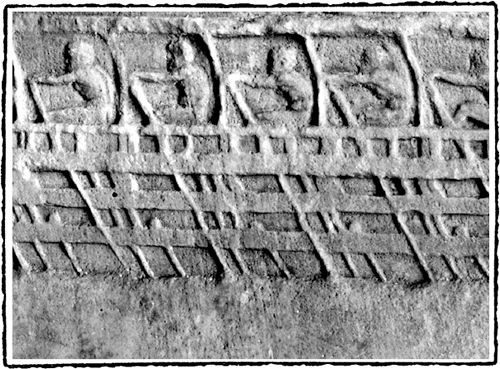
CHAPTER NINE

The admiral Ariabignes, commander of the Ionian and Carian squadrons in the Persian fleet, son of Darius and half brother of His Majesty the Great King Xerxes, sits in the stern of his flagship. The ship, which is unusually large, has a towering stern and high bulwarks. We may imagine Ariabignes in the stern, shortly after dawn on September 25, pondering his uncertainty. Perhaps he absentmindedly fingers the twists of the gold torque that hangs heavily around his neck. The noble blood of Gobryas, a Persian of great courage, runs in Ariabignes’ veins, and it is too rich for seawater. But battle is battle, wherever it takes place, and the admiral is a seasoned warrior. He knows that confusion gets in the way of victory, and he has reason to be confused.
He had expected to catch the cowardly Greeks in the act of sneaking out of their harbors on Salamis during the night, which is why the entire Persian fleet has been deployed in darkness in the straits. Yet not a Greek ship has budged all night except for a trireme that rowed into rather than out of the straits; unbeknown to Ariabignes, it was Aristides’ ship. If indeed the forty Corinthian ships had hoisted sail at dawn and fled, then Ariabignes might have been reassured: how like the Greeks to be so paralyzed by talk that they could not even turn tail in a timely manner. But still, he might wonder why the other Greek triremes had not followed the first to flee.

It is unlikely that Ariabignes suspects that the Persian fleet has blundered into a trap. Royal admirals do not like to admit mistakes, especially not mistakes that might discredit their brother on the throne. Xerxes himself had ordered the navy into the straits, and Xerxes himself was there at Salamis. Aeschylus writes of the king:
He had a seat in full view of the army,
A high hill beside the broad sea.
Xerxes observed the battle from the slopes of Mount Aegaleos on the mainland. The Great King sat on a golden throne, looking down like a god from Olympus on the men who were about to die for the sake of his ambition.
Ariabignes might have comforted himself with the thought that his men would fight well regardless of what awaited them. If the sight of Xerxes on high were not enough to ensure their loyalty, then the presence of Iranian and Sacae marines on every ship should have made up for it. Since the Great King’s ships had crossed the Hellespont in May, only six triremes, all Greek, had defected from the Persian navy to the enemy side. So Ariabignes might have reasoned, but it is doubtful that he had an inkling of what lay ahead.
Meanwhile, about a mile away on the other side of the straits, the Greeks made full use of the advantage they had over the Persians: the knowledge of the truth. They prepared to shock the enemy with an attack.
Surprise is a weapon. Often underestimated, it is one of the most effective and cheapest of all force multipliers as well as one of the most versatile. It is possible to surprise an enemy not only in the time or place of battle but in the manner of fighting. Ariabignes and his other commanders knew that the entire Greek navy faced them. What they did not know, and what they could perhaps hardly fathom, was that the Greeks were ready to do battle. And yet, that morning at around seven o’clock if not earlier, events would force Ariabignes into admitting the truth. The Persians had been swindled.
Themistocles knew, as a modern military maxim puts it, that it is devastating to “come down on the enemy with thunder before he sees the lightning.” The ancients put it more simply: panic, they believed, is divine. And so, the Greeks on Salamis unleashed the storm of war on an enemy that had expected a drizzle.
Shortly before 7:00 A.M., as soon as Themistocles and the other Greek generals had finished their send-offs and the marines had boarded their triremes, an order was passed from ship to ship. Up the row of triremes moored in the harbors and opposite the beaches of Ambelaki and Paloukia bays, the command went out, perhaps by sounding the trumpet, perhaps by raising a purple flag, perhaps by holding aloft a gold or silver shield—or perhaps by doing all three: the Greeks would launch their ships.
On the far side of the straits, the first sign of trouble for the Persians was an unexpected sound from the Greek harbors. “A song-like shout sounded triumphantly from the Greeks,” reports Aeschylus, “and at the same time, the island’s rocks returned the high-pitched echo.” This was the paean.
It was a peculiarly Greek custom, Dorian in origin but eventually adopted by the other Greeks. Aeschylus describes the paean as a “holy cry uttered in a loud voice, . . . a shout offered in sacrifice, emboldening to friends, and dissolving fear of the foe.” When an army marched into battle or a navy left the harbor to wage war at sea, the men sang the paean. It was a combination of prayer, cheer, and rebel yell.
The Persians had heard the paean before, most recently at Artemisium and Thermopylae. But in the last weeks, as they beat down nearly defenseless foes in Euboea, Phocis, and Attica, they had become used to its absence. It was the last thing they had expected this morning. Aeschylus is blunt about its alleged effect on the Persian audience aboard ship:
All the barbarians felt fear because they had been deprived of
What they expected. The Greeks were singing the stately paean at that time
Not for flight but because they were hastening
Into battle and were stout of heart.
Next the alarmed Persians heard the blaring of the Greek trumpets, an unambiguous call to arms. The ancient trumpet, or salpinx, was a long, straight, narrow tube flaring into a small bell. The salpinx ranged from two and a half to about five feet long: thesalpinxwas hardly handy, but it was certainly loud. Homer compares the sound of the salpinx to the terrible cry of Achilles. An ancient music critic, Aristides Quintilianus, calls the salpinx “a warlike and terrifying instrument,” “masculine” and “vehement.”
Next came the sound of enemy oars being rowed on command, crisply and in unison, in what Aeschylus calls “the regular stroke of the rushing oars together.” Ominously, the Greek word for stroke, embole, is the same word used for “charge” or “ramming.” There was no mistaking the meaning of that sound.
By now, the Greeks had left the shadow of the shore and were clearly visible to the Persians. Only a few minutes had passed between the sound of the paean and the sight of the enemy. Unlike the Greeks, who had put together a battle plan on shore and had enjoyed at least a little time to think things through, the Persians had to scramble.
From his flagship, Tetramnestus, king of Sidon, no doubt assessed the situation. Two other Phoenician monarchs were also present nearby: Matten, king of Tyre, and Merbalus, king of Aradus. Since the three of them represented the greatest naval tradition in the world, they are likely to have responded calmly. But a surge of emotions, from the lowest seaman to the loftiest courtier, stood in the way of an unperturbed reaction to the Greek challenge. Besides, the Persian commanders Megabazus and Prexaspes had the final say, and they probably did not enjoy the same ease at sea as the Phoenicians.
We can only imagine the range of feelings on the Persian ships. For the captains, it may have been fear; for the rowers, fury; for the pilots, frustration; for the squadron commanders, finger-wagging; for the skeptics, self-satisfaction; for the admirals, fantasies of revenge. The Phoenicians blamed the Ionians; the Ionians blamed the Egyptians; the Egyptians blamed the Cypriots; and everyone blamed the Persians. And it’s likely that the Persians nervously fingered their necks, thinking of Xerxes’ anger at those who failed him.
Whatever their feelings, the Persians were professional enough to hustle into order. To their credit, they rowed out from the coast of Attica toward the far side of the straits in order to meet the Greek fleet. “When they [the Greeks] launched their ships,” writes Herodotus, “the barbarians were upon them without delay.”
Meanwhile on Salamis the Greek fleet got under way. As was customary, the right wing, here headed by the Spartans under Eurybiades, led the advance. Aeschylus writes:
First the right wing in a good arrangement
Leads in order, and second the whole fleet
Advances.
But where did they advance to? Herodotus offers clues, and the rest may be surmised from the ancient way of war. Triremes were, as the poet says, “bronze-rammed floating chariots.” The key to trireme battle was maximizing the chance to ram the enemy while minimizing his opportunity to ram back. Under perfect conditions, an attacker would approach a victim from the victim’s stern, to protect himself from the ram at his victim’s bow. Bow-to-bow ramming became feasible only after first strengthening the bow timbers of one’s ship, a tactic invented by Corinthians in 413 B.C. Since an enemy would not voluntarily present the sides of his triremes, ramming usually meant having to maneuver around or through an enemy fleet. The attacker would then ram his victim in the victim’s quarter, that is, the stern portion of the ship. In that position, the attacker’s own oars would be clear of the rammed ship, and he could back away quickly and easily. Furthermore, by attacking at a narrow angle, the attacker minimized the danger of wrenching his own ram off sideways.
But conditions are rarely perfect, and the attacker sometimes had to ram the enemy amidships. And sometimes he might risk coming at the enemy’s bow and then quickly turning to ram. In that case, the attacking pilot might try to use his ram to hit the oars of the other trireme and break them against the stem of his own ship, after having his own crew pull in their oars. This was a difficult maneuver but probably deadly to the enemy rowers, whom it knocked about.
The basic tactic at the start of battle was to arrange one’s ships in line abreast while, at the same time, keeping gaps from opening between ships and also protecting one’s flanks. The smaller and slower a fleet, the more important it was to cover the flanks, and the Greeks were outnumbered by an enemy with lighter, faster, and more agile ships.
When they came out of their narrow-mouthed harbors, the Greeks rowed first in single file and then deployed in line abreast. Leading the ships out from Ambelaki Bay, the Spartans anchored the right end of the Greek line near the tip of the Cynosura peninsula. The Athenians, who were probably in Paloukia Bay, anchored the left end of the Greek line either at Cape Trophy (the modern name), which is the tip of the Kamateró peninsula, or at the southeastern end of the islet of St. George. In either case, the Greek line enjoyed the advantages of land bastions at both ends and a friendly shore at its rear.
The channel to the north and east of St. George was all but closed off. Today, a reef sits to the east of St. George, between that islet and the mainland of Attica. But in antiquity the sea level in the straits was at least five feet lower than it is today. The reef, therefore, was itself an islet in 480 B.C. The islet-reef and St. George are probably the little archipelago that the ancients called the Pharmacussae Islands. The distance between the two was perhaps as little as six hundred yards, too narrow for either fleet to risk entrapment.
Extending between Cynosura and either Cape Trophy or St. George, the Greek line was between two and two and a half miles long. It was too short for the Greeks to deploy all their triremes in a single line, but it was perfect for two lines, the formation that the Greeks might also have used on the last day at Artemisium. The triremes in the rear line could stand ready to counterattack any Persian ships that tried to pass through the front line and ram Greek triremes there.
The Athenians held the left end of the Greek line; the Spartans held the right. The Aeginetans probably stood next to the Athenians. The other Greeks were deployed in between, although we do not know where. If the Corinthians had indeed sailed northward to incite false confidence among the Persians, they surely quickly returned to the Greek line, in a position near the left end.
The Persians deployed their ships in battle order in line abreast along the Attic coast, where their infantrymen held the shore. Since the Greeks’ flanks were protected by the terrain, the Persians could not outflank them. So they probably arranged their ships opposite the Greeks in two or three lines, depending on how much of the Persian fleet had entered the straits by dawn. The Phoenicians held the right end of the Persian line, opposite the Athenians and Aeginetans. The Ionians (and perhaps other Greeks) held the left end. We do not know where the other contingents in the Persian fleet were stationed, nor is it clear which contingents were stationed outside the straits.
The Greeks had launched their ships and the Persians had rowed out to meet them. The fleets came close enough to each other for them each to hear the trill of the other’s pipers, keeping time for the oarsmen. The aulos, or Greek pipe (sometimes mistakenly called a flute), was a cylinder with finger holes, sounded with a reed. Normally pipes were played in pairs, one pipe fingered by each hand. A cloth band around the player’s head and face was used to support the cheeks. The sound of the pipe was so stirring that Greek conservatives thundered against it because it might lead youths astray. For the same reason, the pipe proved invaluable in focusing the minds of the oarsmen on the trireme. It served as both a metronome and distraction from the awfulness of what lay ahead.
Perhaps it was now that the Persians heard what Aeschylus calls “a mighty battle cry” from the Greek ships:
O sons of the Greeks, advance:
Liberate the fatherland, liberate
Your children, your women, and the abodes
Of your ancestral gods and the graves
Of your ancestors. Now is the battle for them all!
And the Persians answered in turn with what—to the Greeks—sounded like “the noise of the Persian tongue.”
It was a historic moment. For centuries, Phoenicia had been the eastern Mediterranean’s greatest sea power. Now, a Greek upstart, a city with a newfangled system of government—democracy—and a brand-new fleet, challenged that supremacy.
The two fleets confronted each other, yet the battle did not begin at once. The Greeks flinched first. Or so it seems: at any rate, their ships begin to back water, that is, they continued to face the enemy but rowed backward, stern first, toward the shore of Salamis. If this was panic, it was not panic on the part of the rowers. Below deck, most of the rowers could see nothing. The decision to back water came from the generals and was transmitted to captains and helmsmen by a prearranged signal.
Seen from above, which was Xerxes’ perspective, the opening stage of the battle might have looked like a standoff between two schools of fish. The swordfishlike Phoenician triremes, with their long narrow rams, pursued the hammerhead-shark-like Greek vessels, with their short and stubby rams. The sharks seemed to have lost their nerve.
But the Greeks probably knew just what they were doing. We may imagine that gaps had opened up in the long Greek line; by backing water, the ships were able to close ranks. They also drew the Persians close enough to Salamis to put them in range of Athenian archers on shore: protected by their shields from Persian archers, the Athenians could attack the enemy on deck or wait for Persian survivors of wrecked ships to take to the water. Still another reason for the Greek decision to back water might have been the desire to wait as long as possible for the aura to blow.
But the plan did not work out that way. As often in the history of battle, the first blood was shed not on a general’s order but at the initiative of a subordinate who had grown tired of waiting.
On the western end of the Greek line, an Athenian captain, one Aminias of the deme of Pallene, put his ship out to sea again and rammed a Phoenician trireme. He may have seen that some Greek ships had backed too far, since they actually ran aground. He might have taken this as a sign of the jitters and might have worried that the Persians would seize the moment. And so Aminias took matters into his own hands.
Who was this man who lit the spark of battle? Assuming that Aminias fit the usual Athenian mold of a captain, he was a man of substance but not of advanced age. He owned land and a house in Attica, had legitimate children, and was less than fifty years old. Since Athenian men tended to marry around the age of thirty, Aminias was likely in his thirties or forties. He was also wealthy, since captains had to pay their own crews. Since Pallene, his home, was a farming district in central Attica, Aminias probably owed his wealth to olives, grapes, figs, and grain. We may imagine him as fit and tough, as farmers often are, and we know that he had guts. A captain as courageous as Aminias surely had men loyal enough to follow him anywhere. But it no doubt helped that most of his rowers probably came from Pallene and many would have known each other their entire lives. Trust came easily to such a crew.
It had to, because ramming was a group effort. When Aminias decided to break out of the line and ram an enemy ship, he had to pass the order on to his helmsman, and he in turn to the rowing master, who then had to inform the crew. The marines and archers on deck had to brace themselves for impact by sitting firmly, but it was on the oarsmen’s shoulders that the main burden fell. They would have to power up the boat rapidly from a standing start—or even worse, from backing water—to ramming speed.
It would not take long from the moment that Aminias gave the order to the point of impact. Athens’s heavy ships could not achieve the speed of a fast trireme, which, tests suggest, could accelerate from a standing start to nine or ten knots within about sixty seconds. But Aminias’s trireme did not have to go nearly that fast. The Phoenician ships were either standing still or moving toward the Athenian ships, so the Athenian attacker did not have to outrun the enemy. Aminias merely had to go fast enough to penetrate the planks of a Phoenician ship. Depending on whether Aminias’s trireme struck its victim amidships or in the quarter, a speed of two to four knots would have been sufficient.
Once the captain ordered the attack and the pilot passed the word on, the rowing master would rapidly move the crew up to a high stroke rate, perhaps approaching fifty strokes per minute. At that pace, every rower had to devote all his attention to the task at hand. For no more than a minute it might seem to him as if nothing existed except a narrow, stinking tunnel of 170 men bent over in unison, as if rowing a single oar. Still, the mind might wander to home and happy times, to games and feasts, to anything except the split-second shock of collision. Muscles strained and lungs sucked in air; it seemed as if the agony would never end. And then suddenly, just before the moment of impact, the rowing master, primed by the pilot, ordered the men to switch to backing water, in order to keep the ram from penetrating the enemy ship too far. Then the crash came, and if all went well, the vulnerable attacker would already have begun backing off. Although working at extreme intensity, the men would have to work harder still, rowing the ship in the opposite direction from before.
Aminias’s crew had slammed into a Phoenician trireme and given their captain the first kill of the day. It was a great prize but came at a price: the ram had penetrated too far into the Phoenician ship, and the men could not extract it. The attacker’s goal was always to withdraw as quickly as possible after ramming. Otherwise, if his ram remained stuck in the enemy’s hull, he ran the risk of counterattack by the enemy’s marines and archers, either from their own deck or after boarding his; and the Persian deck troops outnumbered the Greeks.
Aminias’s men knew all this. Below deck, they no doubt backed furiously but still could not move their ship. Above, they could hear the footsteps of their marines and archers as they took their positions to protect the trireme. They could also hear the shouts of the Persian marines eager to board Aminias’s boat. It was at this dangerous moment that other Greek ships came to Aminias’s defense. Up and down the line, the battle had begun.
Meanwhile, the Phoenicians coped with the paradoxes of ramming. The trireme’s ram was as lethal as it was dramatic, but at first it proved deadlier to the victim’s hull than to its men. The opening made by a ram was perhaps only about one foot square in size. Water would pour into the rammed ship through the hole and would swamp the ship but not make it sink; there was time for the crew to get out. At the point of a ram’s impact a few men might die or be injured. Elsewhere on the vessel, other men might be injured by the force of the impact. But most men would probably make it through the ramming unharmed. Danger, however, lay ahead.
Imagine a shower of arrows and javelins between the ships, parried when possible by shields but sometimes finding their mark. Imagine men collapsing on deck or being speared and then thrown into the water. Others would jump into the water voluntarily to escape a foundering ship, first removing helmets and armor to keep from sinking. Meanwhile, aboard the ships, some of the marines may have made it onto the enemy deck and settled matters in hand-to-hand combat. Sword clashed with dagger and with battle-ax, spear collided with spear.
Hand-to-hand combat; close-quarter fighting; coming to grips; coming to blows: the Greeks delicately called all this the “law of hands.” Greek crewmen, as Herodotus notes, had a good chance of surviving the battle if they made it through the law of hands, since they could swim to safety. Not so the Persian and Mede marines: few of them knew how to swim, and so, many of them drowned.
In the end, the Greeks managed to overpower the enemy and free Aminias, his crew, and their vessel. The triumphant victors carried off the stern ornament of the Phoenician ship, probably a figurehead in the shape of a human head. They might have lost a man or two in the fight, but there would be no time to mourn them, let alone to wash the blood off the deck.
And so the battle of Salamis began—at least that is what the Athenians said. The Aeginetans told a different story. They claimed that the first Greek ship to start the attack was not the Athenian vessel of Aminias but the Aeginetan trireme bringing the statues of the sons of Aeacus. And they attributed the initiative to a miracle. The Aeginetans said that while the Greeks were backing water, there appeared an apparition of a woman. She exhorted the Greeks into battle in a voice loud enough for the entire Greek camp to hear. First, however, she gave them a piece of her mind. “Gentlemen, just how long are you going to keep on backing water?” she asked.
Herodotus, who reports both stories, does not choose between them. Aeschylus says merely that a “Greek ship” began the ramming. He was perhaps not being politic so much as realistic. Not only was it difficult to reconstruct a battle years after the fact, it would have been difficult the next day. The Greeks had no official historians to record the details, and no timepieces aside from sundials and water clocks to mark the hours. Besides, Greek city-states were nothing if not competitive; Athens and Aegina, old enemies, were both naval powers; it would have been considered bad form for them to do anything less than argue over bragging rights to having drawn the first enemy blood. But the most important thing of all to remember is the confusion that reigned on the ancient naval battlefield.
The vast majority of the men were below deck, where most could see nothing of what happened outside. Those on deck were generally too busy with matters nearby to take in the overall scene—a common problem in ancient warfare, as Thucydides remarks. The interplay of sun and clouds—and both were present at Salamis—could play tricks on one’s eyes, and so could fear and excitement.
And then there was the noise. In a world without machines, the din of battle was perhaps the loudest sound imaginable. And no battle was noisier than one at sea. The clamors, shouting, and cheers of a naval engagement were commonplaces of classical literature. After the trumpets, the hymns, the battle cries, the rushing oars, and the piping, there came the cacophony of bronze-sheathed wooden rams crashing into wooden oars and ships. There was the twang of bowstrings and the whiz of arrows, the whirring of javelins and sometimes the metallic clang of swords. Afterward there came the screams of the dying. Meanwhile, the shores on both sides of the straits were lined with armed men, and it would not have been surprising if some women and children were present as well. The spectators emitted “wails, cries—winning, losing—and all the other various things that a great force in great danger would have to utter,” as Thucydides writes of a later naval battle. At Salamis, all of this was magnified by the echoes of a narrow space ringed by hills.
Through it all the rowing masters constantly cried out to their men. They called out not merely orders but appeals—pleas for harder effort, invocations of patriotism or of the greatness of empire, promises of rewards or threats of Xerxes’ wrath, references to national tradition and the need to live up to it. Well-trained crews knew the importance of keeping silent, both to preserve energy and to be able to hear the rowing masters.
So—to return to Herodotus’s reluctance to choose whether Aegina or Athens drew first blood—the historian tacitly concedes the difficulty of fishing out the truth from the roiled and noisy waters of the straits. And yet another problem faced the historian: religion. Like the Aeginetans, many of the men who fought at Salamis came away convinced that only the gods could have won the battle for Greece. The numbers of the Persian fleet were so large, the preceding disasters at Thermopylae and on the Athenian Acropolis so awful, the situation of the refugees on Salamis so precarious, the defensive position at the Isthmus so shaky, that it seemed hard to believe that unaided human action had reversed the expected outcome. The Lady of Salamis is not the last divine intervention to be reported of the battle.
Afterward, some claimed to have seen a great light shine out from the direction of Eleusis on the mainland, a few miles north of the straits. They also said that they heard the sound of voices filling the Thriasian plain beyond Eleusis, from the mountains to the sea, as if a crowd of men was participating in a religious procession—as in the Eleusinian Mysteries, which were held annually around the very day of the battle. Then out of the shouting crowd a cloud began to rise up little by little from the earth and land on the triremes.
Others said that they could see the shades of the sons of Aeacus with their hands stretched out to protect the Greek triremes. Others insisted that the hero Cychreus (in Greek mythology, the first king of Salamis) appeared to Athenian crews in the form of snake. And it appears that some Aeginetans may have seen something in the sky above the straits—clouds? the morning star? electrical discharges?—that symbolized the god Apollo and the Dioscuri (the sons of Zeus, the heroes Castor and Pollux).
So the high-pitched religious emotions, the noise and confusion of naval battle, and the Greek habit of competitive bragging all made it difficult to say afterward exactly how the battle had begun. In fact, it was hard to reconstruct the battle altogether. Herodotus, for one, admits that he “can say little precisely about how each of the barbarians or Greeks fought.” Yet he provides invaluable clues, as does that other fifth-century source, Aeschylus, to say nothing of other ancient writers. Nor does Herodotus have the least doubt about why Salamis turned out as it did. More on that presently: first, let us return to the beginning of the battle.
After the Athenian or Aeginetan trireme rammed the Phoenician trireme, the next ship to join the battle came from the Aegean island of Naxos, captained by one Democritus. Then, all along the straits from St. George to the Cynosura peninsula, ship after ship began to aim at each other.
But the crucial confrontation of the morning involved the Phoenicians and the Greeks opposite them. To understand how events unfolded, let us return to Aminias. When other Athenian ships came to the aid of Aminias’s vessel, they might have turned and so created an opportunity for Phoenician ramming. But the Phoenicians are unlikely to have picked off more than one or two Athenian ships, because the Athenian line did not break. What happened next may well have come about as follows:
The Phoenicians tried to row their agile ships around or through the Athenian line, but either flank was protected by a protruding headland. The Athenian triremes held firmly together in mid-line (protected by a second line in the rear to counter any Phoenician breakthrough). The fast-sailing Phoenician ships feinted and darted, but the Athenians would not give them an opening. The Phoenicians charged and retreated, charged and retreated. These superb seamen would do everything that could be done under the circumstances, but they fought under a handicap. The fresh and confident Greeks could afford to make a mistake or two, but the tired and shocked Phoenicians could not.
In this opening stage of the battle, “at first the flood of the Persian host held firm,” according to Aeschylus. But the Persians were not able to maintain their formation. “The barbarians,” says Herodotus, “did not remain drawn up in order of battle.” The Greeks kept in line.
Several things went wrong for the Phoenicians. The confined space of the straits made it impossible for them to carry out their signature maneuvers. As an Athenian admiral put it later, a fast and nimble fleet needs space to get the enemy in its sights from some way off, and it needs room to make sharp turns. In the narrows off Salamis, the Phoenicians’ speed offered them no help.
They were crowded, so if the Phoenicians tried to maneuver in spite of the obstacles, they might run afoul of their own ships, which were closely packed together. In the straits, having more ships turned into a disadvantage. Something similar would happen to the Athenian fleet sixty-seven years later in 413 B.C. during another trireme battle. By then, three generations after Salamis, the Athenian fleet no longer consisted of heavy ships; it had become as light and agile as the Phoenicians were in 480. In 413, Athens ran into trouble in the harbor of the Sicilian Greek city of Syracuse. There, Athens was the invader and Syracuse defended its homeland, just as Athens had done in 480. The Syracusan fleet managed to push the Athenians backward and into confusion in the narrow space of the harbor. To be sure, the Syracusans had a force multiplier, because they had strengthened the bows of their ships enough to allow bow-on ramming.
The Athenians at Salamis had not strengthened their bows, but they, too, had a force multiplier nonetheless; indeed, they had several. The Persian enemy was exhausted from all-night rowing. He suffered from the aftereffects of shock at the Greek attack. When the morning sea breeze, the aura, began blowing between eight and ten o’clock, his boats might have been pushed to their sides.
The breeze and the wave “struck the barbarians’ ships and made them totter and delivered them sideways to the Greeks, who set on them sharply,” says Plutarch. In his reconstruction of the battle, the poet Timotheus refers to the “the boat-wrecking breezes (aurai),” which may point to something similar. Since their ships had bulwarks and also a higher center of gravity than the Greeks’ ships, the Persians were especially vulnerable to the breeze.
For any or all of these reasons, the Phoenicians fell out of order and exposed their sterns to the enemy. The Greeks simply took advantage of it. They charged and charged and did all the damage that could be inflicted by the greatest force multiplier of them all: the heavy weight of their triremes directed against lighter ships.
Timotheus paints a picture of the shock of impact—perhaps from ramming, perhaps from having the oars sheared off, or perhaps from both. If a smashing blow, he writes, “was inflicted on one side, all the sailors fell backwards together in that direction, but if a [. . .] on the opposite side shattered the many-banked sea-going pines, they were carried back again.”
Not at first but eventually, within a matter of hours, the Phoenician line fell apart completely. Many of their ships had been rammed. The rest decided that it was better to live and fight again another day than to suffer certain defeat. Some of the survivors, including high-ranking Phoenicians, made it to safety on the nearby Attic shore. They either found refuge on a neighboring ship or they swam.
The rest of the surviving Phoenician triremes turned and fled to the southeast. If they hugged the Attic shore, they would have seen the struggle on the Persian left continue in the center of the channel. The battle on the Persian left was not decided as quickly as the battle on the Persian right. Herodotus insists that the Ionians and other Greeks on the Persian left did better than the Phoenicians; the Carians were probably on the Persian left as well. Very few Ionians took up Themistocles’ challenge to fight badly in order to help the Greek cause. On the contrary, the Ionians made a stronger showing in the service of Persia than they had at Artemisium, precisely because of Xerxes’ watchful presence at Salamis. Furthermore, we may imagine that some of the Persian ships outside the straits were able to row the short distance to come to the Ionians’ assistance. On top of that, the Persian left did not have to deal with the crack Athenian or Aeginetan squadrons. As a result, the ships on the Greek right could do no better than to hold their own until the Greek left had finished off the Phoenicians and was able to come to their aid.
From his throne at the foot of Mount Aegaleos, Xerxes had a front-row seat at the humiliation of the Phoenician fleet. Greek poets portray him bewailing his fate, but the lord of Persepolis was not a man to let down the facade in public. More confidence is inspired by Herodotus’s description of Xerxes during the battle: asking for ship identifications from a military aide and then turning every so often to a scribe to have him record the name of a rare captain who had done well—and the name of his father and his country.
It was not the scene on the water that got Xerxes’ dander up so much as the Phoenician survivors who approached the royal presence on land. The Phoenicians blamed everything on the Ionians. The Ionians had destroyed Phoenician triremes, they claimed, because the Ionians were traitors.
But the accusers suffered from bad timing. Just as the Phoenicians made their denunciation, a clash of ships unfolded in the straits below. First, a trireme from the Greek island of Samothrace, fighting for Persia, rammed an Athenian trireme. Then an Aeginetan trireme rammed the Samothracian in turn. But the Aeginetan ram must have become stuck in the Samothracian ship, because the Samothracian marines were able to storm onto the Aeginetan ship, javelins in hand, and overpower it.
The indomitable Samothracians were not Ionians, but they were Greeks, and that was good enough for Xerxes. He turned to the Phoenicians, angry beyond measure, and had them hauled away to have their heads cut off. He did not want to let bad men slander their betters, he said, in a lame attempt to justify his rage.
We do not know about the fate of Tetramnestus, king of Sidon. He probably survived the battle, because he is not named in Herodotus’s or Aeschylus’s lists of prominent casualties. Nor is Xerxes likely to have had a king executed, since monarchs do not like to remind their subjects that royal blood can be spilled. But one thing is certain: Tetramnestus never again enjoyed the status in Xerxes’ eyes that he had on the day before Salamis. There may even be some truth in a later story of Phoenician triremes fleeing all the way back to their home ports in the eastern Mediterranean rather than face the Great King’s wrath.
Ariabignes would have been lucky to fare similarly. He fought in the thick of battle on what was no doubt a splendid flagship, and every Greek within eyesight must have aimed for it. Ariabignes represented a trophy and a strategic prize.
Because their generals joined the fray, ancient armies were vulnerable to decapitation. Persian armies were organized in obedience to the Great King and his family and tended to collapse if the commander was killed. The Persian military was hierarchical and not given to individual initiative, while the Greeks excelled at improvisation. The Spartans at Thermopylae, for example, kept fighting after the death of Leonidas. When, 150 years later, King Darius III fled from Alexander the Great at the battle of Issus in Syria in 333B.C., the Persian line collapsed.
Knowing the importance of the Great King in battle, a clever enemy general would make him a target. At the battle of Cunaxa in Mesopotamia in 401 B.C., for example, the rebel prince Cyrus the Younger aimed to kill King Artaxerxes but succeeded only in losing his own life; interestingly, Cyrus’s army, made up of Greek mercenaries, continued fighting to victory.
At Salamis, Xerxes was not available to strike at, but his stand-ins were his half brother Ariabignes and his full brother Achaemenes, admiral of the Egyptian fleet. Ariabignes did in fact die in the battle, as Herodotus confirms, which makes Ariabignes by far the most famous casualty of Salamis.
Herodotus does not record how or when Ariabignes died. But there are stories in other ancient writers about an unnamed Persian “admiral” or Xerxes’ brother “Ariamenes” (apparently a conflation of Aria bignes and Achae menes) killed early in the battle, after which the Persian fleet fell into disorder. The details in these two accounts do not command trust, but they serve as a reminder that, whenever and however he was killed, Ariabignes’ death probably contributed mightily to the plight of the Persian fleet.
And there is poetic truth in Plutarch’s assertion that the drifting body of “Ariamenes” was recognized by Artemisia, who then brought it to Xerxes. Rarely have the mighty fallen further.