
CHAPTER THIRTEEN

After three weeks Gertrude left Baghdad and marched west across the desert to Damascus, ignoring the hardships that hinder most travelers. Her caravan was now smaller, easier to move: two small native tents for camping, with only a rug on the ground as her bed, and Fattuh, Sayyah and Fellah as her staff. They were in Anazeh territory, “the real Bedouin,” she called these camel people who wandered ceaselessly through the desert. “The others are just Arabs.” She was content to be with them, sitting with their sheikhs, drinking their coffee around their fire, although she remembered what one of her rafiqs had said around just such a campfire:
“In all the years when we come to this place we shall say: ‘Here we came with her, here she camped.’ It will be a thing to talk of, your ghazai. We shall be asked for news of it, and we shall speak of it, and tell how you came.” It made her anxious to think what they would say. “They will judge my whole race by me,” she reckoned.
She had no guide to lead her across the Syrian desert, but, she confessed, “it amuses me to run my own show. And so far all has gone well.”
They rode quickly, sometimes for eleven hours a day, and for the first time she succeeded in sleeping on her camel. Only a few days out, however, they saw telltale footprints of a raiding party. It was dangerous to relax. Riding across land that was “flat, flat and flat,” they stopped at a well and learned that the raiders were Shammar who had stolen forty camels from the local Anazeh tribe. The victims had pursued the thieves, she was told by a young boy, and had seized ten of their mares. What’s more, they killed one of the leaders. “Did his companions stay to bury him?” Gertrude asked, suddenly picturing the corpse in the open desert. “No, Wallah,” the boy answered; “they left him to be eaten by the dogs.” The image was gruesome. “I could not get him from my thoughts,” she wrote to Dick, “the dead man lying on the great plains till the dogs came to finish the business.”
Half-drawn, half-repelled by a sea of sinister dots in the distance, she and her men made their way toward the black tents of the Anazeh. They spent the night on a grassy patch of plain near grazing herds of camel, and in the sharp cold air of the early morning they saw the encampment spread out before them. They counted a hundred and fifty goatskin tents on the plain; as many more lay behind the green ridges under a giant cliff. Arriving at the heart of the Anazeh camp, Gertrude rode up to the largest tents, knowing they belonged to the reigning sheikh. Dismounting, kneeling her camel in front of the Bedouin’s coffee tent, she hid her nervousness and strode confidently into the quarters of Fahad Bey ibn Hadhdhal, Paramount Chief of the Anazeh.
The formidable leader of the desert’s most aristocratic tribe, Fahad Bey was an old man with a reputation for ruthlessness and the badges of brutality to prove it. He wore an air of dignity, stemming in part from his powerful position among the Anazeh, in part from the palm fields he owned near Karbala and in part from the notable title his father had won from the Turks. The sheikh was small and slim, his beard bleached to snow, his face deeply browned from almost seventy years in the sun. Beneath his robes he bore the wounds of a youthful raid. A huge hole had been carved in his breast, the work of an enemy lance that, thrust in his back, went straight through his chest. “No one but an Arab of the desert could have recovered,” Gertrude later wrote.
Spreading fine carpets on the ground, he motioned for her to sit. She rested against a wooden camel saddle, watched by a falcon perched behind Fahad Bey and by a greyhound lying beside him. While servants brought them thick coffee and dates, she and the Arab talked. He asked if Iraq was quiet and she answered no, describing the uneasiness with the Turks. They discussed the city of Basrah in southern Iraq and its well-known politician, the ruthless Sayid Talib. And then Fahad Bey questioned her more closely. Why did she want to travel? he asked. “There is lying among Islam,” he continued, “but not among the English. Tell me the truth. Why do so many travelers come into the desert. Is it for profit or for industries?” She told him it was for knowledge and curiosity. He could not believe it, he said. The traveler “might die”; “it was dangerous”; “it was toilsome.” But she insisted that the English made no profit from the desert. They did not like to sit at home much; they liked to see the world. “Sadaq,” she said, “believe me.” “Sadaq,” he answered, “I believe you.”
He showed her his harem, the long tent where the women stayed, and introduced her to his latest wife and their children. They posed and she took their picture. Later in the day she rallied her servants and went off to take the measure of an ancient site. While they were on the way back to camp, the skies blackened and the heavens poured hailstones and rain. After the storm passed, Fahad Bey came to her tents, and his servants prepared the best meal she had ever been served by an Arab sheikh. They dined on roast lamb stuffed with curried rice, and on bread, yogurt and meat patties resting on a pile of rice.
Afterward they drank coffee and smoked, and she gave him news of the Naqib and other acquaintances in Baghdad and Basrah and answered more of his questions about the mood in the cities and the feelings about the Turks. She filled him with information from the European capitals and tickled him with gossip, from the salons of Constantinople to the palace inside Hayil. When she left the next day he urged her to take an escort. She was touched by his kindness, but she had no idea how important an ally he would become.

Only a few days later another fierce storm struck the desert. “Malicious scuds of rain” hit the earth, she wrote, and in her diary she asked Dick, “Do you remember Shelley’s song to the Spirit of Delight?
“I love snow and all those forms of the radiant frost
I love wind and rain storms, anything almost
That is Nature’s and may be
Untouched by man’s misery.”
On the morning of May I she arrived in Damascus, too weary even to celebrate the sight of the vineyards and orchards. She had never felt so tired. She went to sleep early and slept for an hour or two, but her mind was filled with camels marching across her dreams. During her stay in the city she heard frightening news from Hayil. The Emir’s uncle, Ibrahim, had been murdered, his throat slit with a sword.
Word came from Constantinople that Sir Louis Mallet welcomed a meeting with her. He would be interested in hearing what she had learned in Arabia.
Taking a boat from Beirut to Constantinople, she arrived four days later, at a time when the capital of the Ottoman Empire was in upheaval. The Young Turks—university students and young men from the military academy who had banded together in 1908 and forced the Sultan, Abdul Hamid, to reinstate the constitution and then to resign—had only recently overthrown the War Ministry and taken control of the government. In addition, the seven-hundred-year-old empire, which once extended over Asia, Europe and Africa, had been greatly diminished.
The Turkish Government, riddled with corruption and bribery, was in dire financial straits. It had borrowed money to fight the Balkan Wars and depended upon loans from European countries to survive. The Germans had been particularly helpful, financing and constructing the important railway line from Berlin to Baghdad. But the aggressive German presence in the Middle East was threatening the British, who had always been concerned with protecting their routes to India.
Now Britain’s interest in the region had become even greater. Its unrivaled navy delivered goods around the world and brought home three quarters of England’s food supply. To maintain its superiority, in 1911 the First Lord of the Admiralty, Winston Churchill, had ordered a major change, switching the nation’s battleships from coal-burning engines to oil. Far superior to the traditional ships, these new oil-burning vessels could travel faster, cover a greater range, and be refueled at sea; what’s more, their crews would not be exhausted by having to refuel, and would require less manpower.
Britain had been the world’s leading provider of coal, but she had no oil of her own. In 1912 Churchill signed an agreement for a major share in the Anglo-Persian Oil Company, with its oil wells in southern Persia and refineries at Abadan, close to Basrah. It was essential for Britain to protect that vital area, yet with the Ottoman Empire so weakened, the region was highly vulnerable, particularly susceptible to German-sponsored attack.
Gertrude was eager to report her findings on the desert Arabs to the British Ambassador in Constantinople. Despite British hopes that, should war break out, the Turks would remain neutral, suspicions were rife that Turkey might ally itself with Germany. She had seen with her own eyes how loose the Ottoman rule had become over the Arab tribes, and she believed that the British could take advantage of the situation. Well-informed friends had convinced her that the Arabs in Syria were favorably disposed to British rule. She had heard, too, that in Arabia, the increasingly powerful Ibn Saud, who had spent his years in exile in Kuwait, an area friendly to the British, was eager to ally himself with England.
Sir Louis Mallet listened carefully. Intrigued by her story, he immediately wired Sir Edward Grey, the Foreign Secretary. He described her trip, her impressions of Ibn Rashid, what she had heard about Ibn Saud, and the limp rule of the Turks. There was not a shadow of authority, he noted; “the tribes under Ottoman rule were out of hand. Miss Bell’s journey, which is in all respects a most remarkable exploit, has naturally excited the greatest interest here.”
Rumors of Gertrude’s adventures quickly spread around town, and acquaintances from earlier trips were eager to hear her tales. Her stay in Constantinople was brief, but she dined at the home of Philip Graves, a Times correspondent (his wife agape as Gertrude puffed away on a cigarette), and saw the newly married young diplomat Harold Nicolson and his pregnant wife, Vita Sackville-West.
But socializing was not Gertrude’s desire, and on May 24, 1914, she was back in London, recipient of the prestigious gold medal from the Royal Geographical Society. Returning to Rounton, she sought only tranquillity, recuperating from the emotional and physical exhaustion of her trip. Yet in England, too, she found that life was in a state of flux: society was changing. During her absence, controversial books had been published: Proust had written Swann’s Way, D. H. Lawrence had brought out Sons and Loversand James Joyce produced Portrait of the Artist as a Young Man; George Bernard Shaw’s boisterous play Pygmalion had opened at His Majesty’s Theatre in April 1914, with its shocking line “Not bloody likely” parroted across the nation. The Suffragists were still battling, but women had already been released from the bondage of whalebone and steel and were enjoying the freedom of elasticized brassieres. On a more somber note, the world was on the edge of turmoil, only two months away from war.
While Gertrude rested at home, shattering news arrived in England: the heir to the Austro-Hungarian throne, Archduke Ferdinand, had been assassinated. The murder had taken place on June 28, 1914, in the Serbian capital of Sarajevo; the assassin, a Bosnian sympathetic to the Serbs’ demand for independence. The incident, that “damned fool thing in the Balkans,” was just the kind of spark that the German Chancellor Otto von Bismarck had predicted would inflame the world in war. The stunning event touched off a series of pacts and alliances that had been signed by the leaders of the major European nations.
The Anglo-French Entente of 1904 had allied England and France against the aggressive nation of Germany. It followed on the heels of the Anglo-Russian Convention of 1907, uniting England and Russia, two governments that were highly suspicious of each other but even more fearful of the Germans. And it wasn’t just paranoia that made England, France and Russia sign a Triple Entente. War was “a biological necessity,” proclaimed General Friedrich von Bernhardi, one of the leading German military thinkers. Germany now had the second most powerful navy in the world (Great Britain still had the first), and German businessmen and politicians licked their lips at the prospect of bigger markets, expanded territory and the possibility, as they saw it, of becoming the world’s greatest power. The British, the French and the Russians all feared that war-hungry Germans would march across the Continent, both to the east and to the west, on their way to conquer the world.
The assassination of the Austro-Hungarian archduke brought an immediate reaction. Austria-Hungary, hoping to annex Serbia as she had annexed Bosnia and Herzegovina, declared war on Serbia. But Russia, which considered itself a Slavic nation, expressed outrage at the idea that the Slavic Serbs would be swept up into the Austro-Hungarian Empire. The Russian declaration of war touched off a German promise to come to the aid of Austria-Hungary. German mobilization, German forces pressing against the borders of France, and a German fleet prepared to enter the English Channel produced an angry response: France and England had no choice but to activate their forces and join together in the war against the Germans. By August 1, 1914, guns and cannons boomed across the Continent.
On the Eastern Front, the Turks soon allied themselves with the Germans. The British Government was particularly concerned with protecting both its precious routes to India and its petroleum fields in the Persian Gulf, now susceptible to enemy aggression. Gertrude, once the bane of British officials, became a source of vital information about the East. She was asked for a full report on what she had learned in Syria, Iraq and Arabia, and on September 5, 1914, she sent her assessment to the director of Military Operations in Cairo, who immediately passed it on to Foreign Secretary Sir Edward Grey:
Syria [she wrote], especially Southern Syria, where Egyptian prosperity is better known, is exceedingly pro-English. I was told last winter by a very clever German named Loytved, an old friend of mine now at Haifa, that it would be impossible to exaggerate the genuine desire of Syria to come under jurisdiction. And I believe it.…
On the whole I should say that Iraq would not willingly see Turkey at war with us and would take no active part in it. But out there, the Turks would probably turn their attention to Arab chiefs who had received our protection. Such action would be extremely unpopular with the Arab Unionists who look on Sayid Talib of Basrah, [the sheikh of] Kuweit, and Ibn Saud, as powerful protagonists. Sayid Talib is a rogue, he has had no help from us, but our people (merchants) have maintained excellent terms with him. Kuweit depends for his life on our help and he knows it. Ibn Saud is most anxious to get some definite recognition from us and would be easy to secure as an ally. I think we could make it pretty hot for the Turks in the Gulf.
Her report was studied with deliberation at both the War Office and the Foreign Office in London and at Military Intelligence in Cairo. In Europe the battles were already raging; in another few weeks, Britain, France and Russia would be at war against the Turks. Now, in September 1914, even before the men who ran the government had decided on their policy toward the Ottomans, Gertrude presented them with a strong recommendation to organize the Arabs in a revolt against the Turks. She wanted desperately to be on the scene in the East. But for more than a year she was refused permission; the area was considered too dangerous for a female. Being a woman was a major obstacle.

Gertrude Bell, aged three, just after the death of her mother in 1871. (University of Newcastle)

Gertrude, aged eight, reading to her bored brother, Maurice. (University of Newcastle)

Gertrude, aged four, with her adored father, Hugh Bell. “Obstacles are made to be overcome,” he often told her. (University of Newcastle)

Gertrude, aged nine, and her brother, Maurice, with their stepmother, Florence Bell. (University of Newcastle)

Gertrude, aged sixteen, before going away to Queens College in London. (University of Newcastle)

Billy Lascelles, Gertrude’s first love. (University of Newcastle)

Gertrude with family and friends at Rounton after a game of lawn tennis. Seated center: Gertrude, Hugh Bell. To their left: Molly Bell, Maurice Bell, Valentine “Domnul” Chirol (wearing sailor’s cap), Gerald Lascelles, Florence Bell. (University of Newcastle)

Vice-Consul Dick Doughty-Wylie with his wife, Judith, in their garden in Konia, Turkey, July 1907. Dick and Gertrude would become more than just good friends. (University of Newcastle)

Dick Doughty-Wylie, 1914. Soldier, statesman, poet, adventurer, he was everything Gertrude dreamed of in a man. (University of Newcastle)

Gertrude, dressed in her cotton frock, with her servant Fattuh outside her tent in Turkey, June 1907. (University of Newcastle)

Gertrude taking measurements at her major archaeological discovery, Ukhaidir, Iraq, 1909. (University of Newcastle)

The high-columned guest house at Hayil where Gertrude was kept prisoner, 1914. (University of Newcastle)
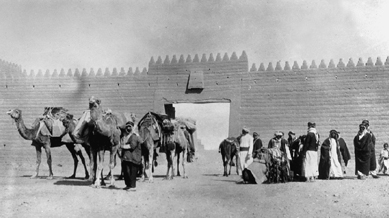
Gertrude’s caravan ready to leave the walled city of Hayil, headquarters of Ibn Rashid, 1914. (University of Newcastle)

Gertrude Bell and Percy Cox give Arabian warrior Ibn Saud a royal tour of Basrah, November 1916. (University of Newcastle)

Hugh Bell reading the newspapers in the sitting room of Gertrude’s house in Baghdad, 1920. (University of Newcastle)

Arnold T. Wilson, 1920. Gertrude’s main adversary, he made life difficult for her in Baghdad.

Sir Percy Cox negotiating with Ibn Saud over the border between Iraq and Kuwait, 1920.

Gertrude’s servants and her saluki dogs stand in the walled garden of her house in Baghdad, 1920. (University of Newcastle)
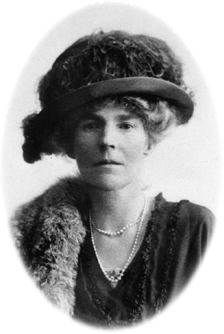
Gertrude in her feathered hat and fur boa. (University of Newcastle)