
CHAPTER 27

In The Indian Journals 1859-62 edited by Leslie White. White gives some intriguing insights into the thoughts of Lewis Henry Morgan, one of America’s earliest progressive thinkers. Morgan’s kinship research looked to find similar custom and family kinship relationships between tribes found in India and the American Indians. “The investigations, of which Systems [1870] was the result, were undertaken in order to demonstrate the Asiatic origin of the American Indian.”212
In the 1850s, Morgan took up comparative kinship studies in his effort to ascertain the origin of the Mound Builders.
Attempts to explain the various kinds of kinship systems and to render their curious features intelligible led Morgan to formulate a theory of social evolution: human society began in a condition of promiscuity, without marriage or the family, and subsequently evolved through a series of stages to the monogamous family of today.
But Morgan’s supposed demonstration of the Asiatic origin of the American Indian was unsound: the similarity, or virtual identity--as in the case of the Tamil (Indians of India) and Seneca (American Indians)—of kinship nomenclatures does not necessarily mean a genetic relationship; such similarities or identities are more properly explained in another way: as functions of like social systems. And his theory of the evolution of the family, which he regarded as the most remarkable result by far of the investigation has been obsolete for decades.213
Yet, there were men in Anthropology such as British Anthropologist, A.C. Haddon, who referred to the works of Morgan as “monumental” with Professor Lowie elevating the interest in Morgan’s work by claiming it to be a “towering monument” and a “colossal achievement.”214

The Indian—India Connection
The kinship relationship that Morgan was looking to find was that the American Indian migrated from India.
In Seeing Things Whole, editor William deBuys writes: “One of the thinkers on whom Powell drew most heavily was Lewis Henry Morgan (1818-1881), a founder of modern anthropology and like Powell, a native son of western New York.”215 “From the appearance of (his book) Ancient Society onward, Powell became one of Morgan’s staunchest allies, not only accepting the classical formulation of social evolution but bending his energy to detailing and fleshing it out.”216
Morgan’s comparisons and the categorizing of kinship patterns “provided the nascent science of anthropology with one of its most powerful classificatory tools.” Morgan’s theory of the stages of evolution —from savagery to barbarism to civilization became “known as anthropology’s classical evolutionary theory [which] dominated anthropological thinking for the decades of Powell’s mature professional life.”217 Morgan’s comparisons further document his interest in developing cross-cultural analogies as a means of interpreting archaeological evidence and in the development of universal support for the evolutionary development of man.
Many theorists were using Morgan’s philosophies and theories on evolution and kinship patterns as the foundation of evolutionary theories for the development of man. “Another ardent admirer of Lewis Henry Morgan was Karl Marx, who developed a theory of human social evolution that was similarly deterministic. Marx found especially interesting Morgan’s assertion that bourgeois conventions of property ownership (in civilization) had been preceded by communal forms (in barbarism).”218 Both Karl Marx and Friedrich Engels would be credited as the inspiration behind the worldwide Communist movement, as both would go on to affirm and reference the works of Morgan.
Morgan’s discovery of some of the true bases of savage society was rich in consequences, one of which was the decision of the United States in the [eighteen] seventies to stop treating with tribal chiefs as if they were kings of petty nations, and to quit drawing up treaties that neither side was capable of abiding by. Other consequences were of the kind Henry Adams envisaged. It is no accident that Marx and Engels found in Morgan’s work scientific support for the materialistic view of history, and that to some Marxist believers even today Morgan stands very little below Marx as a philosopher of ineluctable social change.219
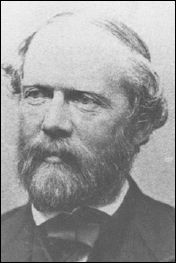
Lewis Henry Morgan
_______________________
212 Leslie A. White ed., Lewis Henry Morgan: The Indian Journals 1859-62, 10
213 Ibid. 10
214 Ibid.
215 William deBuys ed., Seeing Things Whole: The Essential John Wesley Powell, (Washington: Island Press, 2001) 318.
216 Ibid. 319.
217 Ibid.
218 Ibid., 31.
219 Stegner, 346.