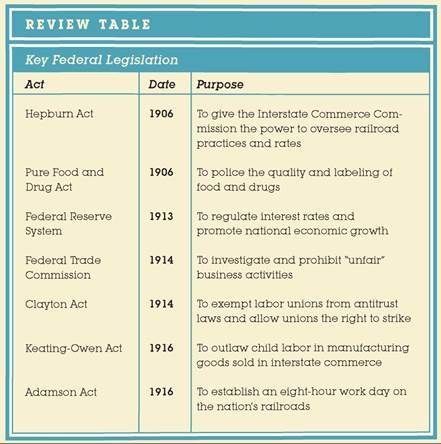
Some of Wilson’s policies seemed more in tune with Roosevelt’s New Nationalism than the New Freedom of 1912. He abandoned the idea of aggressive trust-busting in favor of greater government supervision of the economy. Wilson presided over the creation of two powerful new public agencies. In 1913, Congress created the Federal Reserve System, consisting of twelve regional banks. They were overseen by a central board appointed by the president and empowered to handle the issuance of currency, aid banks in danger of failing, and influence interest rates so as to promote economic growth. The law was a delayed response to the Panic of 1907, when the failure of several financial companies threatened a general collapse of the banking system. With the federal government lacking a modem central bank, it had been left to J. P. Morgan to assemble the funds to prop up threatened financial institutions. Morgan’s actions highlighted the fact that in the absence of federal regulation of banking, power over finance rested entirely in private hands.
A second expansion of national power occurred in 1914, when Congress established the Federal Trade Commission (FTC) to investigate and prohibit “unfair” business activities such as price-fixing and monopolistic practices. Both the Federal Reserve and FTC were welcomed by many business leaders as a means of restoring order to the economic marketplace and warding off more radical measures for curbing corporate power. But they reflected the remarkable expansion of the federal role in the economy during the Progressive era.
By 1916, the social ferment and political mobilizations of the Progressive era had given birth to a new American state. With new laws, administrative agencies, and independent commissions, government at the local, state, and national levels had assumed the authority to protect and advance “industrial freedom.” Government had established rules for labor relations, business behavior, and financial policy, protected citizens from market abuses, and acted as a broker among the groups whose conflicts threatened to destroy social harmony. But a storm was already engulfing Europe that would test the Progressive faith in empowered government as the protector of American freedom.
REVIEW QUESTIONS
1. Identify the main groups and ideas that drove the Progressive movement.
2. Explain how immigration to the United States in this period was part of a global movement of peoples.
3. Describe how Fordism transformed American industrial and consumer society.
4. Socialism was a rising force across the globe in the early twentieth century.
How successful was the movement in the United States?
5. Explain why the Industrial Workers of the World (IWW) grew so rapidly and aroused so much opposition.
6. What did striking workers mean when they declared that they wanted “bread and roses, too”?
7. What did Progressive era feminists want to change in society, and how did their actions help to spearhead broader reforms?
8. Explain how and why Progressivism was an international movement.
9. How did each Progressive era president view the role of the federal government?
10. How democratic was the Progressive movement?

FREEDOM QUESTIONS
1. Immigrants came to the United States in search of freedom and economic opportunity. Describe to what extent they achieved and were denied these goals.
2. Explain the concept of “consumer freedom” and its connections to the growing women’s movement and the new urban society.
3. How did workers and employers differ in their idea of “industrial freedom”?
4. How did the struggles of the Industrial Workers of the World and suffrage advocates promote a broader defense of freedom of expression?
5. Assess the record of the Progressive movement in promoting the expansion of freedom and democracy.