
Chapter 2
SUMMARY OF EVENTS
The two opposing sides in the war were:
|
The Allies or Entente Powers: |
Britain and her empire (including troops from Australia, Canada, India and New Zealand) |
|
France |
|
|
Russia (left December 1917) |
|
|
Italy (entered May 1915) |
|
|
Serbia |
|
|
Belgium |
|
|
Romania (entered August 1916) |
|
|
USA (entered April 1917) |
|
|
Japan |
|
|
The Central Powers: |
Germany |
|
Austria–Hungary |
|
|
Turkey (entered November 1914) |
|
|
Bulgaria (entered October 1915) |
The war turned out to be quite different from what most people had anticipated. It was widely expected to be a short, decisive affair, like other recent European wars – all over by Christmas 1914. This is why Moltke was so worried about being left at the post when it came to mobilization. However, the Germans failed to achieve the rapid defeat of France: although they penetrated deeply, Paris did not fall, and stalemate quickly developed on the western front, with all hope of a short war gone. Both sides dug themselves in and spent the next four years attacking and defending lines of trenches.
In eastern Europe there was more movement, with early Russian successes against the Austrians, who constantly had to be helped out by the Germans. This caused friction between Austrians and Germans. But by December 1917 the Germans had captured Poland (Russian territory) and forced the Russians out of the war. Britain, suffering heavy losses of merchant ships through submarine attacks, and France, whose armies were paralysed by mutiny, seemed on the verge of defeat. Gradually, however, the tide turned; the Allies, helped by the entry of the USA in April 1917, wore down the Germans, whose last despairing attempt at a decisive breakthrough in France failed in the spring of 1918. The success of the British navy in blockading German ports and defeating the submarine threat by defending convoys of merchant ships was also telling on the Germans. By late summer 1918 they were nearing exhaustion. An armistice (ceasefire) was signed on 11 November 1918, though Germany itself had hardly been invaded. A controversial peace settlement was signed at Versailles the following year.
2.1 1914
(a) The western front
On the western front the German advance was held up by unexpectedly strong Belgian resistance; it took the Germans over two weeks to capture Brussels, the Belgian capital. This was an important delay because it gave the British time to organize themselves, and left the Channel ports free, enabling the British Expeditionary Force to land. Instead of sweeping round in a wide arc, capturing the Channel ports and approaching Paris from the west (as the Schlieffen Plan intended, if indeed the Germans were attempting to carry out the plan – see Section 1.4(g)), the Germans found themselves just east of Paris, making straight for the city. They penetrated to within twenty miles of Paris, and the French government withdrew to Bordeaux; but the nearer they got to Paris, the more the German impetus slowed up. There were problems in keeping the armies supplied with food and ammunition, and the troops became exhausted by the long marches in the August heat. In September the faltering Germans were attacked by the French under Joffre in the Battle of the Marne (see Map 2.1); they were driven back to the River Aisne, where they were able to dig trenches. This battle was vitally important; some historians regard it as one of the most decisive battles in modern history:
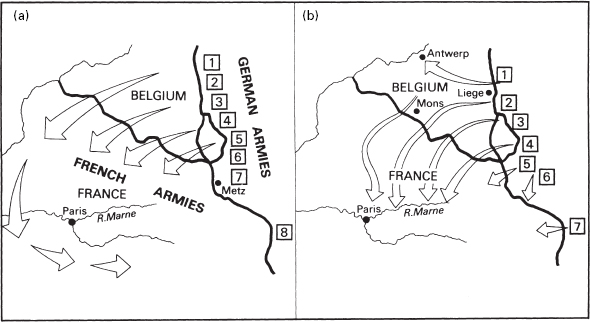
Map 2.1 The Schlieffen Plan
The Schlieffen Plan intended that the German right wing would move swiftly through Belgium to the coast, capture the Channel ports, and then sweep round in a wide arc to the west and south of Paris, almost surrounding the French armies – see (a). In practice, the Plan failed to work out. The Germans were held up by strong Belgian resistance; they failed to capture the Channel ports, failed to outflank the French armies, and were halted at the First Battle of the Marne – see (b).

Map 2.2 The western front
The other important event of 1914 was that although the Germans captured Antwerp, the British Expeditionary Force held grimly on to Ypres. This probably saved the Channel ports of Dunkirk, Calais and Boulogne, making it possible to land and supply more British troops. Clearly the war was not going to be over by Christmas – it was settling down into a long, drawn-out struggle of attrition.
(b) The eastern front
On the eastern front the Russians mobilized more quickly than the Germans expected, but then made the mistake of invading both Austria and Germany at the same time. Though they were successful against Austria, occupying the province of Galicia, the Germans brought Hindenburg out of retirement and defeated the Russians twice, at Tannenburg (August) and the Masurian Lakes (September), driving them out of Germany. These battles were important: the Russians lost vast amounts of equipment and ammunition, which had taken them years to build up. Although they had six and a quarter million men mobilized by the end of 1914, a third of them were without rifles. The Russians never recovered from this setback, whereas German self-confidence was boosted. When Turkey entered the war, the outlook for Russia was bleak, since Turkey could cut her main supply and trade route from the Black Sea into the Mediterranean (Map 2.3). One bright spot for the Allies was that the Serbs drove out an Austrian invasion in fine style at the end of 1914, and Austrian morale was at rock bottom.

Map 2.3 Europe at War
2.2 1915
(a) Stalemate in the west
In the west the stalemate continued, though several attempts were made to break the trench line. The British tried at Neuve Chapelle and Loos, the French tried in Champagne; the Germans attacked again at Ypres. But, like all the attacks on the western front until 1918, these attempts failed to make a decisive breakthrough. The difficulties of trench warfare were always the same:

Figure 2.1 Trench cross-section
(b) The east
In the east, Russia’s fortunes were mixed: they had further successes against Austria, but they met defeat whenever they clashed with the Germans, who captured Warsaw and the whole of Poland. The Turkish blockade of the Dardanelles was beginning to hamper the Russians, who were already running short of arms and ammunition. It was partly to clear the Dardanelles and open up the vital supply line to Russia via the Black Sea that the Gallipoli Campaign was launched. This was an idea strongly pressed by Winston Churchill (Britain’s First Lord of the Admiralty) to escape from the deadlock in the west by eliminating the Turks. They were thought to be the weakest of the Central Powers because of their unstable government. Success against Turkey would enable help to be sent to Russia and might also bring Bulgaria, Greece and Romania into the war on the Allied side. It would then be possible to attack Austria from the south.
The campaign was a total failure; the first attempt, in March, an Anglo-French naval attack through the Dardanelles to capture Constantinople, failed when the ships ran into a series of mines. This ruined the surprise element, so that when the British attempted landings at the tip of the Gallipoli peninsula, the Turks had strengthened their defences and no advance could be made (April). Further landings by Australian and New Zealand troops (Anzacs) in April and by British troops in August were equally useless, and positions could only be held with great difficulty. In December the entire force was withdrawn. The consequences were serious: besides being a blow to Allied morale, it turned out to be the last chance of helping Russia via the Black Sea. It probably made Bulgaria decide to join the Central Powers. A Franco-British force landed at Salonika in neutral Greece to try and relieve Serbia, but it was too late. When Bulgaria entered the war in October, Serbia was quickly overrun by Bulgarians and Germans (see Map 2.4). The year 1915 was therefore not a good one for the Allies; even a British army sent to protect Anglo-Persian oil interests against a possible Turkish attack became bogged down in Mesopotamia as it approached Baghdad; it was besieged by Turks at Kut-el-Amara from December 1915 until March 1916, when it was forced to surrender.

Map 2.4 War on the Eastern, Balkan and Italian Fronts
(c) Italy declares war on Austria–Hungary (May 1915)
The Italians were hoping to seize Austria–Hungary’s Italian-speaking provinces as well as territory along the eastern shore of the Adriatic Sea. A secret treaty was signed in London in which the Allies promised Italy Trentino, the south Tyrol, Istria, Trieste, part of Dalmatia, Adalia, some islands in the Aegean Sea and a protectorate over Albania. The Allies hoped that by keeping thousands of Austrian troops occupied, the Italians would relieve pressure on the Russians. But the Italians made little headway and their efforts were to no avail: the Russians were unable to stave off defeat.
2.3 1916
(a) The western front
On the western front, 1916 is remembered for two terrible battles, Verdun and the Somme.
Losses on both sides, killed or wounded, were appalling (Germans 650 000; British 418 000; French 194 000). The Allied generals, especially Haig, came under severe criticism for persisting with suicidal frontal attacks. In spite of the failures and the appalling casualties, both British and French generals remained convinced that mass infantry charges – the ‘big push’ – were the only way to make a breakthrough. None of them showed any sign of producing alternative tactics, and tens of thousands of lives were sacrificed for no apparent gain. It was after one of the disastrous attacks in 1915 that a German officer remarked that the British army were ‘lions led by donkeys’. Haig came in for the most serious criticism – for the majority of historians, he became the epitome of Allied incompetence and lack of imagination. One historian, W. J. Laffin, went so far as to call his book about the war British Butchers and Bunglers of World War 1 (1988), and for him the chief ‘donkey’ was Haig. J. P. Harris, in Douglas Haig and the First World War (2008), is rather more balanced. He argues that Haig certainly found it difficult to cope with the unprecedented situation that he found himself in on the western front and he misjudged the strength of the German forces. He was slow to see beyond the tactic of the ‘big push’ and must therefore bear much of the responsibility for the massive casualties. However, he did eventually show himself to be receptive to new techniques and strategies and played a vital role in the 1918 campaign which brought the final collapse of German forces.
The horrors of the Somme also contributed to the fall of the British prime minister, Asquith, who resigned in 1916 after criticism of British tactics mounted. And yet the events of 1916 did contribute towards the eventual Allied victory; Hindenburg himself admitted in his memoirs that the Germans could not have survived many more campaigns with heavy losses like those at Verdun and the Somme.
(b) David Lloyd George becomes British prime minister (December 1916)
Taking over from Asquith as prime minister, Lloyd George’s contribution to the Allied war effort and the defeat of the Central Powers was invaluable. His methods were dynamic and decisive; already as Minister of Munitions since May 1915, he had improved the supply of shells and machine-guns, encouraged the development of new weapons (the Stokes light mortar and the tank), which Kitchener (Minister of War) had turned down,and taken control of mines, factories and railways so that the war effort could be properly centralized. As prime minister during 1917, he set up a small war cabinet, so that quick decisions could be taken. He brought shipping and agriculture under government control and introduced the Ministry of National Service to organize the mobilization of men into the army. He also played an important part in the adoption of the convoy system (see Section 2.4(e)).
(c) In the east
In June 1916 the Russians under Brusilov attacked the Austrians, in response to a plea from Britain and France for some action to divert German attention away from Verdun. They managed to break the front and advanced 100 miles, taking 400 000 prisoners and large amounts of equipment. The Austrians were demoralized, but the strain was exhausting the Russians as well. The Romanians invaded Austria (August), but the Germans swiftly came to the Austrians’ rescue, occupied the whole of Romania and seized her wheat and oil supplies – not a happy end to 1916 for the Allies.
2.4 THE WAR AT SEA
The general public in Germany and Britain expected a series of naval battles between the rival Dreadnought fleets, something like the Battle of Trafalgar (1805), in which Nelson’s British fleet had defeated the combined French and Spanish fleets. But both sides were cautious and dared not risk any action which might result in the loss of their main fleets. The British Admiral Jellicoe was particularly cautious; Churchill said he ‘was the only man on either side who could have lost the war in an afternoon’. Nor were the Germans anxious for a confrontation, because they had only 16 of the latest Dreadnoughts against 27 British.
(a) The Allies aimed to use their navies in three ways
The British were successful in carrying out these aims; they went into action against German units stationed abroad, and at the Battle of the Falkland Islands, destroyed one of the main German squadrons. By the end of 1914 nearly all German armed surface ships had been destroyed, apart from their main fleet (which did not venture out of the Heligoland Bight) and the squadron blockading the Baltic to cut off supplies to Russia. In 1915 the British navy was involved in the Gallipoli Campaign (see Section 2.2(b)).
(b) The Allied blockade caused problems
Britain was trying to prevent the Germans from using the neutral Scandinavian and Dutch ports to break the blockade; this involved stopping and searching all neutral ships and confiscating any goods suspected of being intended for enemy hands. The USA objected strongly to this, since they were anxious to continue trading with both sides.
(c) The Germans retaliated with mines and submarine attacks
These tactics seemed to be the only alternative left to the Germans, since their surface vessels had either been destroyed or were blockaded in port. At first they respected neutral shipping and passenger liners, but it was soon clear that the German submarine (U-boat) blockade was not effective. This was partly because they had insufficient U-boats and partly because there were problems of identification: the British tried to fool the Germans by flying neutral flags and by using passenger liners to transport arms and ammunition. On 7 May 1915 the British liner Lusitaniawas sunk by a torpedo attack. In fact the Lusitania was armed and carrying vast quantities of weapons and ammunition, as the Germans knew; hence their claim that the sinking was not just an act of barbarism against defenceless civilians.
This had important consequences: out of almost two thousand dead, 128 were Americans. President Wilson therefore found that the USA would have to take sides to protect her trade. Whereas the British blockade did not interfere with the safety of passengers and crews, German tactics certainly did. For the time being, however, American protests caused Bethmann to tone down the submarine campaign, making it even less effective.
(d) The Battle of Jutland (31 May 1916)
This was the main event at sea during 1916; it was the only time in the entire war that the main battle-fleets emerged and engaged each other; the result was indecisive. The German Admiral von Scheer tried to lure part of the British fleet out from its base so that that section could be destroyed by the numerically superior Germans. However, more British ships came out than he had anticipated, and after the two fleets had shelled each other on and off for several hours, the Germans decided to retire to base, firing torpedoes as they went. On balance, the Germans could claim that they had won the battle since they lost only 11 ships to Britain’s 14. The real importance of the battle lay in the fact that the Germans had failed to destroy British sea power: the German High Seas Fleet stayed in Kiel for the rest of the war, leaving Britain’s control of the surface complete. In desperation at the food shortages caused by the British blockade, the Germans embarked on ‘unrestricted’ submarine warfare, and this was to have fatal results for them.
(e) ‘Unrestricted’ submarine warfare (began January 1917)
As the Germans had been concentrating on the production of U-boats since the Battle of Jutland, this campaign was extremely effective. They attempted to sink all enemy and neutral merchant ships in the Atlantic; although they knew that this was likely to bring the USA into the war, they hoped that Britain and France would be starved into surrender before the Americans could make any vital contribution. They almost did it: the peak of German success came in April 1917, when 430 ships were lost; Britain was down to about six weeks’ corn supply, and although the USA came into the war in April, it was bound to be several months before their help became effective. However, the situation was saved by Lloyd George, who insisted that the Admiralty adopt a convoy system. A convoy was a large number of merchant ships sailing together, so that they could be protected by escorting warships. This drastically reduced losses and meant that the German gamble had failed. The submarine campaign was important because it brought the USA into the war. The British navy therefore, helped by the Americans, played a vitally important role in the defeat of the Central Powers; by the middle of 1918 it had achieved its three aims.
2.5 1917
(a) In the west
On the western front, 1917 was a year of Allied failure. A massive French attack in Champagne, under Nivelle, achieved nothing except mutiny in the French army, which was successfully sorted out by Pétain. From June to November the British fought the Third Battle of Ypres, usually remembered as Passchendaele, in appallingly muddy conditions; British casualties were again enormous – 324 000 compared with 200 000 Germans – for an advance of only four miles. More significant was the Battle of Cambrai, which demonstrated that tanks, used properly, might break the deadlock of trench warfare. Here, 381 massed British tanks made a great breach in the German line, but lack of reserves prevented the success from being followed up. However, the lesson had been observed, and Cambrai became the model for the successful Allied attacks of 1918. Meanwhile the Italians were heavily defeated by Germans and Austrians at Caporetto (October) and retreated in disorder. This rather unexpectedly proved to be an important turning point. Italian morale revived, perhaps because they were faced with having to defend their home-land against the hated Austrians. The defeat also led to the setting-up of an Allied Supreme War Council. The new French premier, Clemenceau, a great war leader in the same mould as Lloyd George, rallied the wilting French.
(b) On the eastern front
Disaster struck the Allies when Russia withdrew from the war (December 1917). Continuous heavy losses at the hands of the Germans, lack of arms and supplies, problems of transport and communications and utterly incompetent leadership caused two revolutions (see Section 16.2), and the Bolsheviks (later known as communists), who took, over power in November, were willing to make peace. Thus in 1918 the entire weight of German forces could be thrown against the west; without the USA, the Allies would have been hard pressed. Encouragement was provided by the British capture of Baghdad and Jerusalem from the Turks, giving them control of vast oil supplies.
(c) The entry of the USA (April 1917)
This was caused partly by the German U-boat campaign, and also by the discovery that Germany was trying to persuade Mexico to declare war on the USA, promising her Texas, New Mexico and Arizona in return. The Americans had hesitated about siding with the autocratic Russian government, but the overthrow of the tsar in the March revolution removed this obstacle. The USA made an important contribution to the Allied victory: they supplied Britain and France with food, merchant ships and credit, though actual military help came slowly. By the end of 1917 only one American division had been in action, but by mid-1918 over half a million men were involved. Most important were the psychological boost which the American potential in resources of men and materials gave the Allies, and the corresponding blow it gave to German morale.
2.6 THE CENTRAL POWERS DEFEATED
(a) The German spring offensive, 1918
This major German attack was launched by Ludendorff in a last, desperate attempt to win the war before too many US troops arrived, and before discontent in Germany led to revolution. It almost came off: throwing in all the extra troops released from the east, the Germans broke through on the Somme (March), and by the end of May were only 40 miles from Paris; the Allies seemed to be falling apart. However, under the overall command of the French Marshal Foch, they managed to hold on as the German advance lost momentum and created an awkward bulge.
(b) The Allied counter-offensive begins (8 August)
Launched near Amiens, the counter-attack involved hundreds of tanks attacking in short, sharp jabs at several different points along a wide front instead of massing on one narrow front. This forced the Germans to withdraw their entire line and avoided forming a salient. Slowly but surely the Germans were forced back until by the end of September the Allies had broken through the Hindenburg Line. Though Germany itself had not yet been invaded, Ludendorff was now convinced that they would be defeated in the spring of 1919. He insisted that the German government ask President Wilson of the USA for an armistice (ceasefire) (3 October). He hoped to get less severe terms based on Wilson’s 14 Points (see Section 2.7(a)). By asking for peace in 1918 he would save Germany from invasion and preserve the army’s discipline and reputation. Fighting continued for another five weeks while negotiations went on, but eventually an armistice was signed on 11 November.
(c) Why did the war last so long?
When the war started the majority of people on both sides believed that it would be over by Christmas. However, Britain’s Secretary for War, Lord Kitchener, himself a successful general, told the cabinet, much to its collective dismay, that it would last nearer three years than three months. Though he did not live to see the end of the war (he was drowned in 1916 on his way to Russia, when his ship struck a mine and sank), he was one of the few who had judged the situation correctly. There are several reasons why the conflict lasted so long. The two sides were fairly evenly balanced, and although the main theatre of war was in Europe, it quickly became a global conflict. Other countries that had not been in the original alliance systems, decided to join in, some because they saw it as a chance to gain new territory, and others waited to see which side looked the more likely to win, and then joined that side. For example, Italy (May 1915), Romania (August 1916), the USA (April 1917) and Japan joined the Allied side, while Turkey (November 1914) and Bulgaria (October 1915) joined the Central Powers. To complicate matters further, troops from the British Empire – from India, Australia, New Zealand, Canada and South Africa – all played their part in the fighting, which eventually spread into the eastern Mediterranean, Asia and Africa.
The main countries involved in the war had very strongly held war aims which they were absolutely determined to achieve. The Germans, anxious to protect themselves from becoming ‘encircled’, aimed to take territory from Poland in the east and Belgium in the west to act as buffer zones against Russia and France. The French were obsessed with taking back Alsace-Lorraine, which the Germans had taken in 1871. The British would never allow Belgium, a country so near to their coast, to be controlled by a hostile power like Germany. Austria–Hungary was desperate to preserve its empire against the ambitions of Serbia. Right from the beginning these competing war aims meant that it would be almost impossible to reach an acceptable negotiated solution.
Once stalemate had been reached on the western front with troops bogged down in lines of trenches, the Allies were faced with difficult problems: the weapons available to the Central Powers as they defended their trenches were more deadly than those available to the attackers. German troops, using fixed machine-guns in trenches protected by barbed wire, had a huge advantage over the attackers, who relied too much on preceding artillery bombardments (see Section 2.2 for more about the problems of trench warfare). Another remarkable factor prolonging the war was the way in which propaganda helped to motivate and encourage the general public as well as the military on both sides. Morale was boosted and support for the war sustained by newspapers, posters, films and advertisements directed at all classes in society to make them proud of their own country and way of life, while spreading stories of horror and atrocity about the enemy. In Germany, in spite of food shortages, labour unrest and a general war-weariness, public support for the war continued. The defeat of Russia encouraged the German generals to continue the struggle and launch what turned out to be a last desperate attempt to break through on the western front in spring 1918, before too many American troops arrived on the scene. A combination of all these factors meant that there would have to be a fight to the finish until one side or the other was either overrun and occupied by the enemy, or was so completely exhausted that it could not carry on fighting.
(d) Why did the Central Powers lose the war?
The reasons can be briefly summarized:
The combination of military defeat and dire food shortages produced a great war-weariness, leading to mutiny in the navy, destruction of morale in the army and revolution at home.
(e) Effects of the war
The impact of the war was extraordinarily wide-ranging, which was not surprising given that it was the first ‘total war’ in history. This means that it involved not just armies and navies but entire populations, and it was the first big conflict between modern, industrialized nations. New methods of warfare and new weapons were introduced – tanks, submarines, bombers, machine-guns, heavy artillery and mustard gas. With so many men away in the armed forces, women had to take their places in factories and in other jobs which had previously been carried out by men. In the Central Powers and in Russia, the civilian populations suffered severe hardships caused by the blockades. In all the European states involved in the war, governments organized ordinary people as never before, so that the entire country was geared up to the war effort. The conflict caused a decline in Europe’s prestige in the eyes of the rest of the world. The fact that the region which had been thought of as the centre of civilization could have allowed itself to experience such appalling carnage and destruction was a sign of the beginning of the end of European domination of the rest of the world. The effects on individual countries were sometimes little short of traumatic: the empires which had dominated central and eastern Europe for over two hundred years disappeared almost overnight.
2.7 THE PROBLEMS OF MAKING A PEACE SETTLEMENT
(a) War aims
When the war started, none of the participants had any specific ideas about what they hoped to achieve, except that Germany and Austria wanted to preserve the Habsburg Empire, and thought this required them to destroy Serbia. As the war progressed, some of the governments involved, perhaps to encourage their troops by giving them some clear objectives to fight for, began to list their war aims.
British prime minister Lloyd George mentioned (January 1918) the defence of democracy and the righting of the injustice done to France in 1871 when she lost Alsace and Lorraine to Germany. Other points were the restoration of Belgium and Serbia, an independent Poland, democratic self-government for the nationalities of Austria–Hungary, self-determination for the German colonies and an international organization to prevent war. He was also determined that Germany should pay reparations for all the damage they had done.
American President Woodrow Wilson stated US war aims in his famous 14 Points (January 1918):
These points achieved publicity when the Germans later claimed that they had expected the peace terms to be based on them, and that since this was not the case, they had been cheated.
(b) Differing Allied views about how to treat the defeated powers
When the peace conference met (January 1919) it was soon obvious that a settlement would be difficult because of basic disagreements among the victorious powers:
By June 1919 the conference had come up with the Treaty of Versailles for Germany, followed by other treaties dealing with Germany’s former allies. The Treaty of Versailles in particular was one of the most controversial settlements ever signed, and it was criticized even in the Allied countries on the grounds that it was too hard on the Germans, who were bound to object so violently that another war was inevitable, sooner or later. In addition, many of the terms, such as reparations and disarmament, proved impossible to carry out.

Illustration 2.1 The three leaders at Versailles: (left to right) Clemenceau, Wilson and Lloyd George
2.8 THE TREATY OF VERSAILLES WITH GERMANY
(a) The terms
The Germans had little choice but to sign the treaty, though they objected strongly. The signing ceremony took place in the Hall of Mirrors at Versailles, where the German Empire had been proclaimed less than 50 years earlier.
(b) Why did the Germans object, and how far were their objections justified?
1 It was a dictated peace
The Germans were not allowed into the discussions at Versailles; they were simply presented with the terms and told to sign. Although they were allowed to criticize the treaty in writing, all their criticisms were ignored except one (see Point 3 below). Some historians feel that the Germans were justified in objecting, and that it would have been reasonable to allow them to take part in the discussions. This might have led to a toning-down of some of the harsher terms. It would certainly have deprived the Germans of the argument much used by Hitler, that because the peace was a ‘Diktat’, it should not be morally binding. On the other hand, it is possible to argue that the Germans could scarcely have expected any better treatment after the harsh way they had dealt with the Russians at Brest–Litovsk – also a ‘Diktat’ (see Section 16.3(b)).
2 Many provisions were not based on the 14 Points The Germans claimed that they had been promised terms based on Wilson’s 14 Points, and that many of the provisions were not based on the 14 Points, and were therefore a swindle. This is probably not a valid objection: the 14 Points had never been accepted as official by any of the states involved, and the Germans themselves had ignored them in January 1918, when there still seemed a chance of outright German victory. By November, German tactics (Brest–Litovsk, the destruction of mines, factories and public buildings during their retreat through France and Belgium) had hardened the Allied attitude and led Wilson to add two further points: Germany should pay for the damage to civilian population and property, and should be reduced to ‘virtual impotence’; in other words, Germany should be disarmed. The Germans were aware of this when they accepted the armistice, and, in fact, most of the terms did comply with the 14 Points and the additions.
There were also objections on specific points:
3 Loss of territory in Europe
This included Alsace–Lorraine and especially West Prussia, which gave Poland access to the sea. However, both were mentioned in the 14 Points. Originally Upper Silesia, an industrial region with a mixed population of Poles and Germans, was to be given to Poland, but this was the one concession made to the German written objections: after a vote among the population, Germany was allowed to keep about two-thirds of the area. In fact most of the German losses could be justified on grounds of nationality (Map 2.5). Where the Germans did have genuine cause for protest was on the question of national self-determination. Right from the start of the peace conference the Allies had emphasized that all nationalities should have the right to choose which country they wanted to belong to. This principle had been applied in the case of non-Germans; but the settlement left around a million Germans under Polish rule, and almost three million in the Sudetenland controlled by the new state of Czechoslovakia. In addition, Austria was a completely German state with a population of some seven million. All these Germans wanted to become part of Germany, but the unification of Germany and Austria was specifically forbidden in the agreement, probably because that would have made Germany larger and more powerful even than in 1914.
4 Loss of Germany’s African colonies
The Germans probably had good grounds for objection to the loss of their African colonies, which was hardly an ‘impartial adjustment’. The mandate system allowed Britain to take over German East Africa (Tanganyika) and parts of Togoland and the Cameroons, France to take most of Togoland and the Cameroons, and South Africa to acquire German South West Africa (now known as Namibia); but this was really a device by which the Allies seized the colonies without actually admitting that they were being annexed (Map 2.6).
5 The disarmament clauses were deeply resented The Germans claimed that 100 000 troops were not enough to keep law and order at a time of political unrest. Perhaps the German objection was justified to some extent, though theFrench desire for a weak Germany was understandable. The Germans became more aggrieved later, as it became clear that none of the other powers intended to disarm, even though Wilson’s Point 4 mentioned ‘all-round reduction of armaments’. However, disarmament of Germany was impossible to enforce fully, because the Germans were determined to exploit every loophole.

Map 2.5 European frontiers after the First World War and the Peace Treaties

Map 2.6 Africa and the Peace Treaties
6 ‘The War Guilt’ clause (Article 231)
The Germans objected to being saddled with the entire blame for the outbreak of war. There are some grounds for objection here, because although later research seems to indicate Germany’s guilt, it was hardly possible to arrive at that conclusion in the space of six weeks during 1919, which is what the Special Commission on War Responsibility did. However, the Allies wanted the Germans to admit responsibility so that they would be liable to pay reparations.
7 Reparations
Reparations were the final humiliation for the Germans. Though there could be little valid objection to the general principle of reparations, many historians now agree that the actual amount decided on was far too high at £6600 million. Some people thought so at the time, including J. M. Keynes, who was an economic adviser to the British delegation at the conference. He urged the Allies to take £2000 million, which he said was a more reasonable amount, which Germany would be able to afford. The figure of £6600 million enabled the Germans to protest that it was impossible to pay, and they soon began to default (fail to pay) on their annual instalments. This caused resentment among the Allies, who were relying on German cash to help them pay their own war debts to the USA. There was international tension when France tried to force the Germans to pay (see Section 4.2(c)). Eventually the Allies admitted their mistake and reduced the amount to £2000 million (Young Plan, 1929), but not before reparations had proved disastrous, both economically and politically.
The Germans clearly did have some grounds for complaint, but it is worth pointing out that the treaty could have been even more harsh. If Clemenceau had had his way, the Rhineland would have become an independent state, and France would have annexed the Saar.
2.9 THE PEACE TREATIES WITH AUSTRIA–HUNGARY
When Austria was on the verge of defeat in the war, the Habsburg Empire disintegrated as the various nationalities declared themselves independent. Austria and Hungary separated and declared themselves republics. Many important decisions therefore had already been taken before the peace conference met. However, the situation was chaotic, and the task of the conference was to formalize and recognize what had taken place.
(a) The Treaty of St Germain (1919), dealing with Austria
By this treaty Austria lost:
(b) The Treaty of Trianon (1920), dealing with Hungary
This treaty was not signed until 1920 because of political uncertainties in Budapest (the capital); the Communists, led by Béla Kun, seized power but were later overthrown.
Both treaties contained the League of Nations Covenant.
These settlements may seem harsh, but it has to be remembered that much of what was agreed had already happened; on the whole they did keep to the spirit of self-determination. More people were placed under governments of their own nationality than ever before in Europe, though they were not always as democratic as Wilson would have liked (especially in Hungary and Poland). However, there were some deviations from the pattern; for example the three million Germans (in the Sudetenland) who now found themselves in Czechoslovakia, and the million Germans who were placed under Polish rule. The Allies justified this on the grounds that the new states needed them in order to be economically viable. It was unfortunate that both these cases gave Hitler an excuse to begin territorial demands on these countries.
The treaties left both Austria and Hungary with serious economic problems
Austria was a small republic, its population reduced from 22 million to 6.5 million; most of its industrial wealth had been lost to Czechoslovakia and Poland. Vienna, once the capital of the huge Habsburg Empire, was left high and dry, surrounded by farming land which could hardly support it. Not surprisingly, Austria was soon facing a severe economic crisis and was constantly having to be helped out by loans from the League of Nations. Hungary was just as badly affected, her population reduced from 21 million to 7.5 million, and some of her richest corn land lost to Romania. Matters were further complicated when all the new states quickly introduced tariffs (import and export duties). These hampered the flow of trade through the whole Danube area and made the industrial recovery of Austria particularly difficult. In fact there was an excellent economic case to support a union between Austria and Germany.
2.10 THE SETTLEMENT WITH TURKEY AND BULGARIA
(a) The Treaty of Sèvres (1920), dealing with Turkey
Turkey was to lose Eastern Thrace, many Aegean islands and Smyrna to Greece; Adalia and Rhodes to Italy; the Straits (the exit from the Black Sea) were to be permanently open; Syria became a French mandate, and Palestine, Iraq and Transjordan British mandates. However, the loss of so much territory to Greece, especially Smyrna on the Turkish mainland, outraged Turkish national feeling (self-determination was being ignored in this case). Led by Mustafa Kemal, the Turks rejected the treaty and chased the Greeks out of Smyrna. The Italians and French withdrew their occupying forces from the Straits area, leaving only British troops at Chanak. Eventually a compromise was reached and the settlement was revised by the Treaty of Lausanne (1923), by which Turkey regained Eastern Thrace including Constantinople, and Smyrna (Map 2.7). Turkey was therefore the first state to challenge the Paris settlement successfully. One legacy of the Treaty of Sèvres which was to cause problems later was the situation in the mandates. These were peopled largely by Arabs, who had been hoping for independence as a reward after their brave struggle, led by an English officer, T. E. Lawrence (Lawrence of Arabia), against the Turks. Nor were the Arabs happy about the talk of establishing a Jewish ‘national home’ in Palestine (see Section 11.2(a)).
(b) The Treaty of Neuilly (1919), dealing with Bulgaria
Bulgaria lost territory to Greece, depriving her of her Aegean coastline, and also to Yugoslavia and Romania. She could claim, with some justification, that at least a million Bulgars were under foreign governments as a result of the Treaty of Neuilly.

Map 2.7 The treatment of Turkey (Treaty of Sèvres) and Bulgaria (Treaty of Neuilly)
2.11 VERDICT ON THE PEACE SETTLEMENT
In conclusion, it has to be said that this collection of peace treaties was not a conspicuous success. It had the unfortunate effect of dividing Europe into the states which wanted to revise the settlement (Germany being the main one), and those which wanted to preserve it. On the whole the latter turned out to be only lukewarm in their support. The USA failed to ratify the settlement (see Section 4.5) and never joined the League of Nations. This in turn left France completely disenchanted with the whole thing because the Anglo-American guarantee of her frontiers given in the agreement could not now apply. Italy felt cheated because she had not received all the territory promised her in 1915, and Russia was ignored, because the powers did not want to negotiate with its Bolshevik government.
Germany, on the other hand, was only temporarily weakened and was soon strong enough to challenge certain of the terms. In fact it is possible to argue that Germany was weakened less than her enemies. Much of France, Poland and the Balkans had been ravaged by occupying troops, whereas German territory was virtually untouched. After all, no enemy troops had set foot on German soil and not surprisingly it was soon widely accepted in Germany that their armies had not been defeated. Returning German soldiers were welcomed back as heroes, fresh and undefeated from the battlefield. German industry was able to switch back to peacetime production remarkably quickly, and by 1921 was producing three times as much steel as France.
All this tended to sabotage the settlement from the beginning, and it became increasingly difficult to apply the terms fully. Clearly, since Germany was still the strongest power in Europe economically, the great failing of the peace settlement was that it left the Germans with a sense of resentment and grievance, but did not leave them too weak to retaliate and seek revenge. These weaknesses were widely recognized at the time, even among allied delegates at the conference. Harold Nicolson, a British diplomat at the conference, wrote: ‘If I were the Germans, I shouldn’t sign for a moment.’ John Maynard Keynes, a senior British delegate and economic adviser, was so disillusioned with the way things were going that he resigned in protest and came home. But it is easy to criticize after the event; Gilbert White, one of the American delegates, put it well when he remarked that, given the intricacy of the problems involved, ‘it is not surprising that they made a bad peace: what is surprising is that they managed to make peace at all’. With the availability of new sources, many historians find themselves in sympathy with this assessment, and argue that the settlement can now be seen ‘as a workable compromise’, and perhaps the best that could have been achieved under difficult circumstances. True, there were some mistakes, but the peacemakers cannot be blamed for Hitler’s rise to power, and certainly not for the Second World War. For example P. M. H. Bell, in his book Origins of the Second World War in Europe (2007), argues that in the early 1920s, Europe, including Germany, was beginning to recover well from the after-effects of the war. The tragedy was that ‘the outline of a successful European recovery was cut off in its prime by the great depression and its dreadful consequence, the advent of Hitler’.
FURTHER READING
Beckett, I. F. W., The Great War, 1914–1918 (Longman, 2000).
Black, J., The Great War and the Making of the Modern World (Continuum, 2010).
Harris, J. P., Douglas Haig and the First World War (Cambridge University Press, 2008).
Laffin, W. J., British Butchers and Bunglers of World War 1 (Alan Sutton, 1988).
Macfie, A. L., The End of the Ottoman Empire (Longman, 1998).
Palmer, A., Twilight of the Habsburgs (Weidenfeld & Nicolson, 1994).
Sharp, A., The Versailles Settlement: Peacemaking in Paris, 1919 (Palgrave Macmillan, 2008).
Sheffield, G., Forgotten Victory: The First World War, Myth and Realities (Headline, 2001).
Sheffield, G., The Chief: Douglas Haig and the British Army (Aurum Press, 2011).
Stevenson, D., 1914–1918: The History of the First World War (Penguin, 2005).
Stevenson, D., With Our Backs To The Wall: Victory and Defeat in 1918 (Allen Lane, 2011).
Watson, A., Enduring the Great War: Combat, Morale and Collapse in the German and British Armies, 1914–1918 (Cambridge University Press, 2008).
QUESTIONS