
CHAPTER SIX
The story of Violette Szabo has been told many times, and rightly so. First in the field was R L Minney’s Carve Her Name with Pride, originally published in 1956, which became a best seller and is still today a much sought after volume in the secondhand book world. In 1958 a J Arthur Rank film of the same name was made, starring Virginia McKenna, with a screenplay by Lewis Gilbert and Vernon Harris. This chapter concentrates only on those aspects of her work for SOE which are essential for the visitor to the site of her action against Das Reich over the period 7 to 10 June 1944. The Circuit to which Violette Szabo (LOUISE) was assigned as courier that month was the SALESMAN 2 team, commanded by Captain Geoffrey Staunton, real name Philippe Liewer, code name HAMLET. Also in the team was Lieutenant Robert Maloubier (PACO) and an American Radio Operator, Jean Claude Guiet. They were parachuted into France together, on the night 6/7 June.
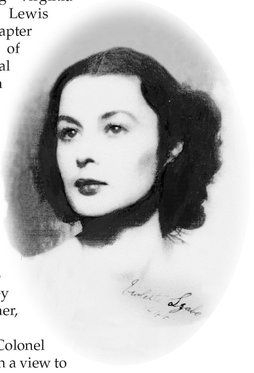
HAMLET made contact with Colonel Guingouin, the local FTP leader, with a view to unifying his forces with the FFI. In this he was successful and he reported that Guingouin, ‘never failed to execute immediately all orders from London as well as attending to all targets’. As a result of SOE parachutages, Guingouin’s FTP was, at the time, about the best equipped Maquis in France. German Intelligence Reports had identified the Limousin area as one of the most dangerous to Das Reich in their march north. In his memoires (Quatre Ans de Lutte sur le sol Limousin) Georges Guingouin pays homage to LOUISE’s heroism and a brief extract from his book may suffice to give a summary of the last moves in the drama:
‘While she and Jacques Dufour (ANASTASIE) were driving to meet a contact near Salon-la-Tour, they ran into a SS ambush. Both armed with machine guns they leapt into a ditch; but they were outnumbered and had to flee across the fields. Unfortunately, Violette fell, twisting her ankle painfully. Strenuously refusing to let her companion help – he wanted to carry her – the English girl bravely told him to save himself. With a superhuman effort, she held out against the pursuers, firing machine-gun bursts at them while ANASTASIE made a desperate run for safety... Dufour was safe. Violette, however, was taken prisoner and sent to Ravensbrück.’
To this brief account must be added a few words to bring Violette before us. She was twenty-three years of age when she parachuted in that night, a girl of ‘haunting beauty’, extraordinarily brave from childhood. Already a widow, she left behind a daughter, Tania, born 8 June 1942. Violette was captured two years later, almost to the day, and was to be shot in Ravensbrück seven months later on 26 January 1945.
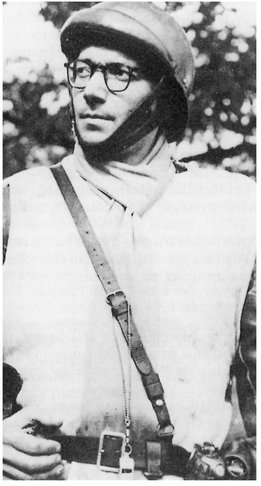
Georges Guingouin, Companion de
la Libération, King’s Medal for
Courage (King George VI).
Let us here take up her story as she climbed, with her three companions, into her US Air Force Liberator on the night of 6/7 June at the secret airfield at Tempsford. Four hours later, after a draught of rum and coffee where they squatted on the floor beside the bomb racks filled with containers of arms and explosives for their mission, they were over the target. Violette was the first to go, dropping through the improvised hole cut in the floor of the aircraft, followed by Staunton, Maloubier and Guiet. Then the plane turned and followed up with their suitcases, guns, ammunition, hand grenades and explosives. The four parachutists swung down to earth.
The Maquis
HAMLET’s London briefing had led him to believe that he was to be received by a very well organised Maquis, strictly devoid of political intrigues. They were numerous enough, some 600 and, instead of the expected three members of the Reception Committee, some thirty men came running across the field to greet them. One of the parachutes was caught in the branches of a small wood beside which they had landed. It was quickly freed and the youth who proudly carried it back to the farm is today the proprietor, M Charial of Le Clos. As he was to tell me on my visit: ‘We had nothing in those days. The silk was valuable’.
In his report Staunton was to detail how he was dismayed to find that the local chief, Colonel CHARLES, was a saxophonist in a Bal Musette, a Private 2nd Class with no war experience. His men were, he reported ‘strictly not trained, and commanded by people who had almost decided not to fight the Germans’. He discovered all this on the very night of his arrival. Colonel CHARLES had done the rounds of his billets, revolver in hand, reminding everyone: ‘Remember, we are not FTPs’. He was, in fact posing as an Armée Secrète chief in order to ensure that the ‘British Imperialists’ of SOE would supply the communist Maquis, known as the 1st Brigade of Marche, with all the arms and material they wanted. He need not have bothered. Robert Maloubier was immediately at work, training the Maquis in the techniques of sabotage on the lines of communication. The 1st Brigade was to distinguish itself in later actions.
Parachuting-in
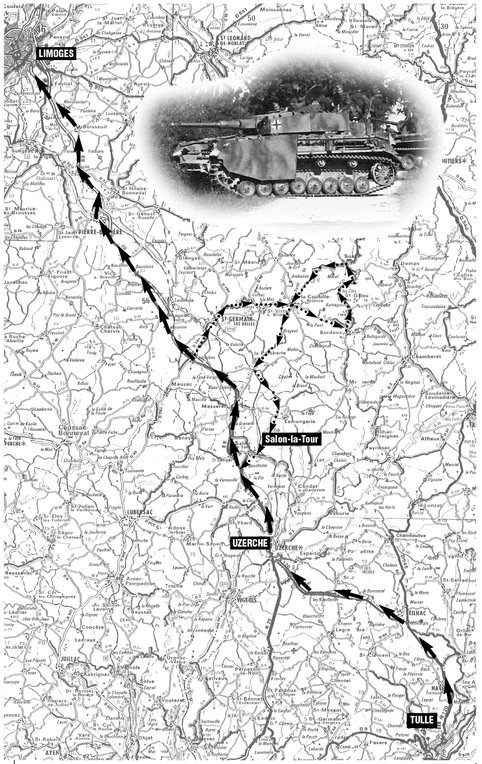
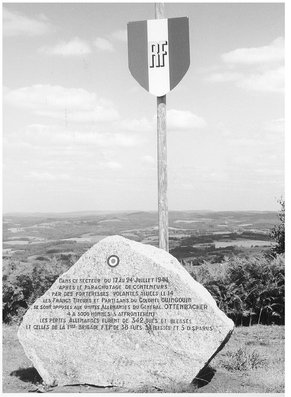
To find Le Clos, you should leave the N20 at the intersection near the Forest of Magnac, half way between Uzerche and Pierre-Buffière, just where the D7 turns off to the east for St Germain. Take the D16 and turn off right for St Vittet and La Croisille-sur-Briance. Then on down the D12 for Surdoux where you turn sharp left for the winding road skirting Mt Gargan, scene of important Resistance battles during the period 17 June to 24 July. Although we are on our way to Violette’s parachutage site you should turn aside here and visit the memorial on Mt Gargan commemorating the Maquis loss of 101 to the Germans’ 342. Also, the commemoration of the USAF parachutage of 409 containers. In Staunton’s citation for decoration he says of Guingouin, ‘he was constantly heading counter-attacks and offensive patrols and ambushes. Mastered the situation in the most brilliant way...’
As you wind down to the valley floor you will see Le Clos in front of you. Crossing the stream, away to your right stands a long, low farm and to your left a number of small buildings. M Charial’s farm is the last on your left as you begin to mount the hill again. Stop here and look across his fields to the right. In the middle distance you will see a grove of chestnut trees: the exact site of the landing. It was here M. Charial carried the parachutes. ‘But, you were only a lad at the time’ I said. ‘Yes, Monsieur, but they were not very heavy!’

The ruined chapel, Mt Gargan.
Mt Gargan: Resistance Memorial, battle of 17-24 July 1944 with commemoration of 14 July parachutage by B-17s, Flying Fortresses of the USAF.
Le Clos: woodland where the SALESMAN 2 team, made up of four agents, landed on the night of 6/7 June 1944.


M Charial points out the grove of trees where Violette Szabo and the three other members of SALESMAN 2 landed.
Piling into a large, black Citroen and a lorry brought for the containers, they were soon off. One account gives it that Violette had twisted her ankle on landing. They drove north on the D39 to Sussac. Today you will pass a commemorative panel to the 14 July parachutage of 416 containers as part of Operation CADILLAC and one marking Guingouin’s HQ at La Villa. The run to Sussac took them about fifteen minutes and, as they had no fear of a German presence, they laughed and talked excitedly. Had not the Allies just landed on the coast of France? Was not Liberation in the air?
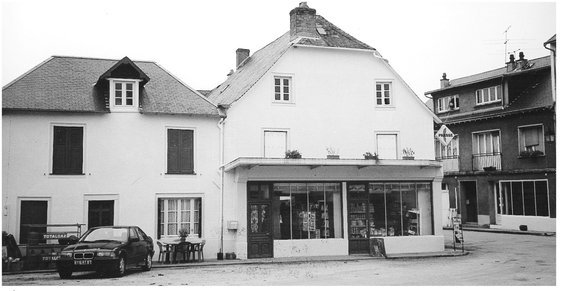
The grocer’s shop in Sussac where Mme Ribéras and Mlle Géry welcomed Violette Szabo and the other members of the team.

SOE and Resistants in Sussac: Back row, Mortier (SOE), Philibert, Grelon, Simon (SOE /JED), Bisset, Edgar (SOE /Jed). Seated, Lannou (SOE /Jed), Staunton (SOE), de Guelis (SOE /Jed), Gaumondie (FTP and A/S) Thomas Mackenzie (SOE /Jed), Lacoutre. The Jeds were Mission TILLEUL.
Arriving in Sussac, drive to the little square in front of the church. Immediately in front of you is the ‘safe house’ they occupied that night. It is still a general store, its appearance virtually unchanged. Violette had a room to herself, the men shared.
The next morning Staunton called a council of war with Jacques Dufour (ANASTASIE) leader of the local Maquis. Violette was due to make contact with Jacques Poirier of Circuit DIGGER and ANASTASIE offered to take her as far as Pompadour by car to meet up with SAMUEL and so, via a number of contacts, to Poirier’s HQ in Dordogne. Staunton emphasised to her the importance of ANASTASIE to his plans for the Resistance in the area: ‘Whatever happens, we need him here’. She understood.

Jacques Dufour (ANASTASIE)
On 10 June, at 9:30 in the morning, the little party assembled in the square in front of the church. Violette was dressed in a light suit, flat-heeled shoes and no stockings. She carried her suitcase, Sten gun and eight magazines of ammunition. She also had her bicycle with her. Villagers were struck by her beauty, youthfulness and confident air: she was never forgotten. To a round of good wishes they set off.
We now take the same route, following the D43 to La Croisille-sur-Briance. The road winds and twists through beautiful countryside; it is marked as a ‘green route’ on the Michelin map. To your left of the road note a new Resistance memorial. At La Croisille they stopped to pick up a friend, Jean Bariaud. Here, if you will and it is convenient, stop for lunch at the Restaurant du Centre for an excellent and inexpensive meal of local specialities. Another Resistance panel marks the centre of the village opposite the restaurant.
Leaving the village take the little D43 road in front of you to La Porcherie, travelling south. In a run of about one hour you will arrive at Salon-la-Tour, passing the lake at Piquette and skirting Lamongerie on the D20E7. You pass under the railway bridge on the outskirts of Salon and the drama is about to unfold.
As you crest the little hill in front of you to your left you will see the old farm buildings exactly as they were in 1944. Ahead, at the end of the road which dips down to the village, you will see the crossroads where the German road-block was erected and from which German soldiers belonging to Das Reich waved to the car to slow down. Pull into the right and park next to the rugby football field. Map page 108.
Leaping from their car, ANASTASIE opened fire from the left hand side while Violette leapt to the right and, taking cover from a tree (which is no longer there, an electric pylon having replaced it) opened fire with her Sten gun. Jean Bariaud had already taken to his heels. The Germans fired back using rapid fire Schmeissers. They were 400 strong, part of Das Reich, making a sweep through the countryside in protection of the main column advancing north to Limoges, or possibly, part of the Deutschland 1st Battalion searching for Sturmbannführer Kämpfe (see page 24) who had gone missing the night before – accounts vary.
The village of Salon-la-Tour from the east.
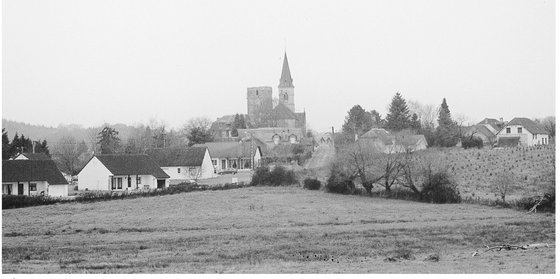

Scene of the action.
Just down the road to the left (a modern house now stands on the site) a farm woman decided to emerge from her barn, believing that if she remained there the Germans would think she was in hiding and would shoot her. She was cut down instantly. Armoured cars began appearing. Cutting across the road Violette joined ANASTASIE and ran headlong into the farmyard to the left.(2) This is Albert Tisserand’s farm today. On 10 June 1944 he was playing in an open barn opposite the farmhouse when he heard running feet and the whizz of bullets, having previously been alerted by the screeching tyres of a car coming suddenly to a stop in the road beside the barn. Leaping the gate into the field, the two fugitives took off across the field towards a small stream. Running into the farmyard, the SS presented a gun to his father and demanded: ‘Terrorist or Frenchman?’ ‘Frenchman’ came the reply. ‘Setting their machine-gun up on the gate (Albert told me ‘It’s not the gate, it’s a new one’) they opened fire again’, volley after volley pursuing them as they plunged into the ripening corn. Violette received a flesh wound in her left arm. Zig-zagging their way, to avoid leaving a clearly defined trail, they ran up the steep hill towards the trees. Suddenly, Violette fell, her ankle twisted. Fighting off ANASTASIE’s attempts to pick her up and carry her, she shouted to him to make his getaway. Dragging herself to the edge of the cornfield, she struggled to an apple tree and clamped in another magazine.(3)

Albert Tisserand, right, witness to the Szabo action, explains what he saw.

The gate where the Germans set up their machine gun, firing at Violette and Dufour as they raced across the field heading for the woods.
The bridge where Violette was questioned. Car is in the position of the German half-track. Behind this, at the time, was a pile of logs where Dufour hid, a matter of a couple of metres away from the Germans.

Today the apple trees have gone and the cornfield is now a pine plantation. Albert took me to the very site, marked by a young pine of some three feet in height. Here, she stood and fought. Firing her Sten gun she held off the advancing Germans enabling ANASTASIE to escape. The shooting lasted about half an hour. One corporal was definitely killed, possibly others, and some wounded. Finally, her ammunition ran out and, kicking and struggling, she was overcome by two men who dragged her to the top of the hill and down the lane towards the railway. Hot and dishevelled, and in considerable pain, she leant against the parapet of the stone bridge over the railway line.(4) She was not to know, and neither were the Germans, that ANASTASIE lay almost at her feet, hidden under a pile of logs. An armoured car drew up (exactly where the car appears in the photo) and Violette was interrogated by a young officer. Blazing with fury, she rejected his smooth congratulations, spat out his forced cigarette and then spat him in the face. ‘All right’ he laughed, wiping his face, ‘take her away’. ‘Tell your men to let go of my arms’ she was heard to say as they set off, ‘I’ll have one of my own cigarettes’. As they passed through the village, the inhabitants peered through their shutters to watch the young English girl go past, her head high. Not many remember now: Albert and a few of his old friends do. Nevertheless, English visitors arrive from time to time and Albert had the honour of a visit by Violette’s daughter Tania, who at that time, was living in Australia.
On my visit we turned back to the village, passing the mill on the road Ruisseau des Forges. There is no memorial to Violette in Salon-la-Tour but a plaque in the square commemorates the execution of Gaston Sarnel of the Armée Secrète by Das Reich on 9 June. In the cemetery we went to see the tombs of Jacques Dufour, killed in Indo-China, and of the farm woman who died the day of the gun battle. Further down the track from the stone bridge you can see the railway station where ANASTASIE hid in one of the wagons on escaping from the wood pile. Salon-la-Tour is little changed and it is easy for the visitor to relive the events of fifty years ago. All the surrounding country is as beautiful now as it was that summer day in June. One would like to think of that little pine tree growing up to mark, for the future, the last stand of a beautiful and brave English girl who gave her all for France.

Violette Szabo action

*Poem allegedly given to Violette Szabo by Leo Marks:
The life that I have
Is all that I have
And the life that I have
Is yours
The love that I have
Of the life that I have
Is yours and yours and yours
A sleep I shall have
A rest I shall have
Yet death will be but a pause
For the peace of my years
In the long green grass
Will be yours and yours
And yours.
At Le Clos, on the D39, is the memorial to Violette Szabo unveiled 6 June 2000.
After the Capture
From here, we trace Violette’s journey to Limoges which took her to the prison on the Place du Champ de Foire (now the Place Winston Churchill) and to her first Gestapo interrogation at their local HQ. Her interrogator, SS Sturmbannführer Kowatch, had presided the previous day at the hangings at Tulle. Later, she was transferred to the vast Paris prison of Fresnes, to interrogations by SS Sturmbannführer Kieffer (later executed for war crimes) at Gestapo HQ No 84 Avenue Foch. From there she was sent to Ravensbrück, fifty miles north of Berlin, the largest women’s prison ever built in the world. Accommodating 7,000 prisoners in 1939, by the time Violette arrived it held over 40,000.
News of the disaster reached Staunton through Jean Bariaud’s return to La Croisille late in the afternoon. Setting out to Salon, Staunton was informed that both Violette and Dufour had been taken prisoner, the Germans having put out the rumour that they had captured him as well. However, the next morning two Resistance agents arrived from Limoges with news that an English girl had been brought in the night before, was lodged in the jail and had been seen ‘limping badly, but with such dignity...’ on her way to questioning at Gestapo headquarters. The Resistance in Limoges was ready to help rescue her. Immediately Staunton and the Resistants evolved a plan. Although it was to be frustrated by her pre-dawn transfer we will follow its manoeuvre when we come to pass some time in the city of Limoges in the next chapter.
There is still talk in Salon-la-Tour about the events of those days. Interestingly, amongst those who remember, the failure of Jacques Dufour to take elementary precautions in driving across enemy infested country is most criticised. Certainly the maquisards were young, lacking in training and experience and without the professionalism of the SOE agents with their intensive training. Staunton recognised this, but the words he spoke to Violette at the time he placed her in the care of Dufour just prior to them leaving for Lubersac, indicated the degree of confidence he had in the committment and personal bravery of the young man and the Resistance in general.
In HAMLET’s ‘Attachment E’ report on the situation in Haute Vienne following D-Day, while regretting the fact that the Resistance could not always achieve what it would have liked, nevertheless he admits to some satisfaction in the manner in which it applied itself to the business at hand:
‘I would like to point out that whatever aims the FTPs have for the future, they have for the last three months constantly played the game. I may point out, for instance, that during the last week of August, when Haute Vienne, as well as Creuse and Corrèze were entirely liberated, while both Creuse and Corrèze were sending out about 700 men each to fight in other Departments, Haute Vienne was sending out at the same time over 3,500.’
When you return to England, pay a visit to the new Violette Szabo Millennium Museum at Cartref, Wormelow, Herefordshire, now the home of Rosemary Rigby. It was here that Violette relaxed between missions during 1944.
Tania Szabo, daughter of Violette, at the unveiling of a memorial to her mother at Le Clos, 6 June 2000.
