
Chapter 1
The Fallschirmjäger’s equipment and uniforms were extremely distinctive. Effectively, they would wear a jump smock, designed to prevent them from getting entangled in the glider or aircraft or when trying to open their parachutes. Most of the photographs show the Fallschirmjäger in the first pattern jump smock. It was produced in either a light green or grey cotton. The paratrooper would step into the garment and then push his arms through the sleeves. They were buttoned from the front. There wereere various versions, particularly with the number of pockets and their position.
A Fallschirmjäger’s steel helmet was of a revolutionary design. It had to fulfil three purposes; it was almost rimless, it needed to give a degree of protection in combat, protect the head in difficult landings and also not to snag either the parachute or rigging. It was normal practice for the helmet to be finished in a field blue colour, but there were a number of different colours actually used and, as we will see, by the time the paratroopers were operating in Russia, they would whitewash the helmets for additional camouflage.
The Fallschirmjäger also had ammunition bandoliers and pouches. The bandoliers were unique to the Fallschirmjäger. The men needed to be as self-sufficient as possible and carry as much of their own ammunition as was practicable. The bandoliers consisted of two rows of ten pouches; each of the pouches carried a clip of five roundsunds for their rifles. The bandolier was worn around the neck and held in place by loops of cloth. The jump trousers were woollen and had a special knife pocket. Early jump boots had laces up one side; later ones were front-laced.
Each of the Fallschirmjäger carried a sidearm. One of the principal problems was that the paratroopers landed just armed with the knife, a sidearm and grenades. They had to find the weapons containers, which had floated down on a parachute from the same aircraft. This meant that the men were able to protect themselves and, as in Crete, actually mount attacks just armed with a pistol and grenades. The primary weapon was the Mauser K98, which had a rate of fire of fifteen rounds a minute. Only a handful of the men at this stage of the war were armed with a machine pistol. Plieschen, as a member of the machine gun company, would have been well versed in the use of the MG34. It was a general-purpose squad machine gun and could be fired on a bipod, which was usually attached, or a tripod for continuous fire. This also meant that the members of his company would be expected to carry a great deal of MG34 ammunition. The MG34 had a maximum range of some 800 metres and had a theoretical rate of fire of 1,200 rounds per minute. The men would use a fifty-round belt.
Wilhelm Plieschen’s unit was commanded by Hauptmann Erich Schulz, who had joined the company in June 1940 and was later to be promoted to the rank of major. It is believed that Schulz was either badly injured or wounded on Crete in the first few days. The parent unit of Plieschen’s company was the 7th Flieger Division, which had been formed in 1938. Some elements of the division had operated as motorised infantry in Poland. As we have already seen, other parts of the division were active in Denmark, Norway, Belgium and the Netherlands. The division was also earmarked for the planned invasion of Britain in the summer of 1940.
It had been t the 2nd Regiment of the division that had landed around the Corinth Canal. Initially, the division had been commanded by Kurt Student, who had been a fighter pilot in the First World War. By January 1941 Student had become the commanding general of the 11th Fliegerkorps and so, in this role, it was he that masterminded Operation Mercury. Over a year later Student also outlined Operation Hercules, which was the planned airborne invasion of Malta, but this was never carried out. By the time Plieschen found himself in Crete the new commander of his division was Major General Wilhelm Sussmann, although he was killed en route to Crete on 20 May 1941. The tow rope pulling his glider snapped and the glider crashed on the island of Aegina. Divisional command passed to Major Alfred Sturm.
The first third of the album shows the Fallschirmjäger in transit from their training base in Austria and their travels through the Balkans to their ultimate destiination, Greek airfields on the mainland. Back in January 1936 the Germans had set up their first parachute training school at the Luftwaffe base at Stendal, some ninety-six kilometres to the west of Berlin. The training programme called for new recruits to spend eight weeks toughening themselves up in order to fulfil essentially a light infantry role. Here, the men would undergo physical exercises, drilling, bayonet practice, unarmed combat and weapons instruction. Many of the men had already received instruction on the use of grenades and the rifle. They were now introduced to pistols, sub-machine guns, machine guns, mines and mortars. They were also lectured on tactics at squad level and would be involved in field exercises up to battalion level. The idea was to build them into a team, but a flexible one that would be able to cope with a variety of challenging operations.
Once the basic training had been concluded the men then underwent a sixteen-day parachute course. Initially, they were shown how to execute high jumps on trampolines, or by somersaulting. It was important for the men to learn how to land properly and without breaking their bones.
Unlike Allied paratroopers, the German Fallschirmjäger was taught how to pack their own parachutes. Usually the parachutes were suspended from rails in an aircraft hangar. This was to ensure that there were no tears or faults and that the parachutes were kept dry. They were then laid out onto long tables. Two men would learn the pattern in which the parachute had to be folded in order for it to not only open, but also to fit into the pack. The parachutes of the Fallschirmjäger opened using static lines. This allowed the men to be dropped from lower heights. The canopies were 8.5 metres in diameter. They were packed into cloth bags and then the bag and the top of the folded canopy were fixed to a 9-metre static line. This would ensure that the parachute was fully deployed before the paratroopeper had dropped 30 metres. It was a flexible system and allowed drops from as little as 100 metres.
Each of the recruits, in order to win their Fallschirmschützenabzeichen, or parachutist badge, had to complete six drops. They were given knee pads to prevent injury. Once on board the Ju52 aircraft the men held the end of their static lines between their teeth so that their hands were free. The dispatcher, or absetze, effectively the instructor at this stage, would have checked the harness and pack and once the aircraft had reached a suitable height he would order the men to stand up and hook their static lines to a cable that ran the length of the aircraft. The first Fallschirmjäger in the stick (or group of men) would be told to stand near the doorway. The paratrooper would then launch himself out of the aircraft in a spreadeagle position. The parachute would deploy after a short drop. When the man hit the ground he would roll and then grab the shroud lines s and try to deflate the parachute. If necessary he would use his combat knife to cut himself free.
Each of the recruits would be required to drop five more times, in different conditions, although at this early stage in the war night drops were not practised. At this point the qualified Fallschirmjäger, proudly wearing his badge, would then be sent to his battalion and be ready for active duty.

Plieschen is pictured on the left. This photograph was probably taken at the parachute training school. By this stage other training centres had been set up and this one may have been in Austria. The two men are wearing their jump smocks and unique Fallschirmjäger helmets. They are wearing first-pattern jump smocks and standard combat trousers tucked into side-laced jump boots. Plieschen wears a Luger holster. The insignia worn on the jump smock is of a Luftwaffe eagle. Rank insisignia would have been worn on both upper arms. Normally, medals and decorations were not permitted, but later the men would have had cuff titles, such as Kreta (Crete). Note that neither of these men yet has the coveted parachutist badge, which may suggest that they were still in training. They wear black leather gauntlets and in battle they would have carried ammunition boxes attached to the waist belt, a water bottle and drinking cup on the right hip. These early issue helmets were blue/grey. The German national colours of black, white and red were worn on the right and the silver grey Luftwaffe eagle on the left. It is not possible to see whether the national colours are on these men’s helmets, but they were removed early on in the war.
The coveted Luftwaffe parachutist’s badge is shown here. During the war years training for this parachute qualification was carried out at regimental training schools. The recruits would have four weeks of ground training and fofour weeks of airborne training. The volunteers had to be relatively lightweight; around 85 kg. They could not have any fear of heights, or suffer from dizziness or air sickness. Throughout the training programme initiative, intelligence and courage were looked for from the recruits. It was an arduous training programme and it was of course different for paratroopers and glider units. The men were issued with the so-called parachutists Ten Commandments:
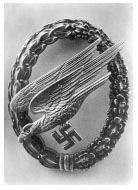
1. You are the elite of the German army. For you, combat shall be fulfilment. You shall seek it out and train yourself to stand any test.
2. Cultivate true comradeship, for together with your comrades you will triumph or die.
3. Be shy of speech and incorruptible. Men act, women chatter; chatter will bring you to the grave.
4. Calm and caution, vigour and determination, valour and a fanatical offensive spirit will make you superior in attack.
5. In facing the foe, ammunition is the most precious thing. He who shoots uselessly, merely to reassure himself, is a man without guts. He is a weakling and does not deserve the title of paratrooper.
6. Never surrender. Your honour lies in Victory or Death.
7. Only with good weapons can you have success. So look after them on the principle – first my weapons, then myself.
8. You must grasp the full meaning of an operation so that, should your leader fall by the way, you can carry it out with coolness and caution.
9. Fight chivalrously against an honest foe; armed irregulars deserve no quarter.
10. Keep your eyes wide open. Tune yourself to the top most pitch. Be nimble as a greyhound, as tough as leather, as hard as Krupp steel and so you shall be the German warrior incarnate.
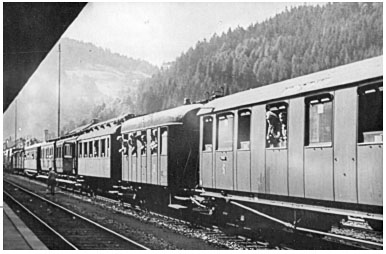
Paratroopers entrained, probably in Austria. The situation in the Balkans prior to the Greeks entering the war had been complicated. German troops had entered Bulgaria in the spring of 1941. The Germans had set up supply points as close to the Greek border as possible, including some in Romania. Yugoslavia had been overrun in just twelve days and the armistice had been signed at 1200 hours on 18 April 1941. The German 2nd Parachute Regiment, reinforced by engineers, had seized the Corinth Canal on 26 April. In order to facilitate this attack 400 Ju52s and towing aircraft, along with troop and cargo-carrying gliders, had been shifted from Bulgaria to the former British airfield at Larisa. If the organisation necessary to carry out this relatively small attack had been complex then the massive troop, equipment and aircraft movement necessary to tackle Crete seemed insuperable.
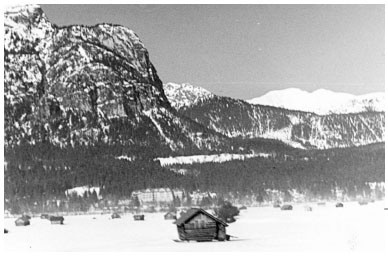
A photograph taken from the window of the train as it passed through the mountainous areas of Austria. Note that it appears that the snow is still thick on the ground, indicating that this is a high region of Austria early in the journey into the Balkans.
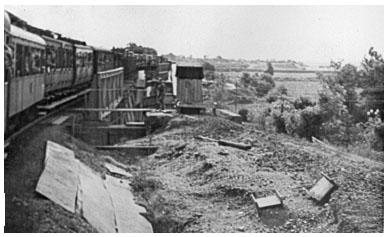
The troop train moves slowly across a railway bridge, possibly in Bulgaria or Romania. The Germans would have to shift their entire parachute army to airfields in Greece and supporting aircraft to the Italian-held Dodecanese Islands. A German army division had actually been trained for air landings, but it could not be included in the invasion of Crete, as it was needed to guard the Romanian oilfields. As a result, this division’s role was taken by the 5th Mountain Division. They had no practical experience of airborne work. This massive troop movement was as a result a compromise; 15,000 combat troops would either be brought in by glider or parachute onto the island and 7,,000 more would be brought in by a ragtag collection of vessels.
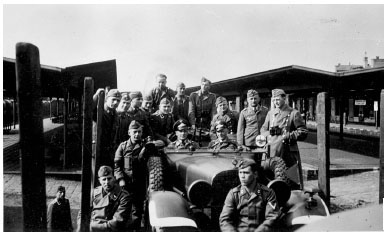
This is a posed shot of Fallschirmjäger around a command vehicle. The men are wearing their field blouse uniforms, which were shorter than normal service tunics and popular with the Fallschirmjäger. The men are wearing standard field caps, or feldmütze (M40). There is a mix of ranks shown in the photograph; the single wing on the epaulette signifies a jäger, or private, two wings shows a gefreiter and three indicate an obergefreiter. A gefreiter was effectively a lance corporal and an obergefreiter was the equivalent of a senior lance corporal.
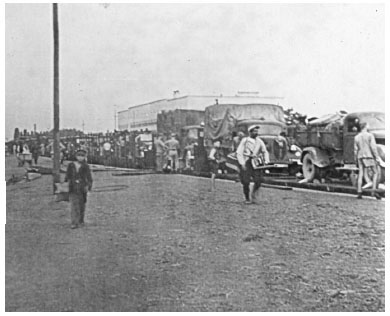
This is a broader view of the German troop train, either in Bulgaria or Romania. Note the flat cars with the trucks and to the rear of these it is possible to see see smaller trucks and transports. The Germans encountered many obstacles as soon as they crossed the Greek border. The Greeks and the British had demolished sections of roads and bridges. Some of the craters along defiles were 100 feet in diameter. The Germans had swiftly extracted as many troops as possible out of Greece due to their impending invasion of Russia. This had actually been done before many of the Greek forces were completely disarmed and the area pacified.
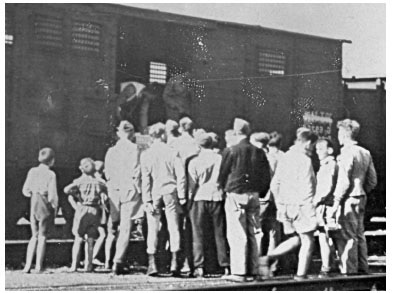
Here we see the handing out of rations to the men and hopeful Bulgarian civilians. Tsar Boris of Bulgaria is quoted as having said ‘My army is pro-German, my wife is Italian, my people are pro-Russian. I am the only pro-Bulgarian in the country’. Bulgaria was a small state trying to pursue its own self-interests. Bulgaria was to find itself in an impossible position as the war ended, as she had found herself simultaneously at war with Great Britain, Gerermany, Russia and the United States.
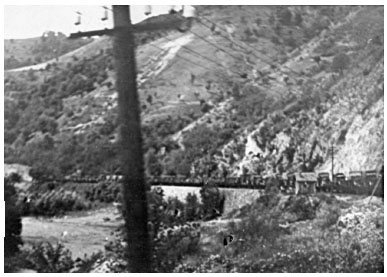
This dramatic photograph shows an extensive troop train carrying masses of trucks and other vehicles making its way through a valley. At this stage of the war the Germans would have had little to fear from partisans and enemy aircraft attacks. Hence, looking in detail at this photograph, it is difficult to see whether any anti-aircraft defences are in position. As the war drew on, armoured trains with twelve to eighteen railroad cars and an armoured locomotive with a coal tender would have been used. It would also have been protected by anti-aircraft guns and groups of soldiers would have been assigned to each train to carry out reconnaissance and to pursue any attackers. The Germans had used armoured trains in the war in Yugoslavia. They had already acquired several of these trains from Austria, Czechoslovakia and Poland.
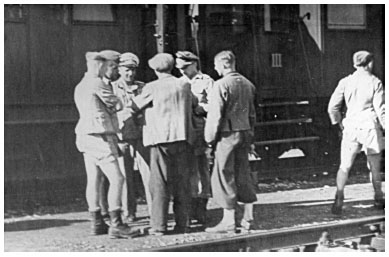
A group of officers and men are chatting to a railroad worker. The 7th Flieger Division had left its barracks in Germany under heavy security. They were not told their destination but were instructed to remove all of their insignia and to travel as if they were ordinary Luftwaffe personnel. All of their parachute equipment was to be hidden away. An order by Hauptmann Shulz to Plieschens Fallschirmjäger MG Battalion 7 stated:
No member of the battalion is to carry any personal papers or documents with him. Buying and sending postcards as well as using the civilian postal service is strictly forbidden. It is forbidden to sing Fallschirmjäger songs. Railway coaches as well as vehicles must bear no identification marks. The special markings identifying our battalion must disappear from all vehicles.
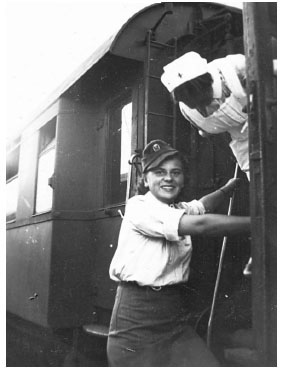
This is a female nurse and a woman from the Luftwaffe on the train. The vast majority of the 1,500-mile journey all the way to Athens was completed by rail, on board slow-moving troop trains. The divisions 3,000 vehicles were offloaded in Romania and driven the remaining 500 miles. The troops began arriving between 8 and 12 May 1941. Despite all of the Germans’ efforts to keep the troop movement a secret the British, in Egypt and on Crete, had been made aware of the situation within thirty-six hours, due to the cracked Enigma codes.
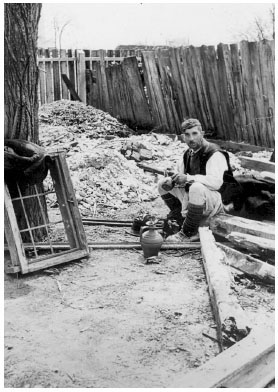
This civilian appears to be a Greek peasant in traditional costume, or possibly a shepherd. As the Fallschirmjäger pressed south they passed German tank regiments on their way back north. The soldiers that they saw were burned brown by the sun and could not help taunting the Luftwaffe men that the fighting was over and they had missed out.
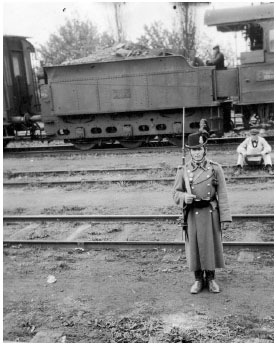
As this border guard is still armed, we must assume that he is Romanian. This area of the Balkans saw enormous troop movements in the spring of 1941. German troops that had been involved in the Greek campaign were moving en masse to the north to assemble for the intended invasion of Russia. Other second-line troops were arriving as part of the occupation force. The Fallschirmjäger, as far as the people in the Balkans were concerned, were just yet another German unit on the move. As the paratroopers approached Greece, rumour was rife as to the nature of their mission and despite all attempts to prevent gossip and rumours men began to draw their own conclusions.
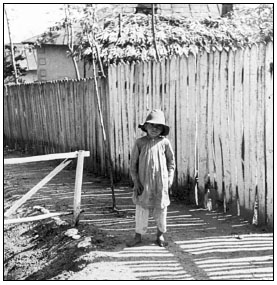
A young, barefoot Greek peasant boy views the German troops with a mixture of fear and fascination. The Greek campaign had been a short and decisive one. The Germanss had launched Operation Marita on 6 April 1941. They had thrust across the Yugoslavian and Bulgarian borders. Initially, they had run into stiff opposition. The main Greek and Allied defensive position, the Metaxas Line, had been fully compromised by 9 April. Thessaloniki had been taken and this led to the collapse of Greek resistance in that region. The Germans had pressed the withdrawing enemy troops, harrying them. The British tried to make a stand at Thermopolis, but this was overcome during the night of 24/25 April and then came the blow that seized the Corinth Canal bridge. The Germans drove, triumphantly, into Athens on 27 April.
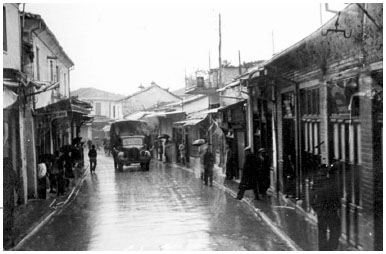
A German truck makes its way along a road in Athens. When the Germans entered Athens on 27 April 1941 the streets were virtually empty. The government had fled for Crete. The streets had been subjected to enemy aircraft attack and many of the Athenians stubbornly shut up their homes and remained inside. The Germans hoisted their flag on the Acropolis and installed a puppet prime minister, the former General Georgios Tsolakoglou.
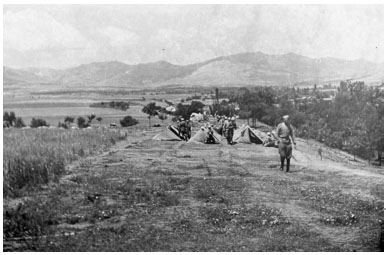
A Fallschirmjäger camp in Greece is shown here. One of the commanders of an air training battalion, Baron von der Heydte, said of the parachutists:
I like the adventurers best. They jumped easily into life and they found it worth living for, whatever it brought along, provided it did not become monotonous. Their heads were filled with nonsensical pranks but also with good ideas. You could go horse stealing with them, but you could also take them on any patrol. They were born parachutists. Many of them had committed some offence, only to become honest with us. Others had run away from home solely to prove themselves men.
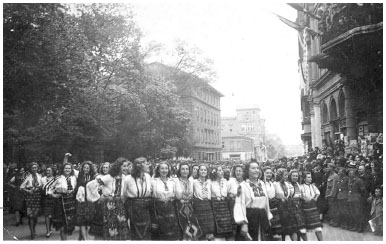
This shows a celebratory parade. The women are probably Romanian, or Bulgarian. A large number of German military personnel are in the crowds. Bulgaria had tried to stay neutral, but it had much to gain by aligning itself with the Germans, as it was promised a port onto the Aegean Sea. Their alignment with Germany brought short-term benefits in the shape of the occupation of Thrace and Macedonia. This photograph may well have been taken in Macedonia, which had endured from their perspective a long period of domination from Belgrade. In Thrace the Bulgarians were somewhat ruthless in trying to eject resident Greeks, leading to an uprising in September 1941, which was violently suppressed.
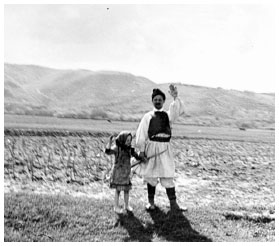
This shows a Bulgarian peasant farmer and his daughter waving at passing German troops. The Bulgarians’ elation with regard to the acquisition of new territories was short-lived, particularly after the Germans attacked Russia in Junee 1941, when there were Communist demonstrations. Bulgaria had signed a treaty with the Germans in March 1941, allowing them to use their naval facilities, airbases and railway lines.

The Fallschirmjäger unit takes a train break. Note the absence of Fallschirmjäger insignia, as ordered by Schulz. Whilst the troops were moving south German planners were feverishly working on getting all the necessary stores, equipment, aircraft and fuel into position. The Corinth Canal was blocked by the wreckage of the bridge and it was not open until 17 May 1941, after German naval divers had removed a sufficient amount of the wreckage for vessels to get through.
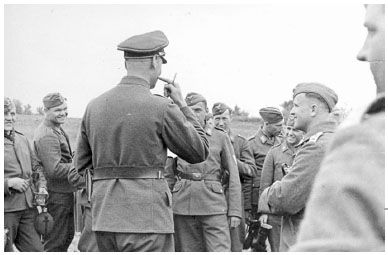
Most of the Fallschirmjäger’s uniform was standard Luftwaffe. In this picture we can see that the men wear a mixture of the tapered waist flying servicrvice blouse and the four-pocketed service tunic. All of the men have a holstered sidearm.
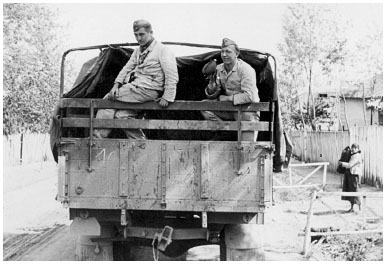
Two men from the unit in fatigue dress, sitting on the back of a German truck as it passes through a village. For some of the men the trip through the Balkans was not entirely by train, as many had to accompany the transports. Note that even the chalk numbers on the back of the truck have been rubbed off in an attempt to prevent any form of identification of the unit.

These are men from a motorcycle reconnaissance unit, or Aufklarung. During the Crete operation 95 Aufklarung Battalion was a part of the 5th Gebirgsjäger Division and designated as air landing reserves.
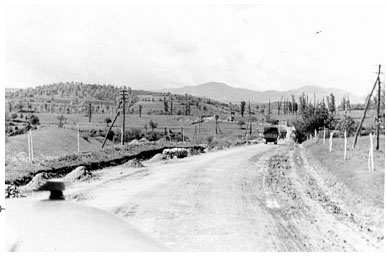
These trucks are moving through the Greek countryside. As farr as the Germans were concerned the Greeks were a friendly nation and their civilisation was admired. Many of the Greeks did not cooperate with the German occupation force, but most chose passive acceptance. Large numbers of people fled into the countryside, where a thriving and effective partisan movement was set up. It is significant to see this unprotected German truck convoy moving along a road and therefore it must be very shortly after the Greek capitulation.
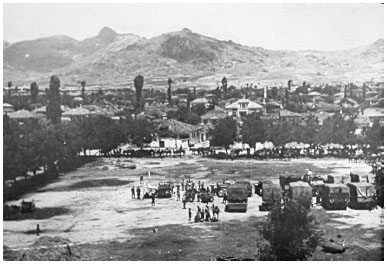
These are the truck born elements of the Fallschirmjäger units, whilst taking a break on waste ground in a Greek town. Note that in the tree line in the shade are large numbers of horses. In fact, until the very end of the war many German artillery units were still horse-drawn. In this early Blitzkrieg period German reconnaissance units would also be mounted.
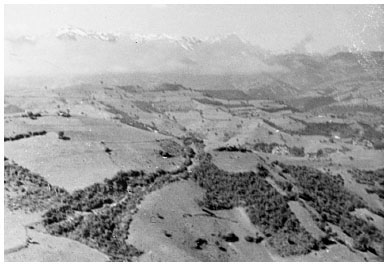
An aerial view, presumably of the Greek mainland; note the mountains in the distance. This would give the Fallschirmjäger a taste of the kind of countryside in which they would be expected to fight in Crete. Beyond the plains on the coastline the hillsides are steep and cut with gulleys and dry water beds and rise into rocky terrain and then high mountains.
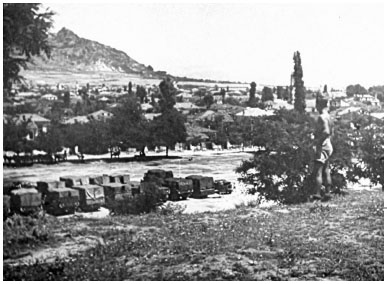
Another view of the lorry park in Greece. In terms of German planning, everything that the men would need would be parachuted down with them and heavier equipment would be brought in by aircraft once one of the airfields had been secured. Theoretically, a full German Fallschirmjäger battalion would have twice the fire power of a standard British infantry battalion. This meant shipping rifles, machine guns, mortars, grenades, light field guns and of course all of the ammunition that they would need. In addition, water containers, food and mededical stores would also be parachuted in.

Here the Fallschirmjäger is taking a last break on the road, as they head towards the airfields in the south of the Greek mainland. Each of the parachute battalions had 550 men organised into four companies. A brigade group could be as many as 2,000 men. Each of the battalions of the storm regiments was 600 strong; these were the air landing troops. The battalion would need seventy gliders. The paratroopers, in their Ju52s, would be dropped in groups of twelve. They would need to carry enough rations of bread and chocolate, along with thirst-quenching tablets, cooking utensils, a blanket and a small water bottle, to last them for two days.
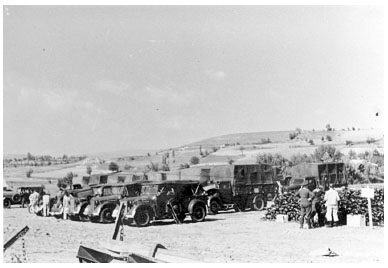
Here we see a close-up of some of the battalion transports. The smaller vehicles in the front are Horch field cars. These vehicles had V8 enginnes and were designed to carry six to eight passengers. They were extremely flexible vehicles and had been developed during the 1930s and continued in production until 1942, by which time over 10,000 had been made.
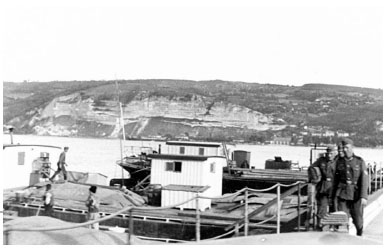
This may be one of the Greek ports, although it does not appear to be the main harbour near Athens, Piraeus. A key part of the operation against Crete would be to transport all of the heavy equipment, along with the bulk of the mountain division and some Fallschirmjäger for which there was no room on aircraft. This meant that the Germans had to scrape together whatever vessels fell into their hands. Many of them were simple fishing boats and others little more than barges. The Germans were acutely aware of the fact that the Royal Navy still retained a potent force in the eastern Mediterranean. The Germans, even with Italian naval support, lacked the necessary protection for these vulnerable convoys. As the Germans would discover, the Royal Navy was able and willing to interdict and would wreak havoc amongst the German reinforcements.
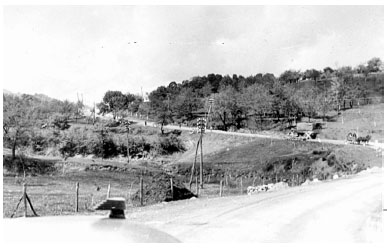
The German trucks are approaching their final destination. Note the countryside, which is very similar to the terrain that the Germans would encounter on Crete. The roads are poor and follow the hill lines. The area is dotted with olive groves, dry water courses and scrubland. As the Germans would also discover, the communication infrastructure on the island was even worse than that on the mainland.
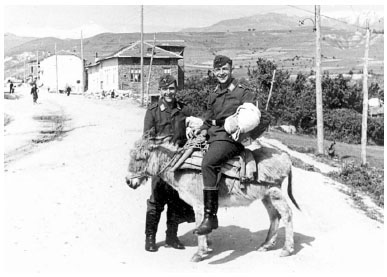
This appears to be Plieschen astride a donkey in Greece. This hardy creature would prove to be invaluable for both the Germans and the Allies during the battle for Crete. Motor transport was in short supply and in any case the roads were so poor in places that only donkeys could bring up ammunition and food to the most inaccessible positions.
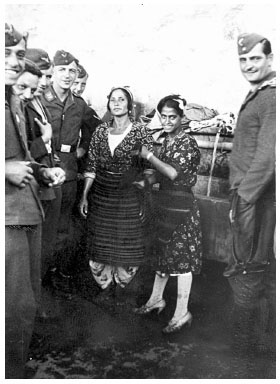
Two Romanian gypsy peddlers are seen here posing with the men on the journey down to Athens.
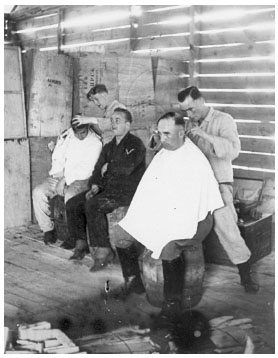
An impromptu barber’s shop has been set up in this photograph. The soldier in the centre is a private. None of the men appear to be wearing their jump boots and they have on their fatigue uniforms. This photograph may well have been taken hours before the assault on Crete was launched.
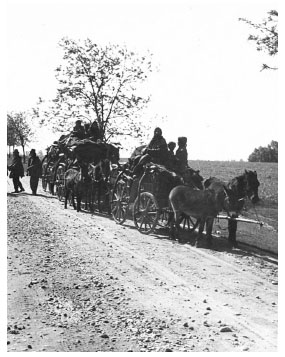
These civilian refugees are probably gypsies. Greek gypsies are also known as tsiganes and are considered to be a distinct ethnic minority; for centuries they were nomadic. Ultimately, many of them would share the same fate as the Jewish population of Greece.
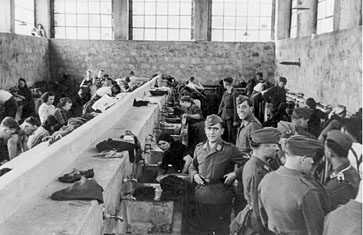
This appears to be a Greek public baths or wash house. Here the Fallschirmjäger are either washing their own clothes or paying local Greek women to do it for them. Note that even though the men are now on the Greek mainland they can only be identified as Luftwaffe personnel and not as Fallschirmjäger.
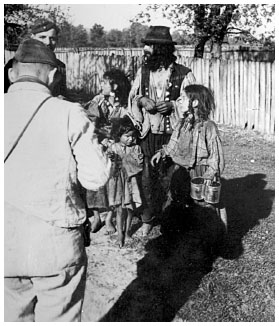
This is a Romany gypsy family. It is not clear exactly how many Romany gypsies were living in Greece in 1941, but like the Jews of Greece they were soon to find themselves in a perilous situation. Many of those in the German-controlled zones were deported. The Bulgarians were equally as fastidious, however the Italians showed little interest and it was not until after 1943, when the Germans took over the Italian occupation areas, that gypsies and Jews in these parts of Greece fell victim to the deportations and exterminations.

The Fallschirmjäger are standing amongst the remains of the Acropolis, in the centre of Athens. When the Germans had entered Athens on 27 April 1941 one of the soldiers guarding the Greek flag flying over the Acropolis was told to remove it. He obeyed, wrapped the flag around himself and then threw himself from the walls of the fortress to his death, rather than let the flag fall into enemy hands. This was just the first act of defiance in Athens. Over a month later two eighteen-year-olds, Manolis Glezos and Apostolis Santas, tore down the German flag that was flying over the Acropolis.
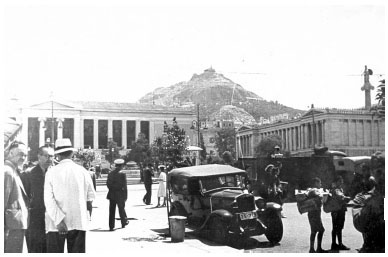
This is Syntagma Square in Athens. The ornate building on the right is the Greek parliament. On the skyline to the left is the statue of Athena, over the Hellenic Academy. In the first winter of occupation around 100,000 Greeks died of starvation. Cities such as Athens were parrticularly badly hit. The bulk of the food was collected and sent to German and Italian troops in North Africa. In Athens people died at such a rate that traditional Orthodox burials were abandoned.
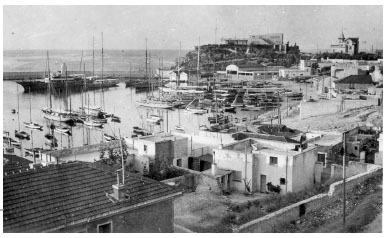
Piraeus harbour, which had been one of the principal ports in which the remnants of the Greek army and the British and Commonwealth troops had used as an evacuation port. Piraeus had been heavily bombed and on 6 April 1941 a munitions ship had been hit. The Germans used Piraeus as one of their major embarkation ports. The convoy carrying the lead elements of the 5th Mountain Division left the harbour on 19 May 1941 and from there it sailed to the island of Milos, arriving there the following day. The convoy left Milos the same evening, just as a second convoy left Piraeus. The first convoy was located by the Royal Navy and despite the presence of an Italian destroyer the bulk of the convoy was destroyed. In effect, the 3rd Battalion of the 100th Mountain Regiment ceased to exist.
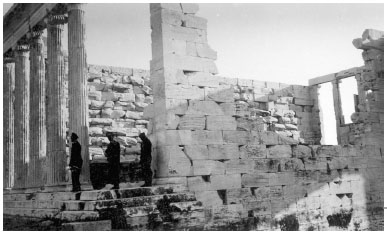
Another shot of the Acropolis in Athens, taken in May 1941. Over the centuries the Acropolis has been the victim of several disasters. The most catastrophic was during the Ottoman occupation of Greece. The Parthenon itself was used as a Turkish garrison headquarters and ammunition dump. It suffered enormous damage during the siege of Athens by the Venetians in 1687.
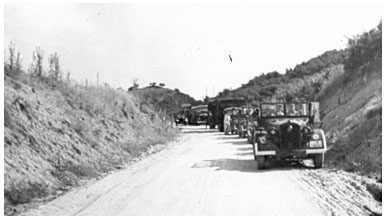
The column makes one final rest stop before arriving for the embarkation ports and airfields in the south of the Greek mainland. Soon the men would be told about the operation and the following is the official brief given to the men regarding the island of Crete:
The island of Crete is approximately 240 km [160 miles] long and varies in width from 12 to 50 km [8 to 35 miles]. The interior is barren and covered by eroded mountains which, in the western part, rise to an elevation of 2,456 m [8,100 ft]. There are few roads and water is scarce. The south coast descends abruptly towards the sea; the only usable port along this part of the coast is the small harbour of Sthion [Hora Sfakion]. There are hardly any north south communications and the only road to Sfhakia [Sfakia] which can be used for motor transportation ends abruptly 1,100 m [3600 ft] above the town. The sole major traffic artery runs close to the north coast and connects Souda Bay with the towns of Maleme, Hania [Chania], Rethymno and Iraklio [Heraklion]. Possession of the north coast is vital for an invader approaching from Greece, if only because of terrain conditions. The British, whose supply bases were situated in Egypt, were greatly handicapped by the fact that the only efficient port is in Souda Bay. The topography of the island, therefore, favoured the invader, particularly since the mountainous terrain left no other alternative to the British but to construct their airfields close to the exposed north coast.

A last chance for a little rest and relaxation before the orders are received for the men to prepare themselves for immediate airlift to Crete. Plieschen’s machine gun company would parachute into the area around Rethymno on 20 May 1941. His company would be part of the first and only wave in that region.