
On a summer afternoon many years ago I sat outside the Gondrée Café in the shadow of the original Pegasus Bridge. Having grown up on a diet of Airfix kits and Commando comics, it was a dream come true to be seeing where the actual events of D-Day unfolded. In those days the café was not as busy as it is now, and two old men sat with me, my only companions. One was my father, a veteran of the Italian campaign who had been good enough to bring me here, the other was a mystery. We sat for a while looking at him; there was something strangely familiar about the face. Seeing he was of a similar age my father asked him if he had served in the war; he confirmed he had. My father asked where. Here, he replied. My father explained that he thought he was a Normandy veteran but he had meant to elicit a response a little more specific than ‘here’. He rose from his chair and walked over to us, his hand outstretched. ‘I did mean here. Let me introduce myself . . . Major John Howard.’
And so began my passion for Normandy. I returned for both the fortieth and fiftieth anniversaries, and often in between, but as the 1970s crept into the 1980s and 1990s my fascination for the Second World War waned a little as I became more and more engrossed in an earlier conflict – the First World War. Living in France for a decade rekindled the interest and led to many family holidays exploring Normandy in the same way I had learned to ‘read’ a battlefield on the Somme and in Flanders, an invaluable schooling as it has proved.
And so this book. I had mistakenly believed that everything was known about the Second World War and that visitors were swamped with guidebooks. Then I realised, as I had done with the Somme two decades before, that there was no clear lead in walking the ground and that the War Diaries in The National Archives sat covered in dust, largely untouched. There was, after all, a tale to tell and a way to tell it.
While the fighting in Normandy was essentially a mobile war, it was still a conflict in which the ‘Poor Bloody Infantry’ marched into battle and saw the ground on their feet. And as such, and in many respects this is true of any battlefield, the best way to see it was, and is, to walk it. I can only hope the reader gets as much pleasure in seeing the D-Day coastline as I did in the research for this book, and takes time to remember those who paid the ultimate price to secure a foothold on that fateful day in 1944.
Paul Reed
Kent and Calvados
January 2012

Men of 101st Airborne receiving directions from a military policeman.
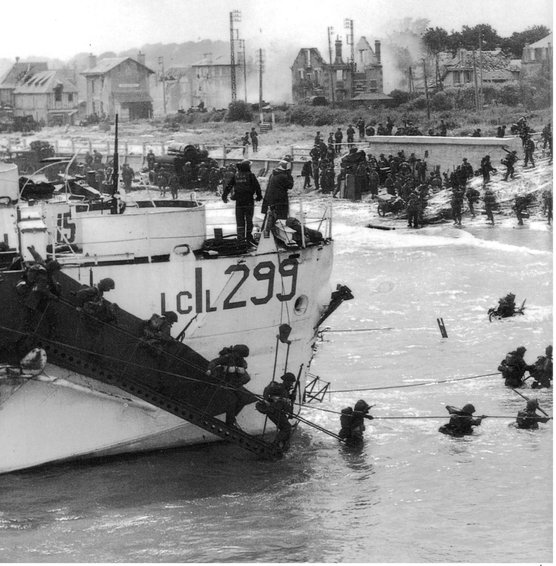
Canadians landing at Bernières-sur-Mer.

ABBREVIATIONS/GLOSSARY
AVRE Armoured Vehicle Royal Engineers; this was a specialist piece tank used by 79th (Armoured) Division on D-Day. The majority were Churchill tanks
BAR Browning Automatic Rifle
Bn Battalion
Bren Light machine gun found in every infantry section
C47 The Dakota aircraft used to drop British and American airborne troops on D-Day
CSM Company Sergeant Major
DD Duplex Drive, Sherman tanks adapted to be able to swim ashore
DUKW An amphibious six-wheeled truck used to ship supplies and men to the beaches. Also known as the ‘Duck’
DZ Drop Zone
Flail Sherman tank with a drum and chain device fitted to the front so it could clear paths in minefields
Funny Generic name for the adapted tanks used by 79th (Armoured) Division on D-Day
H-Hour The time an operation begins
HE High Explosive
KSLI King’s Shropshire Light Infantry
LCA Landing Craft Assault
LCI Landing Craft Infantry
LCM Landing Craft Mechanised
LCT Landing Craft Tank.
LCT(R) Landing Craft Tank (Rocket)
LCVP Landing Craft, Vehicle, Personnel
LMG Light Machine Gun
LST Landing Ship Tank
LZ Landing Zone
MG34 German machine gun
MG42 German machine gun capable of firing up to 1,500 rounds per minute
OP Observation Post
PFC Private First Class
PIAT Projectile Infantry Anti-Tank; spring-fired anti-tank weapon used by British and Commonwealth troops
PIR Parachute Infantry Regiment
PVT Private (US Army)
RCT Regimental Combat Team
RV Rendez-Vous Point
SP Self-Propelled
WN Widerstandsnest, the German name for a defensive structure such as a pillbox or bunker
