
Above all, Fascism, in so far as it considers and observes the future and the development of humanity quite apart from the political considerations of the moment, believes neither in the possibility nor in the utility of perpetual peace. It thus repudiates the doctrine of Pacifism - born of a renunciation of the struggle and an act of cowardice in the face of sacrifice. War alone brings up to their highest tension all human energies and puts the stamp of nobility upon the peoples who have the courage to meet it. All other trials are substitutes, which never really put a man in front of himself in the alternative of life and death.
Mussolini, Dottrina del fascismo, 1932
As a wartime journalist, editor, newspaper owner and male citizen eligible for military service, Mussolini had a direct interest in military plans, operations and the manner in which the war would be conducted. What was the nature of Italian war doctrine and how did Mussolini relate to it? On 21 August 1914 the Chief of General Staff of the Italian Army, Luigi Cadorna, issued a circular to army commanders entitled Memoria riassuntiva circa una eventuale azione offensiva verso la Monarchia Austro-Ungarica durante I’attuale conflagrazione europea (USSME, 1929: Appendix 1). This war plan foresaw an attack against Austria- Hungary along the ninety kilometres of border stretching from the Julian Alps along the river Isonzo and the Carso down to the sea. A further memo of 1 September 1914 entitled Direttive and another of April 1915 entitled Varianti alle direttive del 1 settembre extended the front of potential offensive warfare to a 600 km arc along the north-central and north-eastern frontier (USSME, 1929: Appendices 2 and 3 respectively). This massive dispersal of forces is incomprehensible when one considers that the Austro-Hungarian Army had recovered from the Russian onslaught of the previous autumn and had sacrificed territory along the Italo-Austrian political border to maximize defensive advantage in mountainous terrain. In his post-war account of his period as commander of Italian forces, Cadorna asked readers to note that the Memoria riassuntiva ‘was written on 21 August, when we had no experience of the European war, when, that is, the war had not yet become immobilized in the trenches of the western front’ (Cadorna, 1921, I: 95). Yet it is evident from the foregoing exposition that the war plan of August 1914 was not subsequently modified to take account of the difficulties of offensive warfare revealed at Ypres in October-November 1914 and during the Franco-British offensives in 1915 at the Noyen Salient, between Rheims and Verdun, and at Neuve Chapelle. Cadorna knew of the defensive predominance of modern firepower on the western front, since his observers on both the German and French sides of the lines had conveyed this information (Rochat, 1961).
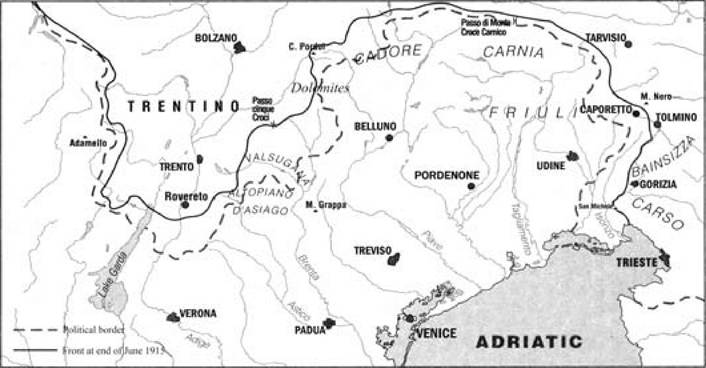
Figure 3.1 Italo-Austrian front June 1915
But Cadorna also made anachronistic tactical miscalculations. In an officer- training circular published on 25 February 1915 he argued that infantry coming face to face with enemy artillery during an assault was to continue moving forward without seeking protection, since in this way losses would be ‘very much lower than those which would occur by hesitating or retreating’. This no doubt explains why the whole of the second part of the circular is dedicated to a detailed exposition of the manner in which the nature of the ground to be crossed, and not enemy or domestic artillery and machine guns, determined the speed of the advance. While Cadorna formally accepted the need to co-ordinate artillery, infantry and machine guns, the circular has no discourse on the division, the army unit in which infantry and artillery were in fact united and co-ordinated. The fact is that Cadorna saw officers’ morale and the bayonet as of greater significance than modern firepower. He insisted that ‘it is indispensable [for the officers] to maintain faith in the offensive’s success and in the efficiency of the bayonet; to infuse this faith in the men and to drag them fearlessly through the zone stormed by enemy projectiles in order to conquer the laurel of victory’ (Cadorna, 1915: 19, 20, 27-8, 31-5, 37-45, 50). In short, soldiers were to duck and dodge enemy shells and machine gun spray as they headed for the real purpose of combat, which was to stab the adversary with a piece of metal attached to the end of the rifle barrel. Like the majority of European commanders Cadorna was off the mark by approximately sixty years. Already in the American Civil War (1861-65) frontal bayonet assaults had shown themselves to be no match for the muzzle-loading rifled musket. Subsequent military developments produced a battlefield dominated by breech-loading rifles, machine guns and above all artillery, both field and heavy, which used high explosive shells. The result was a concentration and destructiveness of firepower that made offensive warfare extremely difficult, large-scale frontal infantry assaults redundant, and hand-to-hand combat a minor feature of war rather than a decisive factor (Howard, 1976: Ch. 6; McNeill, 1983: 190-93). What, then, is the broader significance of Cadorna’s dogmatic insistence on the offensive?
According to Jack Snyder, the training and duties of army commanders can sometimes leave them examining international relations from a narrow military perspective in which war is seen as an inevitable part of life. When suspicion of what others are up to is applied to war planning, the outcome can be a push for preventive war. The consequent offensive war plan allows commanders to structure their armies better by deploying them along pre-established lines of advance. Defence, on the other hand, while certainly more easily organized, allows politicians to enter the fray. Offensive doctrine thus becomes inseparable from the military’s operational autonomy, which in turn is often the reflection of a desire to safeguard institutional interest (Snyder, 1984: Chs 1 and 8). This analysis finds resonance in Cadorna’s doctrine, since he firmly believed that the military should be left free to implement strategic plans without meddling from politicians and government to whom he attributed all Italy’s lost wars, including the disaster of 1866 (Rocca, 1985: Chs 1-3). However, Snyder’s stress on the schism between military and political spheres arguably underplays the possible relation between offensive doctrine, political strategy and ideology. While Clausewitz appears twice in Snyder’s book, the Prussian theoretician’s considerations do not weigh upon his methodological framework. Halfway into writing up his posthumously published (1832) Vom Kriege, Clausewitz reached the conclusion that there could be no purely military dimension to war making and strategy, as in the last analysis politics was the determining factor. Clausewitz also argued that how a society wages war reflects the structure of that society and its core values. This is because interacting social forces impose their logic both on the aims of the war and the intensity with which it is conducted (Clausewitz, 1993: esp. Book 8).
Indeed, Cadorna may have continually assailed politicians, but this was itself from a right-wing political standpoint. In his war memoirs, for example, he quoted the nationalist imperialist Alfredo Rocco on the weakness of the State’s authority (Cadorna, 1921, I: 8, 29). Cadorna claimed that by the turn ofthe century the army was being sneered at by citizens who had too many democratic rights, while the right of the army to shoot on insolent and disrespectful crowds had been diminished. Civilian recruits had brought democratic presuppositions to bear on relations with their superiors, for example, denouncing the latter for mistreatment instead of respecting military discipline whose code was ‘the superior is always right especially when he is wrong’. Like the nationalist far right (but not only), Cadorna pinpointed what he called the ‘Giolittian dictatorship’ as the main root of the evil. He claimed that on taking over the army in July 1914 he found it in a dismal material and psychological state, and he blamed this on the Parliament which in his view was more concerned with the national budget than with what he termed the ‘national interest’ (Cadorna, 1921, I: 4-33). However, statements such as these only show the degree to which Cadorna’s military thinking was propped up by systematic resort to undocumented anti-popular accusations, blatant falsity, denial of objective information and methodological limitations all imposed by reactionary social and political interests. Between 1900 and 1914 politicians voted 23.7 per cent of the national budget to the armed forces and this does not include the thousand million lire for the Libyan war. Under the ‘Giolittian dictatorship’ the army received more money than ever: between 1913 and 1914, when Italy was in the throes of a grave economic crisis, Giolitti handed over 502 million lire against the 284 million the army had received between 1899 and 1900. The Italian Army in 1914 was a well-armed, well-manned and extremely well-financed fighting machine, and could spend its money as it saw fit. Its ‘difficulties’ were due to the fact that it was an overstretched instrument of external expansion and internal repression (Rochat, 1991: Ch. 4).
If the content of Cadorna’s 1915 training booklet finds resonance in Snyder’s understanding of the offensive cult as deriving from the military’s push for operational and institutional autonomy, it is equally true that the self-rule enjoyed by the Italian Army was the expression of a tactical price paid by the ruling conservative elites in order to guarantee their alliance with the military in defence of common class privileges. In exchange, the army invariably supported the conservative and nationalist right (Rochat, 1991: Ch. 1). Cadorna’s doctrine of the offensive can therefore be defined as a militarist ideology. By this is meant that it emphasized the necessity of hierarchy and subordination, physical courage and blind obedience as social values in a situation where war was deemed a natural part of human existence, and where long lists of dead soldiers (the inevitable outcome of men exposed to well-placed machine guns and light field and mountain artillery) were considered as indicators of national determination and the right to Great Power status (Howard, 1976: 212; 1992: 225). A recent reassessment of the meaning of the ‘Cult of the Offensive’ before the First World War concludes in favour of the need for commanders to rhetorically emphasize human will over technology in order to raise it to a level where it might be comparable to material factors (Echevarria II, 2002). The argument is unconvincing, and anyway is certainly not applicable to the Italian case. The ultimate scope of Cadorna’s military ideas cannot be divorced from the strategy of Italian monopoly capitalists and their agrarian and political allies to use Italian intervention in the war for purposes of territorial aggrandizement and internal anti-democratic reaction.
Even before Italian intervention, Mussolini displayed some interest in the military conduct of an eventual armed conflict. On 24 January 1915 he declared: ‘I believe if it comes to war the greatest freedom should be given to the General Staff. Lawyers who practice politics will have to keep quiet, as all wars in which there is rivalry between the political and military authorities are lost’ (OO, VII: 142-8). On 14 February he insisted on the need for an unremitting offensive, suggesting that when politicians and diplomats kept out of military affairs ‘soldiers . . . stop only when they have reduced the enemy to impotence’ (OO, VII: 196-8). The Cadorna line was here repeated almost verbatim. And like Cadorna, Mussolini made a fetish of the bayonet. On 29 April he wrote that ‘the formidable mallet of Italy’s one and a half million bayonets’ would ‘beat without truce and without pity’ until the mortal blow had been delivered to Germany (OO, VII: 356-8). Following D’Annunzio’s speech at Quarto, Mussolini warned the government to leave aside its diplomatic manoeuvres and ‘entrust the lot of Italy to the bayonets of its soldiers’ (OO, VII: 366). When Salandra had been reinstated on 16 May Mussolini could inform the ‘Italian bayonets’ that ‘the destiny of the peoples of Europe is, together with that of Italy, entrusted to your steel’ (OO, VII: 396-7).
What of other weapons? In his polemic with Mussolini in October 1914 (see Chapter 2) Libero Tancredi pointed out that the editor of Avanti! had said privately that the Italian ’91 rifle was a good weapon, a point which Mussolini confirmed in his reply. Like the French Lebel and the German Mauser, the Italian ’91 breechloaders could fire up to twenty rounds a minute at a distance of up to 3 km. In short, these rifles were just one of the many reasons weighing against the frontal bayonet assault. In his November 1914 polemic against the steel monopolists Mussolini noted a shortcoming in the supply of the Deport cannon (OO, VII: 29-31), a French light field model produced under licence in Italy. He did this, however, without specifying the weapon’s calibre, which in this case was 75 mm. No other references to this or any other light field cannon can be found in Mussolini’s writings or speeches before his departure for the front in September 1915. All we find, rather, are some fleeting references to a German mortar. On 1 December 1914 he furnished readers with the name and address of Emilio Kerbs, a German journalist who had supplied information to the Wolff’sches Telegraphen- Bureau (the semi-official German news agency) regarding the financing of IL Popolo d’ltalia by the French. Mussolini justified his intimidating act by claiming that ‘it is as well in these days . . . of the 42 [cm] mortar to know the exact address of the Prussians’ (OO, VII: 62-3). In his speech of 13 December he argued in favour of the historical relativity of firepower by noting that ‘the war machines of the ancient Romans are the ancient equivalent of the present day 42 [cm] mortars’ (OO, VII: 76-81). We must wait almost five months before being reminded once again that during its invasion of Belgium and France the German Army had banked on ‘the efficiency of the famous, but not for that reason less hypothetical “420” [mm] mortars’ (OO, VII: 367-9).
It is evident that Mussolini’s reference to the 42 cm mortar was in the form of a jingoistic catchphrase, and was not based on any real knowledge of the piece. The mortar in question was without doubt the Krupp 420 mm heavy howitzer, more commonly known as Big Bertha, used to devastating effect in the German assault on the fortresses of Liege in August 1914. The point, at any rate, is that precisely because it was a very important and powerful siege weapon Big Bertha was not the first concern of soldiers attacking enemy trenches. These were far more likely to be killed by the cross-spray of machine guns (about which Mussolini said or wrote nothing), or the bombardment of light field artillery such as the 75 mm (which Mussolini discussed only algebraically and arguably not at all), or by the enemy equivalent of the Italian ’91 rifle (a weapon which Mussolini appreciated but whose contemporary significance he clearly did not understand). Thus with no serious knowledge of developments in military technology, Mussolini largely supported the basic approach of Cadorna to the organization and conduct of warfare, namely military autonomy from political control and unbridled offensive warfare as corollaries of a right-wing nationalist programme of external expansion and internal anti-democratic reaction. How did he address the outcome of Cadorna’s opening offensive and subsequent manoeuvres before his own call up in late August 1915? And what impact did these operations have on his understanding of modern war?