
Austria-Hungary managed to contain the Italian offensives in 1915 while rolling back the Russians in Galicia and eventually defeating Serbia. Yet although armaments were produced in good numbers, food supplies were strained, and it became apparent to Chief of Staff Franz Graf Conrad von Hotzendorf that a negotiated peace on favourable terms was the most desirable outcome. The best chance for achieving this was, in his view, an attack on the Italian front. Concentrating on the Trentino, he hoped to break out onto the plains, cut off Italian forces on the Isonzo, and force Italy to surrender. His personal detestation of Italy, which had intensified following what he saw as its treacherous breaching of the Triple Alliance, underwrote his intention to attack there rather than in Russia, and accounts for the unofficial name given to the May 1916 offensive - Strafexpedition, that is punitive expedition.
At least twenty divisions were required to overrun the Italian lines, and German help was therefore needed. However, German Chief of Staff Erich von Falkenhayn reminded Conrad that Germany was not at war with Italy and informed him that he was in any case planning to attack at Verdun. Conrad had to go it alone with between twelve and fourteen divisions. He aimed to unleash a strong diversionary attack on the left in Val Sugana while saving the real offensive for the centre starting from the Folgaria and Vezzena-Luserna plateaus and driving through the Val d’Astico. His intention to begin operations in the third week in March was undermined by the longevity of preparations and by late snow, and the date was therefore moved to mid-May. It was now decided to prepare the ground for the central thrust by increasing the power of the offensive in Val Sugana and by unleashing another massive offensive against the Italian left wing in Val Terragnolo. Two armies, the 11th and the 3rd, were to take part in the offensive. The latter was, in the main, to stay in the background and come up the rear after the XX corps of the 11th Army had broken through onto the plain. Once the transfer of artillery had been completed the 11th Army had 584 small, 174 medium and 58 high calibre pieces in the main theatre, while the 3rd Army had 106 small, 12 medium and 2 high calibre pieces. In the same period the Italian 1st Army, stationed in the area of the imminent attack, had 617 pieces of artillery, many of which were old or overused. The Austro-Hungarians had 300,000 men against Italy’s 200,000.
In mid-March Roberto Brusati, commander of the 1st Army, became aware of the danger and on 22 March, while Cadorna was in London for the inter-allied conference (20 March-1 April), sent news to Command Headquarters at Udine of the ‘almost certain’ attack. He requested more men and materials, and the number of battalions at his disposal subsequently rose from 135 to 199. But sixty-nine of these were stationed between the Stelvio and Lake Garda and hence not in the main offensive’s trajectory. As for Cadorna, he was not unduly alarmed by the news. He was planning yet another offensive against Gorizia and saw the Austro- Hungarian build-up as little more than an attempt to divert Italian attention from the Isonzo. He believed that Germany would not enter the war and that the attack could not go ahead with the forces available to Conrad. He knew of Russian preparations for a summer offensive and was further convinced that the two railway lines linking the Trentino with the rest of Austria-Hungary would be insufficient for the transportation of men and materials to the area of attack.
He was mistaken. Cadorna assessed the enemy’s intentions by relying too much on Italy’s own experiences on the Carso. There, offensives had been clearly limited and Italy had dragged the 149 mm cannons using oxen. In the opening phases of the war, however, Germany had shown the effectiveness of motor traction for the transportation of powerful heavy artillery such as Big Bertha. Cadorna also wrongly assumed that Conrad was privy to his own information about a Russian offensive. Much of this miscalculation was due to the fact that for fear of creating possible successors he had no army group commanders (Trentino-Cadore and Isonzo). He relied instead on a small, insufficiently informed and unauthoritative secretariat headed by Colonel Roberto Bencivenga. A fatal upshot of this bureaucratic centralization was that not only did Cadorna dismiss Brusati’s warnings about the enemy build-up, but he was also unaware of the potential disaster inherent in Brusati’s dangerous glory hunting and congruent appetite for offensive warfare. Brusati interpreted flexibly Cadorna’s 1915 orders to the 1st Army which specified a defensive strategy while allowing limited tactical offensives. He turned permission to rectify the border along tactical lines into an attempt to alter it radically in Val Sugana and Val Lagarina, to come within a stone’s throw of Trento and to eliminate the Austro-Hungarian strongholds on the Folgaria and Lavarone plateaus. He had therefore maintained his men in advanced positions which guaranteed neither solid resistance nor adequate reserves. In the area where the main Austro- Hungarian attack was to come (Val Terragnolo-Altopiano di Tonezza-Altopiano dei Sette Comuni), Brusati had fifty-eight battalions in the front line and only fourteen in reserve, none of which were between Terragnolo and Tonezza. By 29 April Cadorna was concerned enough to visit the area for the first time since the previous September. He discovered that solely the front line was adequately defended; the second only held at certain points, while work on the third was in its early phases. The fourth line had been adequately defended only on Cima Portule, even though it was the last line of resistance before the enemy reached the plain. But by now it was the beginning of May. The main defence was going to be made on the front lines and with virtually nowhere to run. For his negligence Brusati was sacked on 8 May and replaced by General Guglielmo Pecori Giraldi.
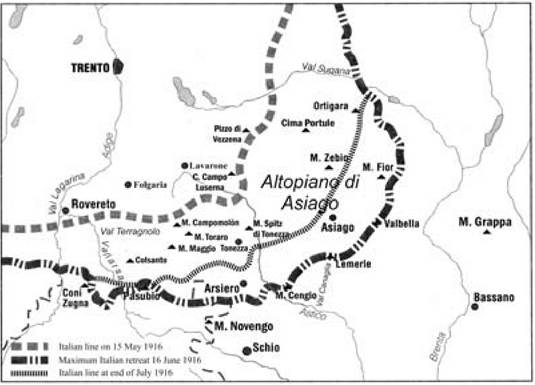
Figure 4.1 Strafexpedition May 1916
When the attack came on 15 May the Italian front line between Vallarsa and Val d’Astico was crushed by the 11th Army’s heavy artillery. The invading forces quickly achieved notable successes in Val Terragnolo and on the Altopiano di Tonezza. Between 15 and 20 May Colsanto, Mount Maggio, Mount Toraro, Mount Campomolon and Mount Spitz di Tonezza all fell into Austro-Hungarian hands. On 20 May the Austrians threw the 3rd Army into the fray on the Altopiano dei Sette Comuni. Conrad’s men occupied Arsiero on 27 May and Asiago on 28. By early June the invaders had penetrated up to 20 km in a line ranging from Val Sugana in the north to the Altopiano dei Sette Comuni (also known as the Altopiano di Asiago) in the centre and, in the south-west, to Val d’Astico, Vallarsa and Val Lagarina. However, at this point the three main Austro-Hungarian commanders differed as to how best to proceed with the offensive, and back-up forces were not numerous. These were symptoms of an attack that was running out of steam. For his part, Cadorna had been working wonders with reserves since 20 May. In the space of two weeks he managed to regroup 179,000 men, mostly from the Isonzo. This was enough for five army corps which made up the new 5th Army.
Italy’s numerical superiority became decisive. Conrad’s latest offensive in the centre everywhere confronted Italian forces defending the last line before the plain. This situation allowed Cadorna to plan a counter-attack against an unsuspecting enemy on the Altopiano dei Sette Comuni. On 1 June he learnt of the Russian offensive to be unleashed on 4 June, and on 2 June announced that the Austro-Hungarian offensive had been successfully held off. As a matter of fact, the situation was still critical. On 3 June Mount Cengio fell and the grenadiers defending it were forced to retreat to the bottom of Val Canaglia, one stop from the plain. But for fear of Italian counter-attacks the Austro-Hungarians did not push the Cengio victory any further. Conrad’s last hope was to conquer Mount Novegno and Mount Lermele but the attack against the former failed between 12 and 13 June, and against the latter on 15 and 16. Cadorna’s 2 June bulletin was therefore optimistic, and was most probably aimed at pre-empting arguments which might see the Russian offensive as the deciding factor in the salvation of Italy. A further Austro-Hungarian offensive in the Val d’Astico was aborted precisely because of Conrad’s decision to send two divisions of reserves to the Russian front. Moreover, the line reached by Italy following its ‘counter-offensive’ between 16 June and 24 July was the one more or less left to it after Conrad’s 16 June decision to call off the Strafexpedition and retreat (beginning 24 June) to a safe line, a manoeuvre once again occasioned by the Russian offensive. Cadorna’s ‘counter-offensive’ only achieved 71,600 casualties in addition to the 76,100 sustained during the enemy offensive. But the invasion had been held off, and Italy was still in the war (Cadorna, 1921, I: Ch. 5; Posani, 1968, I: Chs 11-12; Rocca, 1985: Ch. 7; Pieropan, 1988: Chs 21-22; Herwig, 1997: 204-7; Isnenghi and Rochat, 2000: 176-83; Schindler, 2001: 144-9).