
October 1918. Lightning advance beyond the Piave. Catastrophe of the enemy army. Bulletin of 4 November . . . But is the war over in Italy? Not yet. We need to begin to fight again . . . to defend the rights and above all the spirit of the Victory.
Mussolini, Speech in Parliament, 19 March 1928
The Victory was luminously Italian. Combatants! Already with the battle of June, and by the admission of the enemy himself, the resistance of the Habsburg Empire was crushed; and if it is true that the Allies sent some Divisions, it is equally true that in May 1915 we gave the Allies an entire army.
Mussolini, Speech in Rome, 4 November 1928.
Following the Eleventh Battle of the Isonzo, Austro-Hungarian commanders became convinced that, as men were running short and could not be readily replaced, another Italian offensive in autumn 1917 or spring 1918 could not be contained. On 26 August the Emperor Karl asked Kaiser Wilhelm to replace Austrian troops on the eastern front and allow a strategic counter-attack against Italy between Plezzo and Tolmino, the latter being the only part of the river Isonzo not under Italian control. The Germans approved, but with the stipulation that they were to be involved. They added seven special divisions to the eight Austrian divisions, all of which would form the 14th Austro-German Army (General Otto von Below). Rather than aim at mountain peaks, the key attack was to proceed through the Isonzo valley via Caporetto. This would cut off Italian troops on the Mrzli-Mount Nero chain. Mounts Matajur, Maggiore, Kolovrat and Jeza would likewise be encircled. As a consequence, Mount Globocak would fall, forcing Italian troops stationed on the Bainsizza plateau and in the Carnia to retreat to a new line between Gorizia, Udine and Pordenone. Ideally, too, Italy’s 3rd Army would have to withdraw from its advanced positions on the Carso. In short, the battle plan pointed towards the occupation of the triangle formed by the river Isonzo as it flows from Plezzo to Tolmino via the straits of Saga. Even if the offensive had only achieved these limited aims it would have been an enormous success.
By mid-October Italian troops had been pushed to the point of exhaustion. But this did not deter General Alberto Cavaciocchi, commander of the IV army corps covering Plezzo, from making morale-boosting speeches about the tiredness of the Germans. Capello, who was receiving treatment for nephritis, was completely out of touch with what was happening. Although not convinced that an attack was likely, he planned to confront one with an immediate counter-offensive and boasted about how many German prisoners he would take if the enemy dared try it on. So offensive-minded were Italian commanders, indeed, that Pietro Badoglio, commander of the XXVII corps stationed in the sector of Tolmino, had his troops in advanced offensive positions without reserves. Italy had forty-three divisions on the Isonzo, but only four were in the sector under threat. Three of these, which made up the IV army corps, were guarding the upper sector of the Plezzo-Saga-Tolmino triangle, whereas the trenches at Tolmino were defended only by the 19th division of the XXVII army corps, whose other three divisions were across the water on the Bainsizza plateau. There were no fortified defensive lines behind this stretch of front. For his part, Cadorna, who had just returned from holiday, remained profoundly sceptical about the invasion. Neither did Cavaciocchi and Badoglio alter his optimism: as late as 22 and 23 October they were still supplying their superior with positive assessments of the overall situation.
It was to be a rude awakening. Following heavy artillery bombardment beginning from Tolmino at dawn on 24 October, by 16.00 on the same day the 12th Silesian division was already at Caporetto. The advance from the Plezzo basin was likewise rapid, aided by the deployment of gas. That evening, the whole of the Isonzo triangle, including the mountains overlooking the plain, was under Austro- German control. Yet at 09.15 on 24 October Cadorna informed Capello not to use up too much ammunition, since this would be needed for a spring offensive. Told at eleven o’clock that Plezzo had fallen, Cadorna was not overly concerned. He considered the attack at Tolmino to be ‘a bluff’, and envisaged the transferral of artillery from the 2nd Army to the 3rd to defend against the real attack which he deemed likely to come on the Carso. In the meantime, following the enemy bombardment of 24 October, Badoglio was cut off from his corps. It is thought that once communication lines were cut his over-centralization of control over guns meant that his subordinates were left without orders, and that this explains the ensuing silence of over 500 pieces of Italian artillery. While there was resistance from some Italian units, these were isolated and, where not completely overrun, soon forced to surrender.
In a few days the entire Italian front collapsed. On the night between 26 and 27 October Cadorna ordered a general retreat beyond the river Tagliamento. From the Cadore to the Carso via the Carnia, 750 out of Italy’s 850 battalions were forced to abandon positions conquered in almost two and a half years of fighting.
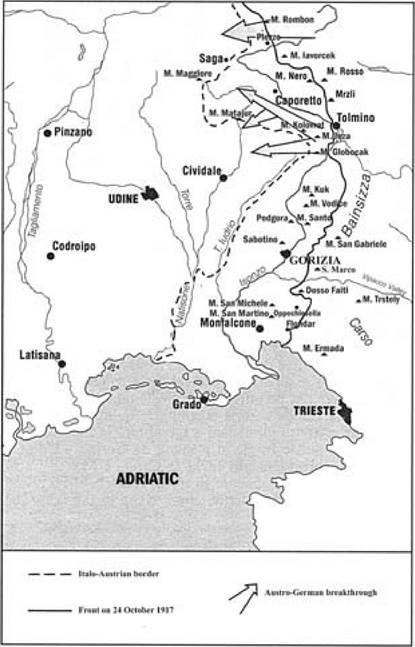
Figure 7.1 Austro-German offensive on Isonzo-Carso front October 1917
Hundreds of thousands of men, many disarmed and without commanders, made their way towards the designated river. The 2nd Army was the most badly hit. When, to its front line divisions of 670,000 men, we add an unspecified number of hospitalized soldiers and units working at the rear in areas such as logistics, airfields and railways, a million routed men is not an unreasonable guesstimate. Moreover, since Italian Army divisions were made up of alternating brigades of infantry and fixed regiments of artillery, there was an enormous loss of guns and ammunition.
Two armies, however, escaped the brunt of the rout. Having lost about 20 per cent of their forces and heavy artillery, about 300,000 men of the 3rd Army on the Carso managed to retreat in reasonably good order as did 230,000 in the Cadore (the 90,000 men in the Carnia were almost all taken prisoner). On 4 November Cadorna issued the order to retreat to the river Piave beginning the following day. The last units were across the water by 10 November, while the 4th Army had completed its withdrawal to Mount Grappa by 13 November. It would not be Cadorna, however, who would direct the defence operations on the Piave. On 8 November he was sacked and replaced the following day by Armando Diaz. In the meantime, five divisions of British and six of French troops were being transferred to Italy to be deployed as reserves. Once the immediate danger on the Piave had been allayed, two divisions of French troops were positioned between the Grappa and the Piave, while three divisions of British soldiers took up posts halfway along the river in front of the Montello.
Diaz was put to the test immediately. In an effort to break through onto the Veneto plain and encircle troops defending the Piave, already on 10 November the enemy attacked on the Altopiano dei Sette Comuni, and on 14 November moved against defending forces on Mount Grappa. Following offensives between 13 and 17 and between 22 and 24 November, most of the Altopiano was occupied by the Austro-Hungarians, though they did not manage to get beyond the southern margin of the plateau. Fighting on the Grappa came to a halt on 30 December due to exhaustion and to the transfer of the German troops to the western front. As regards the Piave, invading forces were held up by the river, which was swollen with autumn rain. All things considered, then, in what has come to be known as ‘Caporetto’ the Italian Army had suffered an immense disaster. However, the class of 1899 was available from 15 November and 300,000 of the disbanded men were reorganized into two new Armies (the 2nd and the 5th). A new front had been established (see Fig. 7.2) and, however tenuously, Italy was still in the war (Cadorna, 1921, II: Chs 10-13; Melograni, 1969: Ch. 6; Rocca, 1985: Chs 13-14; Pieropan, 1988: Chs 46-53; Labanca, 1997; Isnenghi and Rochat, 2000: 367-85, 428-42; Morselli, 2001; Schindler, 2001: Ch. 12).
In an act of callous self-exoneration, on 25 October Cadorna informed the Minister for War that ‘about 10 regiments surrendered en masse without fighting’.
On 27 October he issued his notorious bulletin in which he accused units of the 2nd Army of having ‘retreated in a cowardly manner without fighting’ and of having ‘ignominiously surrendered to the enemy’ (Rocca, 1985: 287 and 292-93). National dissemination of Cadorna’s 27 October statement was blocked by the outgoing government, and the notorious phrase rewritten as: ‘The violence of the attack and the deficient resistance of some units of the 2nd Army.’ But the army information service had already broadcast Cadorna’s bulletin internationally. This gave the Austro-Hungarians the opportunity to implement a three-point plan hatched a week or so before Caporetto: defeat Italy on the battlefield, occupy its territory and saturate it with anti-government and anti-High Command propaganda (Cornwall, 2000: 80-81). The following leaflet, for example, was dropped from the air by the Austro-Hungarians on 29 October 1917:
In such a critical moment for your nation, your Commander-in-Chief, who, together with Sonnino, is one of the most guilty authors of this useless war, resorts to a strange expedient to explain the undoing. He has the nerve to accuse your army, the flower of your youth, of cowardice, that same army which has so many times thrown itself forward in useless and desperate attacks! This is the payment for your valour! You have spilt your blood in so much fighting and the enemy itself has never denied its esteem for you as valorous adversaries. And your General dishonours you, he insults you to cover himself! (Quoted in Melograni, 1969: 398, n. 131)
In the week or so after 24 October Mussolini differed sharply from Cadorna over the causes of the defeat. He responded to the vexed issue of responsibility for Caporetto on 2 November. He did not refer to the wording of Cadorna’s bulletin, limiting himself, rather, to the updated government version (which still mentioned inadequate resistance by some soldiers). Mussolini accepted the official explanation, though not without qualification: ‘Very well: there may have been a moment of weakness and shame . . . But, mark you, this has happened to all armies, to all peoples and in all times . . . Our soldier will return to being what he was. His temperament has not changed . . . The valour of the Italian soldier is consecrated in eleven battles of the Isonzo; it is consecrated in the long line of cemeteries which from Saga to Monfalcone marks the passage of our sacrifice’ (OO, X: 14-16). The following day he remarked that ‘the capsizing does not lie in the loss of Udine, it lies in the bulletin which spoke of the deficient resistance of some units’ (OO, X: 20-22). Mussolini’s point, made clearer in his article of 8 November, was that there was more to that passivity than the cowardice which the bulletins were oversimplistically and accusingly claiming. He demanded that the government ‘say how it came to pass that some units offered “deficient resistance” . . . The government cannot leave the country in the anxiety provoked by Cadorna’s bulletin’ (OO, X: 33-5). On 12 November he argued that factors other than the deficient resistance of some units, such as the dense fog (which had allowed enemy penetration without being seen) and the enemy’s use of gas, had contributed to the defeat (OO, X: 45-7). Two days later he insisted that the government provide a chronological account of events during the week between 24 October and 1 November, ‘not for purposes of “recrimination”, but to use as a lesson’. He demanded ‘a bit of truth for the country’ and ‘a bit of justice for the soldiers!’ (OO, X: 50-51).
Mussolini’s calls for justice went beyond his rejection of Cadorna’s accusations. He supported measures taken by the government and the High Command to rectify the causes of the soldiers’ discontent. For example, under Diaz daily calorific intake rose from 3,067 to 3,580 (Melograni, 1969: 460; Mangone, 1987: 92). When the first improvements were announced in December, Mussolini was ecstatic: ‘In the name of God! Finally someone is beginning to understand what is needed, together with propaganda, to keep soldier morale high’ (OO, X: 152-3). Under Diaz, rest periods and entertainment were more democratically organized; a new leave of ten days was added to the fifteen-day winter leave of the Cadorna regime; special leave periods were also granted to increasing numbers of soldiers who had to work the fields. And with two decrees of December 1917 Francesco Saverio Nitti, Minister for the Treasury, inaugurated free insurance policies of 500 and 1,000 lire for soldiers and NCOs respectively (Melograni, 1969: 460-61). There were no more summary executions (decimazioni), official executions for desertion were half the pre-Caporetto rate, and the highly feared ‘torpedoings’ (siluramenti), that is the sacking of officers scapegoated for Cadorna’s miscalculations, were half the monthly figure under Cadorna. Finally, it is worth noting that from Caporetto to the armistice the death rate of Italian soldiers was drastically reduced by three-quarters (Mangone, 1987: 93).
To what degree did this more humane treatment of the soldiers find resonance in the political reasons for which Italy was fighting the war and the way this was expressed in military strategy? At the inter-allied conference in Versailles from 30 January to 2 February 1918 no offensive plans were hatched, just the occasional local counter-offensive. This was in keeping with pessimistic French and British forecasts that hostilities would end in spring 1919 at the earliest. This suited Diaz, who, in a phase of reconstruction of the Italian Army, was only too willing to limit his ambitions to improvements in position (Mangone, 1987: Ch. 3). Mussolini supported this defensive stance, linking it to a specific, and decidedly modified, understanding of Italian war aims. On 31 October he argued in favour of a non-egotistic politico-military strategy. He was pleased that the British and French press were now announcing the imminence of a unified command, since the ‘fate of one ally is indissolubly linked to the fate of all’ (OO, X: 8-10). With obvious reference to the arrival of French and British reinforcements, he noted on 3 November that ‘today there is only one Entente Army . . . A number of elements which we cannot make public confirm our staunch faith. We will say only that the contribution of the Allies is grandiose’ (OO, X: 20-22). He returned to this issue on 17 November, arguing that even ‘the man in the street’ had been ‘insisting that the Entente become an alliance, that national idiosyncrasies finish, that national “sacred egoisms” conflate into a “sacred egoism” common to all threatened peoples’ (OO, X: 58-60). In early December he claimed that ‘our task is to resist in order to allow America to enter fully into combat. It is the weight of the New World which will crush Germany’ (OO, X: 114-16), and he insisted that American intervention copper-fastened the democratic nature of Italy’s war (OO, X: 127-9).
Mussolini’s proposals became more deeply embedded in a democratic war policy in the first half of 1918. The pro-nationalities current in Italy, under the tutelage of IL Corriere della Sera, began to more vigorously pursue a policy of Italian fraternization with the Balkan peoples. A conference of nationalities oppressed by the Austro-Hungarian Empire was held in Rome between 8 and 10 April 1918. On 7 April Mussolini wrote that the Slavs ‘now turn to Italy as their redeemer’, adding that ‘in these days we feel the omnipotence of the spirit of Mazzini. A politics which takes its inspiration from the prophet of the rights of peoples cannot fail’ (OO, X: 433-5). The ensuing Pact of Rome was signed by Italy, Yugoslavia, Rumania, Poland and Czechoslovakia. It called for the defeat and dismemberment of Austria-Hungary (Amendola, 1919: 5-44). While it was never adopted by Sonnino, it had the approval of the new Prime Minister, Orlando, who had taken office in late October-early November 1917. On 11 April the government sanctioned the formation of a Czechoslovak legion which left for the front towards the end of May. Moreover, in various communiques and conversations between April and June Orlando accepted that the Pact of London was now outdated and agreed to the division of Istria (Evans Line) as the basis of a future accord with the Yugoslavs (Vivarelli, 1991, I: 211-12).
The Pact of Rome emerged during a change in American foreign policy with respect to Austria-Hungary. The latter had originally responded quite positively to the tenth point of Wilson’s fourteen-point plan for peace, since it recognized the right of the peoples of the empire only to ‘the freest opportunity of autonomous development’ and not to independent states. Similarly, in his speech to the Trades Union Congress on 5 January 1918 Lloyd George recognized independence for Poland, but only the right of autonomy to the subject peoples of the Austro- Hungarian Empire (Lloyd George, 1938, II: 1492-3). But following the Clemenceau-Czernin affair, in which it was revealed by the French Prime Minister that the Austrian Minister for Foreign Affairs had lied about Emperor Karl’s recognition in March 1917 of the legitimacy of French territorial claims to Alsace- Lorraine, Robert Lansing, the American Secretary of State, realized that a separate peace with Austria-Hungary was unlikely. On 11 May he expressed approval of the Rome congress, and on 29 May announced American sympathy for the Yugoslav cause. On 5 June a joint declaration of France, England and Italy recognized Polish rights to independence and echoed American approval for Czechoslovak and Yugoslav objectives (Valiani, 1966a: 331 and n. 90, 365).
Writing on 7 June Mussolini argued that the 5 June joint declaration would never have been issued but for the political effects of the Pact of Rome and he also insisted that Czechoslovakia’s right to an independent state should be immediately recognized (OO, XI: 113-15). But things took a further turn in the following weeks. On 24 June Lansing wrote to the Serb ambassador in America to inform him that the US now fully recognized Slav national rights (Lederer, 1966: 43). The Pact of Rome had therefore entered Wilson’s New Diplomacy, and the Pact of London had been definitively superseded. As regards Italy’s territorial claims, in the ninth item of his fourteen-point speech Wilson limited these to what he termed a ‘readjustment’ of Italian borders on the basis of ‘clearly recognizable lines of nationality’. Caporetto therefore appears to have wrought a profound transformation in Mussolini, who now endorsed a radical reinterpretation of Italy’s war from one of conquest and secret treaties to one for national defence and international liberation.
The depth of this mutation can be examined in the context of the Austro- Hungarian offensive of June 1918. On the one side stood the newly regenerated and democratic forces of Italy defending their invaded territory; on the other the Austro- Hungarian oppressor of peoples striving to save itself through one last sweeping offensive manoeuvre. The final plan foresaw attacks on the Altopiano dei Sette Comuni (Operation Radetzky), the Piave (Operation Albrecht) and the Montello, the latter serving as a pivot between the former two. All this was to be preceded by Operation Lawine (Avalanche), a diversionary attack beginning much further east from the Passo del Tonale. Radetzky and Albrecht were to be unleashed on the night between 14 and 15 June, while Lawine was to begin three days beforehand. As for the Italians, while troop morale was still causing concern for the High Command as late as April 1918, by May intelligence reported an improvement. All of the approximately 3,150 pieces of artillery lost in the October 1917 retreat had been replaced, revealing much about the changed balance of forces. In the whole of 1918 the crisis-ridden Austro-Hungarian Empire produced only 2,064 pieces of artillery. Italy’s total artillery in June 1918 was 6,546 pieces which, although deployed in a generally defensive framework, was ready to be used for immediate counter-attack and even pre-emptive strikes. Crucially, two important lessons had been learnt from Caporetto. First, divisions were now made up of four regiments (twelve battalions) of infantry and one of artillery, all of which had to move as an indivisible unit. Secondly, almost a third of all forces were in reserve and all were facing the Piave to the east while ready to move to the west on a reasonably good system of roads and railways.
The Italian Army stood the test. Pinned down by Italian shell fire ‘Operation Lawine’ did not get beyond its starting point. On the Altopiano dei Sette Comuni, where there was the heaviest concentration of Austrian forces (174 battalions), the artillery of Italy’s 6th Army met the enemy barrage blow for blow until 09.00 on 15 June when the Austro-Hungarian troops went over the top. The advance reached the limits of the resistance line but was pushed back with the aid of French and British troops. Austrian advances on the west of Mount Grappa did not endure. Italian assault troops were in action by the evening of 15 June, recapturing the previously lost terrain. On the Montello, Italian defence was weaker and the Austrian advance was able to link up with the offensive taking place to the left on the Piave. The latter initially went well for the Austrians. They managed to cross the river and set up two bridgeheads which soon became one. But the river began to rise, blocking the transportation of men and equipment to the far side. Moreover, the failure of ‘Lawine’ and ‘Radetzky’ meant that the Italian reserves could focus on the defence of the Piave. On 19 June the Montello was re-conquered, and although the Austrians resisted tenaciously on the Piave they retreated to the other side from 21 June onwards. The last bridgehead on the lower Piave was attacked by the Italians on 1 July. Five days later the Austrians were fully back on the other side of the river. The lines were exactly as they were before the offensive, the only difference being that there were 85,620 Italian, French and British, and 118,042 Austro-Hungarian casualties (Rostan, 1974: 200-217; Pieropan, 1988: Chs 62-68; Cervone, 1994: Ch. 3; Massignani, 1998: 42; Isnenghi and Rochat, 2000: 445 and 455-8; Schindler, 2001: 281-7).
On the day ‘Radetzky’ and ‘Albrecht’ were launched Mussolini could be found writing of the success of his paper’s initiative to found a committee for the granting of scholarships to Serbian students to study in Italy. He argued that projects of the sort, which he had in fact begun in May (OO, XI: 91-2), would guarantee that ‘the tangible solidarity between the Balkan peoples and ours will become indissoluble’ (OO, XI: 126-7). The following day, a reasonably short and optimistic article argued that the Austro-Hungarian offensive would not pass. Mussolini’s faith came from the fact that, as he saw it, the nation had ‘finally come to the aid of the army’ and that ‘there has been a transformation in the mentality of our soldier’ (OO, XI: 128-9). He insisted that the Italian government’s new pro-Slav policy had contributed to the changed atmosphere at the front, but he was convinced that this was nothing compared to what that policy would produce in the future (OO, XI: 135-8). On 25 June he finished an article by quoting the anti-Austrian refrain of the Inno di Garibaldi composed in 1859: ‘“Va’ fuori d’ltalia, va’ fuori o stranier!”’, suggesting that, as in the verses of the song, Italy’s war aims were limited to the defence of its own territory and the homes of its own people (OO, XI: 155-7). On 1 July Mussolini sang the praises of the Czechoslovak legion which had ‘wet our Homeland’s soil with its blood’. He added that their valour and that of the Czechoslovak citizens within the Austro-Hungarian Empire had contributed to the retreat of the Austrians. He concluded by insisting that it was high time Bohemia and Yugoslavia were recognized as independent states (OO, XI: 166-8). In a speech of 14 July, commemorating the fall of the Bastille, he announced that the war was ‘to be inserted logically and historically in the French Revolutionary process’ (OO, XI: 200-206). Mussolini, it seems, was a changed man.