
My lords, we have had our fill of the good things we have shared, and of the banquet’s boon companion, the harp. Let us go out of doors now and try our hands at various sports, so that when our guest has reached his house he can tell his friends that at boxing, wrestling, jumping and running there is no one who could beat us. . . . We can run fast and we are first-rate seamen. But the things in which we take a perennial delight are the feast, the lyre, the dance, clean linen in plenty, a hot bath and our beds.
(Homer, Odyssey, Book 8)
Although the Minoan civilization had its origins as long as five thousand years ago and had come to an end by 1000 bc, we nevertheless have a very clear idea of what the Minoan people looked like. There are in the region of a hundred statuettes in stone, metal and clay, showing us ordinary Minoans worshipping. There are also representations of Minoans on sealstones and decorative metalwork, as well as in the best-known medium of all, the frescoes. Among these, there is plenty of evidence of the sort of clothes they wore and of their general appearance or, to be more precise, of the way in which the Minoans liked to see themselves.
The Minoans depicted themselves as straight-nosed (often with a high bridge), and with large almond-shaped eyes. They had conspicuous eyebrows and long, wavy black hair falling in curling locks to their shoulders and sometimes to their waists. Their tanned bodies were athletic and tense with nervous energy; their arms, shoulders and thighs were strong and muscular, their waists and lower legs slim and lithe. It is above all a physically attractive type that we are shown, graceful whether in repose or engaged in energetic activity, and graceful in a rather self-conscious, theatrical way: it is the grace of a matador or a ballet dancer.
Whether the majority of Minoans actually possessed these characteristics is another matter. Perhaps we should see them as goals or ideals against which individual Minoans were measured. Perhaps, alternatively, it is only the young Minoans that are depicted. In Crete today, even millennia later, after many other races have passed through, the stereotypes of Minoan beauty can still be seen in young men and women in their teens and twenties with all the characteristics of the people in the frescoes. One of the bronze figurines of worshippers shows a rather portly man in a loincloth, making the gesture of adoration, fist to forehead: but this departure from the lithe, athletic and above all youthful norm is unusual.
In classical Greece too an ideal of human physical perfection was held up for admiration, and for a particular purpose; the city-state needed strong young men to defend and preserve it, so there was a strong practical need to encourage the development of strong, healthy male bodies. In Minoan Crete a similar impulse may have lain behind the perfect male figures, but the existence of ideals of female beauty must have had a different purpose: no mortal female warriors are shown. It may be that there was a religious motive; only perfect female (and perhaps male) forms could become the incarnation of a deity (see Chapter 6). Wherever possible, the Minoans’ fashions in clothes, jewellery and face-painting were designed to accentuate the bodily characteristics that were specially favoured. The very fact that the men often wore very skimpy clothes revealing as much of their physique as possible indicates their intense love of physical beauty.
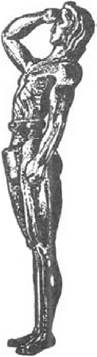 Figure 2 A Minoan worshipper. This fine bronze figurine illustrates the Minoan ideal of youthful manhood
Precisely who the Minoans were is an unanswered question. It seems likely that the native neolithic people of Crete interbred with small numbers of immigrants from mainland Greece and Anatolia to produce the Minoan population, but how distinct the Minoans were is unclear. Studies of Minoan skulls and skeletons from cemeteries at Mavro Spilio and Palaikastro show that there were variations among individuals, but not such as to imply any difference of racial type within the population. When the Minoan bones are compared with those of a sample of twelve hundred modern Cretans (quoted by Faure 1973), there is very little difference: overall, the Cretan physical type has not changed significantly.
There was, however, a very significant difference in appearance because of their clothes. The Minoans’ main cloth-making fibre was wool. Spinning and weaving were well-established cottage industries by the beginning of the bronze age: clay spindle whorls and loom weights are found at a great many Minoan sites. The wooden upright looms on which the cloth was produced have not survived, but there is a stone in the Agia Varvara house at Mallia with two slots which may well have held a loom’s upright posts. Wool is known to have been available from the many references to flocks of sheep on the clay tablets at Knossos; possibly woollen cloth was one of the Minoans’ main exports.
Traces of linen were found in an Early Minoan I tomb at Mochlos. This may have been produced in Minoan Crete, but in view of its early date it may be better explained as an import from Egypt. Possibly silk was produced in Crete: it is known to have been produced in Cos, just to the north-east of Crete, after the Minoan civilization collapsed. Animal furs and skins were used to make garments for rituals (see Chapter 6), although leather was no doubt used for making sandals and boots for everyday wear.
In the Early and Middle Minoan Periods (see Appendix D for chronology), men nearly always wore a loincloth, either rolled and tucked round the waist or held up by a belt. There were several different styles of loincloth and it may be that they were fashionable at different times or in different areas. Sometimes the loincloth was folded out on each side to cover the upper thighs. Sometimes it was simply wrapped round like a mini-skirt. From this it was a straightforward development to turn the skirt or kilt into a pair of shorts by sewing the centre at the front and back together between the legs. The Lion Hunt Dagger (Figure 10), made in Crete although found at Mycenae, clearly shows Minoan hunters wearing patterned shorts; the third hunter from the left in particular is shown to have shorts made in two layers, a curious parallel with the flounced or layered skirts worn by the women. The archer depicted on a carved steatite j ar from the Knossos area is shown wearing similar shorts.
The codpiece was another enduring feature of male attire. The early design was a straight and narrow genital-guard held up by a belt: it was often worn without a loincloth. A fragment of a steatite rhyton showing a wrestler’s naked back and buttocks clearly shows the way the G-string of the codpiece, a narrow strip of cloth, passed between the legs and up between the man’s buttocks. After 1700 BC the codpiece was developed into a more exaggerated feature. Wider and more prominent, it was often worn with a kilt made of a stiff material. The kilt left the codpiece exposed, covering the front of the thigh but rising to expose the side of the thigh: the ‘tail’ was somehow made to curl back. It is a garment like this that the harvesters on the Harvesters Vase from Agia Triadha are wearing. Other kilts were fairly long at the back, sloping up towards the exposed codpiece at the front.
By 1500 BC the codpiece was not always exposed. Several representations of men from this time show them wearing kilts but no codpieces. From 1500 BC a new, bulkier kilt was introduced and, for a time, it seems that both old and new styles were worn. The new kilt had a hem that sloped down from back to front and reached the knees; the codpiece was replaced by a decorative beaded tassel, which was worn rather like a Scottish sporran (Figure 1). It is possible that the new type of kilt originated in the Knossos area, since most of the early representations of it come from Mallia and Knossos: the tribute-bearers in the Procession and Cupbearer Frescoes at Knossos are classic examples (Figure 57).
The Minoans were known as far afield as ancient Egypt and their likenesses were painted on some of the tomb interiors at Thebes by Egyptian artists. The envoys from the Aegean who visited Thebes around 1450-1470 were described in the Tomb of Rekhmire, a vizier who died in 1450 bc, as ‘Princes of the Land of Keftiu and of the isles which are in the midst of the sea’. Keftiu was Crete. The isles were presumably the Aegean islands to the north of Crete, the Cyclades. Since at that time - or at any rate until the time of the great eruption of Thera in 1470 BC - the Minoans had colonies and trading stations in the southern Aegean, it may well have been possible for them to boast to the Egyptians that they ruled the Aegean, although the truth may have been rather different (see Chapter 5). Perhaps the Egyptians misunderstood the subtlety of the situation.
The Rekhmire paintings show the envoys wearing patterned kilts similar to those on the Procession Fresco, without codpieces, with the hemline sloping down towards the front. Cleaning revealed that this representation is an overpainting and that underneath it are the older style kilts, with codpieces and with the hemline sloping up towards the front. This reflects the Egyptian view that the Minoans had significantly changed their appearance in successive embassies: the Egyptian artist only recorded the change of fashion that he had observed. The wall paintings in the Tomb of Senmut at Thebes, dating to around 1500 bc, simply show the older style of kilt, which had decorative braid along the hem and on the broad belt.
Sometimes it is argued that the arrival of the long kilt in Crete signalled the arrival of ‘Mycenean conquerors’ in Crete, but this is not the only possible interpretation. Both short and long kilts were to find their way to mainland Greece. A man in a Pylian fresco (Lang 1969) dating to around 1400 BC is shown wearing the short kilt and codpiece and we would scarcely expect to cite this as evidence of a Minoan conquest of Pylos at that time. There were simply changes of fashion, washing, like the gentle Mediterranean tides, back and forth across the Aegean coastlands.
Women’s fashions, though covering more of the body than male attire, nevertheless showed an equal interest in display. Their clothes are not the clothes of women kept in purdah, but of women who expect to take the centre of the social stage. Generally, designs accentuated full hips, slender wasp-waists and prominent breasts; in fact the most conspicuous and best-known feature of Minoan attire is that it usually left the breasts exposed.
At the time of the first temples, women wore long robe-like dresses held in at the waist by girdles wound twice round and tied in a knot, leaving the girdle-ends hanging down in front. The dress tops, which were sometimes separate bodices, had short and fairly tight sleeves, rather in the style of a modern T-shirt, but with a deep slit at the front right down to the navel. This gave two options. The bodice front could be arranged to cover the breasts, leaving only the cleavage showing, which I suspect was the normal practice; alternatively, it could be pulled sideways, deliberately to display the breasts, as was the custom during religious ceremonies. Often the bodice rose to a high peak at the back of the neck.
The Snake Goddess statuette, which shows how a priestess dressed for a religious ceremony to transform herself into a deity, shows some extra garments. She has a wide belt to accentuate her slender waist and from it, descending at the front and back, is an elaborately embroidered double apron, which may be a sacral garment worn only by priestesses. Underneath this she wears a heavy flounced skirt made of seven overlapping layers of material, each layer composed of different coloured and patterned cloth in 12-15 centimetre squares to make a very striking check pattern.
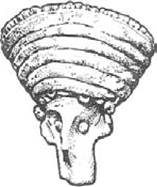 Figure 3 A woman’s head-dress, about 1900 BC. Head from a clay figurine
This style was evidently a very enduring one. It appears on an early ivory seal from Knossos and continued in use through both the temple periods. By 1550 the layered skirts began to develop a marked ‘ V’ in front, which may indicate that a new way of tying on the overskirt was being tried out. It is clear from a careful scrutiny of the figurines and frescoes, including those from Thera, that the flounced skirt was tied on as a kind of kilt and that often - perhaps usually - a long flared underskirt was worn as well. The rather complex textures visible in the dresses on the Arkhanes and Isopata gold rings can be better understood in terms of an ankle-length underskirt and a knee-or calf-length layered overskirt.
An assumption is often made that the heavy flounced skirt was normal to female attire, but this is by no means certain: its use may have been restricted to religious ceremonies. How the priestesses managed to dance in them is hard to imagine, but this is shown in several rings and frescoes.
As for footwear, people often went unshod, particularly indoors or if participating in a religious ceremony. The use of slabs of soft gypsum for stairs and floors in the Knossos Labyrinth, a material which could not have withstood heavy wear, supports the idea that priestesses, attendants and worshippers went barefoot, much as in many temples of the present day. Sometimes sandals were worn. There are ivories which show their design in detail, and it has been suggested that the word ‘sandal’ may even be derived from a Minoan word: the Greek word ‘ sandalon’ seems to have had a preGreek origin. Calf-length leather boots were probably the standard outdoor footwear for men. There is good reason to suppose that the upper parts of at least some boots were either of very soft leather or even woollen fabric.
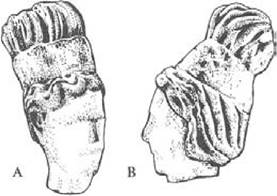 Figure 4 Heads from female figurines, showing hair-styles. Woman A has used a band of cloth to pile her hair up vertically. Woman B has used a similar band to push the hair-pile back towards the crown of her head
The ‘prince’ on the Chieftain Cup from Agia Triadha is wearing boots, but his shins are bandaged up with puttees; this practice may have been a precaution to protect the very soft leather, or to make them warmer, or to prevent stones and other debris falling into the boots, or to hold them on more securely - it is hard to judge which. Curiously, the officer reporting to the prince has boots without puttees. Rank seems not to be the explanation, since the boxers on the Boxer Vase are also shown wearing puttees. On a detail of style, the boots nearly always have pointed, turned-up toes.
Men often went hatless, and it is a little surprising that their styles of headgear were mostly unadventurous: it is an area of missed opportunities. When they wore hats, they had wide flat caps or caps with short, thick rolled brims. Women on the other hand went in for a wide variety of hat styles. In the first temple period, they often wore high, pointed hats, possibly made necessary by their hair-style, although we must not overlook the bronze male worshipper from Katsamba who is also wearing a tall pointed hat. From 1700 onwards, women’s hats became more and more outlandish. Some of the headgear may have been ceremonial in nature and not intended for everyday use.
Both women and men usually had very long dark-brown or black hair falling to the shoulders and below, with curling locks hanging down each side of the face in front of the ears. But some men are shown with short hair, and it may have been felt that it was more appropriate, perhaps even essential for safety, for men in certain occupations to have their hair cut relatively short. This is to an extent borne out by the Chieftain Cup. The ‘prince’ has the beautiful long flowing locks that we might expect of a leisured aristocrat, but the officer reporting to him has short hair and seems to have a broad diadem or visor across the front of his head: this may have had the purely practical purpose of keeping the hair off his face. The hunters on the Lion Hunt Dagger also have short hair, and it may have been customary for soldiers - if indeed there were regular soldiers - to have their hair short. In the circumstances, it seems extraordinary that the bull-leapers had long hair, which must have made their vaulting and somersaulting even more difficult to bring off successfully; but bull-leaping was a religious rite, and there was some ritual reason why the bull-leaping teams - boys and girls alike - wore their hair long.
Men were usually clean-shaven, but at least some had moustaches and beards, such as the man shown on the plaque from Agios Onoufrios, dating to about 2000 bc. This may have been a matter of personal preference or of social group: perhaps instead there were certain localities where beards were preferred. Small bronze blades were used as razors (Figure 5D). For a time they were leaf-shaped, although in the Late Minoan III Period an Egyptian type of razor shaped like a small chopper became fashionable. Tweezers too were used for removing hair and possibly shaping the eyebrows which, as the frescoes clearly show, were regarded as a very important facial feature - and there is no reason to suppose that Minoan men were any less concerned about the beauty of their appearance than Minoan women.
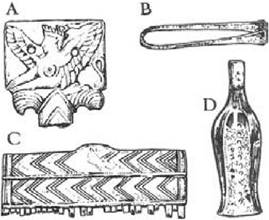 Figure 5 Cosmetic implements. A: fragment of carved ivory mirror handle from Knossos. B: bronze tweezers. C: ivory comb, with all its teeth broken. D: bronze two-edged razor
The pigments used to colour the face and eyes were evidently ground on specially made rectangular stone palettes and later in stone bowls. The priestess known as ‘La Parisienne’ is obviously wearing heavy make-up (Figure 46). The eye is enlarged and emphatic and the arc of the eyebrow is exaggerated; some sort of black eye-liner must have been used to create this impression. The lips too have been emphasized with rouge. To help with this beautification, the Minoans used mirrors of polished bronze, just as their Egyptian contemporaries did, held on handles of wood or ivory. The long hair must have required careful combing and it is assumed that to begin with the Minoans used wooden combs: ivory combs did not appear in Crete until around 1500 BC (Figure 5C).
Both women and men - even the scantily-clad men - wore jewellery. The Minoans reveal their love of physical beauty in many ways, but to an exceptional degree in their addiction to jewellery. They decorated themselves with gold-topped hairpins, earrings that were often large and elaborate - sometimes double and triple earrings were worn - armlets, wristlets and anklets, fancy beaded collars and necklaces made of copper, silver, gold or semi-precious stones.
Some of the early communal tombs at Mochlos yielded silver or gold diadems which may have originated as functional hairbands to keep the long hair off the face. There were also gold flowers and leaves mounted on the tops of gold pins, which were used as hair ornaments; oddly enough, this was a feature that was to become simpler in the Late Minoan Period.
The Aegina Treasure, now in the British Museum, is Minoan work, probably dating to around 1600 BC and generally thought to have been stolen from burials at Mallia. It includes a remarkable gold pendant which was probably worn as a pectoral. It shows the Master of Animals wearing a long kilt with a large beaded tassel at the front, large single earrings that are almost the diameter of his face and an extraordinary head-dress apparently made of two tiers of feathers mounted vertically in a crown; he also wears armlets and wristlets. Whether Minoan priests or kings ever dressed up like this is not known, but it is quite possible that they did as a preliminary to transforming themselves into deities. Another extraordinary jewel from the Aegina Treasure is probably an earring rather than a pectoral, since it is reversible. It has two greyhounds and two monkeys within the ring and, hanging from it, alternating pendants consisting of gold discs and gold birds, which are apparently owls.
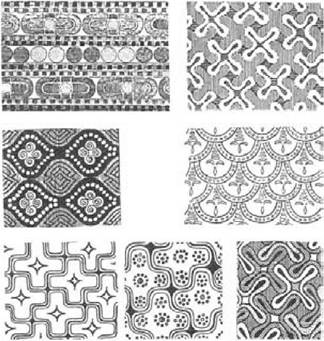 Figure 6 Minoan fabric designs, as shown on garments on the frescoes
The overall picture is one of remarkable richness and inventiveness. The Minoan style is unmistakable, original and intensely sensual. There is a delight in the sheer physical beauty of the human body - all the rest is there to emphasize it - and a delight in the beauty of jewels, coloured textiles, feathers, cosmetics and gold. In all this it would be easy to overlook detail, but the Minoans were careful to make even the smallest detail of a garment interesting to look at. The frescoes show a great variety of fabric patterns, many of them intricate, interlocked repeating patterns in many colours (Figure 6). Some of the fabric patterns may have been woven, some hand-printed with wooden blocks; others may have been produced by a mixture of techniques, with embroidery and beads sewn onto a printed or woven pattern.