1 The stone press stands at the northern end of the narrow West Terrace (see Figure 12). The lower courses of the west facade of Vathypetro are visible on the left and the terrace paving in the foreground.
2 This view south is taken from the northern edge of the site (see Figure 13) along the main north-south corridor and staircase of House C. The walls are well preserved up to the full height of the ground floor and, in places, even higher. The modern village of Tylissos can be seen in the background. With quite remarkable continuity, the village still retains its Minoan name.
3 The bare, smoothed rock ramp represents the Minoan access route to the western side of the small temple building. It was in the background of this picture, on the edge of the precipice, where the most important rituals were conducted. The ruins of the temple can be seen top right.
4 The wooded dell was a forgathering place, and may have been the scene of some religious ceremonies, but the large cavern just inside the cave entrance and the second chamber beyond it were the major focus. Just off the picture, top right, is a little church, preserving the ancient sanctity of the site. Lying almost exactly half-way between the temples of Mallia and Knossos, Skotino may have lain on the territorial boundary and functioned as a sacred place for both.
5 The cleared terrace extends along the hillside to the right, as far as the ravine where the Cave of Eileithyia’s entrance is to be found. Below is the site of the Minoan port of Amnisos; the rocky promontory on the right was probably its centre. The island of Dia can be made out on the horizon.
6 The dramatic entrance to the Diktaian Cave at Psychro has recently been spoilt by the building of an ugly and entirely unnecessary admission kiosk. It is just off the picture to the right.
7 This view eastwards from the doorway of House B into Room 11 of House A shows three vertical slots for tie-beams. It is also possible to see two holes where the vertical beams were braced together by short horizontal timbers passing through the wall.
8 Mudbrick walls have not survived well at Minoan sites: this one is exceptionally well preserved. It is in the temple at Mallia, on the east face of the west wall of the North Entrance Corridor. In the temples, the ground-floor walls were usually built of stone; the walls of the upper storeys and partition walls were often mudbrick.
9 View southwards in the East Wing of the Knossos Labyrinth. The well-made stone drain led water out of the cellarage of the Great Goddess Sanctuary (one or two storeys above this level), northwards and eastwards by way of three right-angle turns to the Court of the Stone Spout, where there was a vertical soak-away. The implication is that the Area of the Stone Drain-Heads (Evans’ name), beyond the wall across the centre of the picture, had a light-well at its centre; but it is also possible that water was ducted from the roof by way of enclosed shafts instead. In the background is the continuous wall separating the Great Goddess Sanctuary from the Double-Axe Sanctuary beyond.
10 The photograph is taken from the courtyard known as the Court of the Keep, looking southwards. In the foreground are the ruins of the doorway into area V, sometimes called ‘the Keep’, in accordance with Evans’ name for the corresponding area at Knossos, immediately to the north-west of the Central Court. The summit of the dark hill in the centre is the site of Mallia’s peak sanctuary, now occupied by a small church, which shows on the picture as a white speck. A sanctuary here, at 125 metres, would have been readily accessible to the people of Mallia - much more so than the Middle Minoan sanctuary at Karfi (off the picture, top left) at a height of 1,100 metres.
11 Although different in detail, the general concept at Mallia is similar to that at Knossos. In the north-west corner of the Bull Court at Mallia, there are four steps up into a selfcontained suite of a dozen or so chambers; at Knossos, in the corresponding location, there are five steps leading down into a similar suite. At both temples, there is a porticoed staircase up to the first floor immediately to the south of this suite. The grooved structure separating the two is a moulded plinth to which two cylindrical wooden columns were attached; they would in effect have been pilasters, an architectural idea taken up again in the classical period.
12 The photograph is taken from the point where the Royal Road, one of the streets of the Minoan town of Knossos, splits into two. The right-hand branch passes up a gentle ramp towards the North-West Portico, the North Entrance and the northern end of the West Court. The left-hand branch terminates in the Theatral Area, a place apparently designed for ceremonial greeting and leave-taking. The restored road surface shows the causewayed central lane and the lower side wings. Possibly the central lanes, being higher, drier, and therefore more secure under foot, were the paths used by palanquin-bearers.
13 The structure of this typical Minoan roadway can be seen, as can two ‘sleeping policemen’, one in the foreground and one in the middle distance. Their function is discussed in the text. The ruins are of House C (left foreground and background) and House A (right background).
14 View towards the south-east of the north-western corner of the villa, which has been tentatively identified (on insufficient evidence) as the residence of the Minoan port commander. Inside, a pier-and-door partition can be seen and, to the left, an area of the distinctive green schist paving which is found at many Minoan sites. The large block in the centre has been pulled over in antiquity. Spyridon Marinatos attributed its movement to the sucking, dragging effect of a withdrawing tsunami produced by the Thera eruption. Finds of pumice-stone among the foundations reinforced this view. He was probably right.
15 Subsidence along the northern and eastern coasts of Crete has taken several important Minoan sites down to, or below, sea-level. At Agii Theodhori, there are visible remains of several Minoan walls, including this one. The tumbled blocks to the right have been displaced from upper courses of the wall. Reconstruction and consolidation would seem desirable here.
16 To left of centre is the large rectangular dock, probably created for shipbuilding and ship repair. To the right is a level platform, also artificial, which was presumably created as a working area. The steel posts cemented into it are the remains of fittings added during the Second World War.
17 This was the subterranean setting of many Minoan religious ceremonies. Architectural references to several of its components (stone, darkness, pillars, pools of liquid in the floor, winding descents) were incorporated into the designs of the urban temples (see Plate 18).
18 Pillar crypts were designed for the appeasement and worship of chthonic deities. Libations were poured into the carved rectangular libation pits in the floor. This one is unusually well preserved; situated half-way down the hillside, it was buried under later debris from the town of Knossos on the crest of the hill.
19 Phourni exhibits a range of different burial monuments - shaft graves, ossuaries, rectangular mortuary buildings, and tholos tombs - built over a period of at least 1,250 years. It is not fully excavated, yet it is already established as the largest and richest bronze age cemetery in the Aegean. Arkhanes, the modern town below, is like Tylissos in that it has somehow clung on to its bronze age name.
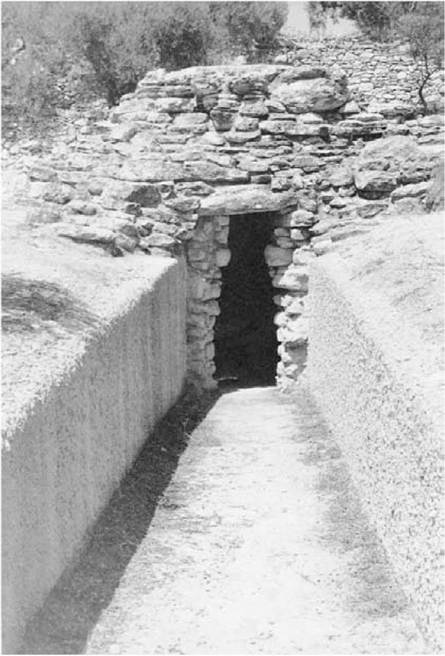
20 This fine tholos tomb dating to about 1400 BC may have been a predecessor and model for the larger and grander tholos tombs on the Greek mainland, which date to around 1250 BC or later.
1 Gold pendant or pectoral 6 centimetres high, part of the Aigina Treasure, which was probably stolen in antiquity from the Chrysolakkos mortuary-complex at Mallia. The style and quality of the craftsmanship are unmistakably Minoan, even though an Egyptian influence is apparent. The nature-god, the Master of Animals, is shown grasping a water-bird in each hand (compare Figure 40). Below him are three birds in flight, perhaps bearing him aloft on a magic carpet. Controversy surrounds the three curving structures, but they appear to be snakes, serpents, or giant worms. The god wears a typical Minoan kilt with beaded tassel, and large ear-rings. The unusual head-dress looks as if it is a two-tiered crown of feathers.
2 A bronze votive offering of unknown provenance, made 1550-1500 BC. It is unusually finely detailed and well finished, compared with most other votives.
3 Clay model from the Kophinas peak sanctuary, made in about 1900 BC. It shows an elaborately tiered head-dress with a frill round the upturned brim.
4 Clay heads from female figurines, probably of votive worshippers. Found at the Piskokefalo sanctuary, and made around 1700-1600 BC.
5 The existence of a range of cosmetic implements reinforces the idea gained from the frescoes and figurines, that the Minoans were very concerned about grooming and selfpresentation.
6 There is no reason to doubt that the fresco painters accurately depicted contemporary textile designs. Some of the simpler designs could have been woven: others were probably embellished with embroidery and applique work. The designs are often surprisingly intricate.
7 Finds of helmets (C and D) at Knossos go a long way towards establishing the Minoans as a ‘normal’ bronze age people, prepared to do battle when their interests were threatened.
8 Dagger A was found in a shaft grave at Mycenae, but seems to be a Cretan product, probably made between 1600 and 1500 BC. It would originally have had a rounded pommel, probably a polished stone. Dagger B was found in the ‘Chieftain’s Tomb’ at Knossos and was made in about 1400 BC; the gold is delicately engraved with lions hunting in a mountain landscape.
9 Fresco fragments (A) were associated with the Palanquin Fresco fragments, although they may not have been part of the same ceremonial scene. The rounded shapes at the top are the lower edges of figure-of-eight shields. The tunic, not seen on other Minoan figures, may be part of the charioteer’s military uniform. The Pylian chariot has semi-circular rear wings, like the Knossian chariot: these were probably added to protect the charioteer’s legs from arrows shot from the rear quarters. The four-spoked wheels seem to have been universal (see title illustration, Chapter 1 ). The curving structure at the front of the Pylian chariot may be a strengthening brace. The chariot symbol clearly shows the light (wooden?) structure of the chariot, and the harness for two horses.
10 Bronze dagger blade 24 centimetres long, found in a shaft grave at Mycenae but made by a Minoan craftsman. The design is executed in gold (flesh and lions), silver (shields and shorts) and niello (background). Two other similarly decorated dagger blades were found in the shaft graves and another, complete with gold hilt, was found at Pylos. These weapons were among the most attractive products manufactured by the Minoans for the Greek mainland market.
11 The Minoan area of influence is shown at its minimum extent; it may be that their influence extended further afield, for instance in contacts with the Sicilians and Libyans. The areas of influence of Hatti, Mitanni, and Egypt overlapped in Syria, making Ugarit and Byblos focal trading towns.
12 Vathypetro had some of the features of the large urban temples, but on a small, informal scale only. There was a rectangular Inner Court, a Tripartite Shrine, a West Terrace and store-rooms. The walled alley running away to the south-east led to a cluster of Minoan houses. This plan is based partly on published plans and partly on additional ancient wall footings evident at the site itself. The ‘porch platform’ is a low foundation wall forming three sides of a square; it may represent the base of a roofed, verandah-style main entrance.
13 The three principal surviving houses have significantly different plans, implying that each may have functioned slightly differently from the others. Houses A and C are very well preserved (see Plate 2).
14 Terracotta bull. A votive offering from the ‘palace’ site at Agia Triadha, dated to about 1300 BC. The original, in Heraklion Museum, is badly broken, but the cracks have been omitted here in order to focus attention on the original design.
15 Fragments of a carved steatite rhyton found on the Gypsades Hill at Knossos. The steep rocky slopes of the mountain setting are shown below and to the left of a typical peak sanctuary. The sanctuary has a tripartite form, with raised central cella, although the columns are not visible. The sanctuary is embellished with horizontal cornices topped with sacral horns, and two masts.
16 The low, G-shaped wall represents a small shrine within the cave, and shows conclusively that the stalactites were the focus of the Minoans’ attention, at least in this cave. This accords well with the whole complex of cult practices focusing on pillars (see Plates 17 and 18).
17 The interpretation of the site follows Todd Whitelaw’s 1983 interpretation. The Period I buildings have been omitted for the sake of clarity; they stood in the open space between houses 3 and 6.
18 The site was excavated at the beginning of the twentieth century, and has lain exposed since then, yet it remains in a remarkably good state of preservation. Much evidence of the daily
lives of the ordinary Minoan people was found in the ruins of the houses. The summit area is poorly preserved, so the reconstruction of the temple area is necessarily tentative and incomplete. Gournia’s temple seems to have been designed differently from other temples; e.g. the large principal chamber with a central ‘avenue’ of columns and piers, the stone sacrificial table at the southern end, on a terrace above the Bull Court. Even so, features found at other temples are retained; e.g. the indented West Facade, a West Terrace, a rectangular Bull Court and a Theatral Area composed of two flights of steps arranged at right angles.
19 The reconstruction is based on the stumps of the masonry plinths and column sockets surviving on the western edge of the Bull Court, which supply the plan, and the representation of a very similar shrine on fragments of the Grandstand Fresco. The shrine was the centrepiece of the Bull Court’s west side. In the central cella, there was a red column against a blue background. In the left cella there were black or blue columns against a red background. In the right cella there were black or blue columns against a yellow ochre background. The sacral horns were white. The check pattern was black and white, and the ‘castle’ motifs were black on a yellow ochre background. The half-rosettes at the centre were painted white, red, and black.
20 These diagrams of just one small part of the plumbing system at Knossos illustrate the complexity of the engineering design. The sewers were flushed mainly by rain-water ducted into the system from light-wells or from pipes leading down from the roof. The sewage from these lavatories was discharged through the east curtain wall and down an open duct which is still very well preserved.
21 The doors, gypsum floor, wooden seat, and the upper parts of the walls have gone, but this faithful reconstruction gives an idea of the sophistication of everyday life at Minoan Knossos.
22 The map shows the location of selected sites. The uneven distribution is very apparent. It is not clear yet whether there really were very few Minoan sites in the western third of Crete; possibly important sites await discovery there.
23 The Thiessen polygons make no allowance for the size or ‘pull’ of each centre, nor do they allow for variations in relief, soil fertility and food production. The real locations of the boundaries are not known, but it is likely that conspicuous physical barriers were utilized. The boundary between the Knossos and Phaistos territories, for instance, probably followed the crest of the ridge separating the Mesara Plain from the lowlands draining towards the north coast. two small harbours, one facing north-east, one facing west. The headland
24 Contours are at 10-metre intervals. The coastline has been reconstructed to give between the two is split by a rocky cleft which may have had some cult significance: the Chrysolakkos tomb is nearby.
25 This reconstruction is taken from Castleden (1989) and is based on several sources: the ruins themselves, the published plan of the present state of the ruins by Sinclair Hood and W. Taylor (The Bronze Age Palace at Knossos: Plan and Sections, Athens and London: British School of Archaeology at Athens and Thames & Hudson, 1981), and Theodore Fyfe’s manuscript plans of the wall footings as originally excavated. The excellent manuscript plans in Mackenzie’s Daybooks have also been used. There are significant departures from Evans’ map and reconstructions; this reconstruction attempts a rational compromise between
the Mackenzie and Fyfe plans on the one hand and the present state of what seem to be the original wall footings. Existing published plans (except my own) usually show the western limb of the Procession Corridor giving way to the cellarage below the South Terrace; in this plan, the building is reconstructed to the common floor level of the Procession Corridor, West Court and Bull Court, which I believe makes the connections significantly clearer and more logical. The many different floor levels in the East Wing make it very difficult to give a simple ground-floor plan. I have attempted a plan which makes the interconnection or (equally important) non-interconnection of chambers as clear as possible.
26 A fine two-handled jar, 40 centimetres high, carved out of white, brown and grey-green marble, found in the temple of Zakro. Although the shaping of the stone is a technical and artistic tour de force, the form (particularly of the high curving handles) is frankly not really appropriate to the material. Possibly the shape was borrowed from a metal original. Made 1500-1470 BC.
27 The bronze artefacts found in the Tomb of the Tripod Hearth are dated to about 1400 BC.
2 8 This famous gold pendant came from the Chrysolakkos burial-complex at Mallia. It measures
4.6 centimetres across and was probably made between 1800 and 1600 BC. Overlooked by treasure-seekers, it probably represents a tiny fraction of the rich grave-goods once deposited at Chrysolakkos. Much of the Aigina Treasure is thought to have come from the same site.
29 The decorative gold sheet covering helped to preserve the wooden disc handle of this sword, which may have been purely ornamental or ceremonial in function. Diameter 6 centimetres. Made 1550-1500 BC.
30 This is the typical attitude of the Minoan worshipper, standing to attention with one fist planted on the forehead in a gesture of adoration.
31 The Linear A sample is part of an inscription on a clay tablet found at Agia Triadha. The Linear B sample is an inscription on one of the chariot tablets (tablet Sc 230) found in the Knossos Labyrinth. The inscription tells of a chariot, a pair of horses and a tunic belonging to a charioteer named Opilimnios.
32 A: A pedestal bowl or goblet 22 centimetres high with a dark, blue-grey burnish, found at Pirgos (the type site) near Knossos. Made in Early Minoan I, or around 2700 BC. B: A jug 20 centimetres high from Agios Onoufrios (the type site). Made in Early Minoan I-II, around 2500 BC. C: A teapot-shaped jar or jug 18 centimetres high from Vasiliki (the type site). Made in about 2500 BC.
33 The Marine Style clay vase from Gournia carries what must surely be the most successful octopus design ever attempted: the tentacles sprawl round the entire surface in a series of free arabesques, with wisps of seaweed filling the spaces. Made in about 1450 BC. The Floral Style clay vase from Mallia was also made in about 1450 BC. The dark-on-light designs draw on leaves, flowers and rocks; the treatment is similar to that of the Marine Style.
34 The goddess on the left is 90 centimetres high. Both idols have non-supporting, detachable clay feet, just like the much earlier and larger wooden idol at Anemospilia, dating to about 1700 BC (see Castleden 1989, pp. 120-1). The Karfi idols were made in about 1050 BC, right at the end of the Minoan civilization.
35 Mottled chalcedony intaglio from Knossos. The curious drapery round the fisherman’s thighs may represent the same flounced or layered shorts seen on the huntsmen of the Lion Hunt Dagger, but wetted and clinging to the man’s flesh. The fisherman may be offering the octopus and fish to the gods, like the boy with the fish in the Akrotiri fresco.
37 A: a broken and incomplete seal impression from Knossos. B: a Minoan seal impression, unknown provenance. C: a broken and incomplete Minoan seal impression. D: clay model 20 centimetres long from an Early Minoan tomb at Palaikastro. The shape is characteristic of early boats and ships of Crete and the Cyclades. Some models have high stems and high sterns, which makes them look very like horns of consecration, and there may be a conscious symbolic reference to the ship in the form of the sacral horns.
38 The map has been devised to show as clearly as possible the geographical structure of the Minoan trading system in the Aegean, as it developed in the sixteenth century BC. The array of trading stations across the southern Aegean acted as a springboard for further trading links with places further afield, in mainland Greece and the interior of Anatolia.
39 Extraordinary for the large number of separate shrines and ritual incidents shown on it, this large gold ring has been dismissed by some scholars as a fake. In the text, the case is argued for its authenticity. Found by chance by a boy on the spot where the Temple Tomb was later discovered, and then bought by the priest of Fortetsa. It is to be hoped that it will one day be rediscovered, whether in America or in Nicolaos Pollakis’ garden in Fortetsa.
40 A gem found at Kydonia (Khania). It shows a male deity grasping two helpless lions by their manes. The significance of the three parallel lines behind the figures is obscure; perhaps they are steps.
41 Clay sealing found in fire debris from the Minoan city of Kydonia, and dating to Late Minoan IB (1500-1450 BC); the right-hand half is blackened and broken up by fire. This reconstruction is based on a photograph of the single, damaged original and the excellent pencil drawing in Tzedakis and Hallager (1987). The metal ring bezel forming the imprint was 2.7 by 2 centimetres and the image was worked in unusually high relief. The commanding male figure standing on the parapet of a building may be intended for a Minoan king or leader, although his gigantic stature - he is shown over three storeys tall - suggests that a deity is intended. He holds out his staff in the same dramatic way as the famous image of the Mountain Mother Goddess. The symbol to the left looks like a fish, and should perhaps be seen in conjunction with the two pellets above it. Rows of pellets are sometimes used to represent continuous features like tresses of hair; here the fish and pellets together may represent a pennant of some kind attached to the staff. The god is in effect holding a standard. To the right is what seems to be a stylized bull’s head, perhaps symbolizing Poteidan. The building shown 1-3 storeys high and surmounted by many sets of sacral horns lining parapets at many different levels, could be a temple or a city; a temple seems more likely. Interestingly, the whole structure seems to be enclosed by a wall with vertical slits in it and two large, monumental gateways. The gates are made of vertical tree trunks; over them are decorative or symbolic panels with half-rosettes, just like those on each side of the throne in the Knossos Throne Sanctuary. In the foreground, the sea is depicted with the conventional ‘net’ pattern and the waves breaking on the shore with the conventional ‘coral’ pattern. The large rock in the centre has been adventurously interpreted by G. Kopke (in Tzedakis and Hallager 1987) as ‘a record of the eruption of Thera’, presumably showing the moment when colossal tsunamis crashed over the walls of a coastal city or temple. Whilst this is possible - and it would fit in very well with an interpretation of the figure as Poteidan - it does seem to be overstretching the evidence; the feature looks more like a rock than a towering wave. The site, if a real site is represented at all, may be that of Kydonia itself or of some other coastal temple-city, such as Zakro. Or perhaps an otherworldly city is intended, a Minoan Asgard across the sea. If that is the case, this is a vision of heaven, with the chief of the Minoan gods making salutation from his tower.
42 Clay model from Agia Triadha. Yellow ochre with painted red stripes. A bird perches on top of each swing-post, indicating that a deity has alighted. Although at first sight a toy, this was probably a model with a religious intention. Swinging may have been used as an aid to meditation, which in turn was a way of approaching the gods.
43 Gold Minoan ring in the Ashmolean Museum, Oxford. Original provenance unknown. A naked woman prays or submits at a group of boulders; she wears a sacral knot at the nape of her neck. A priestess in a flounced dress stands to the left, apparently touching her own sacral knot. A dramatic epiphany of an armed god appears in the air between them, holding a bow and what seems to be a dagger; the dagger seems poised to strike the naked woman. This may be a rare depiction of a human sacrifice (see also title illustration, Chapter 7).
44 Gem of unknown provenance in Heraklion Museum. Two lions stand with their forepaws resting on a low, three-pillared altar ( = shorthand for tripartite shrine?). The arrangement is reminiscent of the Lion Gate at Mycenae, where a single Minoan pillar stands on the altar between the two lions. Here, instead of the single pillar, is a sun-disc, which is taken to represent Poteidan-Poseidon.
45 Large, finely detailed double-axe made of a single thin sheet of bronze in about 1470 BC. Its blades are doubled, which emphasizes its ritual use. The whole surface is covered with engraved stylized lilies, implying a dedication to Potnia. The axe was probably originally raised on a wooden pole, like the axes shown on the Agia Triadha sarcophagus.
46 The fresco fragment known as ‘La Parisienne’ was originally part of a sacred communion fresco of the same type as the one Evans called the Camp Stool Fresco. Some participants sit on cushioned folding chairs, receiving the sacrament from standing officiants. The fragment is of interest for several reasons. It clearly shows a hair-style that was common among both men and women, with a few curls drawn forward over the forehead and a cascade of long, waving ringlets falling down the back. It shows the eyes and eyebrows exaggerated with black eye-liner and the lips emphasized with rouge. The drawing of the sacral knot and the dress is hasty, crude and rather unsatisfactory on the original mural.
47 The two trees are rendered very differently and may be intended as different species. The armless and apparently legless figure has been the subject of a long and unresolved controversy. The most natural interpretation is that it represents a statue of a god wearing a sheepskin robe. The shrine behind the xoanon is elaborately decorated, probably with painted plaster, as is the wall of the sacred enclosure which surrounds the olive tree.
48 Clay statue of a goddess 79 centimetres high, from a small shrine at Gazi, west of Knossos, dating from Late Minoan III, the Post-Temple Period. On her crown are three large and carefully modelled poppy-heads, confirming a link between the worship of the goddess and opium-taking.
49 Figures on a rectangular plaque 8 centimetres long, made of carved shell in 1480-1470 BC. Found in the Phaistos temple. The holes in the corners of the plaque (not shown here) suggest that it was originally fixed to a wooden box. Some of the details have been picked out with paint. This procession of robed animal-headed daemons with long staffs is an early example of a ritual scene that was taken up later by the mainland Myceneans.
50 Clay jug or rhyton in the form of a bull-grappling scene. Made in the Pre-Temple Period. Two members of a bull-grappling team hang on to the bull’s horns, while a third, facing the other way, lies across the bull’s face. This would have had the effect of immobilizing the bull while the bull-leaper (not part of the model) dived over the bull’s head.
51 Detail from one of the two gold cups found at Vaphio on the Greek mainland, and made by a Minoan craftsman in 1550-1470 BC. The quality of craftsmanship in this very naturalistic piece is unsurpassed. It is, as Peter Warren has said, ‘perhaps the finest surviving picture of a Minoan male’. The depiction of the bull and the olive tree is also very fine.
52 Development of a scene on a fragment of a carved steatite vessel from the Gypsades Hill at Knossos. Two men are processing with bowls in their outstretched hands. This offertory procession is probably closely connected with the function of the rhyton on which it was carved. The architectural background shows a balustraded staircase, with sacral horns and masts or banners mounted on the balustrade. It may represent part of the Knossos Labyrinth, possibly the Stepped Portico at the south-west corner of the complex.
53 Some pillar bases of the east colonnade survive. The exterior wall is of very fine masonry and the structure as a whole seems to have been for high-status burials. It was built during the Old Temple Period. Looting and excavating in the interior have left it virtually wrecked.
54 Detail from a miniature fresco fragment found in the Knossos Labyrinth. The figure is about 8 centimetres high. Most of the head and the raised right arm are missing, here reconstructed. The hair, which is worn thigh-length, is painted black, the skin Indian red, the loincloth white, the spear or staff yellow ochre, and the background a dusky blue. The leader is acknowledging the enthusiastic salute, with raised spears, of at least twenty warriors, who are depicted on other fragments of the same fresco. The illustration was sketched freehand from the fresco fragment in Heraklion Museum. Interestingly, the figure carries no recognizable marks of office at all.
55 Detail from carved steatite libation vessel, 12 centimetres high, from Agia Triadha, made between 1650 and 1500 BC. The figure with the staff stands in front of a wall, holding his staff out commandingly in front of him. He wears wristlets, armlets and an elaborate necklace, implying high rank. He is approached by a smaller male who carries a sword and what may be a fly-whisk or a shepherd’s crook; he heads a procession of males who are almost completely concealed under animal skins. The scene may be interpreted as a group of soldiers led by a junior officer reporting to a senior officer or a prince with hunting trophies. An alternative view is that a group of boys who have just completed one of their initiation ordeals is reporting to an older youth who has already been initiated: a kind of prefect, he is supervising the initiation ceremonies of the younger boys. Certainly the youthful appearance of the figures fits in with this second interpretation. Many of the images in Minoan art are images of the young. This illustration has been developed from two photographs, one centred on each figure. As a result, the figure of the prefect or prince is correctly proportioned, and not foreshortened as usually shown: he is sturdier and more thick-set than in most published representations.
56 The almost complete upper part of one of a series of life-size tribute-bearers painted on the walls of the Cupbearer Sanctuary in the Knossos Labyrinth. A youth carries a conical rhyton. In the original, the rhyton is painted blue (black in my drawing) and red. The youth’s hair is dark brown, his skin a deep Indian red. The areas of the nipple, the locks of hair on the shoulder, and the rim of the rhyton have been reconstructed. This is another highly idealized picture of the young Minoan male; when the grainy, mottled texture of the decayed fresco is omitted, as in this drawing, the image is startlingly youthful.
57 A carved gemstone from Kydonia shows a young, short-haired god apparently standing on or hovering above a pair of sacral horns. To his right is a rampant winged goat. To his left is a typical Minoan daemon bearing a ewer. The daemon is animal-headed, bipedal, and wearing a characteristic wasp-tail robe.
1 A stone mould from Sitia. A decorative symbol incorporating a cross, rays, a wheel, and flames: it represents a flaming sun-disc. The Minoan chariot wheel had four spokes (see Figure 9), so the symbolic reference to a sun-wheel is probably not accidental.
2 A gem from the Idaian Cave. The priestess may be blowing the shell horn or using it as a megaphone to summon a deity. She stands on some steps in front of an altar decked with sacral horns and three sacred boughs.
3 A gold ring from Mochlos. To the right is a masonry structure very similar to those on rings from Mycenae and Knossos; it has a high, narrow aperture (a doorway?) with a cornice. In the centre is a stretch of water and a boat floating on it. A goddess or priestess is conveying a sacred tree along the coast in an elaborately tiered shrine which is placed on the after end of the boat.
4 A clay sealing from Zakro. The priestesses may be involved in a public procession, or simply on their way from one part of a temple to another. The large double-axe seems to be hovering in the air in front of one of the priestesses, or standing in the background. The priestess on the right is apparently carrying the robe over her arm; its detail is indistinct, but it seems to have a quilted or scaled texture above and a pleated texture below, in which case it is a cuirass.
5 A Minoan seal showing a ship with two large fish, which may be tuna, and a substantial quadrident (or four-pronged trident). The implication is that ship, fish and quadrident are connected.
6 A Minoan ring, said to have come from eastern Crete, now in the National Museum of Copenhagen. The image is carved in green jasper. It shows a goddess appearing in the centre, slightly above the level of the worshippers. To the right are two women greeting her with upstretched arms. To the left are two men, also greeting her with upstretched arms; they have cast aside their shields to worship. Significantly, the men have knelt before the goddess, whereas the women have not. This may be another indication of the superior status of women in Minoan society. To the right of the goddess, in the sky, are two rows of dots, which may signify a rainbow.
7 A sealstone found at Khania and dating to about 1450 BC. The seated female with unusually exaggerated breasts is probably a goddess. The sword poised above the girl on the left strongly suggests that she is about to be sacrificed; beneath the girl is a suggestion of the sacrificial table. The goddess sits on a complicated structure reminiscent of the tripartite shrine. The form behind her may be a sacred tree, with its fruit or foliage bending symbolically over her shoulder.
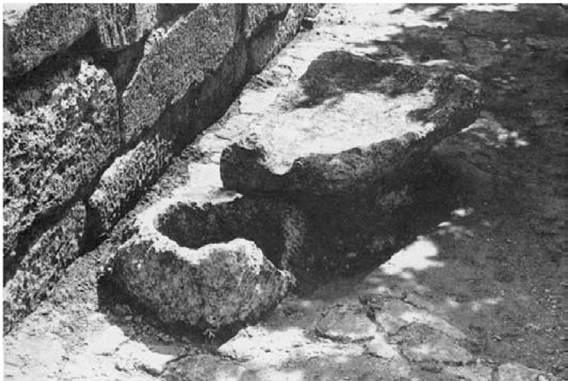
Plate 1 Oil or wine press at Vathypetro
Plate 2 The Minoan village of Tylissos
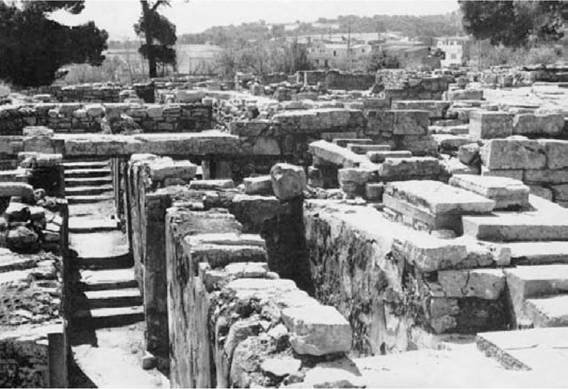
Plate 3 The Mount Juktas peak sanctuary
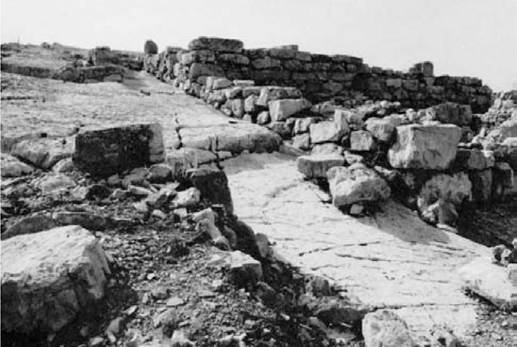
Plate 4 The Skotino cave sanctuary
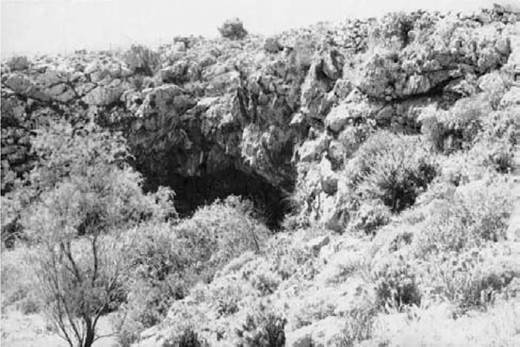
Plate 5 The Square of the Altars at Amnisos
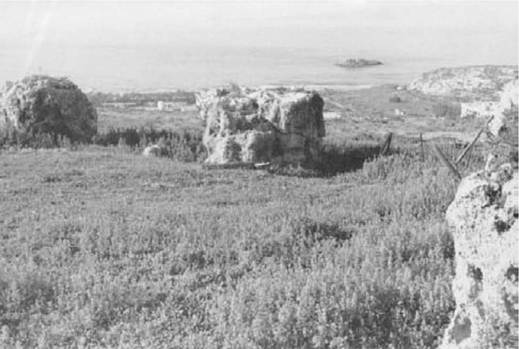
Plate 6 The entrance to the Diktaian Cave
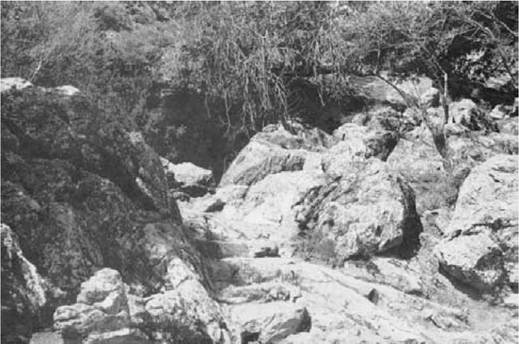
Plate 7 Tylissos, House A, showing slots for tie-beams
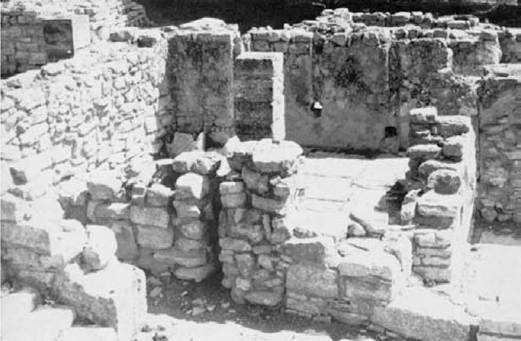
Plate 8 Minoan mudbrick wall at Mallia
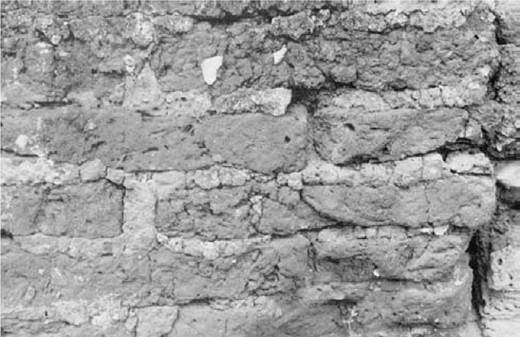
Plate 9 A stone drain at Knossos
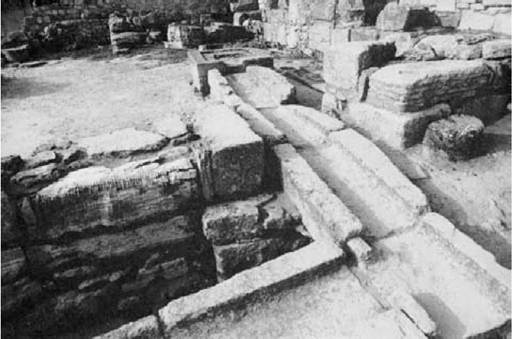
Plate 10 Mallia. The temple ruins in the foreground, peak sanctuary in the middle distance, and the mountains of Lasithi on the skyline
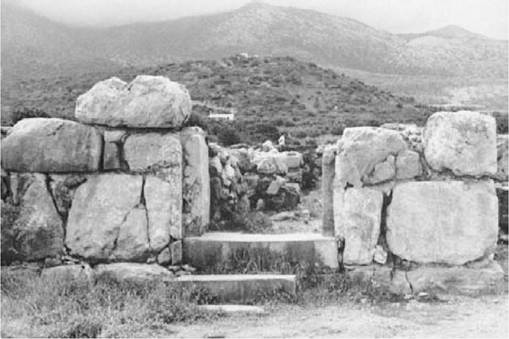
Plate 11 Mallia. Part of the east front of the West Wing, with stairs leading into area VI (right) and up to the first floor (left)
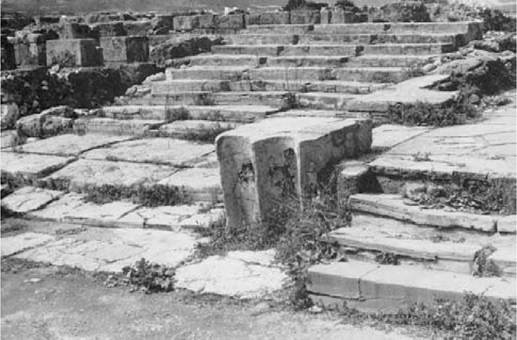
Plate 12 The Royal Road at Knossos, terminating in the Theatral Area (left) and the North Entrance and North-West Portico of the Labyrinth (right)
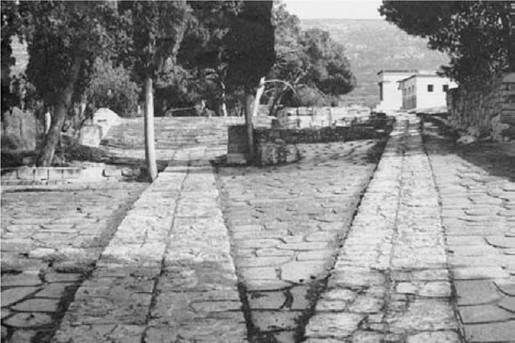
Plate 13 Tylissos. The Minoan village street passing along the west side of House C
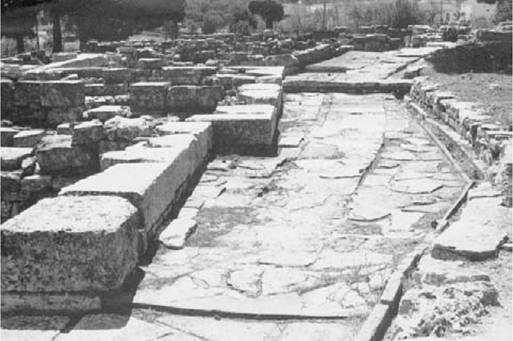
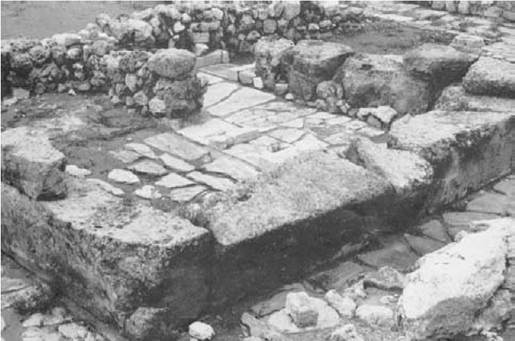
Plate 14 The Villa of the Lilies at Amnisos
Plate 15 Minoan buildings on the beach at Agii Theodhori
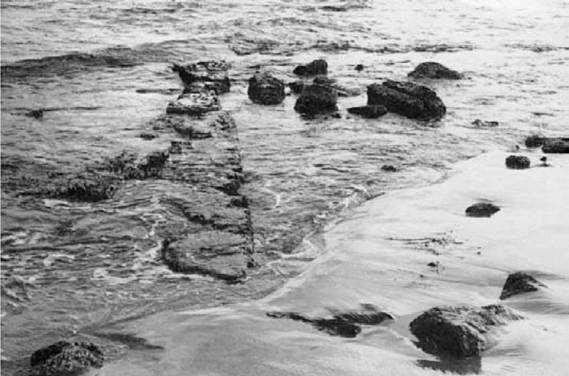
Plate 16 Kolymba, the Minoan dock at Agii Theodhori
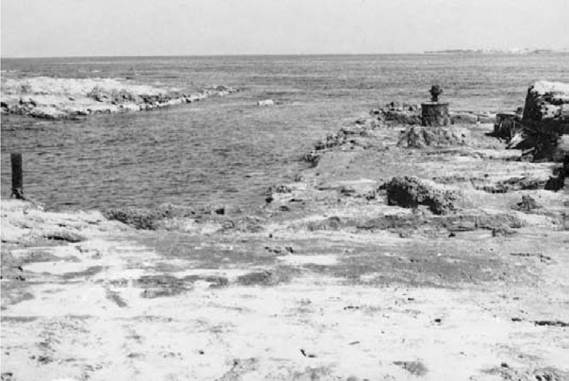
Plate 17 The Diktaian Cave
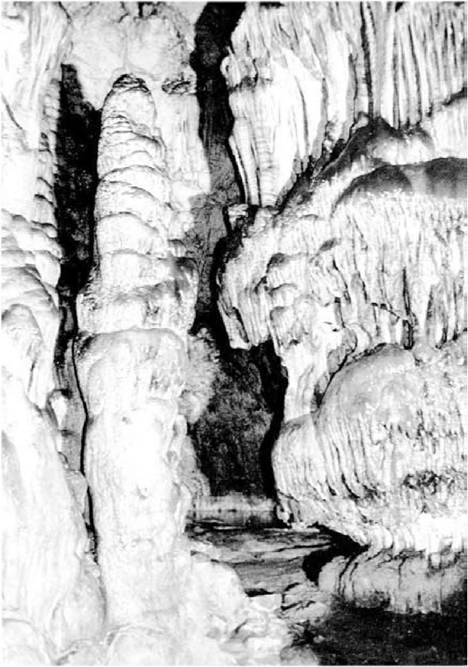
Plate 18 Pillar Crypt at the Balustrade Sanctuary (Evans’ Royal Villa)
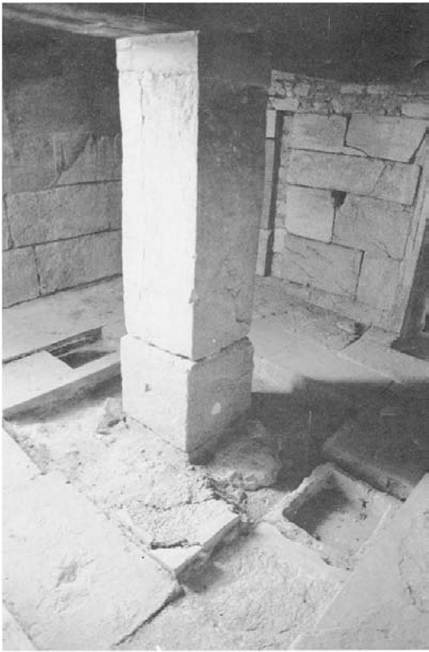
Plate 19 Phoumi. The Minoan cemetery in the foreground: the town of Arkhanes in the background
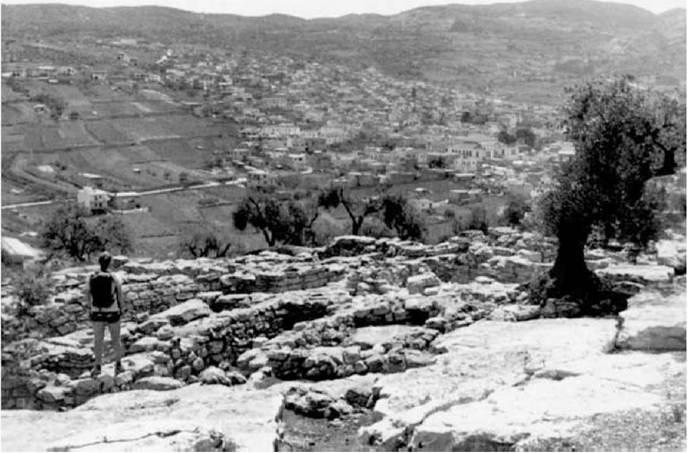
Plate 20 The Tomb of the Lady of Arkhanes