

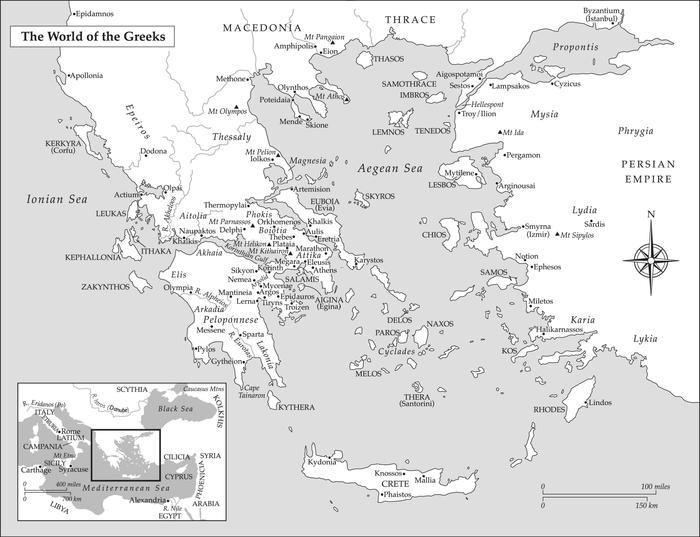
From Grecian urns to Julius Caesar, Roman orgies to Cloud Cuckoo-land, Classical civilization has left an enormous footprint on our cultural environment, both shaping and enriching the lives of millions over millennia, often in ways that are now completely taken for granted. Greece has given us democracy, philosophy, tragedy, comedy, oligarchs, oratory and ostracism; the Roman legacy not only includes unsurpassed engineering skills, the foundations of our legal system, and the fundamental concept that all free people have inalienable rights as well as duties, but, paradoxically for a people that often saw itself in highly militaristic terms, the benefits of peace. It was the Pax Romana, ‘Roman Peace’, which, despite being constructed out of centuries of warfare, allowed Roman civilization to spread across Western Europe and ultimately to shape medieval, Renaissance and modern culture. Many of the underlying ideas of this vibrant tradition came from Greece, but they were transmitted in Latin.
Nowadays ‘Reception Studies’, tracing the influence of the Greek and Roman world in the culture of later generations, is one of the most dynamic aspects of Classical scholarship. It can tap into an immense wealth of material ranging from Harry Potter to fashion trends, ballet and contemporary dance, art, theatre, television and film, opera and musical genres encompassing classical, jazz, rock and the avant-garde. Much of our literary tradition comes directly from the Greeks and Romans; the world’s biggest sporting event is the Olympic Games; and the controversy surrounding the Elgin Marbles, with the Greek government demanding ‘the reunification of a mutilated monument belonging to the world’s cultural heritage’, and the British Museum countering that the sculptures are integral to a world museum telling the story of human cultural achievement, is very much a live issue; we work like Trojans; when in Rome we do as the Romans do; and it’s all Greek to me.
There is no possibility that a book such as this can provide comprehensive coverage of all the history and culture of a time frame that stretches from the epic heroes of Greek mythology to the fall of the Roman Empire. Instead, it focuses on a number of key aspects of Greek and Roman civilization, particularly, but not exclusively, from the ‘classical’ eras of Greek and Roman history, many of which feature on the syllabi of GCSE, A level, and undergraduate courses, but which will also be of interest to any general reader with no intention of ever sitting an exam. The literary and artistic achievements of these often astonishingly sophisticated people will fall under the spotlight, but so too will their everyday lives, along with some of the most important events and processes that shaped the world in which they lived. On the way, we will confront the fascinating issues of their hopes, fears, aspirations, humour, beliefs, morals, values, tastes, politics and strategies for everyday survival.
The book moves in a roughly chronological sequence, although each chapter is organized thematically. We pick up the story in the Bronze Age and focus on the Minoans of Crete, who formed what is arguably Europe’s first civilization, the Mycenaeans (whose culture was rooted largely in mainland Greece), and Troy, which is central to any understanding of later Greek culture. As we start to emerge from the prehistoric world of myth and archaeology we arrive in the Iron Age and encounter the unsurpassed epic poetry of Homer’s Iliad and Odyssey, the standard by which all later literary works were judged (and found wanting). An outline of Greek history, from the mid-seventh to the end of the fifth century BCE follows, tracing the development of the world’s first democracy, the challenges it faced from ‘barbarian’ invaders, the ascendancy of Athens, and its terrible Peloponnesian War with Sparta. Within that historical context we move to the domestic level, to survey the ways in which the Greeks interacted with one another socially, and with their gods, which included not only oracles but athletics. A slight sidestep then takes us into Sparta, whose oligarchic constitution and distinctive social organization illustrates a very different model of how a Greek state might be organized, and provided later inspiration for the English Public School system and the Hitler Youth. The words ‘Greek’ and ‘Tragedy’ now form an inseparable pair, and after a survey of the context in which the plays were performed, we will look at some remarkable dramas by the ‘big three’ tragedians, Aeschylus, Sophocles and Euripides. Our survey of the art and architecture of Ancient Greece takes in the distinctive Red- and Black-Figure vases, temples and their decoration, and concludes with an overview of free-standing sculpture down to the start of the Hellenistic era. Comedy was another of Greece’s crucial contributions to the repertoire of world culture, and we make our transition to the world of Rome via the rumbustious Aristophanes, through the more sedate Menander, to Rome’s two star dramatists, Plautus and Terence, whose work drew heavily on their Greek predecessors.
Benjamin Disraeli said of his wife that ‘she is an excellent creature, but she never can remember which came first, the Greeks or the Romans’.1 Essentially the Greeks do, but there is a degree of overlap, in which the Romans ultimately conquered Greece, leading in some Romans’ eyes to a reciprocal cultural conquest of Rome by Greece. Once in the Roman world, we will take a historical survey of one of the defining eras of world history, that of the transition from the Roman Republic into the Roman Empire, meeting many of Rome’s greatest celebrities on the way. Under its first Emperor Augustus, Rome produced some of antiquity’s finest and most influential literature, none more so than Virgil’s Aeneid. As we turn from legend to the everyday lives of the Roman people in both the Republican and Imperial eras, we will examine their social hierarchies, day-to-day habits, relationship with their gods, and recreational activities. They were some of the greatest builders ever to have walked the planet, and remains left after a cataclysmic eruption of Mount Vesuvius in 79 CE provide us with an intimate and moving insight into the Roman urban environment. Despite its truly astonishing success, the Roman Empire could not sustain itself forever, and the final chapter takes us through the complex, though strangely low-key, events that led to the final demise of Rome at the hands of barbarians in the fifth century CE.
Sometimes the evidence at our disposal is incredibly clear, but at other times totally lacking, aptly described as not the missing pieces of a puzzle, but the only remaining pieces of a puzzle that is itself missing. Yet a centuries-long tradition of scholarship, allied to the more recent science of archaeology, still enables us to construct a vivid picture of what Edgar Allan Poe described as ‘the glory that was Greece and the grandeur that was Rome’.2
A Note on Spellings
The question of Greek, and sometimes Latin, names transliterated into English is always a difficult problem, and has to be a personal decision. Until quite recently the convention was to Latinize Greek names, so that not only does Klytaimnestra (the straight transliteration from the Greek) become Clytemnestra, Alexandros become Alexander, and Menelaos become Menelaus, but names frequently get changed into their Roman (not always exact) equivalents, so that Odysseus becomes Ulysses, Hera becomes Juno, and Zeus becomes Jupiter or Jove. Other names have developed quite familiar anglicized versions such as Pompey (he was Pompeius), Achilles (Akhilleus), Terence (Terentius), or Darius (Dareios or Daryush). Many academic works now tend to be quite scrupulous about sticking as close to the original as possible, but in the interests of ‘user-friendliness’ I have taken the imperfect and inconsistent, but nevertheless very common, decision to use the original spellings of the lesser-known proper names, and keep the Latinate forms of the main players.
Notes – Introduction
1. G.W.E. Russell, Collections and Recollections, ch.1, London: Smith, Elder & Co., 1898.
2. From Edgar Allan Poe’s 1845 revision of his poem ‘To Helen’. First published as ‘To- - -’ in Union Magazine, November 1948, published as ‘To Helen’ in New York Daily Tribune, 10 October 1849