
5
When Greeks joined Greeks, then was the tug of war!
Nathaniel Lee, The Rival Queens IV.ii
Geography, Climate and History
The history of Ancient Hellas (Greece), as the Hellenes (Greeks) called it, is inextricably entwined with weather and landscape. After a colonizing movement in the eighth century BCE, driven largely by a combination of increasing population and land shortage, the Greek world encompassed Greece itself, the Aegean Sea, the coast of Asia Minor (modern Turkey), some very prosperous cities in Sicily and southern Italy (often referred to as Magna Graecia ‘Great Greece’), with outposts in the Black Sea, North Africa, and France. Aristotle believed that this controlled their destiny: Europeans are spirited, but lack skill and intellect, and so remain relatively free; the Asiatic nations possess both intellect and skill, but lack spirit, and therefore remain enslaved; but:
the Hellenic race, occupying a mid-position geographically, has a measure of both, being both spirited and intelligent. Hence it continues to be free, to live under the best constitutions, and, given a single constitution, to be capable of ruling all other people.1
But Hellas is mountainous and communication was never easy, communities tended to remain resolutely separate; autarkeia (= self-sufficiency) was highly prized and so the Hellenes never lived under a single constitution. They inhabited a large number of fiercely independent poleis (sing ‘polis’). The conventional translation ‘City States’ is somewhat misleading, since the word polis covers the urban settlement, the Acropolis (‘high city’ – the fortified stronghold at its heart), the outlying villages and farmland, the residents and their way of life.
Greece has many small fertile plains but only a few large ones, although the jagged, indented coastline means that nowhere is more than about 80 km from the sea. This led many Greeks to become first-rate sailors, despite the capriciousness of the Aegean Sea, where winter sailing was out of the question. The many islands acted like stepping-stones to Asia Minor, and Hellenic mariners were enticed eastwards, making the Aegean basin a hub of exchange for goods and (perhaps more importantly) ideas between Europe, Asia and Egypt. As Perikles reputedly said: ‘How can mere farmers, with no knowledge of the sea, achieve anything worthy of note?’2
Monarchy, Aristocracy, Tyranny and the World’s First Democracy
In the Homeric world, monarchy was the normal way of things in the Greek states, but over time a transition to aristocracy took place. The aristocrats were hereditary groups, and as Eupatridai (‘Sons of Good Fathers’) they dominated all the political, legal, military, social and religious aspects of the polis. The poleis themselves were organized tribally, with political administration depending on kinship groups, and the system was stacked in favour of anyone of noble descent.
The status quo was challenged as the colonizing movement led to the generation of wealth among enterprising non-aristocrats, who started to resent their lack of influence. At the same time, some Eupatrid families exploited popular discontent in order to subvert the dominance of their rivals. Disaffected nobles, or wealthy non-nobles, emerged as ‘champions’ of the masses, and manipulated the situation to seize personal control.
In some cases this shift in power may have been based on the new hoplite soldiers. These heavy-armed infantrymen fought shoulder-to-shoulder in a fighting system that diminished the preeminence of the individualistic military prowess of the old nobility. Such usurpations were replicated right across the Greek world, and the word used for someone who took over like this was tyrannos, ‘tyrant’/’dictator’. The word tyrannos did not initially carry the overtones that ‘tyrant’ now does (although it came to do so later): it simply distinguished this type of monarch from a hereditary king.
Greece’s ‘Age of the Tyrants’ conventionally begins with the takeover of Corinth by Kypselos in c.650 BCE. A representative example is Theagenes of Megara, who got hold of a bodyguard, exploited the unrest caused by land shortage, seized power ostensibly as champion of the oppressed peasants, and carried out a massive slaughter of the cattle of the rich (and presumably hosted a free feast for the poor). Typically, after the revolution, Theagenes introduced an ambitious programme of public works. There was normally a honeymoon period where the interests of the tyrant and the newly influential classes coincided, and often an economic boom based on increased trade, with agriculture making a shift towards ‘agora (market) culture’.3 The sixth-century poet Theognis clearly disliked this topsy-turvy world:
Unchanged the walls, but, ah, how changed the folk!
The base, who erstwhile knew nor law nor right,
But dwelled like deer, with goatskin for a cloak,
Are now ennobled; and, O sorry plight!
The nobles are made base in all men’s sight.4
At the city of Megara Theagenes then married his daughter to Kylon, the would-be tyrant of Athens, but then the nobles fought back. It was the usual pattern for the people, who had got what they wanted, and the aristocracy, who had not, to become drawn together by a common hatred of the tyrant, who would in turn become more ‘tyrannical’ in order to hang on to power, and Theagenes was ousted by such a coalition. Few tyrannies lasted for more than one generation, none for more than three.
At Athens the prospect of tyranny materialized just after 640 BCE when the aforementioned young Athenian noble Kylon tried to perpetrate a coup d’état with Athenian accomplices and Megarian troops. However, most Athenians rallied against him. Kylon himself escaped, but his followers took sanctuary in a temple, only to be executed by Megakles, of the Alkmaionid family. This sacrilegious act brought pollution on the entire polis, and the Alkmaionidai were condemned before a court of 300 aristocrats, cursed and exiled (although they were back by the time of Megakles’ son, Alkmaion).
Some twenty years later Drakon was appointed by the Eupatridai as thesmothetes (law-recorder), to defuse the discontent on which Kylon had hoped to play. Drakon’s laws were proverbial for their severity (‘draconian’) and included debt laws that allowed the creditor to seize the debtor and his family as slaves. His legislation still supported the interests of the power-holding class, even if it did now define those interests in writing, but it became apparent that more comprehensive measures were needed to rectify Athens’ difficulties.
The man ultimately appointed by the Eupatridai in c.594/3 BCE to reconcile these tensions was Solon, a man of good birth, respected for his integrity and moderation, who had written poems in which he ‘everywhere lays the blame for the strife on the rich’.5
Athens had two types of landowner: the orgeones (members of guilds), whose property was alienable, and members of the gene (‘clans’), whose estate was inalienable. This meant that the latter could not use land as collateral on a loan, but could use its produce, and if they became bankrupt they were forced to pay one-sixth of this to the creditor, and became known as hektemoroi, (‘sixth-parters’). The orgeones could mortgage both their property and their families, but bankruptcy for them could result in slavery. So, in a package of measures known as the seisakhtheia (= ‘shaking off of burdens’), Solon made it unlawful to secure loans on the personal freedom of the debtor, abolished the status of hektemoroi, cancelled debts and liberated those enslaved for debt. No longer would Athenians be kept as slaves at Athens.
On the economic front, Solon offered Athenian citizenship to foreign craftsmen, notably Corinthian potters whose expertise helped Athens to dominate the ceramics markets. Solon also decreed that no son was obliged to support his father in old age unless he had been taught a trade, and introduced an export ban on all agricultural produce except olive oil:
The export of figs was prohibited … and those who informed against such exporters were called sycophants, or ‘fig-declarers’.6
With home-grown corn kept at home, famine prices were avoided, and the olive oil trade stimulated.
On the political level, Solon broke the monopoly of the Eupatridai by dividing the Athenians into four census classes with graduated privileges, whose criteria were based on income in kind (the number of medimnoi [= 52-litre measures] of corn or oil that a man’s land produced), shifting Athens from an aristocracy to a timocracy (i.e. where there is a property/wealth qualification for office). The highest political offices were open to the Pentakosiomedimnoi (whose estates produced more than 500 medimnoi per annum) and the Hippeis (= knights) (wealthy enough to equip themselves as cavalry and generating 300 medimnoi). Minor offices were available to the Zeugitai (200 medimnoi, wealthy enough to equip themselves as hoplites); and everyone else, known collectively as theThetes or ‘labourers’, who comprised the vast majority, had what Aristotle dubbed ‘a bare minimum of power’.
Athens’ highest magistrates, the nine arkhontes (arkhons), were no longer necessarily nobles, and it is likely that they were selected by the Assembly of Citizens (ekklesia) by klerosis ek prokriton, i.e. the election of a pool, followed by selection by lot.7Theekklesia dealt with legislation, matters of war and peace, and key questions of public policy – and all classes had a vote. The arkhontes became accountable to the ekklesia, since only if their actions in office were acceptable were they granted admittance to the Council of the Areiopagos. The Areiopagos had been a very powerful and exclusively aristocratic institution, but Solon converted it into the protector of the constitution, guardian of the laws and the chief homicide court. Its pre-eminent constitutional place was taken by the new boule, the Council of Four Hundred, chosen by lot from members of the four Athenian tribes. This council handled the discussion and presentation of business for the ekklesia. Finally, Solon granted a right of appeal from the magistrates’ courts to the heliaia (People’s Court), which was the ekklesia sitting as a court. This was a major step towards democracy: as Aristotle observed, when the people control the judicial system, they control the State.
Solon had initiated some major improvements at Athens, yet even he was aware of his shortcomings; by attempting to avert a tyranny, he actually created a new kind of political unrest in which the old aristocratic inter-family rivalries became blended with class struggles.
We hear that Athens broke up into three factions: the Plain, led by Lykourgos, comprising eupatridai who favoured oligarchy; the Coast, led by Megakles, formed from the orgeones, who sought a ‘middle form’ of constitution; and the Hill, led by Peisistratos, made up of poor countrymen, which aimed at democracy. Peisistratos seized power c.560 BCE by pre-packing the Assembly with his supporters, claiming to have been wounded by a political opponent, being voted a bodyguard, and taking the Acropolis. However, this success simply united Lykourgos and Megakles, who drove him out, until the latter joined him to play what Herodotus described as ‘the silliest trick which history has to record’.8 They dressed up a tall beautiful woman as Athena, and drove her into Athens in Peisistratos’ chariot, saying that the goddess was bringing Peisistratos home. Apparently the Athenians fell for this. Unfortunately, although Peisistratos had married Megakles’ daughter, he didn’t want to add to his sons from a previous union, and ‘lay with her in an unnatural way’.9 Outraged, Megakles reunited with Lykourgos and again expelled Peisistratos. Peisistratos spent ten years planning another coup d’état, and in c.546 BCE he returned, backed by foreign mercenaries. It was third-time-lucky for him, and he defeated his enemies at the Battle of Pallene.
Opponents were murdered, exiled or kept as hostages, and the appointment of the arkhontes was tightly controlled, but in other respects Peisistratos observed Athenian legal protocols. His rule became known as ‘The Age of Kronos’ (a mythical Golden Age): like a good tyrant, he made agricultural loans to the poor; promoted trade and industry; instigated a major programme of public works; and was a high-profile patron of the arts.
When Peisistratos died in 527 BCE, his sons Hippias and Hipparkhos took over. The cultural and building programme flourished, as top-class poets were invited to Athens; recitations of Homer became part of the remodelled Great Panathenaia festival; and new silver coins known as ‘Athenian Owls’ enhanced Athenian trade and prestige. But then things started to unravel. Hipparkhos had a same-sex crush on the beautiful Harmodios, but, having been spurned twice, the tyrant insulted Harmodios’ sister by denying her the honour of being a basket-bearer at the Panathenaia of 514/3 BCE. So Harmodios and his (male) lover Aristogeiton plotted to assassinate Hippias and Hipparkhos at the festival. Unfortunately for them, things went wrong: Hipparkhos was murdered, but Hippias got away; Harmodios was killed; and Aristogeiton was tortured to death.
In a distortion of historical reality, drinking songs in honour of the ‘Tyrannicides’ said that Harmodios and Aristogeiton ‘slew the tyrant and made Athens a land of equal rights’. In fact, Hippias instituted a hard-line regime, again expelling the Alkmaionidai, who rebuilt the Temple of Apollo at Delphi, thereby winning the support of the Oracle, which constantly pressurized the Spartans into ‘liberating Athens’. This they did in 510 BCE when King Kleomenes invaded Attika (the ‘Greater Athens’ area) and captured some of the Peisistratids’ children as they were being smuggled away. The Peisistratids came to terms with the Athenians in order to get them back, and left the country in July. Hippias spent the next twenty years in the Troad cultivating friendly relations with the King of Persia.
Ironically, by replacing the aristocratic in-fighting and class struggle with stable government, the Peisistratid tyranny created a situation in which democracy could flourish. First, however, there was an aristocratic backlash. Kleisthenes, leader of the Alkmaionidai, found himself frustrated by Isagoras, a close friend of Kleomenes, who also had connections with Hippias. When Isagoras was elected arkhon for 508/7 BCE, Kleisthenes ‘joined the people to the company of his followers’,10 and proposed radical reform of the constitution. Isagoras appealed to the Spartans to step in, and Kleomenes invoked the ‘Curse of the Alkmaionidai’ from the time of Megakles to exile 700 households of Kleisthenes’ supporters. However, when he occupied the Acropolis, and tried to replace Solon’s Boule with a junta of Isagoras’ supporters, the Athenians rose up and expelled him. He left in ignominy, taking Isagoras with him, while Kleisthenes returned with the 700 families, and exploited Isagoras’ failure by equating oligarchy withsubservience to a foreign power.
Kleisthenes is said to have established three great rights for the Athenian people: isonomia (= ‘equality under the law’); isegoria (= ‘equality of speech’); and isokratia (= ‘equality of power’). Athens had become a democracy (demokratia = ‘rule of the people’).
Demokratia was achieved by creating ten new tribes for political purposes, and making small localities called ‘demes’ (demoi, sing. demos) the basic unit of local government. There were 168 of these, each with its own Assembly, Boule, Chief Magistrate and Treasurers. A group of contiguous demoi from each of the three areas of Attika (i.e. the coast, inland and city) was amalgamated into a trittys (‘a third’), and these three (non-contiguous) trittyes were then united to form a tribe. Each tribe therefore containeddemoifrom across the coastal, inland and urban areas, in theory giving it a cross-section of the community and eradicating party-strife based on local differences. Demos and tribe membership was hereditary, and citizenship became dependent on your demos. Every Athenian male was identified by three names: given name, patronymic and demos – Perikles Xanthippou Kholargeus (‘Perikles, son of Xanthippos, from the deme of Kholargos’).
Membership of the Boule was increased to 500, with 50 councillors selected from each of the 10 tribes by election, then lottery. Councillors had to be thirty years old, but all classes were eligible, and they could serve on the Boule twice in their lifetime. It effectively became the supreme administrative authority of the State, preparing the agenda for the Assembly, ensuring that the Assembly’s decisions were implemented, examining all new magistrates before they took up office, handling its own internal discipline, practically controlling all the State finances, and dealing with foreign officials and envoys.
The impracticality of keeping together the entire Boule around the clock, twenty-four hours a day, seven days a week, led to the establishment of the Prytany system, where a ‘standing committee’ was authorized to act for the whole group in certain circumstances. Its members were called the prytaneis, and each tribe took it in turn to act ‘in prytany’ for one of the ten months of the year. Each day they selected one member by lot to act as epistates (‘chairperson’, in effect, Head of State for the day), and he presided over any meetings of the Boule or Assembly that might take place.
Aristotle also attributes a remarkable innovation to Kleisthenes: ostracism. This was an optional, annual ‘unpopularity contest’, at which all Athenian citizens could write the name of one person on a piece of broken pottery known as an ostrakon. Subject to a rule of 6,000 votes, the person who polled the highest had to leave the State for ten years. Ostensibly to prevent tyranny, ostracism eventually became a tool of party politics. Hipparkhos, son of Kharmos, was the first man to be ostracized in 488/7 BCE.
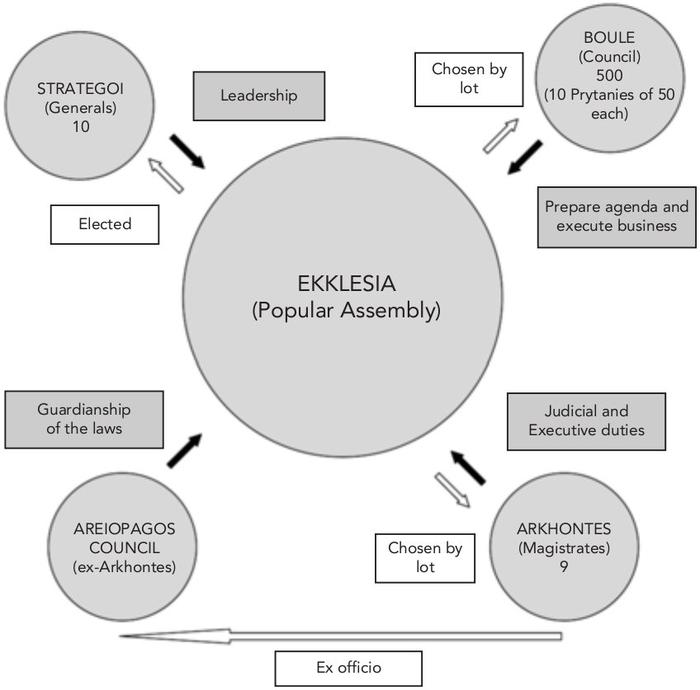
Figure 5.1 The Athenian Constitution
Whether Kleisthenes was cynically exploiting the people for selfish ends or truly committed to widening participation in the running of the State remains difficult to assess. Nevertheless he established the world’s first, and some would say only genuine democracy, and in the context of the ancient world this was a staggering innovation. Nothing remotely like this had existed anywhere ever before. There was still plenty of room for improvement and refinement, but the average Athenian citizen already had far more political power than any citizen of a modern democracy.
The Persian Wars
To the east of Athens’ fledgling democracy, some very disturbing events were taking place. The Persian Empire, ruled by Darius I (521–486 BCE), had become one of the most powerful in the ancient world, and it included the sophisticated Ionian Greek communities of Asia Minor. The Persians installed local tyrants; they levied tribute and taxes, but did not put this money back into local circulation; Ionian trade was up against serious outside competition; and the Greeks resented being subject to a barbarian (quite literally someone whose speech sounds to a Greek like ‘bar, bar, bar …’) monarch and ruled by tyrants at a time when tyranny was patently out of fashion. So in 499 BCE, led by a couple of adventurers called Histiaios and Aristagoras, they rebelled.
Aristagoras went to Greece to garner support and, although he got short shrift at Sparta, the Athenians and Eretrians agreed to send ships. The campaign started promisingly, with the Ionians burning Sardis in 498 BCE. Herodotus says that when Darius learnt of this, he asked who the Athenians were, then cried: ‘Grant, O God, that I may punish the Athenians’, and commanded one of his servants to repeat, ‘Master, remember the Athenians’, three times, whenever he sat down to dinner.11 However, the Persian king had greater resources and time on his side, whereas the Ionians were disunited and ineptly led. When the going got tough, both Aristagoras and Histiaios fled, and the issue was settled in a huge sea battle off the island of Lade near Miletos (494 BCE), where the rebels, rent apart by mutiny and desertion, were overwhelmed. Miletos was sacked, and Darius was left seeking further revenge.
Armed with ‘just grievances’, Darius moved to subjugate Greece itself. Herodotus tells of his wife Atossa wheedling him into invading Greece: (a) to prove himself as a man; and (b) to bring back exotic Greek slave girls to wait on her. In reality, however, expansionism was the default position of the Persian Empire. Two years after an abortive invasion attempt led by Darius’ son-in-law Mardonios in 492 BCE, in which the Persian fleet was devastated in a storm off Mount Athos, Darius demanded earth and water as tokens of submission from the Greeks. The Athenians threw his messengers into a pit; the Spartans pushed them down a well, and told them they could find earth and water there; but many Aegean islands submitted, including Aigine, which was near to, and at war with, Athens, and the Spartan king Demaratos defected to Persia.
The Persian force, commanded by Datis and Artaphernes, was said to be 600 ships strong, and included Hippias, the ex-tyrant of Athens. For Hippias, democracy was worse than collaboration with Persia: people like him were ruthlessly ambitious, hated being governed by other factions, objected to democracy putting their social ‘inferiors’ on a par with themselves, had no ideological objection to monarchy, were perfectly happy to side with a rival state to regain power, and did not feel that collaborating with the enemy was acting against the people, because their ‘people’ were their family, relatives and friends. The leading lights of the anti-Persian party were Themistokles, who as arkhon in 493 BCE had begun the fortification of Peiraieus, 5 km from Athens, in order to create a new naval base and commercial harbour, and Miltiades, a swashbuckling aristocrat who became strategos in 490 BCE after a spell as a tyrant in the Chersonese.
Avoiding Mount Athos, the Persians started at Samos, burned Naxos, spared Delos, took hostages, requisitioned troops, conquered Karystos and sacked Eretria. At this juncture the Athenians sent the first of their two ‘marathon runners’, Pheidippides, to Sparta to seek help. He covered the 260 km from Athens to Sparta in under two days, but the Spartans were genuinely unable to respond immediately, because of a religious festival.
In summer 490 BCE the Persians landed at Marathon, some 40 km north-east of Athens. They expected either that the Athenians would confront them there and lose, or that fifth-columnists would betray the city. It looked like a win–win situation. Miltiades is said to have persuaded the boule and the polemarkhos (‘war-arkhon’) Kallimakhos to march out to Marathon, and most sources say that there were 9,000 to 10,000 Athenians, plus 1,000 Plataians, mainly hoplites.
A stand-off then ensued. The Persians, who were not as heavily armoured as the Greeks, wanted to fight on the plain, where their formidable cavalry and archers would be most effective, but the Hellenes realized this, and remained in the hills covering the roads to Athens. The battle was precipitated when Miltiades was informed that, under cover of darkness, the Persians had started to embark their cavalry. He immediately ordered his men to attack ‘at a run’. This is an extraordinary testament to their strength and fitness, given the weight of the hoplite equipment and the distance they had to cover (some 1500 m), but the speed of their onslaught negated the effect both of the Persian archers and their cavalry. The Greeks were still vastly outnumbered, so to match the length of the Persian line they deliberately thinned the centre of theirs. Although they were pushed back in the centre, the Athenians on one wing and the Plataians on the other were both victorious. Having got the upper hand, they drew the two wings together, turned their attention to the Persians who had broken through in the centre, pursued the fugitives to their ships, where Kallimakhos was killed, and inflicted casualties reported at 6,400 dead; the Athenian losses were 192.
The danger was not over, though. The surviving Persian ships set sail for Athens, and the Athenians dispatched the man whose amazing running is commemorated in the modern marathon race. According to Plutarch, the herald, Eukles (or Thersippos) was somewhat late, and so ran to Marathon, fought in the battle, and afterwards ‘ran in full armour all the way to Athens hot from the battle, and bursting into the City Hall, could only say, “Good news! We’ve won!” and almost at once fell down dead’.12 The Greek forces managed to get to Athens before the Persians, at which point the invaders gave up and sailed for Asia. Miltiades, the Marathon-men and Athens revelled in the glory; Darius yearned for revenge; the Spartans arrived late, surveyed the battlefield, and went home.
Miltiades died of gangrene the following year, having been wounded in an ill-fated military expedition against Paros, but in 483 BCE the Athenians struck a rich vein of silver at Laureion. By adept use of political spin, Themistokles persuaded the people to ostracize his rival Aristeides, and to spend the windfall on building 200 state-of-the-art warships called ‘triremes’. It was one of the most significant decisions the Athenians ever made.
Darius died in 486 BCE and was succeeded by his son Xerxes. Egged on by Mardonios, Demaratos of Sparta and the Peisistratids of Athens, the new king assembled a vast multinational force (5,283,320, including 10,000 of the elite Immortals, if we believe Herodotus), accompanied by a massive fleet. He constructed a bridge of boats across the Hellespont; bridged the Strymon River; installed supply depots along the coast; dug a canal through the Mount Athos peninsula; and sent envoys all over Greece, except to Athens and Sparta, with a demand for earth and water. Many of these states sided with the Persians and thus, remained neutral or dithered. The Delphic Oracle delivered prophecies so pessimistic that the Athenian oracle-seekers refused to go home until they got better ones. The new improved version, reports Herodotus, told them that ‘the wooden wall only shall not fall’13 and that ‘Divine Salamis’ would bring death to women’s sons. The key Greek states met at the Isthmus of Corinth and created an anti-Persian league. Later, thirty-one communities added their names to the Serpent Column, a victory monument in the form of three intertwining snakes, which was dedicated at Delphi and is now in the Hippodrome in Istanbul, having been taken there by the Roman Emperor Constantine.
Never before and never again did the Greeks display even such limited unity: Athens and Aigine buried their differences and combined their large navies; the Athenians recalled their exiles; and Sparta was given the high command in both the military and naval spheres.
The Greek strategy was to confine the Persian forces in restricted areas like mountain passes and narrow waterways, and threaten their supply line. Having rejected the valley of Tempe in the north, the Greek army made its stand with 7,000 hoplites under the Spartan king Leonidas at the pass of Thermopylai in central Greece, while the fleet took up a position at nearby Artemision to stop the Persians landing forces in their rear.
Xerxes’ frontal assault was a disastrous failure, until a traitor, Ephialtes, showed him a mountain track that led round to the rear of the Greeks. Leonidas dismissed the troops, remained in the pass with his 300 Spartan warriors, and was overwhelmed in a heroic last stand that earned him an immortal place among military heroes. The courage of the Spartan warriors is exemplified by Dienekes, who, on being told that when the Persians shot their arrows there were so many of them that they hid the sun, responded: ‘This is pleasant news. If the Persians hide the sun, we shall fight in the shade.’14
Meanwhile, indecisive naval actions were conducted at Artemision until a storm inflicted significant damage on the Persian fleet. However, the setback at Thermopylai forced the Greek fleet to retreat south. Those Athenians who interpreted the ‘wooden wall’ oracle as meaning they should defend themselves on the Akropolis, eventually lost their lives when the Persians sacked the city in September 480 BCE; Themistokles allegedly argued that the ‘wooden wall’ was the navy, and that ‘Divine Salamis’ would bring death to the Persians, and he convinced the allies that the best place to fight was in the narrow waters by that island. Tradition also has it that Themistokles sent a slave with a message to the enemy that the Greeks were at daggers drawn with each other, had many pro-Persians amongs them, and were about to row for their lives under cover of night.
Assuming the authenticity of the tale, the deception worked. Herodotus, Aeschylus and Plutarch all show pro-Athenian bias, and it is difficult to get at the truth underlying the Greek tactics. There were valid reasons for not wanting to engage: the Greek fleet was pretty inexperienced; the Persian fleet included highly regarded Phoenician and Egyptian contingents; the last time the Greeks and Persians had fought at sea was at the Battle of Lade – a comprehensive Persian victory; the Greek fleet had not been keen to seek a showdown at Artemision; and hindsight is always 20/20. It may be erroneous to assume that this had been the Greek plan all along.
The Persian-Egyptian squadron was probably sent to surround the Greeks via the western exit from the bay of Eleusis, while from the base of Mount Aigaleos, Xerxes watched his mammoth fleet move into the confined space between Salamis and the mainland. As the Persians advanced they lost formation, while Themistokles exploited local knowledge by waiting for the wind to whip up a heavy swell. The taller Persian vessels became awkward to manoeuvre, whereas the Greek ships were comparatively small and lay low in the water. Aeschylus, who may have fought in the battle, dramatized the scene brilliantly in a speech by a Persian messenger to Xerxes in his tragedy The Persians:
At once ship into ship battered its brazen beak.
… But soon, in that narrow space,
Our ships were jammed in hundreds; none could help another.
They rammed each other with their prows of bronze; and some
Were stripped of every oar. Meanwhile the enemy
Came round us in a ring and charged. Our vessels heeled
Over; the sea was hidden, carpeted with wrecks
And dead men; all the shores and reefs were full of dead.
Then every ship we had broke rank and rowed for life.
The Hellenes seized fragments of wrecks and broken oars
And hacked and stabbed at our men swimming in the sea
As fishermen kill tunnies or some netted haul.15
With his plans in tatters Xerxes returned to Asia Minor, but left the land forces in Greece under the control of Mardonios. The Spartans eventually put together the largest force ever to leave the Peloponnese under the regent Pausanias. With the combined Hellenic army numbering around 100,000, Mardonios withdrew to a defensive position near the Boiotian town of Plataia (479 BCE). The terrain there suited his cavalry, and the armies stood facing one another for days. Eventually, though, disputes within the Persian high command prompted Mardonios to attack in conditions favouring the Greeks. The battle was a close-run thing, but the discipline, fighting ability and weaponry of the Greek hoplites prevailed; Mardonios was killed.
Herodotus also relates that the Persians suffered another defeat on the same day at Mykale on the Ionian coast. The Persian threat to the Greek mainland was over.
The Pentekontaetia
The period from 479 to 431 BCE is called the Pentekontaetia (= ‘Fifty Years’, even though it isn’t exactly fifty years). To Sparta’s annoyance, Themistokles got the Athenians to rebuild their walls, reinforcing this symbolic rejection of the Spartan’s traditional hegemony by telling them that it was only on the basis of equal strength that fair discussions on the common interest could be held. In some regards, the two states were polar opposites: Athens was an Ionian democratic sea power known for its energy, artistic innovation, and creativity; Sparta was a Dorian oligarchic land power with a reputation for austerity and lack of initiative. However, there was no direct clash of interests at this stage, since Sparta’s formidable alliance (the Peloponnesian League) was not geared up for extensive overseas activity, while Athens’ focus was on the Aegean Sea.
After the Battle of Mykale the allies then sailed to the Hellespont to destroy Xerxes’ bridges, only to find that this had already been done. The Spartan king Leotykhidas wanted to head home, while the Athenians wanted to regain the Chersonese area because of its significance to their corn routes; so they parted company. The Athenians laid siege to Sestos, and its fall in 478 BCE virtually ended the war in Europe. That summer, Pausanias commanded successful operations against Cyprus and Byzantium, but he started to behave like a Persian tyrant, which prompted the allies to appeal to the Athenian admiral Aristides for protection. When Pausanias was recalled to Sparta, the allies refused to accept another Spartan as leader, and Aristides emerged as commander. The Spartans then debated their options and, since it was looking like the leading light in Athenian politics would not be Themistokles, whom they distrusted, but Kimon, who was more sympathetic towards them, they allowed the ephor (Spartan ‘official’) Hetoimaridas to persuade them to opt for compromise solution entailing acquiescence to Athenian sea power but expansion of Spartan interests outside the Peloponnese on land. In the light of these events, a new voluntary confederacy, under Athenian leadership, was constituted in the winter of 478/7 BCE on the island of Delos. What is now called the ‘Delian League/Confederacy’ was then known as ‘Athens and her allies’, and comprised around 150 members drawn from the Ionian cities of Asia Minor, the Hellespont and the Propontis, plus most of the islands in the Aegean. No mainland Greek states were founder members of the League, nor were any states to the west. An oath was taken that they would have the same friends and enemies, and to confirm this they sank wedges of red-hot iron in the sea. Only when the metal floated to the surface would the alliance lapse. The immediate aim was to recoup their losses by ravaging the territory of the King of Persia, but the longer-term objective had to be to preserve Greek freedom from any future Persian aggression.
League policy was decided at meetings held on Delos on a one-state-one-vote basis, although in practice Athens dominated: ten Athenian officials called Hellenotamiai supervised the contributions to the League’s finances, and Athens decided who should contribute ships and who phoros, or ‘tribute’. The first financial assessment, totalling 460 talents, was conducted by Aristeides, and after 454 BCE the phoros was paid to the Hellenotamiai, who deducted one-sixtieth of each state’s contribution (called theaparkhe) and dedicated it to Athena, recording the figures on marble inscriptions. Right from the beginning the Athenians had the wherewithal to turn this alliance into an empire, but, with the Persian threat still the main worry, no one seems to have considered that eventuality.
Everything went smoothly at first, despite Themistokles being ostracized around 472 BCE and, after a brief stay in Argos, ending up, ironically, with the King of Persia. His place was taken by Kimon, son of Miltiades, and under his leadership the Delian League scored some impressive successes, although not just against Persia – there also were actions against its own members, and coercion of other Greek states. The maverick Spartan Pausanias was expelled from Byzantium; Eion, the last major Persian stronghold west of the Hellespont, was captured, followed by Skyros, a pirate base in the north Aegean, which the Athenians colonized – it was on their corn route from the Black Sea. Here a large skeleton was discovered, which, it was claimed, was the remains of the Athenian hero Theseus. Karystos was made to join the Delian League by force in c.472 BCE, and Naxos was the first League member to be ‘enslaved’16 when it tried to withdraw in 469 BCE. The island was forced back, lost its fleet and was made to contribute money, which the Athenians spent on their own navy, presumably justifying their response on the basis of the permanence of the alliance and the ongoing war against Persia. Still, the war was undoubtedly progressing well: Kimon won a resounding victory at the river Eurymedon on the south coast of Asia Minor in 468 BCE, effectively destroying both the Persian fleet and with it any threat to the Aegean. The nearby city of Phaselis was ‘persuaded’ to join the League, and by around 466 BCE the Delian League had achieved unquestioned command of the sea, and acquired vast quantities of booty.
At Sparta things were not so good. There was no king from either of its two royal dynasties to provide positive leadership at this period. Pausanias governed on behalf of the Agiad king Pleistarkhos, who was a minor, but after being expelled from Byzantium for a second time, and unsuccessfully conspiring to change the Spartan constitution, he ended up walled up in a temple to die. When Pleistarkhos came of age he promptly died childless, and was succeeded by his nearest male relative, Pleistoanax, who was a boy of only nine or ten. To make matters worse, Leotykhidas King of the Eurypontid dynasty was exiled after an unsuccessful military expedition in 477 BCE, and, since his son was dead, his grandson Arkhidamos, who was only a boy, assumed the throne. Not surprisingly, the Spartans gave less consideration to Athens than they might have done, especially as they also had to cope with a number of other challenges from within the Peloponnese. When their long-standing enemy Argos effected a constitutional reform from oligarchy to democracy, there was great alarm at oligarchic Sparta. There was also unrest that resulted in all the Arcadian communities (except Mantineia) making an alliance with Argos. Democracy was gaining impetus elsewhere, too: at Elis there was a ‘synoecism’ of the surrounding villages in c.470 BCE, and a walled city with a democratic constitution on the Athenian model was set up; and Sparta’s loyal ally Mantineia underwent a similar process.
By the mid-460s BCE, though, the unrest in the Peloponnesian League had subsided and Sparta’s kings had reached maturity. Focusing on Athens again, the Spartans disliked what they saw and, when the island of Thasos seceded from the Delian Confederacy, they promised to invade Attika, although the promise was never fulfilled because a violent earthquake struck Sparta in 464 BCE. By the following year the Athenians had forced the island back into the League, and Sparta had a Helot revolt on its hands. Although they forced the rebels to take refuge on Mount Ithome in Messenia, the Spartans still appealed to Athens for help, and in 462 BCE the pro-Spartan Kimon persuaded the Assembly to send a force, led by himself. Unfortunately for him, they were almost instantly dismissed from the siege because of Athenian neoteropoiia (= ‘subversive tendencies’), and the consequent loss of face led to Kimon’s ostracism in 461 BCE. The beneficiaries of this were Ephialtes, who had opposed sending help to Sparta, and Perikles. The immediate result was the First Peloponnesian War (461–446).17
Thucydides wrote that:
Perikles, by his position, intellectual ability and manifest incorruptibility, exercised a free control over the commoners: he led them instead of being led by them … Theoretically Athens was a democracy; in practice power was in the hands of the first citizen.18
Paradoxically Perikles rendered the Athenian democracy ‘theoretical’ by maintaining the confidence of the electorate. He ultimately served as one of the ten strategoi (= ‘generals’), who were elected, not selected by lot, and could be reappointed annually, fifteen times in succession. In 461 BCE he was associated with Ephialtes in stripping the Areiopagos of its key judicial and political powers, and when Ephialtes was assassinated Perikles further radicalized the democracy by introducing state payment for jurymen and other officials, thereby enabling participation for all, regardless of their background. He also introduced tighter restrictions on Athenian citizenship, which actually excluded his third son (also called Perikles): his mistress, the glamorous, exotic, morally dubious Aspasia of Miletos, who had a high reputation for her seminars on public speaking, and a low one because she trained prostitutes, gave birth to Perikles junior after the law was passed – having a foreign mother disqualified the boy from citizenship. However, the Athenians waived the rules – a clear indication of the esteem in which Perikles was held.
He also masterminded the impressive ‘Periklean Building Programme’, with the aim of glorifying Athens, and providing employment for the masses. The buildings included the Parthenon, the Hephaisteion, the Temple of Poseidon at Sounion and the Propylaia, the seminal influence of which on world art remain unquestioned. Perikles himself said:
Mighty indeed are the marks and monuments of our empire which we have left. Future ages will wonder at us as the present age wonders now.19
Prophetic words indeed.
Hostilities broke out between Athens and certain Peloponnesian states in 461 BCE. Megara reneged on its alliance with Sparta because of a border dispute with Corinth and joined the Delian League, giving Athens control of Megara’s ports, but contributing to Corinth’s sphodron misos (= ‘bitter hatred’) for Athens. In 459 BCE the Athenians overcame their long-standing rival Aigine, ‘the eyesore of the Peiraieus’,20 and deployed Delian League contingents when they themselves were defeated at the Battle of Tanagra in Boiotia in 457 BCE. However, the Athenians later defeated the Boiotians at Oinophyta, then forced Boiotia and Phokis to join the Delian League. They also began the construction of two ‘Long Walls’ joining Athens to its ports, from where Athenian ships sailed to burn the Spartan dockyards at Gytheion, capture the Corinthian city of Khalkis, attack Sikyon, gain control of the south side of the Gulf of Corinth, and bring the cities of Akhaia into their alliance, along with Segesta and Leontinoi in Sicily, and Rhegion in Italy.
This probably represents the zenith of the Athenians’ power, but in c.460 BCE they had got embroiled in an expedition to Persian-controlled Egypt. King Inaros of Libya had fomented a revolt there, and the Athenians sent a force to help. Initially they had the upper hand, but the Persian government eventually defeated the Delian League forces in the summer of 456 BCE, and blockaded them on the island of Prosopitis on the Nile, which fell after eighteen months. This may not have been the gigantic disaster that Thucydides implies, but nevertheless there was no more Athenian intervention in the affairs of Egypt. A knock-on effect of this was that in 454 BCE the Delian League treasury was moved to Athens, which became the de facto headquarters of the League. Kimon was recalled from ostracism, a five-year truce was signed with Sparta, and Athens turned its focus to Persia.
In 451 BCE Kimon fell ill and died while campaigning in Cyprus. It is possible that a treaty known as the Peace of Kallias was signed between Athens and Persia in spring 449 BCE, effectively ending hostilities and freeing Athens to concentrate on its own empire, but it may be that no such agreement ever existed – scholarly debate revolves around the possibility of a notorious ‘missing’ entry for 449/8 BCE on the first stele of the tribute quota lists that record the aparkhe paid to Athena from 454/3 to 440/39 BCE – but, if it did, it stipulated that the Aegean Sea was to belong to the Delian League, while Egypt and Cyprus were to belong to Persia, with the Asia Minor seaboard as a sort of ‘demilitarized zone’. So now the Athenians faced a dilemma: the Delian League’s objectives had essentially been fulfilled, yet the alliance was forever. Should they disband it and lose their tribute, or insist on its permanence at the cost of goodwill of the allies? It was a no-brainer. Their democratic system was based on the principle of payment for those who served – on the Council, as magistrates, on juries or in the fleet – and someone had to fund the Periklean building programme. There were too many vested interests, and seventeen years later they justified themselves with brutal honesty:
We have done … nothing contrary to human nature in accepting an empire when it was offered to us and then in refusing to give it up. Three very powerful motives prevent us from doing so – security, honour and self-interest.21
However, by the early 440s BCE the Athenian land-Empire was on shaky ground: in 447 BCE the Boiotians defeated them in battle at Koroneia; the following year Euboia revolted, as did Megara; and with the five-year truce with Sparta coming to an end, King Pleistoanax briefly invaded Attika. Peace negotiations followed, and in 445 BCE Perikles and Pleistoanax signed the Thirty Years Peace (which actually lasted for only fifteen years). It appears that Athens agreed to give up its land empire, but was allowed to keep Naupaktos and Aigine despite Corinthian protests. Athens recognized Spartan supremacy on land, and Sparta acknowledged Athens’ hegemony of the Delian League. Neither side would assist revolts by states in the other side’s sphere of influence, and neutral states were to be free to join either bloc.
A kind of ‘Cold War’ thus developed. Not everyone at Sparta was in favour of the treaty, and there were serious reservations about it at Corinth, but the Athenians were pleased: the Delian League was inexorably shifting away from an equal partnership between the hegemon (= ‘leader’) and its allies towards authoritarian rule (arkhe) over subjects.
It was all a question of ‘attitude’. The Athenians used their allies in wars that had little to do with the Delian League, imposed garrisons on disloyal (or potentially disloyal) members, and installed endless officials in the process; Athenian citizens were settled in allied territory, either in colonies or in ‘cleruchies’ (kleroukhia = ‘a holding of plots of land’), where Athenians had the option of going to live, or staying in Athens and leasing out the land; certain religious cults were promoted, notably the worship of Athena Queen of Athens (Athena Athenon Medeousa) and the hero Ion (a mythical King of Athens); offerings of barley and wheat, cows, panoplies and phalluses were demanded at some Athenian festivals; legal cases between Athenian citizens and members of allied states were probably heard in Athens, and cases involving death or exile penalties (defacing Athenian imperial decrees or not paying tribute certainly were heard); the Athenians banned the minting of silver coinage by the allied states, and imposed an embargo on all non-Athenian coins; Athenian weights andmeasures were foisted on the allied states; and Athens generally preferred democracies and did not flinch from regime change in cases of revolts (or before possible ones). On the plus side, the allies achieved revenge and better protection against Persia, the benefits of peace, democratic governments and prosperity through increased trade.
Unsurprisingly, various states became disaffected, and Samos revolted in 440 BCE. In violation of the Thirty Years Peace, the Spartan assembly voted for war, but Corinth, which would have borne the brunt of any fighting, persuaded the Peloponnesian League to reject the proposal. The Athenian fleet, under the command of Perikles and others, including the playwright Sophocles, brought the Samians to heel. Thucydides (an Athenian) had little sympathy with them:
Because of their reluctance to face military service, most of them … had assessments made by which, instead of producing ships, they were to pay a corresponding sum of money. The result was that the Athenian navy grew strong at their expense, and when they revolted they always found themselves inadequately armed and inexperienced in war.22
But it was precisely this (over) confident imperialism that led Athens into the terrible PeloponnesianWar with Sparta.
The Peloponnesian War (431–404 BCE)
Never before had so many cities been captured and then devastated … never had there been so many exiles; never such loss of life.23
Despite Corinth’s refusal to go to war over Samos, its relations with Athens were not good. Decades of Athenian encroachment on areas under Corinth’s sphere of influence had generated that sphodron misos that Thucydides thought made war inevitable. He was really the first historian to analyse seriously the causes of a war:
I propose first to give an account of the causes of complaint (aitiai) which they had against each other and of the specific instances where their interests clashed … But the real reason (alethestate prophasis) for the war was, in my opinion, … the growth of Athenian power and the fear which this caused in Sparta.24
The first of these aitiai really had nothing to do with Sparta or Athens. In 435 BCE civil strife had arisen between democrats and oligarchs at Epidamnos, a colony of Kerkyra (Corfu), which in turn was a colony of Corinth, albeit with an attitude problem towards its mother city. The Epidamnian democrats appealed to Kerkyra, which refused to help, and then to Corinth, which did get involved. So the Kerkyraians sided with the oligarchs. The rival forces engaged in a naval battle that the Kerkyraians won, but, when the Corinthians threatened retaliation, Kerkyra appealed to Athens, which agreed to an alliance. Technically this was not a violation of the Thirty Years Peace, but the combined size of the Athenian and Kerkyraian fleets was extremely threatening to Corinth. Hostilities escalated when Athens sent ten ships to help Kerkyra. This was nominally in a defensive capacity, but when the Corinthians engaged the Kerkyraians at the Battle of Sybota (433 BCE), the Athenian ships inevitably got dragged into the fighting. Corinth accused Athens of breaking the Thirty Years Peace.
The following year a convoluted dispute arose involving Poteidaia, a Corinthian colony in north-eastern Greece that was also a member of the Delian League. Concerned that the Poteidaians might revolt and take the other cities of the area with them, the Athenians demanded that they dismantle their seaward walls and get rid of the magistrates who they still received from Corinth. Sparta threatened to attack Attika if Athens attacked Poteidaia; the Poteidaians revolted; Athens and Corinth both sent troops; and the Athenians won the battle that took place outside the city.
A debate then took place in Sparta; in practice, war could only be declared if Corinth and Sparta were united on policy, which they now were, especially since Corinth also threatened to ‘join a different alliance’ if Sparta did not act; some Athenians who happened to be in Sparta at the time urged the Spartans to seek arbitration under the terms of the Thirty Years Peace, and the moderate Spartan king Arkhidamos warmed to this proposal; the belligerent ephor Stheneliadas argued that the Athenians were the aggressors and that the Spartans should defend their allies; and the Spartan Assembly voted for war. The Peloponnesian League then ratified the decision, but Sparta still felt the need to establish a firm pretext for war, and delivered a series of ultimata, which Athens rejected. Among the issues they raised was the ‘Megarian Decree’ (or Decrees), which excluded the Megarians from all ports in the Athenian Empire and from the market in Attika itself, probably dating from the 430s BCE. In Aristophanes’ comedy The Acharnians(426/5 BCE) Dikaiopolis says:
It was Athenians … who started the whole thing … Some young chaps got drunk and, for a lark, went to Megara and kidnapped their tart Simaitha. Well, this raised the Megarians’ hackles, and they stole two of Aspasia’s girls in retaliation. And that, gentlemen, was the cause of the war … it was all on account of three prostitutes. Olympian Perikles … began making laws written like drinking songs [banning the Megarians from our markets]. Well, pretty soon the Megarians were starving by slow degrees, and not unnaturally asked their allies the Spartans to try and get the decree reversed.25
In Peace (421 BCE) Aristophanes depicts a Megarian farmer trying to sell his daughters dressed as piglets, which, as well as providing a rich source of double-entendre (in Greek ‘piggy’ carries a similar connotation to the English ‘pussy’), may also illustrate the effects of the Athenian embargo. Sparta may have feared that these bullyboy tactics would lead to Athens picking off her allies one by one, and, although Perikles seemed willing to submit to arbitration, he attached so many conditions that negotiations were replaced by hostilities when the Thebans attacked Athens’ ally Plataia in 431 BCE.
The Peloponnesian War was a ghastly conflict. Like many warring states, Athens and Sparta entered the fray without a clear vision of what the war would entail. Perikles’ strategy was to avoid direct confrontation with Sparta on land, keep the sea lanes open, harass the enemy and maintain Athens’ grip on the empire. The Spartans thought that all they had to do was to invade and devastate Attika, which would lead either to the Athenians surrendering or to a battle, which they were confident of winning. However, the Athenians simply sheltered behind the Long Walls, sent their livestock to Euboia, imported their necessities by sea, and retaliated by invading Megara’s territory and ravaging the Peloponnesian coasts. The drawbacks of this policy were the astronomical cost of keeping the navy at sea; the competing vested interests between the farmers and landowners who lost their livelihoods, and the urban population who even benefited financially from naval service; the demoralising nature of the strategy; and worst of all the plague that hit Athens in 430 BCE, which may have killed 30 per cent of the population, including Perikles in 429 BCE. After Perikles’ death, a much more aggressive, but less coherent, strategy was promulgated by Kleon (of whom most of our sources disapprove deeply). More tribute was levied from the allies (almost a 300 per cent increase by 425 BCE), and revolts were handled uncompromisingly. At home Kleon increased the fees of jurymen, who could be useful allies in politically motivated court cases, from two to three obols, and conducted a zealous campaign to ensure that democracy was respected by the magistrates.
The fighting of 429 BCE took place mainly in north-west Greece, although the Athenian admiral Phormio won sea battles in the Gulf of Corinth. The following year Mytilene revolted from Athens but was forced to surrender in 427 BCE. Influenced by Kleon, the Athenian Assembly dispatched a ship with orders to execute the entire adult male population of Mytilene and enslave the women and children, but then had second thoughts: the dramatic ‘Mytilenean Debate’ followed, with Kleon pushing to keep the death penalty. Still, the Athenian people reversed their decision, and sent a second vessel that arrived in the nick of time to prevent the massacre. But, in general, 427 BCE was a particularly grisly year. It witnessed a vicious example of civil strife between the oligarchs (looking to Sparta) and democrats (looking to Athens) at Kerkyra, and the fall of Plataia, where the Spartans perpetrated what the Athenians had shrunk from doing at Mytilene. Meanwhile, Athens sent a small fleet to Leontinoi in Sicily, and their general Demosthenes defeated the Spartans at Olpai in 426 BCE, destroying all Spartan credibility in the north-west and underlining that the Corinthian colonies there could not rely on Spartan support.
In 425 BCE, when a storm forced the Athenian fleet to take refuge on a promontory at the bay of Pylos in the south-west Peloponnese, Demosthenes established a fortified base there. When the Spartans encamped on the promontory and landed troops on the island of Sphakteria opposite, he sent home for reinforcements. These managed to cut off the contingent on Sphakteria. Negotiations for the release of these men were scuppered by Kleon, but as winter approached it began to look as if the Athenians might not achieve anything. Losing popularity, the adept demagogue put the blame on Nikias, one of the generals, and boasted that if he were in command he would easily capture the Spartans. Nikias called his bluff, and Kleon got lucky. The Spartans found themselves blockaded, asked their leaders what to do, and were told: ‘Make your own decision about yourselves, so long as you do nothing dishonourable.’26 To everyone’s astonishment, they surrendered. The Athenians used their 120 prized hostages to prevent further attacks on Attika. So the Spartans adopted a strategy suggested by their brilliant commander Brasidas, and tried to stir up revolts amongst Athens’ allies on the northern Aegean seaboard.
Kleon’s domination lasted until 424 BCE, when a scheme to conquer Boiotia came to grief, and Amphipolis was captured by Brasidas, who also detached thirteen states from the Delian League. These setbacks shocked the Athenians, and Kleon appears not to have been elected for the following year. By the spring of 423 BCE the Athenians and Spartans had made a one-year truce, but then news arrived that Skione had defected to the Spartan commander Brasidas, who refused to hand over the city. Kleon’s fortunes benefited from the outburst of warmongering that resulted at Athens, but only until a major battle fought outside Amphipolis in 422 BCE, in which he and Brasidas were killed. Nikias and Pleistoanax then negotiated the ‘Peace of Nikias’. This was to last for fifty years, but Corinth and Boiotia were against it, and Athens’ allies were never consulted. Its prospects were not good.
One persistent opponent of the treaty was a young Athenian aristocrat called Alkibiades. In 420 BCE he facilitated a new alliance with the anti-Spartan Peloponnesian poleis of Argos, Elis and Mantineia. The Spartans responded by defeating the coalition in battle in 418 BCE, effectively reducing the Peace of Nikias to a meaningless hunk of marble.
In 416 BCE Athens demanded that the neutral (though probably pro-Spartan leaning) island of Melos should join the Delian League. When the Melians refused, the Athenians slaughtered the adult males and enslaved the women and children. Having given a chilling insight into the ‘might is right’ ethic of their imperialism:
This is no fair fight, with honour on one side and shame on the other. It is rather a question of saving your lives and not resisting those who are far too strong for you.27
The next year Alkibiades persuaded the Athenians to launch a massive naval invasion of Sicily. He preyed on the Athenians’ fear that the rich and mighty city of Syracuse posed a security threat to them; Nikias opposed the idea, but, in an example of Greekdemocracy at its chaotic worst, the Ekklesia voted to send the greatest naval force ever to have left Greece, under the command of Alkibiades, Lamakhos and, of all people, Nikias. No sooner had it sailed than Alkibiades was recalled to face accusations of profaning the Eleusinian Mysteries (initiation ceremonies) and being involved in the ‘mutilation of the Hermai’, rectangular stone pillars with a bust of Hermes on the top, feet on the bottom and a set of erect male genitals in the middle. Whether as an act of sacrilege, political subversion or just as a ‘schoolboy prank’, someone had hacked off the statues’ phalluses. Guilty or not, Alkibiades was not willing to face trial; he defected to Sparta.
The Athenian fleet put Syracuse under siege, but Lamakhos got killed, the sickly, dithering Nikias lost the initiative, Alkibiades persuaded Sparta to send their general Gylippos to advise the defenders, and the Syracusans built a counter-wall that turned the Athenian besiegers into the besieged. Nikias asked for massive reinforcements, and to be relieved of the command, hoping that the scale of his request would induce the Athenians to abandon the expedition altogether. Yet the Ekklesia authorized the relieving force. Led by Eurymedon and Demosthenes the new troops tried to act quickly, but a night attack on the Syracusan counter-wall went catastrophically wrong. The Athenians decided to depart, but on the very night when they were going to leave, 27 August 413BCE, there was an eclipse of the moon. The diviners decreed that the Athenians should wait ‘thrice nine days’, during which the Syracusans defeated them, killed Eurymedon in the harbour, blocked them in with boats, chains and bridges, and finally crushed them on 9 September. Nikias was forced to surrender, and he and Demosthenes were undoubtedly executed. Some 7,000 PoWs were incarcerated for months in Syracuse’s stone quarries, although there are stories of some Athenians winning their liberty through reciting excerpts of Euripides to their appreciative captors.
Sicily was a shattering defeat for Athens. Even while the expedition was under way the Spartans had established a fortified base at Dekeleia only a few kilometers from Athens, on Alkibiades’ advice. Because of this, agricultural work was now prohibitively dangerous, Athens became far more dependent on imported food, and the economy suffered a blow as some 20,000 slaves from the silver mines at Laureion ran away to the Spartan camp. Also, the Persian satraps (governors) Tissaphernes (Sardis) and Pharnabazus (Hellespontine Phrygia) started to foment unrest among Athens’ allies and to fund a new Peloponnesian League fleet. Egged on by Alkibiades, numerous states revolted from the Delian League, threatening Athens’ cornroutes to Egypt and the Black Sea. To make things worse, under the Treaty of Miletos the Spartans granted the Persian king dominion over all the territory that had belonged to him and his forefathers: Ionia was back to where it had been before the Persian invasions.
Yet the Athenians were nothing if not resilient. They dipped into their emergency reserve funds, rebuilt their fleet, trained new crews and by 411 BCE they were generally holding their own along the Anatolian coast. Domestically, though, they were in turmoil. An oligarchic-leaning group, including Antiphon, Peisandros and Phrynikhos, asserted that they could handle Athenian policy more effectively than the democracy, and Alkibiades promised that he would broker an alliance with Tissaphernes on condition that Athens become an oligarchy. A return to Athens was becoming rather urgent for Alkibiades because the negotiations with the Persians were making the Spartans suspicious of him, especially King Agis, with whose wife Alkibiades was having an affair. The oligarchs ratcheted up the fear, manipulated the Ekklesia’s lust for Persian gold, and in 411 BCE they got it to replace all the existing magistracies with ‘the Four Hundred’, who would have absolute authority. The Four Hundred were supposed to choose 5,000 men as an Assembly, but they never did.
This oligarchic regime only lasted from June to September. The Athenian fleetwas stationed at Samos and its democratic sailors, urged on by Thrasyboulos and Thrasyllos, who also brought Alkibiades on board, threatened to restore the democracy by force. Before this could happen, though, a ‘moderate democracy/mixed oligarchy and democracy’, dubbed the Five Thousand Legislators, was set up. The system was championed by Theramenes, who earned himself the nickname Kothornos (‘Buskin’ – a boot that fits either foot).
The incoming government voted to recall Alkibiades, but he delayed returning. Under him, Thrasyboulos and Theramenes, the Athenian fleet defeated the Spartans and Pharnabazus in 410 BCE at Cyzicus, killing the Spartan commander, and intercepting a typically (and literally) laconic dispatch from the defeated Spartans: ‘Ships lost. Mindaros dead. Men starving. Don’t know what to do.’28
The victory resulted in the restoration of democracy at Athens. Its most prominent leader was Kleophon, an uncompromising imperialist who instituted the famous ‘two-obol payment’ (for what, we do not know), restarted the building programme on the Akropolis, and rejected a Spartan peace proposal. In retrospect, the Athenians should have accepted this. Alkibiades finally made his long-awaited return to Athens in the summer of 407 BCE, but his honeymoon period was brief. With Persian finance the Spartans constructed the biggest fleet they had had for years, and in spring 406 BCE their commander Lysander captured fifteen Athenian ships at Notion, near Ephesus, and Alkibiades was held accountable. Again he went into exile. Konon took over, only to be defeated and blockaded in the harbour of Mytilene. The Athenians melted treasure from their temples, promised slaves their freedom and resident aliens citizenship, sent out 150 triremes, and won an amazing victory off the islands of Arginousai. And then it all went horribly wrong. Adverse winds prevented the rescue of some crews; a blame-culture arose; politicians got involved; popular hysteria took hold; and all eight Athenian commanders were condemned to death (even Perikles’ son was among those executed).
Again the Spartans offered peace; again the Athenians rejected it. Lysander negotiated further money from Persia, practically became satrap of Sardis, and rampaged over the Aegean before reaching Lampsakos on the Hellespont in the late summer of 405 BCE. Konon’s Athenian fleet beached at Aigospotamoi across the strait, but Lysander surprised his complacent and predictable adversaries while they were eating. The mighty Athenian navy was destroyed practically without a fight.
Athens did not fall immediately, but famine eventually forced the issue. The surrender came in the spring of 404 BCE. The Spartans installed a collaborationist regime of anti-democratic Athenian aristocrats, who became known as the Thirty Tyrants. Repressive and unpopular, they were ousted by a pro-democracy movement led by Thrasyboulos in 403 BCE, which quite remarkably then proclaimed the most famous ancient ‘amnesty’ (arguably the first in Western history).
Athens was again a democracy, but was economically and militarily shattered. The city remained a centre of intellectual creativity, although it was not always tolerant of its creative intellectuals. In 399 BCE Socrates was impeached on nebulous charges of ‘refusing to honour the gods honoured by the state, introducing new divinities, and corrupting the youth’, found guilty, and met his end by drinking hemlock. Revolutionizing Greek thought had cost him his life, and, with the death of the man that Plato dubbed ‘the best man of his time in wisdom and justice’,29 we come to the end of an era.
Notes – Chapter 5
1. Aristotle, Politics 1327b, trans. T.A. Sinclair, in Aristotle: The Politics, Harmondsworth: Penguin, 1962.
2. Thucydides, I.142.
3. Greek agora = ‘market’.
4. Elegies, 53 ff., trans. J.B. Bury and R. Meiggs, A History of Greece to the Death of Alexander the Great, 4th rev. edn, London: Macmillan, 1975, 113.
5. Aristotle, Athenaion Politeia, 5.
6. Plutarch, Solon 24, trans. I. Scott-Kilvert in The Rise and Fall of Athens: Nine Greek Lives, Harmondsworth: Penguin, 1960.
7. Aristotle, Athenaion Politeia 8.1. The previous system had been simply by hairesis (direct election).
8. Herodotus, 1.59.
9. Ibid., 1.61.
10. Ibid., 5.66; cf. Aristotle, Athenaion Politeia. 20.1: ‘he attached the people to his following, by proposing to give political power to the masses’.
11. Herodotus, 5.105
12. Plutarch, Moralia, 347C.
13. Herodotus, 7.141. The actual authenticity of this post eventum oracle is highly questionable.
14. Ibid., 7.226
15. Aeschylus, The Persians, 408 ff, trans. P. Vellacott, in Aeschylus: Prometheus Bound, The Suppliants, Seven Against Thebes, The Persians, Harmondsworth: Penguin, 1961.
16. Thucydides, 1.98.
17. It is important not to confuse the ‘First Peloponnesian War’ of 461–446 BCE with The Peloponnesian War of 431–404 BCE.
18. Thucydides, 2.65, trans. R. Warner, in Thucydides: History of the Peloponnesian War, Harmondsworth: Penguin, 1972.
19. Ibid., 2.41
20. Aristotle, Rhetoric 1407a.
21. Thucydides, 1.76, trans Warner, Thucydides.
22. Ibid., 1.99. Cf. Plutarch Kimon 11.
23. Ibid., 1.23.
24. Ibid.
25. Aristophanes, The Acharnians, 514 ff., trans. A.H. Sommerstein, in Aristophanes: The Acharnians, The Clouds, Lysistrata, Harmondsworth: Penguin, 1973.
26. Thucydides, 4.38, trans. Warner, Thucydides.
27. Ibid., 5.101
28. Xenophon, 1.1.23.
29. Plato, Phaedo, 118a 16 f.