
11
The Death of Artaxerxes III, Reign of Artaxerxes IV, and Accession of Darius III
The death of Artaxerxes III and the period of transition to Darius III’s accession is marked by treachery and violence – in other words, at least according to the Classical tradition, the norm. It may be more appropriate, if less dramatic, to grant that the circumstances of the succession remain elusive. A Babylonian astronomical tablet contains the laconic note that Umakush (the Babylonian name of Artaxerxes III) “went to his fate” (Akkadian ana  imtiu illik). This is standard Babylonian wording for a death often understood to be from natural causes, though that understanding here stems mainly from the direct contrast to the wording used on the same type of tablet for Xerxes I’s assassination by his son (p. 157). Artaxerxes III died sometime between late August and late September of 338 BCE, and he was succeeded by his son Arshu, the Arses of Classical sources who took the throne name Artaxerxes IV.
The terse reference in the astronomical tablet stands in stark contrast to Diodorus (17.5.3–6), who indicates that Artaxerxes III was murdered. Bagoas, a eunuch and a chiliarch (a high-ranking military official), poisoned Artaxerxes, because the king “behaved forcefully and violently toward his subjects.” Bagoas then elevated Artaxerxes’ youngest son, Arses, to the kingship. Bagoas did not stop there: he slaughtered the young king’s brothers with the intent of isolating Arses and making him easier to control. Arses, not surprisingly, reacted negatively to Bagoas’ power play, so Bagoas killed the new king and his family during his third year of reign (336 BCE). Because the royal house was bereft, Bagoas installed as king one of Arses’ “friends” – in reality, a second cousin of Arses – who became Darius III. Bagoas subsequently turned on Darius as well and poisoned his drink. But Darius got wind of the plot and invited Bagoas to drink first, as a token of his friendship, and thus the conniving eunuch met his end.
There are a number of problems with Diodorus’ account. The consistent stereotype in Classical sources of the powerful eunuch gives one pause to consider what level of literary license Diodorus (or his source) may have taken with this sequence. It is hard to accept Bagoas as a kingmaker, especially one who had a hand in the death of two kings over four years and attempted to end the life of a third. A Babylonian text, however, complicates a glib dismissal of Diodorus’ account. Written in the style of a prophecy, the text lists major events that occurred during the reigns of Achaemenid kings.1 For the reign of Artaxerxes IV there is a fragmentary reference to the murder of the king by a sha reshi official, the Akkadian term that has been frequently translated as “eunuch.” This text provides a potential link to Diodorus’ Bagoas, although the Babylonian text does not provide the official’s name or any other details. The prophecy then says that a prince will seize the throne, and it accurately relays Darius III’s five-year reign in Babylonia, from 336 until Alexander the Great’s capture of Babylon after Gaugamela.
To return to the Classical tradition, both Diodorus (17.6.1–2) and Justin (10.3.2–5) trace the future-king Darius III’s name and reputation to his good service and bravery during Artaxerxes III’s war against the Cadusians in northern Iran, during which he slew one of their champions in single combat. Justin names him “Codomannus,” and from the context it is clear that this Codomannus is the future Darius III; that name is sometimes used in modern works to identify him as Darius Codomannus. Babylonian documentation suggests that Darius III’s original name was Artashata. We know little more about him before he became king, beyond the small but significant detail that he was from another branch of the royal line. He was the son of Arsanes, the son of Ostanes, who was a brother of Artaxerxes II. Justin further indicates that Codomannus was a satrap in Armenia, which, if accurate, indicates that the future Darius III had military forces at his immediate disposal. Justin omits entirely the reign of Artaxerxes IV from his account; therein Codomannus became Darius III right after Artaxerxes III died. There are no surviving royal inscriptions attributable to Artaxerxes IV or Darius III, and the telescoped account in the Classical tradition reminds us again of the precarious nature of much of our knowledge.
Macedon Rising
The history of the kingdom of Macedon, north of Greece, is obscure before the mid-fourth century BCE. In the late sixth and early fifth centuries, the Macedonian king, having given earth and water to Darius I, was a Persian vassal (see p. 83). Macedon’s status vis-à-vis Persia after Xerxes’ invasion, when Persian holdings in Europe were reduced, is unclear. Macedonians were not Greek, although the ruling family and elites were thoroughly Hellenized, and they shared cultural and political ties with Greek city-state neighbors to the south. Macedon, however, was not a city-state but rather a kingdom, one with extensive natural resources and manpower.
In the mid-fourth century, the dynamic and aggressive Philip II (reigned 359–336 BCE) expanded Macedonian power in southeastern Europe through alliance and conquest. Philip reformed the Macedonian army based on Greek phalanx warfare, an improvement over the militias that Macedon had relied on in the past. Members of the highly trained phalanx wore armor and helmets and carried a small shield and short sword. The greatest effect came from employment of the sarissa, a long spear or pike that could measure more than sixteen feet. Macedonian cavalry was a force with which to be reckoned, but it was the phalanx that Philip employed to overcome his Greek enemies and that Alexander subsequently used in Asia. Over the course of the 350s and 340s, Philip extended his influence into Greece proper. Athens and other Greek city-states were determined to resist him, despite Philip’s greater numbers and resources. Ironically, that meant seeking Persian assistance; parallels with the situation on the eve of Xerxes’ invasion are many. Philip, however, was already at Greece’s doorstep. With his victory at the Battle of Chaeronia in 338, Philip became master of Greece. While we have massive amounts of Greek material charting Philip’s activities there, we cannot track Persian reactions to Philip’s rise – although the Persians would have monitored his activities closely.
The slim evidence we do have for Persian-Macedonian interaction during this period is often problematic, a function of the paucity of sources and their biased nature. One often cited example is found in Arrian’s Anabasis (2.14). In the aftermath of Darius III’s defeat by Alexander at Issus (see discussion later in this chapter), Darius purportedly sent Alexander a letter that alluded to the friendship and alliance between Artaxerxes III and Philip, mentioned an unspecified injustice that Philip committed against Arses (Artaxerxes IV), and accused Alexander of not renewing the alliance but instead invading Asia. Alexander’s indignant response lambasted Darius for Persian military aid given to the city of Perinthus, a Persian force sent by Artaxerxes III into Thrace (considered by Alexander and Philip to be Macedonian territory), and Persian support for the plot that resulted in Philip’s assassination. Any of these would be big news if confirmed, but the whole exchange appears to be a piece of Macedonian propaganda. Most of the assertions in the letter exchange must be treated with skepticism – as parts of a rhetorically charged context – given that the only verifiable accusation is Persian support for Perinthus in 340/339 BCE.
Perinthus was located on the northern (European) shore of the Propontis, an Athenian allied city that had resisted Philip’s expansionism in Thrace and thus found itself besieged. Some speculate that Philip eyed this city and others nearby, such as Byzantium (modern Istanbul), as strategic holdings from which he could threaten Athens’ grain supply. When word of the siege reached Artaxerxes III, the king sent instructions that provided Perinthus with troops and supplies (Diodorus 16.75). This may be considered the first verifiable clash between Macedon and Persia. In 339 BCE, Artaxerxes III would have considered this another flare-up on the far northwestern fringe of the Empire. The situation soon escalated. In 337, Philip called on the Greek city-states to provide contingents for an attack on the Persian Empire, according to Diodorus (16.89.1) because Philip “wished on behalf of the Greeks to launch a war against the Persians and to take vengeance upon them for their transgression against the temples.” This was a not-so-subtle reference to Xerxes’ destruction of the temples on the Athenian acropolis in 480 BCE, itself cast – according to the Greek tradition – as retribution for Athenian involvement in the burning of the Cybele temple in Sardis in 499. And so the propaganda cycle continued.
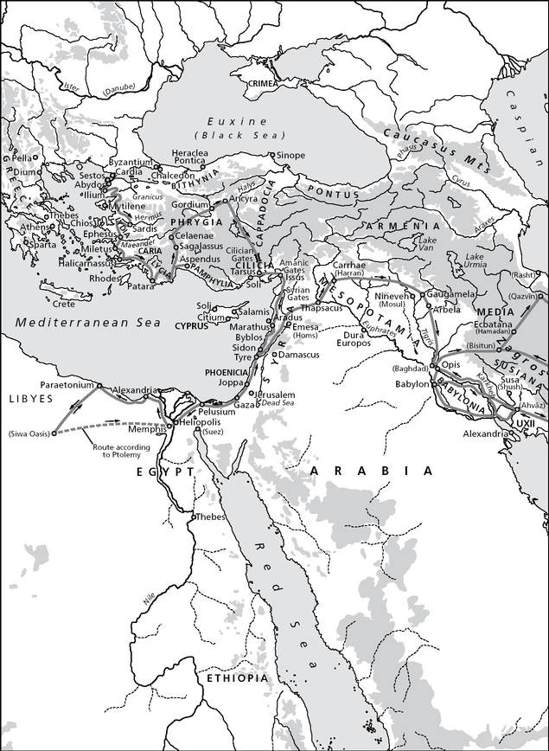
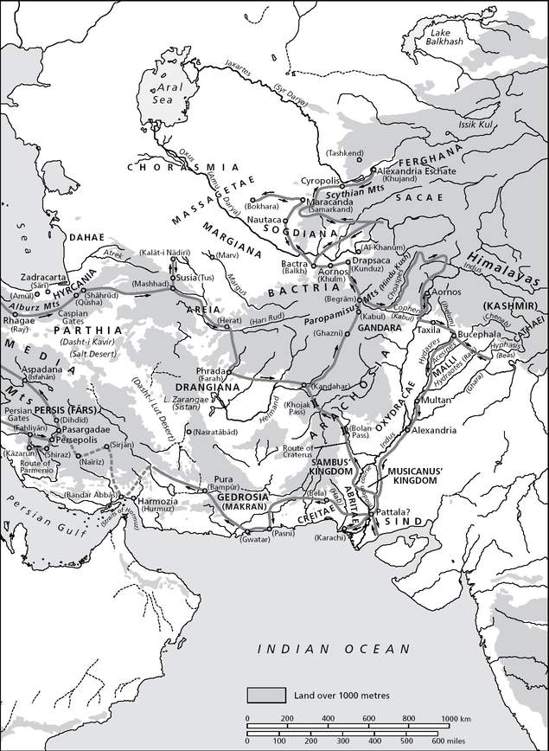
Reprisal against Persia was as good a pretext as any for a war. Philip’s true motivation is much discussed in the modern literature. Perhaps it was nothing more than an expansionist power, flush with recent successes, setting its sights on larger and more tempting targets: the northwestern satrapies of the Persian Empire. This of course leads to larger questions: How far did Philip intend to go? What was the extent of his plans? Similar questions about aims and strategy are raised about Alexander’s progress over the course of his invasion (Map 11.1). Similar questions – with similar uncertainties – have been posed also about Cyrus the Great’s conquests more than 200 years earlier.
In 336 BCE, Philip sent a force of 10,000 men under his generals Attalus and Parmenion across the Hellespont, a campaign cast as the liberation of the Greek city-states of Ionia.2 One target was Abydos on the Hellespont, which later became the staging area for Alexander’s crossing, in 334. In 336–335, however, Persian forces under the commander Memnon, an Ionian Greek mercenary, were able to check the advance of Philip’s forces at several points. At the time of Philip’s death in the summer of 336, there was thus open war between Persian and Macedonian forces in Hellespontine Phrygia. This was the war that Alexander inherited. Alexander was twenty years old when he became king, having been tutored by the philosopher Aristotle and groomed for kingship by governing Macedon while his father was on campaign, when Alexander was not campaigning with him. Between 336 and 334, Alexander consolidated Macedonian power in Thrace and in Greece. He promulgated two clear messages: he would brook no challenges and he planned to continue his father’s military operations in Asia.
Sources and Problems
The historiography of Alexander is gigantic, suitable for a man that so captured the imagination of his own time and ever since. Alexander brought with him several writers and chroniclers to record his deeds, perhaps with an eye on the magnitude of what he meant to do. Not one of the works by writers contemporary with Alexander has survived to our day, but they were extant through much of antiquity and were used by later writers. These are now our main sources. The reader hasalready encountered Diodorus Siculus and Plutarch, to whom we now add Arrian, Quintus Curtius, and Justin, each of whom has been cited only occasionally thus far. All of these later writers date between two and four centuries after Alexander’s death. Arrian, Quintus Curtius, and Justin are sometimes called the “Alexander historians.” Of these, Arrian is generally considered to be the most reliable; he used and cited writings of Alexander’s admiral Nearchus and other high-ranking military commanders. Reflecting the scope and scale of Alexander’s march, these sources shed some light on the Achaemenid Empire’s eastern provinces, which had hitherto been mostly neglected by earlier Greek writers.
Map 11.1 Alexander’s Route through the Persian Empire. After Cambridge History of Iran, Vol. 2, 1985, map 17.
The Invasion Begins: Battles of Granicus (May 334 BCE) and Issus (November 333 BCE) and Alexander’s Operations in Asia Minor
Macedonian control of Abydos served as a bridgehead for Alexander’s forces to cross into Anatolia. Alexander’s army numbered between 30,000 and 40,000 – a combination of the Macedonian phalanx, cavalry and royal guard, and Greek allies. Arrian (1.12.8–10) emphasizes the strategic discussions among the various Persian satraps and commanders in Anatolia, foremost among whom was Arsites, the satrap of Hellespontine Phrygia, in whose territory the Battle of Granicus occurred. The Greek mercenary commander Memnon’s advice to his employers – do not engage the Macedonian phalanx but rather deprive them of provisions via a “scorched earth” policy – was rejected by Arsites, who refused to countenance any damage to property or harm to the people in his charge. In contrast to Arrian, Justin’s account of the preliminaries (11.6.8–10) provides little information on the thinking or preparations of the commanders but focuses on Darius’ attitude. According to Justin, Darius sought a straight-up fight (with no trickery) and even permitted the Macedonians to invade, because it was more honorable to repel them in a battle than to prevent them from landing.
Scholars debate the difference in tone of these two accounts. Justin’s seems more apocryphal and romanticized. Of course Darius was apprised of the situation and in communication with his commanders, but the gist of any specific orders he may have given beforehand is unknown to us. The commanders would have had discretion as to where and how to prepare for battle on the ground. The Macedonians held Abydos, on the Asian side of the Hellespont, and the Persian fleet was not deployed – for reasons unclear to us, although it was later evident in full force around Miletus. So there was no attempt to prevent the Macedonian army’s crossing, and the Persian force could only go about preparing to meet them in battle. Whatever the case about the preliminaries, the end result is clear. Alexander triumphed on the bank of the Granicus River in northwestern Anatolia, near Troy. The Persians focused on killing Alexander himself, and almost succeeded in hard fighting: Alexander barely escaped death thanks to a fellow Macedonian slicing off the arm of a Persian delivering what might have been a killing blow (Arrian 1.15.8). The Persian cavalry was trapped and slaughtered, the infantry fled, and Memnon’s mercenary force was overwhelmed. The satraps’ forces were scattered, and Alexander then had a free hand in western Anatolia, at least in those places that chose not to resist.
One place that did not resist was Sardis, and its loss was a key blow to the Empire. Spithridates, the satrap of Lydia, died at Granicus. Sardis’ garrison commander, Mithrenes, voluntarily surrendered the city to Alexander. Why would a Persian commander freely surrender a satrapal capital so early in the fight against Macedon? Even with Alexander’s victory at Granicus, he controlled only one corner of a vast Empire, and in the summer of 334 BCE the outcome of his invasion was far from certain. Indeed, based on the Persians’ long history of conflict with recalcitrant Greeks – Macedonians were probably not viewed as much different – Darius III and his advisors likely had full confidence that Alexander’s foray, like Agesilaus’ in the 390s BCE, would be foiled or simply run its course. But even if the surrender of Sardis was a simple matter of Mithrenes and the Sardinians trying to save their own skins, their surrender was unlikely to have been spontaneous; there must have been negotiation with Alexander’s agents.
In dealing with Mithrenes and Sardis, Alexander thus gave notice of his approach as conqueror. Achaemenid officials who surrendered were not only spared but might keep their position and status. Alexander needed the Persian imperial bureaucracy – headed mainly by Persian elites – to have any chance at maintaining a successful conquest. Sardis in 334, beyond a change in ruler and allegiance, looked no different than it had before Alexander arrived: local rule and local institutions continued. More than 200 years of Achaemenid rule would have “Persianized” it to some extent, especially among the elites. That component would not have troubled the new ruler, whose main concern going forward was a compliant imperial center behind him.
Alexander’s progress through the rest of western Asia Minor followed a similar pattern: those cities that gave themselves up willingly were “liberated” from Persian rule and subjected to Macedonian rule with no dramatic changes in their civic affairs. Several cities chose that path, but many resisted, and Persian officials initiated counterattacks. Miletus held out thanks to Persian naval power. Alexander had disbanded his own fleet shortly after the Battle of Granicus to focus on the land campaign; his plan was to deprive Persian naval forces of bases and supplies, and thus ultimately to nullify their advantage. Resistance also persisted at Halicarnassus. Alexander was unable to dislodge the defensive forces gathered in the citadels. Meanwhile, Memnon was dispatched north along the Ionian coast to recapture cities that had submitted to Alexander. He met with much success until he was killed in a siege of Mytilene on the island of Lesbos during the summer of 333. Command passed to a certain Autophradates along with Memnon’s nephew, Pharnabazus, who continued operations in Ionia and even the islands – testimony to the Persians’ intent to contest every inch of Alexander’s progress.
During the first part of Alexander’s invasion, the action therefore occurred simultaneously on many fronts in Anatolia. Through the late summer of 334 BCE, Achaemenid forces were active in defending territory in Ionia and the Aegean, efforts that persisted into 332. Leaving the siege of Halicarnassus to deputies, Alexander turned east and during a difficult winter campaign – again facing significant resistance from many cities – took control of the coastal regions of Lycia and Pamphylia, while the Persians employed countermoves. Alexander’s progress was inexorable, however, and the Persians soon lost the Phrygian satrapal capital Kelainai. The city of Gordion in central Anatolia (roughly 50 miles southwest of modern Ankara) was also taken, and Alexander spent several months there during the spring of 333, as he received reinforcements from Macedon and Greece.
Darius III himself was not idle. He massed forces in preparation for the second pitched battle against Alexander, this one at Issus in southeastern Anatolia. Several modern scholars attribute Darius III’s failure to stop Alexander to Darius’ dilatory approach to marshaling his army. The mustering of large Achaemenid forces was never a rapid process. Darius and his officials were in fact broadly engaged in defensive efforts as noted earlier in this chapter. Inexplicably, Darius failed to defend sufficiently the so-called Cilician Gates (a pass through the Taurus Mountains about 25 miles north of Tarsus), and by the summer of 333, Alexander had taken them and then continued on to conquer Tarsus, the capital of the satrapy of Cilicia. Alexander’s and Darius’ armies passed each other, within 100 miles, and wheeled about to meet at Issus, along the Pinarus River (identified with the modern Payas River) near the modern town of Iskenderun. Meanwhile, Persian commanders in Ionia – still fighting – coordinated their efforts with the Spartan king, Agis. The Spartans were determined to resist Macedonian rule, and cooperation with Persia was a logical choice. But before these efforts could bear any fruit, the Persian defeat at Issus changed the calculus. Thereafter the Persians abandoned any thought of operations in Greece, and Pharnabazus, the commander in charge, sped back to Ionia to deal with the consequences of this latest defeat.
The sources describe Darius III’s army at the Battle of Issus (November 333 BCE) as momentous, and similarly the consequences of its defeat. Accounts vary. The Persian right wing apparently smashed the Macedonian left, but a full-out assault by Alexander and his cavalry on the Persian middle caused it to collapse and Darius to flee – a sequence so compellingly portrayed in the so-called Issus Mosaic (Figure 11.1). From the perspective of the Greek accounts on which we must rely, Issus was a complete catastrophe for the Empire. By any measure the battle had important consequences, although Persian forces remained battling in central Anatolia well into 332. Darius fled to a city called Thapsacus, along the Euphrates River. The defeat at Issus meant that the way to Phoenicia was now open, and this gave Alexander access to the Persians’ main naval facilities based in the cities of Phoenicia.

Figure 11.1 Roman Mosaic of Alexander and Darius III, Pompeii, First Century CE, Naples Archaeological Museum. Art Resource. Photo Credit: Erich Lessing/Art Resource, NY.
During the winter of 333/332, Alexander captured the imperial treasury at Damascus, thanks to the treachery of its governor who went over to Alexander. Damascus was a critical center and, as it turned out, the place where many prominent Persian families had gathered: those of the Persian elite and, most importantly, Darius’ own family and household. Alexander thus found himself the captor of Darius’ wife, mother, and several children: a disaster for the King and a gift for Alexander. The Persian defeat found exaggerated expression in the famous mosaic from Pompeii that portrays an energetic, brave Alexander, without a helmet, driving against a despairing, overwhelmed Darius III. This image encapsulates a Greco-Roman perspective of the weak and cowardly peoples of the Orient, an inaccurate stereotype visited time and again in the source material that has so colored subsequent tradition.
Issus was followed by further Macedonian successes, as the important Phoenician cities of Byblos and Sidon surrendered to Alexander. Only a decade earlier, Artaxerxes III forcibly reincorporated Sidon into the Empire after the city’s revolt. Conversely, the Phoenician city of Tyre resisted Alexander for more than a year, ready for a long and expensive siege that Alexander had his soldiers pursue with relentless ferocity. Diodorus portrays the siege of the city and its fall in epic terms. He attributes the Tyrian resolve to their desire to remain on good terms with Darius and to their hopes for great rewards for their loyalty (17.40.2–3). With few exceptions, by the summer of 332 BCE, the Persians had lost control of their northwestern territories in Anatolia and also much of the eastern Mediterranean seaboard. This brought not only the Phoenician and Cypriot fleets to Alexander, but also several other contingents from Rhodes and other important bases along the southern coast of Anatolia. This meant the end of Persian naval superiority.
The Loss of Egypt, the Battle of Gaugamela, and the Surrenders of Babylon and Susa (332–331 BCE)
While Darius III mustered another army, thanks to the extent of the Empire’s reach and resources, Alexander continued to drive south to take Egypt. Batis, the Persian official in charge of Gaza, which served as the access point to Egypt, had readied his forces to withstand a lengthy siege. Arrian relates that even after the city was breached, after two months of siege, the inhabitants of Gaza continued fighting, essentially street by street (2.27.7). Quintus Curtius (4.6.26–29) adds a striking anecdote about Alexander playing the part of Achilles, his ancestor and model. Alexander tied Batis, who refused to bow to Alexander as king even in defeat, to his chariot and dragged him, still alive, around the city, as Achilles had done with the corpse of Hector (Iliad 22.395–404).
With his fleet, Alexander then made a triumphant entry into Egypt. The Persian satrap Mazaces surrendered the satrapy of Egypt to its new overlord. Arrian notes that Darius had recently appointed Mazaces as satrap there, because the previous satrap Sabaceshad been killed at Issus. Arrian’s description of the surrender follows Greek stereotypes: Mazaces scorned Darius’ flight at Issus and was therefore ready to welcome Alexander (3.1.2). In the same passage, Arrian notes that Alexander now controlled Phoenicia, Syria, and much of Arabia. That critical fact and Mazaces’ apparent lack of manpower and resources put him in an untenable position, regardless of his personal feelings toward Darius.
The ease with which Egypt was taken by Alexander remains the subject of intense debate in modern scholarship. If Mazaces was truly unable to muster effective resistance, his surrender is not surprising, but beyond Arrian’s glib remark there is a dearth of detail about the situation. Egypt had only a decade before been reintegrated into the Empire by Artaxerxes III, and we are uncertain about the extent of successful control achieved. In any case, one cannot help but contrast Batis’ fierce resistance at Gaza and Mazaces’ immediate surrender of Egypt without a fight. That the satrapy of Beyond-the-River (Trans-Euphrates) was not fully secured is illustrated by a revolt in Samaria against Alexander’s appointed governor there, Andromachus. Alexander reacted swiftly by executing the perpetrators and installing a new governor. Quintus Curtius (4.8.9–11) also links this episode to a purge of local, Persian-supported rulers who yet remained in the Aegean – a message not only to Samaria’s population but also to his own Greek and Macedonian subjects that he was indeed in command of the situation.
Alexander’s march through Samaria toward Mesopotamia set the stage for the last set battle at Gaugamela (October 1, 331 BCE), just east of the old Assyrian capital Nineveh on the Tigris River, where Darius had amassed his army. Diodorus (17.53) describes an enormous and well-equipped Persian army in splendid array and led by the most excellent commanders – 800,000 infantry and more than 200,000 cavalry – along with scythed chariots, whose function was perhaps more of shock than any real tactical advantage. From a Greek writer’s perspective, the larger and more fearsome that Darius’ army was the better, to magnify Alexander’s victory.
The Classical accounts about the Battle of Gaugamela are replete with details about Alexander’s feelings and anecdotes of high drama. For example, Darius is described as making another approach to Alexander, offering him the territory west of the Halys River in Anatolia, 30,000 talents of silver, and the hand of one of his daughters in marriage. The last would have made Alexander, in effect, Darius’ coruler. Alexander rejected this offer and, with grandiose pomposity, compared an empire with two kings to that of a world with two suns, a violation of the natural order of the earth (Diodorus 17.54.2–6). This is wonderful stuff, but how much is history and how much hyperbole? Darius’ offer to cede half the Empire seems far-fetched to say the least, since there is no precedent in Achaemenid history or no component of their royal ideology to help us imagine such a thing. On the other hand, Darius was dealing with a new situation, an unprecedented threat. Any earlier assumption that Alexander’s expedition would come to naught would have been long since abandoned, and there no longer would have been any underestimation of Alexander’s capability or determination.
Darius’ preparations – careful defense of river crossings, a scorched earth policy along Alexander’s line of approach, choice of battlefield to maximize Persian cavalry – proved insufficient. The Battle of Gaugamela itself hung in the balance for some time, but the Macedonians were ultimately victorious. Darius fled the field, regrouped at nearby Arbela, and then withdrew to Ecbatana in Media, where he intended to muster yet another army from the Upper Satrapies – the phrase Diodorus uses (17.64.1) for the territories of the Iranian plateau and beyond – with which to challenge Alexander. A fragmentary Babylonian astronomical tablet refers to the Persian defeat at Gaugamela, the desertion of at least some of Darius’ troops, and his withdrawal into “Gutium” – an archaic term for the northern Zagros Mountains. It here refers to Media.
Darius’ decision to withdraw to Media left the way open for Alexander to march on Babylon and, from there, east across the Mesopotamian alluvium to Susa. Once at Susa, the route south toward the Empire’s greatest prizes – Pasargadae and Persepolis – lay before him. Why would Darius choose such a move? His withdrawal to Ecbatana in effect ceded the core of the Empire, four of the five main capitals (excluding Ecbatana), to the enemy. The reasons typically given allow varied interpretation. The centrality of the King himself – around whom the entire Achaemenid system revolved – should not be overlooked. One reason was strategic: according to Arrian (3.16.2) Darius thought that Alexander would take the route to Babylon and Susa, and Darius therefore avoided that route. This was no doubt a difficult decision, but it gave him time to organize another army in the north. If part of Darius’ calculations rested on the assumed loyalty of his satraps, that assumption proved ill-founded in the cases of Babylon and Susa.
Alexander’s reception into Babylon in October of 331 BCE, as related by Arrian (3.16.3–5) and Quintus Curtius (5.1.17–23), follows the pattern of Alexander’s reception at Sardis and, subsequently, at Susa – all cities that surrendered voluntarily. Both Arrian’s and Quintus Curtius’ accounts emphasize ritualistic acts that symbolize an orderly transfer of power. Alexander’s entry into Babylon followed a discernible pattern for which there are several earlier historical examples. The most immediate and germane parallel was that of Cyrus’ conquest of the city in 539 (pp. 44–46). After a hard-fought battle and decisive victory at Opis against the forces of the Babylonian king Nabonidus, Cyrus was received into the city of Babylon without a fight. This was a carefully choreographed entrance that belied the violence that preceded it. Cyrus arranged not only his entry into Babylon but also the messages associated with his assumption of power.
Arrian’s and Quintus Curtius’ accounts describe a similar sequence. The Persian satrap Mazaeus delivered the city to Alexander, and he was subsequently reappointed to that office. The Babylonians lined the walls and the streets to greet their new king, and the entry was a grand parade. A fragmentary Babylonian astronomical diary also relates this event.3 The surrender of the city only occurred after negotiations between Alexander and the Babylonians assured a peaceful transition and, by extension, a traditional reception for Alexander. The reception culminated in Alexander paying respect to the Babylonian god Marduk (Bel) and his temple, a necessary part of the exercise. This peaceful entry belied the violence of the Battle of Gaugamela, the battle that paved the way, just as Cyrus’ victory did at Opis in 539. In the astronomical diary Alexander is called “King of the World” (Akkadian ar kiati), the same title used to describe Cyrus in the so-called Verse Account of Nabonidus. The title ar kiati had a long history of use by Assyrian and Babylonian kings. The application of this traditional title to Cyrus was not accidental, nor to Alexander. In the latter’s case, its use implies a continuity of imperial tradition and supplies a connection to Cyrus, highlighted by their similar welcomes into Babylon. Alexander received a similar reception from Susa in December of 331 BCE (Arrian 3.16.6–7). After negotiations, the satrap of Elam, Abulites, sent his son Oxathres to meet Alexander on the road to the city and to offer him a formal welcome. This culminated in the surrender of Susa and delivery of its treasury to Alexander.
The Defense of Parsa
The next step was not so easy. In the first few months of 330, Alexander faced a difficult road from Susa to Persepolis. The Uxians, who dwelled in the Zagros Mountains, were only passed after extremely hard fighting, which was compounded by the difficult terrain. Alexander subsequently split his forces. His group continued traveling through the difficult mountain paths, Parmenion’s group kept to the main road, which was more suitable for wagons, toward Fars.
A Persian army of 40,000 infantry and 700 cavalry, commanded by Ariobarzanes, held the so-called Persian Gates – an east-west pass through a river valley in the northern part of Parsa (Arrian 3.18.2–9). The main Persian forces waited behind a wall, and Alexander thus found his Macedonians in the role of the Persians at Thermopylae in 480 BCE with a narrow and fortified pass held against them. The Classical accounts abound with parallels, and it is therefore difficult to discern which elements are historical, which literary. Arrian’s account relates a group of locals, prisoners, who led the attackers by night over mountain paths behind the defending forces. Unlike the heroic Greeks at Thermopylae, though, the cowardly – according to Arrian – Persian forces attempted to flee. Ariobarzanes with his remaining forces managed to break through the Macedonian line and made for Persepolis, with Alexander in close pursuit. Arrian draws no explicit parallel to Thermopylae, but of course he did not need to. It would have been as familiar to any Greek or Roman reader as a contrast between cowardly Persians and brave Macedonians. A high-ranking official at Persepolis, Tiridates, sent a letter to Alexander promising to deliver the city to him if he got there before Ariobarzanes did. Alexander caught, defeated, and killed Ariobarzanes and the remainder of his forces, and took control of Persepolis in mid-January 330. Gobares, who controlled Pasargadae, surrendered that city and its treasury to Alexander as well. Alexander ordered the mass removal of the contents of the treasuries mainly to Susa – according to Diodorus (17.71.2–3), because he was thoroughly suspicious of the inhabitants of Persepolis and he intended to destroy the city.
The sources are sparse about the next several months, with Alexander encamped in the heart of the Empire. It appears that Alexander had to expend a great deal of effort, and with mixed results, to quell resistance in the outlying regions of Fars. A visit to Cyrus’ tomb to pay his respects to the Empire’s founder culminated in the continuation of the traditional sacrifices performed there, but both Diodorus and Quintus Curtius (5.7.1–4) suggest continuing hostility from the inhabitants of Fars. In May of 330, much of the Persepolis terrace was burned. Alexander’s motives for this are still debated, though most agree that it was a calculated act rather than a drunken impulse (Diodorus 17.72). Arrian casts the destruction (3.18.11–12) as Alexander’s retribution for the Persians’ burning of the Athenian acropolis and all the other harms done to Greeks – a recurrent motif. This makes a good story, but there was more to it. Even Arrian comments that he disagreed with the logic of Alexander’s retribution. Most modern scholars supply much significance to the act: Persian rule was no more, and continued resistance was futile. Alexander thereafter turned his forces north on the direct route from Fars to Ecbatana, to continue his pursuit of Darius III.
Darius had not been idle, but his situation had become precarious. The sources do not reveal if conscripts summoned from the Cadusians and Scythians had not yet arrived or if they had abandoned the King. In any case, Darius’ forces were becoming insufficient to his needs. After emptying Ecbatana’s treasury, Darius departed the city before Alexander arrived (Arrian 3.19.4–5). The news of Darius’ departure was brought to Alexander by none other than Bisthanes, a son of Artaxerxes III, who cast his lot with the invader. As the action progresses, abandonment of Darius becomes a recurring theme. Quintus Curtius portrays Darius as increasingly despondent, as those around him lost faith (5.9.13–17). Keeping with our sources’ Hellenocentric bias, a certain Artabazus and a group of Greek mercenaries take on a prominent role in keeping the Persians’ flagging spirits up. To compound Darius’ grim situation, the satrap of Bactria, Bessus, along with Nabarzanes the chiliarch and other accomplices carried out a plan to capture the King for their own ends. Their strategy in turn, which we may assume was Darius III’s actual strategy, was to employ the resources of Bactria and the eastern satrapies to forestall Alexander’s advance, and from there to win back the Empire. In the end, Bessus and his accomplices attempted to kill the King with Alexander hot on their heels. They mortally wounded Darius and then fled.
Another interpretation of this episode has been put forward that fits well in a Near Eastern context. It is controversial, however. In Quintus Curtius’ account (5.9.8 and 5.12.15–20) Nabarzanes attempts to persuade Darius to allow Bessus to take his place as king “for a time” (the Latin word interim), until the enemy withdrew. In other words, Darius would be replaced temporarily until the danger, made manifest by several bad omens, had passed. In this reading, the conspirators – who were not really conspirators, but loyalists – only apparently abandoned Darius. They removed his royal garb and paraphernalia, bound him in gold fetters, and placed him in an unremarkable wagon – all so that Darius would not be recognized by anyone. This description matches the portrayal in Classical sources of Darius forlorn and abandoned, suffering one disgrace after another as his death approaches. But this portrayal may instead be read as part of the substitute-king ritual of Near Eastern tradition (see p. 75), a divinely-inspired attempt to circumvent horrible omens and the coming disaster that was Alexander. The anguish and dismay of Darius is in this reading viewed as ritualistic behavior in a time of crisis and as a part of the ritual itself. With the perspective of hindsight, it is easy to contextualize such a ritual, if that is the correct interpretation, as a desperate attempt to forestall Alexander’s victory. It is impossible to tell how much of a genuine ritual might have underlain this crisis, but the parallels to the substitute-king ritual provide a compelling counter-narrative. That Bessus and Nabarzanes killed Darius in the end – so the Classical tradition relays – suggests that the substitute-king interpretation is incorrect, that it went awry, or that the situation changed.
When Alexander arrived on the scene, somewhere in northern Iran on the route to Bactria, the last Achaemenid king had died, and the King was the Empire. Alexander did not hesitate to turn this to his advantage as well. Alexander treated Darius’ body with utmost respect and sent it to Persepolis for burial befitting the King. Alexander took upon himself the role of Darius’ avenger and thus his successor. Alexander continued the pursuit of Bessus, who had in the meantime proclaimed himself king with the name Artaxerxes. But the Achaemenid Empire was, for all intents and purposes, finished, although Bessus remained a threat to Alexander and his claim to Achaemenid rule could not be ignored. Even after Bessus’ capture and execution – before which his nose and ears were cut off (Arrian 4.7.3–4, cf. 3.30.4–5), reminiscent of the punishments meted out by Darius I to the liar-kings (pp. 64–65) – Alexander continued to face heavy resistance in the eastern satrapies until early 327 BCE.
Alexander’s “Persianization” also, not coincidentally, became more pronounced via his adoption of elements of Achaemenid kingship and the incorporation of Persian and Iranian elites into his entourage. Alexander’s attitude and approach were bitterly unpopular with many of his Macedonian cohorts. These and other important aspects of Alexander’s rule, however, are part of another (hi)story. It is at this point that we transition from Achaemenid history to the so-called Hellenistic period, in modern periodization starting with Alexander’s successful conquest of Persia, especially the burning of Persepolis and the death of Darius III. Alexander was both transformative and transitional. If he was to have any chance at holding his conquests together, he had to model much of his rule on Achaemenid norms. Even with appropriate emphases on continuity, Alexander was obviously not an Achaemenid. Despite his amazing success, his rule was short-lived, and the Empire Alexander conquered did not long survive his death in 323 BCE.