
9
c.1800 BCE to 700 BCE
Model for All Future Empire-Builders
Near the centre of Baghdeda, a sprawling village not far from Mosul in the north of today’s Iraq, surrounded by ugly concrete buildings from whose flat roofs television aerials and satellite dishes sprout like weeds, rises a tell of crumbled sun-dried brick some 8 metres high. A flight of stone steps leads up its side to an ancient church dedicated to Mart Shmoni.
There is nothing about the architecture of this church that particularly catches the eye: it is a squat, blank-walled building rendered in adobe, with a stumpy domed tower surmounted by a metal cross. But this unpretentious place of worship is a remarkably direct link with the very distant past, and offers a challenge to some of our easy assumptions about the history of the ancient world.
Nobody knows when the present structure was first erected, though a church has stood on this site certainly since the eighth century and probably since the fourth. The design suggests that before this it was a synagogue – a rounded apse at the end angled towards Jerusalem would have housed the aron kodesh, the curtained cabinet in which the Torah scrolls rest between their ceremonial outings. For Mart Shmoni was no Christian saint. She and her seven sons were martyrs in the Jewish battle against forced assimilation to Greek culture and religion in the second century BCE, a story told in II Maccabees. That Christians of this area honoured a Jewish heroine confirms accounts of large Jewish communities living across northern Mesopotamia in the early years of the first millennium CE. When Benjamin of Tudela visited Mosul as late as 1165, he still found 7,000 Jews at home there. The ten tribes of Israel, transferred to the heartland of Assyria in 722 BCE after the destruction of their kingdom by Emperor Sargon II, may not, it seems, have simply disappeared, as we have been taught to believe.
The history of the Mart Shmoni Church site takes us back even before then. The mound on which it stands shows us that here we have the accumulated remains of a series of successive temples and shrines, probably originally dedicated to Sin, the moon god, reaching as far back as 2000 BCE. In keeping with Mesopotamian tradition, none of these were swept away, but carefully levelled and then built over. To this day, unlike around other churches in the vicinity, no grave or well shaft may be dug in Mart Shmoni’s precinct, to avoid desecrating what came before – even though it was a pagan deity who was originally honoured in this place.
It is not unusual for Christian buildings to be erected where older gods once ruled. Many English churches stand in what were once Anglo-Saxon sacred groves. Their names often make their debt to pre-Christian origins clear: Harrow on the Hill, for example, a harrow being a pagan holy site. But in most cases, evidence of the spot’s earlier sanctity has been carefully erased.
Such amnesia would not, however, do for northern Mesopotamia, where it is not only buildings which acknowledge their antecedents. The worshippers attending services here are also proudly aware of their ancestry. They call themselves Assyrians, and see themselves as baptised Christian descendants of the citizens of the Assyrian Empire, the colossus of the early first millennium until its destruction in 612 BCE.
The name of their land, or part of it, has been retained too. After its conquest by Babylon, the western half of Assyria’s domain was still called the province of Assyria – later, having lost its initial vowel, Syria. The Persian Empire retained the same name, as did Alexander’s empire and its successor the Seleucid state, as well as the Roman Empire which was its inheritor. The late Assyriologist Professor Henry Saggs explained in The Might That Was Assyria that after the destruction of the Assyrian Empire,
descendants of the Assyrian peasants would, as opportunity permitted, build new villages over the old cities and carried on with agricultural life, remembering traditions of the former cities. After seven or eight centuries and after various vicissitudes, these people became Christians.
These Christians, and the Jewish communities scattered amongst them, not only kept alive the memory of their Assyrian predecessors but also combined them with traditions from the Bible. The Bible, indeed, came to be a powerful factor in keeping alive the memory of Assyria.
Such ancient identity has cost its bearers dearly. Their neighbours have, over the centuries, conducted vicious campaigns of discrimination and repression against Assyrian Christians, culminating in the genocide of 1914–20, when hundreds of thousands were murdered in the name of the Young Turk movement. They suffered grievously from the recent Gulf Wars, too, attacked by both Arab and Kurdish militias and even the Turkish air force from over the border. A huge number have been forced to flee their land into exile.
Can such very ordinary people, these shopkeepers, tailors, cobblers, doctors, engineers and university professors, really be descended from the people of ancient Assyria? If so, we need to adjust our view of that antique empire. For Assyria must surely have among the worst press notices of any state in history. Babylon may be a byname for corruption, decadence and sin but the Assyrians and their famous rulers, with terrifying names like Shalmaneser, Tiglath-Pileser, Sennacherib, Esarhaddon and Ashurbanipal, rate in the popular imagination just below Adolf Hitler and Genghis Khan for cruelty, violence and sheer murderous savagery. Most histories of Assyria quote the poet Byron’s lines from ‘The Destruction of Sennacherib’. I shall make no exception: ‘The Assyrian came down like the wolf on the fold, And his cohorts were gleaming in purple and gold’.
Yet when one looks more closely at what is known about Assyria and its rulers, which is the story of how Assyria succeeded to Old Babylon’s title as the centre of civilization, one finds a real paradox. The reputation for frightfulness that adheres to the Assyrian rulers and their military arm really does seem to be based on a truth. Which other imperialist would, like Ashurbanipal, have commissioned a sculpture for his palace with decoration showing him and his wife banqueting in their garden, with the struck-off head and severed hand of the King of Elam dangling from trees on either side, like ghastly Christmas baubles or strange fruit?
In truth, Assyrian warfare was no more savage than that of other contemporary states. Nor, indeed, were the Assyrians notably crueller than the Romans, who made a point of lining their roads with thousands of victims of crucifixion dying in agony, as after the slave revolt of Spartacus, when as many as 6,000 bodies lined the Appian Way for years until they rotted away. Not so very long ago in historical terms, the penalty in England for treason was public hanging, drawing and quartering; thought-crime, or heresy, witchcraft or belief in the wrong sort of religion, was punishable by burning; the chopped-off heads of enemies of state were thought suitable decoration for London’s thoroughfares. Even in the twentieth century we have found it acceptable to bomb defenceless villages from the air, incinerate whole urban populations by fire-storm, and drop atomic bombs on Japanese cities.
And yet, at the same time as carrying out acts that now fill us with horror, the Assyrian Empire maintained and developed Mesopotamian art and literature, theology, science, mathematics and engineering to new heights, and oversaw the introduction of the age of iron into the Mesopotamian world. Assyrian emperors advanced the welfare and equality of their subjects in ways no previous polity had ever attempted. Outside the Hebrew Bible, the obligation to abstain from work every seventh day is first recorded in Assyria, while Finnish scholar Professor Simo Parpola writes that ‘Assyrian religious beliefs and philosophical attitudes are still very much alive in Jewish, Christian, and Oriental mysticism and philosophies.’
Assyrian rule served as a model for all future empire-builders: there is direct continuity between the Assyrian, Babylonian, Persian, Hellenistic and Roman empires. Moreover this empire was the conduit through which much of Mesopotamian knowledge and culture was channelled to Greece and points west, thus becoming part of our European inheritance. The high point of Assyrian power coincided with what is known as the orientalizing period in Greece, when Mesopotamian influence on art, literature and even law was the bridge over which the Hellenes passed from their archaic to their classical era. One of Britain’s most distinguished classicists, Martin West, has shown ‘that there is a substantial eastern element in the oldest stratum of Greek mythology, in some of the poetic forms of the early archaic period, in the theology and natural philosophy of the seventh and sixth centuries.’ He even suggests that the works of Homer owe much to Mesopotamian epic, in particular to the story of Gilgamesh.
The people of Assyria were drawn from the same Semitic stock as those of Babylonia to the south, or so their languages suggest. Assyrian and Babylonian Akkadian were so closely related that philologists designate them as dialects of one and the same tongue. Assyrians’ artistic and scientific traditions all derived from the mainstream of Mesopotamian culture. Their religion was more or less identical too, with the addition of their city god Ashur as a replacement or synonym for Babylon’s Marduk in the otherwise universal Mesopotamian pantheon. Sin, god of the moon, was much worshipped here. The goddess Ishtar of Nineveh, mother, virgin and whore, whose planet was Venus, and whose symbol was an eight-pointed star, was famed throughout the Near East.
Some researchers have concluded that the Assyrian nation began when incomers from the southern city-states settled among and mixed with the indigenous inhabitants of the northern valleys, eventually asserting first their independence from, and then their superiority over, their original homeland. If true, then Assyria’s inheritance of leading nation status from Old Babylon was rather like the USA’s progression from British colonial possession to world-dominant power. The ‘special relationship’ between Assyria and Babylonia was extremely ambivalent, swinging between extremes of love and hate, alliance and enmity. On the one hand, Assyria derived almost its entire culture from Babylon, and could not help but recognize that debt. At the same time it was a fierce competitor and rival for trade and power. Assyria assaulted and wrecked Babylon City on a number of occasions – only to be quickly overcome by regret and to make attempts at restitution. It seems as if two powerful parties long vied for influence over Ashur’s foreign policy: one strongly nationalist and anti-Babylon, the other traditionalist and pro-Babylon.
Such differences as separate Assyria from its southern neighbour resulted from living in a very different physical and political environment. Landscape and climate shape nations. Coastal peoples are not like steppe-dwellers, forest-folk are not like mountaineers. Those who sweat under the burning sun of the south have little in common with those who shiver among northern snows. Byron had something to say on that subject too, relating Britain’s cloudy climate to ‘our chilly women’, and claiming that ‘What men call gallantry, and gods adult’ry, / Is much more common where the climate’s sultry’.
The heartland of what was once Assyria, near where today’s Turkey, Syria and Iraq meet, is cradled in the curve of the great highland range, the Antitaurus, that links Turkey’s Taurus Mountains in the west to Iran’s Zagros in the south-east. Narrow valleys in the foothills run down to the wide plain that Arabs call Al-Jazireh, the Island. Across it, north to south, flows the Tigris, a swifter, deeper-cut, more dangerous river than its sister the Euphrates, which is here 400 kilometres off to the west, though both rise close to each other in the mountains and will join together again at the head of the Gulf.
Deserts stretch beyond the plain to the south and parched steppeland to the west, but much of the Jazireh itself shelters within the crucial 200 mm isohyet, the line that marks the limit behind which annual rainfall alone suffices for agriculture. So, unlike in Babylonia, Assyrian cultivators were not impelled towards constant collective action to keep water flowing to the fields; they did not know the ever-pressing need for collaboration to dig and maintain canals, dams, weirs, barrages, drains and sluices. Though later Assyrian emperors did indeed order the digging of aqueducts, canals and tunnels to lead water from the mountains to newly founded or expanded cities, these were prestige projects: luxuries rather than necessities.
From earliest times all over the south of Mesopotamia, particularly near the head of the Gulf, the demand for communal effort and a large labour force had led to cities with substantial populations springing up like mushrooms after rain, sometimes within sight of each other. The resulting sibling rivalry and fratricidal strife shaped history for millennia. Here in the north, by contrast, apart from ancient sacred sites like the goddess Ishtar’s temple at Nineveh, which came to be surrounded by Assyria’s most populous town, there was at first only one other fully-realized city, Ashur, with probably no more than 15,000 inhabitants. Protected in back by the cliffs above the Tigris and later in front by a massively high wall with eight huge gates and a 15-metre-wide moat, Ashur was at the same time the name of a god, the name of his city, and, ultimately, the name of the land and empire over which he presided. Outside these few urban centres Assyria was a country of individual farmers living in small independent settlements, which would eventually be welded together by political and strategic imperatives into an overarching proto-feudal system, as in the European Middle Ages.
The militarism for which Assyria is famous sprang from its location, which was extremely dangerous, making self-defence the necessary first principle of national survival – hence the monumental fortifications of Ashur City. Without natural protection, the area was always strategically vulnerable, lying as it did astride the major raiding and trading routes from the north and east that skirted the mountains to reach across Syria to the Mediterranean. Powerful barbarian kingdoms sprang up beyond Assyria’s northern borders: Hittites, destroyers of the Old Babylonian Empire, who spoke an Indo-European language, and had their capital at Hattusas in central Anatolia; and Hurrians, perhaps from the Caucasus but with an Indo-Iranian ruling class, who set up a state called Mitanni which forced Assyria into prolonged submission.
However there were benefits, too, in both directions. The Hittites and Hurrians learned from Assyria the arts of civilization: most importantly how to write their languages, adapting Akkadian cuneiform to the task. In return the nations of the north led the way in technological developments that would greatly affect political history. From the Hittites, the Assyrians learned how to smelt iron and fashion it into weapons. From the Hurrians they learned horsemanship and acquired a device that would change the face of battle: the fast, lightweight, bentwood chariot with spoked rather than solid wheels.
But while the barbarian kingdoms to the north presented Assyrians with a source of novel ideas as well as a challenge that could be met on the battlefield and ultimately overcome, the Jazireh was also vulnerable to a second threat that was much harder to withstand. For it was ever open to infiltration and assault from the desert and steppe that lie to the west and the south. After the domestication of the camel in the second half of the second millennium, Assyria would have to contend with a new wave of Semitic immigrants: Aramaic-speaking bedouin from the deserts of what is now Syria. Though weak in battle, their numbers made them unstoppable. In time, they would change Assyria profoundly.
That very openness to the outside world in all directions offered an opportunity to the Assyrians which they took up from early times. Assyrian land was much less rich and fruitful than the great tracts of grain-growing alluvium from which Babylonia had benefited throughout her history. Much of the territory was suited only to raising sheep and goats. To supplement their national resources, Assyrians needed to trade, offering both woollen goods produced at home from their flocks, best quality textiles bought from neighbouring Babylonia, and commodities like metal ores originally sourced from the mountains to their east. Business served the Assyrians well. Like merchant nations of much more recent days, Belgians, British, Dutch and French, the demands of business changed the Assyrians slowly but surely from traders to empire builders.
The precise details of how this nation of roving merchants became, in the course of little more than a millennium, the most awe-inspiring and feared imperialist power of the ancient world, are not at all clear. Records are sparse. Archaeology has been able to open no more than a few narrow windows, at widely different times, on to the grand saga. But as luck would have it, we do have a view of the beginnings of the process, when international trading set the people of Ashur off on their historic adventure. We do not see Ashur City itself, nor even the land of Assyria; of both of these we know next to nothing in this era. Our window opens on to a place far from the Assyrians’ home, deep in the heart of Anatolia.
Towards the end of the nineteenth century, large numbers of clay tablets written in the Old Assyrian dialect of the Akkadian language reached the international antiquities market. For a long time nobody knew where they were coming from. Eventually the site was tracked down to an unexpected location far from Mesopotamia: Kültepe, a mound in the highlands of central Turkey, close to a village named Karahüyük, near the watercourse known to Greeks as the Halys, and to Turks as Kızılırmak, the Red River. In 1926 the Czech scholar Bedrich Hrozný discovered that the tablets were actually being dug out of a subsidiary site about a hundred yards away. Closer study revealed that this was what remained of an expatriate enclave, a bonded settlement, within which Assyrian merchants were permitted to live and carry on business with the native community. More recent trading empires would have called it a factory, like the first outpost of the English East India Company at Surat on the west coast of India. In Old Assyrian this one was called Karum Kanesh, Kanesh Port. It was far from being the only Assyrian factory on Anatolian soil: there were several others. However Kanesh was the headquarters for Assyrian trade everywhere in Anatolia, supervising and regulating all business activities and acting as the central communications hub between the widely dispersed trading-posts and Ashur itself – which they called simply ‘The City’. It flourished during the early second millennium BCE: what has been called, for linguistic reasons, the Old Assyrian era.
Like the European ‘nabobs’ resident in India, the merchants of Karum Kanesh were a long way from home. Scions of the most prominent and wealthy Assyrian trading houses were sent out to look after their families’ business interests: receiving consignments of goods shipped from Ashur and selling them on to the locals for silver, which they then dispatched back to base in the satchels of trusted runners. Over time some would go native, marry local wives and beget children. At the end of their expatriate years the law allowed that they could divorce these local women, as long as they paid appropriate compensation both to their temporary wives as well as to their offspring, before returning home.
Centuries earlier Sargon of Akkad had been celebrated for setting out to rescue the Mesopotamian merchants of Purush-khanda from the oppression of a local Anatolian ruler. In those days international business had been largely a matter of state. Now, in Old Assyrian times, private enterprise had taken over, creating the Levantine trading tradition which continues to this day. Indeed the role of Assyrian merchants in assisting the development of the Anatolian economy is strikingly reminiscent of that played by the Jews in opening up the interior of Europe during the Middle Ages. Perhaps that is unsurprising: Jewish culture and tradition, as minutely prescribed in the Babylonian Talmud, was itself largely forged in Mesopotamia.
For several generations the trading houses of Karum Kanesh flourished, and some became extremely wealthy – ancient millionaires. However not all business was kept within the family. Ashur had a sophisticated banking system and some of the capital that financed the Anatolian trade came from long-term investments made by independent speculators in return for a contractually specified proportion of the profits. There is not much about today’s commodity markets that an old Assyrian would not quickly recognize.
Had we ourselves visited Karum Kanesh in the heyday of the expatriate merchant colony, sometime between the twentieth and eighteenth century BCE, we would have noticed everywhere scenes of intense commercial activity. In the courtyard of his warehouse we might perhaps have met young Puzur-Ashur, whom we know from his letters, supervising the unloading of caravans arriving here with merchandise: fifty donkeys or more, mostly carrying fine textiles and also a metal ore, annukum, which most scholars translate as tin, though others as lead. If tin, it was for use in making bronze; it has been calculated that over a span of some 50 years, at least 80 tons of the metal ore arrived here from the southeast, all on donkey-back, enough to make 800 tons of bronze. If, as others propose, it was lead, this was the necessary ingredient for refining silver by the process, still in use today, called cupellation. Silver was certainly available here in Anatolia. It was what the Assyrian merchants sold their goods for.
The animals and their drivers would have been exhausted after a difficult six-week journey that had first taken them up the Tigris to the foot of the mountains, then led them to skirt the highlands until they crossed the Euphrates, after which came the long and arduous climb up to the Anatolian plateau. Along the way they had not only to cope with the bad road surfaces and steep gradients, but also the danger of attack by the robbers and bandits who infested the wilderness; one route was actually called the Danger Road, Harran Sukinim, taken only by braver souls eager to avoid the customs office at Kanesh. A letter from a city merchant to his agent abroad reveals the kind of risk that travellers might run when passing through the domains of local rulers even quite close to home: ‘Askur-Addu [King of Karana, a town less than fifty miles from Ashur] has allowed a caravan on to his land. From it fifty donkeys and their personnel have passed on to Kanesh. But the remainder have been retained at his court.’ The fate of caravaneers could be yet more serious if they were caught transporting forbidden goods. Puzur-Ashur received a serious warning from his relatives back in the City.
The son of Irra sent his contraband to Pushu-Ken, but his contraband was caught, whereupon the palace seized Pushu-Ken and put him in jail. The guards are strong. The queen has sent messages to Luhusaddia, Hurrama, Shalahshuwa and to her own country concerning the smuggling, and lookouts have been appointed. Please do not smuggle anything. If you pass through Timilkia leave the iron which you are bringing through in a friendly house in Timilkia. Leave one of your lads whom you trust, and come through yourself. We can discuss it further when you get here.
Iron, ashium – at this time in history probably only available from meteorites – was a valuable and restricted commodity.
Assuming that they escaped all threats along the way, on the donkey trains’ arrival at their destination the animals were sold together with the goods they carried, and the silver the traders earned was sent back home in the carrying bags of secure couriers. Perhaps these were the same messengers who took letters backwards and forwards between Ashur City and its merchant colonies.
Profits were high to reflect the risks involved: 100 per cent on metal ores and 200 per cent on Assyrian-woven textiles. The highest gains came from best quality cloth manufactured in Babylonia. But this was not always readily available, particularly when political events disturbed trade, as one Ashur trading-house had cause to explain to its Kanesh representative:
As to the purchase of Akkadian [i.e. Babylonian] textiles about which you wrote to me. Since you left, the Akkadians have not entered Ashur City. Their country is in revolt. If they arrive before winter and there is the possibility of a purchase which allows you profit, we will buy for you and pay the silver from our own resources.
In the absence of the real thing, every attempt was made to bring Assyrian production up to the same standard. Only recently Puzur-Ashur needed to write to his wife Waqqurtum back in the City:
Concerning the fine cloth that you sent me: you must make more like that and send it to me via Ashur-Idi. Then I will send you a half pound of silver. Have one side of the cloth combed, but not shaved smooth: it should be close-textured. Compared to the textiles you sent me earlier, you must work in one pound more of wool per piece of cloth, but they must still be fine. The other side must just be lightly combed. If it still looks fuzzy, it will have to be close shaved, likekutanu-cloth. As for the abarné-cloth which you sent me, do not send me that again. If you insist, then at least make it the way I used to wear it.
Not all textiles were woven in home workshops. Apparently Ashur also had a market where fabrics were on sale.
If you don’t want to make the fine textiles yourself, then buy them and send them on to me; I have heard that they can be bought in quantity over there. One finished cloth, when you make it, should be nine ells long and eight ells wide [about 4 metres by 3.5].
Clearly, the merchants’ wives back home in the City played a significant role in their husbands’ trading enterprises: supervising the weaving of cloth, the loading of caravans, the dispatching of goods. Later Assyrian law would show a strong bias against women and their welfare. But, as in many societies where women would come to have de jure lower status than men, in practice at this time many were clearly willing and able to give as good as they got, never hesitating to criticize and complain:
Why do you keep writing to me: ‘The textiles that you send me are always of bad quality!’ Who is this man who lives in your house and criticizes the textiles that are brought to him? I, on the other hand, keep on striving to produce and send you textiles so that on every trip your business gains ten shekels of silver.
An often repeated complaint to their husbands from wives left behind in Ashur is that not enough money is getting back home, even for food. The consequences sound rather grave – though it seems that the husbands did not always take the protests as seriously as their wives intended.
You wrote to me as follows: ‘Keep the bracelets and rings that you have; they will be needed to buy you food.’ It is true that you sent me half a pound of gold through Ili-Bani, but where are the bracelets that you have left behind? When you left, you did not even leave me one shekel of silver. You cleaned out the house and took everything with you.
Since you left, famine has struck the City. You did not leave me a single litre of barley. I need to keep on buying barley for our food…Where is the extravagance that you keep on writing about? We have nothing to eat. Can we afford indulgence? Everything I had available I scraped together and sent to you. Now I live in an empty house and the season is changing. Make sure that you send me the value of my textiles in silver, so that I can at least buy ten measures of barley…. Why do you keep on listening to slander, and write me annoying letters?
Most of all, the correspondence demonstrates how little some things change over the millennia. Setting aside the exotic religious language, the sentiment expressed in the following letter by a wife required to excuse her husband’s long absences from home by the need to earn money, is familiar:
Here we have asked the women who interpret oracles, the women who interpret omens from entrails, and the ancestral spirits. The god Ashur sends you a serious warning: ‘You love money. You hate life.’
A Tetrarchy
In the end, the Assyrian wife got her wish. After three or four generations, the feverish money-making first faltered and then stopped altogether, and with it correspondence ceased to flow between Ashur and Anatolia. The reasons are, as usual, unclear. Perhaps new sources of metal ores were discovered locally. Maybe Assyrian and Babylonian textiles went out of fashion. All we know for sure is that our window on to the Old Assyrian world closes.
Most probably to blame were the great political changes that swept across the region near the beginning of the second millennium BCE. Back in northern Mesopotamia, the Amorite warlord Shamshi-Adad, long afterwards remembered as originator of the Assyrian state, had, with the help of his sons, taken control of the homeland. After no more than a few generations, most of his territory was lost and his line was extinguished. The subsequent confusion, during which time Karum Kanesh’s trading activities came to an end, was expressed laconically in the list of Assyrian rulers compiled centuries afterwards. ‘Ashur-Dugul, son of a nobody, who had no title to the throne; he ruled for six years. In the time of Ashur-Dugul, son of a nobody, the following six sons of nobodies ruled for periods of less than a year: Ashur-apla-idi, Nasir-Suen, Suen-Namir, Ipqi-Ishtar, Adad-Salulu, and Adasi.’
Up until now the Mesopotamian story could be told without much reference to other surrounding powers. Indeed for long ages the people of the Tigris and Euphrates Valleys could claim sole right to the title ‘civilized’. However in the centuries following 2000BCEother nations were making names for themselves on the international scene. Four states, a tetrarchy, jockeyed for power and influence. Egypt – not very much younger and far more long-lived than any Mesopotamian polity, as well as almost as advanced, although considerably more conservative in both religion and politics – was extending its power up the Mediterranean’s eastern shoreline. There Egyptian forces faced resistance from the Hittites of Anatolia, relative newcomers but with knowledge of iron-working, who had grown powerful enough by around 1500 BCE to bring the Old Babylonian state to ruin. In turn the Hittites vied with the kingdom called Mittani, and also known as Khanigalbat, which had sealed off the Mesopotamian north all the way from near the sea in the west to the mountains in the east, from the area of Aleppo to the region of Kirkuk, reducing Ashur to vassalage in the process. In a long-remembered assault, the King of Khanigalbat sacked Ashur and took away a fabulous set of gold and silver doors to erect in his own palace. Meanwhile in central and southern Mesopotamia, Babylon, ruled by its Kassite dynasty, retained a recognized power seat at the concert of nations.
The small trading nation of Ashur was no match for such aggressively militaristic powers, with their novel iron weaponry and their battlefield horses and chariots. The humiliation of seeing their ruler forced into submission to Mitanni was a great blow. The consequent long economic depression visited on their home country taught the Assyrians a lesson that they would never forget: the need to keep trade routes and entrepôt towns, however distant, under their own firmcontrol. Otherwise they would be forever condemned to backwardness and poverty.
As a result the Assyrians came to see their world as a dangerous place, full of ruthless enemies who wished them nothing but harm. We know only too well from recent history how damaging such an attitude can be, and how it can lead nations to act in ways that are excessively savage. Great suffering does not always, or even often, make people gentler and kinder. Existential threats that are perceived to challenge a nation’s very survival can drive it to act in ways that history will later roundly condemn. In Assyria’s case we are fortunate in being able to follow the evolution of her political and strategic paranoia in the closest thing to popular culture that the ancient world has left to us.
Almost all art and literature unearthed from Mesopotamia comprise the works of the elite, representing the way in which the ruling class wished to be seen by their own subjects and by their foreign rivals and enemies. The principal aim was propaganda, the message was public. The works tell us little about how their makers really saw themselves and what they thought of their lives. One class of object, however, had a much more personal meaning: the cylinder-seal. These tiny, intimate sculptures were intended permanently to identify their owners with a particular image, and are, of course, elite items, too: only those who owned property that demanded identification, or who were in a position to issue instructions, needed seals. Yet even so, because they were so personal, they speak more of their users’ true beliefs and feelings than any of the public arts of palace or temple.
The designs on seals used by the expatriate business community in Kadesh, our main record for the Old Assyrian era, show close continuity from their Babylonian, Akkadian and even Sumerian predecessors. They bore pictures of mythological scenes, of gods and goddesses, often depicting their owners as they present themselves to their deities and seek divine blessing. The tableaux were static, dignified, serene. They were usually accompanied by long screeds in Sumerian: hymns and prayers. Such a seal acted not only to identify its user, but also as an amulet or talisman with the power to ward off evil by virtue of the sacred image and text that, like a Tibetan prayer wheel, it both incorporated and endlessly reproduced.
After the disappearance of Karum Kadesh and the decline of Assyria’s fortunes, the seals’ thematic repertoire changed, and we see the first appearance of native Assyrian style. Inscriptions are far rarer. Physical energy and action become the keynote: the predominant theme is mortal combat, with great fights between wild beasts, savage monsters and evil demons. Two seals bearing the names of kings show horrible winged creatures overcoming smaller animals, the Cambridge Ancient History notes: ‘Such winged apparitions…fill the Assyrian seals with a world of fantastic vigour which seems untrammelled with any purpose to tell a story but only to picture the clash of mythological terrors against daemoniac champions of human kind.’
The opportunity to reverse Assyria’s weakness did not finally present itself until the late fourteenth century BCE. The Hittites sacked the Mitannian capital and its ruler was assassinated by one of his own sons in a palace coup. Khanigalbat fell into chaos. Hittites and Assyrians both reacted swiftly and moved to divide most of the Hurrians’ territory between them.
With its newly acquired lands, Ashur, led by a vigorous ruler, Ashur-Uballit, could now claim its place as a player in the great game of Middle Eastern power politics. The Assyrian king lost little time before writing to the King of Egypt, the heretic Pharaoh Akhenaten, to announce publicly his new status.
Say to the King of Egypt, thus speaks Ashur-Uballit, King of the land of Ashur:
May all be well with you, your household, your country, your chariots and your army.
I have sent my envoy to visit you and to see your country. Until now my forefathers have not sent word. Today I have personally sent word to you. I have sent you as goodwill presents one fine chariot, two horses, and a date-shaped jewel of genuine lapis lazuli.
As for my envoy, whom I have sent to visit you, do not detain him. Let him visit and then let him depart. Let him see your hospitality and the hospitality of your country and then allow him to leave.
Akhenaten must have responded positively to the Assyrian’s initiative, for later in his reign Ashur-Uballit wrote again to Egypt, calling the Pharaoh ‘brother’ – diplomatic code for a ruler of equivalent standing: ‘Tell…the Great King, King of Egypt, my brother, thus says Ashur-Uballit, King of the Land of Ashur, Great King, your brother.’
That status of equality had to be fiercely defended. The Assyrian ruler was sensitive to any suggestion of a slight. Where lesser monarchs abase themselves before the Egyptian Pharaoh in their letters – ‘At the feet of my lord the king, I prostrate myself seven times and seven times’ – Ashur-Uballit adopts a straightforward, not to say impolite, tone, in his reaction to an Egyptian present he deemed unworthy.
Is it from a great king, a gift such as this? Gold is dust in your land – one simply gathers it up. Why should it linger before you? I intend to build a new palace. Send me enough gold for its decoration and its furnishing.
When my ancestor Ashur-nadin-ahhe wrote to the land of Egypt, they sent him twenty talents of gold. When the King of Khanigalbat wrote to your father, to the land of Egypt, he sent him twenty talents of gold.
Now I am equal to the Khanigalbatian king, but you send to me only…of gold [unfortunately the crucial sum is illegible on the tablet]. It does not even suffice for the expense of my messengers’ journey there and back. If in good faith your intention is friendship then send me much gold.
In his earlier letter Ashur-Uballit explicitly stated that there had previously been no contact between Ashur and Egypt. In this later message he was claiming that his ancestor had not only communicated with the Pharaoh of his day but had, in return, received a large gift of gold. He clearly felt that his position was now strong enough to play diplomatic games with the facts of history. In any case, there were more important things to concern him, such as the fact that his envoys had been made to stand out in the sun for long hours, apparently at danger to their lives. It may be that they had been made to participate in one of Akhnaten’s sun-worship rituals. If so Ashur-Uballit was having none of it. His sarcasm was scathing.
Why should envoys be forced to stand constantly out in the sun and so die from sunstroke? lf standing out in the sun brings some benefit to the king, then let him stand out in it and let him die right there from sunstroke – provided that there is some benefit for the king.’
The Assyrians’ striking new confidence did not go unnoticed by the surrounding powers. Indeed the sudden rise of this upstart nation so alarmed Kassite Babylon, Ashur’s southern neighbour, that the Babylonian king dispatched an urgent note to the Pharaoh: ‘The Assyrians are my subjects and it was not I who sent them to you! Why have they taken it upon themselves to come to your country? If you love me, let them conduct no business there, but send them back to me empty-handed.’
There is no indication that the Egyptian took the slightest notice.
But Babylon’s Kassite ruler must have understood the new situation well enough. Soon after, he persuaded Ashur-Uballit to send one of his daughters south to be a wife for the Babylonian crown prince. Their half-Assyrian half-Babylonian son took the throne upon his father’s death. However, after some time, a revolt by Kassite nobles resulted in the young man’s assassination, whereupon the King of Assyria marched on Babylon, routed the conspirators, and put his own choice of ruler into the palace. The tables had turned. A Babylonian monarch was, for the first time, answerable to an Assyrian overlord. Babylon now stood in the shadow of Ashur.
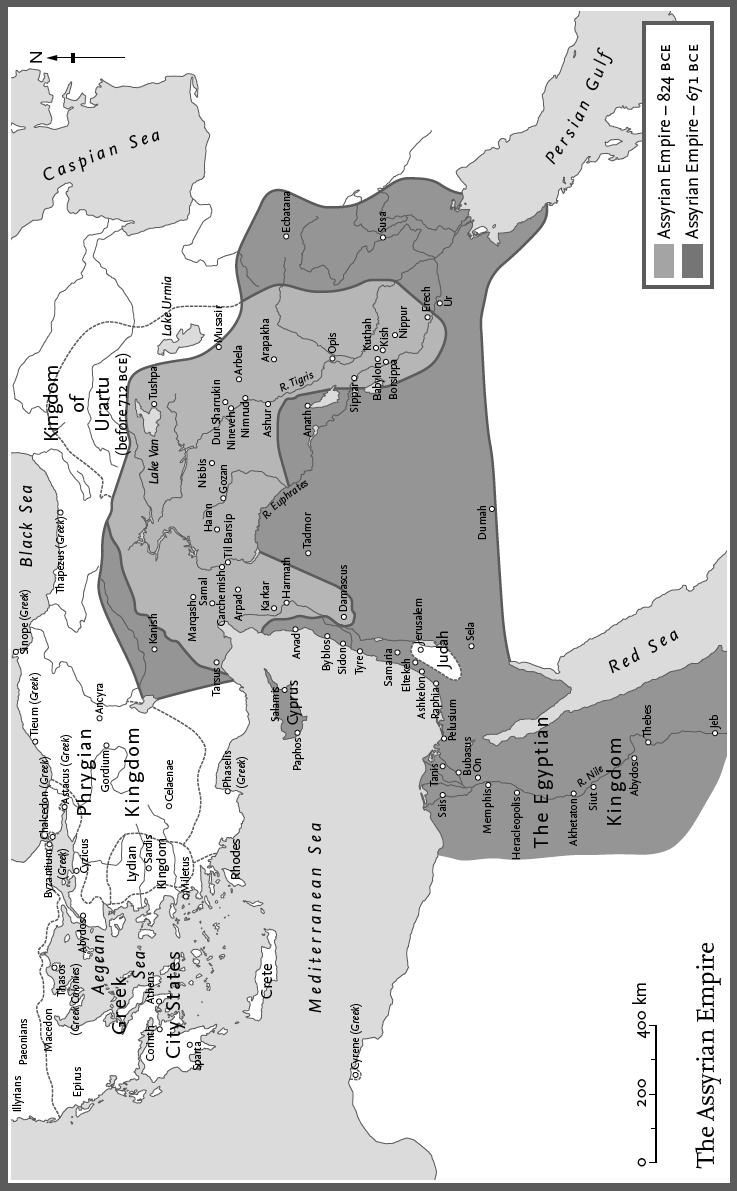
The struggle for dominance between Assyria and Babylon would last for many centuries. The details of the unending conflict between them, not to mention the constant warfare with the surrounding powers, great and small, recorded later in interminable epics and annals full of boasts and dubious claims of victory, quickly become hard to follow and wearisome to relate. It is a relief when one of those powers leaves the stage, as does the Hittite Empire upon its collapse in the late twelfth century BCE, thus simplifying the picture. Enough to say that Assyria grew in territory, piece by piece, though with frequent reverses, to reach a first high point in the 1120s, when the king, Tiglath-Pileser I, crossed the Euphrates, captured the great city of Carchemish, and reached both the Black Sea and the Mediterranean, for the first time creating an Assyrian Empire.
It did not survive for very long. The entire Middle East was soon plunged, once again, into a period of great instability, when the incoming drift of Aramaic-speaking camel-herders from the west now surged into an overwhelming flood. The boundaries of the Assyrian king’s territory were again pushed back. Ashur was again confined to its heartland for rather more than a century.
Yet, though Tiglath-Pileser’s territorial gains were ephemeral, changes in attitude and religious faith were taking place in the City that would have profound and permanent consequences. The Assyrians, heirs to the long Mesopotamian cultural and philosophical traditions that had begun with the Sumerians millennia earlier, were quietly refashioning them into beliefs that would provide some of the foundations for the rest of history.
Misogyny and Monotheism
Among the best known relics of this Middle Assyrian era are lists of laws and palace decrees recovered during the extensive excavations of the Assyrian capital Ashur City, now called Qal’at Shergat, conducted by the Deutsche Orientgesellschaft between 1903 and the outbreak of European war in 1914. A number of legal tablets were found, dating from Tiglath-Pileser’s time, though only three of the documents, labelled A, B and C, were in good enough condition to be deciphered and read. Tablets A and B deal with crime and punishment, property and debt.
The most immediately striking aspects of these laws are how harsh and cruel they seem compared even to Hammurabi’s ‘eye-for-an-eye’ code, and how deep is the misogyny that they express. Punishments include severe beatings, horrific mutilations, and ghastly methods of capital punishment – flaying alive or impalement on a stake for instance, the original model for Roman crucifixions. This is prescribed as the punishment for a woman who procures an abortion: ‘If a woman has procured a miscarriage by her own act, when they have prosecuted her and convicted her, they shall impale her on stakes without burying her. If she died in having the miscarriage, they shall impale her on stakes without burying her.’
For damaging a man’s fertility the penalty is mutilation: ‘If a woman has crushed a gentleman’s testicle in a brawl, they shall cut off one finger of hers. If the other testicle has become affected along with it by catching the infection even though a physician has bound it up, or she has crushed the other testicle in the brawl, they shall tear out both her eyes.’
Adultery is either a capital offence or punishable by disfiguration: ‘If a gentleman has caught another gentleman with his wife, when they have prosecuted and convicted him, they shall put both of them to death…. But if he cuts off his wife’s nose, he shall make the gentleman into a eunuch and they shall mutilate his whole face.’
It must be admitted that we do not know to what extent such penalties were actually imposed in practice. Assyrian rulers energetically promoted their reputation for using appalling savagery – the historian Albert Olmstead called it ‘calculated frightfulness’ – as a tool of governance and a weapon of psychological warfare. An inscription of Tiglath-Pileser, comparing the king to a hunter, who ‘set out before the sun rose and marched three days’ distance before dawn’, proudly claims that he ‘cut open the wombs of the pregnant, he blinded infants’. Gruesome actions indeed, but closely matching those foretold to the Aramean king Hazael by the prophet Elisha in II Kings 8:11: ‘their strongholds wilt thou set on fire, and their young men wilt thou slay with the sword, and wilt dash their children, and rip up their women with child.’ So it is just possible that revelling in the barbarity visited upon women and children was a familiar literary trope rather than a truthful account of real events. After all, similar atrocity stories were told by both Entente and Central Powers during World War I, although this time intended to attract blame rather than praise. The savage provisions described in the Middle Assyrian Laws may have been intended more as a deterrent than as the glorification of cruelty.
However, even if the draconian punishments were theory rather than practice, their anti-female tone cannot be denied. Men could freely divorce their wives and turn them out of the house with nothing; wives had no right to divorce. Women were liable for their husbands’ debts and were punished for their husbands’ crimes; husbands had no responsibility for their wives’ law-breaking. While no ancient society we know of could be truthfully described as a feminist paradise, Middle Assyrian regulations went far further in their oppression of women than any before. It is almost as if the other sex was regarded as another race, or even another species. Public separation of the genders was rigidly enforced. The earliest known requirement for women to wear what is now called the hijab is found here:
Neither wives nor widows nor women who go out on the street may have their heads uncovered. The daughters of noblemen…must cover themselves, whether it is with a shawl, a robe, or a mantle…When they go out on the street alone, they must cover themselves. A concubine who goes out on the street with her mistress must cover herself. A sacred prostitute married to a man must cover herself on the street, but one whom a man did not marry must have her head uncovered on the street; she must not veil herself. A harlot must not veil herself; her head must be uncovered. Harlots and maidservants who cover themselves shall have their garments seized, they shall be beaten with fifty blows, and shall have bitumen poured over their heads.
A slave-girl who had the temerity to veil herself would have her clothing taken from her and her ears cut off. Moreover, witnesses to any transgression of these rules must take action to report it, on pain of prosecution themselves:
He who has seen a harlot veiled must arrest her, produce witnesses and bring her to the palace tribunal; they shall not take her jewellery away, but the one who arrested her may take her clothing; they shall flog her fifty times with staves and pour bitumen over her head.
Not even upper-class men were immune from punishment if found guilty of dereliction of their civic duty:
If a gentleman has seen a harlot veiled and has let her go without bringing her to the palace tribunal, they shall flog that gentleman fifty times with staves; they shall pierce his ears, thread them with a cord, and tie it at his back. He shall do work for the king for one full month.
It must be said that the most fervent Wahhabi or severest Afghan Talib would probably have felt that the Middle Assyrian Laws went rather far in repressing women. The Palace Decrees went even further. Their subject was the royal women, their purpose circumscribing and limiting every activity of those who resided in the palace women’s wing, as well as those who came into contact with them. This was the prototype for what we now know as a harem. Think of the women’s quarters of the Ottoman Topkapı, ‘Cannon Gate’, palace in Istanbul, with its narrow twisting passageways, its secret doorways and grilled windows, its hidden courtyards and secluded chambers.
The Assyrian royal court’s female apartments, in which the kings’ wives and concubines spent their entire lives, were kept firmly locked at all times, to keep men out and women in. It was strictly forbidden for anyone to enter the women’s area without the express permission of the palace commander. Going into any part of the palace from which the women could be observed, such as out on to a roof, was a serious crime. The restrictions even applied to the palace eunuchs, of whom there were apparently many.
When sent on business into the harem, the eunuch must, like everyone else, first apply for permission to the palace commander, who himself had to wait at the entrance to ensure that the eunuch came out again. And even when inside, a eunuch must be very careful of his behaviour: no eavesdropping on the women’s conversations, no listening to the women singing. A eunuch who overheard the women quarrelling was condemned to have one of his ears amputated and to be beaten with a hundred blows. When required to speak to one of the women on official business, a eunuch might approach no closer than seven paces; if the conversation went on longer than necessary, even if the woman had initiated the conversation, the eunuch was flogged and his clothes were taken from him. For a man to engage in conversation with a palace woman, with no third party present as chaperone, was a capital offence. If anyone, a courtier or another palace woman, witnessed such a breach of the rules and failed to report it to the king, he or she was thrown into a hot oven – perhaps of the same kind as the ‘burning fiery furnace’ into which the Book of Daniel tells us that Shadrach, Meshach, and Abednego were cast.
The principles of extreme female seclusion developed here in ancient Assyria would be a model for many future societies. Indeed there is direct continuity from the harem of the Old Palace in Ashur, right through the Babylonian, Persian and Hellenistic eras, to the Byzantine royal court, from which imperial Islam in turn inherited so much of its preference for women’s public invisibility. But Muslim teaching was intended to introduce social justice. The rulings were democratically extended to include all women, not just the nobility. In Assyria, as in Byzantium, lower-class women were strictly forbidden to cover themselves; in Islam there was to be no division between respectable and non-respectable females. Queens, princesses, noblewomen, wives, concubines, unmarried daughters, crafts-women, workers and slaves, all were to be modestly arrayed no matter what their social milieu. In its own eyes the Islamic demand for universal female reserve is seen not as restriction but as liberation.

It is no explanation to ascribe the anti-female flavour of the Middle Assyrian Laws and Palace Decrees, as some have done, to innate Semitic male chauvinism. The letters to and from Karum Kanesh had shown women playing an important role in Assyrian society, taking active responsibility for substantial aspects of their menfolk’s business affairs. Even before then, women had been important in Mesopotamian religion. Ever since the time of Sargon of Akkad the eldest daughters of kings had been appointed to positions of the highest rank, such as high-priestess at the temple of the moon in Ur, the ruling house of all moon-temples. That women’s lives were now so different is just one symptom of a profound and fundamental alteration in religious thinking, a radical shift in the way that Assyrians saw the powers that rule the world, and in consequence the place of men in the grand scheme of things.
This change in religious belief would have dramatic consequences for the world’s history, the first stage in a revolution that has made our world of today what it is. It oversaw the move from faith in gods of immanence, spiritual representations of the forces of nature, deities who inhabit the world and wear the natural phenomena they represent like a suit of clothes, to gods of transcendence, deities outside, beyond and above nature rather than part of it.
We should not allow the fancy language – ‘immanence’, ‘transcendence’ – to obscure the enormous importance of that shift in religious perspective. Here was a new vision that would eventually lead most of humanity away from belief in a sacred earth, of which every feature – sky, land and sea, mountains, valleys and rivers, as well as the plants and animals that inhabit them all – is inspirited by supernatural powers, to faith in an unhallowed material universe which is controlled, as puppeteers manipulate the strings of their lifeless marionettes, by divine forces hidden behind the curtain of appearances that an anonymous medieval Christian mystic famously called the ‘cloud of unknowing’.
In earliest Mesopotamian times the gods had been perceived as personifications, hypostases, of nature and her forces. Enlil, Lord Air or Lord Atmosphere – today we might call him Lord Biosphere – was overall ruler of the divine realm. His son, Enki, Lord Earth, later known as Ea, spirit of the sweet waters that well up to fertilize agricultural ground, was the purveyor of civilization to humanity. Anu was Lord Heaven; Nanna, later called Sin, was the moon; Utu, later Shamash, the sun. Inanna, whom Semites identified with Ishtar, was the adrenaline goddess, present whenever and wherever men fought or fucked. Even when new deities were introduced – as the Babylonians included the god of their city, Marduk, into the divine assembly – every attempt was made to integrate them into the old pattern. Thus Marduk was said to be son of Ea, Lord of civilization, with whom he ruled in harmony. According to his story in the Enuma Elish, he was awarded the competences, prerogatives and powers of Enlil, king of the gods.
Now in Assyrian days, on seals and sculptures, we witness the connection between the gods and nature first slowly stretched, then broken altogether. Previously, gods were represented in human form, wearing the horned crown of divinity, and surrounded by their attributes, as for example the scene of the investiture of the king of Babylon by Shamash the sun god, which adorns the top of the stele inscribed with Hammurabi’s law code. But from now on the gods will first be represented as distanced from the world, positioned like idols on pedestals and podiums and finally not pictured at all, but replaced by symbols: a sun for Shamash, a moon for Sin, the planet Venus, pictured as a star, for Ishtar. A remarkable altar recovered from a temple in Ashur and now in a Berlin museum, presents Nusku, the messenger of the gods, in the form of a writing tablet and stylus, set on a stand as if waiting for the invisible power to inscribe upon it a blessing or a prophecy. Ashur appeared as a winged disc carrying the divine image hovering above the universe, a symbol later adopted by the Persians, whose Zoroastrian community still displays it today to signify the worship of their supreme god Ahura Mazda. Among the most striking imageless, an-iconic divine representations of all is the series of metre-long footprints of God – the sole earthly sign of an otherwise invisible presence – approaching the inner sanctum of a temple uncovered at ’Ain Dara, forty miles from Aleppo in Syria.
Belief in the transcendence rather than immanence of the divine had important consequences. Nature came to be desacralized, deconsecrated. Since the gods were outside and above nature, humanity – according to Mesopotamian belief created in the likeness of the gods and as servant to the gods – must be outside and above nature too. Rather than an integral part of the natural earth, the human race was now her superior and her ruler. The new attitude was later summed up in Genesis 1:26: ‘And God said, Let us make man in our image, after our likeness: and let him have dominion over the fish of the sea, and over the fowl of the air, and over the cattle, and over all the earth, and over every creeping thing that creepeth upon the earth.’
That is all very well for men, explicitly singled out in that passage. But for women it poses an insurmountable difficulty. While males can delude themselves and each other that they are outside, above and superior to nature, women cannot so distance themselves, for their physiology makes them clearly and obviously part of the natural world. They bring forth children from out of their wombs and produce food for their babies from their breasts. Their menstrual cycles link them to the moon. In today’s society the notion that, for women, biology is destiny is rightly regarded as abhorrent. In Assyrian times, it was a self-evident fact that debarred them from full humanity.
It is no accident that even today those religions that put most emphasis on God’s utter transcendence and the impossibility even to imagine His reality should relegate women to a lower rung of existence, their participation in public religious worship only grudgingly permitted, if at all. It is well known that orthodox Jewish men pray every morning ‘Blessed art Thou, O Lord our God, King of the Universe, who did not make me a woman.’ Moreover, women’s lowliness is, apparently, contagious, threatening to drag men down to their level, and especially emphasized at times when their physical nature is undeniable: immediately after childbirth and during menstruation, when according to the Middle Assyrian Palace Decrees, as to orthodox Jews and Muslims to this day, they are regarded as particularly unclean. No menstruating woman was allowed into the presence of the Assyrian king. Priests had to be particularly careful: all sexual contact even with their own wives required them to ritually purify themselves as soon as possible. Women were a danger to men’s half-divine nature. The female sex would not begin to regain a measure of religious respect until Christians came to believe in a God who was born naturally, as a human being, into the physical world out of the womb of an earthly woman.
And this dislocation between the realm of the gods and the domain of nature had another, inestimably influential consequence. If different gods were no longer directly connected with aspects of the material universe, there was much less reason to imagine so many of them. And if the gods were now no longer thought of as embedded in nature and in particular sacred places where they could be worshipped in shrines, chapels and temples, they were freed to become omnipresent. One might pray to Ashur not only in his own temple in his own city, but anywhere. As the Assyrian empire expanded its borders, Ashur was encountered in even the most distant places.
From faith in an omnipresent god to belief in a single god is not a long step. Since He was everywhere, people came to understand that, in some sense, local divinities were just different manifestations of the same Ashur. Several scholars have noted that Assyrians tended to merge all the gods into a single figure for rhetorical effect. Others point out how Mesopotamian writings show that these ancients experienced one, universal deity as a distant presence behind each particular god they worshipped. As Simo Parpola put it in the introduction to his collection Assyrian Prophecies: ‘all the diverse deities being conceived of as powers, aspects, qualities or attributes of Ashur, who is often simply referred to as (the) God.’ Though Parpola’s claim that much of Jewish metaphysics is rooted in Assyrian prophecy has been roundly rejected by his peers, even one of his sternest critics, Jerrold Cooper of Johns Hopkins University, agrees that ‘for a Mesopotamian, ‘the god’ and ‘the gods’ were essentially the same divine power that determined destinies’. The foundations of the monotheism that the Hebrew tribes were to make the world’s patrimony were being laid here in Assyria in the last part of the second millennium BCE.
That is not to say that the Hebrews borrowed the notion of a single omnipotent and omnipresent God from Assyrian predecessors. Just that their new theology was far from an utterly revolutionary and unprecedented religious movement. The Judaeo-Christian-Islamic tradition that began in the Holy Land was not a total break with the past, but grew out of religious ideas that had already taken hold of Late Bronze and Early Iron Age northern Mesopotamia, the world view of the Assyrian kingdom, which would spread its faith as well as its power right across western Asia over the course of the following centuries.
Ideology and Empire
Meanwhile Arameans continued to pour into Mesopotamia from desert and steppe, wresting away from Assyria imperial territory that had been so painstakingly acquired. It is not too hard for us of the twenty-first century to imagine how Assyrians felt about this.
There are times in history when it seems as if all the world is on the move; we seem to be living in such a period at present. According to the United Nations, ‘Between 1960 and 2005 the number of international migrants in the world more than doubled, passing from an estimated 75 million in 1960 to almost 191 million in 2005’. Moreover nobody knows how many unrecorded and illegal migrations should be added to that total: perhaps as many as a quarter or a third more.
Such movements of groups and individuals are rather different from the historic migrations of entire peoples backed by military force, like the entry of Germanic-speakers into Europe in the middle of the first millennium CE, or the conquests in central and western Asia of Turkic-speakers in the first half of the second. Armed incursions can in principle be militarily opposed. Migration is in the end a more powerful force because it is ultimately irresistible: laws that nations introduce to limit it are ultimately unenforceable.
Assyria had no more prospect of halting the human flow than can the British government stop illegal entrants to the UK, although an effective natural moat surrounds the British Isles. There is little hope that the US Department of Homeland Security will have greater success with its border fence than did King Shulgi of Ur and his successors, whose ‘wall to keep out the Amorites’ failed to prevent the migrants’ eventual takeover of all lower Mesopotamia and their founding of Old Babylon.
The region had always experienced regular waves of Semitic incomers from the steppes and deserts to the west. In very earliest prehistoric times, speakers of what would become the Akkadian language had arrived to join the Sumerians in exploiting the potential fertility of the alluvial Tigris and Euphrates plain. Later came the western Semites called Amurru, Amorites. In Assyria’s day, it was the turn of the Arameans.
Mass migrations are the result of two forces: a push and a pull. Emigrants always have reasons for leaving their places of origin and they target destinations that are particularly attractive. In our own times people leave their homes because of unemployment and poverty, political, economic and religious oppression, social turmoil and war. Their aim is to reach places which offer better prospects for their future. Similar motives had probably propelled Semitic-speakers into the Fertile Crescent in a steady trickle from before the start of recorded history. But what confronted the Assyrians near the turn of the first millennium BCE was an influx at least an order of magnitude greater, a drive occasioned by a severe change in climate that made marginal lands uninhabitable.
There is much evidence that for two centuries or so from about 1200 BCE, east of the Mediterranean, rainfall decreased by approximately 20 per cent and average temperature rose by 2–3°. That would have been enough to cause widespread starvation among those who inhabited the steppelands and desert edges. It sent their tribes fleeing, desperate for survival, in all directions: northwards into Assyria, eastwards into lower Mesopotamia and westwards towards the Mediterranean coast, where they carved out petty sheikhdoms on lands taken from their previous inhabitants, who were themselves weakened by climate change famine. An Assyrian chronicle, written not long after, tells us that ‘In King Tukulti-apil-Esharra’s thirty-second year [1082 BCE], the famine was so severe that people ate one another’s flesh….Aramean clans plundered the land, seized the roads, and conquered and took many fortified cities of Assyria. Citizens of Assyria fled to the mountains…to save their lives. The Arameans took their gold and silver and their property.’
The picture looked similar even from the other side of the ethnic divide. It was during these centuries of drought, famine and population movement, when Arameans were flooding into the region, that the Bible has the Children of Israel laying claim to would become known as the Holy Land. Annually recited during the First Fruits Festival at the Jerusalem Temple were the lines from Deuteronomy 26: ‘A wandering Aramean was my father, and he went down into Egypt, and sojourned there, few in number; and he became there a nation, great, mighty, and populous.’ The Egyptian government took unkindly to what they perceived as a threat from a rapidly growing enemy within. ‘And the Egyptians dealt ill with us, and afflicted us, and laid upon us hard bondage.’ So, the Bible continues, the Hebrews were led by God out of Egypt and into the land of Cana’an, where they took advantage of the temporary weakness of the major regional powers to seize territory for themselves: ‘And the Lord brought us forth out of Egypt with a mighty hand, and with an outstretched arm, and with great terribleness, and with signs, and with wonders. And He hath brought us into this place, and hath given us this land, a land flowing with milk and honey.’ After several generations of tribal life under the rule of religious judges, a Hebrew kingdom was founded, according to Jewish tradition, by King Saul not long before 1000 BCE.
Scholars debate whether this is myth or history. But it is certainly true that the land of Cana’an began to take on its Israelite identity just at the time when Assyria was at its weakest and the texts were complaining of the movement of new peoples into the Fertile Crescent; at any other time it is most unlikely that the Twelve Tribes would have been allowed to set themselves up as masters of the Promised Land.
Once again, Assyria’s borders were forced back to enclose an irreducible core. Much of what had for several centuries been Assyrian territory was now divided up among what they thought of as barbarian kingdoms. Once again, Ashur City had lost both much of its best hinterland as well as control of the international trade-routes that had underpinned its prosperity and afforded its luxuries. Ashur was reduced to near penury.
The moral that Assyrian rulers took from the disaster was that their only safety lay in possessing incontestable military power. War was too important to be left to the romantic heroism of kings and generals. If traditional fighting methods could not even hold off a swarm of camel-riding sheep-herders, Ashur’s rulers would concentrate on designing and building a new kind of war-machine, one that nobody would be able to withstand. Moreover, the only sure way to stop people migrating into Ashur was to take over their homelands and rule them with a rod of iron. Empire was a necessity not a luxury. If that caused them unpopularity, so be it. As a well-known Latin tag, supposedly a favourite of the half-mad Roman Emperor Caligula, would later express it, Oderint dum Metuant: Let them hate, so long as they fear.
The process of creating an invincible army could not be achieved overnight. Apart from anything else, it would cost a lot of money, money that Ashur did not have, her base being too small and too poor. Her only recourse was to begin by exacting tribute from her neighbours using the forces already available to her. Initially at least, what the Assyrians lacked in military numbers, materiel and know-how, they would have to make up for by sheer ferocity.
Assyria soon discovered a painful truth: empires are like Ponzi schemes: financial frauds in which previous investors are paid returns out of new investors’ deposits. The costs of holding imperial territory can only be underwritten by loot and tribute extracted by constant new conquests; empires must continue to expand if they are not to collapse. So, from the beginning of tenth century BCE, Assyria set out on the project of regaining her former territories, gobbling up the surrounding Aramean kingdoms and expanding her domain in stages up to the borders of her former possessions. And then surpassing them, to encompass a larger area than any empire ever before known. This was achieved by the eighth century, in the reign of King Tiglath-Pileser III. He is named Pul in II Kings 15:19, which may have been his personal rather than his throne-name, when he makes the first appearance of any Assyrian emperor in the biblical record: ‘And Pul, the King of Assyria came against the land.’
The era of independent monarchy in Israel and Judah coincided with the era of greatest Assyrian imperial re-expansion, which is why most names of the rulers who dominated Assyria during its glory days are still known to us by their Biblical approximations. We have Shalmaneser for Shulmanu-Asharidu, ‘(the god) Shulmanu is the greatest’; Sargon for Sharru-kin, ‘Rightful King’; Sennacherib for Sin-Ahhe-Eriba, ‘Sin (the moon) replaced the brothers’; Esarhaddon for Ashur-Ahhe-Iddina, ‘Ashur Has Given Me a Brother’; and Tiglath-Pileser for Tukulti-apil-Esharra, ‘My trust is in the heir of Esharra’, Esharra being the great temple of the god Ashur in Ashur City.
Tiglath-Pileser’s assault on Israel took place some time around the year 740 BCE during the reign of Menachem, sixteenth ruler of the northern Hebrew kingdom. No stranger himself to savagery, Menachem had gained the throne by coup and assassination. In his struggle to consolidate his rule, the Biblical record – as ever pro-Judah and anti-Israel – attributes to him appalling atrocities: ‘Then Menahem smote Tiphsah, and all that were therein, and the borders thereof, from Tirzah; because they opened not to him, therefore he smote it; and all the women therein that were with child he ripped up.’ (II Kings 15:16) However even he would have been daunted by the sight of the Assyrian field army drawn up in full fighting array outside his capital city Shomron, not far from today’s Nablus.
By now several generations of emperors had reformed the Assyrian military into the first truly modern fighting machine, a model for all future armies until the introduction of firearms and mechanization. The force would have been considerable, numbering between 30,000 and 50,000 men, equivalent to five modern divisions, a huge contingent by the standards of the day. King Menachem no doubt mounted to the top of the great ashlar masonry wall erected by his predecessor King Omri around the city’s acropolis the better to observe the Assyrian battle-line which extended as far as 2.5 kilometres across and nearly 200 metres deep.
He would have seen, in the centre of the formation, the main body of infantry, compact phalanxes of spearmen, their weapon points glittering in the sun, each arranged in ten files of twenty ranks. He would have marvelled – and perhaps trembled – at the discipline and precision of their manoeuvring, a contrast to the relatively freewheeling manner of previous armies, for the reforms had introduced a highly developed and effective command structure. Infantrymen fought in squads of ten, each headed by an NCO, and grouped into companies of five to twenty squads under the command of a Captain, a Kirsu. They were well protected and even better equipped, for Assyria was fielding the very first iron armies: iron swords, iron spear blades, iron helmets and even iron scales sewn as armour on to their tunics. Bronze weaponry offered no real contest: this new material, which was cheaper, harder, less brittle, could be ground sharper and kept a keener edge for far longer. Iron ore is not found in the north Mesopotamian heartland, so every effort had been made to put all nearby sources of the metal under Assyrian control.
Assyrian spearmen were more mobile than their predecessors too. Rather than sandals, they now wore the Assyrian military invention that was arguably one of the most influential and long-lasting of all: the army boot. In this case the boots were knee-high leather footwear, thick-soled, hobnailed and with iron plates inserted to protect the shins, which made it possible for the first time to fight on any terrain however rough or wet, mountain or marsh, and in any season, winter or summer. This was the first all-weather, all-year army.
Behind the phalanxes of spearmen ranged archers and slingers, many of them foreign auxiliaries, also divided into companies, shooting their projectiles over the heads of the infantry. Archers were now equipped with a new weapon, the composite bow, another Assyrian innovation, constructed by glueing different materials together: wood, horn and sinew. Though suffering more from damp weather than traditional bows made of a single piece of wood, and demanding much greater strength to draw – according to some researchers, beyond modern sporting capabilities – and needing two men to string them, they could be made far more powerful and therefore deadly than the previous all-wooden weapon.
In the lead drove the shock-troops: formations of chariots, mobile missile platforms, the ancient equivalent of tanks. These were no longer drawn at a slow pace by asses, but by much faster, larger and more rugged animals: horses. Each chariot was powered by up to four of the beasts and manned by a driver who, as equestrian skills advanced, sometimes rode one of the horses and controlled the others with a system of traces, leaving room on the platform for the bowman and two shield-bearers to fight more freely. These men were also armed with spears, swords and axes, so that after the initial assault they could dismount and fight as heavy infantry while the charioteer returned his vehicle to safety.
Chariotry itself would have been no novelty to the Israelite king. Indeed the northern Hebrews excelled at the use of horse-drawn fighting vehicles. In the following century Israelite charioteers featured prominently in the roster of top officials and equestrian officers of the Assyrian army known as the Horse Lists. But another long-lasting battlefield innovation introduced by the Assyrians would have probably been unfamiliar to him: cavalry. If a driver could ride one of the chariot horses, then so could he ride a horse without a chariot attached. These fighters, wielding spears or bows, rode with bridles of modern style, but without saddles or stirrups, which had yet to be invented. Instead they sat on blankets anchored in place by breastband, girth and crupper, and they controlled their mounts by pressure from their heels. Horses were now so important to the Assyrian line of battle that they were imported from as far away as Nubia, the Land of Kush – ironically the Israelites were among the most important intermediaries in this trade – and the empire’s borders had been redrawn and enlarged to include the best horse-breeding territories. Each province had an entire establishment of officials, musarkisi, dedicated to providing mounts for the army. According to documents recovered from the city of Nineveh they were able to secure some 3,000 animals a month, of which about 60 per cent were destined for the chariot corps, 30 per cent for the cavalry and the rest put out to stud. A century earlier the Assyrian Emperor Shalmaneser III claimed to have fielded a force of nearly 35,000 men, comprising 20,000 infantry, 1,200 chariots and 12,000 cavalry. The absolute numbers may well have been exaggerated for propaganda effect, but their relative ratios probably reflect the truth.
What Menachem would have seen from the top of his city wall was merely the tip of the iceberg. To assemble, provision and keep in the field a great fighting force such as this had required deep changes in Assyrian society, which by the time of Tiglath-Pileser III had been militarized through and through. The army had become the point – in every sense of the word – of the entire Assyrian nation. Each adult male had a duty to serve unless he sent a substitute or paid to be spared. The three highest military ranks, Commander in Chief, Commander of the Left and Commander of the Right, were also governors of provinces. Military officers were addressed in correspondence by their civilian titles and there seems to have been little or no distinction between the roles, just as in the European Middle Ages, when titles like duke, count, knight and esquire originally related to rank on the battlefield. And, as in medieval days, Assyrian aristocrats were granted lands by the king in return for military officer service: a proto-feudal system.
Much of this Menachem knew as he looked down at the Assyrian army in front of his city. He was also only too well aware of what happened to those who resisted, since the Assyrians always made quite sure that nobody could remain ignorant of the penalty. In accordance with the principle Oderint dum Metuant, Tiglath-Pileser’s great-great-great grandfather had proclaimed to the world:
I built a pillar over against the city gate and I flayed all the chiefs who had revolted, and I covered the pillar with their skins. Some I impaled upon the pillar on stakes, and others I bound to stakes round the pillar…I cut the limbs off the officers…who had rebelled…Many captives…I burned with fire and many I took as living captives. From some I cut off their noses, their ears and their fingers, of many I put out their eyes. I made one pillar of the living and another of heads, and I bound their heads to tree trunks round about the city. Their young men and maidens I burned with fire…The rest of their warriors I consumed with thirst in the desert of the Euphrates.
Menachem felt that he could not risk defeat by such a brutal enemy and instead paid a generous indemnity. In any case, he thought the support of the world’s superpower would strengthen his hand in retaining the throne of the Hebrew kingdom against all challengers – of whom there were many: ‘And Menahem gave Pul a thousand talents of silver, that his hand might be with him to confirm the kingdom in his hand.’ ‘And Menahem exacted the money of Israel, even of all the mighty men of wealth, of each man fifty shekels of silver, to give to the King of Assyria. So the King of Assyria turned back, and stayed not there in the land.’ (I Chronicles 5:26; II Kings 15:19)
The decision, and the huge cost, paid off. Thanks to Assyrian support, Menahem was the only Israelite ruler during this anarchic period who managed to retain his position and die naturally in his bed. The transaction is laconically confirmed in one of the Assyrian king’s own inscriptions: ‘I received tribute from Kushtashpi of Commagene, Rezon of Damascus, and Menachem of Samaria [spelled out in cuneiform as Me-ne-khi-im-me Sa-me-ri-na-a-a].’
For the moment the Kingdom of Israel, what the Assyrians called Samaria – or sometimes Omriland after Omri, the powerful founder of the fourth Israelite dynasty, father-in-law of Queen Jezebel, who had built Shomron as his capital – was included among the empire’s client states rather than being incorporated bodily into Assyria proper. The empire’s initial policy was to allow those whose loyalty was assured to retain their nominal autonomy, like the princely states that continued to survive during British Raj India.
Like the British East India Company, Assyria first grew by capturing and securing points of greatest strategic and economic importance, trade routes and entrepôts, and bypassing places of lesser significance as long as they offered no threat to Assyrian interests. Rather than a uniform solid block of possessions, the empire remained until quite late in its history more of an open web. As one historian of the period puts it: ‘The empire is not a spread of land but a network of communications over which material goods are carried.’
For a long period there was a distinction between Assyria proper, a uniform territory centrally administered from the capital, known to its rulers and people as Mat Ashur, ‘the land of Ashur’, and outlying areas subservient to, but distinct from, Ashur’s domain. Should a tributary ruler refuse his obligations, however, or, worse, conspire to attack or damage Ashur’s interests, he would be summarily deposed, his kingdom annexed.
So, over time, the gaps in the network were filled in as resistance and rebellion by less than pliant client rulers led Assyrian emperors to bring more and more nominally independent kingdoms under their direct control, as happened when Hoshea, King of Israel, three reigns but only seventeen years after Menachem, stopped paying tribute and began plotting with the Egyptian Pharaoh to throw off the Assyrian yoke. As II Kings 18:4 recounts:
The King of Assyria found conspiracy in Hoshea; for he had sent messengers to So, King of Egypt [probably Osorkon IV of the 22nd Dynasty], and offered no present to the King of Assyria, as he had done year by year; therefore the King of Assyria shut him up, and bound him in prison.
Then the King of Assyria came up throughout all the land, and went up to Samaria, and besieged it three years.
In the ninth year of Hoshea, the King of Assyria took Samaria.
Sargon himself recorded the event thus: ‘I besieged and conquered Samaria. I led away 27,290 of its people; from among them I formed a contingent of 50 chariots. I made those remaining behind assume their social positions. I installed over them one of my officers and imposed upon them the tribute of the former king.’
It was the end of the northern Hebrew kingdom and – according to religious tradition – the ten tribes that were its inhabitants. Others were brought in from elsewhere to replace those deported. The territory itself was incorporated into Assyria proper and lost its identity. Assyrian royal annals were wont to express it this way: ‘to the land of Ashur I added the land, to its people I added the people’.
Thus by the end of its days the Assyrian Empire had by accident or design become a single huge block of territory incorporating almost the whole of the Near East, stretching across and around the Fertile Crescent from the Mediterranean shore to the head of the Gulf, from Egypt to Elam, a domain in which every inhabitant was considered an Assyrian citizen, just as throughout the vast Roman Empire, after Emperor Caracalla, every free inhabitant could say civis Romanus sum (I am a Roman citizen). For empires cannot be permanently held by power alone. Subject populations will submit to naked military force for only so long. There must also be belief; there must also be principles. The Assyrian Empire rested upon a firm ideology, which has remained a model for imperialists throughout history.
There must be only one realm. Every Assyrian territory, no matter whether directly connected with the home country or separated from it by client states, was regarded as an equal province of ‘the Land’, as surely part of the national patrimony as Ashur City itself. Previous empires had allowed their separate possessions to retain a sense of ethnic identity and had ruled them through local elites co-opted into the imperial system; the slightest sign of weakness at the centre led to revolt and insurgency. The Assyrian Empire was a single unity, its constituent parts as much integral to the mother country as were modern France’s overseas imperial possessions.
There must be only one people. All who lived in Assyria were Assyrians, no matter what language they spoke or what customs they followed. All were subject to the same benefits and burdens, the same taxation and conscription. Hence the best known of what are taken to be penalties imposed on conquered states: the deportation of the population and its replacement by other residents from elsewhere in the empire. From the Assyrian point of view this was no punishment. It was the Assyrian melting-pot, a way of ensuring that, over time, every ethnicity other than Assyrian and every allegiance other than to the empire would be forgotten. The disappearance of the Ten Tribes of Israel into the general Assyrian population demonstrates how well the policy worked, even with people as fiercely dedicated to preserving their identity as the Hebrews.
There can be only one leader. Previous Mesopotamian rulers had been hero-worshipped, idolized and several even deified. They presented themselves as the servants, as well as earthly representatives, of divine patrons, who were the real actors in history. Assyrian emperors were, by contrast, the ultimate expression of their nation: Assyria personified. The image of Assyrian emperors as despots of the worst order, indulging in vile cruelty and depraved luxury, as described by classical Greek authors, and depicted by orientalist painters like Eugène Delacroix in ‘The Death of Sardanapalus’, is about as far as can be from the account we find in Assyrian documents. ‘To the Assyrians, a king immersed in revelries and cruelties would have been an abomination,’ writes Simo Parpola, ‘their kingship was a sacred institution rooted in heaven, and their king was a model of human perfection seen as a prerequisite for man’s personal salvation.’ Israel Finkelstein, professor of archaeology at Tel Aviv University, suggests that for a picture of what the Assyrian court was really like during the late eighth and seventh centuries BCE – the reigns of Tiglath-Pileser III to Ashurbanipal – one need only to look at the biblical Book of Kings and its depiction of King Solomon, his wealth, his wisdom, his wives. This, Finkelstein argues, has little to do with the reality of a rustic highland chieftain of the tenth century, but actually reflects ‘a vision of Assyrian kingship as the ultimate ideal’. The ruler of the Land of Ashur was known as ‘the perfect person’, the very same expression to this day applied in Arabic, al-Insan al-Kamil, to the Prophet Muhammad.
There can be only one god. Ashur was omnipresent throughout the empire. He had just a single temple, the Esharra in his own home city, this too a model for the Hebrews of Judah, who ‘removed the high places, and brake the images, and cut down the groves’ (II Kings 18:4), and for the first time centralized their faith on God’s temple in Jerusalem. Yet at the same time Ashur might be – must be – worshipped anywhere and everywhere: the first missionary divinity. Tiglath-Pileser wrote in an account of one of his victories, ‘I imposed on them the heavy yoke of my empire. I attached them to the worship of Ashur, my Lord.’ True, the old gods retained their followers. The rites of Ishtar continued in Nineveh; the worship of Sin, the moon, did not cease in Harran. But the whole empire was encouraged to share the understanding that these were somehow reflections, aspects, manifestations of a single, omnipotent, omnipresent universal Godhead, increasingly identified with Ashur. It was Ashur who provided the rationale of empire. Like the Christian God of the Byzantines and the Muslim God of the Khalifs, He had decreed that His service and His worship be spread throughout the region. And his earthly representative was the Assyrian emperor.
So we might, perhaps tendentiously, sum up Assyrian imperial ideology in the pithy phrase One Realm, One People, One Leader. It sounds more familiar in German: Ein Reich, Ein Volk, Ein Führer. However, though there may have been only one realm and only one leader, the infamous division of Hitler’s subjects into Arier and Untermenschen, Aryans and Subhumans, would have been seen by Assyrians as a criminal betrayal. As the texts demonstrate, all Assyrians, whether foreign deportees, or of native ancestry like the qinnate sha Ninua labiruti, the ‘old time families of Nineveh’, were regarded as equal. Newcomers were carefully instructed in their duties. ‘People of the four [ends of the world], of alien languages, diverse speech, inhabitants of mountainous regions and of the plains…at the order of Ashur, my lord, I made them as of one tongue and settled therein. I commissioned natives of Assyria, masters of every craft, as overseers and commanders to teach them proper conduct and to revere god and king.’
That this policy was successful is attested to by the foreign names that even high state officials bore. Girisapunu, governor of Rasappa, must have been a Phoenician, as was the famous Ahiqar, ‘keeper of the king’s signet and councillor of all Assyria’ under Esarhaddon – his story would become a classic of Syriac, Arabic, Ethiopic, Armenian, Turkish and Slavonic literature. Provincial and district governors Gulusu, Arbaya and Adad-suri bore Aramean names. So did Hanunu, ‘commander of the Eunuch’s guard’, Salamanu, ‘commander of the Queen Mother’s guard’ and Abdi-ili from Ashkelon, ‘third man on the chariot of the chief eunuch’. Qu’yah, Hilqiyah, Giri-yah and Yah-suri, officials ‘residing in fortresses’, are shown by their names to have been Israelite worshippers of the Hebrew God.
However, this policy of inclusion and equality for all was to have profound consequences. New Assyrians, Aramaic speakers, soon came to greatly outnumber the old. Thus it was not very long before users of Assyria’s original Akkadian dialect were reduced to a minority in their own land. Of course scholars and academics adhered tenaciously to their traditions, yet they could not stop the slow but inexorable progress of the new language, which became first an alternative official tongue, and finally the main chancellery medium of the empire.
So did imperial policy and high principle ensure that Aramaic would bring 2,000 years of civilization built on the Sumerian and Akkadian languages to an end. And yet, paradoxically, at the same time, it would also assure its immortality.