
HENRY HURST
Carthage must be destroyed.
CATO THE ELDER, c. 150 BC
Twice in its history Carthage was one of the world’s greatest cities. Both times it was seen as a threat to what might be called the West: first to the growing power of Rome, then, five centuries later, to the religion which the ageing Roman world had, misguidedly in Edward Gibbon’s view, clasped to its bosom.
The first Carthage was slightly older than Rome, being founded traditionally in 814 BC by colonists from Tyre. Culturally it was thus a hybrid of eastern Mediterranean and North African influences; its inhabitants spoke Phoenician. Overlooking the passage between the east and west Mediterranean seas, Carthage rose to commercial prominence, exercising control over all trade in the western sea, including the vital metals supply from Spain. In the 3rd century BC, faced with the rising power of Rome, a territorial empire was established under one of Carthage’s leading families, the Barcids, in Spain. This included the foundation of Cartagena – ‘New Carthage’ – and it was from here that the family’s most famous son, Hannibal, set out to crush Rome in the second of the three Punic Wars in which the two powers fought for supremacy. After nearly achieving his ambition, Hannibal was finally defeated at the battle of Zama in 202 BC. The third Punic War saw the fulfilment of Cato’s wish, the destruction of Carthage, in 146 BC.
The second Carthage was a Roman imperial city, exemplar of the ‘concord’ of Augustus, whose (re)foundation is celebrated in the story of Dido and Aeneas in Virgil’s Aeneid, Book 4. Though it stood on the same spot as the first Carthage, it was developed slightly more than a century after 146 and was thus physically a different city. Yet the cultural continuities between the two were powerful. St Augustine’s outrage at the licence and popularity of the cult of Caelestis in the early 5th century AD tells us, effectively, that behind the material veneer of Roman Carthage the city’s pre-Roman spiritual core – the worship of Caelestis/Tanit, the Carthaginian variant of the Phoenician goddess Astarte – was intact.
The two Carthages also show intriguing conceptual similarities, over and above their delicious setting at the side of the Gulf of Tunis. Characteristic of both was an ordered and technologically advanced urbanism. Both cities had gridded street layouts with rectangular city blocks. Punic Carthage was disposed radially around the acropolis on the Byrsa hill, but the Roman plan took order to extremes, with the whole city laid out on a single grid which paid no respect to natural variations in elevation. Four centuries after the execution of the plan, the city authorities were still adding blocks of exactly the correct size and alignment, where necessary effacing misaligned buildings. The entry for Carthage in a 4th-century World Geography – the Anonymi Orbis descriptio – shows that the orderliness of the city plan was also noteworthy to contemporaries.
The same love of the abstract in planning can be found in the naval arsenal of the Punic city. This was an inner harbour made by digging out flat coastland in the shape of a circle, leaving a concentric circle of undug island at its centre. It was celebrated in the Aeneid, while its name, cothon, became a generic name for a dug-out harbour and it was imitated in Trajan’s hexagonal basin at Rome’s imperial harbour of Portus.
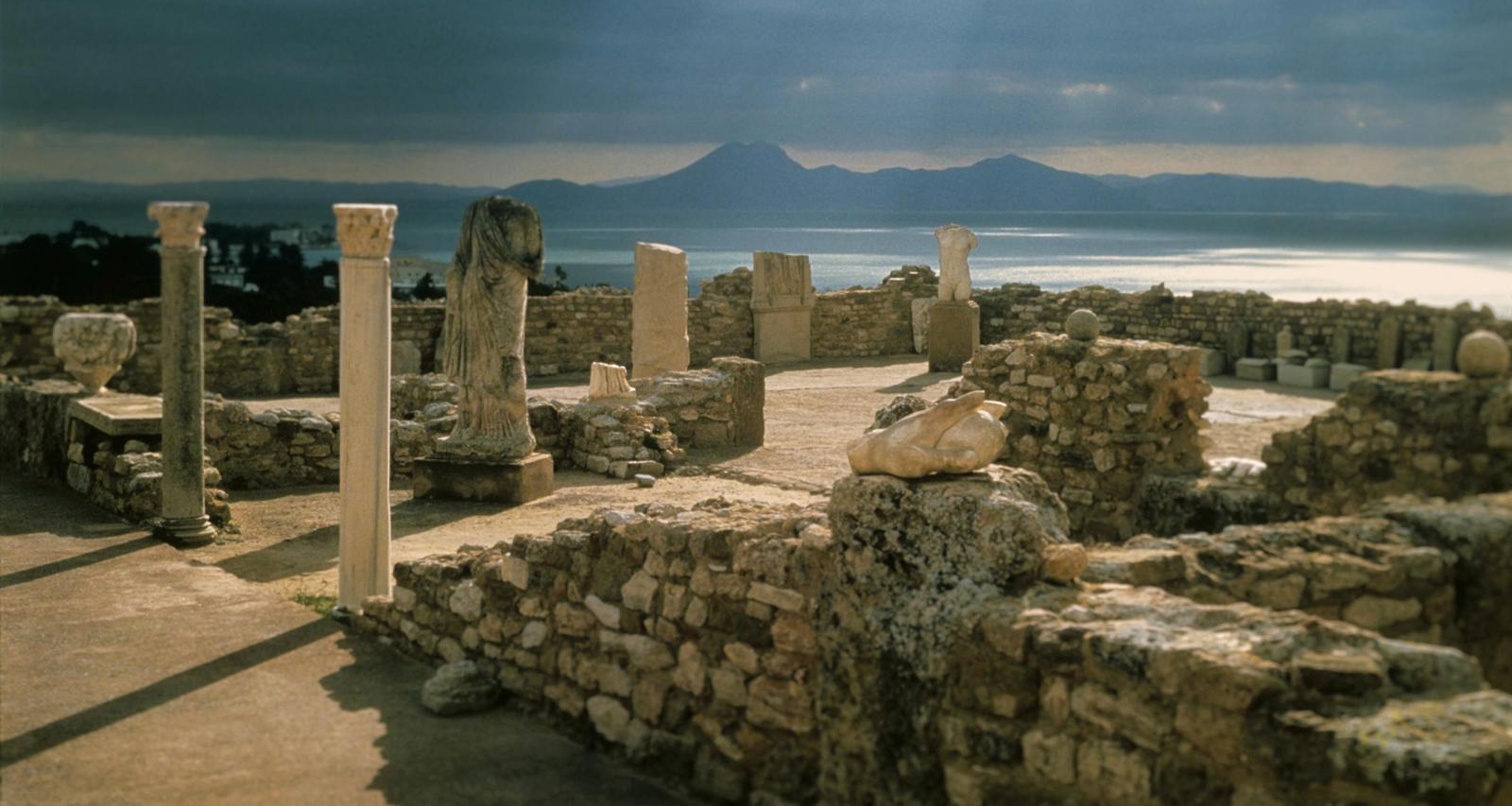
View across the Gulf of Tunis from a Roman house on the Hill of Juno at Carthage. Roman Carthage was built on a strict grid alignment on the same spot as the Phoenician foundation, but following a gap of just over a century.
© Sonia Halliday Photographs.
Little sympathetic writing survives about the people of Carthage. Punica fides – not unlike ‘perfidious Albion’ – was the Roman catchphrase in dealings with pre-Roman Carthaginians, and revulsion was expressed at their cruel religion. Turbulent and still in thrall to unspeakable religious practices is how Christian writers saw the Phoenicians’ Roman successors. But the last word goes to one of the first ‘discoverers’ of the defunct city, El Bekri, writing in the 11th century AD: ‘If someone was to go to Carthage every day of his life and occupy himself only with looking at it, every day he would find a new marvel which he had not noticed previously.’