
MATTHEW C. CURTIS
Opposite Mountain Island, on the mainland twenty stadia from shore, lies Adulis … from which there is a three-days’ journey to Coloe, an inland town and the first market for ivory. From that place to the city of the people called Auxumites there is a five days’ journey more; to that place all the ivory is brought from the country beyond the Nile.
THE PERIPLUS OF THE ERYTHRAEAN SEA, 1ST CENTURY AD
The ancient city of Aksum, situated in the Tigray region of Ethiopia’s far northern highland plateau, was a major political, economic and religious centre during the first seven centuries AD. The city’s position in a fertile agrarian and pastoral landscape, on ancient and far-reaching trade routes, was central to its development as the capital of the Aksumite kingdom. At its height, this polity extended its reach from northern Eritrea to the margins of central Ethiopia and from the southern Arabian Peninsula to the Sudanese Nile borderlands.
Substantial village settlements in the Aksum area are apparent at the sites of Ona Negast and Kidane Mehret dating back to the early 1st millennium BC. By the early 1st century AD, burials, platforms and monolithic stone stelae at Aksum itself indicate its development as the centre of a growing state. Some two-and-a-half centuries later, the city saw the construction of a massive terrace feature and multi-chambered subterranean tombs marked by monumental stelae, including several over 20 m (65 ft) in height, carved from single blocks of local granite-like rock. The largest were probably the grave markers of royal tombs dating to the 3rd and early 4th centuries AD. Six of the stelae are carved to represent multi-storeyed buildings, with low-relief depictions of window-frames and apertures, horizontal wooden beams and false doors; originally, inlayed metal plaques (now gone) were set at the apex of each. The largest stela at Aksum, weighing as much as 520 tons and measuring 33 m (almost 110 ft) in length, is so massive that it is the largest single block of carved stone ever created by ancient people anywhere in the world. It may have stood upright, if at all, only very briefly.

Several stone stelae stand upright today at Aksum: these huge monoliths, some of which are over 20 m (65 ft) high, marked the locations of tombs, the largest of them probably royal burials. Six were carved with details of doors and windows to resemble multi-storey buildings.
Yoshio Tomii/SuperStock.
Archaeological survey and excavation at Aksum reveal an urban layout consisting of loosely clustered buildings and monuments, representing a stratified community comprising an elite and lower-status groups, and with various specialized urban features. During the first six centuries AD, the city’s core grew from around 80 ha (200 acres) to 180 ha (445 acres), with additional satellite settlements and rural communities extending over an area at least 10 km (6 miles) in radius and linked by a network of roads. A conservative estimate of the city of Aksum’s population at its height is at least 50,000 people. One of the striking features of Aksum is the lack of a defensive wall surrounding the city, a characteristic shared by other Aksumite urban centres such as Matara and Qohaito in Eritrea.

The central burial chamber and sarcophagi of the Aksumite tomb of Gabra Masqal, situated to the north of the city. The subterranean tomb, built of well cut blocks of dressed stone, was entered down a flight of steps and consisted of several chambers.
Paul Springett/Still Pictures/Robert Harding.
Large buildings at Aksum were often set on a high stepped foundation or plinth with recessed walls and capped with slabs of slate. Elite dwellings, sometimes referred to as pavilions, were multi-storey, square structures with massive corner towers and an entrance accessed by broad steps, set in an open courtyard and surrounded by a range of subsidiary rooms. Domestic buildings in lower-status neighbourhoods were rectilinear in plan, built of undressed mud-mortared fieldstone walls and connected by narrow alleys. Pottery and stone tool production took place in open-air activity areas interspersed throughout the city. Other specialist craft production included woodworking, the carving of ivory figurines and intricate plaques, the making of glass vessels, and a diverse range of metalworking in iron, copper alloy, silver and gold. A particularly important aspect of metalworking was the production of coinage – the Aksumite kingdom issued its own gold, silver and copper coins. Inscriptions on the coins in Greek and the ancient Ethiopian Ge’ez script record the names of about twenty kings of Aksum, and examples of such coins have been found as far afield as southern Arabia and India.
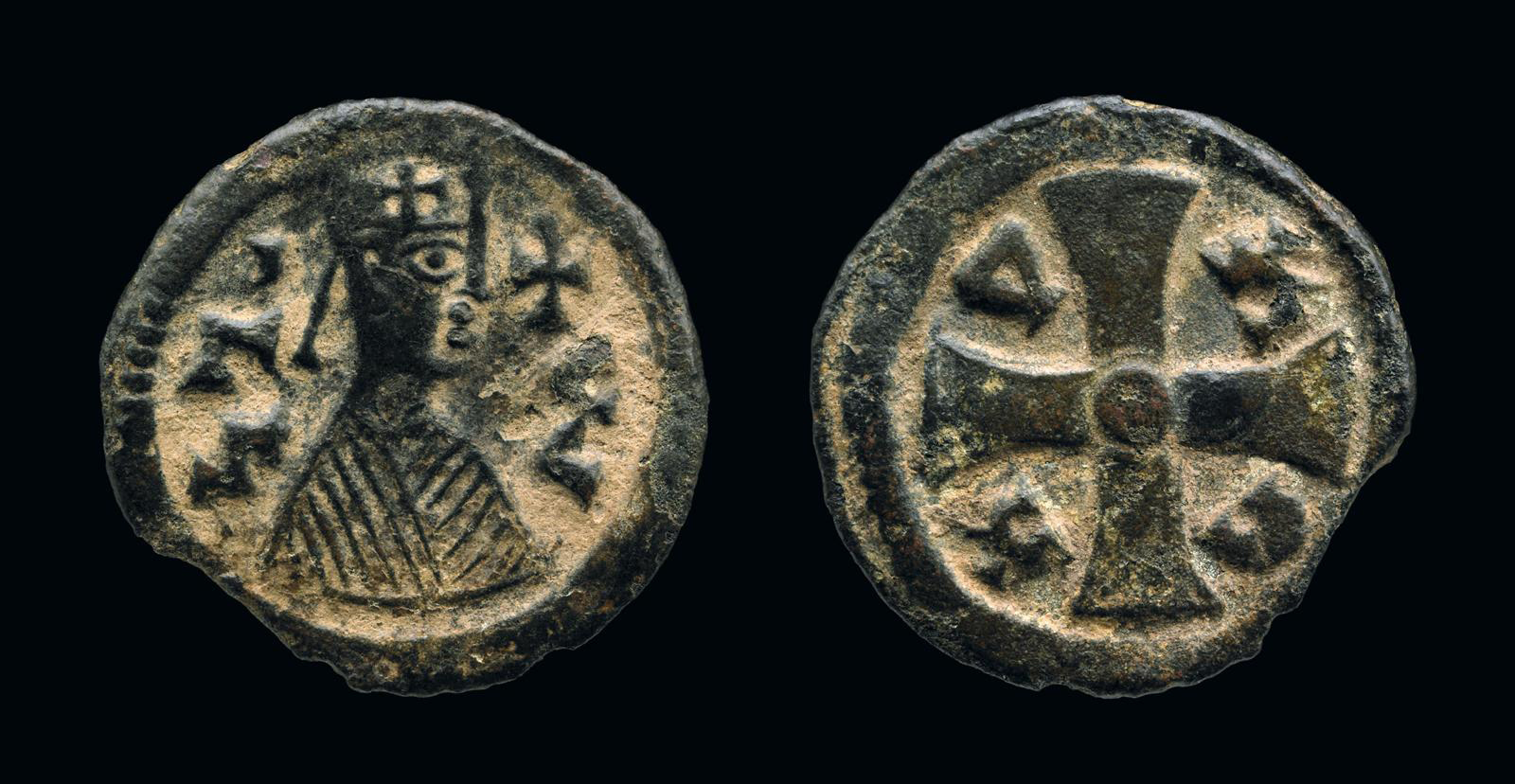
The front and reverse of a copper Aksumite coin bearing the images of King Ioel of Aksum and the Christian cross, c. AD 550, now in the British Museum. Christianity was adopted by the Aksumite kings in the 4th century AD, leading to widespread construction of churches and monasteries and the appearance of Christian symbolism on coinage.
Trustees of the British Museum.
With the adoption of Christianity by King Ezana in about AD 340 and the firm establishment of Christian communities by the 6th century AD, a large amount of church and monastery building took place throughout much of the Aksumite realm. At Aksum the ruins of several early churches have been documented, including one probably built before the 6th century, located where the famous Maryam Tsion cathedral now stands (identified in Ethiopian Orthodox traditions as the resting place of the Ark of the Covenant). This early church took the form of a basilica, with two aisles on either side of the central nave.
Two final characteristic features of the city of Aksum are its monumental stone throne bases and royal inscriptions. Throne bases were made of dressed stone slabs, 2–3 m (6–10 ft) square, with a smaller seat block and slots for monolithic pillars at each corner that probably supported a canopy. Some of the thrones may have been used by Aksumite nobility, while statues may have been placed on others. It is likely that many of the thrones found across the city were erected to commemorate royal achievements.
Royal inscriptions engraved on long stone slabs are found at different locations in the city and record the exploits of various Aksumite kings. Written in the Ethiopic language of Ge’ez and sometimes in trilingual expressions that include Epigraphic South Arabian script and Greek, these inscriptions detail royal titles, decrees, religious references and accounts of military campaigns against foreign enemies. Such inscriptions seem intended for public viewing and at least two trilingual examples may have been freestanding monuments marking the northern and southeastern entrances to the city.
The kingdom of Aksum’s long decline after the 6th century is thought to be the result of a variety of factors, including the Persian conquest in southern Arabia, the growing Arab control of Red Sea trade, challenges from other African polities and environmental degradation in the northern Horn of Africa.