
PAUL ROBERTS
In the future, when crops grow again and this devastated wilderness blooms once more, will people believe that towns, people and estates are all buried beneath the soil?
STATIUS, 1ST CENTURY AD
Pompeii and Herculaneum, two ordinary, provincial Roman cities, buried by Mount Vesuvius in AD 79, may not have shaped their world, but since their rediscovery in the 1700s they have certainly shaped the way their world is perceived by us. It is precisely their ordinariness that makes them so representative of many other cities and therefore so valuable to us, providing a unique picture of the daily lives of the average Roman.
Both cities were already centuries old, lived in by Greeks, Etruscans and the Samnites long before the Romans, who only took over the area around the Bay of Naples in the 80s BC. But they enlarged and rebuilt the cities and by AD 79 each was a mini-Rome, appointed with grand public buildings. In the basilica legal and business matters were decided and recorded on wooden tablets, scrolls or in marble inscriptions. Other buildings were for the administration of various aspects of civic life, from weights and measures to taxes and water supply.
Beautiful temples were built for the worship of the gods. In Pompeii these included temples to Venus, patroness of the city, and Jupiter, the king of the gods, whose great temple or ‘Capitolium’ dominated the forum, the civic centre of Pompeii. There was also a sumptuously decorated temple dedicated to the Egyptian goddess Isis, which had been rebuilt after a major earthquake in AD 62 or 63 had badly damaged Pompeii and the whole area. For entertainment there were theatres, for performances of Greek tragedies and comedies or local farces and satires, as well as public baths, for keeping clean, relaxation and recreation. At Pompeii there was also a Greek-style covered Odeon for smaller recitals, and the great amphitheatre for animal hunts and, most important of all, combats between gladiators – the celebrities of their day.
The streets were busy, noisy and smelly. They bustled with a chaos of people, carts and animals, though evidence exists for one-way systems and pedestrian precincts. Houses and businesses opened straight on to the street, their walls covered in brightly coloured images of gods, animals and people, political posters, adverts for gladiator fights (and their politician sponsors) and notices of property for sale and for rent. Commerce was everywhere. In addition to the market building or macellum there were shops and stalls selling a wide range of local and imported goods, workshops, and a host of bakeries, fullers, bars and taverns.
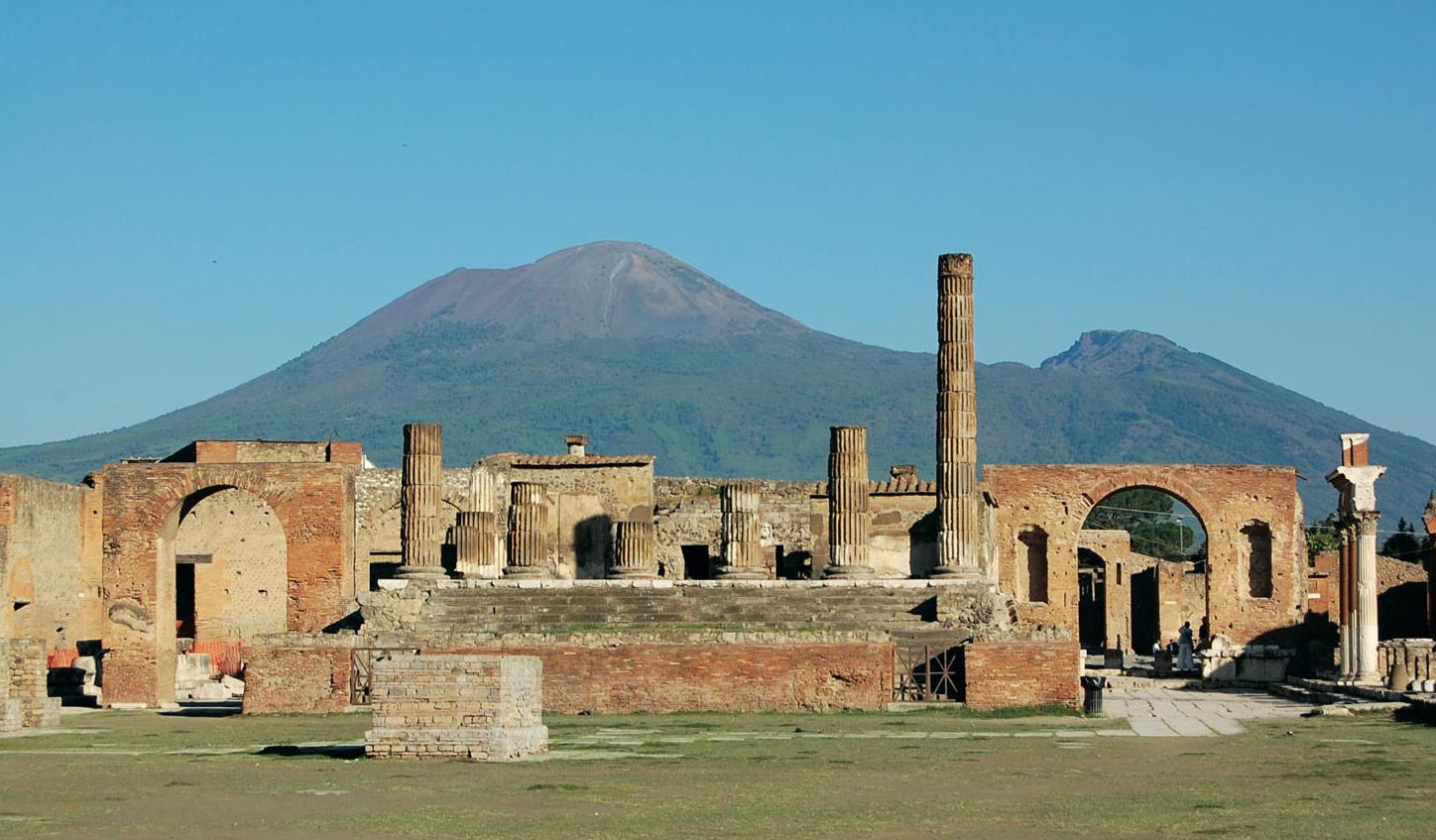
The forum of Pompeii was the economic, religious and administrative centre of this bustling city. It was filled with statues and monuments and was surrounded by arches, temples, law courts, offices and shops. Over everything loomed Mount Vesuvius, which the Romans (so very mistakenly) believed to be extinct.
Photo Paul Roberts.
Roman public buildings, shops and even houses can still be found elsewhere in cities of the former Roman empire, but only in Pompeii and Herculaneum do complete urban landscapes survive. In particular it is the quantity, quality and sheer diversity of the homes, preserved often with their contents, that is unique. Some older houses had quite formal façades, others were plainer, but all types were fronted with commercial premises – there was no stigma in trade. Many people lived in apartments carved out of larger houses or set above them, often with balconies. The poor lived in single-room ‘studios’ or in mezzanines above shops.
Entering a finer house you arrived in the entrance hall (atrium), where home and outside world met. It was used by all the household, from the master, his wife, children and the extended family, to his slaves and ex-slaves (freedmen). Wealthy households had numerous slaves and even smaller homes aspired to one or two. Many slaves came from foreign conquests via auctions, while others were the children of existing slaves. Slaves could be freed by their master, but these freedmen (liberti) remained closely linked to him, even assuming his family name. Liberti were essential to the economy, running shops, banks and businesses of all types.
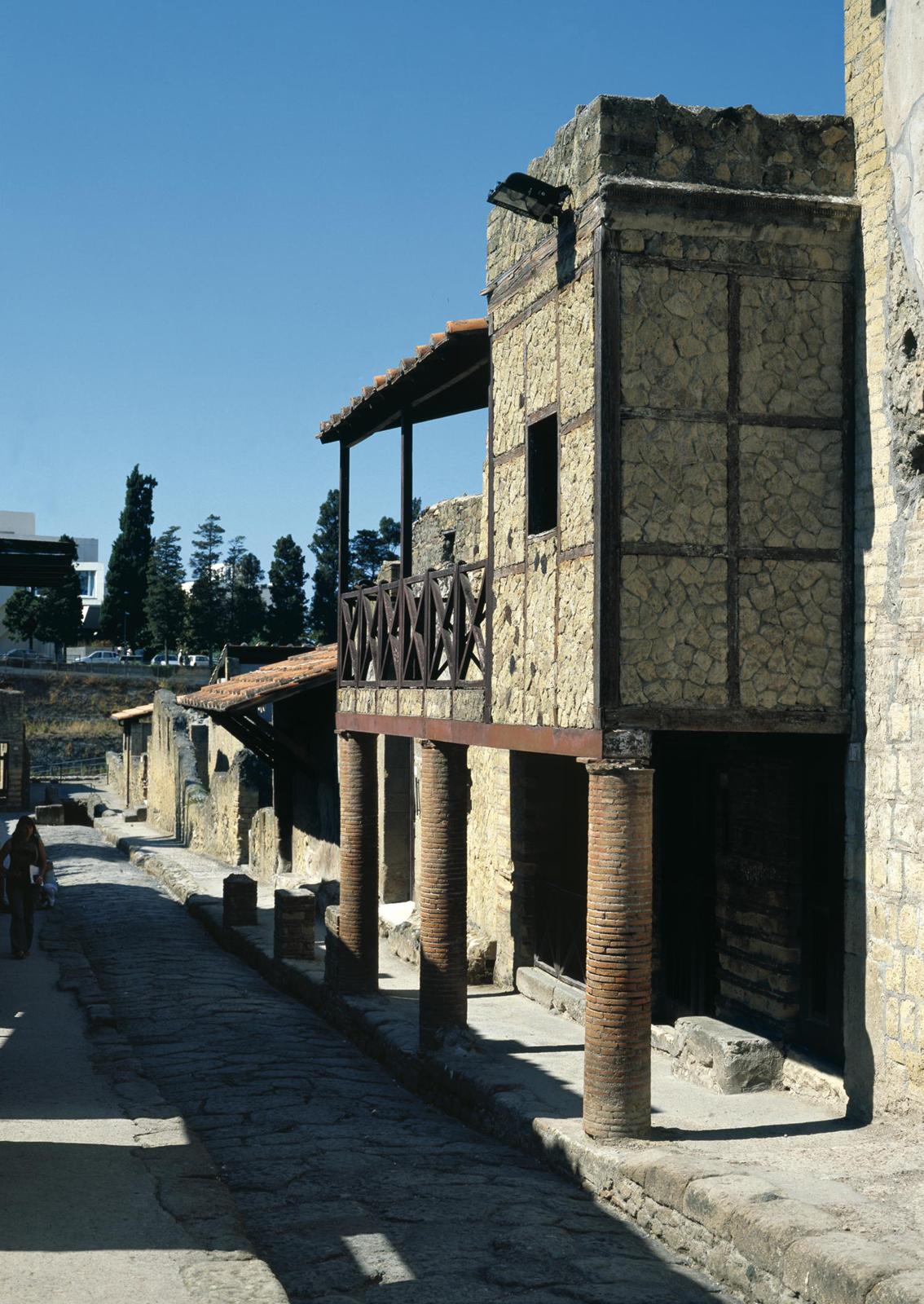
A typical street in Herculaneum, sloping down towards the seashore. A partly reconstructed portico of brick columns provided shelter for pedestrians and supported first- and second-floor apartments, projecting out from the larger houses.
Fotografica Foglia.
The owner’s political and economic dependants (clientes) came into the atrium to ask for favours, so in this public/private space the family impressed (and overawed) them by displaying its power. The house’s scale and decoration, its rich furnishings, strongboxes and silverware declared wealth and status; altars and paintings or statuettes of the gods demonstrated religious devotion, while images of family members and ancestors showed the family’s pedigree. But it wasn’t all grand – the atrium was also used for tasks such as spinning, weaving and storage. Off the atrium or garden were small rooms, bedrooms (cubicula) for sleeping, washing, dressing and grooming. Even in rich homes there was no plumbing, so people washed in basins with water drawn from a well and used chamber pots as toilets. Slaves took care of all of this.
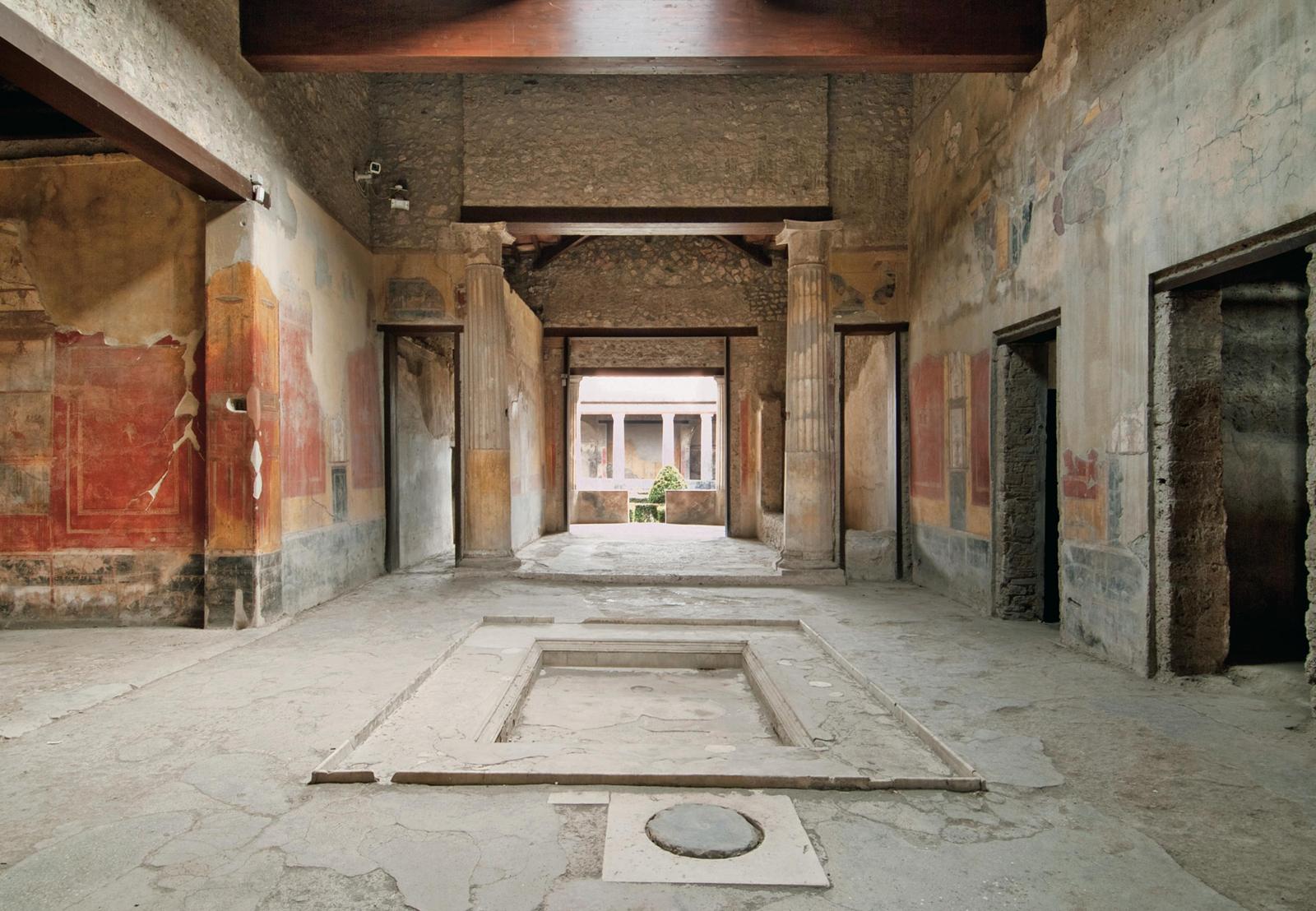
Atrium of the House of the Menander, Pompeii. The atrium was the public/private gateway to the house, a place for audiences with the master of the house and a major showcase for the basis of the family’s power and status. Many houses afforded views of the interior to visitors – of shrines, fountains or, as here, the garden.
© Giovanni Lattanzi.
At the heart of many Roman houses was the garden (hortus), often framed by Greek-style colonnades, a cool oasis of relaxation and an evocation of the countryside. Symbolizing the good life, they sometimes included a dining area (triclinium). Gardens were filled with trees, shrubs and flowers. Beds planted with ferns, lilies and roses were bounded by box hedges or trellis fences, with cypresses, pines, cherry and fig providing beauty, shade and sometimes food. There were also fountains, pools and statues of gods and animals. Around the garden were the largest, most beautiful rooms in the house, where family members lived their daily lives, reading, resting, playing games and making or listening to music. Floors often featured mosaics, ceilings were of brightly painted plaster or coffered wood, but the main features were the wall-paintings, featuring varied scenes.
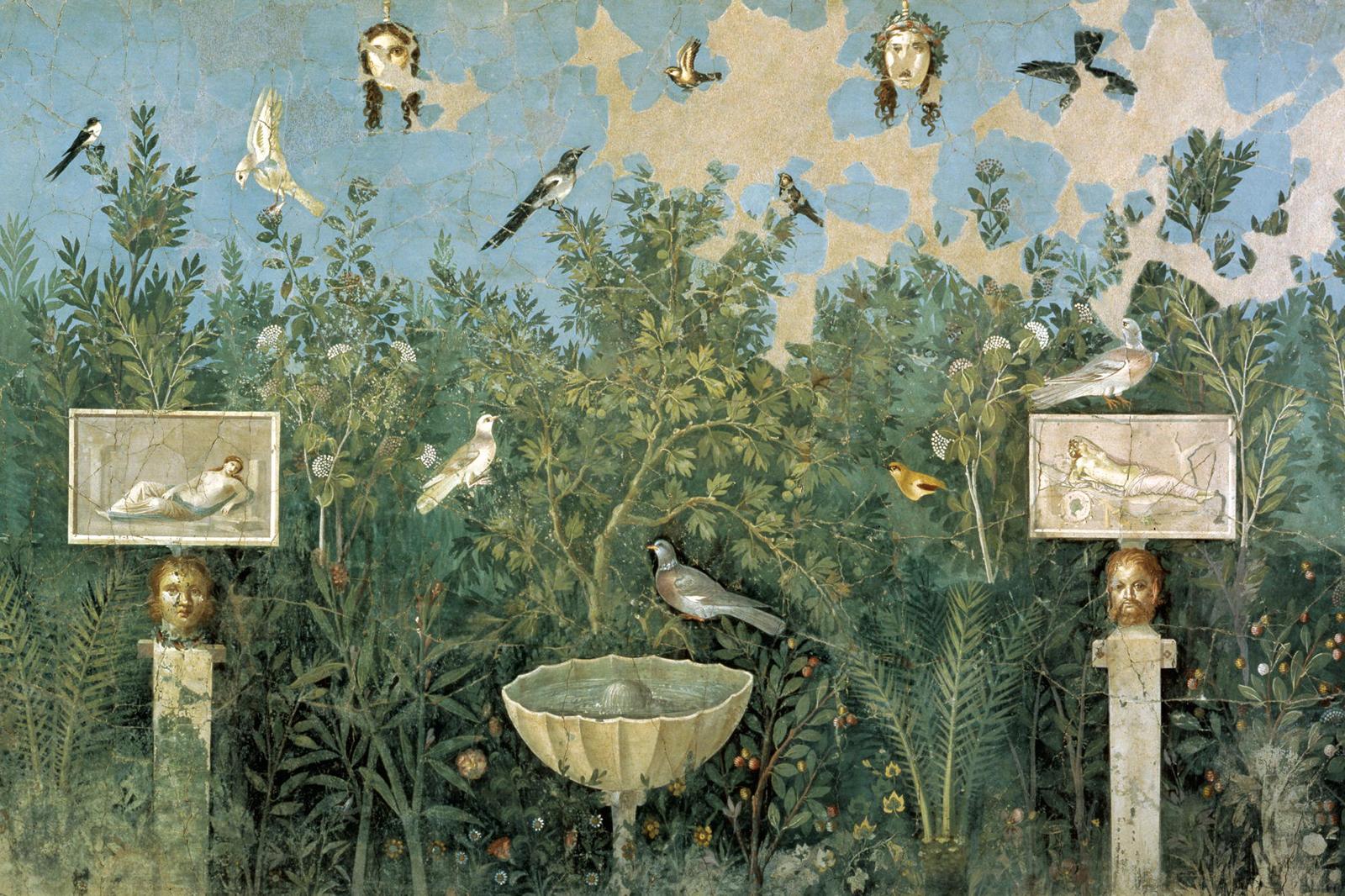
Wall-painting from the House of the Golden Bracelet, Pompeii. Roman wall-paintings had a wide range of subjects, from architecture to Greek mythology, depictions of daily life, still lifes and landscapes. This is one wall of a complete gardenscape.
Fotografica Foglia.
The family also dined here – an important social ritual. Grand households consumed elaborate multi-course meals, while poorer people ate pies and pastries, stews and other snacks in taverns and bars. In a wealthy home, people could eat informally anywhere, but dined formally in a triclinium reclining on couches. The master impressed his guests with fine food and wine, luxurious decoration and expensive tableware. Slaves tended to every need, preparing, serving and clearing away (and perhaps finishing the leftovers). The kitchen (culina) was small, dark, smoky and rarely had piped water. People cooked on a solid masonry platform using pots and pans over charcoal, while in small flats portable metal or terracotta braziers were the only means of cooking – or people simply ate out. Surprisingly, the kitchen often also housed the toilet (latrina), a serious health hazard, but the Romans did not know about infection or germs. As a result food, surfaces and utensils were covered in germs and bacteria.
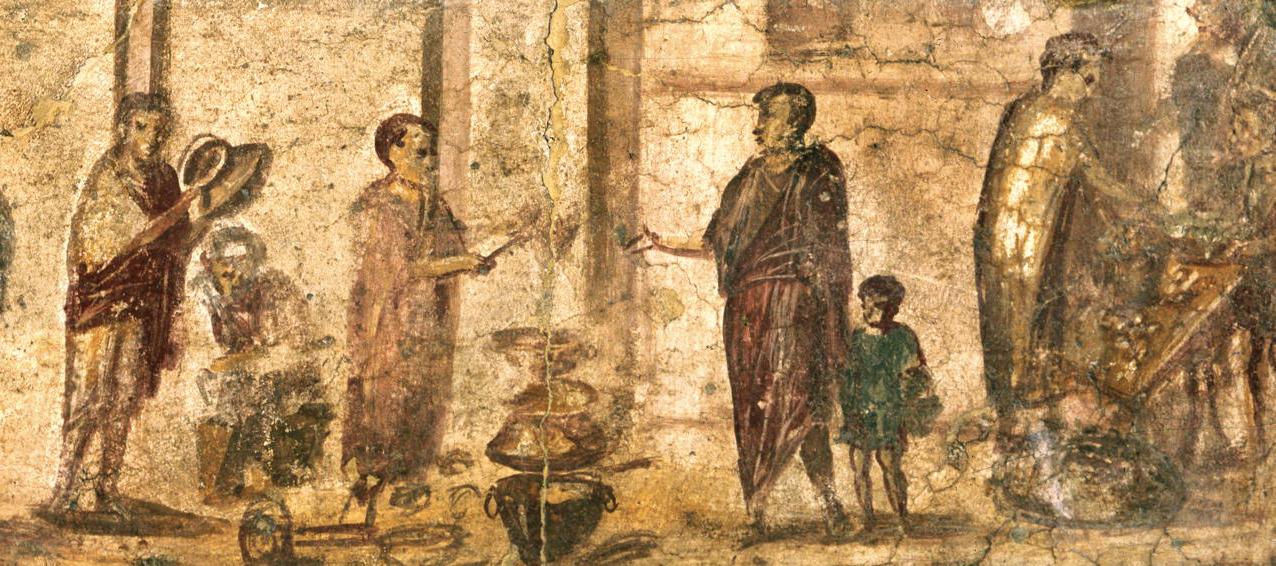
Wall-painting from the House of Julia Felix, Pompeii. Such paintings preserve precious records of everyday life. This detail of a large panorama of the forum of Pompeii includes a man selling cooking pots identical to those found in many of the kitchens in Pompeii and Herculaneum.
Fotografica Foglia.
The Romans believed Vesuvius was extinct. But in AD 79, around midday on 24 August (or later, perhaps 24 October, since the discovery of carbonized pomegranates and figs, and heating braziers apparently in use makes a later date possible), the volcano erupted cataclysmically. Instead of producing lava flows, Vesuvius disgorged a huge cloud of gas, ash and volcanic stones. Rising over 30 km (18 miles) high, this noxious cloud blew southwards and dropped debris on Pompeii and the surrounding area, slowly burying buildings and causing them to cave in under the weight. At about midnight the cloud collapsed and a pyroclastic surge (a superheated avalanche of volcanic debris) travelling at 110 km (68 miles) an hour and at a temperature of 400°C (752°F) destroyed Herculaneum. At about 8 a.m. the cloud collapsed for the last time and a surge of around 300°C (572°F) wiped out Pompeii. The cities were destroyed and the whole area was devastated.

Bar of Lucius Vetutius Placidus, Pompeii. Shops and bars were frequently found on the front of even the wealthiest private homes. This bar in Pompeii had a large counter with characteristic inset jars or dolia containing food or hot and cold drinks.
© G. Dagli Orti/DEA/agefotostock.com.
We do not know how many died in total in the two cities and the region, but so far around 1,500 bodies have been discovered, 350 in Herculaneum, most in excavations in the 1980s on the ancient seashore. Of the 1,150 people found in Pompeii most had died during the final surge, snuffed out instantly by thermal shock. The volcanic ash had hardened around their corpses, which rotted away to leave voids. In 1863 the archaeologist Giuseppe Fiorelli began pouring plaster of Paris into these voids, then dug away the surrounding ash to reveal casts of the bodies, so detailed that some preserve clothing and hairstyles. Many are in the so-called ‘boxer pose’, with limbs flexed and feet and hands tightly clenched, as their tendons contracted in the lethal heat.
Thousands died but many other people escaped – from Pompeii towards the south of the Bay of Naples, and from Herculaneum north towards Naples. Three centuries later, there was still a ‘Herculaneum people’ suburb in Naples, a memory, perhaps, of refugees from the eruption. Descendants of the people of Pompeii and Herculaneum may still be living in the houses and walking through the streets of Naples today.