
We can best divide the eventful story of the Catacombs of Rome into four periods:—
The First extending from circa A. D. 50 to circa A. D. 202.
The Second extending from circa A. D. 202 to circa A. D. 313.
The Third extending from circa A. D. 313 to circa A. D. 410.
The Fourth extending from circa A. D. 410 to circa A. D. 817.
After the last-mentioned date, A. D. 817, the catacombs became gradually forgotten, and were ignored for a long period, extending over some seven hundred and sixty years, when a chance discovery by some laborers of a cemetery lying beneath a vineyard on the Via Salaria in A. D. 1578, in the reign of Queen Elizabeth, brought before men's notice once more this wonderful City of the Dead; and since that date the interest of scholars and explorers has, to some extent, been aroused, and fitful and intermittent exploration works have been undertaken in what has been popularly, though somewhat inaccurately, termed "Roma sotterranea"—inaccurate because no crypt or catacomb was ever excavated beneath the city proper.
The First Period—circa A. D. 50 to A. D. 202—witnessed the devoted and generous conduct of some of the wealthier brethren, who provided graves, and exercised what we have termed "the hospitality of the tomb" in the case of their poorer companions in one common Faith by providing places of interment in crypts and catacombs, excavated in the vicinity of their own family burying places, beneath their gardens and vineyards. These crypts, as time went on and the numbers of the Christians kept increasing, developed insensibly; more and more corridors and sepulchral chambers were perpetually being excavated, and when the limits of the property of the original donor of the cemetery were reached, passages and chambers were dug on a lower level, beneath the first level; thus, four, five, and in some instances six, storeys of these corridors underlie the garden or vineyard which was originally devoted to this generous and pious use. In this way, a cemetery, during the first hundred and seventy years which followed the Ascension of the Master, would gradually grow into that strange labyrinth of passages and chambers filled with the dead, which we are in the habit of styling a catacomb. Several well-known cemeteries belong to this first period. The dates can be determined with fair accuracy, partly from the inscriptions found on some of the slabs which seal the shelves on which the dead sleep, partly from the special style and execution of the decorated portions.
Among the best-known catacombs which belong to this early period (the first and second centuries), foremost must be reckoned the crypt of the Vatican, where a very ancient tradition tells us the remains of Peter were laid, and close to Peter a long line of martyred bishops of Rome who succeeded him, reaching to Pope Victor, who was buried in the Vatican cemetery A. D. 202. The successors of Victor were interred in another place, of which we shall presently speak.
But there are no remains, properly so-called, of this most ancient Vatican cemetery, it having been destroyed at an early date, probably in the fourth century, to make room for the foundations of the mighty basilica of Peter.
The present crypt of Peter, however, with the Confessionary of the great Apostle, occupies a portion of the site of the ancient Vatican crypt. But an authentic record is preserved of what was seen in A. D. 1626, when the works in connection with the foundations of the enormous bronze baldachino which now overshadows the High Altar of Peter's were being arranged; and hence there is little doubt that the great Apostle's remains are still in the spot assigned to them by immemorial tradition.
Another most ancient crypt which a probably accurate tradition points to as the resting-place of Paul has also been in great part destroyed, to make room for the foundations of the basilica of Paul, "outside the walls." Some portions of this ancient cemetery still exist, but in a ruinous condition. These portions are known as the cemetery of S. Lucina or S. Commodilla.
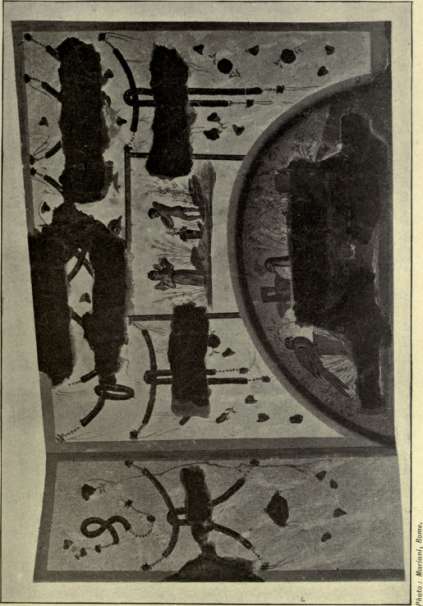
But, although it is impossible for the present to investigate closely these hallowed crypts of the Vatican and Paul fuori muros, we have in perfect condition still other cemeteries of well-nigh an equal antiquity. The most notorious of these are, bordering on the Appian Way, the catacomb of S. Domitilla, the kinswoman, as some maintain, of Vespasian, with its beautiful painted decorations, equal in artistic excellence to many of the Pompeian remains; the catacomb of S. Praetextatus, with its touching memories of various martyrs buried there as early as A. D. 162; the catacomb of S. Lucina, joined by underground corridors with the great cemetery known as that of S. Callistus. On another side of the city, on the Salarian Way, lies the once famous cemetery now generally known as the Ostrian Catacomb, but in early times usually styled the "cemetery of the Fountain of Peter," where an ancient tradition relates that Peter used to baptize and to relate his memories of the Savior—memories now enshrined in the Gospel of Mark.
To this little list of very ancient cemeteries must be added the catacomb of S. Priscilla, on the New Salarian Way possessing traditions which connect it with the Apostles in the middle of the first century. It was said to have been excavated in a garden belonging to Pudens, the disciple of Paul The character of certain decorations, still visible in this most ancient catacomb, fully bears out the tradition of its being, in part at least, contemporary with the Apostles.
The Second Period of the story of the catacombs may be reckoned as extending from circa A. D. 202 to A. D. 313, the date when the Peace of the Church was sealed by the famous edict of the Emperor Constantine. It was in this second period that the catacombs reached their full development. We have seen that in this third century the Christians enjoyed long seasons of comparative stillness after the time of Severus. Then it was that the Church—we are speaking especially of the Roman Christian community—not only very largely multiplied its numbers, but elaborately organized itself. In this work of organization, the construction and management of the cemeteries where the Christian dead were reverently laid to rest, and which undoubtedly were used, even in times of "quietness," for many solemn gatherings, occupied a prominent place.
At the close of the second century it is probable that the Church in Rome numbered some 50,000 souls. It is evident that with such numbers dwelling in the Imperial city—numbers, too, ever increasing—the primitive arrangements for the management of the cemeteries, so precious in the eyes of the early Church, would have to be recast. So we find in the time of Pope Zephyrinus, about the year 202, that Callistus, the archdeacon who subsequently succeeded Zephyrinus to the see of Rome, was specially entrusted with the government of the clergy, and was set over "the cemetery." The words are from Hippolytus, one of the most learned Christian writers of that age. From this time (A. D. 202) onward the mighty and ever growing subterranean necropolis evidently passed out of the private hands of the original donors and their descendants, and became the property of the Church, which henceforward undertook its development, management, and supervision. Callistus greatly enlarged, if he did not construct, the important cemetery known by his name, arranging in it a special sepulchral chamber for the bishops of Rome, in which, from this date onward until the Peace of the Church some 111 years later, most of the Roman Pontiffs were interred. The discovery and identification of this crypt or sepulchral chamber of the third-century popes has been one of the most interesting "finds" of that great scholar in the catacomb lore, De Rossi.
During the years of comparative "stillness" in the first half of the third century the cemeteries at Rome were wonderfully developed. In many of them elaborate works or ornamentation were carried out; oratories, memorial "cellae," dwellings for the Fossores and other officials of the Church, were built above ground. No attempts at concealment or secrecy were made. But, as the century wore on, darker days succeeded; the persecutions revived and even grew in intensity as time advanced. The effect of the troubling times on the works connected with the great underground cemeteries of Rome was very marked. The regular and elaborate plan of the ever-growing corridors and galleries was changed. A curious labyrinth of passages succeeded to the well arranged system of straight corridors with their many highly decorated chambers often arranged for meetings and special worship; secret approaches were contrived; hidden stairs were constructed. Many of the cemeteries were in part "earthed up" to prevent desecration.
The staircases leading to and from the many corridors were in many instances destroyed. The buildings which in quieter times had been erected at or hard by the entrances to the cemeteries were abandoned and often pulled down. The years which preceded the final Peace of the Church appear to have been especially a time of havoc and destruction. Miles upon miles of corridors and sepulchral chambers were closed up and filled with earth and debris, the approaches to them being concealed and destroyed, and no human eye has looked upon them since that terrible time. And in our days the pilgrim to the Eternal City, who is curious to trace out the work of the early Christian communities of Rome, as he wanders through these strange streets of the dead, which are now partially opened, is constantly stopped in this or that corridor by vast piles of earth and rubbish which have never been cleared away. A work of complete re-excavation, intensely interesting and valuable to the archaeologist and historian, would be enormously costly and, in. many cases, not a little dangerous, and would require extreme caution. A little is being done in this direction it is true, but progress here is slow.
The next, the Third Period in the story of the catacombs, lasted from A. D. 313, the date of the final Peace of the Church, until A. D. 410, the year of the raid of Alaric the Visigoth, when Rome was sacked.
After A. D. 313 the position of Christianity in the Roman world was completely changed. There was no longer any necessity for the catacombs. Privacy, complete separateness, comparative secrecy were no longer requisite for interment of the Christian dead. All rites, whether for the living or the dead, after A. D. 313, might be freely performed in the light of day. Paganism was vanquished, and in all its varied forms was a fast dying religion. The Roman world, outwardly at least, was largely Christian, from the Emperor and his court downward through all the grades of society.
Although this period lies outside the area of this work, a few words on the subsequent history of these wonderful cemeteries, is necessary to complete our sketch.
After the date of the Peace of the Church, A. D. 313, we only find records of four or five fresh subterranean cemeteries being excavated, and these of small size and of little importance. As the fourth century advanced, the number of interments in any of the catacombs grew fewer and fewer, and before the century closed had virtually ceased. Many basilicas or churches of various sizes were erected over the ancient cemeteries, and the dead were usually laid in open areas around these sacred buildings.
During this century, the fourth, a deep reverence began to grow up in men's minds for the buried cemeteries of the past. It was in these dark corridors and light-less chambers that their Christian forefathers had been laid to sleep, the brave pioneers of the Faith, men who had confessed their belief in Christ under circumstances of extraordinary difficulty and often of extreme danger. There, too, slept not a few of the noble company of martyrs, men and women, who had positively laid down their lives for the Faith. Those catacombs which, in one or other of their sepulchral chambers, held the graves of the more conspicuous of these confessors, were the especial objects of reverence among the Christians of the new age of "Peace." This not unnatural feeling of tender homage was voiced by Pope Damasus, who ruled the Church of Rome from A. D. 366 to A. D. 384 Damasus will ever be remembered in the annals of the Church for his countless works of skilful and reverent restoration of portions of the wrecked and desecrated catacombs which had suffered so severely in the later persecutions. Many were the ruined tombs of the most conspicuous saints and martyrs restored by him. To this day fragments of the beautifully engraved slabs, the work of his chief artist, Philocalus, are constantly coming to hght and assisting scholars like De Rossi to identify especially sacred spots in these, too often ruined, cemeteries. Pope Damasus not only restored and put in order many of the shrines and sepulchral chambers, but he rebuilt the destroyed staircases in many places and rendered it possible for the pilgrims from far distant countries in his own day and for several generations following to visit spots famous for deeds of endurance and patient bravery on the part of known and unknown martyrs.
The Fourth Period in the story we reckon from A. D. 410, the date of the raid of the Visigoth Alaric. This was the first barbarian occupation of the Imperial City, and this fourth period covers some four hundred years, closing about A. D. 817, when, owing to events which we shall very briefly sketch, public interest in the catacombs altogether passed away.
One striking result of Pope Damasus' loving work of restoration in the more famous spots in the great underground cemeteries was to bring prominently before the eyes of the various strangers and pilgrims, many from distant countries, to the immemorial city, the memory of the brave Confessors of the Faith which the world of Rome now generally acknowledged. The restored shrines of the catacombs in fact became the principal objects of pilgrimage; guides and itineraries for visiting them were composed. Fragments of some of these have come down the stream of time to us, and have proved of the greatest service to De Rossi and other scholars of our day.
The hallowed sites, however, were grievously interfered with, even recklessly injured, and in many cases rifled of their contents, in the course of the successive raids and invasions to which Rome and Italy were subjected by barbarian enemies. Among the more destructive of these we would specify the raids of Alaric the Visigoth in A. D. 410; that of Vitiges, another Gothic chieftain, in A. D. 537, who apparently singled out the catacombs as especially the object of his passion for destruction; and lastly that of Astolphus the Lombard in A. D. 756.
It was, of course, the hope of coming upon gold and gems which stimulated the various hordes of barbarian raiders to ransack the catacombs, knowing, as they did, how precious these ancient shrines were in the eyes of the Christians. But, strangely enough, in some instances, and in the case of the Lombard Astolphus, the idea of procuring the sacred relics of the remains of the dead, either for themselves or for the more sordid purpose of selling them, seems to have been the motive.
Some of the bishops of Rome, too, unconsciously of course, in attempting to repair the mischief done by barbarian spoilers, irreparably injured the old paintings and sculptured work by overlaying them with their new designs and ornamentation; and in the ninth century these prelates completed the work of havoc and spoliation by translating a vast number of remains from those portions of the catacombs which were still open, to various churches in Rome. They pleaded as the excuse for this strange act of sacrilege the greater safety of the churches in times of confusion and pillage. There is, for instance, an inscription in the ancient church of S. Prassede which tells how, in A. D. 817, two thousand three hundred bodies were removed to this church from the catacombs by Pope Paschal I. Vast numbers of. bodies were removed at this period from their original resting places in the ancient subterranean cemeteries to the churches of S. Silvestro, S. Martino, and the Santi Quattro Coronati. Among these strange translations of remains of the dead from the catacombs we read of twenty wagon loads of bones being removed to the Pantheon. These wholesale removals, or translations, on the part of the bishops of Rome; the destructive work of ransacking and pillaging repeated by successive hordes of raiding barbarians, Goth, Vandal, and Lombard; are more than sufficient to account for the innumerable empty and ruined graves which, tier upon tier, line the corridors and sepulchral chambers on all sides in the various catacombs into which the modern pilgrim and student is able now to penetrate. There still remains, however, an enormous burying ground, lying beneath the suburbs of the immemorial city, yet covered up, securely protected by masses of earth and debris.
The catacombs available for the visits of strangers and pilgrims being thus, before the years of the ninth century had run their course, stripped and desolate, lost in the eyes of the many visitors to the Eternal City their peculiar charm. The precious relics of saints and martyrs, even the remains of the rank and file of the Christian dead, had largely disappeared. So it came to pass that, the special interest being gone, the very existence of the catacombs was gradually forgotten. Besides, for some two hundred years mankind, harassed by perpetual wars, by anarchy and confusion, was too wretched to devote much time to pilgrimages. And, when in quieter times the old fervor and zeal for visiting sacred shrines and holy places awoke again, the catacombs of Rome, once so cherished and revered, had ceased to be even "a memory." A dense cloud settled down upon them —a cloud which never lifted for some seven hundred years.
The chance discovery of some laborers digging in a vineyard in the Via Salaria, in the year 1578, to which we have already alluded, brought to light one of the ancient cemeteries, with its curious paintings, its strange sculptures, its pathetic inscriptions, its seemingly endless corridors, lined with (mostly) empty graves. The world of Rome then came to know that a marvelous unexplored City of the Dead lay beneath its feet; old records were investigated, ancient itineraries and pilgrim guides were searched into, and the forgotten story of the past once more was read and studied.
Of these "Itineraries" or local guide books to the Sanctuaries of the City of Rome—where the catacombs as they existed in the seventh century are described—we possess several; perhaps the oldest is a MS. bound up accidentally with the works of Alcuin, Charlemagne's Minister of Education; internal evidence shows that this "Itinerary" was written on the sot, circa A. D. 625-638. This guide book was completed before the wholesale translations of the bodies by certain of the Popes had begun.
Another "Itinerary" is contained in the works of William of Malmesbury, who wrote at the end of the eleventh century or beginning of the twelfth. But the "Itinerary" is plainly copied from a document written some four or five centuries earlier.
We have already spoken of the "find" of A. D. 1578 and what sprang from it; and thus a new chapter bearing on the story of the early Church, when Christianity was a forbidden religion, was added to the somewhat scanty material out of which the tapestry of such a history as this is woven. It is a chapter written on marble and on stone—its genuineness no lynx-eyed critic will ever dare to question.