
Chapter 10
The early Spanish travellers who visited the ruined Bolivian city of Tiahuanaco at around the time of the conquest were impressed by the sheer size of its buildings and by the atmosphere of mystery that clung to them. ‘I asked the natives whether these edifices were built in the time of the Inca,’ wrote the chronicler Pedro Cieza de Leon, ‘They laughed at the question, affirming that they were made long before the Inca reign and … that they had heard from their forebears that everything to be seen there appeared suddenly in the course of a single night …’1 Meanwhile another Spanish visitor of the same period recorded a tradition which said that the stones had been lifted miraculously off the ground, ‘They were carried through the air to the sound of a trumpet.’2
Not long after the conquest a detailed description of the city was written by the historian Garcilaso de la Vega. No looting for treasure or for building materials had yet taken place and, though ravaged by the tooth of time, the site was still magnificent enough to take his breath away:
We must now say something about the large and almost incredible buildings of Tiahuanaco. There is an artificial hill, of great height, built on stone foundations so that the earth will not slide. There are gigantic figures carved in stone … these are much worn which shows their great antiquity. There are walls, the stones of which are so enormous it is difficult to imagine what human force could have put them in place. And there are the remains of strange buildings, the most remarkable being stone portals, hewn out of solid rock; these stand on bases anything up to 30 feet long, 15 feet wide and 6 feet thick, base and portal being all of one piece … How, and with the use of what tools or implements, massive works of such size could be achieved are questions which we are unable to answer … Nor can it be imagined how such enormous stones could have been brought here …3
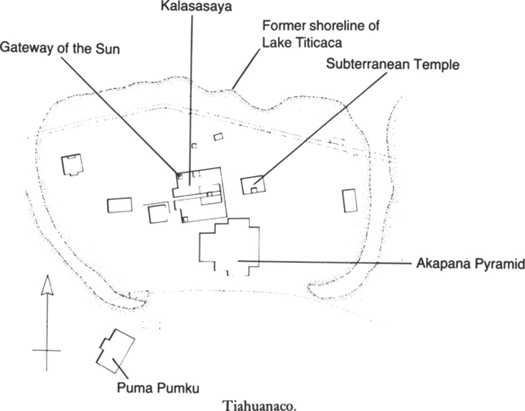
Tiahuanaco.
That was in the sixteenth century. More than 400 years later, at the end of the twentieth century, I shared Garcilaso’s puzzlement. Scattered around Tiahuanaco, in defiance of the looters who had robbed the site of so much in recent years, were monoliths so big and cumbersome yet so well cut that they almost seemed to be the work of super-beings.
Sunken temple
Like a disciple at the feet of his master, I sat on the floor of the sunken temple and looked up at the enigmatic face which all the scholars of Tiahuanaco believed was intended to represent Viracocha. Untold centuries ago, unknown hands had carved this likeness into a tall pillar of red rock. Though now much eroded, it was the likeness of a man at peace with himself. It was the likeness of a man of power …
He had a high forehead, and large, round eyes. His nose was straight, narrow at the bridge but flaring towards the nostrils. His lips were full. His distinguishing feature, however, was his stylish and imposing beard, which had the effect of making his face broader at the jaws than at the temples. Looking more closely, I could see that the sculptor had portrayed a man whose skin was shaved all around his lips with the result that his moustache began high on his cheeks, roughly parallel with the end of his nose. From there it curved extravagantly down beside the corners of his mouth, forming an exaggerated goatee at the chin, and then followed his jawline back to his ears.
Above and below the ears, on the side of the head, were carved odd representations of animals. Or perhaps it would be better to describe these carvings as representations of odd animals, because they looked like big, clumsy, prehistoric mammals with fat tails and club feet.
There were other points of interest. For example, the stone figure of Viracocha had been sculpted with the hands and arms folded, one below the other, over the front of a long, flowing robe. On each side of this robe appeared the sinuous form of a snake coiling upwards from ground to shoulder level. And as I looked at this beautiful design (the original of which had perhaps been embroidered on rich cloth) the picture that came into my mind was of Viracocha as a wizard or a sorcerer, a bearded, Merlin-like figure dressed in weird and wonderful clothes, calling down fire from heaven.
The ‘temple’ in which the Viracocha pillar stood was open to the sky and consisted of a large, rectangular pit, like a swimming pool, dug out six feet below ground level. Its floor, about 40 feet long by 30 feet wide, was composed of hard, flat gravel. Its strong vertical walls were formed from precisely dressed ashlar blocks of varying sizes laid closely against one another without mortar in the joints and interspersed with taller, roughhewn stelae. A set of steps was let into the southern wall and it was down these I had come when I had entered the structure.
I walked several times around the figure of Viracocha, resting my fingers on the sun-warmed stone pillar, trying to guess its purpose. It was perhaps seven feet tall and it faced south, with its back to the old shoreline of Lake Titicaca (originally less than six hundred feet away).4 Ranged out behind this central obelisk, furthermore, there were two others, of smaller stature, possibly intended to represent Viracocha’s legendary companions. All three figures, being severely, functionally vertical, cast clean-edged shadows as I gazed at them, for the sun was past its zenith.
I sat down on the ground again and looked slowly all around the temple. Viracocha dominated it, like the conductor of an orchestra, and yet its most striking feature undoubtedly lay elsewhere: lining the walls, at various points and heights, were dozens and dozens of human heads sculpted in stone. These were complete heads, protruding three dimensionally out of the walls. There were several different (and contradictory) scholarly opinions as to their function.
Pyramid
From the floor of the sunken temple, looking west, I could see an immense wall into which was set an impressive geometrical gateway made of large stone slabs. Silhouetted in this gateway by the afternoon sun was the figure of a giant. The wall, I knew, enclosed a parade-ground-sized area called the Kalasasaya (a word in the local Aymara language meaning simply ‘Place of the Upright Standing Stones’5). And the giant was one of the huge time-worn pieces of sculpture referred to by Garcilaso de la Vega.
I was eager to take a look at it, but for the moment my attention was diverted southwards towards an artificial hill, 50 feet high, which lay almost directly ahead of me as I climbed the steps out of the sunken temple. The hill, which had also been mentioned by Garcilaso, was known as the Akapana Pyramid. Like the pyramids at Giza in Egypt, it was oriented with surprising precision towards the cardinal points. Unlike those pyramids its ground-plan was somewhat irregular. Nonetheless, it measured roughly 690 feet on each side which meant that it was a hulking piece of architecture and the dominant edifice of Tiahuanaco.
I walked towards it now, and spent some time strolling around it and clambering over it. Originally it had been a clean-sided step-pyramid of earth faced with large andesite blocks. In the centuries since the conquest, however, it had been used as a quarry by builders from as far away as La Paz, with the result that only about ten per cent of its superb facing blocks now remained.
What clues, what evidence, had those nameless thieves carried off with them? As I climbed up the broken sides and around the deep grassy troughs in the top of the Akapana, I realized that the true function of the pyramid was probably never going to be understood. All that was certain was that it had not been merely decorative or ceremonial. On the contrary, it seemed almost as though it might have functioned as some kind of arcane ‘device’ or machine. Deep within its bowels, archaeologists had discovered a complex network of zig-zagging stone channels, lined with fine ashlars. These had been meticulously angled and jointed (to a tolerance of one-fiftieth of an inch), and had served to sluice water down from a large reservoir at the top of the structure, through a series of descending levels, to a moat that encircled the entire site, washing against the pyramid’s base on its southern side.6
So much care and attention had been lavished on all this plumbing, so many man-hours of highly skilled and patient labour, that the Akapana made no sense unless it had been endowed with a significant purpose. A number of archaeologists, I knew, had speculated that this purpose might have been connected with a rain or river cult involving a primitive veneration of the powers and attributes of fast-flowing water.
One sinister suggestion, which implied that the unknown ‘technology’ of the pyramid might have had a lethal purpose, was derived from the meaning of the words Hake and Apana in the ancient Aymara language still spoken hereabouts: ‘Hake means “people” or “men”; Apana means “to perish” (probably by water). Thus Akapana is a place where people perish …’7
Another commentator, however, after making a careful assessment of all the characteristics of the hydraulic system, proposed a different solution, namely that the sluices had most probably been part of ‘a processing technique – the use of flowing water for washing ores, perhaps?’8
Gateway of the Sun
Leaving the western side of the enigmatic pyramid, I made my way towards the south-west corner of the enclosure known as the Kalassaya. I could now see why it had been called the Place of the Upright Standing Stones for this was precisely what it was. At regular intervals in a wall composed of bulky trapezoidal blocks, huge dagger-like monoliths more than twelve feet high had been sunk hilt-first into the red earth of the Altiplano. The effect was of a giant stockade, almost 500 feet square, rising about twice as far above the ground as the sunken temple had been interred beneath it.
Had the Kalasasaya been a fortress then? Apparently not. Scholars now generally accept that it functioned as a sophisticated celestial observatory. Rather than keeping enemies at bay, its purpose had been to fix the equinoxes and the solstices and to predict, with mathematical precision, the various seasons of the year. Certain structures within its walls, (and, indeed, the walls themselves), appeared to have been lined up to particular star groups and designed to facilitate measurement of the amplitude of the sun in summer, winter, autumn and spring.9 In addition, the famous ‘Gateway of the Sun’, which stood in the north-west corner of the enclosure, was not only a world-class work of art but was thought by those who had studied it to be a complex and accurate calendar carved in stone:
The more one gets acquainted with the sculpture the greater becomes one’s conviction that the peculiar lay-out and pictorialism of this Calendar cannot possibly have been the result merely of the ultimately unfathomable whim of an artist, but that its glyphs, deeply senseful, constitute the eloquent record of the observations and calculations of ascientist … The Calendar could not have been drawn up and laid out in any other way than this.10
My background research had made me especially curious about the Gateway of the Sun and, indeed, about the Kalasasaya as a whole. This was so because certain astronomical and solar alignments which we review in the next chapter had made it possible to calculate the approximate period when the Kalasasaya must originally have been laid out. These alignments suggested the controversial date of 15,000 BC – about seventeen thousand years ago.