
Chapter 14
After spending so long immersed in the traditions of Viracocha, the bearded god of the distant Andes, I was intrigued to discover that Quetzalcoatl, the principal deity of the ancient Mexican pantheon, was described in terms that were extremely familiar.
For example, one pre-Colombian myth collected in Mexico by the sixteenth-century Spanish chronicler Juan de Torquemada asserted that Quetzalcoatl was ‘a fair and ruddy complexioned man with a long beard’. Another spoke of him as, ‘era Hombre blanco; a large man, broad browed, with huge eyes, long hair, and a great, rounded beard – la barba grande y redonda’1 Another still described him as
a mysterious person … a white man with strong formation of body, broad forehead, large eyes, and a flowing beard. He was dressed in a long, white robe reaching to his feet. He condemned sacrifices, except of fruits and flowers, and was known as the god of peace … When addressed on the subject of war he is reported to have stopped up his ears with his fingers.2
According to a particularly striking Central American tradition, this ‘wise instructor …’
came from across the sea in a boat that moved by itself without paddles. He was a tall, bearded white man who taught people to use fire for cooking. He also built houses and showed couples that they could live together as husband and wife; and since people often quarreled in those days, he taught them to live in peace.3
Viracocha’s Mexican twin
The reader will recall that Viracocha, in his journeys through the Andes, went by several different aliases. Quetzalcoatl did this too. In some parts of Central America (notably among the Quiche Maya) he was called Gucumatz. Elsewhere, at Chichen Itza for example, he was known as Kukulkan. When both these words were translated into English, they turned out to mean exactly the same thing: Plumed (or Feathered) Serpent. This, also, was the meaning of Quetzalcoatl.4
There were other deities, among the Maya in particular, whose identities seemed to merge closely with those of Quetzalcoatl. One was Votan, a great civilizer, who was also described as pale-skinned, bearded and wearing a long robe. Scholars could offer no translation for his name but his principal symbol, like that of Quetzalcoatl, was a serpent.5 Another closely related figure was Itzamana, the Mayan god of healing, who was a robed and bearded individual; his symbol, too, was the rattlesnake.6
What emerged from all this, as the leading authorities agreed, was that the Mexican legends collected and passed on by Spanish chroniclers at the time of the conquest were often the confused and conflated products of extremely long oral traditions. Behind them all, however, it seemed that there must lie some solid historical reality. In the judgement of Sylvanus Griswold Morley, the doyen of Maya studies:
The great god Kukulkan, or Feathered Serpent, was the Mayan counterpart of the Aztec Quetzalcoatl, the Mexican god of light, learning and culture. In the Maya pantheon he was regarded as having been the great organizer, the founder of cities, the former of laws and the teacher of the calendar. Indeed his attributes and life history are so human that it is not improbable that he may have been an actual historical character, some great lawgiver and organizer, the memory of whose benefactions lingered long after death, and whose personality was eventually deified.7
All the legends stated unambiguously that Quetzalcoatl/Kukulkan/ Gucumatz/Votan/Itzamana had arrived in Central America from somewhere very far away (across the ‘Eastern Sea’) and that amid great sadness he had eventually sailed off again in the direction whence he had come.8 The legends added that he had promised solemnly that he would return one day9 – a clear echo of Viracocha it would be almost perverse to ascribe to coincidence. In addition, it will be recalled that Viracocha’s departure across the waves of the Pacific Ocean had been portrayed in the Andean traditions as a miraculous event. Quetzalcoatl’s departure from Mexico also had a strange feel about it: he was said to have sailed away ‘on a raft of serpents’.10
All in all, I felt Morley was right in looking for a factual historical background behind the Mayan and Mexican myths. What the traditions seemed to indicate was that the bearded pale-skinned foreigner called Quetzalcoatl (or Kukulkan or whatever) had been not just one person but probably several people who had come from the same place and had belonged to the same distinctively non-Indian ethnic type (bearded, white-skinned, etc.). This wasn’t only suggested by the existence of a ‘family’ of obviously related11 but slightly different gods sharing the symbol of the snake. Quetzalcoatl/Kukulkan/Itzamana was quite explicitly portrayed in many of the Mexican and Mayan accounts as having been accompanied by ‘attendants’ or ‘assistants’.
Certain myths set out in the Ancient Mayan religious texts known as the Books of Chilam Balam, for instance, reported that ‘the first inhabitants of Yucatan were the “People of the Serpent”. They came from the east in boats across the water with their leader Itzamana, “Serpent of the East”, a healer who could cure by laying on hands, and who revived the dead.’12
‘Kukulkan,’ stated another tradition, ’came with nineteen companions, two of whom were gods of fish, two others gods of agriculture, and a god of thunder … They stayed ten years in Yucatan. Kukulkan made wise laws and then set sail and disappeared in the direction of the rising sun …13
According to the Spanish chronicler Las Casas: ‘The natives affirmed that in ancient times there came to Mexico twenty men, the chief of whom was called Kukulkan … They wore flowing robes and sandals on their feet, they had long beards and their heads were bare … Kukulkan instructed the people in the arts of peace, and caused various important edifices to be built …’14
Meanwhile Juan de Torquemada recorded this very specific pre-conquest tradition concerning the imposing strangers who had entered Mexico with Quetzalcoatl:
They were men of good carriage, well-dressed, in long robes of black linen, open in front, and without capes, cut low at the neck, with short sleeves that did not come to the elbow … These followers of Quetzalcoatl were men of great knowledge and cunning artists in all kinds of fine work.15
Like some long-lost twin of Viracocha, the white and bearded Andean deity, Quetzalcoatl was depicted as having brought to Mexico all the skills and sciences necessary to create a civilized life, thus ushering in a golden age.16 He was believed, for example, to have introduced the knowledge of writing to Central America, to have invented the calendar, and to have been a master builder who taught the people the secrets of masonry and architecture. He was the father of mathematics, metallurgy, and astronomy and was said to have ‘measured the earth’. He also founded productive agriculture, and was reported to have discovered and introduced corn – literally the staff of life in these ancient lands. A great doctor and master of medicines, he was the patron of healers and diviners ‘and disclosed to the people the mysteries of the properties of plants’. In addition, he was revered as a lawgiver, as a protector of craftsmen, and as a patron of all the arts.
As might be expected of such a refined and cultured individual he forbade the grisly practice of human sacrifice during the period of his ascendancy in Mexico. After his departure the bloodspattered rituals were reintroduced with a vengeance. Nevertheless, even the Aztecs, the most vehement sacrificers ever to have existed in the long history of Central America, remembered ‘the time of Quetzalcoatl’ with a kind of nostalgia. ‘He was a teacher,’ recalled one legend, ‘who taught that no living thing was to be harmed and that sacrifices were to be made not of human beings but of birds and butterflies.’17
Cosmic struggle
Why did Quetzalcoatl go away? What went wrong?
Mexican legends provided answers to these questions. They said that the enlightened and benevolent rule of the Plumed Serpent had been brought to an end by Tezcatilpoca, a malevolent god whose name meant ‘Smoking Mirror’ and whose cult demanded human sacrifice. It seemed that a near-cosmic struggle between the forces of light and darkness had taken place in Ancient Mexico, and that the forces of darkness had triumphed …
The supposed stage for these events, now known as Tula, was not believed to be particularly old – not much more than 1000 years anyway – but the legends surrounding it linked it to an infinitely more distant epoch. In those times, outside history, it had been known as Tollan. All the traditions agreed that it had been at Tollan that Tezcatilpoca had vanquished Quetzalcoatl and forced him to quit Mexico.
Tula.
Fire serpents
Tula, Hidalgo Province
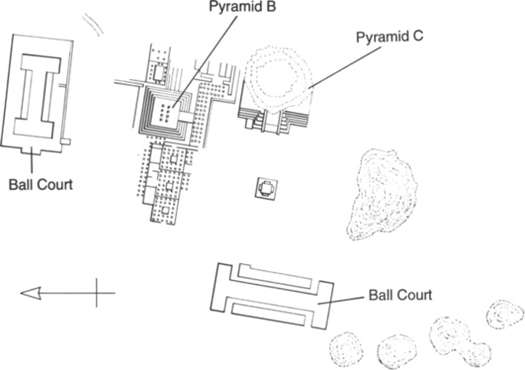
I was sitting on the flat square summit of the unimaginatively named Pyramid B. The late-afternoon sun was beating down out of a clear blue sky, and I was facing south, looking around.
At the base of the pyramid, to the north and east, were murals depicting jaguars and eagles feasting on human hearts. Immediately behind me were ranged four pillars and four fearsome granite idols each nine feet tall. Ahead and, to my left lay the partially unexcavated Pyramid C, a cactus-covered mound about 40 feet high, and farther away were more mounds not yet investigated by archaeologists. To my right was a ball court. In that long, I-shaped arena, terrible gladitorial games had been staged in ancient times. Teams, or sometimes just two individuals pitted against each other, would compete for possession of a rubber ball; the losers were decapitated.
The idols on the platform behind me had a solemn and intimidating aura. I stood up to look at them more closely. Their sculptor had given them hard, implacable faces, hooked noses and hollow eyes and they seemed without sympathy or emotion. What interested me most, however, was not so much their ferocious appearance as the objects that they clutched in their hands. Archaeologists admitted that they didn’t really know what these objects were but had tentatively identified them anyway. This identification had stuck and it was now received wisdom that spearthrowers called atl-atls were held in the right hands of the idols and ‘spears or arrows and incense bags’ in the left hands.18 It didn’t seem to matter that the objects did not in any way resemble atl-atls, spears, arrows, or incense bags.
Santha Faiia’s photographs will help the reader to form his or her own impression of these peculiar objects. As I studied the objects themselves I had the distinct sense that they were meant to represent devices which had originally been made out of metal. The right-hand device, which seemed to emerge from a sheath or hand-guard, was lozenge-shaped with a curved lower edge. The left-hand device could have been an instrument or weapon of some kind.
I remembered legends which related that the gods of ancient Mexico had armed themselves with xiuhcoatl, ‘fire serpents’.19 These apparently emitted burning rays capable of piercing and dismembering human bodies.20 Was it ‘fire serpents’ that the Tula idols were holding? What, for that matter, were fire serpents?
Whatever they were, both devices looked like pieces of technology. And both in certain ways resembled the equally mysterious objects in the hands of the idols in the Kalasasaya at Tiahuanaco.
Serpent Sanctuary
Santha and I had come to Tula/Tollan because it had been closely associated both with Quetzalcoatl and with his arch-enemy Tezcatilpoca, the Smoking Mirror.21 Ever-young, omnipotent, omnipresent and omniscient, Tezcatilpoca was associated in the legends with night, darkness and the sacred jaguar.22 He was ‘invisible and implacable, appearing to men sometimes as a flying shadow, sometimes as a dreadful monster’.23 Often depicted as a glaring skull, he was said to have been the owner of a mysterious object, the Smoking Mirror after which he was named, which he made use of to observe from afar the activities of men and gods. Scholars quite reasonably suppose that it must have been a primitive obsidian scrying stone: ‘Obsidian had an especial sanctity for the Mexicans, as it provided the sacrificial knives employed by the priests … Bernal Diaz [Spanish chronicler] states that they called this stone “Tezcat”. From it mirrors were also manufactured as divinatory media to be used by wizards.’24
Representing the forces of darkness and rapacious evil, Tezcatilpoca was said in the legends to have been locked in a conflict with Quetzalcoatl that had continued over an immense span of years.25 At certain times one seemed to be gaining the upper hand, at certain times the other. Finally the cosmic struggle came to an end when good was vanquished by evil and Quetzalcoatl driven out from Tollan.26 Thereafter, under the influence of Tezcatilpoca’s nightmarish cult, human sacrifice was reintroduced throughout Central America.
As we have seen, Quetzalcoatl was believed to have fled to the coast and to have been carried away on a raft of serpents. One legend says, ‘He burned his houses, built of silver and shells, buried his treasure, and set sail on the Eastern Sea preceded by his attendants who had been changed into bright birds.’27
This poignant moment of departure was supposedly staged at a place called Coatzecoalcos, meaning ‘Serpent Sanctuary’.28 There, before taking his leave, Quetzalcoatl promised his followers he would return one day to overthrow the cult of Tezcatilpoca and to inaugurate an era when the gods would again ‘accept sacrifices of flowers’ and cease their clamour for human blood.29