
Chapter 20
Palenque, Chiapas Province
Evening was settling in. I sat just beneath the north-east corner of the Mayan Temple of the Inscriptions and gazed north over the darkening jungle where the land dropped away towards the flood plain of the Usumacinta.
The Temple consisted of three chambers and rested on top of a nine-stage pyramid almost 100 feet tall. The clean and harmonious lines of this structure gave it a sense of delicacy, but not of weakness. It felt strong, rooted into the earth, enduring – a creature of pure geometry and imagination.
Looking to my right I could see the Palace, a spacious rectangular complex on a pyramidal base, dominated by a narrow, four-storeyed tower, thought to have been used as an observatory by Maya priests.
Around about me, where bright-feathered parrots and macaws skimmed the treetops, a number of other spectacular buildings lay half swallowed by the encroaching forest. These were the Temple of the Foliated Cross, the Temple of the Sun, the Temple of the Count, and the Temple of the Lion – all names made up by archaeologists. So much of what the Maya had stood for, cared about, believed in and remembered from earlier times was irretrievably lost. Though we’d long ago learned to read their dates, we were only just beginning to make headway with the deciphering of their intricate hieroglyphs.
I stood and climbed the last few steps into the central chamber of the Temple. Set into the rear wall were two great grey slabs, and inscribed on them, in regimented rows like pieces on a chequerboard, were 620 separate Mayan glyphs. These took the form of faces, monstrous and human, together with a writhing bestiary of mythical creatures.
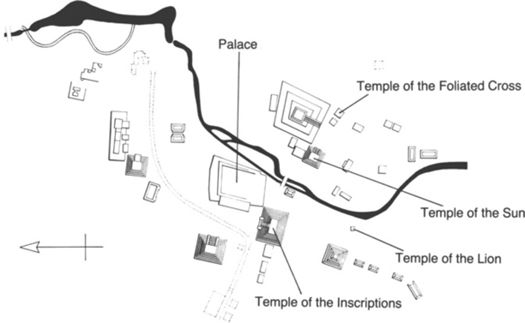
Palenque.
What was being said here? No one knew for sure because the inscriptions, a mixture of word pictures and phonetic symbols, had not yet been fully decoded. It was evident, however, that a number of the glyphs referred to epochs thousands of years in the past, and spoke of people and gods who had played their parts in prehistoric events.1
Pacal’s tomb
To the left of the hieroglyphs, let into the huge flagstones of the temple floor, was a steep descending internal stairway. This led to a room buried deep in the bowels of the pyramid, where the tomb of Lord Pacal lay. The stairs, of highly polished limestone blocks, were narrow and surprisingly slippery and moist. Adopting a crabbed, sideways stance, I switched on my torch and stepped gingerly down into the gloom, steadying myself against the southern wall as I did so.
This damp stairway had been a secret place from the date when it was originally sealed, in AD 683, until June 1952 when the Mexican archaeologist Alberto Ruz lifted the flagstones in the temple floor. Although a second such tomb was found at Palenque in 1994,2 Ruz had the honour of being the first man to discover such a feature inside a New World pyramid. The stairway had been intentionally filled with rubble by its builders, and it took four more years before the archaeologists cleared it out completely and reached the bottom.
When they had done so they entered a narrow corbel-vaulted chamber. Spread out on the floor in front of them were the mouldering skeletons of five or possibly six young victims of sacrifice. A huge triangular slab of stone was visible at the far end of the chamber. When it was removed, Ruz was confronted by a remarkable tomb. He described it as ‘an enormous room that appeared to be graven in ice, a kind of grotto whose walls and roof seemed to have been planed in perfect surfaces, or an abandoned chapel whose cupola was draped with curtains of stalactites, and from whose floor arose thick stalagmites like the dripping of a candle.’3
The room, also roofed with a corbel vault, was 30 feet long and 23 feet high. Around the walls, in stucco relief, could be seen the striding figures of the Lords of the Night – the ‘Ennead’ of nine deities who ruled over the hours of darkness. Centre-stage, and overlooked by these figures, was a huge monolithic sarcophagus lidded with a five-ton slab of richly carved stone. Inside the sarcophagus was a tall skeleton draped with a treasure trove of jade ornaments. A mosaic death mask of 200 fragments of jade was affixed to the front of the skull. These, supposedly, were the remains of Pacal, a ruler of Palenque in the seventh century AD. The inscriptions stated that this monarch had been eighty years old at the time of his death, but the jade-draped skeleton the archaeologists found in the sarcophagus appeared to belong to a man half that age.4
Having reached the bottom of the stairway, some eighty-five feet below the floor of the temple, I crossed the chamber where the sacrificial victims had lain and gazed directly into Pacal’s tomb. The air was dank, full of mildew and damp-rot, and surprisingly cold. The sarcophagus, set into the floor of the tomb, had a curious shape, flared strikingly at the feet like an Ancient Egyptian mummy case. These were made of wood and were equipped with wide bases since they were frequently stood upright. But Pacal’s coffin was made of solid stone and was uncompromisingly horizontal. Why, then, had the Mayan artificers gone to so much trouble to widen its base when they must have known that it served no useful purpose? Could they have been slavishly copying a design-feature from some ancient model long after the raison d’être for the design had been forgotten?5 Like the beliefs concerning the perils of the afterlife, might Pacal’s sarcophagus not be an expression of a common legacy linking Ancient Egypt with the ancient cultures of Central America?
Rectangular in shape, the heavy stone lid of the sarcophagus was ten inches thick, three feet wide and twelve and a half feet long. It, too, seemed to have been modelled on the same original as the magnificent engraved blocks the Ancient Egyptians had used for this exact purpose. Indeed, it would not have looked out of place in the Valley of the Kings. But there was one major difference. The scene carved on top of the sarcophagus lid was unlike anything that ever came out of Egypt. Lit in my torch beam, it showed a clean-shaven man dressed in what looked like a tight-fitting body-suit, the sleeves and leggings of which were gathered into elaborate cuffs at the wrists and ankles. The man lay semi-reclined in a bucket seat which supported his lower back and thighs, the nape of his neck resting comfortably against some kind of headrest, and he was peering forward intently. His hands seemed to be in motion, as though they were operating levers and controls, and his feet were bare, tucked up loosely in front of him.
Was this supposed to be Pacal, the Maya king?
If so, why was he shown operating some kind of machine? The Maya weren’t supposed to have had machines. They weren’t even supposed to have discovered the wheel. Yet with its side panels, rivets, tubes and other gadgets, the structure Pacal reclined in resembled a technological device much more strongly than it did ‘the transition of one man’s living soul to the realms of the dead’,6 as one authority claimed, or the king ‘falling back into the fleshless jaws of the earth monster’,7 as another argued.
I remembered ‘Man in Snake’, the Olmec relief described in Chapter Seventeen. It, too, had looked like a naïve depiction of a piece of technology. Furthermore, ‘Man in Snake’ had come from La Venta, where it had been associated with several bearded figures, apparently Caucasians. Pacal’s tomb was at least a thousand years younger than any of the La Venta treasures. Nevertheless, a tiny jade statuette was found lying close to the skeleton inside the sarcophagus, and it appeared to be much older than the other grave-goods also placed there. It depicted an elderly Caucasian, dressed in long robes, with a goatee beard.8
Pyramid of the Magician
Uxmal, Yucatan
On a stormy afternoon, 700 kilometres north of Palenque, I began to climb the steps of yet another pyramid. It was a steep building, oval rather than square in plan, 240 feet long at the base and 120 feet wide. It was, moreover, very high, rising 120 feet above the surrounding plain.
Since time out of mind this edifice, which did look like the castle of a necromancer, had been known as the ‘Pyramid of the Magician’ and also as the ‘House of the Dwarf’. These names were derived from a Maya legend which asserted that a dwarf with supernatural powers had raised the entire building in just one night.9
The steps, as I climbed them, seemed more and more perversely narrow. My instinct was to lean forward, flatten myself against the side of the pyramid, and cling on for dear life. Instead I looked up at the angry, overcast sky above me. Flocks of birds circled, screeching wildly as though seeking refuge from some impending disaster, and the thick mass of low-lying cloud that had blotted out the sun a few hours earlier was now so agitated by high winds that it seemed to boil.
The Pyramid of the Magician was by no means unique in being associated with the supernatural powers of dwarves, whose architectural and masonry skills were widely renowned in Central America. ‘Construction work was easy for them,’ asserted one typical Maya legend, ‘all they had to do was whistle and heavy rocks would move into place.’10
A very similar tradition, as the reader may recall, claimed that the gigantic stone blocks of the mysterious Andean city of Tiahuanaco had been ‘carried through the air to the sound of a trumpet’.11
In both Central America and in the far-off regions of the Andes, therefore, strange sounds had been associated with the miraculous levitation of massive rocks.
What was I to make of this? Maybe, through some fluke, two almost identical ‘fantasies’ could have been independently invented in both these geographically remote areas. But that didn’t seem very likely. Equally worthy of consideration was the possibility that common recollections of an ancient building technology could have been preserved in stories such as these, a technology capable of lifting huge blocks of stone off the ground with ‘miraculous’ ease. Could it be relevant that memories of almost identical miracles were preserved in Ancient Egypt? There, in one typical tradition, a magician was said to have raised into the air ‘a huge vault of stone 200 cubits long and 50 cubits broad’?12

Uxmal.
The sides of the stairway I was climbing were richly decorated with what the nineteenth-century American explorer John Lloyd Stephens described as ‘a species of sculptured mosaic’.13 Oddly, although the Pyramid of the Magician had been built long centuries before the Conquest, the symbol most frequently featured in these mosaics was a close approximation of the Christian cross. Indeed there were two distinct kinds of ‘Christian’ crosses: one the wide-pawed croix-patte favoured by the Knights Templar and other crusading orders in the twelfth and thirteenth centuries; the other the x-shaped Saint Andrew’s cross.
After climbing a further shorter flight of steps I reached the temple at the very top of the Magician’s pyramid. It consisted of a single corbel-vaulted chamber from the ceiling of which large numbers of bats hung suspended. Like the birds and the clouds, they were visibly distressed by the sense of a huge storm brewing. In a furry mass they shuffled restlessly upside down, folding and unfolding their small leathery wings.
I took a rest on the high platform that surrounded the chamber. From here, looking down, I could see many more crosses. They were everywhere, literally all over this bizarre and ancient structure. I remembered the Andean city of Tiahuanaco and the crosses that had been carved there, in distant pre-Colombian times, on some of the great blocks of stone lying scattered around the building known as Puma Punku.14 ‘Man in Snake’, the Olmec sculpture from La Venta, had also been engraved with two Saint Andrew’s crosses long before the birth of Christ. And now, here at the Pyramid of the Magician in the Mayan site of Uxmal, I was confronted by crosses yet again.
Bearded men …
Serpents …
Crosses …
How likely was it to be an accident that symbols as distinctive as these should repeat themselves in widely separated cultures and at different periods of history? Why were they so often built into the fabric of sophisticated works of art and architecture?
A science of prophecy
Not for the first time I suspected that I might be looking at signs and icons left behind by some cult or secret society which had sought to keep the light of civilization burning in Central America (and perhaps elsewhere) through long ages of darkness. I thought it notable that the motifs of the bearded man, the Plumed Serpent, and the cross all tended to crop up whenever and wherever there were hints that a technologically advanced and as yet unidentified civilization might once have been in contact with the native cultures. And there was a sense of great age about this contact, as though it took place at such an early date that it had been almost forgotten.
I thought again about the sudden way the Olmecs had emerged, around the middle of the second millennium BC, out of the swirling mists of opaque prehistory. All the archaeological evidence indicated that from the beginning they had venerated huge stone heads and stele showing bearded men. I found myself increasingly drawn to the possibility that some of those remarkable pieces of sculpture could have been part of a vast inheritance of civilization handed down to the peoples of Central America many thousands of yearsbefore the second millenium BC, and thereafter entrusted to the safekeeping of a secret wisdom cult, perhaps the cult of Quetzalcoatl.
Much had been lost. Nevertheless the tribes of this region – in particular the Maya, the builders of Palenque and Uxmal – had preserved something even more mysterious and wonderful than the enigmatic monoliths, something which declared itself even more persistently to be the legacy of an older and a higher civilization. We see in the next chapter that it was the mystical science of an ancient star-gazing folk, a science of time and measurement and prediction – a science of prophecy even – that the Maya had preserved most perfectly from the past. With it they inherited memories of a terrible, earth-destroying flood and an idiosyncratic legacy of empirical knowledge, knowledge of a high order which they shouldn’t really have possessed, knowledge that we have only reacquired very recently …