
Chapter 31
Archaeo-astronomer Jane B. Sellers, who studied Egyptology at the University of Chicago’s Oriental Institute, spends her winters in Portland, Maine, and summers at Ripley Neck, a nineteenth-century enclave ‘downeast’ on Maine’s rocky coast. ‘There,’ she says, ‘the night skies can be as clear as the desert, and no one minds if you read the Pyramid Texts out loud to the seagulls …’1
One of the few serious scholars to have tested the theory advanced by Santillana and von Dechend in Hamlet’s Mill, Sellers has been hailed for having drawn attention to the need to use astronomy, and more particularly precession, for the proper study of ancient Egypt and its religion.2 In her words: ‘Archaeologists by and large lack an understanding of precession, and this affects their conclusions concerning ancient myths, ancient gods and ancient temple alignments … For astronomers precession is a well-established fact; those working in the field of ancient man have a responsibility to attain an understanding of it.’3
It is Sellers’s contention, eloquently expressed in her recent book, The Death of Gods in Ancient Egypt, that the Osiris myth may have been deliberately encoded with a group of key numbers that are ‘excess baggage’ as far as the narrative is concerned but that offer an eternal calculus by which surprisingly exact values can be derived for the following:
1 The time required for the earth’s slow precessional wobble to cause the position of sunrise on the vernal equinox to complete a shift of one degree along the ecliptic (in relation to the stellar background);
2 The time required for the sun to pass through one full zodiacal segment of thirty degrees;
3 The time required for the sun to pass through two full zodiacal segments (totalling sixty degrees);
4 The time required to bring about the ‘Great Return’4, i. e, for the sun to shift three hundred and sixty degrees along the ecliptic, thus fulfilling one complete precessional cycle or ‘Great Year’.
Computing the Great Return
The precessional numbers highlighted by Sellers in the Osiris myth are 360, 72, 30 and 12. Most of them are found in a section of the myth which provides us with biographical details of the various characters. These have been conveniently summarized by E. A. Wallis Budge, formerly keeper of Egyptian Antiquities at the British Museum:
The goddess Nut, wife of the sun god Ra, was beloved by the god Geb. When Ra discovered the intrigue he cursed his wife and declared that she should not be delivered of a child in any month of any year. Then the god Thoth, who also loved Nut, played at tables with the moon and won from her five whole days. These he joined to the 360 days of which the year then consisted [emphasis added]. On the first of these five days Osiris was brought forth; and at the moment of his birth a voice was heard to proclaim that the lord of creation was born.5
Elsewhere the myth informs us that the 360–day year consists of ‘12 months of 30 days each’.6 And in general, as Sellers observes, ‘phrases are used which prompt simple mental calculations and an attention to numbers’.7
Thus far we have been provided with three of Sellers’s precessional numbers: 360, 12 and 30. The fourth number, which occurs later in the text, is by far the most important. As we saw in Chapter Nine, the evil deity known as Set led a group of conspirators in a plot to kill Osiris. The number of these conspirators was 72.
With this last number in hand, suggests Sellers, we are now in a position to boot-up and set running an ancient computer programme:
12 = the number of constellations in the zodiac;
30 = the number of degrees allocated along the ecliptic to each zodiacal constellation;
72 = the number of years required for the equinoctial sun to complete a precessional shift of one degree along the ecliptic;
360 = the total number of degrees in the ecliptic;
72 × 30 = 2160 (the number of years required for the sun to complete a passage of 30 degrees along the ecliptic, i. e., to pass entirely through any one of the 12 zodiacal constellations);
2160 × 12 (or 360 × 72) = 25,920 (the number of years in one complete precessional cycle or ‘Great Year’, and thus the total number of years required to bring about the ‘Great Return’).
Other figures and combinations of figures also emerge, for example:
36, the number of years required for the equinoctial sun to complete a precessional shift of half a degree along the ecliptic; 4320, the number of years required for the equinoctial sun to complete a precessional shift of 60 degrees (i. e., two zodiacal constellations).
These, Sellers believes, constitute the basic ingredients of a precessional code which appears again and again, with eerie persistence, in ancient myths and sacred architecture. In common with much esoteric numerology, it is a code in which it is permissible to shift decimal points to left or right at will and to make use of almost any conceivable combinations, permutations, multiplications, divisions and fractions of the essential numbers (all of which relate precisely to the rate of precession of the equinoxes).
The pre-eminent number in the code is 72. To this is frequently added 36, making 108, and it is permissible to multiply 108 by 100 to get 10,800 or to divide it by 2 to get 54, which may then be multiplied by 10 and expressed as 540 (or as 54,000. or as 540,000, or as 5,400,000, and so on). Also highly significant is 2160 (the number of years required for the equinoctial point to transit one zodiacal constellation), which is sometimes multiplied by 10 and by factors of ten (to give 216,000, 2,160,000, and so on) and sometimes by 2 to give 4320, or 43,200, or 432,000, or 4,320,000, ad infinition.
Better than Hipparchus
If Sellers is correct in her hypothesis that the calculus needed to produce these numbers was deliberately encoded into the Osiris myth to convey precessional information to initiates, we are confronted by an intriguing anomaly. If they are indeed about precession, the numbers are out of place in time. The science they contain is too advanced for them to have been calculated by any known civilization of antiquity.
Let us not forget that they occur in a myth which is present at the very dawn of writing in Egypt (indeed elements of the Osiris story are to be found in the Pyramid Texts dating back to around 2450 BC, in a context which suggests that they were exceedingly old even then8). Hipparchus, the so-called discoverer of precession lived in the second century BC. He proposed a value of 45 or 46 seconds of arc for one year of precessional motion. These figures yield a one-degree shift along the ecliptic in 80 years (at 45 arc seconds per annum), and in 78.26 years (at 46 arc seconds per annum). The true figure, as calculated by twentieth century science, is 71.6 years.9 If Sellers’s theory is correct, therefore, the ‘Osiris numbers’, which give a value of 72 years, are significantly more accuratethan those of Hipparchus. Indeed, within the obvious confines imposed by narrative structure, it is difficult to see how the number 72 could have been improved upon, even if the more precise figure had been known to the ancient myth-makers. One can hardly insert 71.6 conspirators into a story, but 72 will fit comfortably.
Working from this rounded-up figure, the Osiris myth is capable of yielding a value of 2160 years for a precessional shift through one complete house of the zodiac. The correct figure, according to today’s calculations, is 2148 years.10 The Hipparchus figures are 2400 years and 2347.8 years respectively. Finally, Osiris enables us to calculate 25,920 as the number of years required for the fulfilment of a complete precessional cycle through 12 houses of the zodiac. Hipparchus gives us either 28,800 or 28,173.6 years. The correct figure, by today’s estimates, is 25,776 years.11 The Hipparchus calculations for the Great Return are therefore around 3000 years out of kilter. The Osiris calculations miss the true figure by only 144 years, and may well do so because the narrative context forced a rounding-up of the base number from the correct value of 71.6 to a more workable figure of 72.
All this, however, assumes that Sellers is right to suppose that the numbers 360, 72, 30 and 12 did not find their way into the Osiris myth by chance but were placed there deliberately by people who understood – and had accurately measured – precession.
Is Sellers right?
Times of decay
The Osiris myth is not the only one to incorporate the calculus for precession. The relevant numbers keep surfacing in various forms, multiples and combinations, all over the ancient world.
An example was given in Chapter Thirty-three – the Norse myth of the 432,000 fighters who sallied forth from Valhalla to do battle with ‘the Wolf’. A glance back at that myth shows that it contains several permutations of ‘precessional numbers’.
Likewise, as we saw in Chapter Twenty-four, ancient Chinese traditions referring to a universal cataclysm were said to have been written down in a great text consisting of precisely 4320 volumes.
Thousands of miles away, is it a coincidence that the Babylonian historian Berossus (third century BC) ascribed a total reign of 432,000 years to the mythical kings who ruled the land of Sumer before the flood? And is it likewise a coincidence that this same Berossus ascribed 2,160,000 years to the period ‘between creation and universal catastrophe’?12
Do the myths of ancient Amerindian peoples like the Maya also contain or enable us to compute numbers such as 72, 2160, 4320, etc. We shall probably never know, thanks to the conquistadores and zealous friars who destroyed the traditional heritage of Central America and left us so little to work with. What we can say, however, is that the relevant numbers do turn up, in relative profusion, in the Mayan Long Count calendar. Details of that calendar were given in Chapter Twenty-one. The numerals necessary for calculating precession are found there in these formulae: 1 Katun = 7200 days; 1 Tun = 360 days; 2 Tuns = 720 days; 5 Baktuns = 720,000 days; 5 Katuns = 36,000 days; 6 Katuns = 43,200 days; 6 Tuns = 2160 days; 15 Katuns = 2,160,000 days.13
Nor does it seem that Sellers’s ‘code’ is confined to mythology. In the jungles of Kampuchea the temple complex of Angkor looks as though it could have been purpose-built as a precessional metaphor. It has, for example, five gates to each of which leads a road bridging the crocodile-infested
moat that surrounds the whole site. Each of these roads is bordered by a row of gigantic stone figures, 108 per avenue, 54 on each side (540 statues in all) and each row carries a huge Naga serpent. Furthermore, as Santillana and von Dechend point out inHamlet’s Mill, the figures do not ‘carry’ the serpent but are shown to ‘pull’ it, which indicates that these 540 statues are ‘churning the Milky Ocean’. The whole of Angkor ‘thus turns out to be a colossal model set up with true Hindu fantasy and incongruousness’ to express the idea of precession.14
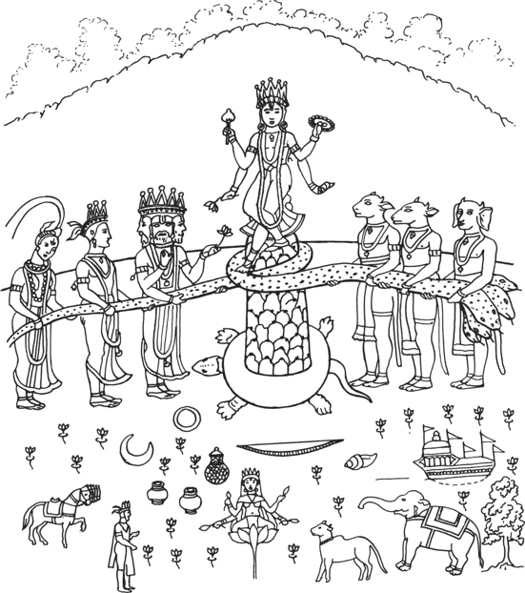
Churning the Milky Ocean, one of the several ‘thought tools’ for precession encountered in ancient myths.
The same may be true of Java’s famous temple of Borobudur, with its 72 bell-shaped stupas, and perhaps also of the megaliths of Baalbeck in the Lebanon – which are thought to be the world’s biggest blocks of cut stone. Long predating Roman and Greek structures on the site, the three that make up the so-called ‘Trilithion’ are as tall as five-storey buildings and weigh over 600 tons each. A fourth megalith is almost 80 feet in length and weighs 1100 tons. Amazingly these giant blocks were cut, perfectly-shaped and somehow transported to Baalbeck from a quarry several miles away. In addition they were skilfully incorporated, at a considerable height above ground-level into the retaining walls of a magnificient temple. This temple was surrounded by 54 columns of immense size and height.15
In the subcontinent of India (where the Orion constellation is known as Kal-Purush, meaning Time-Man16), we find that Sellers’s Osiris numbers are transmitted through a wide range of media in ways increasingly difficult to ascribe to chance. There are, for instance, 10,800 bricks in the Agnicayana, the Indian fire altar. There are 10,800 stanzas in the Rigveda, the most ancient of the Vedic texts and a rich repository of Indian mythology. Each stanza is made up of 40 syllables with the result that the entire composition consists of 432,000 syllables … no more, and no less.17 And in Rigveda I:164 (a typical stanza) we read of ‘the 12-spoked wheel in which 720 sons of Agni are established’.18
In the Hebrew Cabala there are 72 angels through whom the Sephiroth (divine powers) may be approached, or invoked, by those who know their names and numbers.19 Rosicrucian tradition speaks of cycles of 108 years (72 plus 36) according to which the secret brotherhood makes its influence felt.20 Similarly the number 72 and its permutations and subdivisions are of great significance to the Chinese secret societies known as Triads. An ancient ritual requires that each candidate for initiation pay a fee including ‘360 cash for “making clothes”, 108 cash “for the purse”, 72 cash for instruction, and 36 cash for decapitating the “traiterous subject”.’21 The ‘cash’ (the old universal brass coin of China with a square hole in the centre) is of course no longer in circulation but the numberspassed down in the ritual since times immemorial have survived. Thus in modern Singapore, candidates for Triad membership pay an entrance fee which is calculated according to their financial circumstances but which must always consist of multiples of $1.80, $3.60, $7.20, $10.80 (and thus, $18, $36, $72, $108.00, or $360, $720, $1,080, and so on.22
Of all the secret societies, the most mysterious and archaic by far is undoubtedly the Hung League, which scholars believe to be ‘the depository of the old religion of the Chinese’.23 In one Hung initiation ritual the neophyte is put through a question and answer session that goes:
Q. What did you see on your walk?
A. I saw two pots with red bamboo.
Q. Do you know how many plants there were?
A. In one pot were 36 and in the other 72 plants, together 108.
Q. Did you take home some of them for your use?
A. Yes, I took home 108 plants …
Q. How can you prove that?
A. I can prove it by a verse.
Q. How does this verse run?
A. The red bamboo from Canton is rare in the world.
In the groves are 36 and 72.
Who in the world knows the meaning of this?
When we have set to work we will know the secret.
The atmosphere of intrigue that such passages generate is accentuated by the reticent behaviour of the Hung League itself, an organization resembling the medieval European Order of the Knights Templar (and the higher degrees of modern Freemasonry) in many ways that are beyond the remit of this book to describe.24 It is intriguing, too, that the Chinese character Hung, composed of water and many, signifies inundation, i. e. the Flood.
Finally, returning to India, let us note the content of the sacred scriptures known as the Puranas. These speak of four ‘ages of the earth’, called Yugas, which together are said to extend to 12,000 ‘divine years’. The respective durations of these epochs, in ‘divine years’, are Krita Yuga = 4800; Treta Yuga = 3600; Davpara Yuga = 2400; Kali Yuga = 1200.25
The Puranas also tell us that ‘one year of the mortals is equal to one day of the gods’.26 Furthermore, and exactly as in the Osiris myth, we discover that the number of days in the years of both gods and mortals has been artificially set at 360, so one year of the gods is equivalent to 360 mortal years.27
The Kali Yuga, therefore, at 1200 years of the gods, turns out to have a duration of 432,000 mortal years.28 One Mahayuga, or Great Age (made up of the 12,000 divine years contained in the four lesser Yugas) is equivalent to 4,320,000 years of mortals. A thousand such Mahayugas (which constitute a Kalpa, or Day of Brahma) extend over 4,320,000,000 ordinary years,29 again supplying the digits for basic precessional calculations. Separately there are Manvantaras (periods of Manu) of which we are told in the scriptures that ’about 71 systems of four Yugas elapse during each Manvantara.30 The reader will recall that one degree of precessional motion along the ecliptic requires 71.6 years to complete, a number that can be rounded down to ‘about 71’ in India just as easily as it was rounded up to 72 in Ancient Egypt.
The Kali Yuga, with a duration of 432,000 mortal years, is, by the way, our own. ‘In the Kali Age,’ the scriptures say, ‘shall decay flourish, until the human race approaches annihilation.’31
Dogs, uncles and revenge
It was a dog that brought us to these decaying times.
We came here by way of Sirius, the Dog Star, who stands at the heel of the giant constellation of Orion where it towers in the sky above Egypt. In that land, as we have seen, Orion is Osiris, the god of death and resurrection, whose numbers – perhaps by chance – are 12, 30, 72, and 360. But can chance account for the fact that these and other prime integers of precession keep cropping up in supposedly unrelated mythologies from all over the world, and in such stolid but enduring vehicles as calendar systems and works of architecture?
Santillana and von Dechend, Jane Sellers and a growing body of other scholars rule out chance, arguing that the persistence of detail is indicative of a guiding hand.
If they are wrong, we need to find some other explanation for how such specific and inter-related numbers (the only obvious function of which is to calculate precession) could by accident have got themselves so widely imprinted on human culture.
But suppose they are not wrong? Suppose that a guiding hand really was at work behind the scenes?
Sometimes, when you slip into Santillana’s and von Dechend’s world of myth and mystery, you can almost feel the influence of that hand … Take the business of the dog … or jackal, or wolf, or fox. The subtle way this shadowy canine slinks from myth to myth is peculiar – stimulating, then baffling you, always luring you onwards.
Indeed, it was this lure we followed from the Mill of Amlodhi to the myth of Osiris in Egypt. Along the way, according to the design of the ancient sages (if Sellers, Santillana and von Dechend are right) we were first encouraged to build a clear mental picture of the celestial sphere. Second, we were provided with a mechanistic model so that we could visualize the great changes precession of the equinoxes periodically effects in all the coordinates of the sphere. Finally, after allowing the dog Sirius to open the way for us, we were were given the figures to calculate precession more or less exactly.
Nor is Sirius, in his eternal station at Orion’s heel, the only doggish character around Osiris. We saw in Chapter Eleven how Isis (who was both the wife and sister of Osiris32) searched for her dead husband’s body after he had been murdered by Set (who, incidentally, was also her brother, and the brother of Osiris). In this search, according to ancient tradition, she was assisted by dogs (jackals in some versions).33 Likewise, mythological and religious texts from all periods of Egyptian history assert that the jackal-god Anubis ministered to the spirit of Osiris after his death and acted as his guide through the underworld.34 (Surviving vignettes depict Anubis as virtually identical in appearance to Upuaut, the Opener of the Ways.)
Last but not least, Osiris himself was believed to have taken the form of a wolf when he returned from the underworld to assist his son Horus in the final battle against Set.35
Investigating this kind of material, one sometimes has the spooky sense of being manipulated by an ancient intelligence which has found a way to reach out to us across vast epochs of time, and for some reason has set us a puzzle to solve in the language of myth.
If it were just dogs that kept cropping up again and again, it would be easy to brush off such weird intuitions. The dog phenomenon seems more likely to be coincidence than anything else. But it isn’t just dogs.
The ways between the two very different myths of Osiris and Amlodhi’s Mill (which nonetheless both seem to contain accurate scientific data about precession of the equinoxes) are kept open by another strange common factor. Family relationships are involved. Amlodhi/Amleth/Hamlet is always a son who revenges the murder of his father by entrapping and killing the murderer. The murderer, furthermore, is always the father’s own brother, i. e., Hamlet’s uncle.36
This is precisely the scenario of the Osiris myth. Osiris and Seth are brothers.37 Seth murders Osiris. Horus, the son of Osiris, then takes revenge upon his uncle.38
Another twist is that the Hamlet character often has some sort of incestuous relationship with his sister.39 In the case of Kullervo, the Finnish Hamlet, there is a poignant scene in which the hero, returning home after a long absence, meets a maiden in the woods, gathering berries. They lie together. Only later do they discover that they are brother and sister. The maiden drowns herself at once. Later, with ‘the black dog Musti’ padding along at his heels, Kullervo wanders into the forest and throws himself upon his sword.40
There are no suicides in the Egyptian myth of Osiris, but there is the incest of Osiris and his sister Isis. Out of their union is born Horus the avenger.
So once again it seems reasonable to ask: what is going on? Why are there all these apparent links and connections? Why do we have these ‘strings’ of myths, ostensibly about different subjects, all of which prove capable in their own ways of shedding light on the phenomenon of precession of the equinoxes? And why do all these myths have dogs running through them, and characters who seem unusually inclined to incest, fratricide and revenge? It surely drives scepticism beyond its limits to suggest that so many identical literary devices could keep on turning up purely by chance in so many different contexts.
If not by chance, however, then who exactly was responsible for creating this intricate and clever connecting pattern? Who were the authors and designers of the puzzle and what motives might they have had?
Scientists with something to say
Whoever it was, they must have been smart – smart enough to have observed the infinitesimal creep of precessional motion along the ecliptic and to have calculated its rate at a value uncannily close to that obtained by today’s advanced technology.
It therefore follows that we are talking about highly civilized people. Indeed, we are talking about people who deserve to be called scientists. They must, moreover, have lived in extremely remote antiquity because we can be certain that the creation and dissemination of the common heritage of precessional myths on both sides of the Atlantic did not take place in historic times. On the contrary the evidence suggests that all these myths were ‘tottering with age’ when what we call history began about 5000 years ago.41
The great strength of the ancient stories was this: as well as being for ever available for use and adaptation free of copyright, like intellectual chameleons, subtle and ambiguous, they had the capacity to change their colour according to their surroundings. At different times, in different continents, the ancient tales could be retold in a variety of ways, but would always retain their essential symbolism and always continue to transmit the coded precessional data they had been programmed with at the outset.
But to what end?
As we see in the next chapter, the long slow cycles of precession are not limited in their consequences to a changing view of the sky. This celestial phenomenon, born of the earth’s axial wobble, has direct effects on the earth itself. In fact, it appears to be one of the principal correlates of the sudden onset of ice ages and their equally sudden and catastrophic decay.