
Chapter 39
Giza, Egypt, 16 March 1993, 3.30 p. m..
It was mid afternoon by the time I left the Great Pyramid. Retracing the route that Santha and I had followed the night before when we had climbed the monument, I walked eastwards along the northern face, southwards along the flank of the eastern face, clambered over mounds of rubble and ancient tombs that clustered closely in this part of the necropolis, and came out on to the sand-covered limestone bedrock of the Giza plateau, which sloped down towards the south and east.
At the bottom of this long gentle slope, about half a kilometre from the south-eastern corner of the Great Pyramid, the Sphinx crouched in his rock-hewn pit. Sixty-six feet high and more than 240 feet long, with a head measuring 13 feet 8 inches wide,1 he was, by a considerable margin, the largest single piece of sculpture in the world – and the most renowned:
A shape with lion body and the head of a man
A gaze blank and pitiless as the sun.2
Approaching the monument from the north-west I crossed the ancient causeway that connected the Second Pyramid with the so-called Valley Temple of Khafre, a most unusual structure located just 50 feet south of the Sphinx itself on the eastern edge of the Giza necropolis.
This Temple had long been believed to be far older than the time of Khafre. Indeed throughout much of the nineteenth century the consensus among scholars was that it had been built in remote prehistory, and had nothing to do with the architecture of dynastic Egypt.3 What changed all that was the discovery, buried within the Temple precincts, of a number of inscribed statues of Khafre. Most were pretty badly smashed, but one, found upside down in a deep pit in an antechamber, was almost intact. Life-sized, and exquisitely carved out of black, jewel-hard diorite, it showed the Fourth Dynasty pharaoh seated on his throne and gazing with serene indifference towards infinity.
At this point the razor-sharp reasoning of Egyptology was brought to bear, and a solution of almost awe-inspiring brilliance was worked out: statues of Khafre had been found in the Valley Temple therefore the Valley Temple had been built by Khafre. The normally sensible Flinders Petrie summed up: ‘The fact that the only dateable remains found in the Temple were statues of Khafre shows that it is of his period; since the idea of his appropriating an earlier building is very unlikely.’4
But why was the idea so unlikely?
Throughout the history of Dynastic Egypt many pharaohs appropriated the buildings of their predecessors, sometimes deliberately striking out the cartouches of the original builders and replacing them with their own.5 There was no good reason to assume that Khafre would have been deterred from linking himself to the Valley Temple, particularly if it had not been associated in his mind with any previous historical ruler but with the great ‘gods’ said by the Ancient Egyptians to have brought civilization to the Nile Valley in the distant and mythical epoch they spoke of as the First Time.6 In such a place of archaic and mysterious power, which he does not appear to have interfered with in any other way, Khafre might have thought that the setting up of beautiful and lifelike statues of himself could bring eternal benefits. And if, among the gods, the Valley Temple had been associated with Osiris (whom it was every pharaoh’s objective to join in the afterlife),7 Khafre’s use of statues to forge a strong symbolic link would be even more understandable.
Temple of the giants
After crossing the causeway, the route I had chosen to reach the Valley Temple took me through the rubble of a ‘mastaba’ field, where lesser notables of the Fourth Dynasty had been buried in subterranean tombs under bench-shaped platforms of stone (mastabais a modern Arabic word meaning bench, hence the name given to these tombs). I walked along the southern wall of the Temple itself, recalling that this ancient building was almost as perfectly oriented north to south as was the Great Pyramid (with an error of just 12 arc minutes).8
The Temple was square in plan, 147 feet along each side. It was built in to the slope of the plateau, which was higher in the west than in the east. In consequence, while its western wall stood only a little over 20 feet tall, its eastern wall exceeded 40 feet.9
Viewed from the south, the impression was of a wedge-shaped structure, squat and powerful, resting firmly on bedrock. A closer examination revealed that it incorporated several characteristics quite alien and inexplicable to the modern eye, which that must have seemed almost as alien and inexplicable to the Ancient Egyptians. For a start, there was the stark absence, both inside and out, of inscriptions and other identifying marks. In this respect, as the reader will appreciate, the Valley Temple could be compared with a few of the other anonymous and frankly undatable monuments on the Giza plateau, including the great pyramids (and also with a mysterious structure at Abydos known as the Osireion, which we consider in detail in a later chapter) but otherwise bore no resemblance to the typical and well-known products of Ancient Egyptian art and architecture – all copiously decorated, embellished and inscribed.10
Another important and unusual feature of the Valley Temple was that its core structure was built entirely, entirely, of gigantic limestone megaliths. The majority of these measured about 18 feet long × 10 feet wide × 8 feet high and some were as large as 30 feet long × 12 feet wide × 10 feet high.11 Routinely exceeding 200 tons in weight, each was heavier than a modern diesel locomotive – and there were hundreds of blocks.12
Was this in any way mysterious?
Egyptologists did not seem to think so; indeed few of them had bothered to comment, except in the most superficial manner – either on the staggering size of these blocks or the mind-bending logistics of how they might have been put in place. As we have seen, monoliths of up to 70 tons, each about as heavy as 100 family-sized cars, had been lifted to the level of the King’s Chamber in the Great Pyramid – again without provoking much comment from the Egyptological fraternity – so the lack of curiosity about the Valley Temple was perhaps no surprise. Nevertheless, the block size was truly extraordinary, seeming to belong not just to another epoch but to another ethic altogether – one that reflected incomprehensible aesthetic and structural concerns and suggested a scale of priorities utterly different from our own. Why, for example, insist on using these cumbersome 200-ton monoliths when you could simply slice each of them up into 10 or 20 or 40 or 80 smaller and more manoeuvrable blocks? Why make things so difficult for yourself when you could achieve much the same visual effect with much less effort?
And how had the builders of the Valley Temple lifted these colossal megaliths to heights of more than 40 feet?
At present there are only two land-based cranes in the world that could lift weights of this magnitude. At the very frontiers of construction technology, these are both vast, industrialized machines, with booms reaching more than 220 feet into the air, which require on-board counterweights of 160 tons to prevent them from tipping over. The preparation-time for a single lift is around six weeks and calls for the skills of specialized teams of up to 20 men.13
In other words, modern builders with all the advantages of high-tech engineering at their disposal, can barely hoist weights of 200 tons. Was it not, therefore, somewhat surprising that the builders at Giza had hoisted such weights on an almost routine basis?
Moving closer to the Temple’s looming southern wall I observed something else about the huge limestone blocks: not only were they ridiculously large but, as though to complicate still further an almost impossible task, they had been cut and fitted into multi-angled jigsaw-puzzle patterns similar to those employed in the cyclopean stone structures at Sacsayhuaman and Machu Picchu in Peru (see Part II).
Another point I noticed was that the Temple walls appeared to have been constructed in two stages. The first stage, most of which was intact (though deeply eroded), consisted of the strong and heavy core of 200-ton limestone blocks. On to both sides of these had been grafted a façade of dressed granite which (as we shall see) was largely intact in the interior of the building but had mainly fallen away on the outside. A closer look at some of the remaining exterior facing blocks where they had become detached from the core revealed a curious fact. When they had been placed here in antiquity the backs of these blocks had been cut to fit into and around the deep coves and scallops of existing weathering patterns on the limestone core. The presence of those patterns seemed to imply that the core blocks must have stood here, exposed to the elements, for an immense span of time before they had been faced with granite.
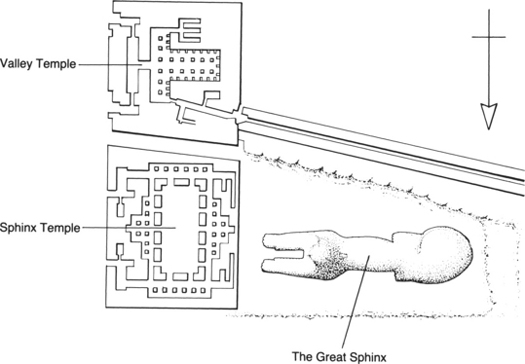
The Sphinx and the Sphinx Temple with the Valley Temple of Khafre.
Lord of Rostau
I now moved around to the entrance of the Valley Temple, located near the northern end of the 43-foot high eastern wall. Here I saw that the granite facing was still in perfect condition, consisting of huge slabs weighing between 70 and 80 tons apiece which protected the underlying limestone core blocks like a suit of armour. Incorporating a tall, narrow, roofless corridor, this dark and imposing portal ran east to west at first, then made a right-angle turn to the south, leading me into a spacious antechamber. It was here that the lifesize diorite statue of Khafre had been found, upside down and apparently ritually buried, at the bottom of a deep pit.
Lining the entire interior of the antechamber was a majestic jigsaw puzzle of smoothly polished granite facing blocks (which continued through the whole building). Exactly like the blocks on some of the bigger and more bizarre pre-Inca monuments in Peru, these incorporated multiple, finely chiselled angles in the joints and presented a complex overall pattern. Of particular note was the way certain blocks wrapped around corners and were received by re-entering angles cut into other blocks.
From the antechamber I passed through an elegant corridor which led west into a spacious T-shaped hall. I found myself standing at the head of the T looking further westwards along an imposing avenue of monolithic columns. Reaching almost 15 feet in height and measuring 41 inches on each side, all these columns supported granite beams, which were again 41 inches square. A row of six further columns, also supporting beams, ran along the north-south axis of the T; the overall effect was of massive but refined simplicity.
What was this building for? According to the Egyptologists who attributed it to Khafre its purpose was obvious. It had been designed, they said, as a venue for certain of the purification and rebirth rituals required for the funeral of the pharaoh. The Ancient Egyptians themselves, however, had left no inscriptions confirming this. On the contrary, the only written evidence that has come down to us indicated that the Valley Temple could not (originally at any rate) have had anything to do with Khafre, for the simple reason that it was built before his reign. This written evidence is the Inventory Stela, (referred to in Chapter Thirty-five), which also indicated a much greater age for the Great Pyramid and the Sphinx.
What the Inventory Stela had to say about the Valley Temple was that it had been standing during the reign of Khafre’s predecessor Khufu, when it had been regarded not as a recent but as a remotely ancient building. Moreover, it was clear from the context that it was not thought to have been the work of any earlier pharaoh. Instead, it was believed to have come down from the ‘First Time’ and to have been built by the ‘gods’ who had settled in the Nile Valley in that remote epoch. It was referred to quite explicitly as the ‘House of Osiris, Lord of Rostau’14 (Rostau being an archaic name for the Giza necropolis).15
As we shall see in Part VII, Osiris was in many respects the Egyptian counterpart of Viracocha and Quetzalcoatl, the civilizing deities of the Andes and of Central America. With them he shared not only a common mission but a vast heritage of common symbolism. It seemed appropriate, therefore, that the ‘House’ (or sanctuary, or temple) of such a wise teacher and lawgiver should have been established at Giza within sight of the Great Pyramid and in the immediate vicinity of the Great Sphinx.
Vastly, remotely, fabulously ancient
Following the directions given in the Inventory Stela – which stated that the Sphinx lay ‘on the north-west of the House of Osiris’16 – I made my way to the north end of the western wall that enclosed the Valley Temple’s T-shaped hall. I passed through a monolithic doorway and entered a long, sloping, alabaster floored corridor (also oriented north-west) which eventually opened out on to the lower end of the causeway that led up to the Second Pyramid.
From the edge of the causeway I had an unimpeded view of the Sphinx immediately to my north. As long as a city block, as high as a six-storey building it was perfectly oriented due east and thus faced the rising sun on the two equinoctial days of the year. Man-headed, lion-bodied, crouched as though ready at last to move its slow thighs after millennia of stony sleep, it had been carved in one piece out of a single ridge of limestone on a site that must have been meticulously preselected. The exceptional characteristic of this site, as well as overlooking the Valley of the Nile, was that its geological make-up incorporated a knoll of hard rock jutting at least 30 feet above the general level of the limestone ridge. From this knoll the head and neck of the Sphinx had been carved, while beneath it the vast rectangle of limestone that would be shaped into the body had been isolated from the surrounding bedrock. The builders had done this by excavating an 18-foot wide, 25-foot deep trench all around it, creating a free-standing monolith.
The first and lasting impression of the Sphinx, and of its enclosure, is that it is very, very old – not a mere handful of thousands of years, like the Fourth Dynasty of Egyptian pharaohs, but vastly, remotely, fabulously old. This was how the Ancient Egyptians in all periods of their history regarded the monument, which they believed guarded the ‘Splendid Place of The Beginning of all Time’ and which they revered as the focus of ‘a great magical power extending over the whole region’.17
This, as we have already seen, is the general message of the Inventory Stela. More specifically, it is also the message of the ‘Sphinx Stela’ erected here in around 1400 BC by Thutmosis IV, an Eighteenth Dynasty pharaoh. Still standing between the paws of the Sphinx, this granite tablet records that prior to Thutmosis’s rule the monument had been covered up to its neck in sand. Thutmosis liberated it by clearing all the sand, and erected the stela to commemorate his work.18
There have been no significant changes in the climate of the Giza plateau over the last 5000 years.19 It therefore follows that throughout this entire period the Sphinx enclosure must have been as susceptible to sand encroachment as when Thutmosis cleared it – and, indeed, as it still is today. Recent history proves that the enclosure can fill up rapidly if left unattended. In 1818 Captain Caviglia had it cleared of sand for the purposes of his excavations, and in 1886, when Gaston Maspero came to re-excavate the site, he was obliged to have it cleared of sand once again. Thirty-nine years later, in 1925, the sands had returned in full force and the Sphinx was buried to its neck when the Egyptian Service des Antiquités undertook its clearance and restoration once more.20
Does this not suggest that the climate could have been very different when the Sphinx enclosure was carved out? What would have been the sense of creating this immense statue if its destiny were merely to be engulfed by the shifting sands of the eastern Sahara? However, since the Sahara is a young desert, and since the Giza area in particular was wet and relatively fertile 11,000–15,000 years ago, is it not worth considering another scenario altogether? Is it not possible that the Sphinx enclosure was carved out during those distant green millennia when topsoil was still anchored to the surface of the plateau by the roots of grasses and shrubs and when what is now a desert of wind-blown sand more closely resembled the rolling savannahs of modern Kenya and Tanzania?
Under such congenial climatic conditions, the creation of a semi-subterranean monument like the Sphinx would not have outraged common sense. The builders would have had no reason to anticipate the slow desiccation and desertification of the plateau that would ultimately follow.
Yet, is it feasible to imagine that the Sphinx could have been built when Giza was still green – long, long ago?
As we shall see, such ideas are anathema to modern Egyptologists, who are nevertheless obliged to admit (to quote Dr Mark Lehner, director of the Giza Mapping Project) that ‘there is no direct way to date the Sphinx itself, because the Sphinx is carved right out of natural rock.’21 In the absence of more objective tests, Lehner went on to point out, archaeologists had ‘to date things by context’. And the context of the Sphinx, that is, the Giza necropolis – a well-known Fourth Dynasty site – made it obvious that the Sphinx belonged to the Fourth Dynasty as well.22
Such reasoning was not regarded as axiomatic by Lehner’s distinguished predecessors in the nineteenth century, who were at one time convinced that the Sphinx long predated the Fourth Dynasty.
Whose Sphinx is it anyway?
In his Passing of Empires, published in 1900, the distinguished French Egyptologist Gaston Maspero, who made a special study of the content of the Sphinx Stela erected by Thutmosis IV, wrote:
The stela of the Sphinx bears, on line 13, the cartouche of Khafre in the middle of a gap … There, I believe, is an indication of [a renovation and clearance] of the Sphinx carried out under this prince, and consequently the more or less certain proof that the Sphinx was already covered with sand during the time of Khufu and his predecessors …23
The equally distinguished Auguste Mariette agreed – naturally enough since he had been the finder of the Inventory Stela (which, as we have seen, asserted matter-of-factly that the Sphinx was standing on the Giza plateau long before the time of Khufu).24 Also generally concurring were Brugsch (Egypt under the Pharaohs, London, 1891), Petrie, Sayce and many other eminent scholars of the period.25 Travel writers such as John Ward affirmed that ‘the Great Sphinx must be numberless years older even than the Pyramids’. And as late as 1904 Wallis Budge, the respected keeper of Egyptian Antiquities at the British Museum, had no hesitation in making this unequivocal assertion:
The oldest and finest human-headed lion statue is the famous ‘Sphinx’ at Giza. This marvellous object was in existence in the days of Khafre, the builder of the Second Pyramid, and was, most probably, very old even at that early period … The Sphinx was thought to be connected in some way with foreigners or with a foreign religion which dated from predynastic times.26
Between the beginning and the end of the twentieth century, however, Egyptologists’ views about the antiquity of the Sphinx changed dramatically. Today there is not a single orthodox Egyptologist who would even discuss, let alone consider seriously, the wild and irresponsible suggestion, once a commonplace, that the Sphinx might have been built thousands of years before Khafre’s reign.
According to Dr Zahi Hawass, for example, director of Giza and Saqqara for the Egyptian Antiquities Organization, many such theories have been put forward but have ‘gone with the wind’ because ‘we Egyptologists have solid evidence to state that the Sphinx is dated to the time of Khafre.’27
Likewise, Carol Redmont, an archaeologist at the University of California’s Berkeley campus, was incredulous when it was suggested to her that the Sphinx might be thousands of years older than Khafre: ‘There’s just no way that could be true. The people of that region would not have had the technology, the governing institutions or even the will to build such a structure thousands of years before Khafre’s reign.’28
When I first started to research this issue, I had assumed, as Hawass appeared to claim, that some incontrovertible new evidence must have been found which had settled the identity of the monument’s builder. This was not the case. Indeed there are onlythree‘contextual’ reasons why the construction of the anonymous, uninscribed and enigmatic Sphinx is now so confidently attributed to Khafre:
1 Because of the cartouche of Khafre on line 13 of the Sphinx Stela erected by Thutmosis IV: Maspero gave a perfectly reasonable explanation for the presence of this cartouche: Thutmosis had been a restorer of the Sphinx and had paid due tribute to an earlier restoration of the monument – one undertaken during the Fourth Dynasty by Khafre. This explanation, which bears the obvious implication that the Sphinx must already have been old in Khafre’s time, is rejected by modern Egyptologists. With their usual telepathic likemindedness they now agree that Thutmosis put the cartouche on to the stela to recognize that Khafra had been the original builder (and not a mere restorer).
Since there had only ever been this single cartouche – and since the texts on either side of it were missing when the stela was excavated, is it not a little premature to come to such hard-and-fast conclusions? What sort of ‘science’ is it that allows the mere presence of the cartouche of a Fourth Dynasty pharaoh (on a stele erected by an Eighteenth Dynasty pharaoh) to determine the entire identification of an otherwise anonymous monument? Besides, even that cartouche has now flaked off and cannot be examined …
2 Because the Valley Temple next door is also attributed to Khafre: That attribution (based on statues which may well have been intrusive) is shaky to say the least. It has nevertheless received the wholehearted endorsement of the Egyptologists, who in the process decided to attribute the Sphinx to Khafre too (since the Sphinx and the Valley Temple are so obviously connected).
3 Because the face of the Sphinx is thought to resemble the intact statue of Khafre found in the pit in the Valley Temple: This, of course, is a matter of opinion. I have never seen the slightest resemblance between the two faces. Nor for that matter had forensic artists from the New York Police Department who had recently been brought in to do an Identikit comparison between the Sphinx and the statue29 (as we shall see in Part VII).
All in all, therefore, as I stood overlooking the Sphinx in the late afternoon of 16 March 1993, I considered that the jury was still very much out on the correct attribution of this monument – either to Khafre on the one hand or to the architects of an as yet unidentified high civilization of prehistoric antiquity on the other.30 No matter what the current flavour of the month (or century) happened to be with the Egyptologists, the fact was that both scenarios were plausible. What was needed, therefore, was some completely hard and unambiguous evidence which would settle the matter one way or the other.