
2
Carlo Natali
2.1 Preambles in Isocrates and Plato
The custom of announcing the theme of a work in a preamble or opening sentence(s) is as old as Greek literature; it begins with the Homeric epics, as Mansfeld says.1 But for the moment, we are interested in considering how preambles are used by authors of the 4th century bc, such as Isocrates, Plato, and Aristotle. We will limit ourselves to the passages that they explicitly identify as prooimia, and will not consider additional passages that we, based on our own criteria, might describe as “proems.”
In Isocrates we find some indication of how he conceives of preambles, and we can gain some insight from what he says about their relationship to the main part of a speech.
He speaks about preambles three times (Panath. 33, Paneg. 13, Antid. 71). In the Panathenaicus, he says that
I perceive that I am being carried beyond the due limits which have been assigned to a preamble
(XII, 33)
In the Antidosis, he describes his own speech To Nicocles, saying:
In the preamble and in the opening words of that discourse I reproach monarchs because they, who more than others ought to cultivate their understanding, are less educated than men in private station. After discussing this point, I enjoin upon Nicocles not to be easy-going.
(XV, 71)
From his references to other parts of his writings, we can identify those passages that Isocrates considers to be preambles: Panathenaicus 1–33 and To Nicocles 1–7. In both of these passages, Isocrates speaks about himself: in the first, he complains about the abuses of his calumniators and defends his kind of paideia; in the second, he explains to Nicocles that his speech is the finest, the most serviceable present, and also the most suitable for him to give and for Nicocles to receive. We have here a sort of capitatio benevolentiae.
All the same, in the Panegyricus he criticizes the preambles of other authors (IV, 13). He blames his contemporaries because they employ the preamble to
seek to conciliate their hearers and make excuses for the speeches that they are about to deliver
(IV, 13)
It is strange that Isocrates considers this to be a flaw since he does the same.
Blass observes that for Isocrates the most important part of a speech is the conclusion, where the main arguments are exposed (Panath. 176 and 199; cf. Blass, 1874, p. 102). He thinks that the preamble is just an introductory section, useful for obtaining the good will of the audience. In this respect, Isocrates is not very original, since from the beginning the preambles in ancient Greece had the function of establishing the credibility of the speaker, by exposing some personal elements of his life, and making the audience well disposed towards him (Cappuccino, 2014, p. 8).
In Plato, “prooimion” is first of all a common term used by the participants in the dialogues and has no technical sense. We can certainly say that it does not refer to the dialogue itself as a written work, because the characters who utter the word don’t know they are in a dialogue written by Plato. It refers to the first parts of the dialogue as an event experienced by them and not as a written work; for this reason, it is possible that what is described as a preamble does not coincide with the beginning of the work. This is the case, for example, of the Symposium, of the Parmenides, and the so-called narrated dialogues.2
Sometimes the term simply indicates the first part of a discussion, as in the Republic 432e. It acquires a more technical meaning in the late dialogues, e.g. in the Laws and the Timaeus. In the Laws, the Athenian Stranger proposes to add preambles to the various laws. In this case, they serve the function of persuading the citizens of the new polis to follow the prescriptions given by the legislators. They perform this function in two ways. On the one hand, the preambles use rhetorical and poetic devices to impress upon the feeling of the hearers in order to produce pistis; on the other hand, they want to teach the public, as an educated doctor does when persuading the patient to follow his precepts (857d).3 The most recent scholars have distinguished three main types of this kind of preamble in the Laws: some promote their laws by means of rational argumentation, e.g. the proems to the laws against asebeia (891b–897d); others praise or blame some kind of behaviour (843a, etc.); others again make reference to a divine sanction and advise the citizens not to offend the gods, as in the laws against incest (838b). This is to be connected, as many scholars have remarked, to the idea of a healthy rhetoric in the Phaedrus.4
Apart from such particular preambles, which aim at convincing their specific audience – the citizens of Magnesia – more generally, we see that the late Plato considers a preamble to be a part of the dialogue in which he can introduce some important premises of the discussion. Thus, the Athenian Stranger says that the discussion contained in the first five books of the Laws is the preamble to the legislation, which is the main subject matter of the dialogue: “everything we have said up till now has been simply a legislative preamble” (722d). In the same vein, shortly after Timaeus has begun his speech in the eponymous dialogue, Socrates interrupts and refers to the description that Timaeus has just given of the main genera of being – that which always is and that which becomes – and the fact that the cosmos is an image of something (27d–29c), as a preamble:
Excellent, Timaeus! We must by all means accept it, as you suggest; and certainly we have most cordially accepted your preamble; so now, we beg of you, proceed straight on with the main theme
(29d)
In sum, at times Plato uses the word prooimoin to indicate the first part of a discussion in which the main premises are established and the fundamental concepts in an inquiry are analyzed. This, however, is not confined to the first lines of a dialogue, but it can be described in larger passages. Thus, the prooimoia are not merely identical with the introductory lines of the dialogues.
Sometimes, those introductory pieces can be misleading. For instance, on the basis of the opening lines, a reader of the Timaeus would be justified in expecting to read a dialogue on matters of government (20b). However, it is only after having read some pages that such a reader discovers that, instead, what he will get is a very long speech by Timaeus about the origin of the cosmos and the nature of human beings (27a).
This point is addressed in a well-known polemic by Aristotle against Plato. Aristotle criticizes Plato’s habit of not explaining clearly the real theme of his lecture. The testimony is given by Aristoxenus, in his Elementa harmonices II 1:
It will be better, perhaps, to review in anticipation the kind of our treatise … in order not to have a false idea of our subject. Such was the condition, as Aristotle often used to relate, of most of the audience that attended Plato’s lecture On the Good … It was for these very reasons, as he told us, that Aristotle himself used to give to those who were going to listen to him (tois mellousin akroasthai par’autou) a preamble indicating the subject and the method of his treatise
(peri tinôn t’estin ê pragmateia kai tis).
2.2 Aristotelian Preambles: The Rhetoric
Aristotle uses the term prooimion a few times in his corpus. In the Categories it is used simply as an example of taxis: the prooimion is prior to the diêgesis (12, 14b3). More important is the discussion in the Rhetoric. In book III.14, he distinguishes two types of preambles. The first is like a prelude in flute playing: the players make an introduction ad libitum, to show how good they are, and only after that do they play the rhythm. This preamble is typical of encomia, such as Isocrates’ Helen (Hel. 1–13). The second type of preamble, on the other hand, is typical of forensic speeches and epic poems.
It aims to provide a sample of the subject, in order that the hearers may know beforehand what it is about … he who puts the beginning, so to say, into the hearer’s hand enables him, if he holds fast to it, to follow the logos
(1415a12–15)
In addition to these two main types, Aristotle also discusses other kinds of preambles in Rhetoric III.14. There are preambles that work as remedies when the audience is inattentive, or is unfavourably disposed, and the like (Cope-Sandys, 1877, p. 169). In these cases, the purpose of the preamble is to generate a positive disposition in the audience towards the speaker, as in Isocrates’ prologues, or to stimulate the indignation of the audience, or to awaken their attention, or to extinguish it.
Aristotle’s analysis is closely connected to the practices of the law courts and is difficult to extend to other fields. However, some of his remarks have a general impact, for example, the idea that in a logos directed to any audience there must be a preamble that makes a summary statement of the subject, so that, like a body, it may have a head (1415b8–10); and also the suggestion that the absence of such a preamble, “makes the speech appear offhand” (1415b36). Aristotle’s comments here are evidently about rhetorical logoi and not about his treatises, but he clearly thinks highly of the idea of giving the audience, at the very beginning of a speech, a hint of the content of that speech, and he criticizes Plato for not always doing that, as we have seen.
Aristotle often simply explains, at the beginning of a work, what the intention and utility of the treatise is (e.g. Top. 100a18, 101a25; A. Po. 24a10, etc.). In some passages, he explicitly uses the verb prooimiazomai to describe what he is doing, and in those cases he uses the rhetorical term in a slightly metaphorical way, because he obviously is not doing forensic or epideictic speeches. Such uses can be found in treatises on practical philosophy, such as the Politics and the two Ethics, but there is also an example from the Metaphysics. Let’s examine them briefly.
2.3 Politics
In Politics VII, we find a preamble. It begins at VII.1, but it is not clear where it ends, because we have two passages in which Aristotle says “This may suffice as preface” at VII.1, 1323b37, referring to VII.1, and at VIII.4, 1325b33, referring to VII.1–3. This may be a sign that the book was revised, as Schütrumpf (2005, IV p. 293) aptly notes.
Aristotle expresses some of his views on the better life, happiness, and related issues, summarizing what he has said in the exoterikoi logoi (1323a22–3). His exposition does not imply that the audience already has any knowledge of Aristotle’s philosophy, and it is a very simplified version of what we find in Nicomachean Ethics (NE) I or Eudemian Ethics (EE) I–II. Aristotle does not define virtue or happiness, but uses popular ideas, such as the distinction of three kinds of human good (of the soul, of the body, external, 1323a23–5) and two kinds of good life (political and contemplative, 1324a14–17). He also discusses whether the best life for the city is identical to the best life for the individual, and says that it is (1326a30–32).
The first half of the 20th century saw a protracted debate among scholars on the topic of which of his published work is Aristotle drawing his material from, with no clear solution. In any case, it is clear that the aim of the preamble is to present to a non-philosophical public some basic points of Aristotle’s ethics, in order to give a standard in relation to which one may judge how the best polis should be organized (Schütrumpf, 2005, IV p. 83).
The style of the preamble is not very different from the style of the rest of books VII and VIII, and this entire section of the Politics has some exoteric flavour. Since the 19th century, scholars have noted that in Politics VII–VIII Aristotle follows Isocrates in avoiding hiatus, as Plato does in his Timaeus and Laws (Blass, 1874, p. 130). According to Kaibel, Aristotle’s style is influenced not only by Isocrates’ stylistic prescriptions, but also – as one might expect – by Plato’s style:
mutet … der kunstvolle, figurenreiche Satzbau, die breitere, gefälligere, wärmere Tonart die manchmal auf Platon erinnert
(Kaibel, 1893, p. 113)
Schütrumpf has studied the style of these two books extensively. He observes that, in addition to avoiding hiatus, they have many further rhetorical refinements. There are homoteleuta, balanced reciprocal phrases (“Sometime the right end is set before men/but in practice they fail to attain it,” 1331b19, cf. b21, 1333b15, 1341a8, etc.). We find opposing concepts placed side by side, connections between different forms of the same word (“they alone trained against people who did not train [tôi monous mê pros askounta askein]”). We have here extreme examples, succinct parallels, sarcasm, rhetorical questioning, anecdotes, ethnographic details, legends, and many other means of keeping the attention of the hearers. Schütrumpf and Newman even suppose that books VII–VIII were intended to be published.5
So, regarding the content, the preamble of the final books of the Politics prepares the audience for the subsequent analysis of the best state by giving them a simplified version of the basic concepts of Aristotle’s practical philosophy, asking some preliminary and general questions, and in general setting the scene for what will follow. In this way, it accomplishes the task of the preamble that Aristotle identifies in the Rhetoric, i.e. to tell the audience what the subject that will be discussed is, and the way in which it will be discussed. As for the style, there is no difference between Politics VII 1–3 and the rest of the two final books of the Politics; they are all written in an audience-friendly style.
2.4 Metaphysics
It may come as a surprise to the modern reader that the whole book A of the Metaphysics should be considered a preamble. In fact, in Metaphysics A we find some of the most important theories of the treatise: the presentation of the idea of wisdom as a science of causes and principles, and the history of the progressive discovery of the four causes by Aristotle’s predecessors, accompanied by a long criticism.
People are justified in having missed the preamble status of Metaphysics A, because the passage in which Aristotle refers to it as a preamble is not in A itself, but in book B, and book B, in the form in which we have the work, does not immediately follow book A, but it follows book a, which has been inserted at a later time between A and B. So, in general, those scholars who are interested in A typically simply ignore the words of B:
The first aporia concerns the subject which we discussed in our preamble
(en tois prephromiasmenois, 995b5).
The reference is clearly to book A. Ross has nothing to say about it; Bonitz is happy to call Metaphysics a proemium, but provides no further discussion of the term; Owens does the same.6 Menn says that “A is certainly the introduction to a treatise on wisdom” (Ia5, p. 8).7
But hardly anyone seems to have bothered to consider the sense in which A is a preamble. In the case of the Metaphysics, we do not have a full stylistic and content analysis comparable to that which Schütrumpf provided for the last books of the Politics. In general, some scholars consider book A to be already part of first philosophy (esp. Cooper, 2012), and do not consider the sense in which it is an introduction to it. Others seem to consider it to be an introduction, because Aristotle is raising, in nuce, some of his main concepts of first philosophy here (archai, sophia, but not protê philosophia). They use “introduction” in a rather loose sense, also referring to PA I and Politics I–II as “introductions.” Aristotle, however, does not refer to either of these texts as a prooimion.
We can find a useful tip in one of the contributions of Sarah Broadie. She provides a careful study of Metaphysics A 2 and says that in A 1–2 Aristotle indicates what his conception of philosophia is, in opposition to different and concurrent conceptions, such as Isocrates’ idea of philosophy as the construction of grand discourses about pan-Hellenic politics, on one side, and the reduction of Platonic dialect is to a kind of mathematization of the fundamental concepts of metaphysics by the Academia, on the other. Broadie says:
It is not so implausible that A 1-2 is, among other things, something of a cultural manifesto, claiming the word philosophia for studies as we get in the Metaphysics in face of Isocrates’ claiming it for his kind of activity … these chapters, in short, represent the contrary value of pure research as conducted according the most stringent standards of thoroughness and penetration.
(Broadie, 2012, p. 50)
To be sure, Aristotle reserves his defence of the bios theoretikos for the ethics, but in the proem of the Metaphysics he expresses his position in refined language, and in explicit opposition to his predecessors and to their theory of the causes. Even if we do not have a complete analysis of the style of Metaphysics A, in particular of A 1–3, it seems evident to me that Aristotle wrote this book in an elegant and relaxed style, very different from the compressed writing we find in books B–N, a style that Jaeger described as “das trockenen Tenor des aristotelischen Kollegstils” (Jaeger, 1912, p. 125). Book A is an example of what Jaeger describes as the dramatic changes in tone in the treatises in general and in the Metaphysics in particular:
Eben noch der gleichmäßige Gang der schulgemäßen Sprache … mit einem Mal schreitet die Rede im Prunkgewande feierlicher isokrateischer Perioden, geschmückt mit platonischer Bilderpracht, reich dahin. Hier will der Autor mit einem besonderen Gedanken auf das Auditorium starken Eindruck machen. … Da Aristoteles aber gehalten ist, wenn er schön schreiben will, nach dem Kunstgeschmack der zeitgenössischen, tonangebenden Prosaiker zu schreiben und zu stilisieren … Dann wendet sie die kataskeuê an, wo sie ihrer bedarf, bedient sich sämtlicher schêmata lexeôs, der dichterischen metaphora, der lexis katestrammenê, meidet den Hiat und bildet wohl gar einen klangvollen arithmos aus. Das nächste Kapitel zeigt sich vielleicht schon wieder von Kunstprosa gänzlich unberührt.
(Jaeger, 1912, pp. 136–137)
In the two texts from the Politics and the Metaphysics, which Aristotle explicitly describes as preambles, we find some common characteristics. They are both long texts, carefully written from a stylistic perspective, in which Aristotle expresses, in a general and preliminary way, some of the lines that he will pursue in more detail later about what sophia is, or what the best polis should look like.
2.5 Eudemian Ethics
Let’s now move to the preamble to the Eudemian Ethics. This text is divided into two sections: the first corresponds to the modern chapters EE I 1–5, and is aporetic; the second, EE I 6, is about the method one should follow in responding to the problems posed in the preceding chapters. From a stylistic point of view, Diels and Dirlmeier have remarked that the first chapters of the EE, as well as book VII of the Politics and book A of the Metaphysics, have a lofty tone. EE I 1–6 avoids hiatus and abounds in realistic details and metaphors, it uses poetic words such as anelpistos (1215a13), it uses a variety of terms, it employs Platonic turns of phrase (autous paraskeauzousi, 1215a19, cf. Plato Apol. 39d7), and so on.8
Let us now look at EE I 1–5. After rejecting an opinion inscribed on the temple at Delos, Aristotle begins by telling us that
about each kind and nature there are many considerations that raise problems and need investigation
(1214a9–10)9
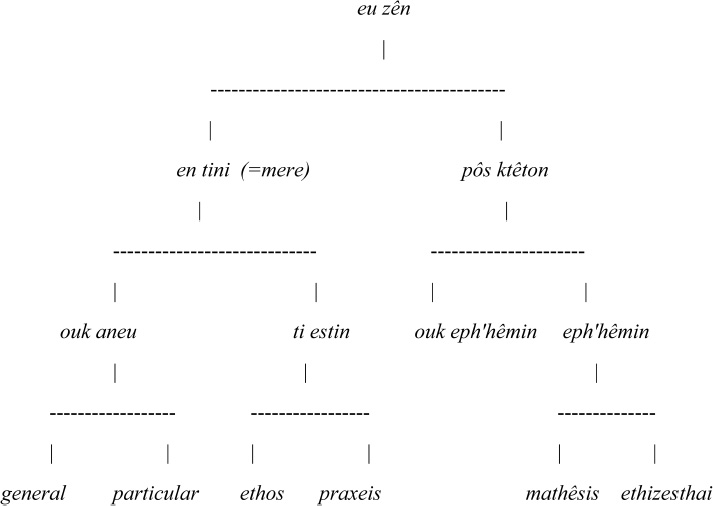
The questions to be asked can be divided into two main groups:
(1) what the good life consists in, and (2) how it is to be acquired (1214a15).10
These issues were also discussed in Plato’s Meno (100b4–6). After establishing what the two main problems are, Aristotle shows that some questions derive from them directly, as we will see. Aristotle does not randomly accumulate questions, but distinguishes the two main problems into sub-questions, and follows a clear pattern in multiplying them
(Bodeüs, 2017).
A warning is now necessary. Many people wrongly identify the question en tini estin with the question ti estin.11 An exception to this is von Fragstein (1974, p. 14), who rightly notes that the first question is only preliminary to the second and is answered using the opinions of common people, who do not have a proper definition of eudaimonia, but only a general idea of what eudaimonia involves. In other words, knowing what eudaimonia consists in can simply amount to recognizing some per se attributes of the thing, without grasping its essence. This corresponds to knowing something of an object X, as indicated in Posterior Analytics 93a22 (echontes ti autou tou pragmatos). It represents a necessary step in the process of finding a definition. This is also mentioned in the EE itself, in a passage which is very similar to that from the Analytics:
We must research in the same way as all people do in other matters, when they grasp something: we must endeavour by means of statements that are true but not clearly expressed to arrive at a result that is both true and clear. For our cognitive state is as if we knew that health is the best disposition of the body and that Coriscus is the darkest man in the market-place; for that is not to know what health is and who Coriscus is, but nevertheless to be in that state is a help towards knowing what is each of these things.
(EE 1220a15–22)12
With respect to question (1), what the good life consists in, Aristotle lists some opinions about the component parts of happiness: en trisi (1214a31–33). The things the good life consists in are identified with its parts (merê 1214b11–24): practical wisdom, virtue, and pleasure. After that, question (1) is specified by a further distinction between (1.1) what the good life is, and (1.2) the necessary conditions for it (1214b12–27). And again, a distinction is made within the necessary conditions: (1.2.1) conditions necessary for life in general, and (1.2.2) conditions necessary for a good life (1214b11–27). After a few lines, Aristotle raises question (1) again from another point of view, that is, by asking if (1.3) happiness consists only in having a soul of a certain character or if (1.4.) it is also necessary that our actions should be of a certain character (1215a20–25).
With respect to question (2), how to acquire it, i.e. what the sources of the good life and its origins (ex tinôn, 1215a9) are, Aristotle gives us a list of five possible ways to acquire it:
· phusei
· dia mathêseôs
· dia askêseôs (i.e. ethizesthai)
· daimoniai epinoiâi
· dia tuchên (1214a15–25)
But after a few lines, he reduces them to two, eliminating god’s influence, nature, and chance, because they do not depend on us, and we are only interested in sources that depend on us (1215a8–15). So, the main distinction is between that which depends on us, and that which does not.
We can summarize them in the following diagram. Here, I present a simplified schema:
The first section of the book has the same function as book B of the Metaphysics – to present a series of aporiai that define the field of research – but is better organized from a systematic point of view; in fact, there is no clear diairetic procedure in Metaphysics B, as there is in EE I 1–2.
After presenting the systematic list of problems, Aristotle begins looking for a solution. First of all, he examines the most important doxai. EE I 3–5 presents an extensive list and discussion of the opinions about ways of life (bioi). Aristotle distinguishes between the opinions of the hoi polloi, the masses, who do not deserve consideration (1214b28–1215a2), and the opinions of the sophoi, cultured people, who deserve to be examined (episkepsis). This will help to find the definition of happiness. In fact, he says:
Since every research has special problems related to it, it is clear that there are problems in regard to the highest life and the best mode of existence too; it is then well to examine those opinions, since the refutations of disputants are demonstrations of the logoi opposed to them.
(1215a3–7)13
The passage reminds us of a famous declaration in NE VII 1:
We must, as in other cases, keep to the phainomena and, after first discussing the difficulties, go on to demonstrate: by preference all the endoxa pertaining to these affections, or (failing this) the majority, and the most important. For if the difficulties are resolved and the endoxa remain in place the demonstration will have been sufficient.
(1145b2–7)14
There are, however, differences between the two passages, as we shall see.
According to Aristotle, it is useful to examine the hupolepseis of other people and refuse them, because it enables us to better see the path to follow in searching for the definition of happiness. The three components of happiness quoted above are now expanded into three different kinds of lives, as Rowe rightly notes (1971, 17), rather than the kinds of lives being reduced to these components, as Gigon (1971, 108) maintains. The transition from discussing the parts of happiness to comparing bioi is a good move, because within the concept of a bios, the qualities of the person and the qualities of his acting are connected. A bios includes both ethê and praxeis.
The relevant opinions are those of people who do not have to earn their lives but can freely choose how to live (1215a 36). They will choose either the political life, or the intellectual life, or the life of pleasure (1215b 1–2). The passage resembles the discussion of NE I 3, but in the NE it is the first step in finding the definition of happiness, while here it is still part of the preamble. I do not have the space here to consider this section in detail. I just want to underline that in the NE, as we will see, the discussion of contrasting opinions is part of the search for the definition of happiness, whereas at this point in the EE this is only a component of a preliminary discussion. It seems that in the EE, Aristotle wants to get rid of the section of the inquiry on endoxa about what happiness does consist in, before starting the philosophical inquiry proper. I will come back to this point.
At the end of I 5, Aristotle concludes the discussion of bioi and returns to the discussion of what happiness consists in, i.e. pleasure, virtue, wisdom:
About the pleasure connected with the body and with enjoyment, its nature and quality and the means that procure it, are not hard to see; so that it is not necessary for us to inquire what these pleasures are … let us first consider virtue and practical wisdom, what the nature of each is, and also whether they are parts of the good life, either themselves or the actions that spring from them, since that they are connected with happiness is asserted, if not by everybody, at all events by all of mankind who are worthy of consideration.
(1216a30–b2)15
None of the problems posed in 1214a1–b28 is solved in the preamble, because the solution depends on finding the definition of happiness. This is the main difference with the passage in NE VII 1. It is interesting to compare the passage 1216a30–b2 with the final part of the proem, EE I 6. There, Aristotle explains that an analysis of puzzles and a conservation of the main endoxa, such as the one he provides in NE VII, are not sufficient to get out of difficulty. The clarification in EE I 6 depends on finding the nature of the thing, because if we start from a definition, it will become easier to solve the problems. This passage introduces the content of EE I 6, which is dedicated to the method to be followed.
EE I 6 has been widely discussed in recent years, and I do not have the space here to examine it in full. It is mainly polemical in character, and continues the criticism of previous thinkers, begun in I 5, with a criticism of Socrates’ theory (1216b2-1–16). The main idea is that much caution (polles eulabeias, 1216b40) is required in the search for truth in political matters, because there are authors who have arrived at wrong positions. They correctly understand that in practical matters, as well as in theoretical inquiries, a philosophical approach is required, and it is necessary to explain the nature and the causes of virtue and phronêsis, but they present idle and inappropriate arguments, either through ignorance or vanity (1217a2–4); their arguments have no practical impact nor can they organize action with a wide constructive approach (a6–7). The practical politicians, as it happens, believe the arguments of such people, because they do not know the rules of argument and do not know how to distinguish appropriate arguments from extraneous ones.16
The error can be twofold. In fact, there is a need not only to judge the result of an argument in the light of phainomena, but also to consider whether the right conclusion has been reached with a wrong middle term, i.e. by mentioning an extraneous cause.17 So, the error can be relative to the hoti and/or to the dioti. To avoid the first kind of error, the philosopher must start from examples and the opinions of people as evidence. This is the typical Aristotelian method, starting from things said in an obscure way in order to arrive at clear judgements. We find it in the Physics and in many other works.18 People can come to see the truth clearly if philosophers persuade them to change their positions (metabibazomenoi, 1216b30) to the extent necessary for this (zêtein tên pistin, 1216b36). What is peculiar in this passage is that here, as in Metaphysics α 1, it is said that everybody has some affinity with the truth (oikeion ti pros tên alêtheian, 1216b31, cf. Metaph. 993a31–b5). It is an element that creates a bridge between dialectic and science, against the position of modern scholars who distinguish sharply between the two.
This passage brings together elements from the dialectical procedure, i.e. the idea of starting from the opinions of the audience in order to modify those opinions, and elements from the theory of definition in the Posterior Analytics, i.e. the distinction between the hoti and dioti. It is not strange that scholars diverge widely on the interpretation of this passage.19 In my view, we have here a clear indication that Aristotle feels free to employ dialectical arguments and procedures in a framework largely inspired by the doctrine of the Analytics, which are explicitly quoted here.
2.6 Nicomachean Ethics
Let us now consider the proem to the NE. At first glance, this proem has three distinguishing features: it is much shorter than the others, it addresses the question of the kind of public that can benefit by listening to the lectures that constitute the NE, and it concludes with a summary.
Let’s examine each of these differences in turn. The preamble to the NE is much shorter than the preamble to the EE, because Aristotle shifts much of the material in the EE preamble to the main discussion of NE. The clearest example is the quotation of the Delic inscription that opens the first chapter of the EE (1214a5–6), which is moved to the final part of book I of the NE (1099a27–28). This is a result of the different general characters of the two preambles. As Richard Bodeüs has shown in an excellent recent contribution (Bodeüs, 2017), the proem to the EE is dialectical in many ways. It opens with a criticism (hêmeis d’auotôi mê sunchôrômen, “Let us disagree with him” 1214a7); it asks questions and describes every possible aporia and problem about happiness; it has a distinctive “philosophical” flavour and never speaks about politics. On the other hand, in the NE we find the material used in the proem of the EE after the definition of happiness with the aim of confirming that definition. That which in the EE was the material of one or more aporiai is used in the NE as material for “confirmative” dialectics, a usage of endoxa typical of many Aristotelian discussions (see e.g. Phys. I 8–9).
The proem to the NE proceeds towards the definition of happiness with no hesitation or doubt. In an authoritative way, Aristotle presents a number of theses about the human good and the validity, for the most part, of human judgements. He never says that his work has a philosophical character; on the contrary, he insists that the search he is beginning is a political one. He wants his audience to understand how important the theory he is about to articulate is for the life of the Athenian citizen. This is why he warns the audience that he is speaking to a mature audience and not one composed of youngsters:
Because of that, a young man is not an appropriate student of political science, for he is inexperienced in the actions that occur in life, but its discussions start from these and are about these; and, further, since he tends to follow his emotions, his study will be vain and unprofitable.
(1095a25)20
The general impression is that Aristotle’s intent is to gain the attention and favour of the audience. This resembles how Isocrates would have written a proem, but in NE Aristotle accomplishes this with greater philosophical depth.
I think that the NE is addressed to a public of free citizens, who are not already dedicated to philosophia or to a philosophikos bios, and because of this, Aristotle does not want to raise doubts in his audience towards his proposal about what should be considered to be the best human good. This is why he does not employ his usual tactic of accumulating aporiai at the beginning of a logos, but instead he insists on the importance and interest of his proposal. He also underlines the practical aspect of his research. He says that our aim is not only to arrive at knowledge of what the human good is, but also to become better (1095a6; 1103b26–29; 1179a35–b4).
Lastly, let us consider the final summary of the preamble (1095a12–13). It is typical for Aristotle to present a summary in the first books of the NE. Aristotle alerts the audience to the main shifts in his argument and describes how the argument develops. This indicates that Aristotle wants to help the audience follow his reasoning, and that he clearly has little faith in the ability of the typical Athenian citizen to follow lengthy demonstrations. This is why he repeats phrases such as
· Let us then resume the argument (1095a13) and
· But let us return to the point from which we digressed (1095b14).
In the NE, Aristotle wants his arguments to be convincing, that is, to inspire pistis. In the EE, on the other hand, he doesn’t need to do that quite so much. I think that the fact that the two treatises are aimed at different audiences is the best explanation of the difference between the two preambles, and, indeed, of the difference between Aristotle’s two treatises on Ethics, in general.
From a stylistic point of view, the situation in NE I–IV and in Politics VII–VIII looks very similar. Aristotle addresses his speech to a non-philosophical audience, and because of that he writes in an elegant and polished style. There is no difference between the proem and the ensuing treatise, in the NE and in Politics VII–VIII; instead, there is a remarkable difference between the proem and the ensuing treatise in the EE and the Metaphysics.
2.7 Conclusion
Let’s take stock. Among the three authors considered there is a substantial difference between Isocrates, on the one hand, and Plato and Aristotle on the other. But there are also minor differences between Plato and Aristotle.
For Isocrates, the most important part of a speech seems to be the conclusion. In the proem, he tries to ingratiate himself with the audience by talking about himself and his enemies. He complains about calumnies and underlines the importance of the subject matter of the speech.
Plato’s characters sometimes use the word prooimion and seem to place much importance on it. In the late dialogues, the proem seems to contain the basic notions upon which an extensive presentation is erected, be it the description of the cosmos in the Timaeus, or the entire legislation of Magnesia in the Laws. The proem contains some basic elements, but not the detail and the refinement of a doctrine.
In Aristotle, as in Isocrates, the term prooimion is used by the author when speaking about his own logos, and not by the characters in a fictional dialogue. Aristotle places the proem at the beginning of a work, because he thinks that it is important to be clear with the audience what the logos is about. From the point of view of style, Aristotle’s proems are always very elegant and carefully written, avoiding hiatus. From this point of view, we can see some influence of Isocrates on Aristotle. In some cases, such as in Politics VII–VIII and in NE I, the prologues share this type of style with the logos they introduce. In other cases, as in the Metaphysics and in the Eudemian Ethics they stand in sharp contrast to the scholastic prose of the main part of the work. In this case, scholars have suspected that Aristotle was using sections of his exoterikoi logoi. This may be the case, but not without some elaboration and adaptation: e.g. in Politics VII 1, 13123a22–23, he refers to the exoterikoi logoi as something different from the present speech, VII 1.
In general, the Aristotelian way of writing preambles is more similar to Plato’s than to Isocrates’, which shouldn’t come as a surprise, but in the NE he uses some Isocratean tricks, the captatio benevolentiae. Even in the NE, however, this is not the main point of the piece.
Does Aristotle agree with Plato that it is best to present the basic notions of his treatise in the prooimion? Yes and no. In reality, in his preambles Aristotle describes, only in a very general way, the issues he wants to discuss, and gives the audience just a hint of the direction he wants to take. Nothing very decisive is presented in the prooimia. In my view, this is explained by Aristotle’s customary procedure in his treatises, starting from a universal and vague description of the subject and working towards a more precise description of its nature. This is the way in which Aristotle proceeds in the Physics, the Ethics, and the Metaphysics too. So, at the beginning we have some true but unclear statements, and only after much discussion do we arrive at a definition that is true and clear per se and not only to us. In Plato, on the contrary, some basic points are clearly established in the preambles.
In any case, it is interesting to note that in all the cases examined here, Aristotle’s prefaces are elegant and general introductions to a given philosophical inquiry, which may, or may not, be written in a more scientific way.21
Notes
1. Mansfeld, 1994, p. 195. On preambles in Greek literature in general see also the essays collected by Dunn and Cole, 1992.
2. I will discuss here only the passages explicitly referred to as “proemia” by Plato’s characters. The question of the function and relevance of Plato’s beginnings in general is widely discussed. See Cappuccino, 2014 for a general assessment of the question and a very wide bibliography.
3. Cf. Ritter, 1896, p. 48; Gastaldi, 1984, Cappuccino, 2014, p. 6.
4. Laks, 1995, p. 53; Schöpsdau, 2003, pp. 223–225.
5. Newman, 1887, I p. 297; Schütrumpf, 2005, IV pp. 87–88.
6. Bonitz, 1849, p. 139; Crubellier, 2009, p. 47; Owens, 1951, p. 157.
7. See https://www.philosophie.hu-berlin.de/de/lehrbereiche/antike/mitarbeiter/menn/texte/ia5.
8. Diels, 1894, p. 226; Dirlmeier, 1962, p. 75.
9. πολλῶν δ’ ὄντων θεωρημάτων ἃ περὶ ἕκαστον πρᾶγμα καὶ περὶ ἑκάστην φύσιν ἀπορίαν ἔχει καὶ δεῖται σκέψεως.
10. ἐν τίνι τὸ εὖ ζῆν καὶ πῶς κτητόν.
11. Dirlmeier, 1962, p. 147, Gigon, 1971, p. 98, Décarie, 1978, p. 46, Kenny, 1978, p. 191, and others.
12. δεῖ δὴ ζητεῖν ὥσπερ ἐν τοῖς ἄλλοις ἔχοντές τι ζητοῦσι πάντες, ὥστε ἀεὶ διὰ τῶν ἀληθῶς μὲν λεγομένων οὐ σαφῶς δὲ πειρᾶσθαι λαβεῖν καὶ τὸ ἀληθῶς καὶ σαφῶς. νῦν γὰρ ὁμοίως ἔχομεν ὥσπερ ἂν <εἰδείημεν> καὶ ὑγίειαν, ὅτι ἡ ἀρίστη διάθεσις τοῦ σώματος, καὶ Κορίσκος ὁ τῶν ἐν τῇ ἀγορᾷ μελάντατος· τί μὲν γὰρ ἑκάτερον τούτων οὐκ ἴσμεν, πρὸς μέντοι τὸ εἰδέναι τί ἑκάτερον αὐτῆς πρὸ ἔργου τὸ οὕτως ἔχειν. At line 1220a18 I supply εἰδείημεν with Spengel and Donini, 1999.
13. ἐπεὶ δ’ εἰσὶν ἀπορίαι περὶ ἑκάστην πραγματείαν οἰκεῖαι, δῆλον ὅτι καὶ περὶ βίου τοῦ κρατίστου καὶ ζωῆς τῆς ἀρίστης εἰσίν. ταύτας οὖν καλῶς ἔχει τὰς δόξας ἐξετάζειν· οἱ γὰρ τῶν ἀμφισβητούντων ἔλεγχοι τῶν ἐναντιουμένων αὐτοῖς λόγων ἀποδείξεις εἰσίν (cf. De caelo 279b6–7: αἱ γὰρ τῶν ἐναντίων ἀποδείξεις ἀπορίαι περὶ τῶν ἐναντίων εἰσίν).
14. δεῖ δ’, ὥσπερ ἐπὶ τῶν ἄλλων, τιθέντας τὰ φαινόμενα καὶ πρῶτον διαπορήσαντας οὕτω δεικνύναι μάλιστα μὲν πάντα τὰ ἔνδοξα περὶ ταῦτα τὰ πάθη, εἰ δὲ μή, τὰ πλεῖστα καὶ κυριώτατα· ἐὰν γὰρ λύηταί τε τὰ δυσχερῆ καὶ καταλείπηται τὰ ἔνδοξα, δεδειγμένον ἂν εἴη ἱκανῶς.
15. τούτων δ’ ἡ μὲν περὶ τὰ σώματα καὶ τὰς ἀπολαύσεις ἡδονή, {καὶ} τίς καὶ ποία τις γίνεται καὶ διὰ τίνων, οὐκ ἄδηλον, ὥστ’ οὐτίνες εἰσὶ δεῖ ζητεῖν αὐτάς […] περὶ δ’ ἀρετῆς καὶ φρονήσεως πρῶτον θεωρήσωμεν, τήν τε φύσιν αὐτῶν ἑκατέρου τίς ἐστι, καὶ πότερον μόρια ταῦτα τῆς ἀγαθῆς ζωῆς ἐστίν, ἢ αὐτὰ ἢ αἱ πράξεις αἱ ἀπ’ αὐτῶν, ἐπειδὴ προσάπτουσιν αὐτὰ κἂν εἰ μὴ πάντες εἰς τὴν εὐδαιμονίαν, ἀλλ’ οὖν οἱ λόγου ἄξιοι τῶν ἀνθρώπων πάντες.
16. I refer paschousi at line 1217a7 to oi empeiroi of line 5 and not to tines of line 1216b40.
17. Aristotle refers here to Prior Analytics 53b3–5 and to Posterior Analytics 88a20, Cf. NE 1142b22–4.
18. I 1, 184a16–23.Phys.
19. It is a method inspired by dialectic, according to Zingano, 2007 and Bodéüs, 2017, and contrary to the views of Karbowski, 2015 and Mendonça, 2017. In my opinion, there is an ambiguity in the use of the term “dialectical”; in one sense of the term the “dialectical” method can be used together with that of the Analytics.
20. διὸ τῆς πολιτικῆς οὐκ ἔστιν οἰκεῖος ἀκροατὴς ὁ νέος· ἄπειρος γὰρ τῶν κατὰ τὸν βίον πράξεων, οἱ λόγοι δ’ ἐκ τούτων καὶ περὶ τούτων· ἔτι δὲ τοῖς πάθεσιν ἀκολουθητικὸς ὢν ματαίως ἀκούσεται καὶ ἀνωφελῶς.
21. I would like to thank Dr Peter Larsen for correcting and improving my not very idiomatic English.
References
1. Blass, F., Die attische Beredsamkeit (2nd ed.). Leipzig: Teubner, 1874.
2. Bodeüs, R., Quelques singularités du prologue de l’Ethique à Eudème (paper delivered in a seminar in the Centre Léon Robin, 12.5.2017, unpublished).
3. Bonitz, H., Aristotelis Metaphysica. Commentarius. Bonn: Ad. Marcus, 1849.
4. Broadie, S., ‘A Science of First Principles’, inSteel, C. (ed.), Aristotle’s Metaphysics Alpha, Symposium Aristotelicum. Oxford: Oxford University Press, 2012, pp. 43–67.
5. Buddensieck, F., Die Theorie des Glücks in Aristoteles’ Eudemischer Ethik. Göttingen: Vandenhoeck & Ruprecht, 1999.
6. Cappuccino, C., ARKE LOGOU. Sui proemi platonici e il loro significato filosofico. Firenze: Olschki, 2014.
7. Cooper, C., ‘Conclusion – and Retrospect’, in Steel, C. (ed.), Aristotle’s Metaphysics Alpha, Symposium Aristotelicum. Oxford: Oxford University Press, 2012, pp. 335–364.
8. Cope, E. M. and Sandys, J. E., The Rhetoric of Aristotle with a Commentary. Cambridge: Cambridge University Press, 1877.
9. Crubellier, M., ‘Aporiai 1–2’, in Crubellier, M. and Laks, A. (eds.), Aristotle’s Metaphysics Beta, Symposium Aristotelicum. Oxford: Oxford University Press, 2009, pp. 47–72.
10. Décarie, V. (ed.), Aristote. Ethique à Eudème, Paris: Vrin, 1978.
11. Diels, H., ‘Review of Kaibel 1893’, Göttinger Gelehrtes Anzeiger, 1894, pp. 293–307.
12. Dirlmeier, F. (ed.), Aristoteles. Eudemische Ethik, Berlin: Akademie Verlag, 1962.
13. Donini, P. (ed.), Aristotele. Etica Eudemia, Roma/Bari: Laterza, 1999.
14. Dunn, F. M. and Cole, T. (eds.), Beginnings in Classical Literature, Cambridge: Cambridge University Press, 1992.
15. von Fragstein, A., Studien zur Ethik des Aristoteles, Amsterdam: B. R. Grüner Verlag, 1974.
16. Gastaldi, S., ‘Legge e retorica. I proemi delle Leggi di Platone’, Quaderni di Storia, 20, 1984, pp. 69–109.
17. Gigon, O., ‘Das Prooimoin der Eudemischen Ethik’, in Moraux, P. and Harlfinger, D. (eds.), Untersuchungen zur Eudemischen Ethik. Berlin: de Gruyter, 1971, pp. 93–133.
18. Kaibel, A. Stil und Text der Politeia Athenaion des Aristoteles. Berlin: Georg Olms Verlag, 1893.
19. Karbowski, J., 'Phainomena as Witnesses and Examples: The Methodology of Eudemian Ethics 1.6’, Oxford Studies in Ancient Philosophy 49, 2015, pp. 196-226.
20. Kenny, A., The Aristotelian Ethics. Oxford: Oxford University Press, 1978.
21. Jaeger, W. W., Studien zur Entstehüngsgeschichite der Metaphysik des Aristoteles. Berlin: Weidmann, 1912.
22. Laks, A. Médiation et coercition. Pour une lecture des Lois de Platon. Villeneuve-d’Ascq: Presses Universitaires du Septentrion, 1995.
23. Mansfeld, J., Prolegomena. Questions to be Settled Before the Study of an Author or a Text. Leiden: Brill, 1994.
24. Mendonça, F. M., ‘Does Aristotle Have a Dialectical Attitude in EE I 6? A Negative Answer’, Archai 20, 2017, pp. 161–190.
25. Newman, W. L., The Politics of Aristotle. Vol. III. Oxford: Oxford University Press, 1887.
26. Owens, J., The Doctrine of Being in the Aristotelian Metaphysics. Toronto: Pontifical Institute of Medieval Studies, 1951.
27. Ritter, C., Platos Gesetze. Leipzig: Teubner, 1896.
28. Rowe, Ch., The Eudemian and Nicomachean Ethics. A Study in the Development of Aristotle’s Thought. Cambridge: Proceedings of the Cambridge Philological Society, 1971.
29. Schöpsdau, K., Platon. Nomoi (Gesetze). Buch IV-VI (ed.), Göttingen: Vandenhoeck & Ruprecht, 2003.
30. Schütrumpf, E., Aristoteles. Politk, Buch VII-VIII (ed.), Berlin: Akademie Verlag, 2005.
31. Zingano, M., ‘Aristotle and the Problems of Method in Ethics’, Oxford Studies in Ancient Philosophy 32, 2007, pp. 297-330.