
PREFACE
On a tall hill flanked by deep ravines, the fortress of Masada, commanding a promontory near the western shore of the Dead Sea, was one of the strongest in all Judea. It had been a refuge of King Herod, who had added a palace, a synagogue, and an arsenal. Cisterns in the rock caught an ample supply of rain water. After Jerusalem fell to the Romans in 70 CE, Masada held out for three years, defended by several hundred Jewish revolutionaries known as Zealots under the command of Eleazar ben Yair, who was convinced that it could never be captured. However, not only did the Roman legionaries come and besiege Masada, but within a few months they built a ramp 400 feet high, from which they were finally able to breach the previously impenetrable walls with their siege engines.
On the night before the Romans’ final assault, Eleazar, in an impassioned speech, ordered his troops to kill themselves and their families. When the enemy broke in the next morning, they found nearly a thousand bodies lying in neat rows. Only two women and some children, who had hidden in a cistern, were left alive to explain what had happened. Instead of feeling jubilant, the legionaries were awestricken.
One of the mottoes of the modern Israeli army is “Masada shall not fall again!” and recruits spend their last night of training trekking through the desert to see dawn break over the great fortress.

Our sole source for the story is Flavius Josephus—Yossef ben Mattityahu ha-Kohen, to give him his true name—who was not present at the siege and who despised Zealots as lowborn fanatics. Even so, he was deeply moved by what the legionaries told him of Masada. As a Jewish general, and then as a Roman prisoner, he had already witnessed the campaign of 66-70 CE, which turned out to be the worst disaster suffered by his people between the Babylonian captivity in the sixth century BCE and the Nazi Holocaust in the twentieth century CE. In The Jewish War and in his Life, written at Rome, he gives us an eyewitness account of the First Jewish-Roman War. The story of Masada restored Josephus’s pride in his nation, inspiring him to write two more books—one a historical study of Jewish religion and civilization, the other a defense of Judaism.
Often the narrative of The Jewish War reads like an adventure story, and it has the immediacy of a first-person historical novel (such as Robert Graves’s I, Claudius). Besides being related by a member of the old aristocracy who somehow escaped the twofold menace of foreign invasion and revolution, it paints an astonishingly vivid, if not always entirely frank, self-portrait of the author. It is easy to understand why over the centuries his Jewish War has been the most widely read book by an ancient Jewish author other than those of the Bible. It is the only surviving contemporary history of Palestine in the days of Herod, the Dead Sea Scrolls, and Jesus of Nazareth.
“The war between the Romans and the Jews was the greatest of our time, in its own way greater than any war in history,” he claims. “For the sake of everybody governed by Rome I decided to translate into Greek a book that I had written about it in my native tongue for the benefit of distant barbarians.” He adds proudly, “I am a Hebrew myself, a priest from Jerusalem.”
The Jewish War recreates the war as he experienced it, seen through his eyes, the Jews’ fight against an overwhelmingly superior enemy—a war that ended in genocide. It describes the destruction of a nation driven into rebellion by Roman brutality. The climax of the Jews’ struggle against the Roman legions was not Masada, however magnificent, but the siege of Jerusalem, during which the defenders’ rival factions slaughtered each other between Roman assaults. When the end came, Jerusalem lay in smoking ruins—a million people had died, the survivors being crucified or sent to the arena or to the slave market. Yet Josephus believed that the war might have been avoided, while he also insisted that it was possible to be both Jewish and Roman. Coupled with nostalgia for a beloved Jerusalem that had vanished forever, this gives his account great poignancy.
No other ancient writer reveals so much about himself, and we know more about him as a human being than about any Jew of his time, however much he boasts or tries to portray himself in a favorable light. By any standards, he seems to have had a difficult personality, yet critics too easily forget the pride he took in his nation—he could not bear his readers to think that Jews could ever be cowards. The Jewish War, his most famous book, is supplemented by the short Vita, his so-called autobiography, which is largely a piece of special pleading in defense of his behavior when he was military governor of Galilee. There is also some information about both himself and the war in his lengthy Antiquities of the Jews, while a few further details are given in the Contra Apionem, his passionate defense of Jewish religion and culture. All of them provide glimpses into his mind.
Since Josephus’s description of the siege is the only one to survive, apart from a few pages in Tacitus and Dio Cassius, it is impossible to check what he says. Occasionally, however, we can identify distortions that are obviously due to prejudice. This applies particularly to his enemies, the Zealots, whom he constantly denigrates and slanders, although sometimes he cannot deny their bravery. We know about them solely from his hostile account—which is rather as if we knew about the Russian revolutionaries of 1917 only from the memoirs of some White Russian general. He plays down the fact that a substantial number came from his own class. At the end of The Jewish War, however, when pride in his faith and his nation overcomes his dislike of the Zealots, he gives us a fairer picture in describing their refusal to surrender at Masada and admits that they included more than a few heroes.
Similarly, his figures for casualties are all too often unconvincing and usually must be questioned. Almost invariably, he seems to exaggerate when stating the number of those who were killed or wounded, died of starvation, or were sent to the slave market. His motive appears to have been a desire to impress his readers.
Those who have written about Josephus over the centuries have had vastly differing perceptions of him. Some imply that he was a quisling, in the twentieth-century sense of the term, although such a view does not stand up to examination. Others suggest that in his own way he was very much a patriot. The problem is that while one may question his account, there is nothing to put in its place. All we can say is that when he is talking about himself or about the Zealots, he is not always to be trusted, but that when writing about the war, he usually, if not invariably, seems to be telling the truth.
To produce as rounded a portrait as possible, I have used not only what he says about himself in The Jewish War and in the Vita but also what he reveals, sometimes inadvertently, in his other books. I have tried to set him in context during the second half of his life, as scholar, writer, and Roman citizen. Yet what tells us most about him is his behavior during the war with Rome, which needs careful investigation and constant questioning.
In recent years, the texts of Josephus’s books, especially those of The Jewish War and of his so-called autobiography, have been examined and re-examined by distinguished scholars, who have produced subtle new interpretations of what he must have really meant, in volumes intended for a purely academic readership. What has been lacking is a straightforward narrative account of the man for ordinary readers who would like to learn more about him. Here is a modest and, I hope, readable attempt to fill the gap and to introduce to a wider public a remarkable figure, together with the war that he made so much his own.
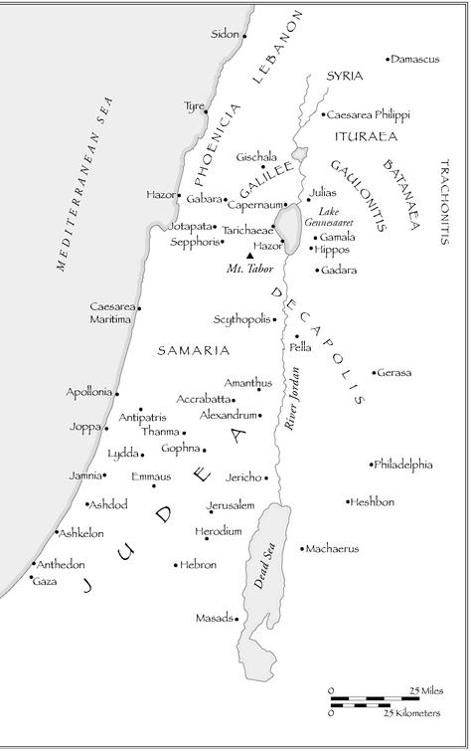
THE HOLY LAND IN THE TIME OF JOSEPHUS
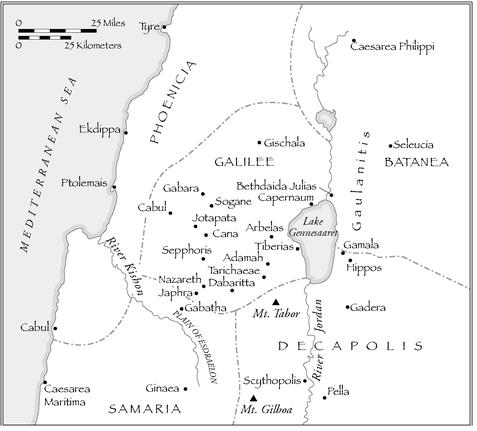
GALILEE
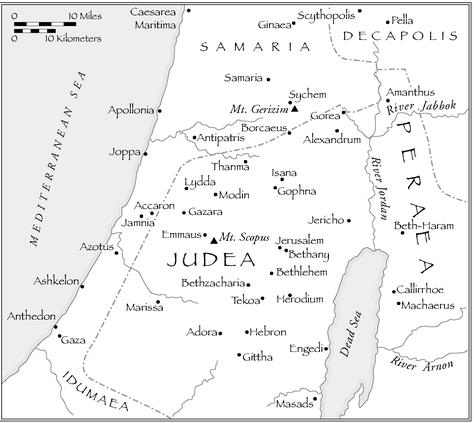
JUDEA
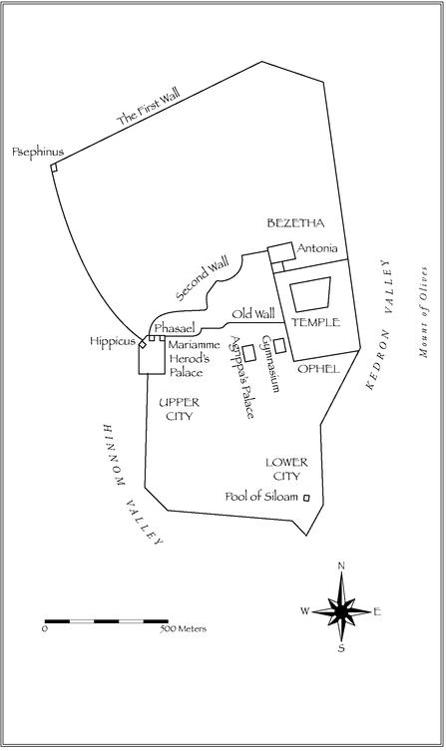
JERUSALEM
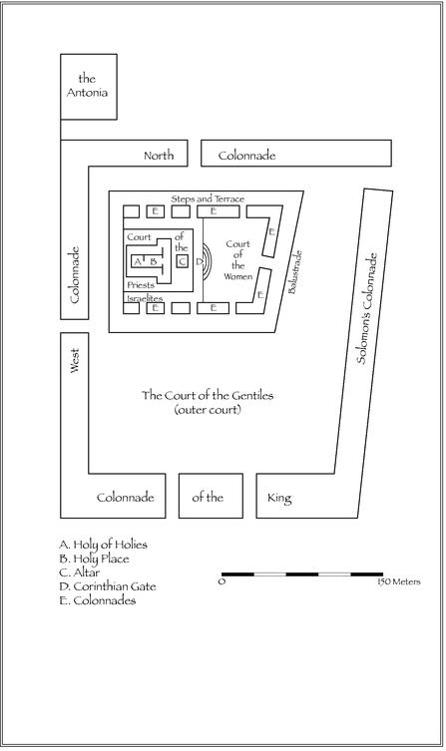
THE TEMPLE