
3
A CHRONOLOGY for the life of Moses clearly depends upon establishing in the first place when the Descent of the Israelites into Egypt took place and how long they remained there before the Exodus. It is generally accepted that they were in the country at the end of the Eighteenth and start of the Nineteenth Dynasties (c.1308 BC), but when they arrived and departed have both been the subject of considerable disagreement. The Old Testament is not very helpful in this matter. It does not give any dates, or the names of any reigning monarch, referring to him only as ‘Pharaoh’, ‘King’ or ‘Pharaoh, King of Egypt’. Nor does it tell us where the capital city of the Pharaoh in question was situated. It also provides us with some conflicting statements about how long the Sojourn lasted:
And he said unto Abram, Know of a surety that thy seed shall be a stranger in a land that is not theirs, and shall serve them; and they shall afflict them four hundred years. (Genesis, 15:13)
But in the fourth generation they shall come hither again … (Genesis, 15:16)
Now the sojourning of the children of Israel, who dwelt in Egypt, was four hundred and thirty years.
And it came to pass at the end of the four hundred and thirty years, even the selfsame day it came to pass, that all the hosts of the Lord went out from the land of Egypt. (Exodus, 12:40–41)
In addition, the Old Testament always provides us with the names of heads of tribes and the names of their descendants who are important to the story that is being related. In the case of the Sojourn we are given the names of four generations – Jacob’s (Israel’s) third son, Levi, and Levi’s son (Kohath), grandson (Amram) and great-grandson (Moses).
If we examine Egyptian sources we find nothing that matches precisely the broad outline of the biblical account of the Descent, Sojourn and Exodus. Yet this lack of precise evidence cannot be taken as a reason to dismiss the account as a complete fabrication or to suppose a mythological origin for these narrations. The Bible gives some inside details of life in Egypt during the Empire (the Eighteenth and Nineteenth Dynasties) that in many cases have to be seen as originating as a result of first-hand knowledge. These details cannot be regarded as a later colouring, as some scholars maintain, for how could a Jewish priest and scribe like Ezra, returning to Jerusalem from the Exile in Babylon in the fifth century BC, be expected to have inside details about life in Egypt during the Empire eight centuries earlier? The only logical explanation is that the biblical accounts of the Descent into Egypt and eventual Exodus have at their core real historical characters and events. It is therefore a matter of seeking clues within the Old Testament that may help us to determine to which period of Egyptian history these events belong.
The historical period we have to examine is a long one, ranging from the seventeenth century BC until the thirteenth. In the seventeenth century BC Lower and Middle Egypt came under the control of the invading Hyksos – Asiatic shepherd rulers, with some Semitic elements among their followers – who set up their capital at Avaris in the Eastern Delta, where they ruled for just over a hundred years. They were eventually defeated in battle and driven from the country by Ahmosis (c. 1575–1550), founder of the Eighteenth Dynasty, which would develop into a golden age in the history of Ancient Egypt and lasted until almost the end of the fourteenth century BC. During this period Thebes in Upper Egypt became the capital and chief religious centre of the country, while the king’s main residence was at Memphis in Lower Egypt. With the arrival of Ramses I, the first Pharaoh of the Nineteenth Dynasty, Thebes retained its importance, but the king’s main residence moved to the old city of Avaris, now rebuilt by the Israelites as Pi-Ramses and named after the Ramses kings of the dynasty. It is also from this period that the whole of the Eastern Delta area named as Goshen in the Bible became known as the Land of Ramses.
The name Ramses (spelled Rameses) is also found in the Pentateuch, but not as the name of a ruling king. In Genesis, 47:11, it is given as the name of the land where the Israelites were allowed to settle on their arrival in Egypt. As the Goshen area did not become known as the Land of Ramses until the Nineteenth Dynasty, and nobody disputes that the Israelites arrived in Egypt at some time before this era, it seems that the name Ramses is simply being used here as an equivalent of Goshen as it became known as ‘the Land of Ramses’ at the time of the Exodus. The name Rameses occurs again in Exodus, 12:37, where it is described as the starting point of the Exodus. Further pointers to a northern residence at the start of the Nineteenth Dynasty are provided by the accounts of the way Moses, having returned to the Eastern Delta to rescue his people, was urged by the Lord to confront Pharaoh in the morning when he went down to the banks of the Nile (Exodus, 7:15; 8:20).
It would seem that two reasonable deductions might be made from these brief summaries of the biblical account of the Sojourn and what we know of the seat of power in ancient Egypt: firstly, that as shepherds were looked upon already as ‘an abomination’ when the Israelites arrived in Egypt, their appearance on the scene must have post-dated the Hyksos period, which was the root cause of the anti-shepherd hostility; and, secondly, the fact that they were settled in Goshen, remote from the seat of Pharaonic power, suggests that this seat must at the time have been at Thebes, some 400 miles away in Upper Egypt, rather than Avaris, the Hyksos capital and capital of the land of Goshen in the Eastern Delta.
However, with no archaeological evidence to help them, early Egyptologists were persuaded to believe – correctly, as it happens – that the Exodus could not be assigned to an earlier time than the Nineteenth Dynasty. It was when they attempted to decide in which reign of the Nineteenth Dynasty it took place that they went astray. Two points misled them: firstly, the figure of 430 years, given in the Old Testament as the duration of the Sojourn, which they appear to have accepted literally; and, secondly, the statement by Flavius Josephus, the Jewish historian of the first century AD, which they also seem not to have questioned, that the Israelite arrival took place during the period of Hyksos rule. This view appeared to be justified by some elaborate mathematical guesswork, for if we add up the figures in the Bible between the start of the Sojourn and the Exodus, and compare them with the then accepted Egyptian dates, we arrive at the following totals:
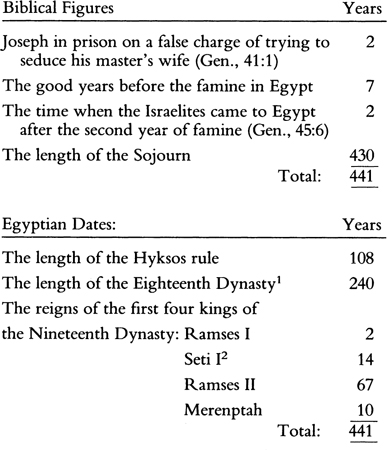
The implication of these calculations is that Joseph must have arrived in Egypt as a slave, and been imprisoned, in the very first year of Hyksos rule. Despite the inherent improbability of this having happened, early Egyptologists, working forward from this date, came down firmly in favour of the Exodus under Moses having taken place during the reign of Merenptah, the fourth ruler of the Nineteenth Dynasty. Furthermore, as the Bible indicates that the Pharaoh of the Oppression, during whose reign Moses fled to Sinai, died while Moses was still in exile, it followed that, if Merenptah was the ruling king at the time of the Exodus, his predecessor, Ramses II, must have been king at the time of the Oppression.
These assumptions were shattered in 1896 when the British Egyptologist W. M. Flinders Petrie found a great granite stela in the funerary temple of Merenptah to the west of Thebes. The stela, which had originally belonged to Amenhotep III and bore a text of his, had been later usurped by Merenptah, who recorded on the other side what some scholars believed to be two separate military campaigns – one his victory over Libyan invaders, the other an expedition into Palestine/Syria, matching the biblical account of the pursuit of the Israelites by the Egyptians. The stela, now in the Cairo Museum, has come to be known as the Israel Stela because it includes – in an epilogue to its main story – the first, and only known, mention of Israel in an Egyptian text. As this stela is dated to Year 5 of Merenptah’s reign and speaks of Israel as people already resident in Palestine, it upset completely the accepted wisdom of Egyptologists of the time. Not only had the Israelites left Egypt proper by that date, but, after spending a supposed forty years in the wilderness of Sinai, had made their way to Palestine and had been there long enough to develop into a power that posed a threat impelling the ruling Pharaoh to send troops to try to subdue them.
This caused the scholars of the time to adjust their position. Faced with the facts, and lacking any alternative explanation, they decided that at least one of the figures in the biblical account of Exodus, the forty years spent wandering in the wilderness, should not be taken literally. In addition they became ready to disregard the two Pharaohs of the biblical account – one for the Oppression and the other, his successor, for the time of Exodus – and came to the conclusion that Ramses II was the Pharaoh of both events during his long reign of sixty-seven years. This belief has since become widely accepted by the majority of both biblical scholars and Egyptologists, who have come to regard it as unquestionable historical fact. However, the choice of Ramses II as the Pharaoh of the Exodus assumes that the military confrontation between the people of Israel and Egyptian forces in Palestine took place during the first five years of Merenptah, but careful examination of the Israel Stela shows that this cannot have been the case.
In Year 5 of Merenptah’s reign, Egypt was invaded by a Libyan leader named Merey, who had gathered to his banner a great army of Libyan tribes as well as five groups of ‘peoples of the sea’, who are believed to have come from the Greek islands. They attacked the Western Delta. Memphis, Heliopolis and other Lower Egyptian cities were forced to shut their gates against the invaders, citizens were unable to cultivate their land in safety or move from town to town. On this occasion the invaders were not merely looking for plunder, as had been the case with previous Libyan invasions, for they brought their women, children and cattle with them, clearly intending permanent settlement. On learning of this threat, Merenptah sent an army that met the invaders at a locality in the Western Delta known as ‘The Fields Of Piyer’. After six hours of fierce fighting, Merey fled, leaving his followers to their fate. The number of Libyans killed in the fighting is said to have been 6000 with a further 9000 taken prisoner.
The section of the Israel Stela devoted to these events opens with the date: ‘Year 5, third month of the third season (Spring), day 3’. This is followed by the titulary and epithets of Merenptah and, after giving a general picture of Egypt after the Libyan invasion, the defeat of the enemy is described: ‘Their advanced guard abandoned their rear. Their legs did not stop, except to run. Their archers abandoned their bows. The heart of their runners was weak from travelling. They untied their waterskins … their packs were loosed and cast aside. The wretched enemy prince of Rebu [Libya] was fled in the depth of the night, by himself. No feather was on his head’ – a sign of dishonour, as Libyan warriors used to wear a feather in their head-dress – ‘his feet were unshod. The loaves for his provision were seized; he had no water … to keep him alive. The face of his brother was fierce, to slay him; among his commanders one fought his companion. Their tents were burned up, made ashes. All his goods were food for the troops.’3
Then come some narrative sections, giving an account of the defeat of the Libyans and the saving of Memphis, which are followed by a religious composition in which the gods of Heliopolis praise Merenptah for saving Memphis and Heliopolis. The last section depicts the Egyptians joyful after their victory:
Jubilation has gone forth in the towns of Egypt. They talk about victories… One walks with unhindered stride on the way, for there is no fear at all in the heart of the people. The forts are left to themselves, the wells [lie] open, accessible to the messengers. The battlements of the wall are calm in the sun until their watchers may awake … The cattle of the field are left as free to roam without herdsmen, [even] crossing the flood of the stream. There is no breaking out of a cry in the night: ‘Halt! Behold, a comer comes with the speech of strangers!’ but one goes and comes with singing. There is no cry of people as when there is mourning. Towns are settled anew again. He who ploughs his harvest will eat it. Re has turned himself [again] to Egypt. He [the king] was born as the one destined to [be] her protector, the King of Upper and Lower Egypt: Ba-en-Re, Meriamon; the son of Re: Merenptah Hotep-hir-Maat.
We have further accounts of the campaign against the Libyans in the war inscriptions of the Cairo and Heliopolis Columns, the Karnak War Inscriptions, the Athribis Stela (also called the Kom el Ahmar Stela), texts in which Merenptah has given accounts of the Libyan war in different parts of Egypt, and the Nubian Stelae, found in Nubia at Amada, Toshka, Wadi es Seboua and Amara West. With the exception of the Nubian Stelae, which describe a second war against the Nubians in Year 6 of Merenptah’s reign, the only hostilities mentioned are those against the Libyans twelve months earlier.
What distinguishes the Israel Stela is that, unlike other texts, the account of the campaign against the Libyans is followed by a separate concluding section of twelve lines (three on the original stela), naming some foreign locations and peoples:
The princes are prostrate, saying ‘Mercy!’ (The word used here is the Canaanite shalam, meaning ‘peace’).
Not one raises head among the Nine Bows.
Desolation is for Tehenu; Hatti is pacified;
Plundered is the Canaan with every evil;
Carried off is Ashkelon; seized upon is Gezer;
Yanoam is made as that which does not exist;
Israel is laid waste, his seed is not;
Hurru is become a widow for Egypt!
All lands together, they are pacified;
Everyone who was restless, he has been bound by the King of Upper and Lower Egypt: Ba-en-Re Meriamon; the son of Re: Merenptah Hotep-hir-Maat, given life like Re every day.
Various interpretations have been placed upon the Israel Stela. It has been described, because of the poetic nature of its composition, as a hymn of victory. Some scholars have dismissed it as unhistorical and being rather a poetic eulogy of a universally victorious Pharaoh, while others have accepted that it provides a historical account of Merenptah’s wars and victories. Although the stela is devoted almost entirely to the war against the invading Libyans, Libya (Tehenu) is also mentioned in the twelve-line epilogue. The other foreign references featured are:
• Hatti, the land of the Hittites in Asia Minor, then extending to include northern Syria;
• Canaan, west and south Palestine, bordering Sinai in the south, the Dead Sea to the east and the Mediterranean to the west;
• Ashkelon, a Canaanite port on the Mediterranean north of Gaza;
• Gezer, a Canaanite city west of Jerusalem:
• Yanoam, an important town of northern Palestine at the southern end of the Sea of Galilee;
• Israel: the sign used here does not indicate a land, but a people; and
• Hurru: although this word is sometimes used to indicate the whole land of Palestine/Syria, it could also mean the land of the biblical Horites, north of Mount Seir at the foot of the Dead Sea.
Merenptah was already an old man of about sixty when he came to the throne. At the time Egypt had enjoyed half a century of peace with Palestine/Syria since Merenptah’s father, Ramses II, had concluded a treaty with the Hittites in Year 21 of his reign. No record of any major Egyptian conflict in Asia has been found during the remainder of the reign of Ramses II, and it is hardly to be believed that Merenptah, in the first five years of his reign and at his advanced age, fought these major wars against the Hittites in northern Syria and in Palestine/Syria without leaving any record of it other than the list of names in the epilogue to the Israel Stela.
This does not mean, however, that the epilogue is without historical value. We find no claim on the part of the king that it was he who subdued these foreign peoples, no dates or other details of any specific confrontation are to be found, only lasting peace. Yet, as the section implies, this peace had been achieved only through the defeat of Egypt’s enemies in Asia. If Merenptah was not the king who confronted and vanquished the Israelites and other peoples in Palestine/Syria, who did? To find the answer we have to go back ninety years before Merenptah’s accession to the throne, back to the very beginning of the Nineteenth Dynasty.