
7
IF Moses was born in 1394 BC, and if he was Akhenaten, according to the king-list of Gardiner (see p. 11) he would have been in his mid-forties when he fell from power in 1350 BC, not an unreasonable age. However, he would have been in his mid-eighties when he led the Exodus during the brief reign of Ramses I at the start of the last decade of the century. This is clearly unlikely – but the whole chronology changes into a more realistic one if it can be shown that the seventeen years Akhenaten spent on the throne included twelve years as coregent with his father, and that Horemheb ruled for less than half the twenty-seven or twenty-eight years assigned to him conventionally.
There is little dispute about the length of the reigns of the three Amarna kings who suceeded Akhenaten. To take them in reverse order, the king before Horemheb, who brought the Amarna era to an end, was Aye. The highest known regnal year for Aye, from the stele in the Louvre and the Berlin Museum, is Year 4. Tutankhamun preceded Aye. In the tomb of Tutankhamun wine dockets dating from Year 10 of his reign have been found, although it seems that he could have died early in this year, signifying that he reigned for only nine complete years. Before Tutankhamun there was Semenkhkare, who is known to have had a coregency period with his predecessor, Akhenaten.
At Amarna, Semenkhkare’s name appears on many small objects enclosed within a cartouche, confirming his kingship, as well as on the wall of the tomb of Meryre II, High Priest of the Aten, Superintendent of the King’s Harem, Royal Scribe and Steward, while in the North Palace Akhenaten’s name is found in many examples, accompanied by the names of Semenkhkare and his queen, who was Akhenaten’s eldest daughter Merytaten, the heiress. His praenomen (coronation name) is Ankh-kheprw-re, meaning ‘Kheprw-re lives’, Kheprw-re being the praenomen of Akhenaten. Some reliefs found at Amarna showed Akhenaten and Semenkhkare together as kings, indicating that they ruled together. But did Semenkhkare rule alone for any period of time? From a graffito in the tomb of Pere, a Theban nobleman, at Western Thebes, the last date – Year 3 – was found and indicated that, at this point, Semenkhkare was sole ruler. The text does not mention Akhenaten at all and here Semenkhkare seems to have begun to number his own years. We also have a hieratic docket inscribed in Year 17 of Akhenaten, the last year of his reign, and later changed to Year 1 of Tutankhaten (Tutankhamun). The only possible conclusion is that Semenkhkare became coregent in Year 15 of Akhenaten and, after Akhenaten’s fall from power, Semenkhkare, who was probably at Thebes at the time, became sole ruler for a few months, or maybe only days, before he met his death and Tutankhaten (Tutankhamun) followed him on the throne.
The question of whether Akhenaten (Amenhotep IV) shared a coregency with his father, Amenhotep III – important in trying to establish a precise chronology – is a vexed one. Many objects bearing the name of Amenhotep III were found at Tell el-Amarna (Akhetaten), the new capital city built by Akhenaten. This has led a large number of Egyptologists to believe that Amenhotep III was alive at the time the new city was built and may even have visited it in person. Others, who did not agree with this argument, have rejected entirely the notion of a coregency.
Both points of view have their distinguished supporters. Scholars who favour the coregency theory include Petrie, Pendlebury, Fairman, Engelbach, Seele, Steindorff, Aldred and Giles: those who dismiss it include Helck, Gardiner, Hayes, Campbell and Redford. The evidence that has been adduced in the argument on both sides includes wine-jar dockets, reliefs, cult objects, cartouches, temples, pylons, stelae, sarcophagi, statues, paintings, letters, praenomen, nomen (birth names) and the length of kings’ reigns. Scholars who take the view that there was actually a coregency disagree among themselves about how long it lasted, with the duration put at anything from two to twelve years. In my view, the evidence pointing to a coregency of twelve years is overwhelming. However, so many counterarguments have been put forward that it is, unfortunately, necessary to examine them in some detail to demonstrate their flaws. In order not to weary the reader, I propose to deal here only with some of the main points: a more detailed analysis can be found in Appendix B.
The Wine-jar Dockets of Amarna
If the notion that Horemheb had a long reign, which will be examined in Chapter Nine, is dismissed, the only king of the immediate period who ruled for more than twenty-eight years is Amenhotep III. The implication is that the wine-jars found at Amarna, dated Year 28 and Year 30 (Years 1 and 3 of Akhenaten), originated in Amenhotep III’s Malkata palace at Western Thebes and were brought to Amarna by Akhenaten around the time that he began construction of his new capital and Amarna had no vineyards of its own. As Amenhotep III reigned for a total of thirty-eight years and died at the beginning of Year 39, this would argue a long coregency.
Amenhotep III’s Soleb Temple in Nubia
The temple, begun and almost completed in the last decade of Amenhotep III’s reign, possesses a few scenes on the pylon that were executed by Akhenaten in the year following his father’s death. Professor Donald Redford of Toronto University, the most recent scholar to argue against the coregency theory, has dismissed all the scenes where Akhenaten or his name appears with his living father as of late date, after the death of Amenhotep III, when Akhenaten completed the work on the temple.1 He cites Joseph M. Janssen, the ‘scholar who has examined the [pylon] scenes most recently’ and whose ‘readings differ markedly from those of other scholars’ before him. Two of his eight readings are of particular significance:
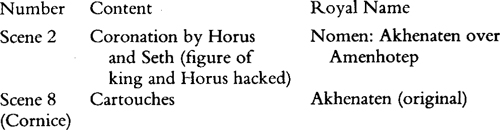
The cornice, according to Redford, is ‘the only portion of the pylon that can be attributed beyond doubt to Akhenaten’. He agrees that Akhenaten’s work on the pylon did not take place before Amenhotep III’s death and was carried out within the following twelve months. He does not explain, however, the fact that, if there was no coregency, how is it that Scene 8 – the only original scene, according to Redford – gives the new king’s name as Akhenaten, a name we know from a variety of sources that he did not adopt until Year 5–6 of his reign? It must therefore follow that the first year after Amenhotep III’s death occurred after Year 5 of his son.
It is also surprising that Redford did not choose to comment on Scene 2. Here we have an original cartouche of Amenhotep (the original birth name of Akhenaten) in a scene that Redford agrees must have been completed by Amenhotep III before his death. Later the new king destroyed this birth name and imposed on it his new name, Akhenaten. The only possible explanation for this is that, while Amenhotep III was alive and busy decorating the temple, his son’s name was still Amenhotep. By the time the old king died, the young king’s name had already been changed, as we saw from Scene 8, and while completing the unfinished scenes he also replaced his Amenhotep name with that of Akhenaten. As Redford confirmed that the original Scene 2 was the work of Amenhotep III, this is again strong evidence for a coregency.
A Rock Relief At Aswan
The relief shows two chief sculptors, Men and Bek, father and son, each adoring an image of the king for whom he worked. Men bears the title ‘Chief Sculptor’ and ‘Overseer of Works in the Red Mountain’ to Amenhotep III: Bek has identical titles appertaining to the reign of Akhenaten. The relief was made during Akhenaten’s reign and use of the late form of the Aten’s name indicates that it cannot be dated before at least the second half of Year 8. At this time the name of the Aten received a new form to rid it of any therio-anthropomorphic or pantheistic ideas that may have clung to it. There is no indication that either Amenhotep III or Men was dead, nor that Bek, the younger official, was giving an account of his relations that justified mentioning his father’s job. The fact that each of them is shown as holding an official position under a different king, with no indication whatever of any lapse of time, is a strong indication that the kings were contemporary.
The Panehesy Stela
A stela found in the house of Panehesy, the Chief Servitor of the Aten, at Amarna shows Amenhotep III with Queen Tiye, seated before a pile of offerings. As the Aten is shining over them in his later form, it cannot date from earlier than the second half of Year 8 of Akhenaten. The king is shown here in the realistic Amarna style with thick neck and bent head, indicating his age at the time. Neither in the scene nor in the text is there any indication that the king was already dead. On the contrary, as the queen is shown next to him – and she was still alive, with separate evidence that she visited Amarna before Year 12 of her son’s reign – it would not have been possible for the artist to show her next to her husband if he were already dead. Furthermore, the artistic nature of the Amarna style used here gives a realistic portrayal of the couple in Amarna, under the Aten’s rays, and not an abstract or idealized scene, drawn from memory, of a king who had died at Thebes a decade or so earlier.
Meketaten’s Sarcophagus
A fragment of the sarcophagus of Meketaten, Akhenaten’s second daughter, who died some time after his Year 12 and was buried in her father’s royal tomb at Amarna, was found, with the praenomen of Amenhotep III beside the praenomen of Akhenaten. In another book Redford reports the first appearance of Akhenaten’s daughter in the decoration of one of Akhenaten’s temples at Karnak where ‘possibly no earlier than the fourth year of the reign … we first see two daughters toddling behind the queen’.2
If Amenhotep III was not alive in Year 4 of his son’s reign when Meketaten had been born, it would not have been possible for his name to appear on his second granddaughter’s sarcophagus. Its presence indicates that he was alive when the sarcophagus was made, although this could have been at any time after the birth of the princess. Moreover, in this example the praenomen of Amenhotep III have been spelt differently. Instead of using the figure of the goddess Maat in writing the middle part of the word ‘Neb-Maat-Re’ – ‘Maat’ signifies ‘truth’ – Akhenaten spelt it phonetically, indicating an advanced stage in his rejection of the old religions, which did not take place until after he had left Thebes for his new capital, Amarna. The sarcophagus inscriptions cannot therefore be dated earlier than that.
The Amarna Rock Tombs of Huya and Meryre II
A scene and inscription in the tomb of Huya, steward to Queen Tiye, at Amarna has been interpreted as evidence that Amenhotep III was alive and in Amarna after the second half of Akhenaten’s Year 8. The scene is drawn in two halves on the lintel of the doorway leading from the first hall of the tomb into the inner rooms.
The scene on the left shows the household of Akhenaten (Akhenaten, Queen Nefertiti and their four daughters), that on the right the household of Amenhotep III, Queen Tiye and the Princess Baketaten). Howard Carter, the British archaeologist who discovered the tomb of Tutankhamun, saw the juxtaposition of these two scenes as evidence that the old king was alive at Amarna: ‘This equipoise of the two households not only confirms the coregency of the two kings, but gives reason to suppose that Amenhotep III continued to live for at least a year or so after the birth of Akhenaten’s fourth daughter, Neferneferuaten Tasheri.’3
Redford, who does not agree with Carter, goes on to argue that, as Tiye is shown without her husband on the outer (south) wall of the hall in question, Amenhotep III must have already been dead when construction of the tomb began: ‘Presumably, if the decoration of the tomb kept pace with its excavation, the scenes in the first hall showing Tiye alone would have been carved before the lintel jambs.’4
This is an over-simple approach. We have to examine the whole hall of Huya’s tomb, as well as the neighbouring tomb of Meryre II, in order to establish which came before which of the tomb scenes. The argument is a somewhat complex one, but from the nature of the scenes, the number of princesses shown and their relative ages, it is possible to make the following deductions (see also Appendix B):
• The South and North Walls, where four daughters of Akhenaten are depicted, plus Baketaten, the daughter of Amenhotep III and Queen Tiye: Year 10;
• The East Wall, which does not show any of Akhenaten’s daughters but depicts Baketaten, looking the same age as she is shown on the South and North Walls: Year 10;
• The West Wall is a unique scene showing celebrations that took place in Akhenaten’s Year 12 and bears the date ‘Year 12, the second month of winter, the eighth day’.
This dating has a further significance in the coregency argument. The temple scene shown on the East Wall shows a colonnade with a statue of a king and queen placed between each pair of columns. The inscribed names are now only partially preserved, but it seemed certain to N. de G. Davies, author of The Rock Tombs of El Amarna,5 that here we have Queen Tiye’s statue with alternating statues of her husband, Amenhotep III, and her son, Akhenaten. While Akhenaten is given his two names, Amenhotep III has only his praenomen, ‘King of the South and North and Lord of the Two Lands, Neb-Maat-Re, given life’. This last epithet, ‘given life’, can appear only if the king was alive at the time the statue was placed in position and the inscription made.
Inside the sanctuary of the temple, statues – Queen Tiye alternating again with her husband and son – under the portico represent figures holding altars between their extended arms for the reception of gifts. In the centre is a naos (inner sanctuary of the temple) standing free from the wall. It is set on a platform to which three or four steps lead up. Here we see Queen Tiye drawn twice, standing on the steps, once with her husband, once with her son, and Amenhotep III himself, depicted inside the temple where the inscriptions have already made it clear that he was alive. A statue can sometimes be a representation of a dead person, but here, because they are shown on the steps, they are living persons.
Davies himself noted that it is not usual to erect statues on steps. Yet he refused to accept the clear evidence of the East Wall that we are not looking here at depictions of statues, but of real figures: ‘ “Statues” I have said, but in truth there is nothing to prevent us from seeing in them four royal personages, except for the difficulty of granting the existence of two kings together at this time.’6 He also chose to disregard the fact that the characters depicted are shown, not within the naos, facing outward, in a position of receiving offerings, which would have been the case if they were statues, but on the steps facing the naos, offering gifts to the Aten, which indicates that the royal characters were alive and worshipping.
As for Redford, he preferred to regard the old king as dead in the lintel scene and a statue on the East Wall, avoiding a real examination of the scenes that would date the decorations correctly and even relying on a misleading judgement by another scholar to obtain more support for his preconceptions. He quotes7 the German scholar Alexander Scharff, who noted in his book Archiv für Orientforschung that Amenhotep III’s accompanying jamb inscription to the lintel scene is not followed by the epithet ‘given life’. Neither Scharff nor Redford seems to have examined the lintel scene carefully, for at the bottom of Amenhotep III’s cartouche, which is shown behind his head, the signs for ‘given life’ are clearly visible, just as they are on the East Wall.
The Age of Baketaten
Redford next takes issue with Frederick J. Giles, the Canadian Egyptologist, who argued that Baketaten in the tomb scenes ‘could not be older than fourteen at the most. On the assumption that Tiye married Amenhotep III in his second regnal year at the age of sixteen, Tiye would have given birth to Baketaten if there were no coregency, in the last year or so of her husband, when she was fifty-four. Since it is unlikely that Tiye was as young as sixteen at the time of her marriage, or as old as fifty-four at the birth of Baketaten, the assumption of a coregency of about twelve years is almost obligatory.’8
Redford complains that Giles’s ‘entirely unwarranted manipulation of numbers and his assumptions regarding Tiye’s age at various times in her life do not command the respect of the uncommitted reader’.9 However, he is using the inability of an opponent to present his case to try to persuade us that he has none.
Examination of the mummy of Amenhotep III suggests that he was about fifty when he died. As he ruled for a full thirty-eight years and died at the start of the thirty-ninth, he could only have been around twelve when he came to the throne and about fourteen when he married Tiye in or just before his second regnal year. As Tiye was not the heiress, whom he had to marry irrespective of her age, we should expect her to be younger than he, as this was the custom of the time, and it is thought that she was only eight years of age at the time of the wedding. This would not have been unusual in that era. The prophet Muhammad married a nine-year-old girl when he himself was fifty, and I think this custom of marrying young girls who had not yet reached puberty accounts for the number of ‘barren’ women who later give birth to children in a variety of biblical stories.
How old was Baketaten in the tomb scenes? Carter has made the point: ‘Among many such scenes in El Amarna private mortuary chapels depicting these children [Akhenaten’s] the relative age of each child is shown by her height. Careful discrimination of that kind excludes the possibility of twin births, and is therefore serviceable when estimating their ages. A reckoning such as the above cannot, of course, be considered exact, but error cannot be more than say a year.’10
In Huya’s tomb scenes Baketaten is shown consistently as being about the same age as Akhenaten’s third daughter, Ankhsenpa-aten. Carter also noted the similarity in size of the two princesses: ‘Judging from the stature of Baketaten figured in this picture [the lintel scene], she was about the same age as Ankhsenpa-aten.’11 Merytaten, the eldest daughter of Akhenaten, was born towards the end of Year 1 of her father. The second daughter, Meketaten, was probably born in Year 3, as she appears as a very young child the following year in the decoration of Akhenaten’s temple at Karnak. If we allow two more years for her birth, the third daughter, Ankhsenpa-aten, would be born around Year 5 of her father, thus making her five or six years of age when Huya’s tomb was decorated in Year 10. (She is seen for the first time in Aye’s tomb, dated by Davies to Year 9 of her father’s reign, and was never depicted with her parents at Thebes.)
If this explanation is accepted as corresponding more closely to the facts, Baketaten must also have been five or six at that time. If there was no coregency between Akhenaten and his father, Baketaten could not have been Amenhotep III’s daughter, being six years of age ten years after her father’s death – yet the inscription in Huya’s tomb confirms that she was. Furthermore, the very name Baketaten indicates that she was born during her brother’s reign when he started relating his own daughters’ names to the Aten. In this case Baketaten would have been born around Year 31 of Amenhotep III when her mother, Queen Tiye, was around thirty-seven, a late, but not impossible, age for giving birth.
Fragments from Amarna
Two objects bearing Amenhotep III’s name, found at Amarna, indicate he was at Amarna at the time. The first is a fragment of a granite bowl with the late name of the Aten, the praenomen of Amenhotep III and the phrase “in Akhetaten”; the second a fragment of a statue of a kneeling person holding an offering slab. Between his outstretched hands is an inscription that includes the late Aten name, followed by the praenomen of Amenhotep III. The Aten’s name is also found twice on the front edge of the slab with Amenhotep III’s praenomen to the right and Akhenaten’s name to the left.
Redford rejects the possibility that Amenhotep III was either at Amarna or even alive at the time these objects were inscribed, which should be, according to the late Aten name, some time after the second half of Year 8. He writes: ‘The most these miserable fragments allow is a cautious suggestion, and nothing more, that a cult of Amenhotep III continued after his death.’12
What Redford is suggesting, without any supporting evidence whatever, is that, in the city of the Aten, another god was worshipped by Akhenaten, a human god, his own father. Not only would the monotheistic beliefs of the king not allow this; the idea of a king being worshipped during or after his life is non-existent in the new city. No funerary temple has been found there for Akhenaten, who was himself the one and only prophet of the new God. The simple explanation is that some time after the latter half of Year 8 Amenhotep came down from Thebes to visit his son and coregent, during which time these objects were made, indicating that both kings were worshipping the Aten. There are other indications that Amenhotep III was converted to worship of the new god, although he continued to worship the older gods as well.