
3
Music doesn’t just come out of nowhere. Songs aren’t abstractions: they don’t exist in some airy space above the earth and outside of time. Sometimes, in the modern world, we can get used to thinking about songs and compositions as if they were immutable, eternal ideas. When we write music down using notation, we create the misleading impression that it can be perfectly reproduced. Now that J. S. Bach’s ‘Magnificat in D Major’ or Lil Nas X’s ‘Old Town Road’ exist on paper, it seems like they can be performed the same way over and over again, communicated across time and space. This lets us fall into the assumption that each song exists in some perfect, Platonic form to be plucked out of the air anytime and anywhere.
But in fact, context matters. A quick search for ‘Ode to Joy Flashmob’ on YouTube returns a long list of videos in which classically trained performers bring their instruments to unexpected places – from an office skyscraper in Minneapolis, to a public square in Nürnberg – and surprise passers-by with a performance of Beethoven’s masterwork. The whole point of the exercize is that a new location makes the experience quite different from a more traditional performance of the same piece in a concert hall. When the artists are in casual clothing, pretending to be part of the crowd until the last minute, they create a brand new kind of art that looks and indeed sounds different than other versions.
Things get still more shocking when an artist puts a song somewhere it was never meant to go – as, for example, in Stanley Kubrick’s film adaptation of the novel A Clockwork Orange. There, the soaring orchestration of ‘Ode to Joy’ is played alongside horrific scenes of violence so that watching and listening creates a sense of surprise and revulsion rather than exultation. Audience, location, and artistic intentions can influence artists’ emphases and interpretation in performance. Where, when, and why you play a song changes how the song comes across – even if the notes on the page would look exactly the same each time.
This was still more true in the ancient world. Because though the Greeks did develop notation, and though that notation has been crucial for us in partially recovering their music, it wasn’t their primary way of learning or thinking about songs. A song in fifth-century BC Athens wasn’t ink on a page or an abstract idea in somebody’s head: it was a particular event, a performance in time and space that occurred once and once only. It wasn’t ‘Aeschylus’ Persians’ in general: it was a glitzy production of a never-before-seen tragedy in front of a huge crowd. It wasn’t ‘Pindar’s Pythian Ode 1’: it was a concert performance for a live audience at a king’s victory celebration. Each of those events was unique, and often – as in the case of tragedy – not likely to be repeated any time soon. It’s worth spending some time, therefore, thinking about where the Greeks liked to play their music, and how their venues shaped their songs.
Some of those venues were made for music, and some weren’t. In a moment, we’ll survey the official concert spaces of ancient Greece – buildings and structures made specially to house musical performance. But probably the majority of singing, dancing, and playing didn’t happen in fancy stone theatres or on wooden stage platforms. Most music is performed in what scholars call ‘occasional’ settings – places whose primary purpose is something other than music.
Whistle while you work
If you take stock of the music in your own life, you are likely to find that a quite small percentage of the songs you listen to are actually performed in a concert setting where the music is the main event. The vast majority of musical consumption these days doesn’t happen that way for most people. Perhaps the most memorable musical experiences of life do tend to take place in spaces specifically designed for music. But most day-to-day music listening happens in the car, or while typing away at a computer, or in the background at parties.
Something similar could be said of ancient Greek life, and in fact parties were among the most important contexts where music was learned, tested, and enjoyed. An ancient Greek dinner party was called a symposium (plural symposia). The word literally means ‘drinking together,’ but though the booze was plentiful it was far from the only focus of the party. These were intimate but lively affairs involving only men – guests gathered in the andrōn (‘men’s chambers’), a room of the host’s house where no women were allowed. Or rather, no free women were allowed – female slaves and prostitutes, on the other hand, were rarely absent.
In fact, they were often the ones making the music. A standard symposium would include a slave-girl with instructions to play aulos music, either in the background or at the centre of attention when a diversion was needed. The philosopher Plato wrote a fictional account of one fifth-century symposium in which the great sage Socrates conducted an inquiry into the nature of love. At the beginning of that dialogue, the host leads a female slave in to accompany the festivities with aulos music as a matter of course. When one of the guests asks the girl to leave, that’s considered remarkable – an unusual sign of seriousness which sets this more sober gathering apart from most parties.1 The girl is sent to play in another room (the gunaikeia or women’s chambers), where the women are housed.
This is a feature of life in ancient Athens which seems deeply alien, and pretty unpalatable, to most modern Europeans and Americans: the simple fact of the matter is, fifth-century Athenian life involved a lot of gender segregation. Women were allowed only into certain spaces, and as a result they could only play and hear certain kinds of music. The vast range of instruments and performance styles that we surveyed in the last chapter was not open to everyone. If you weren’t a man, you weren’t likely to be trained for concert performance on the kithara, for example.
Upper-class women had a specific type of instrument, the cradle kithara (so named because its soundbox was rounded on the bottom like a cradle) reserved for them – its gentle tones were considered appropriate for matrons at their looms. Slave-girls, on the other hand, could play the sultry pipes sometimes associated with theatre music and raucous dancing. So class comes into this, too: the lifestyle reserved for women was often actually reserved for noble women – different places and activities were permitted to other, less fortunate girls.
This isn’t the place to resolve all the anxieties and discomforts that these facts may raize. In such a short book, the best that can be said is this: studying the ancient world means grappling with the fact that social mores change. They change radically over time – so radically that societies to which we owe a great deal may come to look impossibly backwards to us even as we study them to learn their wisdom. Still more unnervingly, it may be that some of our own practices, apparently unobjectionable to us now, will look barbaric to our descendants. We can’t escape this complexity either by condemning the past wholesale (which would mean losing access to all that was great about antiquity as well) or by considering ourselves morally superior in every way (which will turn out to be false in the long run). Nevertheless, it’s worth pausing to note, as we study the ancient Athenians, that we can learn from them without slavishly emulating or approving of them. Their ways were not our ways.
But some things never seem to change, and one of them is this: rowdy drinkers love to sing rowdy songs. It wasn’t just slave-girls that made music at symposia: elite male guests gave impromptu performances as well. Think party playlist meets open-mic night: it wasn’t uncommon for the host to invite a tune or composition from everyone in the circle of drinkers. And the symposium’s wilder cousin, the kōmos – a kind of bar crawl mixed with a parade – featured young men running late at night through the streets of the city, singing and playing on the barbitos.
It may well be that some of the songs which come down to us from the Archaic and Classical periods got their start as drinking tunes. We learned in Chapter 1 about the famous lyric melodies of Sappho and Terpander – we can add to these names that of Anacreon, a sixth-century lyricist known for his drinking songs and hymns. ‘Let us hang garlands of celery across our foreheads and call a festival to Dionysus!’ is one example of a typical Anacreontic call to celebration. Others invite listeners to go out and find love, or bewail the cold sweats that come over a young buck confronted with his crush. These are rousing lyrics meant to celebrate the vigour of life and probably to invite thunderous approval from a tipsy crowd – we may imagine people roaring out the last lines in unison, calling for another round.
But not everyone can be an Anacreon – plenty of sophisticated men had little or no skill at original composition, but were still called upon to contribute a line or two at parties. Images of symposia like the one shown here, painted on the wall in the ‘Tomb of the Diver’ (an archaeological discovery from the fifth century BC in the Greek colony of Poseidonia) suggest that music-making could be done casually by guests while drinking and perhaps even other conversation was still going on. For those without a knack for writing new songs, there was a plentiful canon of classics by the greats to pull from. Accounts like the Symposium of Xenophon bear witness to a culture of quotation and re-performance in which drinkers could borrow old favourites and even alter them – whether intentionally or by a failing of memory – for the occasion.2
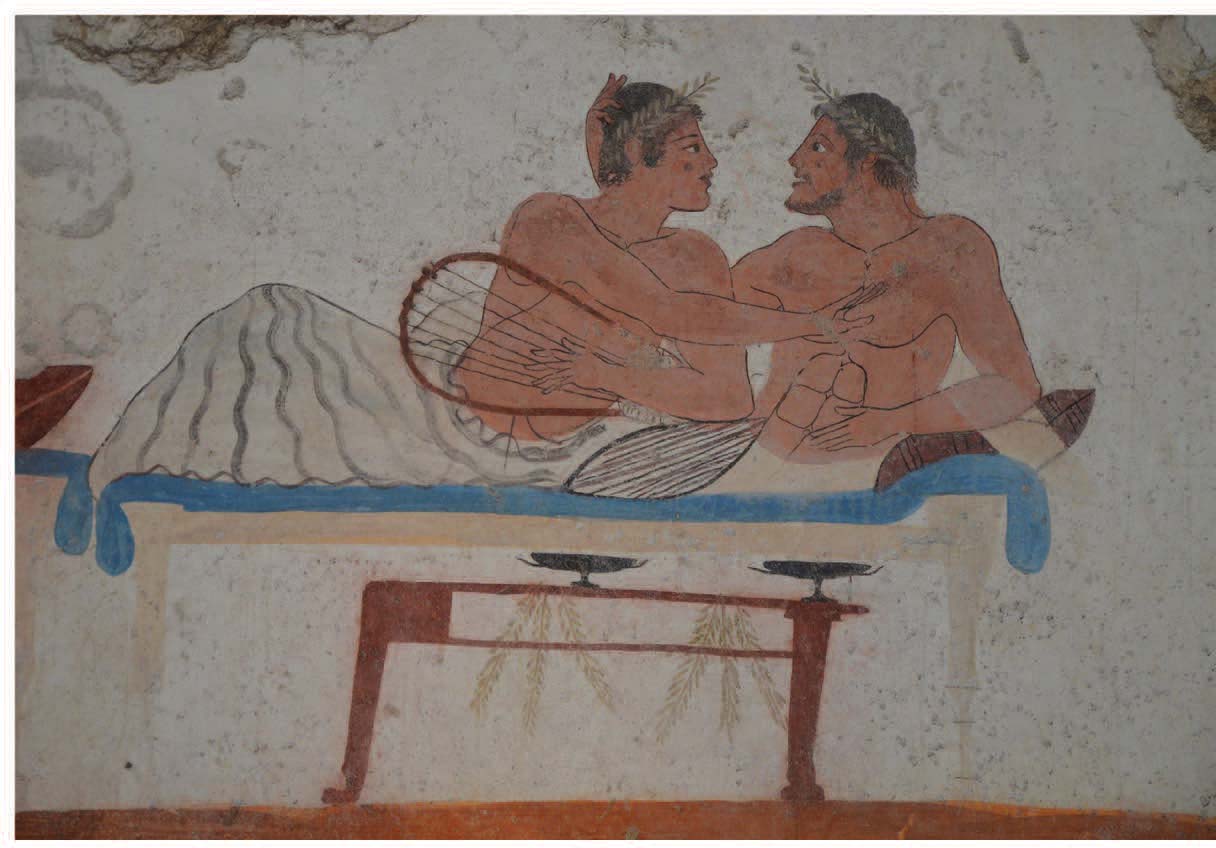
Fig. 3 A fresco painting of guests at a symposium, one holding a stringed instrument. Carole Raddato, Wikimedia Commons. https://creativecommons.org/licenses/by-sa/2.0/deed.en.
This is a good example of how professional and amateur musicianship can influence one another reciprocally. Think of the way in which some musical forms – HAUS and Electronica, for instance – were shaped in their origins by improvisational practice at informal get-togethers. Hip-hop, too, got its start on the streets of the Bronx where kids would gather to pass the time. The music took on its distinctive sound by catering to the needs of a block party, before later getting picked up by big record labels and commercialized for a wider audience. Then, when those records really got big, people all over the USA and the world started to dance and sing in ways inspired by hip-hop. Casual party music changed the industry game, and then the industry fed its way back into the ground-level culture. A similar sort of dynamic seems to have been part of the music scene in Athens: professional concert compositions would often mimic or evoke the atmosphere of casual symposia and private get-togethers, while private get-togethers in turn featured and repurposed some of the biggest hits and classics.
Plenty of other activities in Greece came with background music, too. Aristides Quintilianus tells us that manual labourers and their bosses would sometimes have pipe players accompany them to help lessen the tedium and discomfort of their work – this may represent a later practice from provinces controlled by the Roman Empire, but it’s perfectly easy to imagine it happening in classical Athens as well.3 Certainly, in the Classical period and even before, soldiers used trumpets and pipes to rouse their spirits and give tactical signals that could be heard on a crowded battlefield – think of modern equivalents like Taps and Reveille, the trumpet melodies used to mourn or waken American soldiers.4 Greeks at all levels of society tended to agree that music could make pretty much anything better, and then as now the right song at the right time could create the perfect mood for almost any occasion.
The music of the gods
There was one occasion, in particular, where music was a must: so far as we know, no religious or ceremonial procession was complete without singing and dancing. We’re on especially difficult ground here because religious rites are even more shrouded in mystery than most Athenian social practices. Some of the most important traditions were purposefully kept secret – such as, for example, the biannual celebrations at Eleusis (about fourteen miles west of Athens), where a select group of initiates would honour the goddess of grain and harvest, Demeter, and her daughter, Persephone.
Our descriptions of the mysteries are often hostile (as in the case of later Christian writers) or comedic (as in the case of that great entertainer, the fifth-century Athenian playwright Aristophanes). But all include singing and dancing as part of the solemn procession from Athens to Eleusis. ‘Keep quiet and stand aside, out of the way of our dancing,’ proclaim the choral celebrants in Aristophanes’ spoofed version of the Mysteries: ‘anyone who never watched the revelry of the Muses and never danced – keep away!’5 The origin story of Demeter’s worship at Eleusis is itself recorded in a hymn – the Homeric Hymn to Demeter, written and performed after the Iliad and Odyssey, but somewhat in the style of a miniature Homeric epic. Though the details are hazy, it’s clear music was an essential aspect of Demeter’s worship.
There would have been other public processions involving religious music – pretty much any time a god was being celebrated, the auloi and/or the kithara were involved. Weddings, too, occasioned singing in the street. Bride and groom would walk through the city accompanied by wedding songs (hymenaia), and guests would even stand outside the bridal chamber to sing special consummation songs (epithalamia) while the couple spent their first night together.
When we think about music in modern religious festivals today – in churches, synagogues, and mosques, for example – we often think about pre-prepared songs learned in advance by a select choir, or pre-written hymns that everyone in the congregation is invited to sing in the same way each time. There was pre-prepared singing in Greek worship, too – we certainly have the text of hymns and choral songs from the Archaic period onwards, many of which seem to have been performed at major temple celebrations. But there may have been some more ribald improvisation as well. Some of the hymns were stately and used the high-flown diction of Homeric gods and heroes. But others were more lowbrow and came in the call-and-response form of popular song (Aristophanes gives us a few parodies of wedding song that seem to be based on this boisterous model).6
But there was another religious festival where the music was well-rehearsed, and that was the City Dionysia which took place every year around the month we call March.
It’s possible that the Dionysia began as an occasional setting for music. Aristotle, at least, reports that the historical roots of the Dionysia were to be found in dithyrambic processions – choral dances and songs in honour of the god Dionysus.7 Before Peisistratus’ reign and the transformation of festival culture which accompanied it, the story goes that cultic groups would stage regular but more free-form dances and processions as a way of celebrating the god of wine and madness. It wasn’t until later that the festival got a regular date and a stable venue – the Theatre of Dionysus, carved into the side of the hill on which Athens’ major citadel, the Acropolis, rested. If this is correct, then it’s a good example of how popular performance can form the basis for a more stable, professionalized venue – that is, of how occasional performance can give rise to architectural spaces specifically designated for the enjoyment and creation of musical culture.
Music on the stage
But there’s a problem, which is that Aristotle lived much later than Peisistratus and might not have known any better than we do where the Dionysia actually came from. What does seem clear is that this massive festival included elements of popular performance – every ceremony began with a procession outside the walls of the city, for example – but formalized them into a much more polished and produced event, complete with architectural stability and public subsidy. The Theatre of Dionysus was among the most famous examples of a Greek theatre – a distinctive rounded stage surrounded by a semicircle of seats whose dimensions were expertly calibrated to perfect the acoustics.
Before amps and speakers – before iPod earbuds, surround sound, soundproofing, or car stereos – the Greek theatre was among the great achievements of acoustic technology. Using the natural slope of a hillside as their starting material, architects carved out a hollow half-sphere, or koilon, into which they would set the audience’s seats. In Athens, these were made of disposable wood throughout most of the fifth century, although by the fourth they had been replaced with stone seating banks, some of which can still be seen today. The seats sloped down until they hit a round, flat stage platform called the orchēstra, where the chorus would dance. (The name is Greek for ‘dancing space,’ and it’s the origin of our modern word ‘orchestra’ – in a modern theatre, the orchestra sits right in front of the seats, roughly where the Greek orchestra would have been).
Greek tragic theatres had two entrances to the right and left (the parodoi) along which actors could enter and exit, and some later designs also included a raized wooden platform (a bēma) for the main actors. But the most important feature of all this for our purposes is what the whole structure did to sound. Because of the rounded curve of the koilon and the sloped descent of the seats, words and songs from the stage were amplified enormously so that even the audience in the very back of the crowd could hear – once the seats were made of stone, they even served as dampeners to filter out low-frequency sounds and let the performers’ higher-pitched voices pierce through. All these effects remain powerful in the Greek theatres that still survive: listening to someone speak on a Greek stage leaves little doubt that this is the work of a culture with a collective passion for sound quality.
This meant that, however chaotic the opening procession may have been, attendees at the City Dionysia could probably hear the main event with considerable precision. That main event, of course, was tragedy – one of the enduring achievements of Greek literary and musical culture. Tragedies were a bit like operettas: many of the words which we usually read on a page or hear spoken aloud onstage today were actually sung and chanted in an elaborate musical style. Choral songs would have been accompanied with intricate dancing and aulos-music, and actors playing the main roles would regularly engage members of the chorus in a back-and-forth exchange of sung lines (this kind of lyric dialogue was called an amoibaion). Audience members piled into their seats for long hours at a time, watching three tragedians present their newest work in hopes of winning the grand prize.
The plays came in threes – each poet would present a trilogy, often one that followed a single mythological narrative. At the end, for some light relief, there followed a ‘satyr play’ in which actors dressed up as mythological goat-men and bumbled their way through a ribald comedy – perhaps a spoofed version of the serious narrative that had just been shown, or a farcical mock-up of some other famous story. The subject matter was incredibly varied, but the style – elevated, stately language for the tragedy and lowbrow antics for the satyr plays – was consistent throughout, making the genre as a whole extremely distinctive and recognisable.
The same is almost certainly true of the music, although so little of it survives: tragedians would have composed their songs with a distinctive personal flair (Euripides, for example, was famous for playing around with daring new stylistic and rhythmic twists, whereas Aeschylus was said to be grave and spare in his compositional choices). But they all would have stayed mostly within the conventions of the genre. Those conventions certainly involved rhythm – some standard rhythms of tragic music are covered in Chapter 8 – and probably also involved some rules about melody (in Chapter 5, we’ll see that tonal correspondence between spoken and sung language was a hallmark of traditional Greek music). Looking at our small fragment of surviving written music from Euripides’ Orestes (featured in Chapter 7), we can discern an eerie, unsettled anxiety expressed through the frenetic rhythms and creeping quarter-tone melody. This was probably a mainstay of tragic music. But there were surely other regular tragic styles, as well – regal fanfares to go with the arrival of kings onstage, for example, or keening dirges to accompany the lamentation of bereaved wives.
There were other forms of theatre at other Athenian festivals, too. The Lenaea, held in the winter, was a smaller celebration of the same god, Dionysus, who also presided over the larger Dionysia. There, comedy was presented in much the same fashion as tragedy. In this case, as with tragedy, the performances may have evolved from a more casual, ad hoc presentation into something more formalized and quasi-professional. The comedies, of which only Aristophanes’ survive in full, would have come with their own style of music. Usually, it’s fair to assume that comedic music would have been much more zany than that of tragedy, to go with the broad and bawdy humour of the plays.
On the other hand, though, there are parodies of tragic music in some of Aristophanes’ plays, and those would likely have been performed in a more lugubrious (albeit exaggerated) style.8 In general, since Athenian comedy lampooned all aspects of Athenian public life, there are points at which it would have contained joke versions of hymns, dithyrambic song and dance, wedding songs, and much more – the music of comedy would have been among the most stylistically variable music around. None of Aristophanes’ tunes survive, but what do survive are his many jokes about music, some of which will appear in the pages of this book. Since he was (broadly speaking) a cultural conservative, Aristophanes critiqued the music he heard around him from a very definite point of view: the old, traditional, simple songs were the best ones, he thought, and the complicated riffs of innovators like Euripides were to be shunned and mocked. This bias – plus a hefty penchant for the absurd – means we have to take Aristophanes’ comments with a grain of salt. But if treated with caution, comedy can tell us quite a bit about how musical tastes evolved in Athens over the course of its fifth-century cultural explosion.
There are two important points about musical institutions in Athens that we can extract from this quick survey of dramatic festivals. First, Athenian music, even when fairly stylized and formal, was a community endeavour. Tragedians were professionals, but they directed their own plays and were given amateur actors for their choruses taken from the ranks of elite citizen males. Their art likely grew in some fashion out of local practices and only became professionalized in stages, slowly developing into a fixed art with advanced architectural technology and financial backing to support it.
Second, the people we think of as Athenian ‘poets’ were, more often than not, Athenian composers. This is worth stressing once again, especially in relation to the tragedians: Aeschylus and Euripides didn’t only write ‘words,’ or what we would think of today as ‘poems.’ They composed songs, and they conceived of those songs in a specific time and place, woven into a particular cultural fabric and performed at a particular venue. The vast majority of Greek tragedies got one full performance and one only, the City Dionysia at which they were originally shown. So playwrights, much like other composers such as the lyricists and the competitive instrumentalists whom we’ve already met, would have fashioned their creations with a specific context and setting in mind. The cultural institutions of Athens shaped the kinds of music that accompanied them, just as the music itself did much to create the character of the institutions. The two were tightly bound in a reciprocal and mutually productive relationship.
Old material in new venues
That’s not to say that tragedy, just like lyric, didn’t find its way into other places than its original venue. Schoolchildren might memorize portions of famous plays in their lessons. Partygoers might recite a speech or a few lines to impress their friends – indeed, tragedians (such as the young wunderkind Agathon) were often guests of honour at symposia. And in later centuries there were concert performances featuring excerpts of old favourites (we have one papyrus which seems to come from such a performance featuring sections from Euripides’ Iphigenia at Aulis).9 A few truly iconic plays were even granted the rare honour of a re-performance during the author’s lifetime (Aeschylus’ Persians, for example, got an on-the-road reprize in Sicily). But these were secondary usages of material that was intended for a different context entirely – like a botanist transposing a foreign plant into a new, hothouse environment.
There’s a sense in which our modern readings and performances of Greek poetry and tragedy are themselves versions of this same practice: we take art that was meant for one place and time, and we relocate it into a modern classroom or theatre. This raizes the question: how valid is that kind of exercize, if at all? Since music in ancient Athens was composed with a specific setting in mind, and since any alteration of that setting turns the original performance into something new, haven’t we lost what’s essential about Greek music irrevocably? With all this distance of time and space between us and ancient Greece, isn’t it hopeless to think we could ever recover the real thing?
If the ‘real thing’ is the exact experience of the first ever audience, then the answer is yes, it is hopeless. And if that experience gets more and more diluted the further away we get from the original show, then we’re in a sorry state indeed. There is a level on which we’ll never be able to recapture the ‘true’ music that the Greeks enjoyed or respond to it in the way the original audience did. But in a sense, that’s true of almost all history. We weren’t there when the American Declaration of Independence was signed, or when Britain’s Glorious Revolution was staged. We can’t know what it was like to be there – not fully.
But we do retain records left behind from those times – some were left intentionally, like political documents and historical accounts, while others simply happen to have survived thanks to the accidents of history, like the ruins of ancient Greek theatres and shards of ancient pots. Already in this book we’ve reviewed documents that tell us where Greek music was performed and looked at visual representations which seek to record those performances in one way or another. In the chapters to come we’ll read descriptions of what it felt like to listen to Greek music – what emotions it elicited, and what sort of speculations people made about its place in the universe.
If there’s no consistent human nature – no common thread that links us to all people, past, present, and future – then we have no reason to expect that these ancient documents would make sense or convey to us real aspects of musical experience. But if that’s true, then there’s really no such thing as valid history at all. In order to study anything that happened before our own lifetimes, we have to believe that human experience remains at least partially intelligible and communicable across generations. It’s important to keep reminding ourselves how much has been lost, so we don’t fool ourselves into thinking we know everything. But we needn’t despair entirely: there is a lot that has survived.
This chapter has been about the places and times in which fifth-century Athenians performed their music, and it has argued that each performance had a link to its original venue which is in some sense unrecoverable. But we have also seen that by imagining our way into those venues, and observing how their specifications and customs would have affected composers, we can do a lot to picture Greek musical culture in a more vivid and detailed way.
We can never go back to the Theatre of Dionysus. As the sixth-century BC Greek philosopher Heraclitus famously observed, you can’t step in the same river twice: the stream is constantly flowing onwards and being replenished with new water. Still, though, we can go back to the remains of the theatre, test what’s left of its acoustics, and read the plays that were written to be performed there. We can read what people wrote about the music that accompanied those plays, and we can even catch snatches of that music written on a few precious papyri. We can’t interpret any of that music perfectly – even if we did have the full score of an Athenian tragedy, we would bring our own preconceptions and modern assumptions to it. But we can make an approximation, and that’s not nothing. The river flows on, but even so, all is not lost.
Some further reading
To learn more about the structure of a Greek theatre, it may be useful to refer to a book titled The Architecture of the Ancient Greek Theatre, edited by Rune Frederiksen, Elizabeth R. Gebhard, and Alexander Sokolicek (Aarhus: Aarhus University Press, 2015).
David Raeburn, a translator of Greek and Roman poetry, has written a book called Greek Tragedies as Plays for Performance (Oxford: Blackwell, 2016) which does a good job of thinking about some important stagecraft concerns for putting on Greek plays in their original settings.
Oliver Taplin has done much the same thing as Raeburn but with a closer focus on stagecraft, especially in his careful study, The Stagecraft of Aeschylus (Oxford: Oxford University Press, 1977).
Naomi Weiss is a scholar who has written a fair amount recently about the musical elements of tragedy and their cultural significance. In 2017, she published a book called The Music of Tragedy (Berkeley, CA: University of California Press), and in 2019 had a chapter titled ‘Generic Hybridity in Athenian Tragedy’ published in the book Genre in Archaic and Classical Greek Poetry (edited by Margaret Foster, Leslie Kurke, and Naomi Weiss, Oxford: Brill, pp. 167–190). Both can be useful for thinking through the original performance contexts of tragic music.
On the subject of comedic music, musical developments in the fifth century BC, and musical parody, Andrew Barker’s essay ‘Transforming the Nightingale’ is well worth reading (in Music and the Muses, edited by Penelope Murray and Peter Wilson, Oxford: Oxford University Press, 2004, pp. 185–204).
For more on the distinction between occasional and architectural spaces for Greek music, see Sylvain Perrot’s chapter in the forthcoming Blackwell Companion to Ancient Greek and Roman Music.
On the music of comedy in Rome, and its various settings, the definitive book is Music in Roman Comedy by Timothy J. Moore (Cambridge: Cambridge University Press, 2012).
On performance contexts for choral performance, one helpful recent chapter is ‘Genre, Occasion, and Choral Mimesis Revisited, with Special Reference to the “Newest Sappho”,’ by Gregory Nagy (in Genre in Archaic and Classical Greek Poetry, edited by Margaret Foster, Leslie Kurke, and Naomi Weiss, Leiden: Brill, 2019, pp. 31–54).
Since vase painting and other visual art is one of our main sources of information about both venues and instruments in ancient Greece, it’s well worth taking a look at Music and Image in Classical Greece by Sheramy Bundrick (Cambridge: Cambridge University Press, 2005).