
8
What is rhythm?
Here is an English sentence:
‘I wish I never saw your stupid face.’
Most native English speakers, reading these words, will naturally incline towards a particular pattern of emphasis when doing so:
‘I WISH I ne-ver SAW your stu-pid FACE.’
The parts in bold are called ‘stressed’ syllables: they’re portions of the word which are meant to be pronounced with more emphasis. Native speakers of English learn which syllables to stress naturally, without thinking about it. But anyone who stops to consider the alternatives will realize how bizarre they feel:
‘I wish I ne-VER saw YOUR stu-PID face.’
Pronouncing the sentence that way would feel profoundly unnatural, because the ‘stress accent’ (the special force and volume applied to certain syllables over others) is a crucial part of correct English pronunciation. Even though certain stresses (the stress applied ‘stu’ in ‘stupid,’ for example) are often less forceful than others (e.g. the stress applied to ‘wish’), the basic structure and pattern remains loosely fixed.
English poets often arrange the stress accents of their words into a regular pattern called ‘metre.’ This example sentence fits into one of the most common metrical patterns, called ‘iambic pentameter.’ In this pattern, every line of poetry contains ten syllables which alternate between stressed and unstressed: da-DUM, da-DUM, da-DUM, da-DUM, da-DUM: ‘I WISH I ne-ver SAW your stu-pid FACE.’ Or take a famous line from the great English playwright Shakespeare, who often wrote in iambic pentameter: ‘if MU-sic be the FOOD of LOVE, play ON.’ Even within that pattern there’s huge range for variation in composition and performance (the actor pronouncing the line may well also emphasize other words like ‘play,’ as I’ve indicated). And English poetry offers a huge array of other patterns as well. But this basic rule remains the same: taking the normal stress accent of everyday English speech, poets arrange their words in a particular sequence so that they conform to a regular order.
Now, though, consider this famous chorus from ‘The Battle Hymn of the Republic’:
‘Glory, glory hallelujah!
Glory, glory hallelujah!
Glory, glory hallelujah!
His truth is marching on!’
In each of those repeated lines, certain syllables must be held out longer than others for the song to sound correct: in the first ‘glory’ of each line, for example, the ‘glo-’ is longer than that of the second ‘glory.’ And ‘-lu-’ in ‘hallelujah’ is longer than ‘ha-,’ ‘-le-’, and ‘-jah’ in every line where the word appears.
A syllable’s length in time – its ‘duration’ – is of course a separate thing from its stress. Unlike stress, syllabic duration in English-language songs doesn’t develop naturally out of speech patterns: no speaker in normal conversation would say ‘Glooo-ry, gloo-ry haaa-le-luuuu-jaaaah!’
So, when we sing songs in English, we stretch syllables out longer in time, or compress them into a shorter space of time, than we would when speaking. But just as in poetry, we tend to keep the normal stress accents from speaking and simply arrange them into a regular pattern. So in addition to the syllable durations, the song we’ve been singing has regular stresses as well:
‘GLOOO-ry GLO-ry haaa-le-LUUUU-jaaaah!’
This combined pattern of stress accent and syllable durations in music is called ‘rhythm.’
Ancient Greek poetry also had metre, and Greek music also had rhythm, just as do English music and poetry. But the spoken language of ancient Greek was different from English in some important ways that affect how Greek rhythm works.
There are no set rules in spoken English for how long or how short to hold out each vowel sound – that is, spoken English syllables have a set stress accent, but not a set duration. But in spoken Greek, there are fairly strict set durations for each vowel sound. Some vowels are always long, some are short, and some change length depending on the word. When a vowel is called ‘long’ in Greek, it really is long – that is, it is meant to be pronounced for a longer time than short vowels.
Even if a vowel is naturally short in and of itself, though, it can be ‘lengthened’ when it is followed by two consonants in a row. So, in the Greek word en (ἐν), which means ‘in,’ the ‘e’ sound is short. But if it is followed by the word de (δέ), which means ‘and,’ then you get en de – the ‘e’ sound is now followed by two consonants in a row, ‘n’ and ‘d’ (it makes no difference that there’s a space between them). Those two consonants lengthen the ‘e,’ so when spoken the phrase would sound a bit like ‘e-en de.’ (There is a list of which vowels are naturally long, which are naturally short but may be lengthened by positioning before two consonants, and which may be different depending on the word, in the appendix at the end of this chapter.)
In everyday speech, these differences in vowel duration were probably quite casual. But in poetry, they became strictly formalized: long vowels were meant to be held out for precisely twice as long as short ones. Poets arranged their long and short vowels into patterns, and those patterns were the basis of Greek poetic metre.
This is one of the major differences between English poetry and ancient Greek poetry. English poems take the natural stress accents of spoken language and arrange them into metrical patterns. But Greek poetry takes the natural vowel durations of spoken languages and arranges them into metrical patterns.
Here is a short example from one of Homer’s poems. The Odyssey begins with these famous lines (as translated by Emily Wilson):
‘Tell me about a complicated man.
Muse, tell me how he wandered and was lost
when he had wrecked the holy town of Troy …’
Those words could be written in Greek something like this:
μοῦσα, ἔννεπε μοι ἄνδρα πολύτροπον, ὃς μάλα πολλὰ πλάγχθη ἐπεὶ Τροίης ἱερὸν πτολίεθρον ἔπερσεν.
(mousa, ennepe moi andra polutropon, hos mala polla planchthē epei Troiēs hieron ptoliethron epersen).
These words, with long syllables written in bold and short ones written in regular type according to the rules of Greek metre (or ‘scansion’), would be pronounced as follows:
Mou-sa en-ne-pe moi an-dra po-lu-tro-pon, hos ma-la pol-la planchthē e-pei Troi-ēs hi-e-ron pto-li-eth-ron e-per-sen.
This is how the words would be pronounced in everyday speech. But to give poetic shape to them, Homer arranged them in a particular order so as to fit their long and short syllables into a pattern. And so the actual first lines of the Odyssey, as originally composed, are as follows:
ἄνδρα μοι ἔννεπε, μοῦσα, πολύτροπον, ὃς μάλα πολλὰ
πλάγχθη, ἐπεὶ Τροίης ἱερὸν πτολίεθρον ἔπερσεν.
When you speak the words aloud now, they sound like this:
And-ra moi en-ne-pe mou-sa po-lu-tro-pon, hos ma-la pol-la
planch-thē e-pei Troi-ēs hi-e-ron pto-li-eth-ron e-per-sen.
Standard notation for Greek scansion uses one symbol (˘) for short syllables and another (–) for long syllables. Another symbol (x) marks an ‘anceps,’ the indeterminate syllable which sometimes falls at the end of lines (since there are no consonants which follow to determine syllable length). Written out this way, these first two lines of the Odyssey look like this:
– ˘ ˘ | – ˘ ˘ | – ˘ ˘ | – ˘ ˘ | – ˘ ˘ | – x
– ˘ ˘ | – – | – ˘ ˘ | – ˘ ˘ | – ˘ ˘ | – x
Or, in modern rhythmic notation, they look like this:

Now there’s a pattern: each of the lines is broken up into six units (called ‘feet’) with either one long and two short syllables (a ‘dactyl’: – ˘ ˘) or two long syllables (a ‘spondee’: – –). This is one of the most common ancient Greek poetic metres, ‘dactylic hexameter.’ It is the metre that was used for epic poetry like Homer’s – poetry of myths and gods, ancient wisdom and foolish heroes. This was the rhythm in which the Greeks told their oldest stories. It was the heartbeat of their ancient legends.
In her translation, Emily Wilson has changed Homer’s Greek dactylic hexameter into a loose English iambic pentameter (‘Muse, TELL me how he WAN-dered and was LOST …). Because English uses stress-accent metres, and because iambic pentameter is the metre we use to write our own epic poetry, this is one quite common way in which translators transfer the feel of Homer’s poetry into English. It makes the English sound to us like high legend and ancient myth, somewhat as the Greek must have done to its original audience. What’s lost, however, is the musical feel that comes of arranging rhythmic patterns rather than stress patterns.
From words into music
This Greek approach makes for a somewhat different way of thinking about poems than moderns may be used to. At least in English-speaking countries, we often make a distinction between something called ‘poetry,’ which is written down in the pages of books, and ‘music,’ which is sung and played on instruments. Of course, we might read poetry aloud and appreciate the metrical sounds of its words. And we often ‘set’ poems to music – by which we mean taking written words and composing a melody or instrumentation to go along with them. But in general we separate these two things and call them different art forms.
The ancient Greek language doesn’t distinguish music from poetry in quite the same way. The Greek art of poiētikē (which is where we get our English word ‘poetry’) literally means simply the art of ‘making.’ A ‘poet’ was a craftsman: someone who put things together in an artful way to make an expressive depiction. And the three ‘materials’ that poets in Greece were supposed to ‘make’ their compositions out of were language (logos), rhythm (rhythmos), and melody (harmonia). According to Aristotle, whose theory of poiētikē is partially preserved in a very influential book called The Poetics, anyone who uses one or more than one of those media to depict something qualifies as a poet. So chanting words in rhythm, playing a wordless tune on the pipes, or singing a song along to the lyre all counted in ancient Greece as types of poetry. And poetry itself was considered one form of mousikē, music.1
What this suggests is that music for the ancient Greeks wasn’t just a specialized art form – something you watched one evening at a performance on a concert stage and then didn’t think about again until the next show. Instead, Greek mousikē was a way of giving artistic form to everyday speech, which already had a kind of musical quality to it. Rhythm was how the Greeks took the vowels of spoken language and arranged them into something aesthetically pleasing, usually by imposing a basic pattern onto them and then playing around with that pattern to give it fluidity and variation.
There were a few basic rules that went into making rhythmic patterns. As already discussed, every vowel had an assigned length. That length could be measured in terms of a unit called the mora (plural morae – the Greek word usually used here is chronos, plural chronoi). A short syllable (˘) lasts for one mora, while a long syllable (–) lasts for two. Depending on how fast or slow a song was performed, the mora could last as long as needed in absolute time – it could be half a second long, or two seconds long, so long as every mora in a given stretch of song lasted the same amount of time.
In modern music, a mora corresponds to what is called a ‘beat’: every rhythm is made up of a certain number of beats that can be played fast or slow, as long as they’re regular. This too is apparent from the Battle Hymn: in the phrase ‘glory, glory hallelujah,’ the whole line is divided up into two groups of four equal beats: ‘ONE, two, three, four, ONE, two, three, four’ (where bold syllables indicate stress, not length). Tapping those beats out while singing the song reveals that the syllables ‘-lu-’ and ‘-jah’ last two beats each, whereas the syllables ‘ha-le’ take up just one beat between the two of them. But the beats themselves stay the same throughout, a regular pulse behind the words.
The same goes for our example from the Odyssey, which is in dactylic hexameter rhythm. Each foot (where a ‘foot’ is the smallest repeated unit of arranged syllables) contains four morae: two for every long syllable, and one for every short syllable. And just as one can tap out the beat when singing an English song, one can tap out the morae when singing or reciting in Greek. So the first line of Homer’s Odyssey would begin (with long syllables in bold):
And-ra moy | en-ne-pe | mou-sa po- |-lu-tro-pon, | hos ma-la | pol-la:
onetwo-three-four | onetwo-three-four | onetwo-three-four | onetwo-three-four | onetwo-three-four | onetwo-threefour
But stress isn’t absent from Greek poetry either. As noted, in English music the beats are arranged according to duration, but they are also given a regular stress which is made to match up with the natural stress accents of speech. Greek music did have something like stress, but it’s a little unclear from our surviving sources how exactly it worked. The technical terms here are arsis and thesis, which literally mean ‘lifting up’ and ‘putting down.’ Somehow these two terms refer to a kind of emphasis not unlike stress accent in English. They might have originally referred to dance steps: perhaps the arsis was the part of the rhythm where dancers would lift up their feet, and the thesis was the part where they would place them down on the ground. Or else the thesis would be marked out specially by percussion players – a regular emphasis beaten on the drums or with a pair of castanets.
What we know is that each foot in a Greek rhythm is split into an arsis and a thesis. Most scholars think that, however it was marked, the thesis was the moment of greater emphasis – like a stressed beat or ‘down-beat’ in modern music (as opposed to the less forceful ‘up-beats,’ which would correspond to the arsis).
If I use a colon (:) to mark the split between arsis and thesis (this split is called the diaresis in Greek), we can see that there are three basic ways to divide feet:
1.A foot can have an arsis and a thesis of equal duration. Dactylic feet are like that: both arsis and thesis are two morae long (– : – or – : ˘ ˘).
2.A foot can have an arsis which is twice as long as its thesis, or a thesis which is twice as long as its arsis (that is, arsis and thesis can be in a ratio of 1:2 or 2:1). A good example of this is the iambic foot (˘ : –).
3.A foot can have an arsis and thesis in a ratio of 2:3 or vice versa (3:2). A good example of this is the paeonic foot (– : ˘ ˘ ˘ or ˘ ˘ ˘ : –).
Almost all Greek metres were made by combining feet of these three basic kinds. Sometimes the combinations were simple – like dactylic hexameter, in which every foot is the same pattern. There’s an arsis and a thesis, both two morae long. But musicians also made more complex patterns by putting these three basic kinds of foot together into bigger, more elaborate feet – these were called ‘compound’ or ‘mixed’ feet. For example, they could put two iambic feet together into one big foot, like this:
˘ – : ˘ –
The result is iambic-style subsections arranged into a dactylic pattern because the arsis and thesis are equal: they’re each three morae long. That’s why this foot is called an ‘iambic dactyl’ by Aristides Quintilianus.2
There are all sorts of other ways to build up variations on these basic patterns. For example, feet which usually contain a long syllable (–) can be broken up or ‘resolved’ into two short syllables (˘ ˘), because both arrangements take up the same number of morae. Sometimes, a single short syllable (˘) can be lengthened or ‘dragged’ out into a long syllable (–), often to make the line more expressive or emphasize a particular word.
Take as an example the iambic trimeter rhythm, which contains three iambic dactyls. This is the rhythm that was used for speeches in Greek tragedy:
˘ – : ˘ – | ˘ – : ˘ – | ˘ – : ˘ –
Here’s a line from Sophocles’ famous play Oedipus the King which follows this pattern exactly. King Oedipus has met with a group of terrified subjects on the steps of the Theban altars, and he notes that the whole city is echoing ‘with hymns and groaning prayers for help’:
˘ –:˘ –| ˘ – : ˘ – | ˘ – :˘ –
ὁμοῦ δὲπαιάνωντεκαὶστεναγμάτων·
homou : de pai-|-anōn : te kai | stenag:matōn
But here’s another line from Euripides’ Bacchae, in which a different king, Pentheus, hears rumours of a foreign visitor to his city of Thebes who is ‘wine-faced, with the charms of Aphrodite in his eyes’ (line 236):
– – : ˘ – | – ˘ ˘: ˘ ˘ ˘ | ˘ – :˘ –
οἰνῶπαςὄσσοιςχάριταςἈφροδίτηςἔχων
oi-nō:pas os-|-sois cha-ri:tas af-ro-|-di-tēs : e-chōn.
This is the same fundamental pattern of iambic trimeter, but with all sorts of ornaments and variations layered into it. The first syllable of the first foot (‘oin’) and of the third (‘-sois’) are long, even though those syllables are usually short (this is sometimes called ‘drag,’ because the actor would drag the syllable out longer than he normally would otherwize). And usually the second half of the third foot is a long syllable, but here it has been ‘resolved’ into two shorts: ‘cha-ri.’ Even more daringly, the whole fourth foot consists entirely of short syllables, because Euripides has resolved the second syllable into two without dragging the first: ‘-as af-ro-.’ It’s fairly uncommon to find a line with this many variations, but Euripides is especially known for his rule breaking. And indeed all Greek composers played around with rhythm to some degree, switching up the usual structure to give their pieces nuance and variation.
Mixing it up
Using these tools, Greek musicians were able to create an enormous array of complicated rhythms – many more than we can list here. One particularly important one, though, will help give a sense of the wide variation that was possible. The form of rhythm called the ‘dochmiac’ was often used for songs sung in tragedy by the chorus. In its basic form, the dochmiac foot looks like this:
˘ – : – ˘ –
It’s a compound rhythm, because it’s made up of two smaller units: the iamb (which has three morae: ˘ –) and the cretic (which has five, like the paeonic foot: – ˘ –). But in practice, this basic pattern can be broken up with drags and resolutions, just as in iambic trimeter. The choral song from Euripides’ Orestes which we studied in the last chapter was written in dochmiacs. Take these two lines, for example, in which the chorus cry out to the goddesses ‘who preside over grim festivals with tears and wailing’:
˘ – : –˘ –|˘ ˘ ˘ : ˘ ˘ ˘–
ἀβάκχευτον αἳ θίασον ἐλάχετ’ ἐν
˘ ˘ ˘: – ˘ –
δάκρυσι καὶ γόοις
a-ba:cheu-ton hai | thi-a-son : e-la-chet’ en
da-kru-si : kai go-ois
The first line starts with a fully regular dochmiac, but then Euripides resolves the long syllables into a string of short ones – this gives the prayer a frantic, staccato sound which conveys the chorus’ agitation and distress. Dochmiacs are often used to create that kind of mood, in fact, which is one of the reasons they’re a good rhythm for a tragic chorus.
Rhythm contributes a lot to the mood of a song. Consider the stately wedding march (by the nineteenth-century composer Felix Mendehlssohn) that is often played when brides walk down the aisle. It’s in a slow, steady rhythm which gives it a feel of majesty and ceremony. Compare that to the driving, agitated beat of a song like Kanye West’s ‘Heartless’: the lurching sway of Kanye’s notes makes perfect sense for his lyrics, which are about betrayal and the anguish of heartbreak. But that kind of rhythm would feel completely out of place at a wedding procession: the timing of notes in a song alters the way it can make its listeners feel. Similarly, the clipped staccato of Euripides’ resolved dochmiacs makes, by and large, for a more desperate unrest than the regular heartbeat of Homer’s dactylic hexameter. (This is to speak very generally of course – variations within a rhythm can often make more difference than variations between different kinds of rhythm. There is room in Homer’s dactylic for plenty of frenzied aggravation, just as there is for a wide variety of other moods.)
One important component of the emotional atmosphere created by a rhythm is how fast or slow the song is played. The modern term for this is ‘tempo,’ and the Greek term is agōgē.3 So far, we’ve seen that the metrical structure of a Greek song can tell us the relative lengths of each syllable: long syllables last twice as long as short ones. But agōgē dictates how long in absolute time to hold out each syllable. If I am performing a dactyl, does the long syllable last for a whole second, or a quarter of a second? That length will determine how quickly the song proceeds, which in turn will help shape the song’s rhythmic feel. Consider a song like Joni Mitchell’s ballad of love and loss, Both Sides Now. When she was a young woman in 1969, Joni recorded this track at a lilting, moderate tempo that gave the song a wistful, reflective tone. But then, in 2000, an older Joni recorded the same song at a slower tempo, giving the song a mournful feeling of loss and regret. The same song, with the same rhythmic structure, sounds extremely different at different speeds.
That’s a bit of a problem for reading Greek music, because the Greeks didn’t leave behind a way of writing down the agōgē of a song. A reader can tell the basic rhythmic pattern of most Greek songs by analysing the metre of the words. And there was rhythmic notation which showed how the rhythm worked if it wasn’t obvious from the syllable lengths involved (if the composer had taken liberties, for example, or if the song had an instrumental melody without words). But the speed at which the rhythm ought to be played was something that performers decided for themselves, without ever leaving written instructions that we know of. Much of the time, we have to guess what the agōgē would have been from the style and mood of the piece overall.
This is another area where we’ve lost a lot. In the previous chapter, I mentioned some of the little details of performance that can’t be captured in written form: the scoops and grace notes of a pop singer, for example, or the special finesse with which Timotheus must have bent the pitch on his lyre just so. These are the ineffable nuances that make live music what it is, and we are always going to have to imagine them when we think about Greek music – we can never go back and hear exactly how they would have sounded. Rhythm is like that too: in modern recordings like those of the jazz artist Miles Davis, for example, the performer hangs back on the beat in a unique and idiosyncratic way, staying in tempo but using his perfect feel for the song to give his playing a laid-back, self-confident vibe. There’s no way to nail that kind of rhythmic intuition down, no way to capture it in symbols: it has to be heard and felt.
We know that Greek musicians took some liberties with their playing, and that there was plenty of space even in the formal rules of Greek metre for experimentation. Some vowel combinations, for example, could be pronounced as a single sound (a phenomenon called synecphonesis or synizesis) or as a succession of separate sounds (diaresis). Achilles, the great hero of Homer’s Iliad, has the title Pē-leus (Πηλεύς: ‘son of Peleus’). In its basic form that word has two syllables, both long. In the first line of the Iliad, though, Homer uses a different grammatical form, compresses some of the vowel sounds together through synecphonesis, and separates others through diaresis, to get Pē-lēi-a-deō, which in this case is pronounced ‘pē-lē-i-a-dyo’ (– – ˘ ˘ –) so that it fits into the dactylic rhythm.
It is often easier to grasp how this sort of thing works and makes sense in practice by comparison with modern examples. Shakespeare’s history play, Henry V, begins with an invocation: ‘O, for a Muse of fire, that would ascend / The brightest heaven of invention.’ To make the iambic pentameter work, the actor has to pronounce the word ‘fire’ as one syllable: fahr. But in Billy Joel’s song ‘We Didn’t Start the Fire,’ the same word (‘fire’) has to be pronounced with two syllables to fit the rhythm: fah-yer. It’s the same word, but different artists make changes to the vowel sounds depending on what they need rhythmically. The same is true in Greek music: sometimes, as with Homer, we can see some of the changes made to stay in rhythm. But a lot of those changes were probably too subtle and performer-specific to make their way into the written record.
Writing it down
Some basic rhythmic variations could be notated, though. We can see some of that notation at work if we look at another piece of ancient music. Unlike the Orestes chorus, this song wasn’t written on papyrus: it was carved into a stone column which marked a grave in an ancient town called Tralles (located in modern Turkey). It’s not as old as the Euripides: it dates from sometime roughly around 100 AD, when the Roman Empire was in command of the region. Mostly, the rhythm follows the usual pattern laid out by the vowel lengths of the words. Since those lengths would have been obvious to the ancient reader, there’s no notation needed unless a vowel is being stretched out to a longer duration than its usual length. In those cases, the writer uses two symbols to show the unusual length:
⏤ means that a syllable should be held for two morae, whatever its original length
⏗ means that a syllable should be held for three morae, whatever its original length
The only other symbol here is the dot or stigma (·), which marks out the arsis and distinguishes it from the thesis. So, reproduced here are a picture of the column, a transcription of its ancient notation, and a transcription of the same tune in modern notation.

Fig. 8 The Seikilos stele, a gravestone carved with words and notation for a short commemorative song. Inharecherche, Wikimedia Commons. https://creativecommons.org/licenses/by/2.0/deed.en.

Fig. 9 Text transcription of the Seikilos stele. Spencer Klavan.
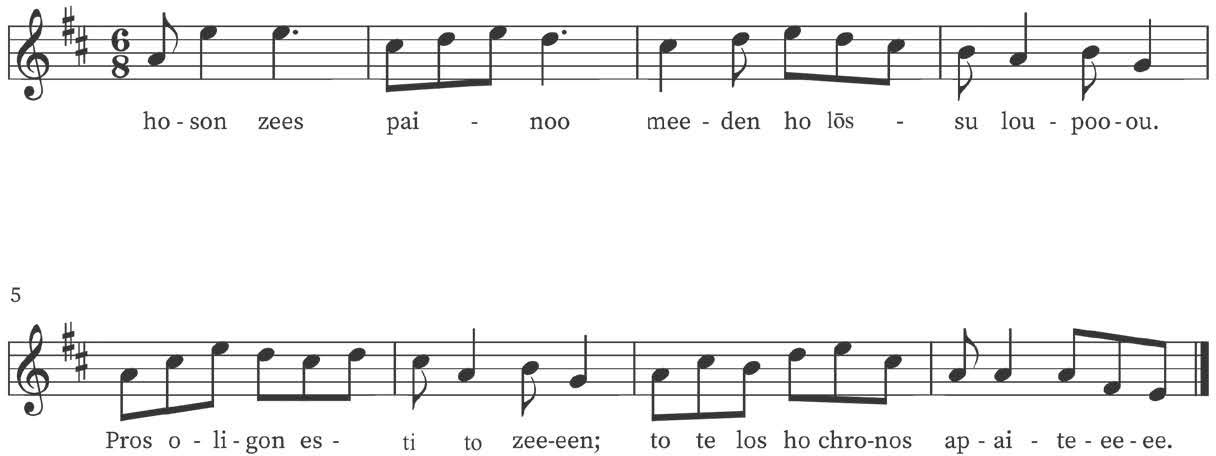
Fig. 10 Musical transcription of the Seikilos stele. Spencer Klavan.
The basic metre of this piece is iambic dimeter: two feet to each line with the arsis on the second half of each foot (˘ – : ˘ – | ˘ – : ˘ –). But some vowels have been stretched out to three morae (like ‘zēs’, ‘phai-’, and ‘-nou’ in the first line), and some of the places where there would normally be long syllables have been resolved into two shorts (like the ‘-oli-’ in pros oligon, ‘for a little while’). As long as each line has two feet of six morae each, with alternating arseis and theseis of three morae each, the pattern stays recognisable. And some of the irregularities help contribute to the mood: for instance, when the poet says that life only lasts ‘for a little while,’ the string of short syllables on pros oligon gives a sense of a swift little life rapidly tripping towards its conclusion. The artistry of the rhythm adds to the song’s poignant mood.
We can notice something else important about this epitaph, too. Even at this much later date and in this city far from Athens, people were still using the Greek scales and the Alypian system of notation. There are some differences in style – the tune is quite a bit simpler, for example, and the subtle quarter tones we talked about in the previous chapter seem to be falling out of fashion.4 But the basic tetrachords and rhythms of Greek music have stayed the same all over the Mediterranean. As we’ve seen throughout this book, Greek music found its way far from Greece and lasted for centuries after the heyday of Athens.
Appendix: vowel lengths
For those interested in the basic rules for which Greek vowels are long or short, here’s a rough-and-ready guide (there are more detailed suggestions in the ‘further reading’ section).
The long vowels are:
1.Omega (ω, capital Ω), which sounds roughly like the English ‘oh’ sound in the word ‘tone’ or ‘grow’ – written throughout this chapter as ‘ō.’
2.Eta (η, capital Η), which sounds roughly like the English ‘ay’ sound in ‘hay’ or ‘prey’ – written throughout this chapter as ‘ē.’
These vowels and the syllables containing them are always long, no matter where they appear in a sentence.
The short vowels are:
1.Epsilon (ε, capital Ε), which sounds roughly like the English ‘eh’ sound in ‘step’ or ‘get.’
2.Omicron (ο, capital Ο), which sounds roughly like the English ‘o’ sound in ‘hot’ or ‘not.’
These vowels are always short, but the syllables containing them may be long if they are followed by more than one consonant.
The changeable vowels are:
1.Iota (ι, capital Ι), which sounds roughly like the English ‘ih’ sound in ‘sit’ or ‘pin.’
•Iota is short in some words, like kurios (κύριος), ‘lord,’ and long in others, like sitos (σῖτος), ‘grain.’
2.Alpha (α, capital Α), which sounds roughly like the English ‘ah’ sound in ‘car’ or ‘art.’
•Alpha is short in some words, like patēr (πατήρ), ‘father,’ and long in others, like pas (πᾶς), ‘all.’
3.Upsilon (υ, capital Υ), which has a very thin ‘oo’ sound like the French tu or déjà vu.
•Upsilon is short in some words, like huper (ὑπέρ), ‘above,’ and long in others, like kurios (κύριος), ‘lord.’
Some further reading
Andrew Barker’s Greek Musical Writings Volume 2 (Cambridge: Cambridge University Press, 1989) contains a translation of Aristides Quintilianus’ On Music with a helpful introduction and notes (pp. 392–535). The sections which deal with rhythm are Book 1, Chapters 13–19.
The complicated issue of arsis, thesis, and which one represents which kind of emphasis, has been the object of much recent speculation. For an outline of the issues, an essay by Thomas J. Mathiesen called ‘Rhythm and Meter in Ancient Greek Music’ from the journal Music Theory Spectrum (volume 7, 1985, pp. 159–80) may be helpful. Tosca Lynch has recently challenged the traditional approach, however, by arguing that arsis was actually the point of greater emphasis: ‘Arsis and Thesis in Ancient Greek Rhythmics and Metrics’ (Classical Quarterly volume 66, 2016, pp. 491–513).
Stefan Hagel has also recently done some work analyzing the rhythmic notation found in a series of ancient music practice exercizes called ‘Bellerman’s Anonymi’ – see his essay, ‘Ancient Greek Rhythm’ in Quaderni Urbinati di Cultura Classica (volume 88, 2008, pp. 125–38).
For a very clear and accessible introduction to the most important rules of Greek metre, see Martin West’s Introduction to Greek Metre (Oxford: Clarendon Press, 1987). It’s an abridgement of his more comprehensive book, Greek Metre (Oxford: Oxford University Press, 1984), which is also excellent for more in-depth analysis.
Dionysius of Halicarnassus also wrote an essay On Literary Criticism in which he discusses the relationship between poetic metre and musical rhythm at some length – see especially his Chapter 17.