
Introduction, Commentary Notes and Vocabulary by Stephen Anderson
A Level: Book 4: 7–8
Introduction
Xenophon’s life
Xenophon, son of Gryllus, an Athenian, was born at some time around 430 BC. His family came from the deme of Erchia, a country district a little to the north-east of Athens, and must have been reasonably wealthy – certainly wealthy enough to provide the young Xenophon with a horse, so that at the age of 20 he could enlist in the cavalry – but there is no indication that it played any active role in the politics of the day.
In the dangerous climate of the early years of the Peloponnesian War (431–404 BC), it is likely that Gryllus and his family sought safety inside the city walls. Certainly Xenophon received his education in Athens, and in the course of it associated with, and was heavily influenced by, the philosopher Socrates. A story related by Diogenes Laertius tells how Socrates met the young Xenophon in a narrow alley, and blocking his path asked him where one might buy various goods. When Xenophon answered, he asked again where men could become honourable and virtuous. This time Xenophon had no answer, and Socrates said, ‘Follow me and learn’.
After some experience fighting in the cavalry in various campaigns during the closing years of the Peloponnesian War, Xenophon returned to Athens, and at this stage may have begun to flex his muscles as a writer. He was still in Athens during the rule of the Thirty Tyrants (404–403 BC), the tyrannical government imposed by Sparta after Athens’ defeat in the Peloponnesian War, and it is likely that, given his oligarchic sympathies, he played some part in fighting in the cavalry against the exiled democrats.
Although protected by an amnesty after the restoration of democracy in 403, Xenophon must now have found life in Athens rather uncomfortable. His big break came in 401 BC. At the invitation of his Boeotian friend Proxenus, he joined the mercenary forces enlisted by Cyrus the Younger in a campaign against his elder brother, Artaxerxes II, king of Persia. This ill-fated expedition, and the subsequent retreat of the Greeks under his own leadership, Xenophon was later to immortalize in his most famous work, the Anabasis, or ‘March Up-Country’.
Mercenary soldiers, it is worth saying, were never in short supply in the Greek world: there was almost always a war somewhere, there was no shortage of men for whom a love of adventure, poverty or poor home circumstances made professional soldiering an attractive proposition and, even when military service was seen as a duty in one’s home state, there were plenty of tyrants and foreign potentates ready to pay for such support. Cyrus was able to raise more than ten thousand Greeks for his attempt on his brother’s kingdom, including not only specialist Cretan archers and Rhodian slingers, but also considerable contingents of Spartans, Athenians, Arcadians, Achaeans, Boeotians and Thessalians.
At the end of the expedition, after some ultimately unsatisfactory service with Seuthes, king of Thrace, Xenophon eventually, in 399 BC, handed over the remnant of the ‘Cyreans’ to the Spartans, to help with their campaign to protect the Greek cities of Asia Minor against Persian aggression. He himself stayed with them and served successively under each of Thibron, Dercylidas and King Agesilaus.
In 394, Agesilaus was recalled to deal with rebellion on the part of Sparta’s allies. Xenophon came with him and fought alongside him at Coronea against Athens and Boeotia. This act of treachery led to his formal exile from Athens, unless, as some hold, this had already happened earlier, as a result either of his joining Cyrus’ expedition in the first place or of his continuing opposition to Artaxerxes.
Whatever, he was comfortably settled by the Spartans on a country estate at Scillus, near Olympia in Elis (see Anab.5.3.5 ff.), acting as Spartan proxenos in that area, and for the next twenty years or so enjoying country life and writing his books.
After the Battle of Leuctra (371 BC) Sparta lost her position as the pre-eminent state in Greece. Elis accordingly reclaimed the estate at Scillus, and Xenophon and his family were obliged to retire to Corinth. There, in all likelihood, despite the revocation of his banishment from Athens in c. 368, he stayed for the rest of his life, eventually dying in or around 354. It is recorded that his two sons fought for Athens at Mantinea in 362, Gryllus, the elder of them, dying in the course of the battle.
Xenophon’s works
Although his fame in antiquity was greatest as a philosopher and leader of mercenary soldiers, Xenophon can, with some justification, be counted a pretty prolific writer. All the works we know of, some fourteen of them, still survive, though we have only a vague sense of their relative chronologies. They may conveniently be divided into three loose categories: first, historical or quasi-historical narratives, secondly Socratic texts and thirdly a more miscellaneous group, itself containing inter alia a collection of technical treatises on subjects closely reflecting the author’s own interests and experience.
The historical narrative group contains (i) the Hellenica, a seven-book history of Greece from 411 to 362 BC, not in essence a single work, but rather a series of instalments eventually published together; (ii) the Anabasis, Xenophon’s account of Cyrus the Younger’s doomed campaign against his brother, King Artaxerxes II of Persia, and of the retreat of the Ten Thousand Greeks after the battle of Cunaxa; and (iii) the rather different Cyropaedia, a pseudo-historical account of the career of Cyrus the Great, founder of the Achaemenid Persian empire.
Even though his grasp of philosophy may never have been the strongest, Xenophon’s early association with Socrates, whom he greatly admired, is responsible for some four of his works: in the Apology he gives his own account of Socrates’ defence speech at his trial in Athens in 399 BC, a poor second, it has to be admitted, to Plato’s speech of the same name; the Memorabilia provides us with four books of reminiscences of Socrates, largely imaginary conversations which describe the philosopher’s character and some of his views; the Symposium recalls the discourse, both witty and serious, at an imaginary banquet at the House of Callias in c. 421 BC; and in the Oeconomicus, possibly the best of the Socratic works, the subject at issue is household and estate management, presented in the form of a dialogue between Socrates and two interlocutors. The second of these, Ischomachus, may well represent Xenophon himself.
In the third group, then, the treatise On Horsemanship offers equestrian training, the Hipparchicus deals with the duties of a cavalry commander, the Cynegeticus gives advice on hunting with hounds, and Ways and Means suggests practical ways of increasing public resources through commercial and industrial enterprises; whilst the Constitution of the Spartans provides an uncritical account of the system of government in Sparta, the Hieron consists of a dialogue between Hieron of Syracuse and the poet Simonides of Ceos, comparing the lot of the tyrant with that of the private citizen, and the Agesilaus gives us an encomium of the Spartan king with whom Xenophon served and whom he much admired.
A number of common factors can be seen to pervade the whole of Xenophon’s oeuvre, most significantly (i) the close relationship between the author’s writings and his own personal experience, (ii) a strong didactic thread particularly as regards matters of leadership and military skill, and (iii) an entirely conventional brand of morality, founded on an unquestioning belief in the gods and in the importance of omens and sacrifices: Xenophon is at his happiest, whether as leader, as teacher or as writer, when he is confident that he is acting, to use his own phrase, σὺν τοῖς θεοῖς.
The Anabasis
The Anabasis is easily the most famous of Xenophon’s works, thanks, in no small part, to its popularity as a school text: generations of schoolchildren have been alternatively delighted or bored rigid by its tales of soldiers advancing so many parasangs towards uninhabited villages, or by the analysis of how hard it was, when supplies ran short in the Arabian desert, to catch an ostrich for the pot, compared with the relative ease of outmanoeuvring a bustard. Its seven books constitute the first extended autobiographical work in ancient literature and the earliest military memoir in history. They recount the events of 401–399 BC, telling how Cyrus, the younger son of Darius II of Persia, led an army of Greek mercenary soldiers against his brother, King Artaxerxes, and how, after Cyrus’ defeat and death at the Battle of Cunaxa, Xenophon led his men back to the fringes of the Greek world through the mountainous deserts of Armenia.
The work’s date of composition remains uncertain; various theories have been advanced, but some time in the course of the 360s seems the most likely. And there were other accounts too of the same expedition: certainly we know of one by another of the Greek commanders, Sophaenetus of Stymphalus, and Xenophon himself (Hell. 3.1.2) tells us that the story was written up by one Themistogenes of Syracuse, though it is usually assumed that this is merely a pseudonym used by the author himself, perhaps so that he could present a rosy picture of his own role with minimal embarrassment.
Xenophon’s aim in writing the Anabasis may have been to tell his side of a controversial story, and, with an apparently objective, third-person account, to defend himself against criticisms of his leadership; he may have been trying to manipulate the Athenians who had exiled him, or the Spartans after their awkward dealings with the Ten Thousand on their arrival at Byzantium; or again he may have been trying to illustrate the overall weakness of the Persians as an encouragement to the Greeks to mount a panhellenic attack upon them. All these motives have been claimed, and all are possible: we cannot be sure. What is definite, however, is that we have in the Anabasis Xenophon’s own fresh, interesting and eminently readable account of an exciting adventure in which he himself took part: that is at least as important as any other more hypothetical consideration.
General summary
Book 1
After the death of King Darius and the accession of Artaxerxes, Cyrus gathers his army at Sardis and sets out ostensibly against the Pisidians, but in reality against his brother. At Thapsacus, on the River Euphrates, he reveals his true goal, and the Ten Thousand continue their march across the Arabian Desert. The traitor Orontas is captured and put to death and battle is eventually joined with the forces of Artaxerxes at Cunaxa. Cyrus is killed, the king plunders his brother’s camp and the Greeks repulse a Persian attack.
Book 2
On learning of Cyrus’ death, the Ten Thousand refuse to surrender to Artaxerxes and join forces with Ariaeus, Cyrus’ second-in-command. When a truce is suggested, the Greeks agree terms with Tissaphernes, the king’s envoy. However, after the retreat has begun, Ariaeus joins forces with Tissaphernes, and as suspicion grows between Greeks and Persians, Clearchus, now the de facto leader of the mercenaries, has what he considers a successful meeting with Tissaphernes. He is then invited a second time, with four other Greek commanders. All are seized and put to death, and the book ends with obituary notices for all five, Clearchus of Sparta, Proxenus of Boeotia, Meno of Thessaly, Agias of Arcadia and Socrates of Achaea.
Book 3
After initial despair in the Greek camp, Xenophon emerges as leader, and when new generals have been elected, the Ten Thousand resume their retreat, under attack from Persian cavalry and archers. Marching past Larisa and Mespila, still skirmishing with Persian troops they reach the hills, and when eventually caught between the River Tigris and difficult high ground, they decide not to try to cross the river on animal skins, as has been suggested, but rather to head into the Carduchian mountains.
Book 4
As the Greeks enter the mountains, the Carduchians abandon their villages and attack them from higher ground. The Ten Thousand, however, do eventually reach the plain on the other side and cross the River Centrites. They then continue their march, dealing with Tiribazus, governor of western Armenia, suffering hardship as they pass through the snow, facing opposition from troublesome locals and finally arriving at Gymnias, from where a guide leads them to a sight of the sea. After appropriate jubilation they move on, and eventually come to Trapezus on the shores of the Black Sea. Here they hold sacrifices and celebratory games.
[For a detailed summary of the A Level prescription, Anab, 4.5–8, see below.]
Book 5
Chirisophus now leaves to fetch ships, and the Ten Thousand proceed to Cerasus – and it is at this point that Xenophon gives us a fascinating flash-forward to his later life at Scillus. Then, resuming his story, he tells how the Greeks continue on their way and come to Cotyora; here they receive envoys from Sinope who advise them to complete their journey by sea. Xenophon briefly thinks of staying behind and founding a colony; he also defends himself against various allegations of misconduct which are brought against him.
Book 6
The Ten Thousand elect Chirisophus as supreme commander and sail to Heraclea. Here the Arcadians and Achaeans split from the rest of the army and the whole force marches or sails on in three separate groups. They are reunited, however, at Calpe Harbour, where there is trouble over supplies and some fighting with the cavalry of Pharnabazus, the local Persian satrap. Meanwhile Cleander, the Spartan governor of Byzantium, has arrived to bring help; but when a mini-riot breaks out among the men, he threatens to leave and to direct all Greek cities to refuse them assistance or shelter. Still, he is eventually placated and the Ten Thousand proceed on their way through Bithynia and arrive at Chrysopolis in Chalcedonia.
Book 7
When the Ten Thousand cross to Byzantium they are ordered out of the city. The Spartan admiral Anaxibius wants to take them back to Asia, but they decide to join up with Seuthes, king of Thrace. This doesn’t turn out well, as there are disputes over pay and Xenophon himself is charged with having received bribes. Eventually, the Spartans offer to employ the army, and sailing over to Lampsacus they make their way to Pergamum where they join the Spartan general Thibron.
Prescribed text: Anabasis 4.5–6 (English), 7–8 (Greek)
As well as containing the most famous and iconic scene in the whole Anabasis (the sighting of the sea), these four chapters give us useful examples of many of the main themes which pervade the whole work. In particular a spotlight is shone on Xenophon’s own qualities as a leader – his resourcefulness, strategic ability and his care for his men; and also on the types of problem which the Ten Thousand regularly have to surmount in the course of their long march – bad weather (snow), difficult terrain (rivers and mountains) and hostile local tribes (Chalybians, Taochians, Phasians, Macronians and Colchians). Again and again, from whatever difficulties appear in his path, Xenophon manages to emerge triumphant.
Book 4, Chapter 5
Determined to evade Tiribazus and his hostile attacks, the Greeks advance through heavy snow and wade across the River Euphrates. They continue their march across a plain covered with thick snow, making a sacrifice to the wind, in the hope that this will alleviate the weather conditions, and obliged to deal with those suffering from bulimia, not the modern eating disorder of the same name, but rather an extreme hunger that caused faintness, particularly prevalent in cold weather. Chirisophus at the head of the marching column, reaches a village and is able to spend the night there, but Xenophon and most of the army are forced to bivouac without fire or food.
On the next day they all meet up at the village where Chirisophus had spent the night, and separate divisions of the army are allotted to different villages. The underground dwellings of the village where Xenophon ends up, and whose headman promises to be their guide, are described in considerable detail.
The next day Xenophon and the village headman go for a meeting with Chirisophus. The Greeks discover that they are in Armenia. Xenophon then returns with the headman to his village and gives him a horse to be fattened up and sacrificed to the Sun God.
Book 4, Chapter 6
Some seven days later the Ten Thousand continue on their march with Chirisophus in the van and the village headman as guide. On the third day Chirisophus gets angry and strikes the headman; he then runs away the following night, but leaves behind his son, who had accompanied them.
After a week’s further march the Greeks come to and cross the River Phasis, and two days later they arrive at a mountain pass held by a force of Chalybians, Taochians and Phasians. Chirisophus, Cleanor and Xenophon joke with each other about whether Spartans or Athenians are the better thieves. Xenophon’s suggestion, that they seize the heights of the pass by night, meets with approval and is adopted with pleasing success: after only minor fighting on the next day, the enemy turn tail and flee, and the Greeks march down the other side to the plain where they find well-stocked villages, able to supply all their needs.
Book 4, Chapter 7
The Greeks arrive at a Taochian stronghold. As supplies are running low, they need to take this, but are currently prevented by the enemy rolling down huge stones and rocks upon them. Xenophon realizes that they can easily take the place if they can trick the enemy into using up all their rocks. This they do, helped by rivalry among some of the soldiers, and the hilltop is duly taken. Rather than submit to capture, the Taochians hurl themselves down from the clifftops.
The Ten Thousand then pass through the country of the Chalybians and crossing the River Harpasus march through Scythenian territory. On their arrival at the city of Gymnias, the local ruler sends them a guide who promises in five days to bring them within sight of the sea.
The Greeks are overjoyed by their sight of the sea from Mount Theches. Crying θάλαττα θάλαττα, they embrace one another in tears, build a cairn to mark the spot and send off their guide, suitably rewarded for his services.
Book 4, Chapter 8
While passing through Macronian territory, the Greeks arrive at a river crossing where a crowd of hostile locals blocks the way on the opposite bank. Still, a former slave who can speak their language negotiates successfully with them, and with their help the Greeks cross the river and advance to the Colchian border.
There the Colchians are drawn up against them on a mountain range. Xenophon’s plan now is that the Ten Thousand should advance on the enemy not in horizontal lines, but in vertical columns. This stratagem is successful, and the enemy are put to flight.
After scaling the mountain, the Greeks encamp in some villages where they encounter some poisonous honey. No one, however, dies, and after a march of two more days they eventually reach the sea at the city of Trapezus. Here sacrifices are made and athletic competitions are held to the great enjoyment of all.
Greece and Persia
The Achaemenid empire of Persia was one of the greatest and most important in the ancient world. It had been founded through the amalgamation of two earlier kingdoms, Media and Persia, by Cyrus the Great in 559 BC; its capital was at Susa, and it consisted of some twenty provinces, each under the control of its own governor or satrap. The satraps, then, were answerable to the king himself; and he kept watch over all their activities through his own agents, each known as ‘the King’s Eye’: Pseudartabas in Aristophanes’ Acharnians is a richly comic example. There was a highly developed network of roads stretching out in all directions from Susa, and a complex communications system, involving riders with fresh horses at various stages along the way, enabled the easy dissemination of information from the centre.
Existing side by side with this was the Greek world with its independent city-states, each with its own fighting force, and all regarding their Persian neighbours as βάρβαροι, non-Greek speakers of unintelligible gibberish. Relations between the two were never easy, certainly never completely friendly, but never entirely in conflict either. Hostilities were at their peak during the two so-called Persian Wars, in 490 and 480–479 BC. Even then, however, there were Greek cities, both in Asia Minor and on the mainland, which supported the Persian side; and the single most important architect of the Persian defeat at Salamis, the Athenian Themistocles, was able to end his days in a position of great honour in the retinue of Artaxerxes I, with whom he had sought refuge from his political enemies in Greece.
After 479, Persian policy was largely directed towards encouraging Greek cities to fight with one another, so ensuring that they remained as weak as possible: at the close of the Peloponnesian War Persia helped Sparta build a fleet with which it could oppose Athens; but when Sparta in turn became more powerful, the Persians then helped the Athenians rebuild their navy to be a match for their Peloponnesian opponents. Indeed, it was against the meddlesome interference of Persia with the Greek cities of Asia Minor that the Spartans were actively campaigning when, at Pergamum, Xenophon handed over to Thibron the remnant of the Ten Thousand Cyreans in 399 BC.
Xenophon’s language
Xenophon has long been famous for the straightforward, clear and elegant quality of his Greek. An Athenian, he wrote in Attic, but, because of his long absence from Athens, in a brand of Attic less akin to the pure dialect of Plato or the orators, and more influenced by both the usage and vocabulary of other parts of Greece.
His narrative style has a liveliness and fluency greatly admired by the critics of all ages. He achieves this in a number of readily identifiable ways:
(i) by avoiding a complex periodic structure, but rather writing in a sequence of simple sentences with parallel coordinate clauses;
(ii) by the regular use of direct speech;
(iii) by varying the tenses he uses, and in particular by pinpointing important moments by use of the historic present; cf. 4.7.24 – καὶ ἀναβὰς ἐφ᾽ ἵππον … παρεβοήθει· καὶ τάχα δὴ ἀκούουσι βοώντων τῶν στρατιωτῶν θάλαττα θάλαττα …;
(iv) by inventive word order, in particular by promoting finite verbs to an early position in their sentences, so that the action in question is given greater prominence; cf. 4.8.4 – ἔνθα δὴ προσέρχεται Ξενοφῶντι τῶν πελταστῶν ἀνὴρ Ἀθήνησι φάσκων δεδουλευκέναι (also a significant historic present);
(v) by the occasional omission of a verbal form; cf. 4.7.3 – τὸ γὰρ χωρίον αἱρετέον, where ἐστί is left out, or 4.8.20 – ἀλλ᾽ οἱ μὲν ὀλίγον ἐδηδοκότες σφόδρα μεθύουσιν ἐῴκεσαν, οἱ δὲ πολὺ μαινομένοις, οἱ δὲ καὶ ἀποθνῄσκουσιν, where ἐδηδοκότες must be understood with πολύ, and ἐῴκεσαν with both μαινομένοις and ἀποθνῄσκουσιν.
On the whole Xenophon avoids writing in a markedly rhetorical way. Still, various devices are common to all or virtually all Greek prose authors, and Xenophon is no exception. A few examples from the prescribed portion of text are:
(i) anaphora: repetition, particularly of the same word in a significant position; cf. 4.8.19 – ἐν πολλαῖς κώμαις καὶ τἀπιτήδεια πολλὰ ἐχούσαις ;
(ii) polyptoton: the close repetition of the same word in different grammatical forms; cf. 4.8.19 – ἀλλὰ φυγῇ ἄλλος ἄλλῃ ἐτράπετο ;
(iii) balance, often with μὲν … δέ: cf. 4.8.2 – ἦν δὲ οὗτος δασὺς δένδρεσι παχέσι μὲν οὔ, πυκνοῖς δέ ; 4.8.9 – καὶ τὸ μὲν πρῶτον οἱ Ἕλληνες … ἔπειτα δὲ ἔδοξε τοῖς στρατηγοῖς ; 4.8.17 – οἱ μὲν ἐπὶ τὸ δεξιὸν οἱ δὲ ἐπὶ τὸ εὐώνυμον διεσπάσθησαν ;
(iv) hyperbaton, where emphasis is created by a disturbance of normal word order; cf. 4.7.1 – χωρία γὰρ ᾤκουν ἰσχυρὰ οἱ Τάοχοι ;
(v) use of particles: though not all are found in the prescribed passage, Xenophon is particularly fond of δή, καὶ … δή, τε καί and μέντοι; cf. 4.7.4 – ἐνταῦθα δὴ κοινῇ ἐβουλεύοντο ; the first two of these, especially by putting the words around them in higher profile, serve to pinpoint important moments in the story ;
(vi) asyndeton (the omission of connecting particles and conjunctions): cf. 4.7.18 – ἐκ τούτων οἱ Ἕλληνες ἀφίκοντο (at the beginning of a sentence) and at the start of the next sentence, ἐντεῦθεν ἐπορεύθησαν διὰ Σκυθηνῶν. We might have expected – ἐκ δὲ τούτων οἱ Ἕλληνες ἀφίκοντο and καὶ ἐντεῦθεν ἐπορεύθησαν διὰ Σκυθηνῶν. Here the effect is to add urgency and rapidity to the narrative.
A few of Xenophon’s usages are at odds with the normal Attic practice. Not all are exemplified in the prescribed passage, but they are included here for the sake of completeness:
(i) ὡς and ὡς ἄν in place of ὅπως and ὅπως ἄν introducing purpose clauses and after verbs of precaution;
(ii) a fondness for the optative which makes him more likely than other writers to use it when he might have had the more vivid indicative or subjunctive: cf. 4.7.19 – ἡγεμόνα πέμπει, ὅπως διὰ τῆς ἑαυτῶν πολεμίας χώρας ἄγοι αὐτούς, where especially after the historic present he might have had the subjunctive ἄγῃ ; 4.8.4 – λέγων ὅτι γιγνώσκοι τὴν φωνὴν τῶν ἀνθρώπων, where another writer might well have had a present indicative in the indirect statement.
(iii) ὡς in place of ὥστε + infinitive or indicative in consecutive clauses;
(iv) some prepositional usages: σύν + dative instead of μετά + genitive; cf. 4.8.16 – καὶ Χειρίσοφος μὲν καὶ Ξενοφῶν καὶ οἱ σὺν αὐτοῖς πελτασταὶ …; ἀνά and ἀμφί which are rarely found in Attic authors; cf. 4.8.21 – ἀμφὶ δὲ τὴν αὐτήν πως ὥραν; and ἐκ, παρά and πρός + genitive with passive verbs (Attic usually has ὑπό);
(v) words and forms not usually found in Attic prose; cf. 4.7.16 – ὅσον ξυήλην Λακωνικήν (‘a Laconian dagger’); 4.8.5 – ἀντιτετάχαται (Ionic for ἀντιτεταγμένοι εἰσίν).
Further reading
Texts, editions and translations
Antrich, J. and Usher, S. Xenophon, The Persian Expedition (BCP, 1978).
*Brownson, C.L. revised Dillery, J. Xenophon: Anabasis (Loeb, Harvard University Press, 1998).
Marchant, E.C. Xenophontis Opera Omnia, Tomus III, Expeditio Cyri (Oxford, OCT, 1904).
Mather, M.W. and Hewitt, J.W. Xenophon’s Anabasis, Books I–IV (University of Oklahoma Press, 1962).
*Warner, R. Xenophon: The Persian Expedition (Penguin, 1972).
*Waterfield, R. Xenophon: The Expedition of Cyrus (Oxford, Oxford World’s Classics, 2005).
*= translation
Xenophon
Anderson, J.K. Xenophon (London, Duckworth, 1974).
Flower, M.A. (ed.) The Cambridge Companion to Xenophon (Cambridge, Cambridge University Press, 2017).
Gray, V.J. (ed.) Oxford Readings in Classical Studies: Xenophon (Oxford, Oxford University Press, 2010).
The Anabasis
Cawkwell, G.L. ‘Introduction’, in Xenophon: The Persian Expedition, trans. R Warner (Penguin, 1972).
Lane Fox, R. (ed.) The Long March: Xenophon and the Ten Thousand (New Haven, Yale University Press, 2004).
Parker, R.C.T. ‘One Man’s Piety: The Religious Dimension of the Anabasis’, in R. Lane Fox (ed.), The Long March (New Haven, Yale University Press, 2004).
Rood, T.C.B. The Sea! The Sea! The Shout of the Ten Thousand in the Modern Imagination (London, Duckworth, 2004).
Rood, T.C.B. ‘Introduction’, in Xenophon: The Expedition of Cyrus, trans. R. Waterfield (Oxford, Oxford University Press, 2005).
Waterfield, R. Xenophon’s Retreat: Greece, Persia and the End of the Golden Age (London, WCIN, 2006).
Mercenary soldiers
Parke, H.W. Greek Mercenary Soldiers: From the Earliest Times to the Battle of Ipsus (Oxford, Clarendon Press, 1933).
Roy, J. ‘The Ambitions of a Mercenary’, in R. Lane Fox (ed.), The Long March (New Haven, Yale University Press, 2004).
Persia
Brosius, M. (trans. and ed.) The Persian Empire from Cyrus II to Artaxerxes I (London, LACTOR 16, 2000).
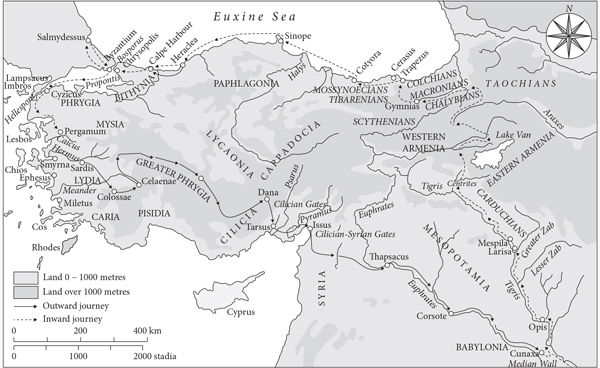
Map The route taken by Xenophon and the Ten Thousand through Persia
Text
|
7 |
||
|
ἐκ δὲ τούτων ἐπορεύθησαν εἰς Ταόχους σταθμοὺς πέντε παρασάγγας τριάκοντα· καὶ τὰ ἐπιτήδεια ἐπέλειπε· χωρία γὰρ ᾤκουν ἰσχυρὰ οἱ Τάοχοι, ἐν οἷς καὶ τὰ ἐπιτήδεια ἅπαντα εἶχον ἀνακεκομισμένοι. ἐπεὶ δ᾽ ἀφίκοντο πρὸς χωρίον ὃ πόλιν μὲν οὐκ εἶχεν οὐδ᾽ οἰκίας - συνεληλυθότες δ᾽ ἦσαν αὐτόσε καὶ ἄνδρες καὶ γυναῖκες καὶ κτήνη πολλά - Χειρίσοφος μὲν οῖν πρὸς τοῦτο προσέβαλλεν εὐθὺς ἥκων· ἐπειδὴ δὲ ἡ πρώτη τάξις ἀπέκαμνεν, ἄλλη προσῄει καὶ αῖθις ἄλλη· οὐ γὰρ ἦν ἁθρόοις περιστῆναι, ἀλλ᾽ ἀπότομον ἦν κύκλῳ. ἐπειδὴ δὲ Ξενοφῶν ἦλθε σὺν τοῖς ὀπισθοφύλαξι καὶ πελτασταῖς καὶ ὁπλίταις, ἐνταῦθα δὴ λέγει Χειρίσοφος· “εἰς καλὸν ἥκετε· τὸ γὰρ χωρίον αἱρετέον· τῇ γὰρ στρατιᾷ οὐκ ἔστι τὰ ἐπιτήδεια, εἰ μὴ ληψόμεθα τὸ χωρίον.” ἐνταῦθα δὴ κοινῇ ἐβουλεύοντο· καὶ τοῦ Ξενοφῶντος ἐρωτῶντος τί τὸ κωλῦον εἴη εἰσελθεῖν, εἶπεν ὁ Χειρίσοφος· “μία αὕτη πάροδός ἐστιν ἣν ὁρᾷς· ὅταν δέ τις ταύτῃ πειρᾶται παριέναι, κυλίνδουσι λίθους ὑπὲρ ταύτης τῆς ὑπερεχούσης πέτρας· ὃς δ᾽ ἂν καταληφθῇ, οὕτω διατίθεται.” ἅμα δ᾽ ἔδειξε συντετριμμένους ἀνθρώπους καὶ σκέλη καὶ πλευράς. “ἢν δὲ τοὺς λίθους ἀναλώσωσιν,” ἔφη ὁ Ξενοφῶν, “ἄλλο τι ἢ οὐδὲν κωλύει παριέναι; οὐ γὰρ δὴ ἐκ τοῦ ἐναντίου ὁρῶμεν εἰ μὴ ὀλίγους τούτους ἀνθρώπους, καὶ τούτων δύο ἢ τρεῖς ὡπλισμένους. τὸ δὲ χωρίον, ὡς καὶ σὺ ὁρᾷς, σχεδὸν τρία ἡμίπλεθρά ἐστιν ὃ δεῖ βαλλομένους διελθεῖν· τούτου δὲ ὅσον πλέθρον δασὺ πίτυσι διαλειπούσαις μεγάλαις, ἀνθ᾽ ὧν ἑστηκότες ἄνδρες τί ἂν πάσχοιεν ἢ ὑπὸ τῶν φερομένων λίθων ἢ ὑπὸ τῶν κυλινδομένων; τὸ λοιπὸν οῖν γίγνεται ὡς ἡμίπλεθρον, ὃ δεῖ ὅταν λωφήσωσιν οἱ λίθοι παραδραμεῖν.” “ἀλλὰ εὐθύς,” ἔφη ὁ Χειρίσοφος, “ἐπειδὰν ἀρξώμεθα εἰς τὸ δασὺ προσιέναι, φέρονται οἱ λίθοι πολλοί.” “αὐτὸ ἄν,” ἔφη, “τὸ δέον εἴη· θᾶττον γὰρ ἀναλώσουσι τοὺς λίθους. ἀλλὰ πορευώμεθα ἔνθεν ἡμῖν μικρόν τι παραδραμεῖν ἔσται, ἢν δυνώμεθα, καὶ ἀπελθεῖν ῥᾴδιον, ἢν βουλώμεθα.” |
2 3 4 5 6 7 |
|
|
ἐντεῦθεν ἐπορεύοντο Χειρίσοφος καὶ Ξενοφῶν καὶ Καλλίμαχος Παρράσιος λοχαγός· τούτου γὰρ ἡ ἡγεμονία ἦν τῶν ὀπισθοφυλάκων λοχαγῶν ἐκείνῃ τῇ ἡμέρᾳ· οἱ δὲ ἄλλοι λοχαγοὶ ἔμενον ἐν τῷ ἀσφαλεῖ. μετὰ τοῦτο οῖν ἀπῆλθον ὑπὸ τὰ δένδρα ἄνθρωποι ὡς ἑβδομήκοντα, οὐχ ἁθρόοι ἀλλὰ καθ᾽ ἕνα, ἕκαστος φυλαττόμενος ὡς ἐδύνατο. Ἀγασίας δὲ ὁ Στυμφάλιος καὶ Ἀριστώνυμος Μεθυδριεύς, καὶ οὗτοι τῶν ὀπισθοφυλάκων λοχαγοὶ ὄντες, καὶ ἄλλοι δέ, ἐφέστασαν ἔξω τῶν δένδρων· οὐ γὰρ ἦν ἀσφαλῶς ἐν τοῖς δένδροις ἑστάναι πλέον ἢ τὸν ἕνα λόχον. ἔνθα δὴ Καλλίμαχος μηχανᾶταί τι· προύτρεχεν ἀπὸ τοῦ δένδρου ὑφ᾽ ᾧ ἦν αὐτὸς δύο ἢ τρία βήματα· ἐπειδὴ δὲ οἱ λίθοι φέροιντο, ἀνέχαζεν εὐπετῶς· ἐφ᾽ ἑκάστης δὲ τῆς προδρομῆς πλέον ἢ δέκα ἅμαξαι πετρῶν ἀνηλίσκοντο. ὁ δὲ Ἀγασίας ὡς ὁρᾷ τὸν Καλλίμαχον ἃ ἐποίει τὸ στράτευμα πᾶν θεώμενον, δείσας μὴ οὐ πρῶτος παραδράμῃ εἰς τὸ χωρίον, οὐδὲ τὸν Ἀριστώνυμον πλησίον ὄντα παρακαλέσας οὐδὲ Εὐρύλοχον τὸν Λουσιέα, ἑταίρους ὄντας, οὐδὲ ἄλλον οὐδένα χωρεῖ αὐτός, καὶ παρέρχεται πάντας. ὁ δὲ Καλλίμαχος ὡς ὁρᾷ αὐτὸν παριόντα, ἐπιλαμβάνεται αὐτοῦ τῆς ἴτυος· ἐν δὲ τούτῳ παραθεῖ αὐτοὺς Ἀριστώνυμος Μεθυδριεύς, καὶ μετὰ τοῦτον Εὐρύλοχος Λουσιεύς· πάντες γὰρ οὗτοι ἀντεποιοῦντο ἀρετῆς καὶ διηγωνίζοντο πρὸς ἀλλήλους· καὶ οὕτως ἐρίζοντες αἱροῦσι τὸ χωρίον. ὡς γὰρ ἅπαξ εἰσέδραμον, οὐδεὶς πέτρος ἄνωθεν ἠνέχθη. ἐνταῦθα δὴ δεινὸν ἦν θέαμα. αἱ γὰρ γυναῖκες ῥίπτουσαι τὰ παιδία εἶτα ἑαυτὰς ἐπικατερρίπτουν, καὶ οἱ ἄνδρες ὡσαύτως. ἐνταῦθα δὴ καὶ Αἰνείας Στυμφάλιος λοχαγὸς ἰδών τινα θέοντα ὡς ῥίψοντα ἑαυτὸν στολὴν ἔχοντα καλὴν ἐπιλαμβάνεται ὡς κωλύσων· ὁ δὲ αὐτὸν ἐπισπᾶται, καὶ ἀμφότεροι ᾤχοντο κατὰ τῶν πετρῶν φερόμενοι καὶ ἀπέθανον. ἐντεῦθεν ἄνθρωποι μὲν πάνυ ὀλίγοι ἐλήφθησαν, βόες δὲ καὶ ὄνοι πολλοὶ καὶ πρόβατα. |
8 9 10 11 12 13 14 |
|
|
ἐντεῦθεν ἐπορεύθησαν διὰ Χαλύβων σταθμοὺς ἑπτὰ παρασάγγας πεντήκοντα. οὗτοι ἦσαν ὧν διῆλθον ἀλκιμώτατοι, καὶ εἰς χεῖρας ᾖσαν. εἶχον δὲ θώρακας λινοῦς μέχρι τοῦ ἤτρου, ἀντὶ δὲ τῶν πτερύγων σπάρτα πυκνὰ ἐστραμμένα. εἶχον δὲ καὶ κνημῖδας καὶ κράνη καὶ παρὰ τὴν ζώνην μαχαίριον ὅσον ξυήλην Λακωνικήν, ᾧ ἔσφαττον ὧν κρατεῖν δύναιντο, καὶ ἀποτεμόντες ἂν τὰς κεφαλὰς ἔχοντες ἐπορεύοντο, καὶ ᾖδον καὶ ἐχόρευον ὁπότε οἱ πολέμιοι αὐτοὺς ὄψεσθαι ἔμελλον. εἶχον δὲ καὶ δόρυ ὡς πεντεκαίδεκα πήχεων μίαν λόγχην ἔχον. οὗτοι ἐνέμενον ἐν τοῖς πολίσμασιν· ἐπεὶ δὲ παρέλθοιεν οἱ Ἕλληνες, εἵποντο ἀεὶ μαχούμενοι. ᾤκουν δὲ ἐν τοῖς ὀχυροῖς, καὶ τὰ ἐπιτήδεια ἐν τούτοις ἀνακεκομισμένοι ἦσαν· ὥστε μηδὲν λαμβάνειν αὐτόθεν τοὺς Ἕλληνας, ἀλλὰ διετράφησαν τοῖς κτήνεσιν ἃ ἐκ τῶν Ταόχων ἔλαβον. ἐκ τούτων οἱ Ἕλληνες ἀφίκοντο ἐπὶ Ἅρπασον ποταμόν, εῖρος τεττάρων πλέθρων. ἐντεῦθεν ἐπορεύθησαν διὰ Σκυθηνῶν σταθμοὺς τέτταρας παρασάγγας εἴκοσι διὰ πεδίου εἰς κώμας· ἐν αἷς ἔμειναν ἡμέρας τρεῖς καὶ ἐπεσιτίσαντο. |
15 16 17 18 |
|
|
ἐντεῦθεν διῆλθον σταθμοὺς τέτταρας παρασάγγας εἴκοσι πρὸς πόλιν μεγάλην καὶ εὐδαίμονα καὶ οἰκουμένην ἣ ἐκαλεῖτο Γυμνιάς. ἐκ ταύτης ὁ τῆς χώρας ἄρχων τοῖς Ἕλλησιν ἡγεμόνα πέμπει, ὅπως διὰ τῆς ἑαυτῶν πολεμίας χώρας ἄγοι αὐτούς. ἐλθὼν δ᾽ ἐκεῖνος λέγει ὅτι ἄξει αὐτοὺς πέντε ἡμερῶν εἰς χωρίον ὅθεν ὄψονται θάλατταν· εἰ δὲ μή, τεθνάναι ἐπηγγείλατο. καὶ ἡγούμενος ἐπειδὴ ἐνέβαλλεν εἰς τὴν πολεμίαν, παρεκελεύετο αἴθειν καὶ φθείρειν τὴν χώραν· ᾧ καὶ δῆλον ἐγένετο ὅτι τούτου ἕνεκα ἔλθοι, οὐ τῆς τῶν Ἑλλήνων εὐνοίας. |
19 20 |
|
|
καὶ ἀφικνοῦνται ἐπὶ τὸ ὄρος τῇ πέμπτῃ ἡμέρᾳ· ὄνομα δὲ τῷ ὄρει ἦν Θήχης. ἐπεὶ δὲ οἱ πρῶτοι ἐγένοντο ἐπὶ τοῦ ὄρους καὶ κατεῖδον τὴν θάλατταν, κραυγὴ πολλὴ ἐγένετο. ἀκούσας δὲ ὁ Ξενοφῶν καὶ οἱ ὀπισθοφύλακες ᾠήθησαν ἔμπροσθεν ἄλλους ἐπιτίθεσθαι πολεμίους· εἵποντο γὰρ καὶ ὄπισθεν ἐκ τῆς καιομένης χώρας, καὶ αὐτῶν οἱ ὀπισθοφύλακες ἀπέκτεινάν τέ τινας καὶ ἐζώγρησαν ἐνέδραν ποιησάμενοι, καὶ γέρρα ἔλαβον δασειῶν βοῶν ὠμοβόεια ἀμφὶ τὰ εἴκοσιν. ἐπειδὴ δὲ βοὴ πλείων τε ἐγίγνετο καὶ ἐγγύτερον καὶ οἱ ἀεὶ ἐπιόντες ἔθεον δρόμῳ ἐπὶ τοὺς ἀεὶ βοῶντας καὶ πολλῷ μείζων ἐγίγνετο ἡ βοὴ ὅσῳ δὴ πλείους ἐγίγνοντο, ἐδόκει δὴ μεῖζόν τι εἶναι τῷ Ξενοφῶντι, καὶ ἀναβὰς ἐφ᾽ ἵππον καὶ Λύκιον καὶ τοὺς ἱππέας ἀναλαβὼν παρεβοήθει· καὶ τάχα δὴ ἀκούουσι βοώντων τῶν στρατιωτῶν “θάλαττα θάλαττα” καὶ παρεγγυώντων. ἔνθα δὴ ἔθεον πάντες καὶ οἱ ὀπισθοφύλακες, καὶ τὰ ὑποζύγια ἠλαύνετο καὶ οἱ ἵπποι. ἐπεὶ δὲ ἀφίκοντο πάντες ἐπὶ τὸ ἄκρον, ἐνταῦθα δὴ περιέβαλλον ἀλλήλους καὶ στρατηγοὺς καὶ λοχαγοὺς δακρύοντες. καὶ ἐξαπίνης ὅτου δὴ παρεγγυήσαντος οἱ στρατιῶται φέρουσι λίθους καὶ ποιοῦσι κολωνὸν μέγαν. ἐνταῦθα ἀνετίθεσαν δερμάτων πλῆθος ὠμοβοείων καὶ βακτηρίας καὶ τὰ αἰχμάλωτα γέρρα, καὶ ὁ ἡγεμὼν αὐτός τε κατέτεμνε τὰ γέρρα καὶ τοῖς ἄλλοις διεκελεύετο. μετὰ ταῦτα τὸν ἡγεμόνα οἱ Ἕλληνες ἀποπέμπουσι δῶρα δόντες ἀπὸ κοινοῦ ἵππον καὶ φιάλην ἀργυρᾶν καὶ σκευὴν Περσικὴν καὶ δαρεικοὺς δέκα∙ ᾔτει δὲ μάλιστα τοὺς δακτυλίους, καὶ ἔλαβε πολλοὺς παρὰ τῶν στρατιωτῶν. κώμην δὲ δείξας αὐτοῖς οὗ σκηνήσουσι καὶ τὴν ὁδὸν ἣν πορεύσονται εἰς Μάκρωνας, ἐπεὶ ἑσπέρα ἐγένετο, ᾤχετο τῆς νυκτὸς ἀπιών. |
21 22 23 24 25 26 27 |
|
|
8 |
||
|
ἐντεῦθεν δ᾽ ἐπορεύθησαν οἱ Ἕλληνες διὰ Μακρώνων σταθμοὺς τρεῖς παρασάγγας δέκα. τῇ πρώτῃ δὲ ἡμέρᾳ ἀφίκοντο ἐπὶ τὸν ποταμὸν ὃς ὥριζε τὴν τῶν Μακρώνων καὶ τὴν τῶν Σκυθηνῶν. εἶχον δ᾽ ὑπὲρ δεξιῶν χωρίον οἷον χαλεπώτατον καὶ ἐξ ἀριστερᾶς ἄλλον ποταμόν, εἰς ὃν ἐνέβαλλεν ὁ ὁρίζων, δι᾽ οὗ ἔδει διαβῆναι. ἦν δὲ οὗτος δασὺς δένδρεσι παχέσι μὲν οὔ, πυκνοῖς δέ. ταῦτ᾽ ἐπεὶ προσῆλθον οἱ Ἕλληνες ἔκοπτον, σπεύδοντες ἐκ τοῦ χωρίου ὡς τάχιστα ἐξελθεῖν. οἱ δὲ Μάκρωνες ἔχοντες γέρρα καὶ λόγχας καὶ τριχίνους χιτῶνας κατ᾽ ἀντιπέραν τῆς διαβάσεως παρατεταγμένοι ἦσαν καὶ ἀλλήλοις διεκελεύοντο καὶ λίθους εἰς τὸν ποταμὸν ἔρριπτον· ἐξικνοῦντο γὰρ οὒ οὐδ᾽ ἔβλαπτον οὐδέν. |
2 3 |
|
|
ἔνθα δὴ προσέρχεται Ξενοφῶντι τῶν πελταστῶν ἀνὴρ Ἀθήνησι φάσκων δεδουλευκέναι, λέγων ὅτι γιγνώσκοι τὴν φωνὴν τῶν ἀνθρώπων. “καὶ οἶμαι,” ἔφη, “ἐμὴν ταύτην πατρίδα εἶναι· καὶ εἰ μή τι κωλύει, ἐθέλω αὐτοῖς διαλεχθῆναι.” “ ἀλλ᾽ οὐδὲν κωλύει,” ἔφη, “ἀλλὰ διαλέγου καὶ μάθε πρῶτον τίνες εἰσίν.” οἱ δ᾽ εἶπον ἐρωτήσαντος ὅτι Μάκρωνες. “ἐρώτα τοίνυν,” ἔφη, “αὐτοὺς τί ἀντιτετάχαται καὶ χρῄζουσιν ἡμῖν πολέμιοι εἶναι.” οἱ δ᾽ἀπεκρίναντο “ὅτι καὶ ὑμεῖς ἐπὶ τὴν ἡμετέραν χώραν ἔρχεσθε.” λέγειν ἐκέλευον οἱ στρατηγοὶ ὅτι οὐ κακῶς γε ποιήσοντες, ἀλλὰ βασιλεῖ πολεμήσαντες ἀπερχόμεθα εἰς τὴν Ἑλλάδα, καὶ ἐπὶ θάλατταν βουλόμεθα ἀφικέσθαι. ἠρώτων ἐκεῖνοι εἰ δοῖεν ἂν τούτων τὰ πιστά. οἱ δ᾽ ἔφασαν καὶ δοῦναι καὶ λαβεῖν ἐθέλειν. ἐντεῦθεν διδόασιν οἱ Μάκρωνες βαρβαρικὴν λόγχην τοῖς Ἕλλησιν, οἱ δὲ Ἕλληνες ἐκείνοις Ἑλληνικήν· ταῦτα γὰρ ἔφασαν πιστὰ εἶναι· θεοὺς δ᾽ ἐπεμαρτύραντο ἀμφότεροι. |
4 5 6 7 |
|
|
μετὰ δὲ τὰ πιστὰ εὐθὺς οἱ Μάκρωνες τὰ δένδρα συνεξέκοπτον τήν τε ὁδὸν ὡδοποίουν ὡς διαβιβάσοντες ἐν μέσοις ἀναμεμιγμένοι τοῖς Ἕλλησι, καὶ ἀγορὰν οἵαν ἐδύναντο παρεῖχον, καὶ παρήγαγον ἐν τρισὶν ἡμέραις ἕως ἐπὶ τὰ Κόλχων ὅρια κατέστησαν τοὺς Ἕλληνας. ἐνταῦθα ἦν ὄρος μέγα, προσβατὸν δέ· καὶ ἐπὶ τούτου οἱ Κόλχοι παρατεταγμένοι ἦσαν. καὶ τὸ μὲν πρῶτον οἱ Ἕλληνες ἀντιπαρετάξαντο φάλαγγα, ὡς οὕτως ἄξοντες πρὸς τὸ ὄρος∙ ἔπειτα δὲ ἔδοξε τοῖς στρατηγοῖς βουλεύσασθαι συλλεγεῖσιν ὅπως ὡς κάλλιστα ἀγωνιοῦνται. ἔλεξεν οῖν Ξενοφῶν ὅτι δοκοίη παύσαντας τὴν φάλαγγα λόχους ὀρθίους ποιῆσαι· “ἡ μὲν γὰρ φάλαγξ διασπασθήσεται εὐθύς· τῇ μὲν γὰρ ἄνοδον τῇ δὲ εὔοδον εὑρήσομεν τὸ ὄρος· καὶ εὐθὺς τοῦτο ἀθυμίαν ποιήσει ὅταν τεταγμένοι εἰς φάλαγγα ταύτην διεσπασμένην ὁρῶσιν. ἔπειτα ἢν μὲν ἐπὶ πολλῶν τεταγμένοι προσάγωμεν, περιττεύσουσιν ἡμῶν οἱ πολέμιοι καὶ τοῖς περιττοῖς χρήσονται ὅ τι ἂν βούλωνται· ἐὰν δὲ ἐπ᾽ ὀλίγων τεταγμένοι ὦμεν, οὐδὲν ἂν εἴη θαυμαστὸν εἰ διακοπείη ἡμῶν ἡ φάλαγξ ὑπὸ ἁθρόων καὶ βελῶν καὶ ἀνθρώπων πολλῶν ἐμπεσόντων· εἰ δέ πῃ τοῦτο ἔσται, τῇ ὅλῃ φάλαγγι κακὸν ἔσται. ἀλλά μοι δοκεῖ ὀρθίους τοὺς λόχους ποιησαμένους τοσοῦτον χωρίον κατασχεῖν διαλιπόντας τοῖς λόχοις ὅσον ἔξω τοὺς ἐσχάτους λόχους γενέσθαι τῶν πολεμίων κεράτων· καὶ οὕτως ἐσόμεθα τῆς τε τῶν πολεμίων φάλαγγος ἔξω οἱ ἔσχατοι λόχοι, καὶ ὀρθίους ἄγοντες οἱ κράτιστοι ἡμῶν πρῶτοι προσίασιν, ᾗ τε ἂν εὔοδον ᾖ, ταύτῃ ἕκαστος ἄξει ὁ λόχος. καὶ εἴς τε τὸ διαλεῖπον οὐ ῥᾴδιον ἔσται τοῖς πολεμίοις εἰσελθεῖν ἔνθεν καὶ ἔνθεν λόχων ὄντων, διακόψαι τε οὐ ῥᾴδιον ἔσται λόχον ὄρθιον προσιόντα. ἄν τέ τις πιέζηται τῶν λόχων, ὁ πλησίον βοηθήσει. ἤν τε εἷς πῃ δυνηθῇ τῶν λόχων ἐπὶ τὸ ἄκρον ἀναβῆναι, οὐδεὶς μηκέτι μείνῃ τῶν πολεμίων.” ταῦτα ἔδοξε, καὶ ἐποίουν ὀρθίους τοὺς λόχους. Ξενοφῶν δὲ ἀπιὼν ἐπὶ τὸ εὐώνυμον ἀπὸ τοῦ δεξιοῦ ἔλεγε τοῖς στρατιώταις· “ἄνδρες, οὗτοί εἰσιν οὓς ὁρᾶτε μόνοι ἔτι ἡμῖν ἐμποδὼν τὸ μὴ ἤδη εἶναι ἔνθα πάλαι σπεύδομεν· τούτους, ἤν πως δυνώμεθα, καὶ ὠμοὺς δεῖ καταφαγεῖν.” |
8 9 10 11 12 13 14 |
|
|
ἐπεὶ δ᾽ ἐν ταῖς χώραις ἕκαστοι ἐγένοντο καὶ τοὺς λόχους ὀρθίους ἐποιήσαντο, ἐγένοντο μὲν λόχοι τῶν ὁπλιτῶν ἀμφὶ τοὺς ὀγδοήκοντα, ὁ δὲ λόχος ἕκαστος σχεδὸν εἰς τοὺς ἑκατόν· τοὺς δὲ πελταστὰς καὶ τοὺς τοξότας τριχῇ ἐποιήσαντο, τοὺς μὲν τοῦ εὐωνύμου ἔξω, τοὺς δὲ τοῦ δεξιοῦ, τοὺς δὲ κατὰ μέσον, σχεδὸν ἑξακοσίους ἑκάστους. ἐκ τούτου παρηγγύησαν οἱ στρατηγοὶ εὔχεσθαι∙ εὐξάμενοι δὲ καὶ παιανίσαντες ἐπορεύοντο. καὶ Χειρίσοφος μὲν καὶ Ξενοφῶν καὶ οἱ σὺν αὐτοῖς πελτασταὶ τῆς τῶν πολεμίων φάλαγγος ἔξω γενόμενοι ἐπορεύοντο· οἱ δὲ πολέμιοι ὡς εἶδον αὐτούς, ἀντιπαραθέοντες οἱ μὲν ἐπὶ τὸ δεξιὸν οἱ δὲ ἐπὶ τὸ εὐώνυμον διεσπάσθησαν, καὶ πολὺ τῆς αὑτῶν φάλαγγος ἐν τῷ μέσῳ κενὸν ἐποίησαν. οἱ δὲ κατὰ τὸ Ἀρκαδικὸν πελτασταί, ὧν ἦρχεν Αἰσχίνης ὁ Ἀκαρνάν, νομίσαντες φεύγειν ἀνακραγόντες ἔθεον· καὶ οὗτοι πρῶτοι ἐπὶ τὸ ὄρος ἀναβαίνουσι· συνεφείπετο δὲ αὐτοῖς καὶ τὸ Ἀρκαδικὸν ὁπλιτικόν, ὧν ἦρχε Κλεάνωρ ὁ Ὀρχομένιος. οἱ δὲ πολέμιοι, ὡς ἤρξαντο θεῖν, οὐκέτι ἔστησαν, ἀλλὰ φυγῇ ἄλλος ἄλλῃ ἐτράπετο. οἱ δὲ Ἕλληνες ἀναβάντες ἐστρατοπεδεύοντο ἐν πολλαῖς κώμαις καὶ τἀπιτήδεια πολλὰ ἐχούσαις. καὶ τὰ μὲν ἄλλα οὐδὲν ὅ τι καὶ ἐθαύμασαν· τὰ δὲ σμήνη πολλὰ ἦν αὐτόθι, καὶ τῶν κηρίων ὅσοι ἔφαγον τῶν στρατιωτῶν πάντες ἄφρονές τε ἐγίγνοντο καὶ ἤμουν καὶ κάτω διεχώρει αὐτοῖς καὶ ὀρθὸς οὐδεὶς ἐδύνατο ἵστασθαι, ἀλλ᾽ οἱ μὲν ὀλίγον ἐδηδοκότες σφόδρα μεθύουσιν ἐῴκεσαν, οἱ δὲ πολὺ μαινομένοις, οἱ δὲ καὶ ἀποθνῄσκουσιν. ἔκειντο δὲ οὕτω πολλοὶ ὥσπερ τροπῆς γεγενημένης, καὶ πολλὴ ἦν ἀθυμία. τῇ δ᾽ ὑστεραίᾳ ἀπέθανε μὲν οὐδείς, ἀμφὶ δὲ τὴν αὐτήν πως ὥραν ἀνεφρόνουν· τρίτῃ δὲ καὶ τετάρτῃ ἀνίσταντο ὥσπερ ἐκ φαρμακοποσίας. |
15 16 17 18 19 20 21 |
|
|
ἐντεῦθεν δ᾽ ἐπορεύθησαν δύο σταθμοὺς παρασάγγας ἑπτά, καὶ ἦλθον ἐπὶ θάλατταν εἰς Τραπεζοῦντα πόλιν Ἑλληνίδα οἰκουμένην ἐν τῷ Εὐξείνῳ Πόντῳ, Σινωπέων ἀποικίαν, ἐν τῇ Κόλχων χώρᾳ. ἐνταῦθα ἔμειναν ἡμέρας ἀμφὶ τὰς τριάκοντα ἐν ταῖς τῶν Κόλχων κώμαις· κἀντεῦθεν ὁρμώμενοι ἐλῄζοντο τὴν Κολχίδα. ἀγορὰν δὲ παρεῖχον τῷ στρατοπέδῳ Τραπεζούντιοι, καὶ ἐδέξαντό τε τοὺς Ἕλληνας καὶ ξένια ἔδοσαν βοῦς καὶ ἄλφιτα καὶ οἶνον. συνδιεπράττοντο δὲ καὶ ὑπὲρ τῶν πλησίον Κόλχων τῶν ἐν τῷ πεδίῳ μάλιστα οἰκούντων, καὶ ξένια καὶ παρ᾽ ἐκείνων ἦλθον βόες. μετὰ δὲ τοῦτο τὴν θυσίαν ἣν ηὔξαντο παρεσκευάζοντο· ἦλθον δ᾽ αὐτοῖς ἱκανοὶ βόες ἀποθῦσαι τῷ Διὶ τῷ σωτῆρι καὶ τῷ Ἡρακλεῖ ἡγεμόσυνα καὶ τοῖς ἄλλοις θεοῖς ἃ ηὔξαντο. ἐποίησαν δὲ καὶ ἀγῶνα γυμνικὸν ἐν τῷ ὄρει ἔνθαπερ ἐσκήνουν. εἵλοντο δὲ Δρακόντιον Σπαρτιάτην, ὃς ἔφυγε παῖς ἔτι ὢν οἴκοθεν, παῖδα ἄκων κατακανὼν ξυήλῃ πατάξας, δρόμου τ᾽ ἐπιμεληθῆναι καὶ τοῦ ἀγῶνος προστατῆσαι. ἐπειδὴ δὲ ἡ θυσία ἐγένετο, τὰ δέρματα παρέδοσαν τῷ Δρακοντίῳ, καὶ ἡγεῖσθαι ἐκέλευον ὅπου τὸν δρόμον πεποιηκὼς εἴη. ὁ δὲ δείξας οὗπερ ἑστηκότες ἐτύγχανον “οὗτος ὁ λόφος,” ἔφη, “κάλλιστος τρέχειν ὅπου ἄν τις βούληται.” “πῶς οῖν,” ἔφασαν, “δυνήσονται παλαίειν ἐν σκληρῷ καὶ δασεῖ οὕτως;” ὁ δ᾽ εἶπε· “μᾶλλόν τι ἀνιάσεται ὁ καταπεσών.” ἠγωνίζοντο δὲ παῖδες μὲν στάδιον τῶν αἰχμαλώτων οἱ πλεῖστοι, δόλιχον δὲ Κρῆτες πλείους ἢ ἑξήκοντα ἔθεον, πάλην δὲ καὶ πυγμὴν καὶ παγκράτιον ἕτεροι, καὶ καλὴ θέα ἐγένετο· πολλοὶ γὰρ κατέβησαν καὶ ἅτε θεωμένων τῶν ἑταίρων πολλὴ φιλονικία ἐγίγνετο. ἔθεον δὲ καὶ ἵπποι καὶ ἔδει αὐτοὺς κατὰ τοῦ πρανοῦς ἐλάσαντας ἐν τῇ θαλάττῃ ἀποστρέψαντας πάλιν πρὸς τὸν βωμὸν ἄγειν. καὶ κάτω μὲν οἱ πολλοὶ ἐκαλινδοῦντο· ἄνω δὲ πρὸς τὸ ἰσχυρῶς ὄρθιον μόλις βάδην ἐπορεύοντο οἱ ἵπποι· ἔνθα πολλὴ κραυγὴ καὶ γέλως καὶ παρακέλευσις ἐγίγνετο. |
22 23 24 25 26 27 28 |
|
Commentary Notes
Chapter 7
7.1–7.7
The Greeks arrive at a stronghold of the Taochians. Supplies are running low, so they need to take this, but there are difficulties. Xenophon and Chirisophus discuss tactics.
7.1
ἐκ δὲ τούτων: ‘after this’, i.e. the capture of the mountain pass related at the end of the previous chapter.
εἰς Ταόχους: ‘into (the territory of) the Taochians’, a largely Ionic usage. The Taochians were a tribe living near the south-eastern shore of the Black Sea.
σταθμοὺς πέντε: an accusative of extent of space = ‘five days’ march’. σταθμός properly means ‘a stopping place’ and then comes to be used of the distance between each nightly stop, i.e. ‘a day’s march’.
παρασάγγας τριάκοντα: another accusative of extent of space = ‘(a distance of) thirty parasangs’. The parasang was a Persian unit of measurement denoting two hours’ travel, an average of three miles; but the distance was dependent on the nature of the terrain and the speed of the travellers. It is likely that here we are talking about a distance of some 60 miles rather than the 90 which we might expect.
χωρία … ἰσχυρά: ‘strongholds’. Notice that the natural word order (i.e. χωρία γὰρ ἰσχυρὰ ᾤκουν …) has been disturbed here by hyperbaton: see introduction, p. 187, first note iv). The effect is to put emphasis on the strength of these positions.
καί: ‘also’, i.e. as well as themselves.
ἀνακεκομισμένοι: perf. part. mid. of ἀνακομίζω, lit. ‘having carried up for themselves, having stored up’. The whole relative clause (ἐν οἷς … ἀνακεκομισμένοι) can be translated: ‘in which they kept stored up all their provisions also’.
7.2
ἀφίκοντο: the subject is ‘the Greeks’.
συνεληλυθότες δ’ ἦσαν αὐτόσε: ‘but there were gathered there’. συνεληλυθότες is the nom. masc. pl. of συνεληλυθώς, perfect participle of συνέρχομαι; this combination of perfect participle with ἦσαν (imperfect of εἰμί) is the equivalent of a pluperfect (συνεληλύθεσαν), but with an emphasis on the result rather than on the act.
Χειρίσοφος: ‘Chirisophus’, a Spartan general, originally sent by his government to help Cyrus, and now, with Xenophon, one of the main leaders of the Greek army.
μὲν οὖν: resumes the main thought after the parenthesis; best omitted in translation.
προσέβαλλεν: ‘began to attack’, an inceptive imperfect.
εὐθὺς ἥκων: ‘immediately on his arrival’.
τάξις: ‘detachment’ or ‘division’.
προσῄει: third pers. sing. of the imperfect of προσέρχομαι.
οὐ γὰρ … περιστῆναι: ‘for it was impossible for a continuous line (lit. ‘them [sc. αὐτοῖς] all together) to surround it’. Note that ἦν here = ἐξῆν (‘it was possible’).
κύκλῳ: lit. = ‘in a circle’ = ‘all around’.
7.3
σὺν τοῖς ὀπισθοφύλαξι … ὁπλίταις: note that Xenophon regularly uses σύν + dative as an alternative to μετά + genitive: see introduction, p. 187, second note iv).
εἰς καλόν: ‘at just the right moment’, a colloquial usage.
αἱρετέον: passive verbal adjective expressing obligation from αἱρέω; ἐστίν is understood.
εἰ μή: used here with fut. indicative, instead of ἐὰν μή + subjunctive, in a future open condition expressing a warning.
7.4
ἐνταῦθα δή: note the lack of the usual connecting particle at the beginning of this sentence. This asyndeton (see introduction, p. 187, note vi) is a regular feature of Xenophon’s writing. Students should keep a careful watch for it; it usually serves to speed up the narrative. But it will not be commented on every time it occurs.
κοινῇ: ‘in common’, ‘together’.
τί τὸ κωλῦον εἴη εἰσελθεῖν: ‘what it was that was preventing them from entering’; the neuter of the present participle is here used with the article as a noun (‘the thing preventing’), ‘them’ is left unexpressed and the infinitive εἰσελθεῖν is the regular construction after κωλύω.
μία αὕτη πάροδός ἐστιν: ‘there is (just) this one approach route’. The fortress was on a hill which was precipitous all the way round, and whose only approach was made impassable by men rolling down rocks and boulders.
ταύτῃ: ‘this way’.
ὑπέρ: + gen. = (here) ‘down over’.
ὃς δ᾽ ἄν: here for the more common ὅστις ἄν = ‘and whoever’.
οὕτω διατίθεται: lit. ‘is treated thus’ = ‘ends up like this’; as the next words make clear, Chirisophus is pointing at some victims while saying this.
συντετριμμένους … πλευράς: ‘men with both legs and ribs crushed’. σκέλη and πλευράς are both accusatives of respect (lit. ‘men crushed with respect to both legs and ribs’).
7.5
Ἤν: = ἐάν.
ἄλλο τι ἤ: used to introduce a question which expects the listener to agree. The whole phrase, ἄλλο τι ἢ οὐδὲν κωλύει, means ‘there is nothing, is there, to hinder’.
οὐ … δὴ … εἰ μή: ‘nothing at all except’.
ἐκ τοῦ ἐναντίου: ‘opposite’, ‘on the other side’.
δύο ἢ τρεῖς: ‘(only) two or three’.
7.6
χωρίον: (here) ‘distance’.
καὶ σύ: ‘you also’.
σχεδὸν τρία ἡμίπλεθρα: a plethron measures about 100 ft (approx. 30.5 m); so ‘nearly three half-plethra’, as here, is a distance of approximately 150 ft (45.75 m).
ὃ δεῖ βαλλομένους διελθεῖν: understand ἡμᾶς with βαλλομένους = ‘which we must cross under fire’.
ὅσον πλέθρον: ‘as much as a plethron’.
δασύ: understand ἐστί.
διαλειπούσαις: ‘with space between them’.
ἀνθ᾽ ὧν ἑστηκότες ἄνδρες: the participle is conditional; = ‘and if men were to stand behind them’.
ὑπὸ τῶν φερομένων λίθων: ‘from the flying (lit. ‘being borne’) stones’. We might have expected a Dative of Instrument here, but ὑπό + gen. is sometimes used of things, especially if destructive, as well as of people.
γίγνεται ὡς ἡμίπλεθρον: ‘comes to’ (lit. ‘becomes’) about (ὡς) a half-plethron, i.e. about 50 ft (approx. 15.25 m).
7.7
τὸ δασύ: ‘the wooded area’.
Αὐτὸ … εἴη: = ‘the very thing we’d want’.
ἔνθεν: ‘(to a point) from where’.
μικρόν τι: ‘just a small distance’.
ἤν: = ἐάν (both times).
ῥᾴδιον: ἔσται is understood.
7.8–7.14
Rivalry among the soldiers helps the Greeks take the Taochian stronghold. There is then a horrible sight to behold.
7.8
ἐπορεύοντο: ‘began to advance’.
Παρράσιος: ‘of Parrhasia’, a district in south-west Arcadia.
τούτου … τῇ ἡμέρᾳ: we can deduce from this that the captains of the rearguard, and presumably also of the vanguard, took it in turns, a day at a time, to lead their divisions.
ἐν τῷ ἀσφαλεῖ: i.e. ‘in safety’.
καθ᾽ ἕνα: ‘one by one’.
φυλαττόμενος ὡς ἐδύνατο: ‘protecting himself as best he could’; note this reflexive use of the middle.
7.9
Στυμφάλιος: of Stymphalus, a town in Arcadia.
Μεθυδριεύς: of Methydrium, a town in central Arcadia.
καὶ οὗτοι … ὄντες: ‘who also were’ (lit. ‘these too being’).
καὶ ἄλλοι δέ: ‘and some others too’.
ἐφέστασαν: 3 pl. plup. (intrans.) of ἐφίστημι = ‘took up positions’.
οὐ γὰρ ἦν: = οὐ γὰρ ἐξῆν.
πλέον ἢ τὸν ἕνα λόχον: ‘that more than the one company’, i.e. that of Callimachus. The whole phrase is subject of the infinitive ἑστάναι.
7.10
μηχανᾶται: historic present, the first in a series in this passage, cf. ὁρᾷ, χωρεῖ, παρέρχεται (7.11) and ὁρᾷ, ἐπιλαμβάνεται, παραθεῖ and αἱροῦσι (7.12). The effect each time is to highlight the action of the verb as the story progresses (see introduction, p. 186, note iii).
ἐπειδὴ … φέροιντο: ‘whenever … began to fly’; note the indefinite construction after ἐπειδή.
ἐφ᾽: ‘at’.
7.11
τὸν Καλλίμαχον … θεώμενον: ‘the whole army watching what Callimachus was doing’. The subject of the indirect question, Callimachus, is extracted from it and made the object of the introductory verb, θεώμενον.
τὸ χώριον: ‘the enemy position’.
πλησίον ὄντα: ‘though he was close by’; the participle, as in ἑταίρους ὄντας later in the sentence, is concessive.
Λουσιέα: ‘of Lusi’ (in northern Arcadia).
χωρεῖ αὐτός: ‘set off on his own’.
7.12
μετὰ τοῦτον: ‘after him’; note that τοῦτον is masculine.
ἀντεποιοῦντο ἀρετῆς: ‘were rivals in valour’.
ὡς γὰρ ἅπαξ εἰσέδραμον: ‘once they had run in’ (lit. ‘when they had once run in’).
ἄνωθεν ἠνέχθη: ‘flew down (lit. ‘was borne’) from above’.
7.13
ὡς ῥίψοντα: both this future participle with ὡς and ὡς κωλύσων later in the sentence are used to express purpose.
στολὴν ἔχοντα καλήν: ‘wearing a beautiful garment’. Aeneas seems to have been more concerned to save the robe than the man.
7.14
ὁ δέ: ‘but he’, i.e. the man with the beautiful robe; αὐτόν is Aeneas.
ᾤχοντο κατὰ τῶν πετρῶν φερόμενοι: ‘went flying down the cliffs’ (lit. ‘were gone being carried down the cliffs’).
7.15–7.18
The Greeks pass through the country of the warlike Chalybians, cross the River Harpasus and then march through the territory of the Scythenians.
7.15
διὰ Χαλύβων: ‘through (the land of) the Chalybians’; cf. εἰς Ταόχους (7.1).
ὧν διῆλθον: relative attraction = ἐκείνων οὓς διῆλθον.
εἰς χεῖρας ᾖσαν: ‘they fought at close quarters’.
ἀντὶ δὲ τῶν πτερύγων: ‘and instead of flaps’. In normal Greek hoplite armour πτέρυγες (lit. ‘wings’) were flaps, of either leather or felt, which hung from the lower edge of the θώραξ to protect the hips and groin.
σπάρτα πυκνὰ ἐστραμμένα: ‘thick twisted cords’; these formed a sort of fringe, taking the place of the πτέρυγες on a Greek θώραξ, but are unlikely to have offered much effective protection.
7.16
εἶχον δὲ καί: ‘and they had also’; note that the next sentence starts with the very same words.
ὅσον ξυήλην Λακωνικήν: ‘as long as a Spartan dagger’; a ξυήλη, not an Attic word, was a curved Spartan dagger.
ὧν: more relative attraction = ἐκείνους ὧν.
ήν … ἐπορεύοντο: ‘would march on’. ἄν is used here with the imperfect indicative to denote customary action, things which the Chalybians regularly did; it is to be taken also with ᾖδον and ἐχόρευον, i.e. ‘they would sing and dance’.
μίαν λόγχην ἔχον: ‘with (only) one point’, a fact worth recording, as the normal Greek spear was pointed at both ends, so that it could be stuck upright in the ground.
7.17
ἐπεί: ‘whenever’, as the optative παρέλθοιεν shows.
μαχούμενοι: N.B. future = ‘ready to fight’.
ἀνακεκομισμένοι ἦσαν: plup. mid. = ‘they had stored away’.
7.18
ἐκ τούτων: ‘from here’ (lit. ‘from these people’); note also that once again the lack of any connection speeds up the narrative.
Ἅρπασον ποταμόν: a definite identification is not possible, but it is likely that this is the Kara Su, the northern stretch of the Euphrates.
εὖρος τεττάρων πλέθρων: c. 400 ft (122 m).
παρασάγγας εἴκοσι: a distance of some 80 to 85 miles.
7.19–7.20
The Greeks come to Gymnias, where the local ruler sends them a guide who promises to bring them in five days within sight of the sea.
7.19
παρασάγγας εἴκοσι: cf. on 7.18.
Γυμνιάς: quite possibly the modern Bayburt, a city in north-eastern Turkey, approximately 50 miles south of the southern shores of the Black Sea.
ἐκ ταύτης ὁ τῆς χώρας ἄρχων: this simple transposition, suggested by Schneider, eliminates the textual problem noted in the OCT; = ‘from this the local ruler’.
διὰ τῆς ἑαυτῶν πολεμίας χώρας: ‘through territory at war with his own people’ (lit. ‘through their own hostile territory’).
ἄγοι: note the use of the optative here, in a final (purpose) clause (after ὅπως) following an historic present (πέμπει). On Xenophon’s liking for the optative, see introduction, p. 187, second note ii).
7.20
ὄψονται θάλατταν: important, as they hoped that arrival at the coast would mean an easy voyage home to Greece.
τεθνάναι ἐπηγγείλατο: ‘he said he was ready to be put to death’ (lit. ‘he offered to be dead’).
τὴν πολεμίαν: χώραν is understood.
παρεκελεύετο: the use of the imperfect is significant: the guide ‘kept on exhorting’ them.
ᾧ καὶ δῆλον ἐγένετο: ‘and thereby it became clear’ (lit. by which it also became clear’).
ἔλθοι: this optative in an indirect statement, where he might have had an indicative, is in keeping with Xenophon’s preference; see above on ἄγοι (7.19).
τῆς τῶν Ἑλλήνων εὐνοίας: ‘goodwill towards the Greeks’, an objective genitive. If the genitive were subjective, the phrase would mean ‘the goodwill of the Greeks’, i.e. towards others, clearly not the case here.
7.21–7.27
The Greeks are overjoyed at the sight of the sea. They build a cairn and the guide,suitably rewarded, takes his leave.
7.21
Θήχης: Theches, identified as Deveboynu Tepe, some thirty miles south of Trabzon (ancient Trapezus). In Online News of the Archaeological Institute of America (April 7, 1997), Norman Hammond reports that Timothy Mitford, the scholar who made the identification, found at the mountain-top ‘no fleeting glimpse between the mountains, no view snatched from a precipitous track, but a stupendous vantage point where perhaps 400 men could stand and gaze down on the distant sea’.
7.22
ἄλλους … πολεμίους: i.e. in addition to those in the rear, mentioned in the following sentence.
εἵποντο: the subject is ‘enemies’.
ἐκ τῆς καιομένης χώρας: i.e. the Greeks are burning and plundering as they go, in compliance with the guide’s request.
αὐτῶν: to be taken with τινάς later in the sentence.
ἀπέκτεινάν … ἐζώγρησαν … ἔλαβον: all these aorists are best translated as pluperfects.
γέρρα … δασειῶν βοῶν ὠμοβόεια … εἴκοσιν: ‘about twenty wicker shields covered with raw, shaggy ox-hides’ (Brownson).
7.23
ἔθεον δρόμῳ: ‘started running at full speed’.
πολλῷ μείζων … ἐγίγνοντο: ‘the shout became much greater the more of them there were’ (lit. ‘by how much indeed they became more numerous’). Both πολλῷ and ὅσῳ are Datives of the Measure of Difference.
μεῖζόν τι: ‘something quite important’.
7.24
Λύκιον: Lycius was commander of the Athenian cavalry.
τάχα δή: ‘suddenly’.
βοώντων τῶν στρατιωτῶν: a genitive of the source of sound after ἀκούω.
παρεγγυώντων: i.e. as if it were a watchword or instruction from a commander.πάντες καὶ οἱ ὀπισθοφύλακες: ‘all the rearguard also’.
7.25
ὅτου δή: = τινός, ὅστις δὴ ἦν, i.e. ‘someone or other’.
κολωνὸν μέγαν: as a trophy or shrine; its base, some 40 ft in diameter, can still be seen on Deveboynu Tepe (cf. note on 7.21).
7.26
τὰ αἰχμάλωτα γέρρα: ‘the captured wicker shields’.
κατέτεμνε … διεκελεύετο: presumably to prevent them being reused by enemies.
7.27
ἀπὸ κοινοῦ: ‘from the common store’.
δαρεικοὺς δέκα: ‘ten darics’, gold coins introduced as regular currency in Persia by Darius I. Each was worth approximately 25 Athenian drachmae.
σκηνήσουσι … πορεύσονται: both futures of purpose after the relatives οὗ and ἥν = ‘a village to encamp in and the road to take for the land of the Macronians’.τῆς νυκτός: presumably because he had to negotiate hostile terrain.
Chapter 8
8.1–8.3
At a river crossing the Greeks have some initial trouble with the Macronians.
8.1
διὰ Μακρώνων: ‘through (the country of) the Macronians’. The Macronians were a tribe living close to the south-eastern shore of the Black Sea, near the city of Trapezus (modern Trabzon).
τὴν … Σκυθηνῶν: χώραν is to be understood with τήν in both phrases. The Scythenians were yet another tribe in the same area.
8.2
ὑπὲρ δεξιῶν: = ‘above them, on the right’.
χωρίον οἷον χαλεπώτατον: ‘extremely difficult ground’; οἷον, like ὡς or ὅτι, strengthens the superlative.
ἐνέβαλλεν: ἐμβάλλω can be used intransitively of rivers, meaning, as here, ‘to empty (into)’.
ὁ ὁρίζων: sc. ποταμός = ‘the boundary stream’.
παχέσι μὲν οὔ, πυκνοῖς δέ: a neatly balanced pair of phrases; see introduction, page 187, first note iii); παχέσι = ‘of large girth’ (lit. ‘stout, chunky’).
8.3
κατ᾽ ἀντιπέραν: on the other side of (+ gen.)
εἰς τὸν ποταμόν: just a hint of sarcastic humour here. As Xenophon goes on to show, the Macronian efforts are far from effective, and they end up doing no more than throwing stones into the river.
ἐξικνοῦντο γὰρ οὔ: the subject is the stones = ‘for they did not reach their mark’. Note that οὐ is accented, as here, at the end of a clause or sentence.
8.4–8.7
A slave who can speak their language negotiates successfully with the Macronians.
8.4
προσέρχεται: the verb’s early position in the sentence gives some prominence to the action; see introduction, page 186, note iv).
γιγνώσκοι: ‘he recognised’.
εἰ μή τι κωλύει: ‘if there is no objection’ (lit. ‘unless something hinders it’).
8.5
ἀλλ’: ‘Well’, as often conversationally.
ἐρωτήσαντος: a one-word genitive absolute; understand αὐτοῦ.
ὅτι Μάκρωνες: understand εἰσίν or εἶεν.
τί: = διὰ τί.
ἀντιτετάχαται: Ionic third pers. pl. of the perfect passive of ἀντιτάσσω. In Attic we should expect the more usual periphrastic form, ἀντιτεταγμένοι εἰσίν.
8.6
ὅτι … ἀπερχόμεθα … βουλόμεθα: despite the ὅτι, Xenophon writes here essentially in direct speech, adding immediacy and pinpointing the importance of what the Greeks are saying. In a real indirect statement we should expect ἀπέρχονται and βούλονται. In translation omit ὅτι and render in direct speech = ‘The generals told him to say, “… we are going back to Greece and want to reach the sea”’.
οὐ κακῶς γε ποιήσοντες: the future participle denotes purpose; = ‘with no evil intent’.
8.7
ἐκεῖνοι: i.e. the Macronians.
εἰ δοῖεν ἄν: an indirect question representing δοῖτε ἄν (‘would you give?’) in the original direct speech.
τούτων τὰ πιστά: ‘pledges to this effect’ (lit. ‘the usual [= τά] pledges of this’).
οἱ δ᾽: ‘and they’, i.e. the Greek generals.
διδόασιν: historic present.
ἔφασαν: the Macronians are the subject.
ἀμφότεροι: ‘both parties’; note the emphatic position at the end.
8.8–8.14
With the Macronians’ help the Greeks cross the river and advance to the Colchian border. The Colchians are drawn up against them on a mountain range: Xenophon gives his views on how to proceed.
8.8
τήν τε ὁδὸν ὡδοποίουν: the noun in this phrase is redundant, as the sense is already present in the first part of the compound verb.
ὡς διαβιβάσοντες: a future participle of purpose = ‘in order to get them across’.ἀναμεμιγμένοι: perf. part. mid. and pass. of ἀναμίγνυμι.
ἀγορὰν οἵαν ἐδύναντο: ‘the best market they could’ (lit. ‘a market such as they were able’).
Κόλχων: the Colchians are another tribe living close to the southern shore of the Black Sea.
8.9
καὶ τὸ μὲν πρῶτον: contrasted with ἔπειτα δέ later in the section.
ἀντιπαρετάξαντο φάλαγγα: ‘drew up their line in opposition’.
ὡς οὕτως ἄξοντες: another future participle of purpose = ‘intending to advance in this formation’; note this intransitive use of ἄγω.
συλλεγεῖσιν: dat. pl. of aor. part. pass. of συλλέγω, agreeing with τοῖς στρατηγοῖς.
8.10
παύσαντας τὴν φάλαγγα: understand αὐτούς, i.e. ‘that having broken up (lit. ‘put an end to’) the phalanx, they should …’.
λόχους ὀρθίους ποιῆσαι: ‘form companies in columns’ (lit. ‘straight companies’).
ἡ μὲν γὰρ κτλ: Xenophon continues his remarks in direct speech.
τῇ μὲν … τῇ δέ: ‘in one place … in another’. Note the balancing phrases, further highlighted by the contrasting adjectives ἄνοδον and εὔοδον.
ὅταν … ὁρῶσιν: εἰς φάλαγγα belongs with τεταγμένοι, ταύτην with διεσπασμένην ὁρῶσιν, i.e. ‘whenever drawn up in a phalanx they (i.e. the soldiers) see this broken up’.
8.11
ἤν: = ἐάν.
ἐπὶ πολλῶν: ‘many deep’.
προσάγωμεν: ‘advance towards (them)’.
χρήσονται ὅ τι ήν βούλωνται: ‘ will make whatever use they like’.
ἐπ᾽ ὀλίγων: ‘(just) a few deep’; cf. ἐπὶ πολλῶν.
ὑπὸ … ἐμπεσόντων: ἁθρόων should be taken with ἐμπεσόντων, and πολλῶν with both βελῶν and ἀνθρώπων = ‘by many missiles and many men falling upon it all together’.
8.12
ποιησαμένους: with ἡμᾶς, the understood subject of κατασχεῖν.
τοσοῦτον χωρίον κατασχεῖν: ‘should cover as much ground’.
διαλιπόντας τοῖς λόχοις: ‘by leaving spaces between (lit. ‘with’) the companies’.ὅσον … κεράτων: ‘as will allow the outermost companies to get beyond the enemy wings’. ὅσον (correlative with, i.e. picking up the sense of, τοσοῦτον) is here followed by an accusative + infinitive (τοὺς ἐσχάτους λόχους γενέσθαι) and ἔξω is separated from its genitive (τῶν πολεμίων κεράτων), its early position some indication of how important Xenophon considered the outflanking of the enemy.
οἱ ἔσχατοι λόχοι: in apposition to ‘we’ in ἐσόμεθα.
ὀρθίους ἄγοντες: i.e. ‘at the heads of columns’.
οἱ κράτιστοι ἡμῶν: it was the norm in a Greek force for the best men to be at the very front, so that they would be first to fight with the enemy.
ᾗ τε ήν … ταύτῃ: ‘and wherever … there’.
ἄξει: intransitive again, as at 8.9.
8.13
τὸ διαλεῖπον: ‘the intervening space’.
ἔνθεν καὶ ἔνθεν: to be taken with the genitive absolute λόχων ὄντων = ‘with companies on this side and on that’.
ἄν: = ἐάν.
ἤν: = ἐάν.
οὐδεὶς … πολεμίων: ‘none of the enemy will any longer remain’. οὐ μή + aorist subjunctive expresses an emphatic negative in the future.
8.14
ἀπὸ τοῦ δεξιοῦ: these words show that the council of war took place on the right wing of the battle line. Xenophon now returns to the left, the usual position for the rearguard once the phalanx is in formation.
τὸ μὴ ἤδη εἶναι: ‘from now being’; note the regular redundant μή with an expression of preventing.
ἔνθα πάλαι σπεύδομεν: ‘where we have long been eager (to be)’. Note this use of the present tense with πάλαι.
καὶ ὠμοὺς δεῖ καταφαγεῖν: ‘we must eat quite raw’, a proverbial expression which indicates the total annihilation of the enemy; cf. in English such expressions as ‘make utter mincemeat of’.
8.15–8.21
Xenophon’s stratagem is successful and the Colchians are put to flight. The Greeks encounter some toxic honey.
8.15
ἐν ταῖς χώραις: ‘in position’.
ἕκαστοι: ‘each group’.
ἀμφὶ τοὺς ὀγδοήκοντα: ‘about eighty’.
σχεδὸν εἰς τοὺς ἑκατόν: ‘(numbered) close to a hundred’.
τριχῇ ἐποιήσαντο: ‘they divided in three’.
τοῦ εὐωνύμου ἔξω: ‘beyond the left wing’, i.e. of the hoplites.
τοῦ δεξιοῦ: understand ἔξω from the previous phrase.
σχεδὸν ἑξακοσίους ἑκάστους: ‘each division numbering almost six hundred’.
8.16
παρηγγύησαν: cf. on 7.24.
σὺν αὐτοῖς: Xenophon often uses σύν + dative where we might expect μετά + genitive.
τῆς τῶν πολεμίων … ἐπορεύοντο: ‘were making their way forward, outflanking (lit. ‘having got outside’) the enemy phalanx’.
8.17
οἱ μὲν … τὸ εὐώνυμον: note the carefully balanced phrases with μέν and δέ.
κενὸν ἐποίησαν: ‘they left empty’.
8.18
κατὰ τὸ Ἀρκαδικόν: ‘in the Arcadian division’.
νομίσαντες φεύγειν: understand αὐτούς = ‘thinking that they were fleeing’.
ὧν: note the plural relative pronoun with a singular antecedent (τὸ Ἀρκαδικὸν ὁπλιτικόν) which is collective.
8.19
ἤρξαντο: the Arcadians are the subject.
ἀλλὰ … ἐτράπετο: ‘but took to flight in various directions’ (lit. ‘another one in another direction’). Note the polyptoton in ἄλλος ἄλλῃ; see introduction, p. 187, second note ii).
ἀναβάντες: i.e. ‘having got to the top’.
ἐν πολλαῖς … ἐχούσαις: καί technically links πολλαῖς with ἐχούσαις, but a relative clause works better in translation = ‘in many villages which had an abundance of provisions’.
8.20
τὰ μὲν ἄλλα: an accusative of respect = ‘as for everything else’.
οὐδὲν ὅ τι καὶ ἐθαύμασαν: ‘there was (ἦν is understood) nothing at which they were really surprised’.
τῶν κηρίων: partitive genitive, i.e. ‘any of the honeycombs’.
πάντες ἄφρονες … ἐγίγνοντο: the fragrant yellow flowers of the rhododendron luteum, sometimes incorrectly called azalea pontica, are the culprits here. This poisonous plant grows profusely in the area and will have provided a lot of the bees’ food. Some 350 years later, local tribesman are said to have left out supplies of this ‘mad honey’ as a trap for Pompey’s soldiers.
κάτω διεχώρει αὐτοῖς: i.e. ‘suffered from diarrhoea’.
σφόδρα: with μεθύουσιν.
οἱ δὲ πολὺ … ἀποθνῄσκουσιν: ἐδηδοκότες is to be understood again with πολύ, and ἐῴκεσαν (from ἔοικα) with both μαινομένοις and ἀποθνῄσκουσιν.
8.21
ἔκειντο δὲ οὕτω πολλοί: ‘accordingly there were many lying (on the ground)’. ὥσπερ: here with a genitive absolute.
ἀπέθανε: translate as pluperfect.
ἐκ φαρμακοποσίας: ‘after taking medicine’.
8.22–8.28
The Greeks come to Trapezus. They make sacrifices and hold athletic competitions.
8.22
εἰς Τραπεζοῦντα: ‘at Trapezus’, the modern Trabzon (earlier known in English as Trebizond), an important Greek city on the southern shore of the Black Sea, euphemistically known to the Greeks as the Euxine (i.e. ‘hospitable’) Sea. Trapezus was a colony of Sinope, a Milesian colony also on the Black Sea.
8.23
κἀντεῦθεν ὁρμώμενοι: ‘and using these as a base’ (lit. ‘setting out from there’).ξένια: in apposition with the objects, = ‘as gifts of hospitality’; cf. the same thing in καὶ ξένια καὶ παρ᾽ ἐκείνων ἦλθον βόες (8.24).
8.24
συνδιεπράττοντο: i.e. they joined (with the Colchians) in negotiations (with the Greeks), presumably in order to protect the Colchians from further plundering.
τῶν … μάλιστα οἰκούντων: ‘who lived for the most part on the plain’.
καὶ παρ᾽ ἐκείνων: ‘from them too’.
8.25
τὴν θυσίαν ἣν ηὔξαντο: i.e. when they had begun the retreat after the Battle of Cunaxa.
ἦλθον: translate as pluperfect.
ἀποθῦσαι … ἡγεμόσυνα: ‘to sacrifice to Zeus the Saviour and to Heracles thank offerings for guidance’.
Σπαρτιάτην: ‘a Spartiate’, a member of the Spartan ruling class.
ἔφυγε … οἴκοθεν: ‘had been exiled from home’, as was normal for the avoidance of pollution, when someone, even accidentally, as here, had caused another’s death. κατακανών: aor. part. act. of κατακαίνω, not an Attic word.
ξυήλῃ: cf. on 7.16.
8.26
τὰ δέρματα: i.e. of the sacrificial victims. These were entrusted to Dracontius presumably as prizes for the competitors in the games.
ὅπου: ‘(to the place) where’.
κάλλιστος τρέχειν: understand ἐστί = ‘is the best for running’; τρέχειν is an epexegetic or explanatory infinitive.
ἐν σκληρῷ καὶ δασεῖ οὕτως: ‘on hard, overgrown ground like this’.
μᾶλλον τι: emphatic at the beginning of the sentence. The likelihood of competitors sustaining even serious physical harm was no obstacle in the organization of games like these.
8.27
ἠγωνίζοντο … οἱ πλεῖστοι: ‘boys competed in the stade-race, most of them belonging to prisoners’. The stade-race, approximately 200 yards (c. 183 m), was the regular short race in Greek athletics.
δόλιχον: anything between three and twelve circuits of the stadium.
πάλην: ‘wrestling’; three throws were usually considered a win. Spraining an opponent’s toes or fingers and throttling were considered all part of the fun.
πυγμήν: ‘boxing’. As an equivalent of modern boxing gloves competitors wore strips of leather bound round the hands. These increased the force of the blow and could have nails and pieces of lead attached.
παγκράτιον: the ‘pancratium’, a vicious combination of wrestling and boxing. The sport had virtually no rules, and, as well as more normal techniques, regularly included such elements as kicking and choking. Only biting, eye-gouging and attacks on the genitals were forbidden. The pancratium was introduced to the Olympic Games in 648 BC and in 200 BC was extended to include boys as well as adults.
ἕτεροι: understand ἠγωνίζοντο again.
θέα: to be carefully distinguished from θεά.
κατέβησαν: i.e. ‘entered the contest’.
8.28
αὐτούς: i.e. the riders.
κατὰ τοῦ πρανοῦς: ‘down the slope’.
ἐλάσαντας … ἀποστρέψαντας … ἄγειν: understand τοὺς ἵππους as the object of all three verbs.
ἐν τῇ θαλάττῃ: i.e. ‘on the shore’, ‘at the water’s edge’.
πρὸς τὸν βωμόν: the altar where the sacrifices had been offered clearly served also as a starting post for the races.
κάτω: ‘on the way down’, followed by ἄνω = ‘on the way up’.
πρὸς τὸ ἰσχυρῶς ὄρθιον: ‘against the exceedingly steep slope’.
Vocabulary
While there is no Defined Vocabulary List for A Level, words in the OCR Defined Vocabulary List for AS are marked with * so that students can quickly see the vocabulary with which they should be particularly familiar.
|
Ἀγασίας -ου, m. |
Agasias, a captain in the Greek army |
|
*ἀγορά -ᾶς, f. |
marketplace, market |
|
*ἄγω |
to lead, lead up; bring, carry; to lead the way, advance |
|
*ἀγών -ῶνος, m. |
contest, games; struggle |
|
ἀγωνίζομαι |
to contend, strive, fight |
|
ᾄδω (imperf. ᾖδον) |
to sing |
|
*ἀεί |
always |
|
Ἀθήνησι |
at Athens |
|
ἁθρόος -α -ον |
all together, close together, in a mass |
|
ἀθυμία -ας, f. |
despondency, despair |
|
αἴθω |
to burn |
|
Αἰνείας -ου, m. |
Aeneas, a captain in the Greek army |
|
*αἱρέω |
to take, capture, catch; mid. to choose |
|
Αἰσχίνης -ου, m. |
Aeschines, a leader of peltasts in the Greek army |
|
*αἰτέω |
to ask, ask for |
|
*αἰχμάλωτος -ον |
taken by the spear, captive; m. as noun prisoner |
|
Ἀκαρνάν -ᾶνος, m. |
an Acarnanian, someone from Acarnania (on the west coast of Greece) |
|
*ἀκούω |
to hear |
|
*ἄκρος -α -ον |
at the point, highest; neut. as noun summit; pl. heights |
|
*ἄκων, ἄκουσα, ἆκον |
unwilling(ly), unintentional(ly) |
|
ἄλκιμος -ον |
mighty, valiant, brave |
|
*ἀλλά |
but |
|
ἀλλήλους -ας -α |
one another, each other |
|
ἄλλος -η -ο |
other |
|
ἄλφιτα, -ων, n. pl. |
barley meal |
|
*ἅμα |
at the same time; + dat. at the same time as |
|
ἅμαξα -ης, f. |
waggon |
|
*ἀμφί |
+ acc. round, about, on |
|
*ἀμφότερος -α -ον |
both; in pl. both parties |
|
ἀναβαίνω |
to go up; mount (a horse) |
|
ἀνακομίζω |
to carry up; mid. to carry up for oneself, store up |
|
ἀνακράζω |
to raise a shout |
|
(aor. ἀνέκραγον) |
|
|
ἀναλαμβάνω |
to take up, take along |
|
ἀναλίσκω |
to use up, squander, waste |
|
(fut. ἀναλώσω) |
|
|
ἀναμίγνυμι |
to mix up, mingle |
|
ἀνατίθημι |
to set up, dedicate |
|
ἀναφρονέω |
to come back to one’s senses |
|
ἀναχάζω |
to retreat, draw back |
|
*ἀνήρ, ἀνδρός, m. |
man |
|
*ἄνθρωπος –ου, m. |
man, person, human being |
|
ἀνιάω (fut. mid. as pass. |
to trouble, hurt |
|
ἀνιάσομαι) |
|
|
ἀνίστημι |
trans. tenses to make get up; intrans. to stand up, get up |
|
ἄνοδος -ον |
impassable |
|
*ἀντί |
+ gen. facing, opposite to; instead of |
|
ἀντιπαραθέω |
to run along to oppose |
|
ἀντιπαρασκευάζομαι |
to make preparations in turn |
|
ἀντιπαρaτάττομαι |
to draw up against |
|
ἀντιπέραν |
over against, opposite |
|
ἀντιποιέομαι |
+ gen. to be rivals in |
|
ἀντιτάττω |
to array against; mid. or pass. to array oneself against |
|
ἄνω |
up, upwards; above |
|
ἄνωθεν |
from above |
|
ἅπαξ |
once |
|
*ἅπας, ἅπασα, ἅπαν |
all together |
|
ἀπέρχομαι |
to go away, go back |
|
*ἀποθνῄσκω |
to die; be killed |
|
ἀποθύω |
to sacrifice (what is due), pay a vow |
|
ἀποικία -ας, f. |
colony |
|
ἀποκάμνω |
to grow tired |
|
*ἀποκρίνομαι |
to answer, reply |
|
*ἀποκτείνω |
to kill, put to death |
|
ἀποπέμπω |
to send back, send away |
|
ἀποστρέφω |
to turn back, turn round |
|
ἀποτέμνω |
to cut off |
|
ἀπότομος -ον |
steep, precipitous |
|
*ἀργυροῦς -ᾶ -οῦν |
of silver, silver |
|
*ἀρετή -ᾶς, f. |
excellence, valour; good service |
|
*ἀριστερός -ά -όν |
on the left |
|
Ἀριστώνυμος -ου, m. |
Aristonymus, a captain in the Greek army |
|
Ἀρκαδικός -ή -όν |
Arcadian |
|
Ἅρπασος -ου, m. |
Harpasus, a river in north-east Asia Minor |
|
*ἄρχω |
act. be first, rule, command; act. & mid. to begin (+ gen.) |
|
*ἄρχων -οντος, m. |
ruler, leader |
|
*ἀσφαλής -ές |
safe, secure |
|
*αὖθις |
again |
|
αὐτόθεν |
from there, thence |
|
αὐτόθι |
there |
|
*αὐτός -ή -ό |
him, her, it, them; himself, herself, etc.; ὁ αὐτός, etc. the same |
|
αὐτόσε |
to the very place, thither, there |
|
*ἀφικνέομαι |
to arrive |
|
ἄφρων -ον |
out of one’s mind |
|
βάδην |
at a walk |
|
βακτηρία -ας, f. |
walking stick, stick |
|
*βάλλω |
to throw, pelt |
|
βαρβαρικός -ή -όν |
barbarian, foreign |
|
*βασιλεύς -έως, m. |
king (without an article when referring to the King of Persia) |
|
βέλος -ους, n. |
missile |
|
βᾶμα -ατος, n. |
step |
|
*βλάπτω |
to harm, injure |
|
*βοάω |
to shout |
|
*βοή -ᾶς, f. |
shout, cry |
|
*βοηθέω |
to come to the aid of (+ dat.); go to the rescue |
|
*βουλεύω |
to plan; usually mid. to take counsel, deliberate, plan |
|
*βούλομαι |
to wish, be willing |
|
βοῦς, βοός, c. |
ox, cow |
|
*βωμός -οῦ, m. |
altar |
|
*γάρ |
for |
|
γέλως -ωτος, m. |
laughter |
|
γέρρον -ου, n. |
wicker shield |
|
*γίγνομαι |
to become, happen, be |
|
*γιγνώσκω |
to (get to) know, find out; understand |
|
Γυμνιάς -άδος, f. |
Gymnias, a city of the Scytheni, possibly the modern Bayburt |
|
γυμνικός -ή -όν |
athletic, gymnastic |
|
*γυνή, γυναικός, f. |
woman, wife |
|
*δακρύω |
to weep |
|
δακτύλιος -ου, m. |
finger ring, ring |
|
δαρεικός -οῦ, m. |
daric (a Persian gold coin) |
|
δασύς -εῖα -ύ |
thickly wooded, bushy; shaggy |
|
*δέ |
but, and |
|
*δεῖ |
it is necessary |
|
δείδω (aor. ἔδεισα) |
to fear, be afraid |
|
*δείκνυμι |
to show, point out |
|
δέκα |
ten |
|
*δένδρον -ου, n. |
tree |
|
*δεξιός -ά -όν |
right, on the right hand |
|
δέρμα -ατος, n. |
skin, hide |
|
*δή |
indeed |
|
*δᾶλος -η -ον |
clear, evident |
|
*διά |
+ gen. through, by means of |
|
*διαβαίνω |
to cross, go over |
|
διάβασις -εως, f. |
crossing |
|
διαβιβάζω |
to take across, transport |
|
διαγωνίζομαι |
to strive continually |
|
διακελεύομαι |
to urge on, encourage |
|
διακόπτω |
to cut to pieces, cut through |
|
*διαλέγομαι |
to speak with, converse with |
|
διαλείπω |
to leave an interval between, stand at intervals |
|
διασπάω |
to draw apart, separate |
|
διατίθημι |
to place apart, arrange; of persons to treat |
|
διατρέφω |
to nourish thoroughly, support |
|
διαχωρέω |
to go through |
|
*δίδωμι |
to give |
|
(aor. part. δούς, δόντος) |
|
|
διέρχομαι |
to go through; of distance to cover |
|
*δοκεῖ |
it seems good |
|
δόλιχος -ου, m. |
long race |
|
δόρυ, δόρατος, n. |
spear, spear shaft |
|
δουλεύω |
to be a slave |
|
Δρακόντιος -ου, m. |
Dracontius, a Spartan in the Greek army |
|
*δρόμος -ου, m. |
running; race course; δρόμῳ at a run |
|
*δύναμαι |
to be able |
|
δύο, δυοῖν |
two |
|
*δῶρον -ου, n. |
gift |
|
*ἑαυτόν -ήν -ό |
himself, herself, itself; pl. themselves |
|
ἑβδομήκοντα |
seventy |
|
*ἐγγύτερον |
nearer |
|
*ἐθέλω |
to be willing, wish |
|
*εἰ |
if, whether |
|
εἴκοσι |
twenty |
|
*εἰμί |
to be |
|
*εἰς |
+ acc. into, to; with numerals up to, about |
|
εἷς, μία, ἕν |
one |
|
εἰσέρχομαι |
to go into, enter |
|
εἰστρέχω |
to run into |
|
εἶτα |
then, next |
|
*ἐκ |
+ gen. out of, from |
|
*ἕκαστος -η -ον |
each |
|
ἑκατόν |
a hundred |
|
*ἐκεῖνος -η -ο |
that; he, she, it, they |
|
*ἐλαύνω |
to drive; to ride |
|
*Ἑλλάς -άδος, f. |
Greece |
|
*Ἕλλην -ηνος, m. |
a Greek |
|
Ἑλληνικός -ή -όν |
Greek, Grecian |
|
Ἑλληνίς -ίδος |
fem. adj. Greek |
|
ἐμβάλλω |
+ εἰς + acc. to invade; of a river to empty into |
|
ἐμέω |
to vomit |
|
ἐμμένω |
to stay in |
|
ἐμός -ή -όν |
my |
|
ἐμπίπτω |
to fall upon, attack |
|
ἐμποδών |
in the way, hindering |
|
ἔμπροσθεν |
before, in front |
|
*ἐν |
+ dat. in, on, at, among |
|
*ἐναντίος -α -ον |
opposite, over against; opposed to, against |
|
ἐνέδρα -ας, f. |
ambush |
|
*ἕνεκα |
usually after gen. on account of, because of |
|
*ἔνθα |
where; there, then, thereupon |
|
ἔνθαπερ |
just where |
|
ἔνθεν |
from where, whence; to the place from which |
|
ἐνθύμημα -ατος n. |
idea |
|
*ἐνταῦθα |
there, thither; thereupon, then |
|
*ἐντεῦθεν |
from that place, thence; then, afterwards |
|
ἑξακόσιοι -αι -α |
six hundred |
|
ἐξαπίνης |
suddenly |
|
ἐξέρχομαι |
to come out, go out, escape |
|
ἑξήκοντα |
sixty |
|
ἐξικνέομαι |
to arrive at, reach (the mark) |
|
ἔξω |
outside; + gen. outside of, beyond, outflanking |
|
ἔοικα |
to be like, resemble |
|
ἐπαγγέλλω |
to notify, proclaim; mid. to promise, offer |
|
*ἐπεί |
when, after; since, as |
|
*ἐπειδάν |
when, whenever |
|
*ἐπειδή |
when; since |
|
*ἐπί |
+ gen. on, upon; at; + acc. on upon, to, against |
|
ἐπικαταρριπτέω |
to throw down upon |
|
ἐπιλαμβάνω |
to seize upon; mid. to lay hold of, catch |
|
ἐπιλείπω |
to leave behind; of things to run out, fail |
|
ἐπιμαρτύρομαι |
to call to witness, invoke |
|
ἐπιμέλομαι |
to take care of, take charge of |
|
ἐπισιτίζομαι |
to lay in provisions |
|
ἐπισπάω |
to draw to, draw after; mid. to draw after oneself |
|
ἐπιτήδειος -α -ον |
suitable, fit, necessary; n. pl. as noun provisions, necessaries |
|
ἐπιτίθεμαι |
+ dat. to attack, set upon |
|
*ἕπομαι |
+ dat. to follow |
|
(imperf. εἱπόμην) |
|
|
ἕπτα |
seven |
|
*ἔρχομαι |
to come, go |
|
*ἐρωτάω |
to ask, enquire |
|
*ἐσθίω (perf. ἐδήδοκα) |
to eat |
|
*ἑσπέρα -ας, f. |
evening |
|
*ἔσχατος -η -ον |
furthest, last, outermost |
|
*ἑταῖρος -ου, m. |
companion, comrade |
|
*ἕτερος -α -ον |
the other (of two); another; pl. others |
|
*εὐδαίμων -ον |
happy, fortunate, prosperous |
|
*εὐθύς |
immediately, at once |
|
εὔνοια -ας, f. |
goodwill, friendly feeling |
|
Εὔξεινος -ον |
Euxine; used as a proper name for the Black Sea. |
|
εὔοδος -ον |
easy to travel, passable |
|
εὐπετῶς |
easily |
|
*εὑρίσκω |
to find, invent |
|
εὖρος -ους, n. |
width, breadth |
|
Εὐρύλοχος -ου, m. |
Eurylochus, an Arcadian in the Greek army |
|
*εὔχομαι |
to pray; to vow, promise |
|
εὐώνυμος -ον |
on the left |
|
ἐφίστημι |
trans. tenses to set over, put in command; intrans. to take a position |
|
*ἔχω |
to have, hold; mid. to hold on to |
|
*ἕως |
until, while, as long as |
|
*Ζεύς, Διός, m. |
Zeus |
|
ζωγρέω |
to take alive |
|
ζώνη -ης, f. |
belt, girdle |
|
*ἤ |
or; than; ἢ… ἤ either … or |
|
ἡγεμονία -ας, f. |
leadership, command |
|
ἡγεμόσυνα -ων, n. pl. |
thank offerings for guidance |
|
*ἡγεμών -όνος, m. |
leader, guide; commander |
|
*ἡγέομαι |
to lead, guide |
|
*ἥκω |
to have come, to come, arrive |
|
*ἡμεῖς, ἡμῶν |
we |
|
*ἡμέρα -ας, f. |
day |
|
*ἡμέτερος -α -ον |
our |
|
ἡμίπλεθρον -ου, n. |
a half-plethron (c. 50 feet) |
|
ἤν |
= ἐάν |
|
Ἡρακλᾶς -έους, m. |
Heracles |
|
ἦτρον -ου, n. |
abdomen, belly |
|
*θάλαττα –ης, f. |
sea |
|
θᾶττων |
comparative of ταχύς |
|
*θαυμάζω |
to wonder, be astonished; to admire, wonder at |
|
θαυμαστός -ή -όν |
wonderful, surprising |
|
θέα -ας, f. |
sight, spectacle |
|
θέαμα -ατος, n. |
sight, spectacle |
|
*θεάομαι |
to watch |
|
*θεός -οῦ, m. |
god |
|
θέω |
to run |
|
Θήχης -ου, m. |
Theches, a mountain, possibly the modern Deveboynu Tepe |
|
-θνῄσκω |
to die, be killed |
|
θυσία -ας, f. |
sacrifice |
|
*θώραξ –ακος, m. |
breastplate |
|
*ἱκανός -ή -όν |
sufficient, enough; able |
|
*ἱππεύς -έως, m. |
cavalryman; in pl. cavalry |
|
*ἵππος -ου, m. |
horse |
|
*ἵστημι |
trans. tenses to cause to stand, stop, set up; intrans. to |
|
(perf. infin. ἑστάναι) |
stand, be stationed, stand one’s ground |
|
*ἰσχυρός -ά -όν |
strong, powerful |
|
ἴτυς -υος, f. |
edge, rim (of a shield) |
|
ἴχνος -ους, n. |
track, footprint |
|
*καθίστημι |
trans. tenses to set down, station, establish, appoint; intrans. to be established, take one’s place, be stationed |
|
καθοράω |
to look down at, see, observe, catch sight of |
|
*καί |
and, also, even |
|
*καίω |
to burn |
|
*κακός -ή -όν |
bad, wicked |
|
καλινδέομαι |
to roll over and over |
|
Καλλίμαχος -ου, m. |
Callimachus, a captain in the Greek army |
|
*καλέω |
to call |
|
*καλός -ή -όν |
beautiful, fine, handsome |
|
*κατά |
+ acc. at, in, by, according to; + gen. down from, down over |
|
καταβαίνω |
to come down, go down; to enter a contest |
|
κατακαίνω |
to kill |
|
καταλαμβάνω |
to capture, seize, occupy |
|
καταπίπτω |
to fall down |
|
κατατέμνω |
to cut down, cut up, cut to pieces |
|
κατεσθίω |
to eat up, gobble down |
|
(aor. κατέφαγον) |
|
|
κατέχω |
to hold down, restrain; hold, occupy; cover (a space) |
|
(aor. infin. κατασχεῖν) |
|
|
κάτω |
down below |
|
*κεῖμαι |
to lie |
|
*κελεύω |
to order, command |
|
*κενός -ή -όν |
empty |
|
*κέρας -ατος, n. |
horn; wing (of an army) |
|
*κεφαλή -ᾶς, f. |
head |
|
κηρίον -ου, n. |
honeycomb |
|
Κλεάνωρ -ορος, m. |
Cleanor, a general in the Greek army |
|
κνημίς -ῖδος, f. |
greave |
|
κοινῇ |
in common, together |
|
*κοινός -ή -όν |
common, shared by all; ἀπὸ κοινοῦ from the common store |
|
Κολχίς -ίδος, f. |
Colchis, a district along the eastern and south-eastern coast of the Black sea |
|
Κόλχοι -ων, m. pl. |
Colchians, a tribe living near Trapezus |
|
κολωνός -οῦ, m. |
mound (of stones), cairn |
|
*κόπτω |
to cut down |
|
κράνος -ους, n. |
helmet |
|
*κρατέω |
to rule, hold sway over (+ gen.) |
|
κράτιστος -η -ον |
best, strongest, bravest |
|
κραυγή -ᾶς, f. |
cry, shout, uproar |
|
Κρής, Κρητός, m. |
a Cretan |
|
κτᾶνος -ους, n. |
piece of property, domestic animal; pl. cattle, livestock |
|
*κύκλος -ου, m. |
circle, ring |
|
κυλινδέω (or -ω) |
to roll, roll down |
|
κωλύω |
to hinder, prevent |
|
*κώμη -ης, f. |
village |
|
Λακωνικός -ή -όν |
Laconian, Spartan |
|
*λαμβάνω |
to catch, capture, take |
|
*λέγω |
to say, speak, tell |
|
λῄζομαι |
to plunder, pillage |
|
*λίθος -ου, m. |
stone |
|
λινοῦς -ᾶ -οῦν |
of linen |
|
*λόγχη -ης, f. |
spear, spearhead |
|
*λοιπός -ή -όν |
left, remaining |
|
Λουσιεύς -έως |
a Lusian, someone from Lusi (in northern Arcadia) |
|
λόφος -ου, m. |
hill, ridge |
|
*λοχαγός -ου, m. |
captain |
|
λόχος -ου, m. |
ambush; company |
|
Λύκιος -ου, m. |
Lycius, a cavalry commander |
|
λωφάω |
to abate, cease |
|
μαίνομαι |
to be mad, insane |
|
Μάκρωνες -ων, m. pl. |
Macronians |
|
*μάλιστα |
most of all, especially |
|
*μανθάνω |
to learn, find out |
|
μαχαίριον -ου, n. |
knife |
|
*μάχομαι |
to fight |
|
*μέγας, μεγάλη, μέγα |
great, large |
|
Μεθυδριεύς -έως |
a native of Methydrium, a small town in Arcadia |
|
μεθύω |
to be drunk |
|
μείζων -ον |
comparative of μέγας |
|
*μέλλω |
to be about to, be going to |
|
*μὲν… δέ |
on the one hand … on the other |
|
*μένω |
to remain |
|
*μέσος -η -ον |
(in the) middle |
|
*μετά |
+ acc. after, next to |
|
*μέχρι |
+ gen. up to, as far as |
|
*μή |
not |
|
*μηδείς, μηδεμία, μηδέν |
no, no one, nobody; nothing |
|
μηχανάομαι |
to contrive, devise |
|
*μικρός -ά -όν |
small, little |
|
*μόνος -η -ον |
alone, only |
|
*νομίζω |
to think |
|
*νύξ, νυκτός, f. |
night |
|
ξένια -ων, n. pl. |
gifts of friendship |
|
Ξενοφῶν -ῶντος, m. |
Xenophon, an Athenian, eventual leader of the Greek army, and author of the Anabasis |
|
ξυήλη -ης, f. |
curved dagger |
|
*ὁ, ἡ, τό |
the |
|
ὀγδοήκοντα |
eighty |
|
ὁδοποιέω |
to make a road |
|
*ὁδός -οῦ, f. |
way, road |
|
*ὅθεν |
whence, from where |
|
*οἰκέω |
to live; live in, inhabit; pass. be inhabited, situated |
|
*οἴκοθεν |
from home |
|
*οἶνος -ου, m. |
wine |
|
οἴομαι/οἴμαι |
to think |
|
(aor. ᾠήθην) |
|
|
οἴχομαι |
to have gone, take one’s leave |
|
*ὀλίγος -η -ον |
small, little; in pl. (a) few |
|
ὅλος -η -ον |
whole, entire, all |
|
*ὄνομα -ατος, n. |
name |
|
ὄνος -ου, m. |
ass, donkey |
|
*ὄπισθεν |
in the rear, from the rear, behind |
|
*ὁπλίζω |
to arm, equip |
|
*ὁπλίτης -ου, m. |
hoplite, heavy-armed infantryman |
|
ὁπλιτικός -ή -όν |
of a hoplite; neut. as noun hoplite division |
|
ὁπότε |
when, whenever |
|
ὅπως |
how; that, in order that |
|
*ὁράω |
to see |
|
ὄρθιος -α -ον |
straight up, steep; in column |
|
*ὀρθός -ή -όν |
straight, upright |
|
ὅρια -ων, n. pl. |
borders, boundaries |
|
ὁρίζω |
to separate, be the boundary between |
|
*ὁρμάομαι |
to set out, start |
|
(aor. ὡρμήθην) |
|
|
*ὄρος -ους, n. |
hill, mountain |
|
Ὀρχομένιος -α -ον |
Orchomenian, from Orchomenus (in Arcadia) |
|
*ὅς, ἥ, ὅ |
who, which |
|
*ὅσος -η -ον |
as much as; pl. as many as, all those who |
|
*ὅστις, ἥτις, ὁ τι |
whoever, whatever |
|
*ὅταν |
when, whenever |
|
*οὐ |
not |
|
οὗ |
where |
|
*οὐδέ |
and not, but not; not even |
|
*οὖν |
accordingly, therefore, then, so |
|
*οὗτος, αὕτη, τοῦτο |
this |
|
*οὕτω(ς) |
in this way, so, under these circumstances |
|
ὀχυρός -ά -όν |
strong |
|
παγκράτιον -ου, n. |
pancratium, all-round contest (a combination of boxing and wrestling) |
|
παιανίζω |
to sing a paean, sing a war song |
|
παῖς, παιδός, c. |
child |
|
*πάλαι |
long ago, long since |
|
παλαίω |
I wrestle |
|
πάλη -ης, f. |
wrestling |
|
*πάλιν |
back; again |
|
πάνυ |
very |
|
*παρά |
+ acc. by (the side of), beside; + gen. from |
|
παραβοηθέω |
to go to help, go to the rescue |
|
παράγω |
to lead along, lead on |
|
*παραδίδωμι |
to give up, hand over, surrender |
|
παραθέω |
to run past |
|
παρακαλέω |
to call to, summon, invite |
|
παρακελεύομαι |
to urge, advise, exhort |
|
παρακέλευσις -εως, f. |
encouragement, cheering |
|
παρασάγγης -ου, m. |
parasang (a Persian measure of distance denoting 2 hours’ travel or approx. 3 miles) |
|
*παρασκευάζω |
to prepare; mid. to prepare (for oneself), provide |
|
παρατάττω |
to draw up side by side |
|
παρατρέχω |
to run over, run across |
|
παρεγγυάω |
to pass the word along |
|
παρέρχομαι |
to pass by, pass through, go along |
|
*παρέχω |
to furnish, provide, supply, offer |
|
πάροδος -ου, m. |
way past, approach route |
|
Παρράσιος -α -ον |
Parrhasian, from Parrhasia, a district in south-west Arcadia |
|
*πᾶς, πᾶσα, πᾶν |
all, the whole |
|
*πάσχω |
to suffer, be hurt, experience |
|
πατάσσω |
to strike |
|
*πατρίς -ίδος, f. |
native land |
|
*παύω |
to stop, put an end to; mid. to cease, desist |
|
παχύς -εῖα -ύ |
thick, large |
|
*πεδίον -ου, n. |
plain, level ground |
|
*πελταστής -οῦ, m. |
a peltast, light-armed soldier |
|
πέμπτος -η -ον |
fifth |
|
*πέμπω |
to send |
|
πέντε |
five |
|
πεντεκαίδεκα |
fifteen |
|
πεντήκοντα |
fifty |
|
περιβάλλω |
to embrace |
|
περιίστημι |
transitive tenses to set around; intrans. to stand around, surround |
|
περιττεύω |
to be over and above, outflank |
|
περιττός -ή -όν |
over and above, superfluous; οἱ περιττοί the outflanking troops |
|
Περσικός -ή -όν |
Persian |
|
πέτρα -ας, f. |
rock, cliff, boulder |
|
πέτρος -ου, m. |
stone |
|
πῄ |
in any way |
|
πᾶχυς -εως, m. |
cubit (c. 17½ inches or 444 mm) |
|
*πιέζω |
to press, press hard |
|
*πιστός -ή -όν |
faithful, trusty; πιστά pledges |
|
πίτυς -υος, f. |
pine tree |
|
πλέθρον -ου n. |
a plethron (c. 100 feet or 30.5 m) |
|
πλείων -ον |
comparative of πολύς |
|
πλευρά -ᾶς, f. |
rib |
|
πλησίον |
nearby |
|
*ποιέω |
to do, make; κακῶς ποιεῖν to injure, maltreat |
|
*πολεμέω |
to make war (upon + dat.) |
|
*πολέμιος -α -ον |
hostile; m. pl. the enemy |
|
*πόλις -εως, f. |
city, state |
|
πόλισμα -ατος, n. |
town |
|
*πολύς, πολλή, πολύ |
much, great, large; pl. many |
|
πόντος -ου, m. |
sea |
|
*πορεύομαι |
to go, proceed, march, travel |
|
*ποταμός -οῦ, m. |
river |
|
πρανής -οῦς |
steep |
|
πρόβατον -ου, n. |
sheep |
|
προδρομή -ᾶς, f. |
running forward, sally |
|
*πρός |
+ acc. to, towards |
|
προσάγω |
to lead towards, lead against; march against |
|
*προσβάλλω |
to attack (+ dat.) |
|
προσβατός -ή -όν |
accessible |
|
προσέρχομαι |
to come or go to; to come up, approach |
|
προστατέω |
to be manager of (+ gen.) |
|
προτρέχω |
to run forward |
|
*πρῶτος -η -ον |
first |
|
πτέρυξ -υγος, f. |
wing; flap |
|
πυγμή -ᾶς, f. |
boxing |
|
πυκνός -ή -όν |
close together, compact, solid |
|
*πῶς |
how? in what way? |
|
*ῥᾴδιος -α -ον |
easy |
|
*ῥίπτω |
to throw, throw aside, hurl down |
|
Σινωπεύς -έως, m. |
a Sinopean, a citizen of Sinope, a colony of Miletus on the southern shore of the Black Sea |
|
σκέλος -ους, n. |
leg |
|
σκευή -ᾶς, f. |
dress, attire |
|
σκηνέω |
to be encamped |
|
σκηνόω |
to encamp |
|
σκληρός -ά -όν |
hard, rough; neut. as noun rough ground |
|
Σκυθηνοί -ῶν, m. pl. |
Scythenians, a tribe living near the south-eastern shore of the Black Sea |
|
σμᾶνος -ους, n. |
swarm of bees |
|
Σπαρτιάτης -ου, m. |
a Spartan (citizen) |
|
σπάρτον -ου, n. |
rope, cord |
|
σπεύδω |
to hasten, be in a hurry |
|
*στάδιον -ου, n. |
stade; stade-race |
|
σταθμός -οῦ, m. |
halting place; day’s march |
|
στολή -ᾶς, f. |
robe |
|
*στράτευμα -ατος, n. |
army |
|
*στρατηγός -οῦ, m. |
general |
|
*στρατιά -ᾶς, f. |
army |
|
*στρατιώτης -ου, m. |
soldier |
|
*στρατοπεδεύ ομαι |
to encamp |
|
στρέφω |
to turn, twist |
|
(perf. pass. ἔστραμμαι) |
|
|
Στυμφάλιος -α -ον |
Stymphalian, from Stymphalus in north-eastern Arcadia |
|
συλλέγω |
to collect, gather, assemble |
|
*σύν |
+ dat. with |
|
συνδιαπράττ ομαι |
to join in negotiations |
|
συνεκκόπτω |
to help cut down |
|
συνέρχομαι |
to come together, assemble |
|
(perf. συνελήλυθα) |
|
|
συνεφέπομαι |
to follow after, accompany |
|
συντρίβω (perf. pass. |
to crush |
|
συντέτριμμαι) |
|
|
σφάττω |
to slaughter, kill |
|
*σφόδρα |
very, very much, exceedingly |
|
*σχέδον |
nearly, almost |
|
σωτήρ -ᾶρος, m. |
saviour, deliverer |
|
*τάξις -εως, f. |
rank, line |
|
Τάοχοι -ων, m. pl. |
the Taochians, a tribe near the south-eastern shore of the Black Sea |
|
*τάττω |
to draw up, arrange |
|
τάχα |
quickly, forthwith |
|
τεθνάναι |
perf. infin. of θνῄσκω |
|
τέταρτος -η -ον |
fourth |
|
τέτταρες -α |
four |
|
τήμερον |
today |
|
*τίς, τί |
who? what? |
|
*τις, τι |
someone, something; any one, anything; a certain |
|
τοίνυν |
therefore, then; well then |
|
*τοξότης -ου, m. |
archer |
|
*τοσοῦτος -αύτη -οῦτο |
so great; pl. so many |
|
Τραπεζοῦς -οῦντος, f. |
Trapezus (modern Trabzon) |
|
τρεῖς, τρία |
three |
|
*τρέπω (aor. mid. |
to turn |
|
ἐτραπόμην) |
|
|
*τρέχω |
to run |
|
τριάκοντα |
thirty |
|
τρίτος -η -ον |
third |
|
τριχῇ |
in three |
|
τρίχινος -η -ον |
of hair, made of hair |
|
τροπή -ᾶς, f. |
flight, rout |
|
*τυγχάνω |
to happen |
|
*ὑμεῖς, ὑμων |
you |
|
*ὑπέρ |
+ gen. over, down over, on behalf of |
|
ὑπερέχω |
to be above, project, overhang |
|
*ὑπό |
+ acc. under, at the foot of; + gen. by, from, at the hands of |
|
ὑποζύγιον -ου, n. |
pack animal |
|
*ὑστεραῖος -α -ον |
following, next; τᾶ ὑστεραίᾳ on the next day |
|
φάλαγξ -αγγος, f. |
phalanx, line of battle |
|
φαρμακοποσία -ας, f. |
taking medicine |
|
φάσκω |
to assert; to allege, claim |
|
*φέρω |
to bear, bring, carry; pass. to be borne, be thrown, rush on |
|
*φεύγω |
to flee, run away |
|
*φημί |
to say, assert |
|
φιάλη -ης, f. |
cup |
|
φιλονικία -ας, f. |
rivalry |
|
*φυγή -ᾶς, f. |
flight |
|
*φυλάττω |
to guard, keep guard, defend; mid. to be on one’s guard, defend oneself |
|
*φωνή -ᾶς, f. |
voice; language |
|
*χαλεπός -ή -όν |
hard, difficult |
|
Χάλυβες -ων, m. pl. |
the Chalybes, a tribe on the northern frontier of Armenia |
|
*χείρ, χειρός, f. |
hand; εἰς χεῖρας in, to hand-to-hand conflict |
|
Χειρίσοφος -ου, m. |
Chirisophus, a Spartan general in Xenophon’s army |
|
χορεύω |
to dance |
|
*χράομαι |
to use, make use of (+ dat.) |
|
χρῄζω |
to need, desire |
|
*χώρα -ας, f. |
country, land; post, station |
|
ὠμοβόειος -α -ον |
of raw oxhide |
|
ὠμός -ή -όν |
raw |
|
*ὥρα -ας, f. |
hour |
|
*ὡς |
as, how; with numerals about |
|
ὡσαύτως |
in this same way, likewise |
|
*ὥστε |
so that |