
“Gangleri began his questioning thus: ‘Who is foremost, or oldest, of all the gods?’ Hárr answered: ‘He is called in our speech Allfather, but in the Elder Ásgard he had twelve names: one is Allfather; the second is Lord, or Lord of Hosts; the third is Nikarr, or Spear-Lord; the fourth is Nikudr, or Striker; the fifth is Knower of Many Things; the sixth, Fulfiller of Wishes; the seventh, Far-Speaking One; the eighth, The Shaker, or He that Putteth the Armies to Flight; the ninth, The Burner; the tenth, The Destroyer; the eleventh, The Protector; the twelfth, Gelding.’" The Gylfaginning III, from the Prose Edda.[1]
Throughout the millennia, a lot of different gods have been worshipped by different cultures and civilizations, and many of them have fascinated even those who read about them without believing in them. But one often overlooked aspect of the various gods is the similarities some of them tend to share with each other, almost unquestionably a result of the fact that cultures interacted with each other via trade, war, and other forms of communication. Thus, it should not come as a surprise that the Christian God shares similarities with other ancient deities among neighboring civilizations in the Near East, and it’s readily apparent that the Romans co-opted their mythology almost entirely from the Greeks. .
The Norse gods were descended from a religious tradition often referred to as "Indo-European," which includes the pantheons of ancient Europe, including the Greeks, Romans, Celts, Germans, Slavs, etc. "Indo-European" is a term not for cultures but for language families, great groupings of languages that share a historical root even as they have diverged greatly over their histories. Indo-European languages include all of the Western European languages, the languages of Iran, and those of Northern India. This is a sweeping generalization, and there are a number of exceptions. For example, Basque, Turkish, Finnish, Estonian, Saami and Hungarian are not Indo-European despite the fact many of the peoples speaking these languages reside in Europe. This is particularly important when discussing mythology and gods because it is important not to automatically associate language family with culture. The traditional Saami and Finnish pantheons had great similarities with those of the Norse, including their own versions of Thor, despite wide language differences.
Generally, the "Indo-European" religion is associated with the language groups, but this religious system, which took many forms in different regions, was worshiped by other groups of people who did not speak Indo-European languages. Indeed, there is nothing inherent in speaking an Indo-European language that makes one predisposed to follow their gods, as evidenced by the fact that huge numbers of Indo-European speakers today follow the Semitic god of the Christians, Muslims and Jews.
When coming across such similarities between the gods of different cultures, there are only three logical explanations for the similarities. The first is parallel evolution, meaning the same outside force led people in different contexts to develop similar ideas. The second is a common origin, meaning that the two different but somewhat similar concepts both came from the same historical roots. Finally, the third option is diffusion, an idea that was developed in one culture and was then exported to other societies.
In the case of these gods, when researchers cannot establish historical contact between two peoples who have gods that only share a few similarities, they generally assume the reason is parallel evolution. For instance, Thor and the Christian Jehovah were probably both partially inspired by the same awe at the natural phenomenon of thunder and lightning. However, in circumstances where the cultures in question have shared historical contacts, such as trade or war, then the idea of independent development becomes far less likely. For example, in the case of the thunder gods of Europe, there have long been discussions about the relationships between them, and one school of thought has promoted the idea that these gods in fact emerge from a single historical deity.
One of the methods used by scholars is the use of historical linguistics to reconstruct words. Historical linguists take related ("cognate") words in related languages and attempt to trace them back to the original root word that they descend from. This is more complex than a simple comparison, as it also involves taking into account how sounds shift over time. When there are more cognate words available, the search for the root becomes progressively easier, and (theoretically) the results become more accurate and can have a greater time depth. At the same time, unfortunately, the results are always hypothetical, since it’s impossible to be sure how the speakers of a dead language spoke. Thus, the products of these studies, the proposed ancient words, are always marked in scholarship with an asterisk "*" to note that they cannot be confirmed.
*Þunraz (pronounced "*thunraz") is just such a word. Scholars took various terms, including the gods Thor (or, as the word is sometimes written, "Þórr"), Donar, Donner, and Þunor, but they also looked at cognate terms like "thunder" (English), "dunder" (Swedish), "donder" (Dutch), "tornden" (Danish), "donner" (German) and "þrumuveðri" (Icelandic). Scholars who traced backwards from these words to reconstruct *Þunraz argue that the word was probably both the term for the god and for the natural phenomenon of thunder. *Þunraz would be an ancient, early Indo-European god, one of the archetypes which the other pantheons drew upon, altered, and mixed with currents from other cultures to create the various gods that can be accounted for in the historic record.[2]
For centuries, observers have discussed the roots of religious belief and deities, and historically there have been three major schools of thought which have sought to explain the existence of the traditional pantheons, specifically those of Greece, Rome, the Norse and the Near East. These schools are the Euhermist, Historicist and Psychological, all of which seek to explain not just the religious aspects but also the history and secular nature of the religions. What they share is a respect for the believers of those past eras, and these schools attempt to show how people could have rationally believed in the existence of these gods and have found meaning in their lives from them.
Unfortunately, the ultimate answer to the question of the roots of Germanic Heathenism will never be entirely clear, because these peoples did not write. This means scholars are limited to three imperfect sources of information: the surviving myths, historical linguistics and archeology. Each of these three suffer from something known as a "preservation bias", a term used in archeology to explain that some materials preserve well (like stone and ceramic) while others do not (like cloth or wood). This means that when scholars look back at ancient peoples, they are apt to discover more about the finest stone tool makers than about the finest ancient weavers or woodcarvers.
Furthermore, information is not maintained perfectly among any of these sources. Instead it is spotty and has major gaps. For instance, archaeology can explain quite a bit about ancient peoples' food, housing and technology, but little about their stories, myths and music. Historical linguistics can explain the ancient relationships between peoples and something about their movements, comparative mythology can provide insight about belief systems, but neither creates a perfect picture. The past is always murky, and this means that while people may favor one explanation about the origins of the gods over another, they can never argue from a position of perfect certainty.
The Euhemerists are named after an early Christian figure named Euhemerus, who theorized that the Greek pantheon was in fact the deification of long-dead war leaders. Euhermerus argued that the Greek deities were in fact ancient human kings and heroes transformed into gods through the process of centuries of retelling and exaggeration. The Euhemerist position was a common one taken by early Christian polemicists fighting against Greek and Roman paganism, and it was well-known to any Medieval European Christian scholar, especially those who studied (and argued against) the Norse Heathen pantheon.[3]

Ancient statue of Euhemerus
The early Christian Norse scholars began to use Euhemerism as an argument against the Heathens, and the two most important writers in this area were Saxo Grammaticus and Snorri Sturluson, the author of the Prose Edda.[4] Snorri proposed his Euhemerist theory in the Prose Edda when he explained his belief that Odin and Thor and the other gods were once mortal humans, and that the sites of their tombs became places of worship over the centuries. Snorri believed that the Aesir were a group of people who lived in a city called Asgard in Western Asia and that their king - Odin - led them westward into the Germanic lands to found a new kingdom.
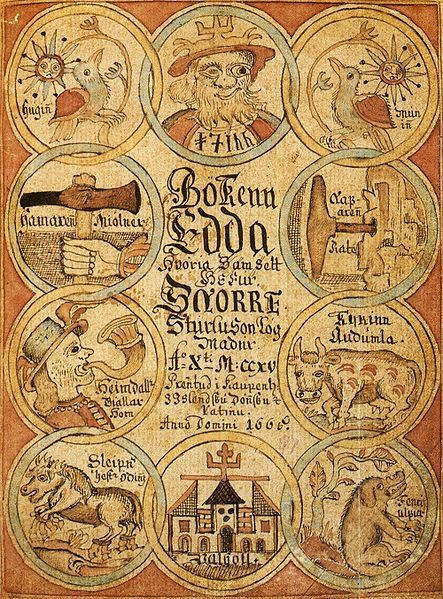
18th century manuscript of Snorri’s Prose Edda
Saxo went even further, giving a more elaborate story. He believed that Odin was the king of Uppsala, and that he had encouraged his people to worship him as a god, to the point of having a golden idol made of himself for the temple. His wife, Frigg, along with her lover (a servant), stole the gold and forced Odin into exile. A sorcerer took his place and attempted to create his own cult, but eventually Odin returned and cast him out. The site of his tomb in Uppsala became a sacred place, which it continued to be until the end of the Heathen era. Uppsala was the ceremonial center of the Heathen Swedish kingdoms, with splendid temples in Saxo's days as well as the tombs of the royal families, all of which added to his argument.[5]
The Euhemerist authors of the early Christian and Medieval period had reason to believe that ancient kings would set themselves up as gods, and that they might be worshiped by their descendents. After all, they could simply point to the Roman Emperors. The Imperial Cult was the state religion of Rome between the founding of the Empire and its conversion to Christianity, and emperors were said to have divine guidance and, after their death, could be elevated to godhood by a vote in the Roman Senate. Some Romans who were elevated in this way included Julius Caesar and his heir Augustus. It served as a crucial element in holding the Roman Empire together, and it was bitterly opposed by the Early Christians. They could point to the human origins of Caesar and Augustus, and no doubt it was easy to theorize there was a similar explanation for the deification of gods like Zeus and Odin.[6]
In a similar vein, it’s possible that actual historical figures were integrated into mythology. For example, Achilles may not have actually fought at Troy, but historians are virtually certain there was a Trojan War, and it would make sense for the figures in Homer’s Iliad to be based off actual stories of the war that at least had some basis in fact. There is, however, little direct evidence that suggests pantheons of gods were based on actual historical figures.
Thus, this theory about actual historical figures probably does not explain the origins of the Norse gods, at least not comprehensively. The Norse gods of the late Pre-Christian era have direct links to deities from across Northern Europe, and over a vast period of time. Naturally, this means theories about the origins of the Norse Heathen pantheon have a habit of paralleling interest in Paganism more generally.
For many centuries, interest in Odin and the Aesir lay dormant, but it was rekindled in the 19th century during the Romantic Movement. Germans became interested in folklore, and with that came a scholarly interest in the roots of the German language and ancient Germanic culture. The earliest linguists like the Grimm brothers (the ones of fairy tale fame) sought to compare surviving remnants of various German dialects and folk traditions and then use a comparative approach to slowly trace backwards and find the shared common roots of what are today disparate languages and cultures. This technique was applied not only to languages but also to religious belief. By collecting the fragments of folklore and written tales and comparing them across regions, an understanding of the earlier forms could be made, and they did the same with the names of the gods. For example, the Norse "Odin" is joined by a number of other Germanic gods with similar names: the Old English "Wōden", Old Saxon "Wôdan" and Old High German "Wôtan." Using these names, as well as their understanding of how languages have evolved and what types of sound changes are the most common, historical linguists have argued that the original Germanic god in the language they call "Proto-Germanic" was known as "*Wodanaz" or "*Wōđanaz." The asterisk (*) is used in historical linguistics to denote a word for which scholars have no confirmation but is a hypothetical reconstruction.
This origin is complicated by the existence of a relatively minor character in the mythology named "Óðr", who is married to Freya. The name "Óðr" means a madness or fury, perhaps akin to the poetic fury which the seers and prophetic poets so closely associated with Odin were known for. Some scholars have argued that this character is in fact a descendant from the same root god as Odin and represents his association with this concept of poetic fury. Certainly, the proposed Proto-Germanic root for this concept, "*wōþuz," has similarities to the names of both gods.[7]
*Wodanaz appears to have been similar to a god found amongst the neighboring Celtic peoples. The Celtic god Lugus (or Lugh amongst the Irish) was the patron of royal sovereignty, sorcery and poetry amongst other things, and his August festival - Lughnasa in Ireland - was a celebration of dancing, poetry and drama.[8] Interestingly, Roman observers believed that both Lugus in Gaul and Odin in Germany were actually representations of their god Mercury[9].
The "Psychological" approach endeavors to explain the forms of religious belief - particularly legends - by explaining them as localized manifestations of universal human psychological impulses. The roots of this approach come from the late 19th century, but it fully flowered in the early 20th century. In 1902, William James published The Varieties of Religious Experience, which explored the nature of religious belief from a psychological perspective, trying to uncover exactly how people’s psychological needs fuel various forms of religious experiences.
Building on pioneers like James, the works of psychoanalysts like Freud and Jung explored the power of the unconscious mind. Jung especially examined the concept of "archetypes", and the powerful influence that these figures have upon on people’s minds. Myths and gods can be interpreted within this framework as psychological tools societies have created to assist in navigating their crises.
One important concept that Jung examined that has particular relevance on a study of Odin is the idea of the "psychopomp." In mythology, a psychopomp is the figure who delivers the souls of the dead from the land of the living to the afterlife. But Jung pushed further and explained that psychopomps were also mediators between the conscious and unconscious parts of people’s minds. These figures are sometimes animals, like ravens (who have a special connection to Odin), sometimes human, like shamans who assist the spiritual journeys of their flocks, and sometimes mythical human-like beings, such as Odin. Odin is a perfect example of a Jungian psychopomp, as he navigates not only life and death but also the worlds of the seen and unseen, between magic and reality. He is a god of prophecy, and, like the shaman, his insight into the hidden realm provides insight into the future.
While the three schools do have some similarities, in the end they provide very different explanations for the existence of Odin and similar gods. Was he a human king misguidedly deified by his followers? Was he part of an ancient folktale that has been morphed and melded with other tales over the centuries? Was he simply a psychological tool created to help people address and make sense of events in their own lives? The truth may be somewhere in the middle, with true historical figures providing some of the fodder and being welded to ancient tales and folklore.