
Chapter 10
The prevalence of grass in the savanna vegetation cover is associated with the diversity and abundance of especially grazers in Africa’s large herbivore fauna. But how is it that all of these species came to coexist, dependent on the same basic food resource? Ecological theory maintains that species cannot coexist in the same places unless they differ sufficiently in (1) the food types that they consume, (2) how they evade falling prey to predators, or (3) how they cope with extremes in physical conditions. Fundamental differences in digestive anatomy and physiology distinguish grazers from browsers, but what further distinctions exist among grazers and browsers to enable numerous species to coexist, including several rather similar in body size? How do they cope with seasonal variation in the nutritional value of the remnants of the plant cover that remain into the dry season? How do they gain sufficient security from predation despite being conspicuously exposed in mostly open grasslands? How do seasonally diminishing sources of surface water restrict where they can be during the dry season? This chapter addresses how these requirements contribute to niche partitioning among Africa’s large herbivores, particularly the numerous grazers.
Grazers Versus Browsers: Seasonal Diets
During wet seasons, vastly more potential food confronts large herbivores than they could potentially consume. Then rains cease, most trees shed their leaves and grasses desiccate and turn brown. Browsers seeking tree leaves encounter an absolute shortage of food because so few leaves remain within reach on trees and shrubs and most are chemically defended. Grazers face especially a reduction in forage quality, because the grass parts that remain above ground are dry, fibrous and hence difficult to digest. Thus dietary distinctions become heightened during the dry season.
Under wet season conditions of abundant food, the grass-dependent species form a dietary cluster in the lower right quadrant of Figure 10.1A. They include antelope representing three tribes (Alcelaphini, Reduncini and Hippotragini), along with African buffalo (Syncerus caffer), zebras (Equus spp.), warthogs (Phacochoerus africana), hippo (Hippopotamus amphibius) and white rhino (Ceratotherium simum; Figure 10.2). Browsers augment woody plant leaves with varying contributions from forbs, flowers and fruits, but consume only small amounts of grass. They include most of the tragelaphine (spiral-horned) antelope, various dwarf antelope, gerenuk (Litocranius walleri), giraffe (Giraffa camelopardalus) and black rhino (Diceros bicornis; Figure 10.3). Then there are the mixed feeders, encompassing various gazelles, along with impala (Aepyceros melampus), nyala (Tragelaphus angasi) and oribi (Ourebia ourebi), which consume a variable mix of tree, shrub and grass leaves. Nevertheless, they can be subdivided between those dependent mainly on grass and those consuming mainly browse. Note that forbs, encompassing non-grassy herbs, form part of the browse component. The African elephant (Loxodonta africana) is not represented in the figure because it is in a league on its own, consuming not only both grass and browse but also fibrous bark and roots not eaten by other large herbivores.1

Figure 10.1
Seasonal diet composition of African large herbivores, comparing contributions from dicotyledonous trees, shrubs and forbs (‘dicots’) against that from graminoids (grasses and sedges). Deviations below the dashed line indicate contributions from fruits, pods and other plant parts. Note the distinct clusters of grazers and browsers with relatively few species falling within the ‘mixed feeder’ divide.
(modified and updated from Owen-Smith (1997) Zeitschrift fur Saugetierkunde 62, Suppl.II: 176–191)

Figure 10.2
Grazers grazing grass mostly of similarly low height. I could have chosen an image of a waterbuck also grazing short grass, but the picture showing it grazing reeds indicates its ability to feed on quite tall graminoids when little else remains. (A) Blue wildebeest; (B) red hartebeest (Alcelaphus buselaphus); (C) topi (Damaliscus lunatus); (D) sable antelope; (E) roan antelope; (F) gemsbok (Oryx gazella); (G) waterbuck; (H) Uganda kob (Kobus kob); (I) common reedbuck; (J) plains zebra (Equus quagga); (K) African buffalo; (L) white rhino.
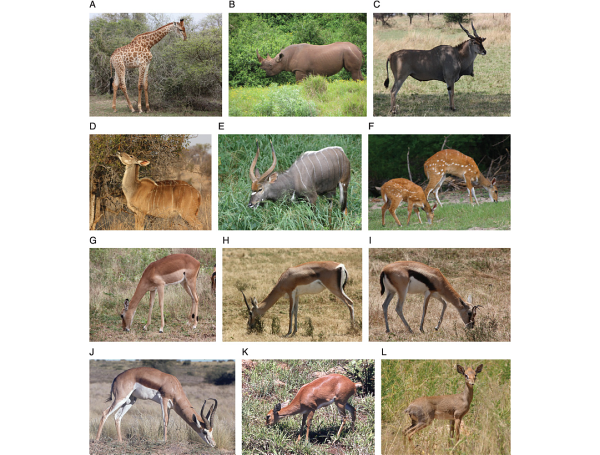
Figure 10.3
Various browsers and mixed feeders. (A) Giraffe; (B) black rhino; (C) eland; (D) greater kudu; (E) nyala; (F) bushbuck; (G) impala; (H) Grant’s gazelle (Gazella granti); (I) Thomson’s gazelle (Eudorcas thomsonii); (J) springbok (Antidorcas marsupialis); (K) steenbok; (L) dikdik.
During the dry season, the browsers concentrate more narrowly on browse while the mixed feeders shift their diets towards a greater contribution from woody plant foliage (Figure 10.1B). Africa’s savanna browsers seldom consume leafless twigs, unlike moose in northern latitudes. Some grazers consume a little more browse in the dry season, notably the hippotragine antelope locally, but the combined dicot contribution (trees plus forbs) to the diet of these grazers rarely exceeds 10–15 percent. Warthogs retain a primarily graminoid (grasses plus sedges) diet through the dry season by using their snouts to dig up corms and rhizomes. Porcupines (Hystrix africaeaustralis) also seek roots and bulbs, but these large rodents do not fall size-wise within the large herbivore category. Elephants fall back on woody plant parts like bark and roots in the dry season, along with grass roots.1,2 The group of specialist grazers retain their primary dependency on grass, however dry, through the dry season.
Within the dietary component categorised broadly as grass or browse, particular vegetation constituents can play a key role in supporting animals through crucial periods of the year.3 During my white rhino study, I noted how these mega-grazers shifted their grazing among grassland types during the course of the year (Figure 10.4). Rhinos concentrated on lawn grasslands as long as the predominant short grasses retained adequate foliage.4 After the intensifying dry season caused plant regrowth to cease, rhinos turned their attention to the grasses growing under tree canopies, which retained green leaves longest. After these grasses became flattened, rhinos shifted their grazing to the extensive red grass grasslands. After these taller grasslands had mostly become grazed down, the rhinos moved up onto hillslopes where tall grass remained abundant. Wildebeest (Connochaetes taurinus) show similar shifts over the seasonal cycle, concentrating in grazing lawns as long as these retain adequate foliage.5 Other grazers, like sable antelope (Hippotragus niger), buffalo and zebra, favour somewhat taller grass during the wet season and seek localities where grasses retain some green leaves in the dry season.6 Eventually, all of the grass consumed may be in the form of dry, brown ‘necromass’, however inadequate nutritionally.
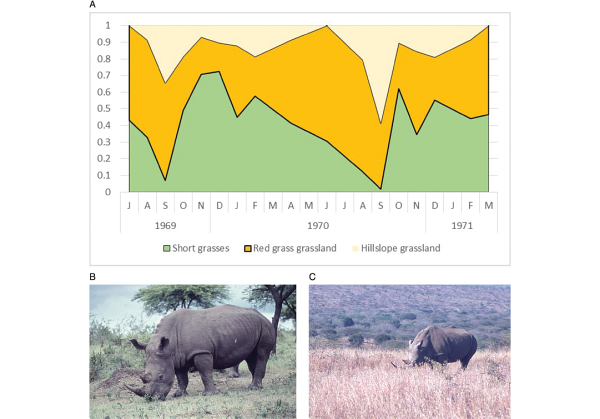
Figure 10.4
Shifting grazing among grassland types by white rhinos over the seasonal cycle in western Mfolozi GR. (A) Changing proportion of white rhinos grazing in different grassland types, shifting from short grass lawns during the wet season towards taller red grass grassland reserves during the dry season; (B) white rhino grazing short grass lawn; (C) white rhino grazing in hillslope grassland.
For both grazers and browsers, lowlands where gravitated soil moisture supports some green foliage retention can serve as key resource areas in the dry season.3 Grazers also benefit from places where fires have removed the accumulated dry material (or ‘top-hamper’), promoting some green grass regrowth before the wet season commences. In very dry years, grazers may fall back on grass species they normally do not eat.7 Such forage reserves help buffer animals against starvation. When too little grass remains locally, animals may wander further afield in search of places where local rain showers have generated some green flush.8
The browsing kudus (Tragelaphus strepsiceros) that I followed in the Nylsvley Nature Reserve showed a more intricate sequence of dietary shifts over the seasonal cycle (Figure 10.5).9,10,11 These habituated young animals ranged freely in a fairly large (213 ha) enclosure and selected their diets from the savanna plants available there. The vegetation on offer included 60 tree and shrub species plus over 100 forb and grass species. These could be grouped into relative palatability classes based on seasonal variation in how they were utilised.9 While food remained plentiful through the wet season into the early dry season, the staple food component consumed by the kudus was constituted by the foliage of various broad-leaved deciduous trees and shrubs, including several species of bushwillow plus wild raisins. Fine-leaved thorn trees made only a small contribution because they were scarce in the enclosure; elsewhere, acacia species feature prominently in the wet season diet of kudus. However, what these kudus especially sought were various forbs and creepers lacking the woody twigs of trees and shrubs. Fruits and flowers were eaten when available, especially the large monkey oranges that ripened late in the dry season, as well as the pods of the acacias. After forbs had withered and deciduous trees had mostly shed their leaves, the kudus turned to the foliage remaining on evergreen or semi-evergreen trees and shrubs. Near the end of the dry season when the relatively palatable evergreens had developed browse lines with no leaves left within reach, the kudus began consuming the leaves of several deciduous species that they had previously ignored, which flushed new foliage ahead of the rains. Chemical analyses revealed that these apparently unpalatable species had high contents of condensed tannins in their leaves. Thus, each of these plant groups played a distinct key role in supporting the kudus at different stages of the seasonal cycle.10
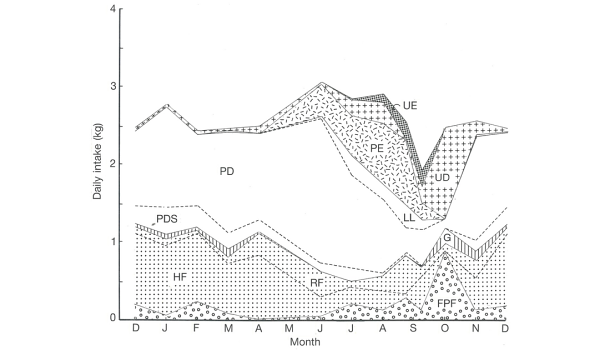
Figure 10.5
Monthly shifting diet of kudus in broad-leaved savanna woodland in Nylsvley Nature Reserve by plant types from the wet season through the dry season. FPF, fruits, pods and flowers; HF, herbaceous forbs; RF, robust forbs; G, grass; PDS, palatable deciduous spinescent trees; PD, palatable deciduous trees; LL, fallen leaf litter; PE, palatable evergreen trees; UD, unpalatable deciduous trees; UE, unpalatable evergreen trees.
(from Owen-Smith & Cooper (1989) Journal of Zoology 219:29–43)
These observations led me to generalise the following categories of functionally complementary food types over the seasonal cycle: (1) sought out foods of high nutritional value, represented for kudus by forbs, flowers and fruits; (2) staple foods, providing the bulk of the wet season diet, constituted by palatable deciduous trees and shrubs; (3) reserve foods, added to the diet after the deciduous species had started shedding their leaves, constituted by relatively palatable evergreens; (4) bridging foods, consumed during transitional periods when little other edible food remained, formed by the early flushing deciduous species; and (5) buffer foods, eaten only when little other food remained late in the dry season, constituted by unpalatable evergreen shrubs.12 Functionally, the high-quality and staple food types govern reproductive performance and offspring growth. Reserve food sources supply marginally adequate nutrition for survival through the dry season. Bridging and buffer resources slow rates of starvation during particularly adverse periods. Accordingly, each of these vegetation components serves as a ‘key resource’ under different conditions. A missing category could render a local habitat uninhabitable. This helps explain the absence of kudus from Serengeti NP where deciduous acacias are overwhelmingly dominant and evergreen browse sparse.
Reserve resources can be equated with the ‘fall-back’ foods recognised by primatologists. However, the importance of buffer resources, eaten only in years when extremes of food depletion are experienced, is widely overlooked. If these are missing, animals soon starve and die unless they have adequate fat reserves.
Besides protein and digestible energy, animals require mineral nutrients, most especially sodium and phosphorus. In Serengeti, ‘hot spots’ where herbivores concentrate are associated with locally elevated levels of sodium along with other mineral nutrients in grasses.13,14 Some of the grasses prevalent in grazing lawns accumulate much higher levels of sodium in their leaves than is typical of most plants.15 In Kruger NP, faecal phosphorus levels of grazers occupying basaltic soils were substantially higher than those of animals of the same species found on granitic soils.16 In contrast, faecal nitrogen levels tended to be higher in regions with granitic geology, perhaps because grasses retain more green foliage into the dry season where soils are sandy and the tree cover is greater.16,17
Digesting Grass Versus Browse
Dietary distinctions among large herbivores are supported by physiological and anatomic features. Plant leaves are difficult to digest because the cell contents containing nutrients are enclosed within cell walls composed of cellulose and strengthened by lignin (the substance of wood). In order to extract sufficient nutrition from a leafy diet, large herbivores depend on microbial fermentation to break down the cellulose into volatile fatty acids, which can be metabolised to provide energy. To increase the surface area for bacterial action, herbivores must macerate plant tissues into fine enough particles. The leaves of trees and shrubs present somewhat different properties from the leaves and stems of grasses. Leaves of woody plants digest more rapidly, but less completely than grass leaves because much of the fibre they present is strengthened by lignin. The more fibrous leaves of grasses take longer to digest, but are ultimately more digestible, unless very stemmy. The digestibility of C4 tropical grasses is restricted by the thickened walls surrounding the bundle sheath cells (see Chapter 6). This feature, along with the dry season desiccation, helps explain why the dietary distinction between grazers and browsers is especially clear-cut in Africa.
The incisor teeth play a frontline role in plucking bite-sized clusters of leaves. Ruminants lack incisors in their upper jaws and grasp plant parts between the lower incisors and a hard pad on the upper palate. The lower incisors of grazers tend to protrude forwards, allowing tougher stems to slide out while leaves are retained. Grazers have relatively wider incisor arcades and correspondingly broader muzzles than browsers,18,19 facilitating cropping grass tillers. The narrower muzzles and more upright incisors of browsers enable them to pluck individual leaves or clusters of leaves from woody branches. Mixed feeders resemble browsers in their dental features. The reduncine antelope associated with wetland grasslands have somewhat narrower muzzles than wildebeest and other alcelaphine grazers. Non-ruminants like zebras clip plant parts between their upper and lower incisors, and thus ingest a higher proportion of grass stems than ruminants. The very largest herbivores crop grasses using their widened lips, like rhinos and hippos, or use extended noses to gather sufficient material, as elephants do. The projecting incisor teeth of elephants, forming tusks, aid in removing bark and in digging up roots of trees in addition to serving as weapons during fights among males. Warthogs dig with their fibrous snouts, not their tusks.
The molar teeth comminute the plant material ingested into finer particles. Browsers have elevated cusps on their molar surfaces, which help in puncture-crushing tree leaves to release the nutrients encapsulated. Grazers have complex patterns of enamel ridges that are more effective for shredding grass leaves. The height of the molar crown above the gum is taller (more ‘hypsodont’) among grazers than in browsers, so as to cope with the abrasive silica bodies contained within grass leaves and the grit that coats low-lying tufts.20,21 Gazelles, which also feed at low levels but on forbs and shrublets, likewise have relatively high-crowned molars. There are also distinctions among grazers in degree of hypsodonty and relative size of molars versus premolars.22 The alcelaphines, especially wildebeest, have higher molar crowns and reduced premolars compared with reduncines and hippotragines. Roan antelope (Hippotragus equinus) converge on zebra in some of their dental features, in line with their dependency on somewhat tall grass. Wear patterns on tooth surfaces provide further indications of the kind of material chewed: pits indicate browsing and scratches grazing.23,24
All large herbivores, apart from elephants, rely upon digestive fermentation to gain sufficient energy from plant parts consumed. They differ in where the fermentation chamber is located in the digestive tract and in features of the anatomy of this chamber related to the diet composition. Ruminants have enlarged compartments situated between the oesophagus and the true stomach or abomasum (Figure 10.6).25 The largest of these chambers, called the rumen, forms the main fermentation chamber. The preceding one (the reticulum) receives the ingested food, and the next one (the omasum) absorbs excess water from the mix passed on to the true stomach (abomasum), where protein gets digested under acid conditions. An advantage of the foregut fermentation is that food can be regurgitated and chewed further (ruminated) to reduce particle sizes for efficient digestion. The contents of the rumen must be kept neutral or only slightly acid, despite the release of fatty acids, otherwise the bacteria get digested. The pH is maintained by copious secretion of slightly alkaline saliva. Food residues are held in the rumen until particles become fine enough to be passed on. Grass residues tend to form a floating raft until they are reduced in size sufficiently to sink.26 Hence grazers have relatively larger rumens than browsers, enabling them to retain food residues for longer. Browsers ingesting woody stems along with leaves must allow larger particles to pass from the rumen than grazers do. They are better adapted than grazers to cope with bloat caused by gases released by rapidly fermenting starches and sugars. Consequently, grazers seldom consume succulent fruits. Mixed feeding impala, which switch their diet from mostly grass to mainly browse seasonally, increase the surface area formed by papillae lining the interior of the rumen to cope with rapidly fermenting browse.27 Although the eland is commonly classified as a mixed feeder, because in places it consumes substantial amounts of grass, its digestive anatomy is typical of that of a browser. Much of their low-level feeding is actually on various forbs and dwarf shrubs amid the grasses. The coupled features of digestive anatomy and physiology constrain the relative portions of grass and browse that large herbivores can consume.28 Because of their foregut fermentation, ruminants release gases generated during fermentation by burping.
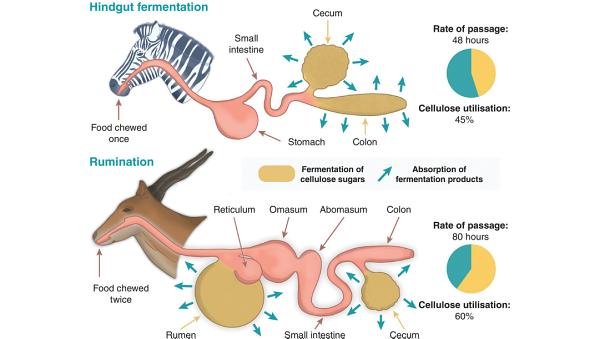
Figure 10.6
Comparative digestive anatomy and physiology of foregut and hindgut fermenters.
(artwork by Nuria Morales Garcia guided by Christine Janis)
Non-ruminants, or hindgut fermenters, have an expanded and sacculated large intestine along with an enlarged side compartment called the cecum, which is situated at the junction between the small and large intestines (homologous with our appendix).29 An advantage of hindgut fermentation is that plant proteins as well as soluble carbohydrates get digested in the true stomach and small intestine before fermentation occurs, meaning that their products are absorbed more completely. However, because chewing post-ingestion is precluded, hindgut fermenters digest cell wall constituents less completely than do ruminants. In compensation, they pass food material through the gut faster and are less adversely affected by indigestible fibre.30,31 Differences in gut anatomy among grazing and browsing non-ruminants, such as the two African rhinos, have yet to be documented. Hindgut fermenters release gases by farting.
Hippos have a capacious foregut that is partly compartmentalised, but do not ruminate. Instead they rely on prolonged retention of the forage they consume to extract sufficient nutrition for their comparatively low metabolic requirements.32 White rhinos are able to digest grass fibre nearly as effectively as several medium-sized ruminants, because larger size prolongs digestive retention.4 Elephants pass food especially rapidly through their digestive tracts, absorbing carbohydrates and other nutrients from highly fibrous plant parts like tree bark and roots, without digesting much fibre.32 Their digestive physiology is basically similar to that of much smaller herbivores like large rodents and hares.
Because of their dental and anatomic adaptations, browsers digest grass poorly and thus gain less nutritional value when they consume grass than do grazers. When the kudus that I followed did graze, they chose the leafiest species or post-burn regrowth. Browsing ruminants would starve with rumens clogged by floating mats if they ate much grass. Grazers are limited in the amounts of rapidly fermenting forbs and leaves they can consume because they are less able to release the bloating gases produced. Furthermore, they have relatively smaller livers than browsers27 and thus less capacity to deal with the potentially toxic chemicals commonly present in tree, shrub and forb leaves, but rare among grasses. Tree leaves commonly contain tannins,33,34 which bind with proteins (both plant proteins and digestive enzymes) to further inhibit digestive degradation. Some browsers have relatively large salivary glands, secreting proteins that bind effectively to tannins, thereby reducing their effects. Browsers also seem to differ in their tolerance for particular kinds of chemicals. Kudus readily feed on bushwillows, which test positive for polyphenols, but elephants frequently discard leaves of plants in this genus.1 Black rhinos commonly browse succulent euphorbias despite the toxic milky sap they contain.
Body Size
Body size influences diet composition because of how metabolic requirements scale with body mass. The resting metabolic rate is a function of body mass raised to the power 0.75, rather than being directly proportional to mass (i.e. exponent of 1).35 This means that, per unit of body mass, larger animals require less energy than smaller animals (M0.75/M1 = M–0.25). Accordingly, larger ungulates can subsist on poorer-quality diets higher in fibre and lower in digestible energy and protein than smaller ones.36,37 Nevertheless, larger ungulates could satisfy their lower metabolic requirements by consuming relatively less food per day, rather than food of lower quality. While a buffalo or a wildebeest needs to eat about 2–3 percent of its body mass per day (as plant dry mass over animal live mass), elephants and rhinos typically consume only 1–1.5 percent of their body mass daily. As a result, very large herbivores like elephants, rhinos and giraffes may show diets similar in protein content to those eaten by smaller ungulates at times when food is plentiful. Their metabolic tolerance for poor-quality food comes into play during the dry season when the green leaf supply fades. Larger herbivores can subsist on poorer-quality food, but smaller herbivores can get by on less food.
Among browsers, a mass ratio by a factor of ~2.5 is apparent in the series duiker→bushbuck (Tragelaphus scriptus)→nyala or lesser kudu (T. imberbe)→greater kudu (T. strepsiceros)→eland (T. oryx)→giraffe. Besides metabolism, body size influences the height reach while bite size requirements of browsers are restricted by leaf size. A 180-kg kudu nibbling the tiny (1.5 g) leaves of umbrella thorn trees all day would starve, whereas a 45-kg impala would be adequately nourished. Leaves that had been out of reach up in tree canopies become available to browsers when shed during the dry season, until the wind disperses them. Kudus gain less from fallen leaves than impalas because the rate of food intake they obtain by plucking single leaves is too slow for their greater quantitative requirements.38 This allows impalas to be abundant in places where kudus are absent.
Mouth size and hence bite dimensions also influence how browsers cope with the physical defences presented by plants to restrict losses to herbivores.39 Small antelope can nibble the leaves between thorns, but potentially get entangled by hooked thorns (see Chapter 7). Larger browsers requiring bigger bites can manage hooked thorns by swallowing the twigs the right way. They are more greatly restricted by long straight thorns or spines. Giraffes use their tongues and lower incisors to strip multiple leaves from branch tips of fine-leaved acacia trees, thereby largely overcoming the restriction posed by thorns (Figure 10.7).

Figure 10.7
Browsing actions. (A) Giraffe stripping leaves among thorns with its lower incisors; (B) kudus plucking thorny branch tips; (C) kudu pruning forb branchlets; (D) impala nibbling leaves among thorns.
For grazers, the grass height preferentially grazed has been related to body size.36 However, there is no consistent relationship. The two smallest grazers – mountain reedbuck (Redunca fulvorufula) and oribi – both occupy quite tall grasslands.40 Impalas graze quite a wide range in grass height.41 White rhinos and hippos actually graze the shortest grass, despite their large size. Among the set of grazers weighing between 100 and 250 kg, some favour short grass (notably wildebeest) and others quite tall grass (like sable and roan antelope). The ability of roan antelope to handle tall and hence fibrous grass is facilitated by digestive passage rates more similar to those of browsers than other grazers,42 although the supporting anatomy has yet to be investigated. Among the reduncine grazers, an intriguing sequence in relative body mass is apparent: from mountain reedbuck to reedbuck (Redunca spp.), various wetland kobs (Kobus spp.) and waterbuck (K. ellipsiprimnus). The various species of wetland kobs replace one another geographically, except in northern Botswana where a remnant number of puku (K. vardoni) exists close alongside much larger numbers of red lechwe (K. leche).43
Coping With Heat and Aridity
While seeking food, savanna herbivores must cope with high heat loads towards midday and, in higher southern latitudes, temperatures that may drop towards freezing overnight during the austral winter. Ungulates usually seek shade through midday (Figure 10.8A,B),44 but where shady trees are sparse they must rely on the reflectance of their hair coat or pelage to reduce the radiant heat load (Figure 10.8C).45 Thermal loading restricts the amount of time that animals have available to feed, especially during the midday period when conditions are hottest. The activity of kudus was curtailed on days when the maximum daily temperature exceeded 36°C in the wet season and 30°C in the dry season.46 The seasonal difference was due to a change from a shaggier hair coat for the winter cold to a sleeker one to cope with summer heat. Kudus became compromised when cold spells followed hot days during the transition between the dry season and the wet season, when food is particularly sparse, and some may die of hypothermia.47 Lethal conditions depended not on how low temperatures dropped overnight, but on the persistence of cool, wet and windy conditions through the day, inhibiting feeding. Grazers seem less vulnerable to cold-related mortality than browsers, perhaps because they benefit from heat generated by the fermentation of dry grass.

Figure 10.8
Coping with midday heat and sunshine. (A) Wildebeest occupying shade in the Kalahari; (B) gemsbok herd clustered in shade in the Kalahari; (C) red hartebeest displaying its shiny pelage reflecting radiant heat in Kalahari; (D) zebra enduring sunshine laterally with stripes supposedly ameliorating the heat load, Kruger NP; (E) buffalo immersed in mud wallow, Manyaleti; (F) white rhino plastered with mud after wallow, Mfolozi GR.
The very largest herbivores, such as elephants, rhinos and buffalos, are sparsely haired, because their problem is getting rid of excess heat generated by activity. As body size increases, the surface area available to dissipate heat decreases relative to the body mass producing the heat. Hence these big animals seek cooling by wallowing in pools or mud, when opportunities are presented (Figure 10.8E,F). Warthogs, although much smaller, are also rather hairless, because they seek security underground through the night and must be active through midday to meet their food needs.
White rhinos have exceptionally large sweat glands, which can drench the body surface when they overheat. Elephants lack sweat glands, but do lose water through their skin, which is corrugated to increase surface area.48 Their large ears contribute to body cooling via blood circulated through them, with ear-flapping promoting convectional heat losses. While zebras and most antelope possess sweat glands, they restrict sweating because of the water loss incurred. Smaller antelope conserve water using nasal panting rather than sweating so that condensed fluid in the nasal passages can be recycled. Heat generated by muscular activity coupled with exposure to radiant energy can restrict how long animals continue foraging into the heat of midday.
However, large herbivores gain a substantial amount of water from their food. In addition to water absorbed from green leaves, further water is released as a product of carbohydrate fermentation. Ruminants reabsorb water from digested residues passing through the large intestine, thereby producing dry dung pellets.49 Grazing ruminants inhabiting wet grasslands, including the reduncine antelope as well as buffalo, have less-lengthy large intestines than dry savanna grazers like the alcelaphines and thus produce moister dung pats. The dung pats of hindgut fermenters are also moist. The kidneys assist further by concentrating urine. Ungulate species differ in the effectiveness of their adaptations,50 and water needs also depend on diet. Grazers consuming dry grass need to drink more frequently than browsers able to find some green leaves even during the dry season. Hindgut fermenters have a lesser capacity to reabsorb moisture than ruminants, so that rhinos, zebras and elephants have a greater dependence on surface water than most ruminants.
Ultimately, water lost from sweat glands or via panting must be replaced, which requires travel to and from places retaining surface water. Non-ruminant grazers like zebras generally need to visit surface water sources daily or every other day during the dry season (Figure 10.9), while ruminants producing dry dung pellets may drink only at intervals of 3–4 days.51

Figure 10.9
Drinking at waterholes in the form of pans. (A) Buffalo at dam, Kruger NP; (B) zebras at pan, Tarangire NP, Tanzania; (C) elephants at pan, Hwange NP; (D) kudus at pan, Hwange NP.
For much of the year, grazers can access water from ephemeral pans that retain pools for varying periods into the dry season.52 Browsers with access to green leaves may not need to drink at all, unless conditions become very dry. Supremely independent of surface water are the various dwarf antelope, like steenbok (Raphicerus campestris) and dikdik (Madoqua spp.), which remain in small home ranges far from surface water year-round.53 Among larger grazers, the oryxes (Oryx spp.) can also remain independent of surface water except during extremely dry conditions.54 South African oryxes (O. gazella) can overcome the lack of surface water in the semi-desert areas they inhabit by consuming various moisture-containing melons.
Travel to and from water restricts time available for feeding and habitat occupation during the dry season, especially among grazers.51 Most grazers must remain within 4 km of rivers or pools retaining water.55,56 The salinity of the water remaining can also affect its use for drinking and contributes to the seasonal movement of migratory grazers from the Serengeti plains.57 Concentrations of water-dependent species near drinking places draw predators, increasing the exposure of these ungulates to being killed. With food also running short locally near water, the stress levels experienced by grazers are greatly elevated during the dry season. As will be discussed in Chapter 12, this can lead to population crashes.
Body Fat Reserves
The fat stores of African ungulates seldom exceed 5–10 percent of body mass,58,59 much less than the 10–20 percent typical of deer inhabiting high northern latitudes. This limitation may seem surprising, considering the lean conditions experienced by savanna dwellers through the dry season. For grazers, the problem is not the amount of potential food remaining, but rather how to digest the dry grass. The gut microbes remain active only if supplied with adequate protein, which can be obtained via breakdown of the muscular tissues of the host. This helps explain why savanna ungulates depend more on body protein rather than fat in the dry season and recycle urea via the hindgut to maintain the activities of the gut bacteria in digesting cellulose.60 A further consideration is that fat stored subcutaneously interferes with the ability of animals to get rid of excess body heat. The fat stores of African ungulates are located mainly in the mesenteries around the gut and near the kidneys, where it is less insulating.
Furthermore, body fat is needed not only to enable survival through the dry season, but also to subsidise particular activities. For male ungulates, the peak expenditure occurs around the time when competition for mating opportunities occurs, typically early in the dry season. Male impalas deplete most of their fat reserves during this period and enter the remainder of the dry season with little kidney fat, although much fat is still retained in bone marrow.61 Female impala retain body fat through the dry season and drawn on it to support the peak energy demands of late gestation and early lactation around the beginning of the wet season. Once animals have used up their mesenteric fat and start calling on bone marrow reserves, they are at risk of starvation.62
White rhinos were renowned among early hunters for the amount of subcutaneous fat they yielded, while hippos can also carry substantial fat stores.63 Eland carry more body fat than other ruminants.
Evading Predation
Exposure to predation contributes to niche partitioning by restricting habitat occupation. The first line of defence by potential prey entails detecting an approaching predator before it comes close enough to launch a successful attack. Herd formation increases security by providing more eyes for surveillance. Grazing ungulates are particularly vulnerable while cropping grass head-down. They must lift their heads and look around periodically in order to detect approaching carnivores. However, this vigilance is at the expense of feeding time.
Speedy running helps evade an attack. The fastest antelope are topi (Damaliscus lunatus cokei) and hartebeest (Alcelaphus buselaphus), as discovered by big game hunters pursuing them on horseback. However, a fast gallop is less effective when there are trees in the way. Hence these alcelaphine antelope typically occupy open savanna grasslands. Wildebeest are almost as speedy, but their special feature is endurance locomotion, facilitating migration.64 They strongly avoid entering thicker patches of woodland.65 Larger ungulates run less fast and must rely on overt defence to ward off attacks by lions. Zebras attempt to deflect attacks from behind with flailing hooves. Buffalos resist predation by closing ranks in large herds. Mega-herbivores weighing over 1000 kg are invulnerable to being killed by lions once they reach maturity, but must still protect their offspring. Sable antelope and oryx deploy their horns, possessed by females as well as males, to ward off hyenas or wild dogs trying to take their young, but this defence is ineffective against lions. Consequently, these hippotragines are found in habitats where their risk of predation is reduced because there are fewer lions – sable antelope in savanna woodlands and oryx in arid regions. Roan antelope occupy moist savannas where low overall herbivore densities support few lions. Hartebeest also seem quite vulnerable to predation66,67 and are commonly present in regions with fewer other grazers. Kob and their congeners inhabit wetland grasslands where waterbodies hamper chases by lions and other carnivores. Waterbuck, generally found on dry land near rivers, have a novel deterrent – a musky skin secretion, which seems to make them less palatable to carnivores as well as humans.68
Browsers living in wooded habitats evade predation by jumping or dodging and are elusive because of their lower densities than grazers. Impalas are outstanding long-jumpers, while eland and kudu are renowned high-jumpers. Gazelles and steenboks are particularly adept at dodging round bushes when chased by cheetahs (Acinonyx jubatus).69 Healthy antelope may advertise this by pronking or stotting up and down, signalling to the predator that chasing after them would be wasted effort.70 These differences in predator evasion tactics are supported by physical differences. The alcelaphine grazers have high shoulders forming a pivot, while the tragelaphine browsers have high rumps, powering jumping.
The risk of being killed by a predator increases at night, when darkness obscures stalking lions and leopards and hyenas are also most active. Most of the larger ungulates forage for less time and move less at night than during the day.4,71 At night, wildebeest keep away from the edges of the open glades with short grass that they inhabit, where vegetation cover increases.72 Ungulates typically schedule their journeys to water during mid-morning while visibility is great and rising temperatures inhibit carnivore activity. Only the largest ungulates, from buffalo to rhinos and elephants, drink frequently around or after sun-down when temperatures are cooler. They are also equally active day and night. Small antelope the size of a steenbok or dikdik have to contend with diurnal predation by large eagles as well as cheetahs and wild dogs, and so may be more active nocturnally when they are better concealed.
Trade-offs must be made when food runs short. Animals cannot survive very long without food and so must take a chance on meeting up with a predator in more risky habitats in these circumstances.62 Hence, the risk of being killed increases during the dry season for many species.73 The conundrum is, should this mortality be ascribed ‘top-down’ to predation, or ‘bottom-up’ to resource limitations? These two influences on niche occupation are inextricably entangled.74
Overview
Large herbivores are adapted to their specific plant-based diets through a combination of dentition, digestive anatomy, toxin physiology and body size. These features come into play especially during the dry season when little food remains and most of it is low in nutritional value and chemically or structurally defended. However, there is much overlap in the plant species favoured among both grazers41,75,76 and browsers.9 We need to look beyond dietary adaptions to consider other features of species niches.
Dietary partitioning alone is inadequate to explain the regional coexistence among medium–large ruminants of rather similar size. The role of predation in restricting habitat occupation, particularly in relation to the woody plant cover, becomes of overriding importance. Habitat features become less important for herbivores from zebra and buffalo size upwards. They occupy wooded as well as open savanna habitats and rely on their capability to ward off lion attacks. Surface water requirements form an additional constraint on where grazers can be during the dry season. The large grazers capable of defending themselves against lions happen to be the most water-dependent. They attract predation when they concentrate near water in the late dry season and they become weakened from food deficiencies.
Africa’s current diversity of medium–large grazers is unmatched on other continents. However, for fair comparisons we must look prior to the end-Pleistocene extinctions. Earlier, South America contained more species of large herbivore than Africa does today. However, those that grazed were almost only either equids or mega-sized, adapted via hindgut fermentation to handle tall fibrous grasses.77 The only wild grazer still found there is the vicuna (Vicugna vicugna), a camelid occupying fertile meadows in high Andean plateaus. The pampas deer (Ozotoceros bezoarticus) is a mixed feeder inhabiting the low-lying pampas grasslands of Argentina and Pantanal wetlands rather than the cerrado savanna. North America retained a large grazing bovine in the form of the American bison (Bison bison), once hugely abundant through its grasslands; but the deer found there are either browsers or mixed feeders. No deer anywhere in the world is as specialised anatomically for a purely grass diet as the grazing bovids. Wild equids disappeared from North America soon after humans arrived. Various mammoths had been the major grazers, as they were over most of Eurasia outside the tropics, coupled there with woolly rhinos. Tropical Asia retains an intact large mammal fauna, with grazers represented by various forms of wild cattle, but none of these feeds exclusively on grass, and neither does the European bison. None of Australia’s large kangaroos feeds narrowly on grass – they all consume a somewhat mixed diet. The kangaroos that went extinct following the arrival of modern humans were mostly large browsers.
African savannas uniquely feature the ecology of large grazers, vastly more diverse than found in other continents even before the late Pleistocene extinctions. The next chapter will familiarise you with the ecology of Africa’s large carnivores, the predators that threaten these herbivores and also, of course, the larger primates.
SUGGESTED FURTHER READING
Du Toit, JT; Cumming, DHM. (1999) Functional significance of ungulate diversity in African savannas and the ecological implications of the spread of pastoralism. Biodiversity and Conservation 8:1643–1661.
Kingdon, J; Hoffmann, M (eds) (2013) The Mammals of Africa. Vols I–VI. A & C Black, London.
Owen-Smith, N. (2002) Adaptive Herbivore Ecology. From Resources to Populations in Variable Environments. Cambridge University Press, Cambridge.
REFERENCES
1.Owen-Smith, N; Chafota, J. (2012) Selective feeding by a megaherbivore, the African elephant (Loxodonta africana). Journal of Mammalogy 93:698–705.
2.Barnes, RFW. (1982) Elephant feeding behaviour in Ruaha National Park, Tanzania. African Journal of Ecology 20:123–136.
3.Illius, AW; O’Connor, TG. (2000) Resource heterogeneity and ungulate population dynamics. Oikos 89:283–294.
4.Owen-Smith, RN. (1988) Megaherbivores: The Influence of Very Large Body Size on Ecology. Cambridge University Press, Cambridge.
5.Yoganand, K; Owen‐Smith, N. (2014) Restricted habitat use by an African savanna herbivore through the seasonal cycle: key resources concept expanded. Ecography 37:969–982.
6.Macandza, VA, et al. (2012) Habitat and resource partitioning between abundant and relatively rare grazing ungulates. Journal of Zoology 287:175–185.
7.Macandza, VA. (2003) Forage selection of African buffalo through the late dry season in the Satara region of the Kruger National Park. South African Journal of Wildlife Research 34: 113–121.
8.Staver, AC, et al. (2019) Grazer movements exacerbate grass declines during drought in an African savanna. Journal of Ecology 107:1482–1491.
9.Owen-Smith, N; Cooper, SM. (1987) Palatability of woody plants to browsing ruminants in a South African savanna. Ecology 68:319–331.
10.Owen‐Smith, N; Cooper, SM. (1989) Nutritional ecology of a browsing ruminant, the kudu (Tragelaphus strepsiceros), through the seasonal cycle. Journal of Zoology 219:29–43.
11.Owen-Smith, N. (1994) Foraging responses of kudus to seasonal changes in food resources: elasticity in constraints. Ecology 75:1050–1062.
12.Owen-Smith, RN. (2002) Adaptive Herbivore Ecology: From Resources to Populations in Variable Environments. Cambridge University Press, Cambridge.
13.McNaughton, SJ. (1988) Mineral nutrition and spatial concentrations of African ungulates. Nature 334:343–345.
14.McNaughton, SJ, et al. (1997) Promotion of the cycling of diet-enhancing nutrients by African grazers. Science 278:1798–1800.
15.Stock, WD, et al. (2010) Herbivore and nutrient control of lawn and bunch grass distributions in a southern African savanna. Plant Ecology 206:15–27.
16.Grant, CC, et al. (2000) Nitrogen and phosphorus concentration in faeces: an indicator of range quality as a practical adjunct to existing range evaluation methods. African Journal of Range and Forage Science 17:81–92.
17.Grant, CC, et al. (1996) The usefulness of faecal phosphorus and nitrogen in interpreting differences in live-mass gain and the response to P supplementation in grazing cattle in arid regions. Onderstepoort Journal of Veterinary Research 63:121–126.
18.Gordon, IJ; Illius, AW. (1988) Incisor arcade structure and diet selection in ruminants. Functional Ecology 2:15–22.
19.Janis, CM; Ehrhardt, D. (1988) Correlation of relative muzzle width and relative incisor width with dietary preference in ungulates. Zoological Journal of the Linnean Society 92:267–284.
20.Mendoza, M; Palmqvist, P. (2008) Hypsodonty in ungulates: an adaptation for grass consumption or for foraging in open habitat? Journal of Zoology 274:134–142.
21.Damuth, J; Janis, CM. (2011) On the relationship between hypsodonty and feeding ecology in ungulate mammals, and its utility in palaeoecology. Biological Reviews 86:733–758.
22.Codron, D, et al. (2008) Functional differentiation of African grazing ruminants: an example of specialized adaptations to very small changes in diet. Biological Journal of the Linnean Society 94:755–764.
23.Schubert, BW, et al. (2006) Microwear evidence for Plio–Pleistocene bovid diets from Makapansgat Limeworks Cave, South Africa. Palaeogeography, Palaeoclimatology, Palaeoecology 241:301–319.
24.Ungar, PS. (2017) Evolution’s Bite: A Story of Teeth, Diet, and Human Origins. Princeton University Press, Princeton, NJ.
25.Hofmann, RR; Stewart, DRM. (1972) Grazer or browser: a classification based on the stomach-structure and feeding habits of East African ruminants. Mammalia 36:226–240.
26.Clauss, M, et al. (2008) The morphophysiological adaptations of browsing and grazing mammals. In Gordon, IJ; Prins, HHT (eds) The Ecology of Browsing and Grazing. Springer, Berlin, pp. 47–88.
27.Hofmann, RR. (1989) Evolutionary steps of ecophysiological adaptation and diversification of ruminants: a comparative view of their digestive system. Oecologia 78:443–457.
28.Codron, D; Clauss, M. (2010) Rumen physiology constrains diet niche: linking digestive physiology and food selection across wild ruminant species. Canadian Journal of Zoology 88:1129–1138.
29.Langer, P. (1988) The Mammalian Herbivore Stomach: Comparative Anatomy, Function and Evolution. Gustav Fischer, Jena.
30.Duncan, P, et al. (1990) Comparative nutrient extraction from forages by grazing bovids and equids: a test of the nutritional model of equid/bovid competition and coexistence. Oecologia 84:411–418.
31.Meyer, K. (2010) The relationship between forage cell wall content and voluntary food intake in mammalian herbivores. Mammal Review 40:221–245.
32.Clauss, M, et al. (2007) The relationship of food intake and ingesta passage predicts feeding ecology in two different megaherbivore groups. Oikos 116:209–216.
33.Cooper, SM; Owen-Smith, N. (1985) Condensed tannins deter feeding by browsing ruminants in a South African savanna. Oecologia 67:142–146.
34.Owen-Smith, N. (1993) Woody plants, browsers and tannins in southern African savannas. South African Journal of Science 89:505–510.
35.Farrell-Gray, CC; Gotelli, NJ. (2005) Allometric exponents support a 3/4‐power scaling law. Ecology 86:2083–2087.
36.Bell, RHV. (1971) A grazing ecosystem in the Serengeti. Scientific American 225:86–93.
37.Jarman, P. (1974) The social organisation of antelope in relation to their ecology. Behaviour 48:215–267.
38.Owen-Smith, N; Cooper, SM. (1985) Comparative consumption of vegetation components by kudus, impalas and goats in relation to their commercial potential as browsers in savanna regions. South African Journal of Science 81:72–76.
39.Cooper, SM; Owen-Smith, N. (1986) Effects of plant spinescence on large mammalian herbivores. Oecologia 68:446–455.
40.Owen-Smith, N. (1985) Niche separation among African ungulates. In Vrba, ES (ed.) Species and Speciation. Transvaal Museum Monograph 4. Transvaal Museum, Pretoria, pp. 167–171.
41.Arsenault, R; Owen‐Smith, N. (2008) Resource partitioning by grass height among grazing ungulates does not follow body size relation. Oikos 117:1711–1717.
42.Heitkonig, IMA. (1993) Feeding strategy of roan antelope in a low nutrient savanna. PhD thesis, University of the Witwatersrand, Johannesburg.
43.O’Shaughnessy, R, et al. (2014) Comparative diet and habitat selection of puku and lechwe in northern Botswana. Journal of Mammalogy 95:933–942.
44.Fuller, A, et al. (2016) Towards a mechanistic understanding of the responses of large terrestrial mammals to heat and aridity associated with climate change. Climate Change Responses 3:1–19.
45.Finch, VA. (1972) Thermoregulation and heat balance of the East African eland and hartebeest. American Journal of Physiology 222:1374–1379.
46.Owen‐Smith, N. (1998) How high ambient temperature affects the daily activity and foraging time of a subtropical ungulate, the greater kudu (Tragelaphus strepsiceros). Journal of Zoology 246:183–192.
47.Owen‐Smith, N. (2000) Modeling the population dynamics of a subtropical ungulate in a variable environment: rain, cold and predators. Natural Resource Modeling 13:57–87.
48.Dunkin, RC, et al. (2013) Climate influences thermal balance and water use in African and Asian elephants: physiology can predict drivers of elephant distribution. Journal of Experimental Biology 216:2939–2952.
49.Woodall, PF; Skinner, JD. (1993) Dimensions of the intestine, diet and faecal water loss in some African antelope. Journal of Zoology 229:457–471.
50.Kihwele, ES, et al. (2020) Quantifying water requirements of African ungulates through a combination of functional traits. Ecological Monographs 90:e01404.
51.Cain III, JW, et al. (2012) The costs of drinking: comparative water dependency of sable antelope and zebra. Journal of Zoology 286:58–67.
52.Naidoo, R, et al. (2020) Mapping and assessing the impact of small‐scale ephemeral water sources on wildlife in an African seasonal savannah. Ecological Applications 30:e02203.
53.Manser, MB; Brotherton, PNM. (1995) Environmental constraints on the foraging behaviour of a dwarf antelope (Madoqua kirkii). Oecologia 102:404–412.
54.Knight, M. (2013) Oryx gazella. In Kingdon, J; Hoffman, AM (eds) The Mammals of Africa VI Pigs, Hippopotamuses, Chevrotain, Giraffes, Deer and Bovids. A & C Black, London, pp. 572–576.
55.Western, D. (1975) Water availability and its influence on the structure and dynamics of a savannah large mammal community. African Journal of Ecology 13:265–286.
56.Smit, IPJ, et al. (2007) Do artificial waterholes influence the way herbivores use the landscape? Herbivore distribution patterns around rivers and artificial surface water sources in a large African savanna park. Biological Conservation 136:85–99.
57.Gereta, E; Wolanski, E. (1998) Wildlife–water quality interactions in the Serengeti National Park, Tanzania. African Journal of Ecology 36:1–14.
58.Ledger, HP. (1968) Body composition as a basis for a comparative study of some East African mammals. Symposia of the Zoological Society of London 21:289–310.
59.Smith, NS. (1970) Appraisal of condition estimation methods for East African ungulates. East African Wildlife Journal 8:123–129.
60.Sinclair, ARE; Duncan, P. (1972) Indices of condition in tropical ruminants. African Journal of Ecology 10:143–149.
61.Dunham, KM; Murray, MG. (1982) The fat reserves of impala, Aepycevos melampus. African Journal of Ecology 20:81–87.
62.Sinclair, ARE; Arcese, P. (1995) Population consequences of predation‐sensitive foraging: the Serengeti wildebeest. Ecology 76:882–891.
63.Selous, FC. (1881) A Hunter’s Wanderings in Africa. R. Bentley & Son, London.
64.Curtin, NA, et al. (2018) Remarkable muscles, remarkable locomotion in desert-dwelling wildebeest. Nature 563:393–396.
65.Stabach, JA, et al. (2016) Variation in habitat selection by white‐bearded wildebeest across different degrees of human disturbance. Ecosphere 7:e01428.
66.Georgiadis, NJ, et al. (2007) Savanna herbivore dynamics in a livestock-dominated landscape. II: Ecological, conservation, and management implications of predator restoration. Biological Conservation 137:473–483.
67.Ng’weno, CC, et al. (2017) Lions influence the decline and habitat shift of hartebeest in a semiarid savanna. Journal of Mammalogy 98:1078–1087.
68.Spinage, CA. (2013) Kobus ellipsiprymnus. In Kingdon, J; Hoffmann, M (eds) Mammals of Africa VI Pigs, Hippopotamuses, Chevrotain, Giraffes, Deer and Bovids. A & C Black, London, pp. 461–468.
69.Mills, MGL. (2017) Kalahari Cheetahs: Adaptations to an Arid Region. Oxford University Press, Oxford.
70.Caro, TM. (1986) The functions of stotting: a review of the hypotheses. Animal Behaviour 34:649–662.
71.Owen‐Smith, N; Goodall, V. (2014) Coping with savanna seasonality: comparative daily activity patterns of African ungulates as revealed by GPS telemetry. Journal of Zoology 293:181–191.
72.Owen‐Smith, N; Traill, LW. (2017) Space use patterns of a large mammalian herbivore distinguished by activity state: fear versus food? Journal of Zoology 303:281–290.
73.Owen‐Smith, N. (2008) Changing vulnerability to predation related to season and sex in an African ungulate assemblage. Oikos 117:602–610.
74.Owen-Smith, N. (2015) How diverse large herbivores coexist with multiple large carnivores in African savanna ecosystems: demographic, temporal and spatial influences on prey vulnerability. Oikos 124:1417–1426.
75.Kleynhans, EJ, et al. (2011) Resource partitioning along multiple niche dimensions in differently sized African savanna grazers. Oikos 120:591–600.
76.Pansu, J, et al. (2019) Trophic ecology of large herbivores in a reassembling African ecosystem. Journal of Ecology 107:1355–1376.
77.Owen‐Smith, N. (2013) Contrasts in the large herbivore faunas of the southern continents in the late Pleistocene and the ecological implications for human origins. Journal of Biogeography 40:1215–1224.