5
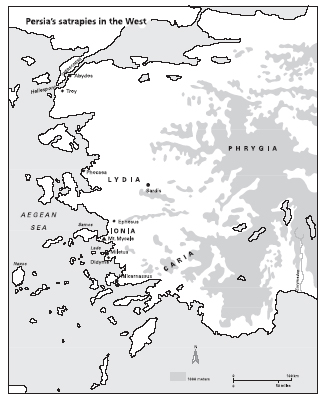
Artaphernes had been well rewarded by his royal brother for the blow that struck down Bardiya. Sardis was by any reckoning a great and fitting prize. The capital of the west, it ranked, in the opinion of the Persians, as one of the four corners of their dominion, a city so fabulously wealthy that even its rivers ran with gold. Croesus, when not bribing the Delphic oracle or being stung by the Alcmaeonids, had used the proceeds to mint the world’s first golden coinage, an innovation that had helped him become, if anything, even more obscenely rich than he had been before. Forty years on, and with Croesus long since dead, his Persian conquerors could still enjoy the fruits of his lavish spending.
Even those familiar with Babylon would have found it hard to sniff at Sardis. Showcase of the city was a magnificent temple to Cybele, a mother goddess as ancient as the hills, and capable of inspiring such extremes of devotion in her worshippers that they might end up dancing on a mountainside, writhing in orgies, or even, should the rituals be going with a particular swing, hacking off their testicles. Beyond the temple, rising in rings like those of Ecbatana, loomed the celebrated walls of Sardis. The innermost one, circling the acropolis, was so immense that Croesus had been led into the fatal error of assuming it impregnable. The acropolis itself, a red shard of mountain jagging up from the river plain, was even more intimidating, topped as it was along one of its spurs by what had once been the royal palace, and was now the brooding stronghold of Persian power. From there, gazing down at the sprawl of the lower town, or far westward over vast expanses of wheat and barley, and the road that led onward for three days to “the bitter sea,” Artaphernes might well have felt himself the equal of any king.
With one exception, of course. Master of the west he might be, but Artaphernes—“faithful Artaphernes”—knew better than to forget for even a moment that he was merely his brother’s vassal, his servant, his “bandaka.” Although, to instill in the locals a due sense of Persian majesty, he had modeled his court on Darius’ own, he ruled it not as a king himself but rather as the “Guardian of the King’s Power”—as a satrap.* Darius, having won his throne amid an inferno of rebellions, had no intention of permitting overmighty subjects ever again to endanger either his or Persia’s greatness. The merest command from his secretariat, then, and a satrap would be obliged to jump. For a provincial capital, the arrival of a royal letter was a major and often alarming event. Certain satraps, presented with a missive from the Great King, might go so far as to prostrate themselves before it and humbly kiss the floor.
Excess of zeal—or simple common sense? No one could ever tell who might be in the shadows, keeping watch, taking notes. Some claimed that the king appointed spies specifically to tour his empire, all-seeing officials known simply as his “eyes.” Others suspected an even more unsettling truth:
The king’s subjects, after all, would be put on their guard by any inspector whom they knew to be his “eye.” What really happens is quite the opposite—for the King will listen to anyone who claims to have seen or heard anything untoward. Hence the saying that he has a thousand eyes and a thousand ears.1
Here was paranoia on an almost global scale. No matter where within the inconceivable vastness of the empire his subjects might be, Darius could be imagined as always watching them, as overhearing all they said.
It was not enough for a servant, however, even one as favored as Artaphernes, to owe his duty simply to the king. Master accountant and insatiable for tribute though Darius was, yet he demanded from his satraps something more than revenue alone. “By the favour of Ahura Mazda,” he reminded those who served him, “I am the kind of man who is a friend to the right, who frowns upon the wrong, who has no wish to see the weak oppressed by the strong.”2 Darius spoke, as was his privilege, as the fount of law for all the world, but he was also closely reflecting how the Persians saw themselves. No people had a greater faith in their own virtue. So stern were the demands of justice, the Persians liked to believe, that they might outface even those of class and breeding. A peasant, his upright nature spotted by the unblinking eye of the Great King, might be promoted to the judicial bench; once installed there, he might find himself seated upon strips of drying skin, the hide of his corrupt predecessor, justly flayed alive. This was the kind of anecdote, both edifying and gruesome, that never failed to delight the Persians. Naturally—for it helped to confirm all their dearest preconceptions. There was no other people, they could reflect contentedly, with a sense of justice, an aptitude for rule that could remotely match their own. What good fortune for lesser nations, then, that they should all have ended up the slaves of the Persian king!
A justification for world conquest, of course, that the Persian King himself had already made his own. Upon Darius’ satraps, however, out on the empire’s fringes, far from the royal presence, it imposed particular demands. The obligation to provide justice for the same provincials whom they were simultaneously fleecing was not straightforward. Where it might easily lead could be discovered by a visit to the royal mint at Sardis, where coinage, just as it had been in Croesus’ day, continued to be struck, stamped now with the image of Darius as an archer, bending back the royal bow of power, the warrior champion of truth, of justice, of Arta. Then, chinking, glinting brightly, the gold would be crated and carted off to Susa.
Perhaps a certain brutal hypocrisy was merely the mark of any successful satrap. Nor did it necessarily make the trumpeting of the “pax Persica” a total sham. Even though he was sure to keep a regular supply of tribute wagons rumbling out of Sardis, Artaphernes did not look to bleed his province dry. That would have been to risk the goose that was laying the Great King his splendid golden eggs. As under Croesus, so under Artaphernes, Lydia continued to boast a class of native super-rich. One of these, a mine owner by the name of Pythius, was so successful in husbanding his assets that it was said only Darius lay ahead of him on the empire’s rich list. Lydians like Pythius, to whom Persian rule had opened up global horizons, had not the remotest interest in agitating for independence. Artaphernes, quite as subtle as his brother, encouraged such collaboration wherever and however he could—and not merely among the rich. Lydian functionaries still dutifully ran the province for their masters, just as they had done under Croesus. Their language, their customs, their gods, all were scrupulously tolerated. Only in temples particularly associated with Croesus and his dynasty might symbols of the old regime be pulled down or adapted into fire altars—and even then no attempt was made to force the worship of Ahura Mazda down unwilling Lydian throats. Indeed, if anything, it was the conquerors who adopted the natives’ customs. Perhaps the most startling evidence of this could be seen eight miles to the north of Sardis, a wonder visible from Artaphernes’ palace: eerie mounds of stone and turf looming over the cornfields like waves whipped up from a golden swell. Three of these were the graves of famous Lydian kings; but around them, filling the necropolis, rose newer, smaller tombs, the resting places of both wealthy natives and their Persian masters.3 Even in the dust and silence of a cemetery, then, Artaphernes’ Sardis was an unabashedly multicultural place.
Not that the Persians’ tolerance of foreigners and their peculiar habits in any way implied respect. Just as Cyrus, conquering Babylon, had felt free to claim the favor of a whole multitude of gods precisely because he believed in none of them, so too did Artaphernes, by appropriating the Lydians’ traditions and twisting them to his own ends, display his appreciation of a bleak and baneful truth: the traditions that define a people, that they cling to, that they love, can also, if cunningly exploited by a conqueror, serve to enslave them. This maxim, applied by the Persians across the vast range of all their many satrapies, was one that underpinned their whole philosophy of empire. No elite anywhere, they liked to think, but it might somehow be seduced into submission.
And when no elite existed, one could always be imported from elsewhere. Cyrus, even as he flattered the Babylonians with the attentions he paid to Marduk, had not ignored the yearnings of the city’s deportees, exiles such as the Judaeans, brought to Babylon decades previously—for the Persians had recognized in these wretched captives, and in their homesickness, a resource of great potential. Judaea was the pivot between Mesopotamia and Egypt; a land of such strategic significance might certainly be considered worth a small investment. Not only had Cyrus permitted the Judaeans to return to the weed-covered rubble of their homeland, but he had even paid for the rebuilding in Jerusalem of their obliterated Temple. Yahweh, the Judaeans’ god, was said to have hailed the Persian king in gratitude as His “anointed,” His “Christ,”4 and asserted that for the messiah of his chosen people the earth itself would prove the limit. “I will break in pieces the doors of bronze and cut asunder the bars of iron, I will give you the treasures of darkness and the hoards in secret places, that you may know that it is I, the Lord, the God of Israel, who call you by your name.”5
This comical notion, that Cyrus might somehow have owed all his greatness to the Judaeans’ boastful god, was one that the Persians were nevertheless perfectly content to indulge; for they well understood the longing of a slave to believe himself his master’s favorite. There was no greater source of self-contentment for a subject nation, after all, and no surer badge of its continued servitude, than to imagine that it might have been graced by a special relationship with the king. So it had always been: the Persians themselves, back in the days of their nomadic insignificance, had hardly been oblivious to the magnificence of Mesopotamia. Now the masters of the world, they could still remember what it was like to experience the gravitational pull of wealth and power and glamour.
The Greek upper classes too, long before the coming of the Persians, had been intrigued by the golden splendors of the kingdoms of the East. Athletics and dinner parties were not the only passions of their smart sets; as the decor on the Acropolis bore flamboyant witness, so too was anything that smacked of the Orient. If this was evident even in a backwater such as Athens, then how much more so back across the Aegean, on the shores of Asia itself, where the Ionians had for centuries been cultivating a taste for the exotic. “In the agora you can see them, sporting their purple cloaks, soused in heady perfumes, tossing their exquisite locks.”6 Yet still the Ionians, to their masters, were an enigma—and a challenge. All they ever did, it seemed to the Persians, was quarrel. This interminable feuding, which had helped immensely when it came to conquering them, also made them a uniquely wearisome people to rule. Where the Lydians had their bureaucrats and the Judaeans their priests, the Greeks seemed to have only treacherous and floating factions.
As a result, even with their aptitude for psychological profiling, the Persians struggled to get a handle on their Ionian subjects. True, some advisers in Sardis held out high hopes for the priests of Apollo, identifying them as the nearest thing the Greeks had to an order like the Magi, and recommending lavish patronage of their shrines as a possible means to winning Ionian hearts. Enthusiasm for such a policy went all the way to the top, for even Darius himself might fire off a stinging rebuke if it were reported to him that his officials had been infringing Apollo’s prerogatives. Yet the king was to be sorely disappointed if he hoped thereby to recruit the Greeks’ god of light to the sacred cause of “Arta.” It was simply not in Apollo’s character to offer his worshippers lectures on the truth. As at Delphi, so at his great oracle of Didyma on the south Aegean coast, he much preferred to speak in teasing riddles—which was at least an improvement on the behavior of his fellow Olympian, Athena, who positively delighted in sponsoring men with a talent for telling lies.
Whatever were the Persians to make of such gods? Nothing, really, could have been more shocking to their sensibilities—unless it was the trend, among the more adventurous of the Ionian elite, to deny a divine plan for the universe at all. The first philosophers may have been raised within the Persian Empire, but they could hardly be considered supportive of the Great King’s claims or ideals. Where Darius saw in the rise to power of his people certain evidence of the animating favor of Ahura Mazda, a daring Ionian might see only the operation of the principles of nature. As to the character of these principles, that was also the subject of heated debate. One sage might argue that the world was formed entirely out of air, thereby reducing the Persian Empire and all its works merely to the interplay between condensation and rarefaction. Another might press the counterclaim of Zoroaster’s sacred element of fire, seeing in it, however, not the immanence of truth, or justice, or righteousness, but only a ceaseless flux. To such a philosopher, the belief that any profounder order might lie behind it was merely the stupidest pretension. “All things are constituted from fire and all things will melt back into fire.”7 Not much for a propagandist at the satrapal court to work with there.
Yet Artaphernes’ dependence on tyrants to administer Ionia, forced on him by the lack of any obvious alternative, hardly served to set Persian power on a rock-solid footing, either. Indeed, it might have been designed to illustrate a theory much favored by certain philosophers, and one that to them appeared simply an observable fact of life: that everything in the world was conflict and tension. Ionian noblemen, after all, were no more keen on being subjected to a tyranny than were their counterparts across the Aegean. The Persians, by favoring one faction over another, were inevitably sucked into the Ionian aristocracy’s endless feuding. Whereas in Sardis they could base their administration upon an efficient and respectful bureaucracy, in Ionia they had to found it upon intrigue, factionalism and espionage. A Persian agent there had to prove himself quite as adept at back-stabbing as any Greek. For Artaphernes himself, the challenge was to pick winners, keep them in power until they had outgrown their usefulness, and then dispose of them with a minimum of fuss.
No wonder that his protégés, perfectly aware of the role they had been allotted within the satrap’s scheme of things, felt themselves under an infinitely greater pressure than that which weighed upon their counterparts in Greece. Although clearly indispensable, Persian backing came at a perilous cost—for an Ionian tyrant had to deflect not only the jealousy of his peers but the suspicions of a turbulent and xenophobic lower class. While the aristocracy, suckers for Oriental chic, had proved themselves natural collaborators with their counterparts from the East, their countrymen retained an invincible contempt for foreigners of any kind. Thales, for instance, a man ranked by the Ionians as the most brilliant of their sages—as the first philosopher, indeed—was reckoned to have given a fine example of his wisdom by observing how grateful to Fate he was for three things: “first, that I am not a beast but a man; second, not a female but a male; and third, not a foreigner but a Greek.”8 The Ionians liked to call their neighbors “barbarians”: people whose languages were gibberish; who went, “bah, bah, bah.” This failure to speak Greek, self-evidently contemptible, was also widely believed to veil more sinister failings. Ionian suspicion of foreign habits long predated the humiliation of conquest by the Persian king. The same Lydians so admired by upwardly mobile aristocrats back in the days of Croesus, for instance, had been widely despised by the vast majority of Ionians who were unable to afford purple cloaks, perfumes or golden supperware. Scandalous stories had been enthusiastically told of Croesus’ predecessors, in particular. One, it was said, had patented female circumcision in an effort to economize on eunuchs; another had been in the habit of showing off his naked queen to voyeurs; yet another was claimed, revoltingly, to have developed a taste for cannibalism, and to have woken up one morning after a night of heavy drinking to find his wife’s hand protruding from his mouth.
What kind of Greeks could choose to ape monsters such as these? Clearly, critics of the nobility liked to imply, only those who were perverts and degenerates themselves. Lydia, like her notoriously expert whores, was both diseased and predatory; those who surrendered to her embraces deserved all the scorn they got. Strip away the veil of barbarian delicacies so prized by the aristocracy—the silken eroticism, the refinements, the displays of wealth—and the reality would be an infinitely sordid one: the court at Sardis could fittingly be portrayed as a prostitute “speaking Lydian,” kneeling in a back alley, thrashing her client’s testicles while shafting his dripping arse. “The passageway reeked. Clouds of dung-beetles came whirring after the stench.”9 A vile and shocking scene: fitting metaphor for a vile and shocking truth. The aristocracy were wallowing in shit—and tyrants, the worst offenders, were in it up to their necks.
Which left the tyrants themselves with an invidious choice: either to rule as traitors or to be lynched by angry mobs. If they were to be given the opportunity to strike a devastating blow against their overlords— even, perhaps, to finish off the King of Kings himself—what then? A fantastical hypothetical—except that, back in 513 BC, the question had suddenly become pressingly real.10 Darius, fresh from his triumphs in India, had rolled into Sardis with a vast army, crossed from Asia into Europe, and then vanished north into what is now the Ukraine on a great raid against the Scythians. The various Greek tyrants, ordered to play their part in the Persian war effort, had been sent with their squadrons into the Black Sea to build a pontoon bridge across the mouth of the Danube and await their royal master’s return. Among them, recently brought under the Persian yoke and not very happy about it, had been the Athenian aristocrat Miltiades the Philaid, tyrant of the Chersonese. Counting the weeks and watching the skies turn steadily more leaden and icy, he had conceived an audacious plan. What if the Greeks, by cutting the bridge, were to strand Darius and his army on the Danube’s freezing northern bank? Scythia was certainly no place to pass a winter. The snowstorms were appalling, and the natives partial to drinking human blood. Conceivably, just conceivably, it lay within the power of the Ionians to doom the Great King’s whole expedition. A dangerous, teasing thought—and by late autumn, with Persian outriders only days away, an increasingly urgent one, too. A conference of the tyrants had duly been convened. Miltiades had pressed his case. For a brief, intoxicating moment, the other Greeks had allowed themselves to be swayed; until reason, inglorious but pragmatic, had prevailed. After all, as every Ionian tyrant was perfectly aware, “there was not one of them but he owed Darius his position as head of state.”11 So they had voted to stay loyal and to keep the bridge afloat. Discreetly suppressing any mention of the treachery they had been contemplating, the assembled tyrants—Miltiades included—had duly welcomed back their master. The prospect of liberty might have been sweet, but not so sweet, it appeared, when weighed in the balance, as the reality of power.
And for one Greek in particular, a man as sensitive to the opportunities opened up to him by Persian rule as any Lydian or Mede, that power was especially precious. Histiaeus, the chief opponent of Miltiades’ braggadocio on the Danube, had spoken out as tyrant of the Aegean’s sole world city, the acknowledged “glory of Ionia,”12 Miletus. The birthplace of Thales, and of philosophy itself, the city was an economic as well as a cultural powerhouse. The port’s four magnificent harbors, thronged with a great bobbing forest of masts—those of grain ships from the Crimea, merchant ships from Syria, from Egypt, from Italy, warships, sleek and menacing, from the Great King’s own battle fleet—were unparalleled anywhere else in the Greek world as scenes of opulence and bustle. So prized was Miletus by the Persians, both as trading entrepôt and naval base, that she enjoyed, in comparison to the other Ionian cities, a uniquely privileged form of vassalage, one that enabled her to pretend almost to the rank of ally. While being sure never to let this status go to his head, Histiaeus had nevertheless relished the advantages it had given him over his fellow tyrants—and the opportunity, above all else, to establish a personal relationship with the world’s most powerful man.
On his return from Scythia, the Great King had duly rewarded Histiaeus for his stalwart support of the Persian expedition by summoning him to Sardis, and inquiring graciously of his Milesian bandaka if there were any gift that he had his eye on. Since the army that Darius had left behind in Europe was at that very moment advancing westward from the Chersonese into Thrace, painstakingly conquering the north coast of the Aegean and its interior, Histiaeus, greatly daring, had wondered if he might perhaps be gifted a portion of this splendid new satrapy? The Great King had inclined his head; the request had been granted; Histiaeus had found himself the owner of an area of Thrace named Myrcinus. It was no mean reward: situated on a broad river not far from the empire’s new border with the kingdom of Macedon, Darius’ gift came complete with silver mines and forests, excellent raw material for a fleet. Histiaeus, unsurprisingly, was delighted. No longer confined to Ionia, he dared to dream of greater things.
But already, even as he hurried to Thrace to found a city on his new property, eyebrows had begun to be raised among the Persian military. After much nervous clearing of throats, words had very respectfully been put to the royal ear. It had been suggested to Darius that Greeks, especially subtle and ambitious Greeks such as Histiaeus, were simply not to be trusted with too much power. It was out of the question, of course, for the Great King, having presented Histiaeus with a reward, to snatch it back; still less for him to admit that he might possibly have made an error. Instead, summoning the Milesian to Sardis, Darius had announced that Histiaeus was to be graced with yet further marks of high esteem: the magnificent title of “Royal Table-Companion,” and an official post as the king’s adviser on Greek affairs. Naturally, since Darius would shortly be leaving Sardis, Histiaeus would now have the supreme honor of accompanying his master on his travels. A fixed grin no doubt plastered on his face, Histiaeus had duly been obliged, in 511 BC, to pack his bags, turn his back on his homeland, and leave for Susa.
Even languishing in the gilded cage of the royal court, however, he did not abandon all his hopes of exploiting Persian dominance to establish an Aegean power base for his dynasty. Back in Miletus, Histiaeus’ stand-in as tyrant, his nephew Aristagoras, was soon proving himself a chip off the old block, and a keen student of his uncle’s methods. In 500 BC, he approached Artaphernes with a scheme that he trusted might prove to their mutual benefit. Why not, Aristagoras suggested smoothly to the satrap, send an expedition against the island of Naxos? It was a rare prize, lying midway on any likely invasion route across the Aegean to Greece, and ripe for the plucking. The island was riven by factions; class war was threatening; the aristocracy were positively begging for Persian intervention. Sardis could provide the ships; Aristagoras himself would provide contacts within the disgruntled Naxian aristocracy. Everyone would be a winner.
Artaphernes, after consultations with his royal brother, duly gave the plan the nod—to Aristagoras’ immense, but unspoken, relief. Although he could hardly let slip as much to the satrap, he was finding the delicate balance between the rival demands of his Persian masters and his own people an increasingly precarious one to maintain. Miletus had always been notorious, even by the standards of other Ionian cities, for the savagery of her class hatreds; but recently they had threatened to turn peculiarly internecine. The revolution in Athens, a city which claimed, in the mists of the fabulous past, to have sent the first colonists to Ionia, had been followed as enthusiastically in Miletus as in the islands of the Aegean. Calls for the establishment of a similar democracy, for the overthrow of the tyranny and an end to barbarian rule, were growing increasingly violent in the city’s streets. Aristagoras, embarking with the Persian task force for Naxos, knew that he was playing for very high stakes indeed; the consequences of failure simply did not bear contemplation.
Soon enough, however, he would find himself facing them. Everything that could go wrong with the expedition did go wrong. The attempted conquest of Naxos proved a debacle, and Aristagoras, setting the seal on the disaster, then had a monstrous falling-out with the expedition’s Persian commander—who just happened to be Artaphernes’ cousin. When news of this reached Sardis, the satrap, with the decisiveness he habitually brought to his administration of Ionian affairs, resolved that Aristagoras would have to be replaced, and signed an order to that effect. But Aristagoras himself, with nothing now left to lose, and strongly backed by his uncle in far-off Susa, responded to his dismissal with a startling, not to say acrobatic, volte-face. Abdicating his tyranny before it could be taken from him, he suddenly pronounced himself a keen enthusiast for democracy—so keen, he added loudly, that he would like to see it established in all the Ionian states. This, of course, was to toss a flame into a kindling box: revolution duly flared throughout Ionia, tyrannies were toppled everywhere and democracies proclaimed in their place. Those tyrants who managed to avoid being stoned to death all fled to Artaphernes.
Whose fury was naturally terrible. The Ionians, by raising the banner of democracy, had taken a fateful and perilous step. Having defied the orders of Darius’ appointed satrap, and ousted the regimes he had imposed, they had effectively chosen to declare war on the King of Kings. In the first giddy flush of their liberty, this seemed barely to concern most of them. Aristagoras, however, knew better. He, at any rate, had no illusions as to the scale of the challenge his countrymen now faced. A superpower such as Persia was not lightly challenged; Artaphernes’ desire for revenge was sure to prove swift and devastating. If the rebellious cities—and their dreams—were not to be crushed utterly, they would need, at the barest minimum, not merely a united front but an effective fleet and allies too.
But how to secure them? Aristagoras’ fertile mind was already cooking up any number of hopeful plots. The first was particularly audacious. One of his agents, pretending to be an officer loyal to Artaphernes, coolly sailed into the port some miles north of Miletus where the Persian navy was docked, rounded up all the Ionians serving there as admirals, and proceeded to sail off to Miletus with the fleet.13 It was a daring and spectacular triumph—and encouraged Aristagoras to embark on a secret mission of his own. In the winter of 499 BC, he boarded a warship and glided out from the great harbors of his city. Across the bay to the north of Miletus he could see a great spine of rock, the ridge of Mount Mycale, rising above the sea. This was where the Greeks of Asia, in happier times, had been accustomed to meet to celebrate their common bonds, at the sanctuary of the “Panionium”—“the shrine of all the Ionians.” There would be opportunity enough, perhaps, for councils of war there, for assemblies of generals, and the plotting of strategy—but not now. Aristagoras had other, more pressing business. Onward he sailed. Mount Mycale and then, just beyond its westernmost tip, the island of Samos both began to fade over the horizon. Ahead lay the open sea—and the currents that led to Greece.