
The deadliest enemy that a hoplite had to face in battle was panic. All it took was for one man to despair of victory, to abandon his place in the line, to drop his shield and start shoving his comrades aside in a desperate scrabble to the rear, and a shudder of dread might pass through the whole phalanx, and that single soldier’s flight become within seconds a general rout. An unsettling phenomenon—and one that the Greeks preferred to blame not on mortal fallibility but rather on some freakish supernatural event, the breath of a god, perhaps, sending a chill across the ranks, or the sudden apparition of an angered hero woken from his grave and striding across the battlefield. Yet even this theory, though it might provide balm to the injured pride of a routed army, still carried with it a disturbing implication: that to fight in a phalanx was always to be vulnerable to the faintheartedness of a few. “Men wear helmets and breastplates for their own protection—but shields they carry for the good of everyone who forms the line.”40 March to war without perfect confidence in the stomach of one’s fellows for the coming fight, and a hoplite might well reflect that he was marching to his doom.
So that when men in Athens, looking from their walls to Mount Pentelikon and seeing the blaze of a great beacon there, warning of the Persians’ landing, knew that the moment dreaded for so many years had finally arrived, opinion on how best to meet the peril was by no means unanimous. Fabulous reports of the size of the Asiatic hordes were already swirling through the city, and it was evident even to the soberest Athenian strategist that any army the democracy could put into the field was bound to be horrendously outnumbered. Add to that the invaders’ overwhelming superiority in cavalry and the numbing fact that no Greek army had ever, in fifty years, succeeded in defeating the Persians in open combat, and the arguments for staying put, manning the city’s walls and hunkering down for a siege might have appeared irresistible.
Yet the decision to march from the city and confront the invaders had in fact already been taken. No sooner was it confirmed that the Persians had landed at Marathon than the hoplites of the democracy, all those citizens who could afford to arm themselves, perhaps some ten thousand in total, prepared “to take food with them and march.”41 They left under the command of the war archon, Callimachus—but the strategy was Miltiades’, and it was one that had been adopted, after days of bitter debate in the Assembly, as an official resolution of the Athenian people. The judgment of the city’s greatest Mede fighter was not one to be lightly set aside; and Miltiades, against the claims of everyone who had pushed for a defensive policy, had presented a compelling case of his own. Yes, the invaders had landed in overwhelming force; and yes, they had brought with them their fearsome cavalry; but that was precisely why they had to be met. Two roads led from Marathon round Mount Pentelikon to Athens: only let the Persians take command of one of these, and their horsemen would be granted the whole sweep of Attica. If the Athenians marched quickly, however, and secured the two exits from the plain, they might yet contain the Persian beachhead. True, they would almost certainly then be committing themselves to battle—but it was not only within a phalanx that fraying nerves might breed disaster. It had needed only two traitors to open the gates of Eretria, after all. Could a city such as Athens, one that had been rife for a decade with rumors of treachery, fifth columnists and profiteers from the Great King’s gold, really hope to hold out during a siege? It beggared belief. Better, surely, if the worst came to the worst, to die in harness than to be stabbed ignominiously in the back.
Yet the Athenian people, despite having voted in favor of Miltiades’ forward policy, still shrank from believing that they might have to stand and face the terrifying invaders on their own. Even as the army of the democracy, heading for Marathon, vanished from the sight of those left behind in Athens, one citizen was leaving in the opposite direction, south, into the Peloponnese. His name was Philippides, an athlete celebrated as his city’s greatest runner, and a man of prodigious stamina and speed. By covering the staggering distance of 140 miles in under two days, he found himself, on the second evening of his epic run, descending the rugged northern hills of Lacedaemon into the Eurotas valley. As the sun sank behind the peaks of Mount Taygetos, Philippides reached the unwalled cluster of barracks and temples that constituted Sparta.
The scenes he found there could not have been in sharper contrast to those he had left behind in Athens. The whole of Lacedaemon was en fête. Philippides had arrived while one of the Spartans’ holiest festivals, the Carneia, was in full swing, and all across the city young men were resting after a day spent playing brutal games of tag, while their elders feasted in field tents set up in deliberate imitation of a battlefield encampment. Far from signaling the Spartans’ readiness to leap up and march off to war, this parody of their conventional campaigning style in fact displayed the precise opposite: the Carneia was a time of peace. There could be no question, the Spartans informed Philippides regretfully, of breaking such a sacrosanct period of truce. Only once the moon climbed full in the silver-lit August sky would they be able to march to Marathon. On the evening of Philippides’ arrival in Sparta, that was still a week away. Add the marching time, and the Athenians could not expect to see a Spartan army for at least another ten days. Surely, had he still been alive, Cleomenes, that scoffer at taboos and inveterate enemy of Persia, would have insisted upon an immediate departure—but he was dead, and Sparta, in the wake of his violent end, was still in a state of shock. Of faction-fighting too. The bitterness between Leotychides and Demaratus, in particular, was continuing to poison public life, with the new king jeering at his predecessor as a commoner at every turn. With the Spartans embroiled in such turmoil, it would hardly do to anger the gods further—even though, as Philippides put it, “the Athenians beg you for your assistance, they beg you not to stand by idly while the most venerable city in the whole of Greece is crushed, they beg you not to let it be enslaved by gibberish-speaking invaders.”42
Yet even if ten days must have struck the disconsolate runner as a perilously long time for the Athenians to have to hold out, he was not destined to return from his mission entirely empty-handed.43 As he headed back to Athens, he was greeted by name on the heights beyond Tegea by a figure with the legs of a goat, two jutting horns and an enormous phallus. Perhaps it was a hallucination brought on by despair, exhaustion, or heatstroke—but Philippides himself had no doubt that he was being spoken to by a god. A potentially mischievous one as well—for Pan had a warped sense of humor, and was perfectly capable, if he bore a grudge against a city, of giving every citizen within its walls a raging erection. But on this occasion, appearing to Philippides, the god had only words of encouragement, reassuring the runner of his affection for the Athenians and promising to be of use to them very soon. Pan did not go into specifics; but since he was, as his name implied, the god of panic, whose very appearance on a battlefield could send a chill through one army and fire another with potent courage, his words must have struck Philippides as rich with hope and promise.
And all the more so when he finally arrived home and found not the smoldering pile of rubble that he might have feared but rather a city that was just about keeping its nerve. In fact, the news from the front appeared almost promising: the Athenian hoplites had marched with such speed to Marathon that they had been able to secure the two roads to Athens, then had promptly dug themselves in before the invaders could break out from the plain. On top of that, they had been joined in their camp by some eight hundred men from Plataea: every hoplite the tiny city had been able to dispatch. This was hardly a substantial reinforcement, but it was so bold a gesture of gratitude and so touching a demonstration of friendship that the Athenians had found themselves powerfully fortified by it. Perhaps, they now began to hope, as they listened to Philippides’ news, the standoff at Marathon might continue until the Spartan relief force arrived. Perhaps their city might be preserved from the Persian firestorm, after all.
Not that the mood of optimism, among a people stripped of their fighting men, could be reckoned wholly unclouded, of course. Fearful imaginings, fearful questions still swept through the nervous streets. What if the Persian fleet, making its way round the coast of Attica while the Athenian hoplites were being held at Marathon, suddenly landed at Phalerum? What if traitors were in touch with Hippias? What if they had plans to open the gates? The darkest whisperings of all inevitably had as their focus the Alcmaeonids. But nothing could be proved against them; nor, despite all the rumors, was there evidence of overt treachery or defeatism from anyone else. The city gates remained barred. Philippides, heading on to Marathon, could report to the generals there not only the news from Sparta and his encounter with Pan, but that morale back in Athens was holding firm.
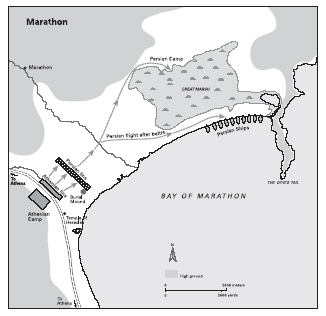
Yet the runner, when he arrived at the Athenian camp and had his first view of what his fellow citizens there were facing, must surely have felt his own resolve begin to waver. The spectacle of the plain of Marathon was fit to chill the blood; as terrifying, perhaps, as the sight that had greeted defenders on the walls of Troy, for when since those ancient times had there been any invasion force to compare with that of Datis? At the far end of the bay, sheltered by a long promontory known to locals as the “Dog’s Tail,” the Persian ships had been hauled onto the sand, and they now extended along the curve of the beach for miles. The Asiatics themselves, monstrous numbers of them, dressed in their outlandish, brightly colored costumes and swarming over the plain, trampled beneath their alien feet crops sprung from the sweat of Athenian farmers and the holy Attic soil. Their horsemen, galloping up to the Athenian lines, wheeled and turned, wheeled and turned, mocking their adversaries’ lack of archers with fast-dispersing plumes of dust.
They did not yet dare to venture beyond the lines, however—for the Athenians, camped as they were on raised ground, with steeper ground rising sheer behind them, and a grove sacred to Heracles screening them from the approach of the Persian cavalry, occupied a formidable defensive position. Now, with the arrival of Philippides at their base, they could gauge precisely how much longer they would have to hold out until the Spartans arrived: a single week. Perfectly feasible, in the opinion of a majority of the Athenian generals. When others heard Philippides’ news, however, they knew that it brought a perilous moment of reckoning that much nearer. The Persians, as Miltiades in particular had good cause to appreciate, had a sinister mastery of the arts of espionage: there could be little doubt that Datis was already factoring the vagaries of Spartan timetabling into his own calculations; little doubt either that he would have realized that he was running out of time. Since the Athenian holding force had—so far—signally failed to disintegrate amid treachery and dissension, as Datis had evidently been expecting it to do, the Persian commanders would soon find themselves obliged to adopt a new strategy—and Miltiades, for one, appears to have had little doubt what it would prove to be. With the Athenians blocking the two roads south, there was only one way for Datis to strike at Athens before the Spartans arrived: by sea. If—when—the invaders began to embark, the Athenian army would be confronted with a hideous choice: stay put and risk seaborne enemy cavalry being welcomed into Athens by fifth columnists; or advance into the open plain and offer the Persians battle. Both were fearful prospects; but only the latter, Miltiades argued, offered even the faintest hope of victory.
A day passed, then another, and another. Four days now until the Spartans were due to arrive, and still the deadlock held. The Persian ships remained where they were, menacing but motionless, beached on the sand. The sun sank behind the mountains that rim the plain of Marathon. The moon, at last, shone full in the August sky. Far off in Lacedaemon, the men of Sparta would be preparing to march to war. And in the Persian camp? Illumined a ghostly silver the plain may have been, but it was hard, miles from the invaders’ ships, to track what might exactly be happening within the shadow of the Dog’s Tail. Something, certainly: for a great commotion, the sound of thousands upon thousands of tramping feet, could be heard faint, then louder, nearing the Athenian lines. The invaders, it appeared, were advancing in force at last. But was this a full assault or a diversion? The answer would come soon enough. Datis was not the only commander to have realized the vital significance of intelligence. Someone—and one can only assume that it was Miltiades, experienced as he was in all the Persian arts of war—had recruited spies from among the invaders. That night of the full moon, some Ionian conscripts, sneaking across the plain, crept into the grove that screened the Athenian camp. The news they brought could not have been more urgent. Hurriedly, it was conveyed to Callimachus and the ten tribal generals who together constituted the Athenian high command. “The horsemen are away!”44
Here was the moment that Miltiades had been waiting for. Clearly, if his spies’ intelligence was accurate, the Persian task force had been split, with a holding force advancing to distract the Athenians’ attention while far to the rear the cavalry was being clandestinely embarked.45 A council of war was hurriedly convened; Miltiades implored his fellow generals to vote for immediate battle. Never, he urged, would there be a better chance of victory: the invaders’ army was divided and all but a skeleton force of its cavalry had gone. Four of Miltiades’ nine fellow generals agreed; five, appalled at the prospect of attacking the Persians on open ground, without archers, without cavalry, and still overwhelmingly outnumbered, did not. The casting vote now lay with the war archon, Callimachus, who had consistently shown that he felt it no shame to bow to the superior expertise of Athens’ most famous Mede fighter. He did so again now, and sided with Miltiades. The order was given. Battle would be joined at dawn.
Throughout the Athenian camp men were woken with the news that within the hour they would be advancing against an enemy who had never before been beaten by a hoplite army in open combat, “and whose very name, when spoken, was sufficient to send a shiver down the spine of any Greek.”46 Yet if, by summoning every last reserve of physical and moral strength, and by screwing their courage to a truly excruciating pitch, there was a chance of averting their obliteration, and that of their families and their city, then the Athenian hoplites had to brace themselves now to seize it. Slaves, charged with the care of their precious armor, duly brought out the burnished panoplies. The naked Athenians were transformed into fearsome automata of bronze. Then, sheathed within their breastplates and their greaves, their shields and spears in their hands, their helmets propped back upon their heads, the hoplites took their places in the battle line, standing alongside their fellows from their demes, their thirds, their tribes. It was the custom among the Athenians to serry their phalanx in ranks eight deep; but Miltiades, fearful of being outflanked by the Persians’ more mobile light infantry, and by what remained of their cavalry, ordered the center to be thinned out so that the Athenians’ line exactly matched that of the invaders, now increasingly visible a mile away through the early glimmerings of the dawn. With the first rays of sun touching the gray Euboean hills in the distance, sacrifices were offered to the gods; the omens proving favorable, the generals then took up their positions directly in the foremost line. Callimachus, as was customary for the war archon, took command of the right wing; the Plataeans were stationed on the left; Themistocles and a fellow rising star of the democracy, Aristeides, led their tribes in the center of the phalanx, at its perilously weakened heart.47 Miltiades himself, allotted overall command for the day, stood where all could hear him, and at length raised his arm, pointed to the Persians, and yelled out: “At them!”48
A shimmering of metal all along the line as the hoplites lowered their helmets, hefted their shields, shouldered their spears. Here, at last, was the moment of no return. His head encased now almost entirely within metal, every member of the phalanx found himself frighteningly cut off from the sights and sounds of the battlefield, barely able to see the enemy ahead of him, barely able to hear the braying of trumpets that instructed the Athenians to start their charge. Only the sudden jolting of his fellows on either side and the surging of the weight of men behind him appeared real. Downward, into the open expanse of the plain, the phalanx began lumbering, keeping its formation, not once threatening to break. All were borne on the dread and the intoxication of the moment—for while it was true that the faintheartedness of a few within a shield wall might prove fatal to the many, then so too was the converse, that even a hoplite shaking with terror as he advanced, wetting himself uncontrollably, streaking his cloak with shit, could know himself strong for being one with his friends and relatives, one with a mighty body of armed and freeborn men. How, indeed, without the self-consciousness of this, would any Athenian have dared to do what all in the phalanx did that August dawn: to move against a foe widely assumed to be invincible, to cross what many must have dreaded would prove to be a plain of death.
Extraordinary stories were later told of this advance. It was said that the Athenians ran the whole mile, as though men bold enough to attack the Persians for the first time must have been somehow more than human. In truth, no man wearing the full panoply of a hoplite, some seventy pounds of bronze, wood and leather, could possibly run such a distance and still have energy left to fight effectively. Even in the relative cool of the early morning, sweat rapidly began to mingle with the dust kicked up by ten thousand pairs of feet, half-blinding the advancing hoplites and stinging their blinking eyes, so that their vision of the enemy ahead of them—the outlandishly dressed archers reaching for their arrows, the slingers for their shot, the expressions of glee and disbelief in the Persian ranks—grew ever more obscured. Soon, as the Athenians crossed deeper into no man’s land, the first arrows began to hiss down upon them; then, raising the monstrous weight of their shields to protect their chests, the hoplites did at last begin to run. Simultaneously, as though the phalanx were “some ferocious cornered creature, stiffening its bristles as it turns to face its foe,”49 those in the front three ranks lowered and aimed their spears, in preparation for the coming collision. By now, with some 150 yards still to travel, a storm cloud of arrows and slingshot was breaking over them, thudding into their shields, bouncing off their helmets, striking the odd hoplite in the thigh or through the throat, but still the Athenians, braving the black rain, only quickened their pace. Those of the enemy directly in their path had already begun scrabbling to erect wicker defenses, as they realized, to their horror, that the wall of shields and iron-tipped spears, far from providing easy pickings for their bowmen, as they had at first imagined, was not going to be halted. A hundred yards, fifty, twenty, ten. Then, as the Athenians’ war cry, a terrifying ululation, rose even above the thundering of their feet upon the dry earth, the cacophony of clattering metal and the screams of the panic-stricken enemy, the phalanx crunched into the Persian lines.
The impact was devastating. The Athenians had honed their style of warfare in combat with other phalanxes, wooden shields smashing against wooden shields, iron spear tips clattering against breastplates of bronze. Now, though, in those first terrible seconds of collision, there was nothing but a pulverizing crash of metal into flesh and bone; then a rolling of the Athenian tide over men wearing, at most, quilted jerkins for protection, and armed, perhaps, with nothing more than bows or slings. The hoplites’ ash spears, rather than shivering, as invariably happened when one phalanx crashed into another, could instead stab and stab again, and those of the enemy who avoided their fearful jabbing might easily be crushed to death beneath the sheer weight of the advancing men of bronze. Soon enough, on the wings of the Persian army, men were breaking in terror, streaming back across the plain, as the Athenians, skewering and hacking, continued their deadly work. Only in the center, where the force of the phalanx’s impact had been much weaker, did the invaders have the better of the fight, withstanding the collision and then slowly pushing the hoplites back. Here was where the invaders’ best troops had been stationed: the Persians themselves, more heavily armored than most of the other levies, and the Saka, those brutal fighters from the far-off eastern steppes, their axes perfectly capable of cleaving a hoplite’s helmet or smashing through his chest. Yet already the Athenian wings were wheeling inward, attacking them on their flanks, reinforcing the hard-pressed tribesmen of Aristeides and Themistocles, so that soon the Persian center too began to crumple and the slaughter grew even more incarnadine. It was then that the few Persians and Saka who were left joined the general rout, and fled for their ships, some miles back across the plain, stumbling in the sands. They were pursued by the Athenians, exultant in their triumph, but half disbelieving it too, thoroughly dazed by the manner in which Pan had kept his word.
Yet, if the battle was won, the victory was still far from decisive. The necessity of the two Athenian wings to finish off the battle in the center had given plenty of time to the sailors manning the Persian fleet to prepare their ships for departure, and to start hauling aboard the panic-stricken levies as they milled among the shallows. True, many of their comrades had been crushed in the general stampede, or else had floundered in a great marsh that stretched northward from where the Persian ships had been beached, drowning there in such vast numbers that it was estimated later “to have been the site of the deadliest slaughter of all.”50 Yet, while Datis and Artaphernes kept control of their fleet, they remained a menace; and Miltiades and his men, powerless to deal with those ships that had already embarked, were naturally desperate to capture or burn any still remaining on the sand. The fighting on the beach, then, was as ferocious as at any stage in the battle, and, for the Athenians, just as fatal: one hoplite, reaching up to seize the stern of a ship, had his hand hacked off by an axe, and fell back spraying blood from the fatal wound; Callimachus, the war archon, was also killed; so too one of the tribal generals. Seven ships were ultimately secured; but all the rest succeeded in pulling away. The road to Athens may have been blocked to the Persians—but not the sea.
And what of the ships containing the cavalry that had embarked before the battle? The question haunted the Athenian high command. Even as they waded back past the corpses bobbing in the shallows and gazed across the plain in the direction of their city, the weary hoplites could see, glinting from the slope of Mount Pentelikon, the flashing of a brightly polished surface, deliberately angled to catch the rays of the morning sun.51 It was clearly a prearranged signal, and one that could only have been intended for the Persian fleet, somewhere out to sea. It was impossible to know its precise meaning—but every Athenian guessed at once that it spoke of treachery.
Consternation swept through the ranks. Twenty-six miles away, their families and homes still lay wholly undefended. Exhausted, sweat-soaked and blood-streaked, they had no choice but to head back at once for Athens “as fast as their legs could take them.”52 It was not yet ten in the morning when they left the battlefield; by late afternoon, in an astounding display of toughness and endurance, they had reached their city.* In the nick of time, too—for soon afterward the first ships of the Persian fleet began to glide toward Phalerum. For a few hours they lay stationary beyond the harbor entrance; then, as the sun set at last on that long and fateful day, they raised anchor, swung around, and sailed eastward into the night. The threat of invasion was over.
So it was that Athens escaped the terrible fate of Miletus and Eretria, and proved herself, in the ringing words of Miltiades, “a city fit to become the greatest of all in Greece.”53 At Marathon, her citizens had stared their worst nightmare directly in the face: not merely that the Athenian people might be transplanted far from the primordially ancient soil that had given them birth, from their homes, their fields, their demes, but, even worse, that their bloodlines, amid hideous scenes of mutilation, might be extirpated. Every hoplite fighting on that day must have known that the Great King, incensed by the Athenians’ oath-breaking, had ordained for them that “most terrible of all known acts of vengeance”:54 the castration of their sons. Had the Athenians, perhaps, in their darkest imaginings, dreaded that the gods themselves might uphold this ghastly sentence? Athens had indeed betrayed her promises of loyalty to Darius; and it was the habit among the Greeks when they swore an oath to stamp upon the severed testicles of a sacrificial beast, and pray that their progeny be similarly crushed if they went back on their word. By charging the enemy at Marathon, the Athenians had, in effect, steeled themselves to put this most terrible of all their fears to the test—and had resolved it spectacularly.
And much more besides. Whoever had sent the signal to the Persians from Mount Pentelikon kept his silence now. When the news was brought that Hippias, dashed of all his hopes, had expired of disappointment en route back into exile, it merely confirmed what everyone already knew: that no one after Marathon should stake his future on there being a tyranny in Athens again. Everyone was in favor of rule by the people now. Or at least in favor of rule by the people who had won the famous victory: the farmers, the landed gentry, the armor-owning stock. 192 of them, it was discovered, had died in the battle—and to these heroes of Athenian liberty a unique honor was accorded. No tombs in the Ceramicus for them; instead, for the first and only time in their city’s history, the dead were buried, “as a tribute to their courage,”55 on the very field where they had fallen. A great tomb was raised over their corpses to a height of more than fifty feet, and marble slabs listing the names of the fallen were placed along its sides. Not even the haughtiest of noble dynasties could boast of anything to compare. Mingled with the dust they had fought so courageously to defend, the dead were to lie buried together, without class or family distinctions of any kind. They were citizens—nothing less and nothing more. What prouder title than that of Athenian could possibly be claimed? Athens herself was all.
Even the Spartans, when they arrived there after their grueling three-day march, regarded the men who had conquered the Mede unaided with a new and ungrudging respect. Marching onward to inspect the battlefield, they found at Marathon, rotting amid the dust of the plain or half sunk into marsh slime, evidence enough of the scale of the menace that had been turned back so heroically. Six thousand and four hundred invaders lay there, fattening the flies—and that was only a fraction of the task force that Datis had led. How many teeming millions more the Great King might have at his command, breeding and swarming within the fathomless hinterlands of Asia, neither the Athenians nor the Spartans much cared to contemplate. Every Greek, looking upon the Persian dead and reveling in the great victory, must nevertheless have felt just a tremor of apprehension. Yet the Spartans, methodically inspecting the battlefield, turning over the corpses, making notes, would have found much to reassure them as well. It was the first opportunity they had ever been given to study the armor and the weapons of the fabled masters of the East; and what they saw did not greatly impress them. Datis may have led a huge army to Marathon—but nothing that the Spartans would have recognized as their equal.
Meanwhile, even as they continued their tour of inspection, a great trench was being dug on the southern margins of the marshes. Into this makeshift refuse tip the invaders’ corpses were flung unceremoniously. No memorial for the slaughtered Persian hordes.* Mute and inglorious as their grave was, what better was deserved by men who in life had known nothing of the comradeship of a city, or of liberty from royal diktats, or of the discipline of a phalanx, but had instead milled like the merest herd of beasts, their voices animal screechings, full of sound and fury, signifying nothing? The Ionians had labeled the Persians “barbarians”; now, in the aftermath of their great victory the Athenians began to do the same. It was a word that perfectly evoked their fear of what they had seen that early morning on the plain of Marathon: an army numberless and alien, jabbering for their destruction, “gibberish-speakers” indeed. Yet “barbarian,” especially on the tongue of a veteran of the famous battle, could also suggest something more: a sneer, a tone of superiority, or even of contempt—one, certainly, that few Greeks would have dared to adopt prior to that fateful August dawn.
Marathon had taught not only Athens but the whole of Greece a portentous lesson: humiliation at the hands of the superpower was not inevitable. The Athenians, as they would never tire of reminding everyone, had shown that the hordes of the Great King could be defeated. The colossus had feet of clay.
Liberty might be defended, after all.
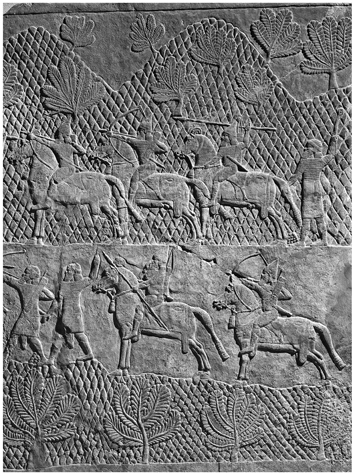
1. A relief from Nineveh, showing the Assyrian army on a mountain campaign; cavalry predominates. The tribute of horses from Media was vital to Assyria’s efforts to stay ahead in the Near Eastern arms race. (The Art Archive/Musée du Louvre, Paris/Dagli Orti)
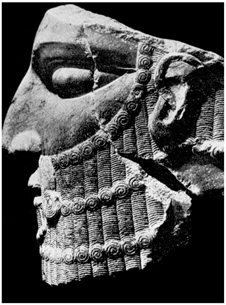
2. The head of a king found among the ruins of Ecbatana. If not a fake, then this is almost certainly a representation of Astyages, the dream-haunted last King of Media.
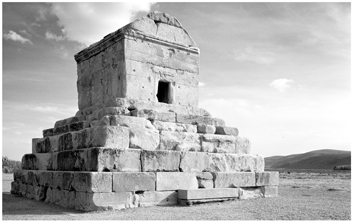
3. The tomb of Cyrus the Great at Pasargadae. “Mortal!” an inscription on it is said once to have read. “I am Cyrus, who founded the dominion of the Persians, and was King of Asia. Do not begrudge me then my monument!” (Bridgeman Art Library)
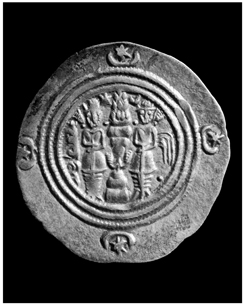
4. A coin illustrating a fire altar. The blaze of fire was profoundly sacred to the Persians, and served as an empire-wide symbol of the power of the Great King. (Ancient Art & Architecture)
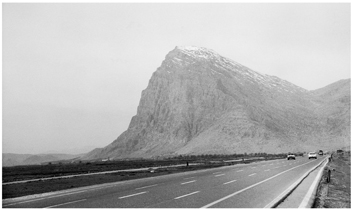
5. Bisitun as it appears today, with the main Iran-Iraq road in the foreground. It was ten miles to the south of the sacred mountain that Darius and his assassination squad murdered Bardiya, on the Khorasan Highway that ran below it that he defeated the rebel king of Media, and on its cliff face that he memorialized his great victory over the Lie.(Tom Holland)
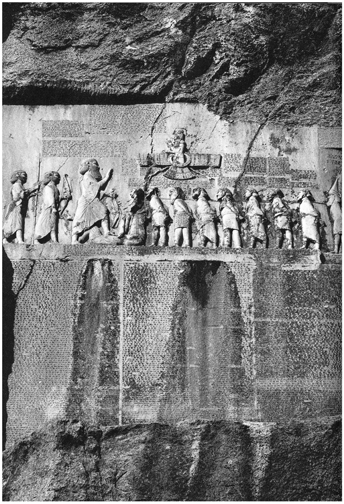
6. Darius triumphant, as represented on the cliff face of Bisitun. A prostrate Gaumata grovels beneath his foot. The nine liar kings who dared to challenge him are shown tethered by their necks: Nidintu-Bel, the rebel king of Babylon, is second from the left; Phraortes, the rebel king of Media, third from the left; Vahyazdata, the rebel king of Persia, sixth from the left. The rebel king of the Saka, wearing his distinctive pointed cap, brings up the rear. (R. Woods)
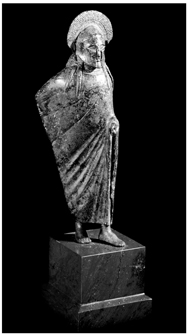
7. The face of the most terrifying state in Greece. A Spartan warrior, long-haired and swathed in a cloak, peers out through the eye slits of his helmet. (Wadsworth Atheneum Museum of Art, Hartford, CT; gift of J. Pierpont Morgan)
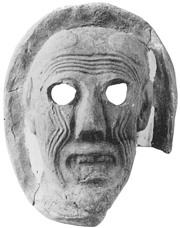
8. A mask from the temple of Artemis Orthia in Sparta. The masks hung upon the walls, some of them of young men or soldiers, but many more, like this one, withered and grotesque. In their ugliness lay a reminder to every Spartan of the failure it was his lifelong duty to avoid. (British School at Athens)
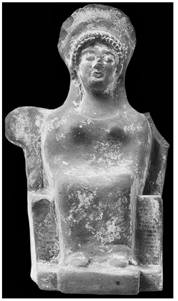
9. Athena “Polias”—“The Guardian of the City.” The original icon of the warrior goddess, jealously preserved by the Boutad clan on the Acropolis, was the oldest and most sacred statue in the whole of Athens. (Acropolis Museum)
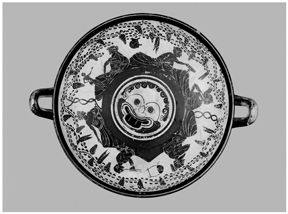
10. By the sixth century BC, the Athenian aristocracy were rousing themselves from their traditional provincialism. The interior of this Attic drinking cup shows revelers adorned in the turbans and long robes that were characteristic of the international party set. (Ashmolean Museum)
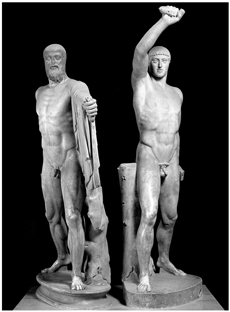
11. Harmodius and Aristogiton. Following the establishment of democracy in Athens, a bronze of the tyrannicides—of which this is a Roman copy—was the only public portrait to be seen in the whole of the city. A squalid crime of passion had been transfigured into a heroic blow struck for liberty. (Museo Archeologico Nazionale, Naples/Bridgeman Art Library)
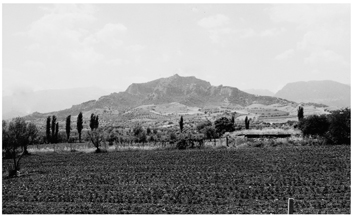
12. The site of the great city of Sardis. The splendors that made it the capital of the Persian West have long since vanished, but the imposing acropolis still rises steep and jagged above the plain. (Tom Holland)
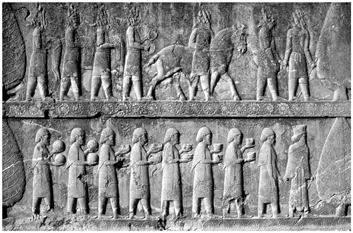
13. Ionians bringing the Great King tribute, as shown on a relief at Persepolis. Above them, instantly recognizable in their pointed hats, are the ambassadors of the Saka. (The Art Archive/Dagli Orti)
14. A bronze weight in the shape of a duck, found in the Treasury at Persepolis. Ducks, just like any other user of the imperial road system, would be issued with ration chits by the ever-punctilious Persian bureaucracy. (Oriental Institute Museum, University of Chicago)
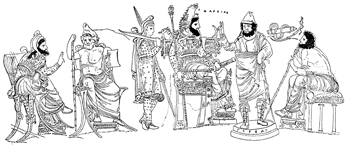
15. Darius and his court, as imagined by a Greek painter of the fourth century BC. A century after Marathon, Darius remained the archetype of royal power. (Museum of Naples)
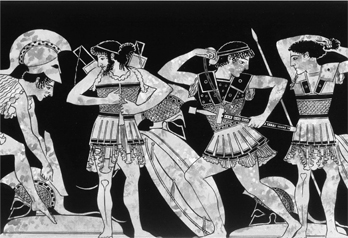
16. This watercolor of hoplites arming for battle is based on a vase that dates from the decade before the battle of Marathon. The Athenian victory over the Persian invaders in 490 BC was the first demonstration of how lethal Greek armor and weapons might be when brought to bear against the much more lightly armed troops of the East. (akg-images/Peter Connolly)
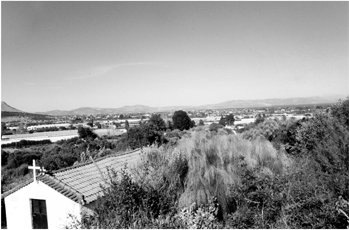
17. A view of the modern-day plain of Marathon, looking north from the position of the Greek camp to where the Persian camp would have been. (Tom Holland)
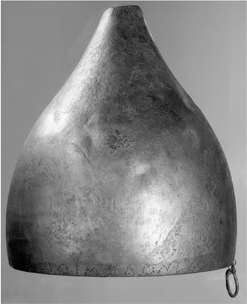
18. A bronze helmet worn by a Persian soldier who fought at Marathon. It was dedicated by the victorious Athenians to the temple of Zeus at Olympia. (akg-images/John Hios)
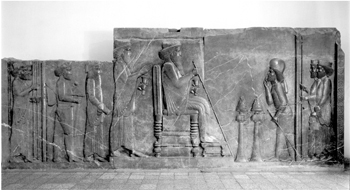
19. The King of Kings seated on his throne. This is probably a representation of Darius—in which case the Crown Prince standing behind the throne is Xerxes. Alternatively, the King may be Xerxes himself. Artists at the Persian court were employed to portray idealized representations of royal power, not to draw from real life. (National Museum of Iran, Tehran/Bridgeman Art Library)
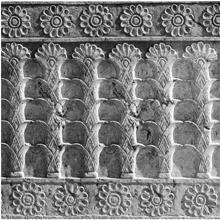
20. A frieze of palm leaves and sunflowers from Xerxes’ private quarters at Persepolis. Gardens and the beauties of the natural world were a universal passion among the Persian elite.
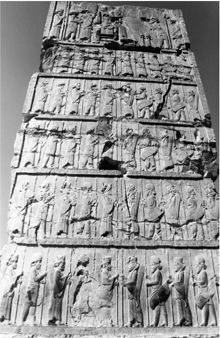
21. The Great King, symbolically borne on the shoulders of his soldiers. The invasion of Greece was not merely a military expedition—it was also designed to demonstrate the full scale and reach of royal power. (Sadie Holland)
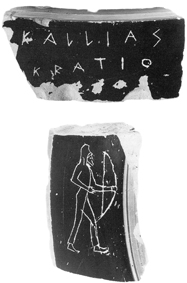
22. An ostracon cast in the 480s BC, when dread of Persia was starting to infect political life in Athens. This particular shard was cast against “Callias the son of Cratius”; the rough sketch on its reverse side, showing Callias as a Persian archer, makes clear the crime of which he was suspected. (Deutsches Archäologisches Institut, Athens)
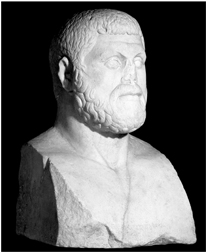
23. Themistocles: “the subtle serpent of Greece.” (Werner Forman/CORBIS)
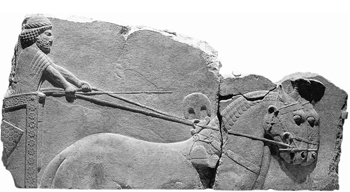
24. A fragment of a relief from Persepolis, showing a chariot pulled by Nisaean horses. This was the form of transport that Xerxes used to cross the Hellespont. (British Museum)
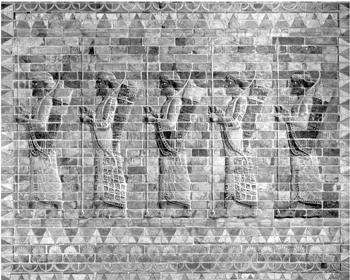
25. Persian infantrymen, from a frieze discovered at Susa. The richness and beauty of their robes suggest that they belong to the Immortals, the elite squad of 10,000 who served the Great King as his shock troops. (Gianni Dagli Orti/CORBIS)
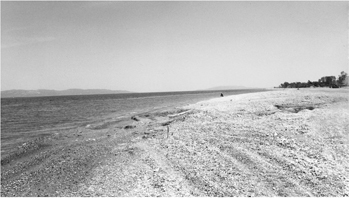
26. A view of the beach at Artemisium as it looks today. Back in 480 BC, the ships of the Greek fleet could easily be hauled up onto the shingle or launched back into the sea as the movements of the enemy demanded. (Tom Holland)
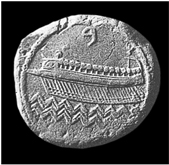
27. A coin from the fourth century BC, showing a Sidonian warship. Slim, shield-hung and sublimely maneuverable, Phoenician triremes moved faster than anything the Greek fleet could pitch against them. (British Museum)
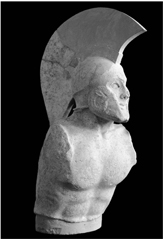
28. This bust of a Spartan warrior has traditionally been taken to represent Leonidas, the king who lead the 300 men of his bodyguard to their heroic deaths at Thermopylae. Whether it is truly a portrait of Leonidas or not—and the overwhelming probability must be that it is not—it powerfully expresses the resolution and defiance that Spartans were trained all their life to attain. (The Art Archive/Archaeological Museum Sparta/Dagli Orti)
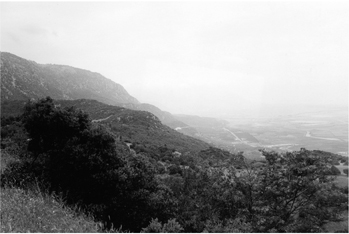
29. Thermopylae, seen from the heights above the East Gate. Back in 480 BC, the flatlands stretching away from the pass to the east would have been submerged beneath the waters of the Malian Gulf. Otherwise, this is essentially the view that Hydarnes and the Immortals would have had as they descended from the mountain pass to attack the Greek holding force in its rear. (Tom Holland)
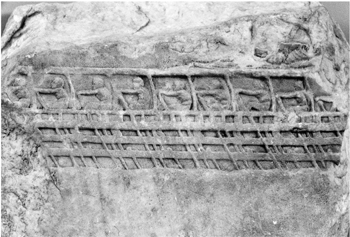
30. This relief, sculpted some eighty years after the battle of Salamis, shows the midsection of a Greek warship. Banks of straining rowers pull on oars. (Bridgeman/Alinari Archives)
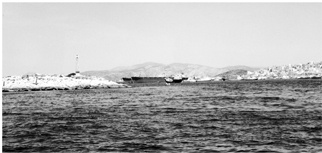
31. Modern-day Salamis. The straits in which the Persian fleet were defeated are now crowded with tankers, warships and speedboats. The topography, however, has stayed essentially the same. This is the view from the entrance to the straits. A full view of them is only possible once a ship has advanced further into the channel. (Tom Holland)
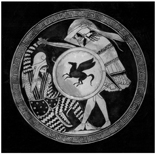
32. Down, and almost out. The Persian defeat at Plataea finished off the Great King’s hopes of conquering Greece for good. (National Museums of Scotland)
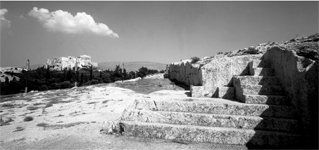
33. A view from the Pnyx, where Themistocles rallied his fellow citizens to defiance of the Persian juggernaut, looking eastward toward the Acropolis. On the summit of the sacred rock stand the ruins of the Parthenon: the most beautiful war memorial ever built. (Bridgeman/Alinari Archives)