
Once, before the coming of the Persians, the Aegean had been a Greek lake. That winter of 481 BC, however, with a crippled Ionia still counting the ruinous cost of rebellion, with Miletus a blackened shell of her former greatness, and Naxos and the other islands having submitted a decade previously to Datis’ armada, the journey of the three Greek spies from the Peloponnese was very much a voyage into enemy waters. The nearer they drew to Asia, the more unsettling it became. Evidence of the terrifying scale of Xerxes’ preparations was everywhere. Winter was drawing in, but the Aegean sea-lanes were still unseasonably busy. Along the Ionian coast, vessels that had swarmed there from every corner of the eastern Mediterranean crowded the harbors. The Greeks, even in their own backyard, were being swamped. Thirteen years previously, at Lade, the last fleet of a free Ionia had been swept off the sea. Now, with the invasion of Greece itself only months away, the contingents that had contributed most notably to that crushing victory for the King of Kings were back in Ionian waters. Any Greek would have recognized them with a sinking heart. Slim, shield-hung and sublimely maneuverable, the triremes that would constitute the shock force of Xerxes’ fleet had a deadly reputation. The sailors who manned them were universally acknowledged as the most proficient in the world. “Your borders,” as the Judaean prophet Ezekiel put it, “are in the heart of the sea.”46 He was addressing the city of Tyre, but he might just as well have been speaking to her even wealthier neighbor Sidon, or to Byblos, or to any of the great merchant strongholds that stood on islands or abreast of double harbors along the seaboard of what is now Lebanon. Proudly independent of one another each city may have been, but this, to many outsiders, was a wasted subtlety. The Greeks, certainly, lumped all their citizens together as one single, perfidious crew: Phoinikes—Phoenicians.
This name, deriving as it almost certainly did from “phoinix,” the Greek word for “purple,” reflected that same blend of admiration and contempt with which they tended to regard any people whom they found threatening. Admiration—because the violet dye which the Phoenicians manufactured from shellfish was definitively the color of refinement and privilege, an internationally desired luxury product that had helped to fill the coffers of Tyre and Sidon to overflowing. Contempt—because how vulgar it was, after all, how crashingly and irredeemably vulgar, to be defined by an item of merchandise! “The love of lucre, one might say, is a peculiarly Phoenician characteristic.”47 So Athenian aristocrats liked to sniff. Yet this characterization of Phoenicians as oily money-grubbers, universal Greek prejudice though it was, might just as easily inspire resentment as disdain. The merchants of Tyre and Sidon were not the only people who had a taste for turning a profit. There were many Greeks who shared it, and who profoundly resented the competition that the Phoenicians gave them. No matter how far they traveled, no matter where they sought new markets, or raw materials, or land for a trading post, “those celebrated sea-rovers, those sharp dealers, the holds of their black ship filled up with a hoard of flashy trinkets,”48 seemed always to have got there first.
This rivalry, stretching back centuries, extended to the outer limits of the known world. The Phoenicians, their cities quite as hemmed in by mountains as were those of the Greeks, had always set their sights upon the open horizons of the sea. As far back as 814 BC, it was said, the Tyrian princess Elissa, leaving her homeland, had led a great party of colonists along the coast of North Africa until, arriving opposite Sicily, she had founded there a “new city”—“qart hadasht,” or Carthage—destined to become the greatest metropolis of the West. By the time that Euboean colonists, a few decades later, began nosing their own way westward, the tentacles of Phoenician trade had already reached to Spain. Soon they were extending even further, into the Atlantic and toward the Equator, to beaches fringed by jungle, where the Carthaginians would trade with impassive natives: gewgaws and baubles for gold.
The Greeks, listening to these travelers’ tales with an envious gleam in their eyes, had found themselves, by and large, too late on the scene to gatecrash the African market; and yet, although frozen out of Africa and Spain by the sophistication of their rivals’ commercial networks, they too had discovered in the West a frontier ripe with opportunity. Although their first colony, on the island of Ischia in the bay of Naples, had initially courted Phoenician investors, partnership with the old enemy had not come naturally. Soon enough, throughout Italy and Sicily, it had degenerated into open confrontation. As ever more Greek settlers arrived looking for a new beginning, so the sheer weight of their numbers had begun to tell. On and on they had come, from Euboea, from Corinth, from Megara, from Ionia, a flood of maritime colonization, unsurpassed in scale until the discovery of America more than two thousand years later. By the turn of the eighth century BC, a new city was being founded in Italy or Sicily virtually every other year. Even the natives had begun to talk of “Great Greece.”
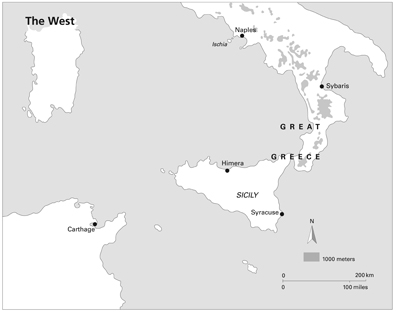
Certainly, by the time that mass colonization had finally trickled to a halt in the mid sixth century BC, the wild West was semi-tamed. Determined to overawe the natives where they could not enslave them, the colonists had adopted a self-consciously swaggering style. Everything they did was on a monumental scale: walls loomed far vaster in the Greeks’ new world than in the old; temples sprawled more grandiosely; colors gleamed brasher and more polychrome. Even the pleasures that men took in the West smacked of intimidation. In Sybaris, a town on the instep of southern Italy and an object of appalled fascination even to her neighbors, dandies would sprawl languidly on beds of rose petals and then complain in a drawl of suffering blisters. In war, their horses had only to hear flautists piping an enemy phalanx into battle and they would start shimmering together in a perfect synchronicity, practicing their dance steps. Even the ruin of Sybaris, when it ultimately came, had been spectacular. Captured by a coalition of its enemies in 510 BC, the city had been obliterated, razed from the face of the earth, so that not a trace of it remained. Success and failure in the West were both lit by a lurid and extravagant glow.
No wonder that the allies meeting at the Hellenion had resolved, even as they dispatched their three spies eastward, to send a mission in the opposite direction as well. Enthusiasts for rose petals and late-night dancing the western Greeks may have been, but they could be fearsome soldiers when the mood took them. A tyrant by the name of Gelon, a ruthless and exuberant adventurer who had seized power in the great Sicilian port of Syracuse four years previously, appeared particularly well qualified to play the role of Greece’s savior. His credentials as a man of action were so impressive as to be unsettling. Already, rather as an Assyrian might have done, he had annihilated three neighboring cities, transplanting their populations to Syracuse when not selling them into slavery, and raising fleets and armies on an almost Oriental scale. Just the brand of militarism, in short, that might seem to promise much against the King of Kings.
Except that there was, that same winter of 481 BC, the shadow of a looming crisis over Syracuse as well. Gelon, crashing and swaggering ever further westward in a bid to expand his supremacy over the whole of Sicily, had found himself colliding with a rival power bloc on the other side of the island, one largely comprised of Phoenician settlements. These, looking around frantically for an ally, had turned for help, as was only natural, from the most powerful Phoenician settlement of all: the city of Carthage. There, the subtle and calculating merchant princes who guided its affairs had been watching Gelon’s progress with mounting alarm. Their Sicilian kinsmen were welcomed with open arms: the opportunity to overthrow the troublesome tyrant of Syracuse while simultaneously indulging in some expansionism of their own was far too good to let slip. During the autumn of 481 BC, even as the triremes of Tyre and Sidon were gliding northward into the Aegean, the Carthaginians had begun equipping a fleet and recruiting a fearsome army of mercenaries, ready for a showdown with Gelon come the spring. In the West as well as in the East, it seemed, the Phoenicians were massing. And west and east, it was the Greeks who were to bear the brunt of their drive to war.
Coincidence? No one in Greece could quite be sure. The spies sent to Sardis, for all that they might be able to nose around a few harbors on their way, had not the slightest hope of tracking down communications—even if they existed—between the Carthaginians and the King of Kings. Nevertheless, suspicion of the long reach of Phoenician cunning came naturally to most Greeks. After all, if the Carthaginian high command had indeed been liaising with Xerxes, attempting to synchronize their twin invasions, then the likeliest suspects as middle-men were agents from the mother city of Tyre. Some conspiracy theorists, though, fretted that even this might not be the limit of Phoenician malignancy. What if the entire expedition of the King of Kings, the massing of the hordes of Asia, and the extermination of Greek freedom that it threatened, were merely the climax of a feud infinitely more ancient and inveterate? “Persians in the know,” it would be asserted with bald confidence after the war, “put the blame for the quarrel squarely on the Phoenicians.”49 The hatred between East and West, Asia and Europe, barbarian and Greek: all, according to this theory, welled from a single perfidious source.
It was stretching paranoia to extremes, of course, to imagine Xerxes the mere tool of a fiendish global conspiracy masterminded from Tyre. The King of Kings went to war on no one’s behalf save his own. The Phoenicians, just like any other subject people, were his slaves. They were obliged to pay him tribute, to host a satrap and even, when they sailed to war, to submit to the authority of a lubberly Persian courtier. But that is not to say that the Phoenicians lacked all influence with the imperial high command. The Medes aside, there was perhaps no group of people in the Persians’ entire dominion with such ready access to the royal ear. The kings of Tyre and Sidon were perfectly aware that the Great King’s expedition would be holed below the waterline without the enthusiastic participation of their fleets. So it had always been. Cambyses, when he founded the imperial navy, had soon discovered the limits of what he could achieve with his new toy. Ordering a task force prepared for the conquest of Carthage, he had been astounded to have his plans vetoed by the Phoenicians, “on the grounds that it would be an unnatural deed for them to go to war with their own children.”50 The lesson of this startling display of lèse-majesté was one that Persian strategists had been quick to absorb. While the levies of other subject nations could be dragooned into war, it was wise to handle the Phoenicians more diplomatically. Slaves though they were, it might sometimes prove counterproductive to rub their noses too brutally in the fact. Better to have them sailing not merely as conscripts but as eager partisans for the cause of the King of Kings. Better, in short, to have them believe that their own interests were also at stake.
And, of course, in the enterprise of Greece, they certainly were. The Phoenicians, who had provided the Persians with the bulk of their fleet at Lade, had already profited hugely from the destruction of Miletus—a city once quite as much of a commercial hub as Sidon or Tyre. Were Athens to be flattened in a similar manner, and the neutralization of Corinth and Aegina secured, then the prospects for Phoenician business would glitter promisingly indeed. As a result, enthusiasm in the chanceries of Tyre and Sidon for the Great King’s war was unstinting. The Phoenicians brought three hundred ships with them to the Aegean: more than the entire fleet of Athens. Nor had these been patched together in a hurry: Sidon, which competed with Corinth for the title of birthplace of the trireme, had been at the forefront of naval innovation for centuries. The Athenian oarsmen, often with only a few months’ practice under their belts, would find themselves, in their first true taste of battle, going head to head with the very best.
Horrendously outnumbered too. The Phoenicians were far from the only people to have sent a fleet in answer to the Great King’s summons. Some, notably the Egyptians and the Ionians, were almost the equals of the Sidonians with an oar. True, both came from satrapies with a track record of rebellion; and perhaps, as they snooped along the harbor front, the three Greek agents found some hope in this fact. If so, they were clutching at straws. The Persian admiralty, having been caught napping in the early days of the Ionian Revolt, knew better now than to neglect their backs. Command of the Egyptians and Ionians had been placed directly in the hands of two of Xerxes’ brothers, and every ship in the armada manned with marines of proven loyalty. Why, then, would anyone in the Great King’s fleet risk mutiny and their own annihilation for the sake of the Athenians, who were clearly doomed anyway? No one crowded into the ports of Ionia that winter could have had much doubt on that score. The mammoth fleet would soon start sweeping along the Aegean coastline, and all who stood in its way were bound to be destroyed. The Greek spies totted up 1207 triremes: a figure of suggestive precision.51 Whether all that vast number would embark for Greece and, if they did, whether they would all survive the summer storms unscathed were questions that only the campaign to come would answer. But the odds, even if the Great King lost a quarter of his fleet, even if he lost a half, would still be far from balanced. One simple, brutal fact, to the Greek spies, was menacingly clear. The allies, come the summer, would be facing a force greater than any that had ever been seen at sea.
And by land? Only a visit to Sardis could answer that question. The Greek agents hurried on. By their third day of travel from the coast, they could see ahead of them, obscuring the silver mountains that loomed to the east, an ominous pall of smoke. Soon, nearing their destination, they began to make out great humps of earth, the cemetery of the ancient Lydian kings; then, dimly through the haze, Sardis itself, the red cliffs of the acropolis framed by steepling walls and surmounted by Croesus’ monumental palace. The banners that flapped over the city’s battlements, however, one adorned with “an image of the sun enclosed in crystal,” and the other, the royal battle standard, embroidered with the image of a golden eagle,52 were those of a monarch mightier by far than Croesus had ever been; and the evidence of his greatness, there before the dumbfounded agents’ gaze, stretched for miles far across the plain. The smoke they had seen from the far distance was pluming up from campfires: thousands upon thousands of them. Whether huddled in tents, or practicing with their outlandish weaponry or jabbering in their impenetrable tongues, the multitudes of the Great King’s army seemed conjured from a world stranger and more barbarous than most Greeks had ever cared to imagine. All the spies’ darkest forebodings appeared fulfilled. The remotest reaches of Asia and of Africa had emptied themselves. Millions upon millions would be pouring, in barely a few months, into Greece.
Or so it seemed. In truth, to count—or even to estimate—such monstrous hordes was no easy matter; and the spies, before they could even start their calculations, were unmasked and apprehended. The men who had arrested them were soldiers, not intelligence officers, and so it never crossed their minds not to have their captives tortured, then put to death. Just as the sentence of execution was about to be carried out, however, captains from the Great King’s personal bodyguard came rushing up, frantically ordering that the prisoners must be spared. Led stumbling up the acropolis into the inner depths of the palace, the three spies found themselves, to their astonishment, being personally interrogated by the Great King himself, then escorted on a full tour of the imperial camp. Only once they were laden down with copious notes were they finally sent packing back to Greece.
And the reports they took with them, just as the Great King had intended they would be, dealt only in terrifying superlatives. What the spies had been shown was nothing less than a panorama of his world-spanning dominions. At its heart the Great King himself and his crack corps of bodyguards: the thousand who attended him personally and bore golden apples on their spear butts, and then a further nine thousand, also hand-picked, with silver apples on their spears, a shock force of warriors known collectively as the “Immortals”—“for if one of them were killed or fell sick, a replacement would immediately step forward to fill the gap in the ranks.”53 Then elite contingents of cavalry, from Persia and various subject nations: Media, Bactria, India, the steppes of the Saka. Finally—for the Great King lacked heavy infantry fit to measure against the bronze-clad hoplites of Sparta or Athens—teeming brigades of spear fodder: exotically armed levies who might not, under normal circumstances, have appeared to a Greek observer as anything other than contemptible foes, but who, rolling forward in a great torrent of humanity, might be expected to sweep away any shield wall standing in their path. This, at any rate, was how it was reported back in Greece—for the three spies, reliant on their own dazzled estimates of the Great King’s troop numbers, and no doubt on records helpfully provided by their Persian minders, did indeed find themselves talking in terms of millions. One million, seven hundred thousand to be precise—and even that total took no account of the levies that the Great King was planning to recruit as he advanced through Thrace and into Greece.
Such figures, so colossal as to be virtually meaningless, were almost certainly a grotesque exaggeration. Most historians, forced to make an estimate, would put the army under Xerxes’ command closer to 250,000.54 Even that, however, translated into an invasion force vaster than any previously assembled; and it was hardly a surprise that the Persian propaganda machine, looking to panic the Greeks into despair and perhaps even outright surrender, should have pumped their agents full of disinformation. Statistical sleight of hand the muster lists may have been, of the kind that a talented bureaucracy could pull off in its sleep; but they were not—to the Great King’s way of thinking, at any rate—a total fraud. Rather, in the message they proclaimed—that the whole world stood united beneath his banner, and that only the most inveterate of terrorist states could possibly presume to defy it—they expressed the simple truth.
And Truth, after all, was what Xerxes sat on his throne to defend. Strongly though considerations of geopolitics had weighed with him, and a sense of duty to his father, and personal ambition, yet Athens was to be burned, and Greece conquered, for a reason profounder than any of these. “All I do, I do by the favor of Ahura Mazda.” So it pleased Xerxes, as it had pleased Darius before him, to proclaim. “When there is a task to be done, it is Ahura Mazda who gives me aid, until that task is completed.”55 To the imperial army, then, as it embarked upon the supreme challenge of its master’s reign, there clung a nimbus of the divine. The Lord of Light was to be regarded as a constant presence on the campaign. Not, of course, that Ahura Mazda could be represented as other people chose to portray their gods, in the form of some vulgar idol or painted image; yet vacancy, mystery-hedged and awful, might serve instead. So it was that an exquisitely decorated war chariot, guided by a charioteer following it on foot, was to accompany the army into Greece, wholly empty—“for the mortal does not exist who may take his place upon that chariot’s throne.”56 To pull it, eight white horses, of marvelous size and beauty, had been brought specially to Sardis. Others, when the army left for Greece, were to lead the way; still others were to pull the chariot of Xerxes himself. These creatures, as was only fitting, were touched by the sacred themselves—for they came from the plain of Nisaea. There, on that fateful first day of Darius’ reign, when the assassin of the false Magus had emerged from the fort of Sikyavautish holding aloft his bleeding dagger to pronounce Persia and all her dominions purged of the Lie, the white horses had whinnied in salutation. Now, far from Nisaea, horses of the same breed, pulling the chariot of Darius’ son, were to witness the dedication of demon-racked Athens, and all of Greece with her, to the Truth.
For if, as Xerxes had been raised to believe, the world was his to conquer, it was also his to mend. Keen horticulturalist that he was, he knew that a paradise, before it could be considered completed, first had to be cleared of weeds, set in order, beautified. Significantly, even embarking on a brutal campaign of destruction, Xerxes’ love of the natural world and his eye for its glories never left him. Nearing Sardis, for instance, he had come across a plane tree of such surpassing loveliness that he had halted the entire march of his army in admiration. One of the Immortals had even been detached from the company and ordered to serve as its guard. Golden jewelry brought out from the expedition’s mobile treasure trove had been festooned from its sweeping branches. To be sure, the Great King took—but he also gave away.
And not just to trees. Xerxes, tending the garden that was the world of his enormous empire, delighted in servants who served him loyally, and loaded them down just as he had loaded down the plane tree, with lavish rewards. “For what robes are there that can compare in beauty to those the King hands out to his friends? Whose gifts—whether bracelets, or necklaces, or horses in harnesses studded with gold—are so distinctive?”57 Xerxes’ Europe-bound expedition, while it was certainly intended to demonstrate the folly of scorning the Great King’s favor, also had a more pacific intent. Remote satrapies, hitherto cruelly denied the royal presence, might now enjoy the supreme privilege of paying homage to the King of Kings in person. His subjects, as he rode through their towns, would line the roads, tossing flowers before the clattering hooves of the Nisaean horses, and prostrating themselves in the dust; attendants, following in their master’s wake, would gather up gifts and petitions; guards, lashing the moaning, sobbing crowds with whips, would ensure that they retained, even in their ecstasy, a sense of their proper place. Naturally, there was nothing that any of the Great King’s subjects, whether peasants or plutocrats, could offer their master that was not already his; but Xerxes, turning the light of his royal favor upon those who humbled themselves, might be munificent as well as gracious. “Generously,” he boasted, “do I repay all those who do well by me.”58 Even the Greeks, if they would only submit to the majesty of the Great King, might hope to win, as Demaratus already had, extravagant honors and gifts. This, at its heart, was the symbiosis of global monarchy. Even Xerxes had to plant as well as reap.
Which was not to deny that blooms, for the good of the garden, might sometimes need to be pruned. Servants, unlike plants, could on occasion grow presumptuous. Xerxes, shortly before passing the plane tree that had so astounded him with its beauty, had been entertained by Pythius, the Lydian reputed to be the richest commoner in the world. Some thirty years previously, this same plutocrat, sensitive to the tastes of his Persian masters, had presented Darius with a plane tree made of gold. Now, greeting Xerxes, he had not only fed the Great King’s entire army, but vowed to bankroll it. Xerxes, breezily dismissing this offer, had nevertheless been charmed. All that winter, Pythius and his five sons stood high in the royal favor. Pythius himself had been lavished with gifts; his sons all confirmed in prominent military posts. Then, with the coming of spring to Sardis, and the time at last for Xerxes and his task force to depart upon their great enterprise, there was sudden consternation. An eclipse, blotting out the sun, had cast the world into shadow. Although the Magi were quick to reassure their anxious master that this portended the ruin not of his expedition but of the rebel Greeks, Sardis remained racked by a sense of foreboding. The aged Pythius, as “alarmed by the sign from the heavens”59 as anyone, even went so far as to beg the Great King for his eldest son to be spared from going to Greece. A terrible, a fatal mistake. At a time when Xerxes himself was preparing to ride into danger with all his “sons, and brothers, and relatives, and friends,”60 no more scandalous a request could possibly have been imagined. While the Great King, mingling mercy with the stern dictates of justice, did somehow bring himself to spare his former favorite’s life, it was clearly out of the question to pardon the Lydian’s impertinence altogether. Pythius’ precious eldest son was duly apprehended, killed and sawn in two. Then, with the army massing to march northward for the Hellespont, the two halves of the corpse were exhibited on either side of the Sardis highway. “And the army, everyone in it channelled between the two halves of the young man’s body, embarked on its advance.”61
A less than cheery send-off, it might have been thought. In fact, grisly though this blood offering certainly was, and an increasingly fly-blown one at that, yet it broadcast to the jumpy levies passing between it a potent message of reassurance. The demands of ritual as well as justice had doomed the son of Pythius. The sacrifice of a human life was an act pregnant with fearful magic, a magic that Xerxes, hoping to purify his army, had now dared to harness. The Great King himself, trusting in the judgment of the Magi that the eclipse had been a favorable portent, had his private doubts whether there was in fact any evil that needed keeping at bay; but he also knew, with Sardis so shadow-haunted, that it was better to play things safe. Certainly, as his troops prepared to venture into the wilds of a new continent, they could do so confident that there was nothing their royal master would not countenance in his drive for victory.
Nor, as the Great King neared Europe, did he neglect to toy with the superstitions of his foes. Devout in the worship of Ahura Mazda he may have been—yet Xerxes had the traditional Persian genius for turning the religious sensibilities of alien peoples to his advantage. This was why, having closed in on the Hellespont, he took the opportunity to break his journey and explore a site that to him would have appeared merely a grass-covered series of bumps, but to the Greeks meant infinitely more: Troy. By ordering the Magi to pour libations upon the site, Xerxes was self-consciously laying claim to the role that the Greeks, in their terror, had already given him: that of nemesis for the carnage wrought by Agamemnon. Vengeance, on behalf of all the men of Asia slaughtered in the Trojan dust, was to be the King of King’s. Just as Troy had once done, Athens and Sparta were shortly to burn.
Then, with the Pisistratids no doubt whispering helpful encouragements from the side, a thousand oxen were driven up the hill, and the whole lot immolated on the summit as an offering to Athena. This, since the goddess had always been notorious for her loathing of the Trojans, might have been thought a maladroit gesture—except that Xerxes, by displaying his respect for the protectress of Athens so extravagantly, was sending the Athenians a very public message. The Athena worshipped in their city was no Olympian, but rather a demon who had taken on her form, one of thedaivas, a servant of the Lie. The King of Kings, pledged though he was to burn the Acropolis, was no enemy of the true goddess, whose worship, in the company of the Pisistratids, he would shortly be restoring. Only with Athens under Persian rule could Athena return to her ancient home—and that moment, in the spring of 480 BC, was drawing ever nearer.
For the Great King, from the summit of Troy, could see at last, beyond the plain on which so many Greeks and Trojans had once fought and died, the fateful glittering of the Hellespont. Further along the straits, where Asia and Europe stood separated by barely a couple of miles of sea, twin pontoon bridges were awaiting him, their immense cables chaining together the two continents, proof against the currents and the raging of the winds. That winter, it was true, a particularly ferocious gale had swept away two prototypes of the pontoon, but the Persian high command, having decapitated a few engineers pour encourager les autres, and with plenty of ships and manpower to spare, had quickly made good the repairs. Even the Hellespont appeared to have been taught to behave itself: a few symbolic touches of the whip, a set of fetters dropped into its waters, and the sea had been peaceable ever since. Now, as Xerxes descended from the grass-covered hill of Troy, all was ready for him: his army massed along the beaches and plains of Abydos, the city nearest to the bridgehead; his fleet, gliding into the straits, cramping the fish with beating oars. The locals, having correctly gauged the kind of welcoming gift that might prove acceptable to a world monarch, had erected a throne of white marble on a promontory overlooking the awe-inspiring scene. When he arrived, the Great King duly took his seat to admire the view.
“And from where he sat, gazing out across the bay, he could take in the spectacle of his army and his navy in a single sweep . . . And when he saw the whole of the Hellespont covered with ships, and all the beaches and plains of Abydos filled with men, Xerxes counted himself truly blessed.”62 The world was all before him: a spectacle of outright global dominion such as no king had ever staged before. Of intimidation, too. The extravaganza may have been flamboyant, and self-consciously theatrical in its mustering of levies from around the world, but the parade, beneath its flummery, bared fearsome teeth. The Great King, concerned even amid the ecstasy of the moment to demonstrate his enthusiasm for quality as well as quantity, sent messengers to the various naval contingents, instructing them to demonstrate their proficiency in a rowing match. Only once the regatta had been staged—and won, inevitably, by the Sidonians—did he decree that preparations for the crossing should commence.
All afternoon they took, all evening, all night. Finally, with the horizon lightening to their right, the Immortals, wearing wreaths in their hair and holding their spears upside down, assembled in serried formation beside the eastern bridge, while distantly, from the other, there drifted the sound of pack animals, the braying of donkeys, the complaining of camels; and over them all, from glowing braziers, perfumes of incense billowed upward to meet the dawn. The King of Kings himself, emerging past the Immortals and treading over boughs of myrtle, walked to the edge of the bridge. By now, beyond the straits, the silhouette of Europe was growing clearer by the minute—until, from the east, the first ray of sunlight touched the Hellespont, and Xerxes, pouring wine from a golden cup into the sea, raised a prayer of supplication to the heavens for the success of his great enterprise. When he was done, he dropped the cup into the black currents, then a golden bowl, and finally a sword. The ceremony was over. The crossing could begin. And the sun, touching the ranks of the Immortals as they advanced onto the creaking bridge, caught the gold and silver apples on their spears, so that they seemed, as they advanced, to be moving points of light.*16
Seven days in all it took the task force to pass from Asia into Europe. The army crossed the eastern pontoon; the baggage trains the western. No one knows for sure when Xerxes himself rode onto the bridge: some said that it was on the second day; others that he was the very last man to make the crossing. What is certain, however, is that the expedition made it over the Hellespont without mishap—and that the achievement, to those who witnessed it, appeared to be the work less of a man than of a god. “Why, O Zeus,” one local is said to have exclaimed, watching the King of Kings ride by, “have you gone to the bother of disguising yourself as a mortal from Persia, and giving yourself the name of Xerxes, and summoning the world to follow you, all for the purpose of annihilating Greece? Surely that was something that you could have done more simply on your own!”63