
Even road-blocked on a dusty plain, beside the shore of the Bitter Sea, in a remote and savage land, the Great King remained the hub around which the spokes of his world empire turned. Unable to direct the invasion of Greece from Persepolis, Xerxes had simply ordered Persepolis to be brought with him to Greece. Night after night, no matter where the Great King halted, servants would scurry to unload mountains of luggage from trains of mules and camels, to level out a huge expanse of ground, and then to raise on it a tent so splendid as to put most palaces in the shade. Since Persian royalty was inveterately restless, migrating from capital to capital depending on the season, the Great King’s engineers, with their long experience of providing for royal road trips, knew precisely how best to prefabricate luxury. As a result, even in the bleak surroundings of the approach to Thermopylae, the imperial dignity, cocooned in rugs and cushions, leather awnings and colored hangings, was never under any threat: chamber after chamber led away from the royal presence, while the Immortals, stationed by every doorway, stood as surety against any assassination attempt by veterans of the Crypteia.*17 The contrast with conditions inside the Hot Gates could hardly have been more brutal: while Leonidas was obliged to camp out amid stench and putrescence, the Great King could direct the battle from within the perfumed cool of his audience hall; or, at night, looking to conserve his energy, retire to a silver-footed couch, where the coverings would have been prepared for him by a specialist bed-maker, a slave trained to “make linens beautiful and soft, for the Persians were the very first people to have regarded this as an art.”26
The Greeks, clutching at straws, presumed to attribute the extravagances of such a campaigning style to effeminacy: a woeful betrayal of their own lack of sophistication. Having given ample demonstrations of his courage while still a young man, Xerxes had no intention of risking his life in battle now, not with a great army and fleet both looking to him for leadership, and a campaign of unprecedented complexity to direct. The royal tent may have been monumental, but it had to be if it were to provide an adequate nerve center for a global superpower. As at Persepolis, so on the wayside of the road to Thermopylae, the Great King did not disdain advice but rather demanded it, having recognized that the wisest master is the one who makes best use of his slaves. Xerxes, whose subordinates were rarely short of obedience and courage, evidently had a talent for inspiring devotion in them: not for nothing did his name mean “He Who Rules Over Heroes.”
No less than the Spartans, then, the Great King’s followers were steeled by a rigorous discipline. Protocol, even on campaign, even for heroes, was rigid and sacrosanct. No matter how violently the gales outside the tent might rage, or how alarming the news from the front might prove to be, the Great King, seated in due magnificence upon a throne of solid gold, conducted his councils of war precisely as though presiding at Persepolis. Only in the degree to which the royal ear might bend itself to foreigners did the very different circumstances of Thermopylae intrude upon proceedings. Filled by the Great King’s relatives and intimates though the top ranks in the military were, not everyone honored with a summons to the royal presence was necessarily a Persian. There were two sons of Datis, for instance, in command of the cavalry; and then, of course, the key adviser on everything Greek, there was Demaratus. Even as Xerxes, periodically dispatching his troops into the Hot Gates, continued to probe the defenders of the pass for any suggestion of weakening, he pumped the exiled king for insights into Spartan psychology. Overwhelming force and a mastery of data: the twin characteristics, as they had ever been, of the Persian way of making war. To synthesize these adequately, in order to neutralize a problem such as the one presented by defenders of Thermopylae, was a challenge that could only really be met in the tent of the King of Kings, where princes of the royal blood, and intelligence agents, and logistics chiefs, and Greek renegades, all might equally be summoned and have their reports and judgments pooled.
And Xerxes, though enraged by the defense of the Hot Gates, did not surrender to his frustration, but rather consulted his briefings, made calculations, gave orders and kept his patience. The king of a mountain people, it hardly came as any great revelation to him that a narrow pass might be rendered impregnable to a frontal attack. The Syrian Gates, for instance, through which Datis and his army had snaked on their way to Marathon, bristled with fortifications far more imposing than those of Thermopylae: a tourniquet ever ready to be applied, in case of emergency, to the flow of the Royal Road. Yet even when “a natural gateway exactly imitates the defences raised by human ingenuity,”27 it will invariably, as the Persian military well knew, betray a fatal weakness—for there are few gorges that cannot somehow be bypassed by a path across their heights. The Syrian Gates, and the Cilician Gates, and the Persian Gates: all were vulnerable to being outflanked by mountain roads. Why not the Hot Gates, too?
With the Greeks holding out against all that could be thrown directly at them, this became, hour by hour, an ever more pressing question. There can be little doubt that Persian agents, even before the arrival of the Great King, would have been fanning out over the foothills of Oeta and Callidromus, scanning the lie of the land, waving gold before peasants, appealing for native guides. None had been forthcoming: Trachis, perched above the fissure of the nearby, boulder-strewn Asopus gorge, was openly hostile to the Great King, and most of the locals had fled either into the mountains or to Leonidas. Some were left, however, and all it would take was for one Greek, just one, intimidated by the spectacle of the Great King’s magnificence, to crack; and magnificence, of course, was something that the Great King did surpassingly, superlatively well.
In particular, colossal in the middle of the sprawling camp, the imperial war banners decorated with eagles flapping imperiously above it, there was Xerxes’ own tent. This was not merely a campaign headquarters, but, thanks to its careful reproduction of the layout of Persepolis, right down to the very last detail, a mobile master class in the dynamics of royal power. Oblivious to these as only savages on the outer rim of the world could be, the Greeks were to be dazzled, overawed and terrified out of their lamentable ignorance. Attempting to explain to Xerxes the significance of the Lycurgan code, Demaratus had boldly asserted that the Spartans feared it “more than your subjects fear you”28—at which the King of Kings, “showing no anger,” had merely laughed, “and then with great gentleness dismissed him.”29 Perhaps the bristling provincialism of a homesick exile was altogether too pathetic a joke to anger the master of a superpower. And perhaps—for the Spartans were a people who had dared to kill his father’s ambassadors, and had sent their king with only three hundred men to oppose the whole might of his army—their arrogance was something that Xerxes could hardly doubt. “The typical Greek: a man who envies the good fortune of others, and resents the power of those stronger than himself.”30 This, delivered with crushing but not inaccurate condescension, was the considered judgment of the Persian high command on the psychology of their enemy. Precisely the same profile, however, could once have been applied to the Medes, the Babylonians, or the Egyptians—and all those ancient peoples had been sternly shown the error of their ways.
That the Great King felt a solemn obligation to open the eyes of Europe to its future in the new world order could be gauged from the leisurely pace of his advance from the Hellespont. This had left him arriving at Thermopylae perilously late in the campaigning season; but it had been important to Xerxes to instruct his new subjects very precisely in the character of the submission that they owed to him. While a succession of parades, regattas and horse races had continued to flaunt the global scale of the Great King’s resources, so the contribution that the natives themselves were to make to this magnificence, and the abasement that they would graciously be permitted to display to their master, had been similarly driven home. Over the winter, every city on the expedition’s path had been instructed to prepare a feast fit for a king. For months, the natives had done little except panic over menus. To be charged with preparing a dinner party to the opulent standards of Persepolis would have been headache enough for any hosts, but that was almost the least of their obligations. There were also the Great King’s soldiers to be fed, and his horses, mules and camels. Wood had to be provided for the fires of the royal cooks. The cups on the Great King’s table had to be fashioned of silver and gold, the fittings of finest linen, the rugs and carpets of the softest and most luxurious materials that the wretched citizenry could afford. Nor, once these had been used, was there any prospect of then selling them off to help recoup expenses, since the Persians, like the worst kind of houseguest, were in the habit of crating up all the furnishings “and marching off, leaving not a single thing behind.”31 No wonder that one wag, bled white by the “honor” of hosting the imperial army, had called on his fellow citizens to offer up thanks to the gods “that King Xerxes was not in the habit of demanding breakfast as well.”32
No wonder either that Alexander of Macedon, back in May, when confronted by the prospect of a Greek holding force bedding down at Tempe on the southern borders of his kingdom, had sent it a frantic message, warning its commanders that their position was untenable. Perfectly true, of course—and a conclusion that the Greeks had already begun drawing for themselves—but the security of the task force had been, from Alexander’s point of view, merely incidental. Rather, his principal concern had been to ensure as short a stay for the Persian army in Macedonia as possible. Vassal of the King of Kings that he was, Alexander had been painfully aware that his master regarded the whole empire as his larder—that “the various delicacies of the countries over which he ruled, the choicest first-fruits of each,”33 were all his due, a tribute to be skimmed for the exclusive benefit of the royal table. The feasts scraped together with such expense and agony by those on Xerxes’ path had been portrayed as the gifts, not of those who had provided them, but of the Great King himself, magnanimously bestowed upon his followers: the “King’s Dinner.” It was also said, conversely, that Xerxes had refused any Greek specialities, and ordered them taken away if they were ever served—for only the fat of his own subjects’ lands could be permitted to pass the Great King’s lips. Time enough for Attic figs once Xerxes sat in conquered Athens.
The prospect, then, that his army might starve, or even—perish the thought—that the royal table itself might stand empty, was a crisis of far more than mere logistics: for at risk were the very foundations of imperial prestige. Deprive the Great King of his pudding, and morale might start to plummet. Not that it was an easy matter to catch out a bureaucracy so attentive to detail that it was in the habit of issuing travel chits to ducks. Extensive preparations had been made for just such a moment of crisis as was brewing at Thermopylae. Waterfowl would certainly have been brought in the imperial baggage train, but so also would any number of the other delicacies to which the royal palate had grown accustomed: acanthus oil from Carmania, dates from Babylon, cumin from Ethiopia. Even the Great King’s drinking water had been transported in great jars from a river near Susa.
All the same, the supply of ingredients—and particularly fresh ingredients—had its limits, even for the peerless logistics chiefs of Persia. By the sixth day of the enforced halt at Thermopylae, the situation beyond the gilded confines of the royal tent, out among the teeming multitudes of the rank and file, was turning serious. The appetites of Iranians, in particular, did not readily lend themselves to belt-tightening. The Greeks, who tended to eat only the meat of animals that had first been sacrificed to the gods, told wide-eyed stories of their enemy’s carnivorous tastes. A Persian, it was said, would think nothing of baking a whole donkey by way of a birthday celebration; or even, if he were particularly well off, a camel. Soldiers on campaign took a regular supply of “oxen, asses, deer, smaller animals, ostriches, geese and cocks”34 as their daily right. The approaches to Thermopylae, never abundant in ostriches at the best of times, were proving an alarming culinary letdown to the men of the Great King’s army. Persian cooks, celebrated though they were for the inventiveness of their recipes, could hardly magically produce meals out of fields stripped wholly bare.
Yet Xerxes, though anxious about the rumbling in his soldiers’ stomachs, knew that there were others who would be feeling the pinch even worse. The presence of the Persian army on their doorstep threatened local landowners with ruin. Since responsibility for this regrettable state of affairs clearly stopped with Leonidas and his pestilential little army, the obvious—indeed, the only—way for the natives to spare themselves utter destitution was to help the Great King flush the Hot Gates clear of its obstruction. Surely, then, Xerxes had to trust, where the spectacle of royal invincibility had so far failed to recruit a guide, self-interest was bound to succeed?
And so in the end it did, as, amid the dust and disappointments of the second day’s fighting, the Greek capacity for backstabbing came to the rescue of the Persian high command. For almost a week the imperial army had been encamped before Thermopylae—and now, at last, an informant was brought cringing into the royal tent. His name was Ephialtes, a native of the plain on which the Persian army was camped, and he it was who revealed to his interrogators that Callidromus did indeed possess a secret. “In the hope of a rich reward, he told the king about the trail which led over the mountain to Thermopylae”35—and even offered, in the truly fatal act of treachery, to serve the invaders as their guide.
Immediately the fearsome machinery of the imperial army was set into smooth and deadly motion. Late in the day though it already was, further delay was clearly out of the question: the ascent of Callidromus was ordered for that very night. Nor was it to be attempted by the light infantry that Leonidas had presumed would be the only troops capable of making such a journey. The Immortals, their toughness bred amid the uplands of Iran, were a squad made for such an adventure. Bloodied the previous day in the pass, there was not a man among them who would not have relished his chance of revenge. For their commander, in particular, the mission had a particular piquancy. Hydarnes was son and namesake of the coconspirator with Darius who, forty-one years previously, had held the Khorasan Highway against a vast army of rebel Medes. Now, given the perfect opportunity to add to his family’s battle honors, Hydarnes would serve Darius’ son, not by holding, but by clearing a vital pass.
He and his ten thousand men left at dusk. Their route began several miles west of the Hot Gates, west too of Trachis and of the Asopus gorge above which it stood.36 Behind them, as they began their ascent, watch fires were already starting to dot the plain, but soon the view of the camp was lost. Fortunately, just as Ephialtes had said it would be, the trail was easy to follow, and the moon, the fateful Carneian moon, full in a cloudless sky, outshone even the brilliance of the August stars. For hours the Immortals marched, through silver light and shadow, swinging left across the broad plain which stretched beyond the high cliffs of Trachis, down into a valley and then over the River Asopus. Here, beyond the far bank, the way at last grew steeper. Even now, however, despite being weighed down by shields and armor, the Persians could still make their ascent without zigzagging, and after an hour or so, breasting a fringe of oaks and pines, they reached the edge of another wide plateau. Ahead of them, past more woods, and over occasional stretches of open grass, the path wound on, still climbing, but gently once more, and the Immortals, picking up speed again, began to round the peak that now loomed between them and Thermopylae. Between them and their view of the eastern horizon, too. But gradually, as the stars began to fade, so the marching Persians could sense the coming of morning, and that the sun, bright with the eternal beauty of Ahura Mazda, would soon be rising over the Hot Gates. The gradient began to flatten out. The Immortals passed into a wood of oaks. Even beneath the trees, however, the way ahead of them remained perfectly visible, for not only was it growing lighter by the minute, but the recent gales had swept bare the trellis of branches above them. The leaves, already dry, crackled underfoot. Then, above the rustling and the tramping of ten thousand pairs of feet, there came a sudden ringing: the sound of metal.
Stepping forward to the edge of the trees, the Immortals’ commander saw, to his consternation, a garrison of hoplites blocking his path. He had clearly taken them by surprise, for the Greeks were still struggling to pull on their armor; but Hydarnes, who had learned the hard way not to underestimate the Spartans, wanted his rematch with them at the Hot Gates, not on the heights above the pass. When Ephialtes, however, pointing to the lack of scarlet tunics and cloaks among the enemy, reassured his master that he was not facing Leonidas’ men, but the soldiers of another city, most likely Phocis, Hydarnes immediately gave his men the order to attack. Drawing their bows, the Immortals duly fired a withering volley at the half-formed phalanx. The Phocians, lacking the strategic good sense that would have been supplied to them, perhaps, by the presence of a Spartan officer, and taking it for granted that the barbarians had marched through the night with the specific goal of wiping them out, retreated chaotically to the top of a nearby hill. Here they steeled themselves to make a heroic final stand—only to see the Immortals sweep contemptuously past them, and continue along the open path.
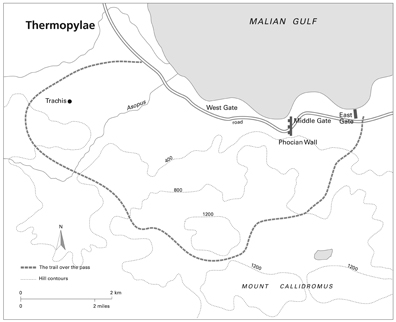
Hydarnes, as he began his descent toward the Hot Gates, now had to presume that there was a Phocian runner on the trail ahead, hurrying to alert Leonidas. It is unlikely that this reflection greatly unsettled him; it may even have been Persian strategy to give the Greeks warning of their doom. Shortly before sunrise, and the Immortals’ clash with the Phocians, a deserter from the Great King’s camp had slipped into the Hot Gates. He was an Ionian, one Tyrrhastiades—motivated, he insisted, purely by concern for his fellow Greeks. Perhaps he was—except that there appears to have been more than a whiff of the Persian dirty-tricks department about his arrival. Quite apart from the fact that it is unusual for rats to join a sinking ship, the timing of his appearance in the Greek camp had shown every sign of the most careful calculation. Too late to enable Leonidas to reinforce the Phocians, it simultaneously tempted him with the hope that there might yet be the chance of a withdrawal. Which was, of course, precisely what the Great King wanted him to believe: for the Greeks, if they opted to defend both ends of the Hot Gates against the pincer movement being deployed against them, might yet hold the pass for days. Catch them retreating on the open road, however, and the Persian cavalry would have no problem cutting them to pieces. The pass would be clear, five thousand Greek hoplites would have been eliminated from the military balance sheet, and the Great King’s triumph would be complete.
But would Leonidas take the bait? The commander in chief of the Allied League, desperate not to see his whole army lost, but also pledged, as a Spartan king, not to abandon Thermopylae, had a third option. Once it had been confirmed that disaster could be read in the entrails of goats killed in sacrifice, he summoned the bleary-eyed leaders of the other contingents to a council of war. Confusion and alarm, not surprisingly, was general at this meeting, with some refusing to countenance evacuation, while the majority demanded that it begin at once. Leonidas, silencing the uproar, announced that it was the intention of his bodyguard to hold the breach against the enemy, no matter what was thrown against them. Then he not merely permitted but positively ordered the main body of the army to leave, and as fast as possible, to give itself every chance of surviving to fight another day. The Thespians, famously cussed, refused to abandon their posts; so too—for with their city now doomed to medize, they had nothing to return to, save the prospect of being purged—did the loyalist Thebans.37 Leonidas ordered the helots to remain at the Hot Gates as well, to help the Spartans prepare for battle, to serve as light infantry and to die in the cause of their masters’ freedom. Some 1500 men in all, then, fingering their notched and battered weapons with clammy fingers, feeling the sun’s first rays against their faces, trying not to let their expressions betray their emotions, whether of scorn, resignation or envy, watched their comrades pack up their armor, leave the camp and head south.38 A fading of the sound of marching feet, a dispersal of white dust on the morning breeze, and the tiny holding force was left alone to the reek and the closeness of the pass. Nothing to disturb the calm came from the westward slopes of Callidromus, down which Hydarnes and his Immortals were even at that moment descending; nothing to suggest that the barbarians were drawing near. As yet, there was nothing from the West Gate, either. “Eat a good breakfast,” Leonidas advised his men, “for tonight we eat in the underworld.”39
Meanwhile, in the royal tent, breakfast was also being taken, but no doubt in a far cheerier mood. A more relaxed one as well: for Xerxes, although he had risen at dawn to pour libations to the sun, wished to give Hydarnes a chance to reach the pass before he launched his own attack. Finally, at around nine o’clock, he gave his generals the nod, and the colossal mass of his army began its advance. Even before they reached the pass, the stench of death, given sound by carrion flies, would have seemed to shimmer like the dust clouds and the heat; and when they entered the Hot Gates, they would have seen ahead of them the tangled limbs of their slaughtered fellows, bellies swollen, or else ripped apart, abdomens pale, the viscera spilled across the ground. The enemy, too, were in the open; for rather than staying behind the wall of the Middle Gate, as they had done during the two previous days’ fighting, the Greeks had advanced beyond it, braced to fight, not in relays, but in a single, bristling mass. For a moment, appalled by the sight of these men of bronze and blood, the Great King’s troops held back; then their officers, brandishing whips, began to lash them forward. Scorned as Greek propaganda though this detail often is, there seems no real cause to doubt it. Weight of numbers, now that it could more effectively be brought to bear against the enemy, was a crushing advantage that the Persian high command had every reason to exploit; and the use of untrained levies, at least during the hellish opening of the battle, must have struck them as the most cost-effective way of neutralizing the long spears of the Greeks. Trapped between their own military police and the fearsome, bronze-tipped, blood-bespattered Greek phalanx, the hapless levies had little choice but to shamble forward, to be crushed against the shield wall or else drowned in the shallows, falling in their hundreds upon hundreds, to be sure, but also, as they did so, gradually splintering the Greek spears into matchwood.
And then it was, it seems, when all the shafts had been snapped, that the Persian elite moved in for the kill. What followed was battle as The Iliad had described it: the clash of mighty champions, “screams of men and cries of triumph breaking in one breath.”40 Among those who fell were two sons of Darius, and a brother—and then Leonidas himself. A desperate struggle, fittingly Homeric, was fought over the dead king’s body, until the Spartans, in the ferocity of their anguish and despair, hauled it back to temporary safety. But then, from behind them, just above the eastern exit from the Hot Gates, there came the glinting of spear tips amid the scrub of the slope: the Immortals had arrived. Menaced from all sides now, the surviving Greeks retreated back beyond the wall, aiming for a small hillock in the shadow of the Middle Gate. There—although the Thebans, separated from their fellows, and forced against the cliff face, never reached it—the Spartans and the Thespians made their final stand. Feathered with arrows, slathered with gore, they resisted to the end. Even when their swords shivered, they used the hilts as knuckle-dusters, or else fought with their teeth, their fists, their nails. Only when every last Spartan and Thespian lay dead, the dust blood-slaked, the corpses piled high, could the struggle be reckoned over, and the pass the Great King’s at last.
Xerxes himself, entering the Hot Gates at around midday, was both elated by the sight of Persian banners fluttering over the battlefield, and revolted by the carnage. As was his duty to the men who had fallen in his cause, he gave instructions for trenches to be dug, and the bodies of his dead to be laid in them, then reverently covered with earth and leaves. He left the corpses of the Greeks to rot, while those few Thebans who had chosen to fling down their weapons rather than be slaughtered he ordered to be chained and branded. That he was in no mood for magnanimity was hardly surprising; for, despite his brilliant success in destroying, after only two and a half days’ fighting, the Greeks’ seemingly impregnable position, it had been no part of his battle plan that so many of the defenders should escape annihilation. Another pinprick was soon to come; for the Greek fleet, it was reported to him the following afternoon, had staged its own successful evacuation, having skulked away in the dead of night to safer waters. The Persian fleet, crossing to Artemisium in the morning, had found nothing of the enemy save for the smoking embers of campfires and the well-gnawed bones of cattle. Fugitives the Greeks may have been, humiliated by land and sea—but it seemed that they were still resolved to carry on the fight.
Yet surely now it would not be long before they would have their necks wrung like chickens. The Great King, sifting intelligence reports in the aftermath of Thermopylae, could not help but smile at the desperate attempts of his enemies to rival him in psychological warfare. It was reported, for instance, that a Greek admiral, pausing in his flight down the coast of Euboea, had carved messages along the seashore, appealing to the Ionians to desert—or at least to fight badly. A laughable stratagem! Why, when two great victories had just been won by Persian arms, when the cities of Boeotia were scurrying to open their gates to the conqueror, when the mastery of Europe lay within the Great King’s grasp, would any of his subjects contemplate mutiny? His squadrons may have been storm-battered, possibly even disconsolate because the Greeks had slipped from their grasp—but a way to boost their spirits was conveniently close at hand. A formal invitation was issued to the fleet: “leave to go and see how King Xerxes deals with lunatics who think that they can beat him.”41 So many men took up this offer, it is said, that there were not enough boats to ferry them all to the Hot Gates.
More than the corpses of the Greeks, more than the piles of helmets with their horsehair crests, hacked and dented, more even than those badges of the Spartans’ pride, their blood-red cloaks and tunics, now nothing but tattered rags, one trophy, shocking and hideous, would certainly have brought home to Ionian sailors the full awful scale of their master’s power. Driven into the side of the road was a stake, and driven onto the top of the stake was a human head. Although it was normally the custom of the Persians, “more than any other people in the world, to honor men who distinguish themselves in war,”42 no honor had been shown Leonidas. King of a city accursed, what better fate had he deserved? So did his conqueror, the King of Kings, deal with all servants of the Lie.
And the sightless eyeballs of the allied commander in chief, shrunken already and crawled across by flies, were fixed upon the road that led to Athens—now open and defenseless.