
8
And so it came to Salamis.
“You will be the ruin of many a mother’s son.” More menacingly than ever now, with the allied fleet moored off the island, and the Persians at Phalerum, the ambiguities of the oracle were weighing on people’s minds. But it was not only among the Greek high command that Apollo’s teasing words were being debated: the Persians too, ever assiduous in their intelligence work, would surely have learned of the prophecy. “He who revealed truth to my ancestors”:1 so Darius himself had described the archer god. Yet, respectful of Apollo though the Persians had often shown themselves, their faith in the pronouncements of Delphi was hardly, of course, as instinctive as that of their enemies. There must have been many on the Great King’s staff, puzzling over the phrase “divine Salamis,” who found themselves debating its precise authorship. Perhaps someone aside from the god had breathed a word in the Pythia’s ear. A priest, for instance? Delphi was the center of a great web of international contacts, after all, and Apollo’s servants, with their profound knowledge of current affairs, were as well qualified as anyone to forecast the likely progress of the war.
They would certainly not have forgotten the fate of the last Greek attempt to defeat an imperial armada. Fourteen years previously, some 350 Ionian triremes, outnumbered almost two to one by the Persian fleet, had rowed out to battle off the Milesian island of Lade and been annihilated. Just as Miletus had been the heart of resistance to the Persians then, so Athens was now. And the only potential equivalent to Lade off Attica was, of course, Salamis. Whether Persian strategists believed the Delphic prophecy to have derived from the heavens or from mere mortal calculations, it would certainly have buttressed them in their belief that the hand of a god infinitely greater than Apollo was guiding their affairs. The great wheels of time, turning as they did at the command of he who dwelt beyond them, Ahura Mazda, were clearly grinding with a quite merciless precision. Once already a fractious alliance of Greek squadrons, when menaced by a much larger Persian fleet, had disintegrated amid treachery and back-stabbing—and now, with a mysterious but no doubt divinely sanctioned symmetry, history appeared destined to repeat itself.
To be sure, there were some among Xerxes’ entourage who urged their master not to depend upon this. Demaratus, for instance, with a hearty appreciation of what his countrymen would least like the Great King to do, had advocated the launching of an amphibious operation directly against Lacedaemon—“for you need hardly worry that the Spartans, if the flames of war are consuming their homeland, will bother themselves coming to the rescue of anyone else in Greece.”2 True enough; but so depleted had storms and enemy action left the imperial navy that the detachment of even a small task force from the main body of the fleet might leave the Greeks a match for either. The proposal was therefore vetoed. So too—although after more soul-searching—was the advice of the formidable Queen Artemisia of Halicarnassus. When the Great King, descending in state upon Phalerum, summoned his admirals to a council of war, hers was a lone voice raised in warning against the plan to force a second Lade. Battle, she insisted, was a pointless risk. Athens was captured, and autumn was closing in. Better by far, then, to maintain a standoff, and leave the Greek squadrons either to starve or to “scatter and sail for their homes.”3 A shrewd analysis, as Xerxes himself was well aware; but time was running out, and he could not afford to adopt it. For the Great King to pass a winter on the remote frontiers of the West was clearly out of the question: a devastated Athens was no place from which to administer the world. Having graced the expedition against Europe with his royal presence, it was now imperative for him to finish the war before the close of the campaigning season. Only a thumping victory while the weather held would do.
How gratifying, then, that the imperial spy chiefs could report to their royal master that the enemy, squabbling and snarling in their camp, were behaving true to form. Just as hatreds, doubts and fears had once riven the Ionian squadrons off Lade, so now, across the straits off Salamis, a Greek fleet appeared to be on the verge of a similar implosion. The proofs of defeatism could hardly be doubted. Already, on the day of the burning of the Acropolis, several crews had stampeded in panic down to their boats and tried to raise their sails ready for flight. That same evening, it was reported, the high command itself had fragmented yet again into rival factions, Peloponnesians against Athenians and their supporters. The insults bandied had been the talk of the whole Greek camp. Adeimantus, it was said, had sneered at Themistocles as a “refugee,” and warned him, when he spoke out of turn, that “athletes who start a race before the signal is given are whipped.” “Yes,” Themistocles was claimed to have retorted bitterly, “and those who are left behind never win the crown.”4 Only by threatening to withdraw the entire Athenian fleet from the battle line and sail at once for Italy, and permanent exile, had he ultimately had his way. But it was impossible to say for how long. What if the Peloponnesians, panicking at the prospect of being bottled up in the straits, finally opted to call his bluff? What options then for the Athenians and their fleet?
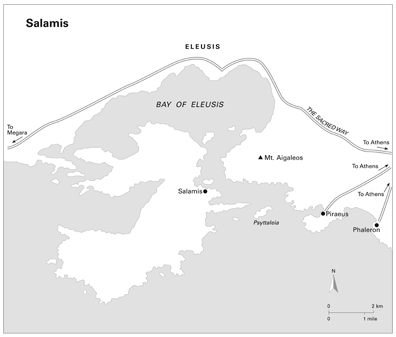
Persian intelligence chiefs, with more than sixty years’ experience of exploiting Greek fractiousness to draw upon, knew precisely how best to find out. In the wake of the conference at Phalerum, with the Great King’s wish to conjure up a second Lade now clear in his servants’ minds, a contingent of Persian troops was ordered to take the road to the Isthmus. Since the corniche beyond Megara had been destroyed, and the Isthmus itself solidly fortified, the expedition had little prospect of storming the gates of the Peloponnese—but that was not its mission. Leaving Athens, rounding Mount Aigaleos, following the Sacred Way toward Eleusis, the soldiers marched along the southern reaches of the Attic coast. Their weapons glittered brightly. Their war songs could be heard for miles. Their feet, thirty thousand pairs of them, pounded the road. A great cloud of dust, rising in their wake, drifted on the breeze, and was borne across the straits toward Salamis.
Where the reaction was—just as Persian strategists had anticipated that it would be—one of consternation. Mutinous whisperings began to sweep through the Peloponnesian contingents yet again. Then, with afternoon fading into evening, and anxious sailors already besieging their captains with demands to sail for the Isthmus, the Great King gave instructions that the screws be tightened further. Squadrons of the imperial fleet, “bearing down on Salamis, and taking up their stations with a perfect show of leisure,” began to patrol directly off the island—menacing the escape routes.5 As the setting sun blazed its reflection across the sea from Salamis to the Isthmus, many Peloponnesians appeared on the verge of insurrection.
For there they were, stranded on Salamis, obliged to fight in defence of Athenian territory, and certain, if they were defeated, to find themselves trapped and blockaded on an island. And all the while their own country stood defenceless, even as the barbarians, marching through the night, were advancing directly on the Peloponnese.6
This, since the very earliest days of contact between the two peoples, was how the Persians had always played cat and mouse with the Greeks. News of the wrangling on Salamis, brought to the Great King by his agents, confirmed him in his assurance that he had gauged the character of his enemies to perfection. Now, with the whole Greek fleet apparently at daggers drawn, it was time to bait the trap that he had laid with such cunning. It was almost sunset. The squadrons on patrol off Salamis were ordered back to base.7This withdrawal, performed in full view of the allied lookouts, left the escape route to the Isthmus very obviously—and very temptingly—open. As the Persian admiralty had discovered at Artemisium, Greek sailors were hardly reluctant to conduct a hurried nocturnal retreat if a sudden crisis appeared to demand it. The Peloponnesians, not knowing when the opportunity to bolt from their rat hole might present itself again, would surely feel themselves facing just such a crisis that evening. If so—and irrespective of whether the Athenians agreed to sail with them—they might very well take their chance and flee the straits. Just as had happened at Lade, a Greek fleet would then disintegrate into fragments.
But Xerxes, weighing the odds that evening, still had to know for sure. The ambush could be attempted only once. It was not enough merely to foster division; active treachery was needed, too. The ideal would be a double agent within the ranks of the Greek high command. Fortunate, then, that the Persian intelligence chiefs had long and fruitful experience of recruiting top-level moles. It was, after all, as the royal spymasters would hardly have needed to point out, the bribing of the Samian captains that had doomed the Ionian battle line at Lade. With that delectable precedent before them, it beggars belief that the Great King’s agents, armed with gold and the promise of royal patronage, would not have been active in the allied camp on Salamis. And if so—who might their target have been? The Persians, in the war of nerves that they were waging with such proficiency against the various Greek divisions, would surely have been tempted to launch a two-pronged attack. Even as they menaced the Peloponnesians, pressuring them to flee, they would have been alert to the anxieties and resentments of those who faced being left in the lurch: the Aeginetans, the Megarians—and the Athenians.
“The man who co-operates with me, on him will I bestow rich rewards.”8 This, baldly stated, had always been the manifesto of the Persian monarchy. What rewards, then, for the man who had it within his power to betray the whole Greek fleet, and win the war, and the West itself, for the Great King? Splendid and glorious beyond compare, no doubt. Little matter that Themistocles was the native of what for years had been a demon-racked stronghold of the Lie—not now that fire, having consumed the Acropolis, had purged Athens of evil. If they would only prostrate themselves with due contrition before the royal presence, the Athenians might certainly hope to be graced with a pardon—and perhaps even, if they gave good service, with marks of the Great King’s favor. No man in the world, after all, had the power to be more gracious, more generous, more beneficent. “The rewards that I bestow—they are in proportion to the help that I am given.”9
We are nowhere openly told of contacts between Themistocles and Persian agents. The murk that veils treachery and espionage is often impenetrable—and all the more so at a remove of two and a half thousand years. What we do know, however, is that shortly after the Persian squadrons had returned from patrol back to Phalerum, and while the various Greek commanders, digesting the day’s alarming events, were reported to be at loggerheads with one another, a tiny boat was slipping out from the dark ranks of the Athenian fleet and making its way across the straits. On board was the trusted tutor of Themistocles’ sons, a slave by the name of Sicinnus. It is possible, since his name derived from Phrygia, a satrapy to the east of Lydia, that he spoke some Persian.10 It is also possible that his arrival on the mainland did not come as a total surprise to those who met him—for no sooner had Sicinnus set foot on dry land than he was being hurried into the presence of the Persian high command. Certainly, the message that he had to deliver was of the utmost urgency: the Greeks, Sicinnus reported, were planning a getaway that very night. “Only block their escape,” came the advice from Themistocles, “and you will have a perfect chance of success.” Meanwhile, the Athenian admiral himself, revolted by his allies’ pusillanimity, was described by his slave as being “in full sympathy with the king, and earnestly longing for a Persian victory.”11 The imperial espionage chiefs, if they had indeed been fishing for a communication from Themistocles, could hardly have hoped to land better news.
A dazzling coup indeed. The Great King, who had no doubt been alerted to the prospect of an intelligence breakthrough coming that evening, was informed of it at once. Contingency plans, evidently prepared in the expectation of just such an opportunity, were put smoothly into action. The fleet was ordered to ready itself for battle. Rising from their suppers, oarsmen hurried to their benches, marines to their stations on deck. “Crew cheered crew, all the way down the length of the battle-line,”12 and then, rank after rank, pulling out from Phalerum into the waiting darkness, they took to sea. No more cheering now—for the slightest sound might alert the enemy. Instead, with only the measured beating of their oars to mark their progress, the various squadrons glided through the night to the positions allotted them by their master. One, comprising the two hundred ships of the Egyptians, had been ordered to circle the entire south coast of Salamis, aiming for the narrow bottleneck of the westernmost strait, there to stopper it, in case the Greeks should attempt to escape that way. Others, serrying themselves in ranks of three, cruised into position off the eastern channel, out of which, so their captains had assured them, the panicking Peloponnesians would be bolting at any minute. Just beyond the exit, where it led out to the open sea, there was an island, sacred to Pan, known to the Athenians as Psyttaleia; here, setting the seal on the ruthless efficiency of his preparations, the Great King stationed a garrison of four hundred infantry. Come the midnight breakout, these troops would be “directly in the passage of the expected action, ready for all the men and shattered ships that would soon be swept onto the island’s rocks.”13 Nothing had been left to chance. Not a single Greek was to be permitted to escape the Great King’s deadly trap.
Meanwhile, Sicinnus, the slave whose message had led to all of these preparations, had returned to Themistocles. His courage had been astonishing. He would surely have expected to be kept for further interrogation; indeed, it is hard to imagine why he was released, unless it was to carry a message from the Persian spy chiefs back to his master.14 Nor is it hard to guess what the contents of this communication might have been: the Great King’s final terms; the offer of an amnesty, perhaps, a chance for the Athenians to pick up their families before they sailed off into exile; or the assurance of a privileged future in Attica as favored servants of the King of Kings. Whatever the precise details, Themistocles must surely have breathed a sigh of relief when he read them, for he would have known that he had preserved his daughters from the slave market, his sons from the gelding knife, his fellow citizens from obliteration. Even were the Greek fleet to be wiped out in the morning, the Athenians, at least, would have a claim to the Great King’s mercy.
But there was a second prospect, infinitely more glittering and glorious, that had also been opened up by Sicinnus’ return. The Greek admirals, even as the imperial battle squadrons were embarking upon their secret maneuvers, remained in urgent session, “still quarrelling furiously,” it is said.15 At some point toward midnight, Themistocles—who had evidently been having a busy time of it, slipping in and out of the meeting—rose to his feet and made his excuses yet again. Stepping outside, he found waiting for him, cloaked in the shadows, an old enemy. Aristeides, the “Just,” summoned back from exile along with Xanthippus and all the other victims of ostracism, had smoothly resumed his place at the very heart of the democracy’s affairs. Returning that same evening from a mission to Aegina, he had seen, as he slipped back toward Salamis, the ominous silhouettes of the Persian fleet fanning out across the gulf to plug the exits from the straits. Themistocles, to whom this news naturally came as little surprise, confessed himself delighted, and told Aristeides that it was all his doing—“for our allies had to be forced into making a stand that they would otherwise have shrunk from, had it been left to themselves.” Then, embracing his old adversary, he urged Aristeides to take the news in to the other admirals, “for if I report it, they will think that I am making it up.”16
All of which, of course, was to cast the Peloponnesians as hapless stooges. No wonder that the Athenians, in the years to come, would enjoy harping on the story. Even so, there is something strange about it. Aristeides, although he did indeed inform the Greek commanders that their fleet was surrounded, neglected to mention, it appears, that this was courtesy of a trick pulled by one of their own colleagues. Understandably, it might be thought. Yet it is curious that the Spartans and the other Peloponnesians, even once the full details of Themistocles’ stratagem had become public knowledge, betrayed not the slightest hint of resentment toward the man who was supposed to have outsmarted them so comprehensively, but, on the contrary, only lauded him for his cleverness and foresight. Nor, despite being ambushed, as we are told, by Aristeides’ revelation, does it seem that the Greek admirals were thrown into a panic by it. Just the opposite—their dispositions for the morning appeared to reflect the minutest forward planning. Almost as though the news of the Persian blockade had come as no great surprise to them, either. Almost as though they had been complicit in Themistocles’ scheme from the start.
And perhaps they had been. Details of the Salamis campaign only ever come into focus as though through a swirling fog, and then they are either lost, or are so confused that they can be interpreted in any number of ways. Frustrating, of course—and yet there is, in this very murk, a tantalizing glimpse of the contours of an otherwise hidden war, a shadowy counterpoint to all the din and crash and shove of battle. The Persians could legitimately claim to be the masters of the dirty trick, so it should be no surprise that their spy chiefs, arriving in Attica, brought with them the easy presumption of superiority that came naturally to members of the world’s ruling class. Yet, just as the Great King’s admirals should have been warned against any complacency by the performance of the Greeks at Artemisium, so his intelligence agents should similarly have been on their guard. The allies had already demonstrated their proficiency at feints and disinformation. At Salamis, there can be no question that Themistocles, displaying his customary pitiless grasp of psychology, had fed the Persian agents not merely what their master wanted but what he desperately needed to believe was true. Even at his most eager, however, the Great King would surely have discounted the possibility of Athenian treachery, had it not been for the Peloponnesian admirals’ very public flaunting of their own demoralization. Whether they were indeed a squabbling, incompetent rabble with no appetite for fighting in the straits, despite all the lessons they had learned at Artemisium, or rather coconspirators in a devastating sting, we can never know for sure. What is certain, however, is that the Peloponnesian admirals, if they truly had been desperate to make their escape that night, adjusted to the news that they were blockaded inside the straits with remarkable equanimity. Dawn rose on a day as fateful as any in human history—and found every squadron in the Greek fleet primed and nerved for battle.
And over the straits, men imagined, there glimmered a sudden sense of something uncanny, an almost palpable heightening of intensity upon the early morning light. To the Athenian marines, before they took their places on deck, Themistocles delivered an address that would long be remembered, urging them to consider “all that was best in human nature and affairs, and all that was worst—and to choose the former.”17 Yet not even these words, it may be, raised as many hairs upon the back of men’s necks as did the assurance—one that seems suddenly to have swept the entire fleet—that the sons of gods who in ancient times had been the guardians of the rocks and groves and temples of Greece were present among them: so that men would later speak of seeing phantoms and even ghostly serpents gliding on the surface of the water, and of hearing unearthly battle cries echoing around the straits. That long-dead heroes would rise up from their graves to repel the barbarian invader was a conviction that had been sedulously promoted by the Greek high command. Indeed, it is probable that Aristeides, when he ran the gauntlet of the Persian blockade, had been sailing back with the relics of some Aeginetan heroes, sprung from Zeus himself. There could certainly have been no doubting the urgency of such a mission—and a measure of its success, perhaps, is the fact that the Peloponnesians, near mutinous the evening before, prepared for battle with as much conviction as anyone.
And, to be sure, there had been something eerie in the air for days. Even Greeks in the Great King’s train appear to have sensed that the heavens might be turning against their master. Walking through the deserted fields beyond Eleusis on the day before the battle, Demaratus had seen a cloud of dust billowing up from the coastal road. This could only have been kicked up by the Persian division heading for the Isthmus, but an Athenian collaborator, strolling with Demaratus, had immediately identified the faint singing he could hear coming from the Sacred Way as the “iacche”: the chant of joy raised by worshippers as they journeyed every September to Eleusis. This was impossible, of course, even though it was indeed the time of year for the annual pilgrimage—unless the iacche were being performed by a supernatural procession, in celebration of that great mystery of Eleusis, the return to life of what had appeared to be utterly and irrevocably dead. This, to the Athenian, as he trod the burned soil of his homeland, had proved a most unsettling thought. “I fear,” he said at length, as he gazed towards the dust cloud, “that this presages some great disaster for the king’s forces.” And Demaratus, alarmed though he was by this judgment, had not disputed it. “Only keep quiet,” he urged his companion. “For if your words should reach the ears of the king, then you will be sure to lose your head.”18
Sensible advice—for Xerxes, in his determination to force a victory, was certainly in no mood to tolerate defeatism. That the failure to wipe out the Greek fleet at Artemisium had been due to a lack of backbone on the part of his servants appeared to him self-evident. Concerned to rectify this, he had issued his captains an uncompromising warning that “should the Greeks succeed in evading the terrible fate planned for them, and slip out through the blockade, then all those responsible would lose their heads.”19Conversely, those who fought well would have the supreme honor of having their exploits personally noted by their master—an incentive that had been sorely lacking off Artemisium. So it was that even as the Greek oarsmen were hurrying to their benches, the Great King, followed by a mighty train of generals, officials and flunkeys, was riding out in his chariot past the southern spur of Mount Aigaleos, and round on to “the rocky brow / Which looks o’er sea-born Salamis.” Here, above a temple of Heracles, he ordered his Nisaean horses reined in. As he descended, first onto a golden footstool and then—for the royal platform heels could hardly be permitted to touch bare earth—along a hurriedly unrolled carpet, servants were busy erecting a throne. The Great King had chosen his vantage spot well. Below him, becoming clearer by the minute, there stretched an unrivaled panorama: of Salamis, the straits, the gulf beyond them, and the distant Isthmus. But what, on the waters themselves, did Xerxes see that fateful morning, as the sun rose behind him, and the fateful moment of battle, long awaited, long maneuvered for, dawned at last?
Not what he had been hoping to see, that much at least is certain: not the spectacle of the Greek fleet shattered in his ambush, spars bobbing in the open sea, corpses twisted and heaped upon the rocks of Psyttaleia. The Great King would have been notified before his arrival above Salamis that the anticipated breakout by the Peloponnesians had failed to occur; even so, the spectacle of the Greek fleet drawn up in the narrows below him would still have come as a sore disappointment. And his own squadrons—where were they as dawn broke? A momentous question: for just as the allied strategy was dependent upon fighting a battle in the straits, so the Great King’s admirals had all along been committed to facing the Greeks on the open sea. The resulting stalemate had already endured for three weeks. Only a conviction that their enemy was indeed a hapless rabble would ever have persuaded the commanders of the imperial fleet to break it, and advance with their squadrons into the channel. A decision as fateful as any in the history of warfare; for upon it rested the future course not merely of the battle, not merely of the war, but of Europe and of Western civilization itself. Infuriatingly, we are not told when or why it was made—only that battle, when it was joined, did indeed take place where the Persians had been most desperate not to fight it: within the straits of Salamis.
Historians have generally presumed that the Persians infiltrated these under cover of darkness. Yet this seems improbable.20 The instructions given to the Great King’s captains by their master had been perfectly clear: “guard the exits leading out to the sounding sea.”21 It is unlikely, with the threat of decapitation hanging over them, that there had been much enthusiasm that night for bold displays of initiative. The signal failure of the Greeks to come blundering out into the ambush that had been so carefully laid for them would only have confirmed the imperial admirals in their resolve not to budge from their station; for their oarsmen, rowing hard just to prevent their vessels from drifting and fouling the line, had hardly been given the ideal night’s preparation for a battle. It may be that the Great King’s dawn arrival above Salamis prompted some captains, eager for royal favor, to order their ships forward into the channel, and that the whole battle line then lurched and followed them. It is more probable, however, that the sight of its master served only to confirm the fleet in its discipline. While individual captains, no matter how desperately they peered from the prows of their triremes, could make out little of what was happening in the straits ahead of them, they could also see how well placed the Great King was to do it for them. And who better than Xerxes to make the final judgment? Who better to give the nod to a gamble on which so much had come to rest?
It seems likeliest, then, that the order to engage the enemy in the straits was given to the Persian fleet shortly after sunrise, and that it came directly from the King of Kings himself. We do not know how the signal was broadcast, nor whether Xerxes was able to communicate to his admirals a sudden and thrilling spectacle, clearly visible to him from his vantage point above the straits: the apparent disintegration of the whole Greek battle line. Some fifty triremes, veering off in the direction of Eleusis, looked to be in headlong flight, making for that narrow channel off the northwest of the island where, evidently unbeknown to their commander, the Egyptians were lurking. So it had happened at Lade, and so it seemed to be happening now—just as the traitorous Athenian admiral had said it would. Time, then, to close the twin jaws of the trap. Time to finish off Greek resistance for good. Time to enter the straits.
A fearsome din of trumpets, amplified by the closeness of the hills on either shore, and the great mass of the Persian battle fleet, breasting the island of Psyttaleia, rounding the southern spur of Salamis, began to quicken its oar strokes. Phoenicians on the right wing, Ionians on the left, Cilicians, Carians and other contingents in the center, they still, during these first minutes of their advance, had no clear view of the enemy, for the angle of the channel precluded it, and spray and the mists of an early autumn dawn would have veiled the waters. But then, rising from ahead of them as the front ranks closed in on the Greek positions, they heard singing, and the paean soared to such a pitch that “a high echo rolled back in answer from the island crags.”22 Hardly the sound of men in panicked retreat—but there could be no turning back now for the Great King’s fleet, not even if certain captains in the front ranks of the battle line felt a sudden lurching in their stomachs, and a presentiment clammy like cold sweat across their brows that it was they who were sailing into the ambush. Already, stretching far behind them, an immense mass of shipping could be seen, crowding the channel, bobbing on the oar-churned waters, as the various squadrons sought to maneuver themselves into position, struggling not to foul one another in the narrowness of the straits. Hugging the mainland, where the shore was reassuringly thronged with their own troops, the Persian captains could hardly doubt now, as they looked toward Salamis, that the Great King had been well and truly conned. The Greek triremes, far from fleeing at their approach, were marshaled in a great battle line of their own along the bays and spurs of the island, from the Athenians on the northernmost wing to the Aeginetans in the south; and the ram of every ship was pointed directly at the Persian fleet.
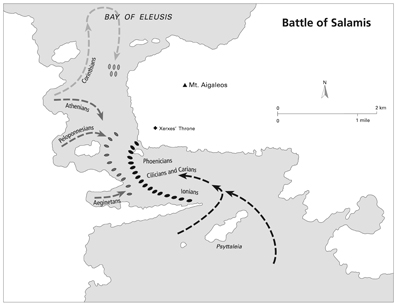
Nevertheless, in the last, stomach-knotting moments before battle was finally joined, the imperial admirals must still have hoped that the enemy might prove a rabble: for the Greek warships, as though in trepidation, kept backing ever closer to the shore. But then, just when it seemed as though they would run themselves aground, a single ship came darting out of the ranks of retreating triremes. Men would later claim that those on board it had been stung by the words of a female apparition, a phantom who had materialized suddenly before the Greek line and asked, in ringing scorn, “Madmen, how much further do you propose to back off?”23 Now the crew gave their answer: pulling hard on their oars, powering their vessel so that it sped across the open waters which still lay between the two battle lines, maneuvering it so that the bronze of its ram, glinting as it sliced through the sea, was aimed at the stern of a stray Persian ship. The rattling of a drove of arrows on the deck, then a crash and a splintering of wood: the first contact of the battle had been made. There was no clean kill, however, for the oars of the two triremes quickly became entangled, so that the vessels were locked together. Seeing this, captains of other ships brought their craft skimming forward in support of their comrades. Soon all were on the move, and the Greeks, as they advanced “with discipline and in perfect order,”24 sang nevertheless with the joy and frenzy of the killing that was to come.
And in no time the battle was general along the whole course of the channel. It is a mark of the confusion of the engagement that even the identity of the first ship to engage the barbarians should later have been furiously debated: for both the Aeginetans and the Athenians laid claim to the honor. Proper adjudication was impossible. The two contingents were fighting at opposite ends of a line that stretched for upward of a mile—and no one in the straits had a view of the whole panorama of the battle. No wonder, then, that memories of that grim and glorious day should have been, not of strategy, nor of the performance of rival squadrons, nor of the ebb and flow of the fighting, but rather of stirring deeds of individual heroism, exploits that shone all the more brightly for being set against a backdrop of such clamor and carnage and chaos.
The greatest glamour of all attached itself to certain trireme aces. Most celebrated of these was an Athenian, Ameinias, from the village of Pallene. In the shock of the battle’s opening, he dared to attack the flagship of the Phoenician fleet, a towering vessel commanded by one of the Great King’s own brothers. The royal admiral, naturally infuriated by the impudence of his assailant, ordered missiles to be rained down upon the Athenians while he himself led a boarding party—but he was skewered by Ameinias as he made the jump, and pitched overboard. Altogether more ambiguous was the performance of a second of the Great King’s commanders to be attacked by the same Athenian captain: none other than Queen Artemisia of Halicarnassus. Seeing Ameinias bearing down upon her, and panicking, she found her escape blocked by the trireme of one of her own vassals—and so resorted to the startling expedient of ramming it herself. Ameinias, presuming that the queen had deserted the Persian cause, duly abandoned his pursuit of her. And so it was that Artemisia made her escape.
And the Great King, seated upon the heights above the battle, saw it all, and was hugely impressed. As mistaken, in his own way, as Ameinias had been, he imagined that the ship sunk by Artemisia had been Greek; for the ferocity of the fighting was such that his aides found it hard to distinguish friend from foe. Yet, while it might certainly prove a challenge on occasion for the royal secretaries, busily scribbling down examples of particular prowess, to transcribe all the details with total accuracy, they and their master could have had few illusions as to the broader progress of the battle. “My men have turned into women,” Xerxes is said to have cried, watching as Artemisia’s warship pulled away from the wreckage of its victim, “and my women into men.”25 His bitterness was understandable—for the Great King, far more clearly than any of his captains embroiled in the actual fighting, could take in the full sweep of the catastrophe unfolding in the straits. He could see how his crack Phoenician squadrons, left leaderless by the death of their admiral, and hemmed in by the Athenians, were being progressively driven back onto the shore, or else into open flight. He could mark the chaos that was the result of his squadrons’ attempts to withdraw, as rank after rank of them began to lose formation, cramping one another in the narrows, “their bronze rams smashing the sides of their neighbors, shearing off whole banks of oars.”26 He could observe in mounting disbelief how a deadly wedge of Greek ships, massing inward, was splitting his fleet in two, leaving the Phoenicians on the right wing of the battle line trapped like tuna fish in a net, there to be speared or battered or hacked to death. And he could reflect, perhaps, that the order to engage the Greeks had been his own.
That he had blundered in giving it would have been evident to him even before the battle had begun. The triremes which he had observed heading north up the channel toward Eleusis, and which the Greeks among his aides would no doubt have identified as Corinthian, had not, once they reached the northeastern cape of Salamis, continued their flight. On the contrary: after scanning the straits which lay between Eleusis and Salamis, the Corinthians had veered round, lowered their sails and masts, and headed back to the battle line. Clearly, far from panicking, they had been engaged on a reconnaissance mission, making certain that the Egyptian squadron, which had been sent around the island during the night, was not now advancing in the Greek fleet’s rear. Which, of course, it was not. The Egyptian squadron, as Xerxes himself was painfully aware, was still eight miles from a battle in which its extra numbers might well have proved crucial, lurking by the westernmost straits, waiting for a Greek escape bid that was never going to come.
Unsurprisingly, the Great King, in his vexation, was testy in the extreme with any survivors of the fiasco. When a group of bedraggled Phoenician captains, attempting to excuse the loss of their ships, sought to lay the blame for it on the treachery of other contingents in the fleet, he had them decapitated on the spot. Naturally, it was out of the question for the Great King himself to accept any responsibility for the catastrophe; and the Phoenicians, now that their strength had been shattered upon the rocks below his throne, could serve him well enough as scapegoats. Yet Xerxes, as he followed the course of the debacle from his command post, must have felt an increasingly embittered consciousness that his own stratagems, devised with such care and with such confidence of victory, had been turned against him. Midday turned to afternoon, and the Persians began to be swept out of the straits. Perhaps half of those triremes that had entered the deadly channel survived to leave it. Behind them, harrying them as they lurched and limped desperately back to Phalerum, came the Greeks, pursuing them across those same open waters on which, the day before, the Great King had planned to stage his ambush and secure his mastery of Greece.
Perhaps the cruelest cut of all came toward sunset. By now, excepting the “lamentations and screams that echoed across the sea” and the bobbing of Persian corpses as they snarled up the oars of the predatory victors, the straits had been cleared of the Great King’s men. There was only one further deed of slaughter left for the Greeks to perform before the coming of “black-eyed night.”27 The four hundred troops stationed by the Great King on Psyttaleia the previous evening had been left stranded at their post, for there had been no opportunity, amid all the panic and desperation of the imperial navy’s rout, to secure their evacuation. Now, having been ordered to serve as the executioners of any Greeks who might be swept onto the rocks, the unfortunate Persians found that they themselves had become the objects of an execution squad. Slingers, archers and heavily armored marines, debouching from allied warships, won bloody payback for the cornering of the Spartans at Thermopylae. Led by Aristeides, the Greeks “dashed over their enemies like a roaring wave, their voices raised in a single cry, hacking at the limbs of the wretched men until the life had been butchered out of them every last one.”28 The rocks were left slippery after the slaughter, and Aristeides’ men, slithering over the corpses, hacked at them with their knives, harvesting their rings and bracelets, or else waded through the red surge of the shallows, scavenging from the dead that they found drifting there. And the sea for miles was filled with the timbers of countless warships, and they slowly drifted and were dispersed upon the swell of the darkening gulf.
And so ended the attempt of the Great King to force the straits of Salamis.