
Long delayed it may have been, but there were no half measures about the advance of the Peloponnesians from their bunk hole when it came. Making good their demolition work of the previous summer, engineers had already repaired the land route to Megara, and it was just as well that they had not botched their responsibility, for the Isthmus road, shuddering under thousands of tramping feet, had never before had to bear the weight of such an army. Indeed, a Greek expeditionary force to rival it had not been seen since the fabled times of the Trojan War. From Corinth to Mycenae, from Tegea to Troezen, an immense coalition of Peloponnesians had answered the Spartans’ call. Naturally, the Spartans themselves, five thousand of them, almost three-quarters of their city’s total manpower, provided the task force with its most menacing spear thrust. With five thousand further hoplites recruited from the outlying townships of Lacedaemon, and thousands of helots rounded up to serve as orderlies and light infantry, it was almost certainly the largest army that Sparta had ever committed to the field.45
Even cowards had been mobilized; or rather—which was not necessarily the same thing—men whom the Spartans had labeled cowards. One of these, an unfortunate veteran by the name of Aristodemus, was particularly grateful to have been given a chance to redeem his honor, for this was not the first time that he had marched to war against the barbarians. Less than a year previously, he had been one of the three hundred who had accompanied Leonidas to Thermopylae. Arriving at the pass, he and a fellow Spartan had fallen sick with an eye inflammation, and the two men had been dismissed and ordered to recuperate. Come the fateful morning of their king’s last stand, however, Aristodemus’ partner, rising from his sickbed, had instructed a helot to lead him, blind as he still was, into the thick of the fighting. Aristodemus, preferring to obey Leonidas’ direct orders, had invalided himself home. There, on his arrival, he had been greeted with revulsion. His fellow citizens had branded him “trembler”: the single most shameful word in the Spartan lexicon.
Harshly unfair—but it was only to be expected, in a city where courage was reckoned the greatest virtue, that the slightest hint of cowardice in a citizen would doom him to ignominy. The life of a “trembler” in Sparta was signally wretched. Patches sewn onto his cloak would alert the whole city to his disgrace. Whether sitting down at his mess table or attempting to join in with a ball game, he would be icily ignored by all his former friends. At festivals, he would have to stand up or make way for anyone who demanded it—even the most junior. Cruelest cut of all, his daughters, if he had any, would find it impossible to secure a husband: a typically Spartan eugenicist measure designed to prevent the taint of cowardice from being inherited by future generations. Unable to endure these humiliations, the only other survivor of Thermopylae, a liaison officer sent by Leonidas on a mission to Thessaly, had ended up hanging himself. “For after all, when cowardice results in such shame, it is only to be expected that death be preferred to a life of dishonor and obloquy.”46
And for Aristodemus, the man who had spurned the chance to die in battle beside his king, the long months following his return from Thermopylae had been particularly bitter. The shadow cast by Leonidas’ end had proved impossible to escape. Mourning in Lacedaemon was not, as it was in, say, Athens, the responsibility only of women. Every man too, whether ephor or helot, was obliged to wail and beat his brow when a king descended to the underworld. To other Greeks, indeed, Spartan lamentations appeared so excessive as to verge on the barbarian. Officially, the obsequies that accompanied a royal funeral lasted for ten days, but Leonidas was no easy ghost to lay to rest. His mutilated corpse, left as food for kites and dogs in a far-distant pass, had never been recovered.*19 Adding to the pathos of his fate, and a constant reminder to the Spartan people of the loss they had sustained, was the fact that his son, the new king, was just a boy. Cleombrotus, Leonidas’ younger brother, had been serving ably as regent but he, too, during the course of the winter, had died. When the Spartans, then, having resolved to give battle at last, marched out from the Isthmus, they did so under the generalship of a young man barely in his twenties: Pausanias, the son of Cleombrotus. Since he was, as the Regent of Sparta, also the supreme commander of the allied forces, this was a startling weight of responsibility for one so young to bear—but Pausanias himself, whose qualities as a general never entirely outpaced his conceit, shouldered it with insouciance. Even so, the brute fact of their general’s youth must have kept Thermopylae, and Leonidas’ death there, all the more firmly in the Spartans’ minds. Marching to liberate Greece, they were also after revenge. And Aristodemus especially—for it was due to the barbarians that he wore his trembler’s patchwork cloak.
And there were others, too, of course, who wanted payback—men whose losses had been infinitely greater than the Spartans’. At Eleusis, thirty-five miles along the coastal road from the Isthmus, Pausanias waited while Aristeides and eight thousand other Athenians ferried themselves across from Salamis. Also joining the expedition were six hundred exiles from a second city occupied and torched by the invaders: Plataea. Now at last, a year after fleeing their homeland, the cherished moment of return had finally arrived. It was time for the Plataeans, and for everyone else committed to meeting with the barbarian, to take the road to Boeotia.
Heading northward, the allies duly left Eleusis. Soon enough, dusty ridges of limestone and slopes of mangy brushwood began to obstruct any backward glances at the sea. As the advance progressed, so the way ahead of the tramping hoplites turned increasingly rugged, the valleys lonely, the fir-dotted slopes of Mount Cithaeron even more so, the haunt not of men but of wild beasts, deer and bears and lions—and sometimes, for he loved all such deserted spots, of the great god Pan himself. In happier times, the Boeotians had been accustomed to celebrate an eerie festival, wheeling colossal idols of wood from the banks of the Asopus, hauling them all the way up the side of the mountain, and then, at the very summit, incinerating them, so that the conflagration might be seen for miles around, a beacon lit for the gods. The Plataeans, surely, passing beneath the austere heights of Mount Cithaeron, would have pressed ahead now with particular eagerness, for they were just hours away from their city; and the road, after winding past spurs and jagged crags, suddenly opened out, giving them, away to their left, a view at last of their beloved homeland.
But not as they had left it. Their fields were overgrown and their city a blackened shell. Trees for miles around had been leveled. Stripped and raw, the timbers now formed the barbarians’ palisade. Meanwhile, the barbarians themselves, their numbers appearing to slur together in the shimmering heat, swarmed across the plain, and everywhere, it seemed, there were horses, whether hobbled, or in corrals, or else being ridden across the parched dirt of Boeotia, plume-shadowed as they flaunted their speed and proficiency. There could have been few among the Greeks who did not feel a tremor of consternation at such a sight; and Pausanias himself, who was arrogant but certainly not foolhardy, had not the slightest intention of crashing down directly to confront the enemy on ground so favorable to their cavalry. Instead, sternly ordering his men to keep to the foothills, he then maneuvered them into a position roughly opposite Mardonius’ forces—not only above but some seven miles to the east of Plataea. For the city’s six hundred hoplites, the return to what remained of their homes was evidently going to be delayed.
Yet, though Pausanias was proving himself to be cautious, it is unlikely that his first sight of the Persian forces had prompted anything like the alarm that Mardonius must have experienced when he looked up from the banks of the Asopus and saw the full scale of the army snaking across the foothills above him. His agents had certainly brought him some reports of the allied preparations. For days, the mood among the high command had been jittery. At a dinner party hosted by a prominent Theban collaborator, for instance, a Persian officer had turned to his Greek neighbor and whispered that of all the guests around them, and of all the troops camped beside the river, “you will see, in a short time, only a very few left alive.”47 Mardonius himself would never have admitted to such defeatism; but neither, not even at his most pessimistic, would he have imagined the ever-fractious allies capable of coordinating a task force such as was now being brought to bear against him on the lower slopes of Mount Cithaeron. On and on, throughout the day, the Greeks descended from the pass, taking up their positions, until, by the time that they were finally embedded, Mardonius found that he was staring at the largest hoplite army ever assembled in a single place: almost forty thousand men.48
Against these fearsome numbers, he himself could muster perhaps twice as many again; but he would have had no illusions that his infantry, only lightly armed and armored, could hope to overrun the Greek positions.49 Instead, only two options appeared to give him any real prospect of victory. The first was somehow to lure the allies down to the plain, and then to trust that their various contingents, unaccustomed as they were to fighting side by side, would blunder apart and prove easy meat for his cavalry. The second was to sow divisions among the enemy ranks with a strategic deployment of bribes, and then to wait for the endemic rivalries that afflicted all Greek coalitions to take hold. Horsemen and spies: the deadliest weapons, as they had ever been, in the Persian armory.
And Mardonius, looking to coordinate their deployment, decided that his first move should be to resume the war of nerves that he had been waging all summer against the Athenians. The Spartans, it would soon emerge, had been right to suspect a canker of medizm in the refugee camps on Salamis. The murdered Lycidas had not been alone in his pro-Persian views. Other prominent citizens, ruined by the war, resentful of the democracy, hungering to restore their lost fortunes, had also been plotting; and not merely appeasement, but naked treachery. Mardonius, who had lost contact with these collaborators following his withdrawal from Attica, would surely have looked to reestablish communications with them as a matter of urgency; simultaneously, hoping to concentrate the traitors’ minds even as he dispatched agents to infiltrate their camp, he ordered his cavalry to launch a hit-and-run raid on the allied lines.
A cunningly crafted pincer attack—except that it did not go entirely according to plan. First, far from demoralizing the Greeks, the cavalry raid served only to boost their morale: for the Persian commander, a hulking dandy who had ridden into battle sporting a purple tunic and an eye-catching cuirass of golden fish scales, had his Nisaean horse shot from under him and ended up dead and exposed on a wagon, being paraded before the gawking allied troops. Shortly afterward, the treachery in the Athenian camp was uncovered by Aristeides, who, deciding that he could hardly ignore the plot but not wishing to stick his nose too far into the ordure, contented himself with arresting only the eight most prominent conspirators.50 Two of these fled; the other six, ordered to redeem themselves in the coming battle, were released without charge. Aristeides, who had himself been labeled a Mede-lover when ostracized, knew perfectly well what it was to be given a second chance. There was no more talk of treachery, from that moment on, in the Athenian camp.
Yet these setbacks, rather than crippling Mardonius’ strategy, served ironically to give it a second wind. Pausanias, his spirits much boosted, felt sufficiently emboldened to take up a new position, much closer to the Asopus, and therefore to the enemy. Mardonius, hoping to catch the Greeks on open ground, immediately began to hurry along the opposite bank, shadowing them, waiting for a chance to strike. It never came. Pausanias, even as he inched onto the plain, had been sure to move sideways into the territory of Plataea, and there was not a spur along the route he took, not a stretch of elevated ground, but the Plataeans were able to guide the allies along it. By the time that their dispositions had been completed, the Spartans were dug in along a broken ridge on the right of the battle line, and the Athenians were installed on a hillock on the left. The remaining contingents, led by men whose clout could hardly compete with that of Pausanias or Aristeides when it came to securing the safest billets, had to be content with occupying the lower—and therefore more exposed—ground in the center. Mardonius, eyeing up his opportunities from the opposite side of the Asopus, must have felt a quickening of excitement. He may not yet have been in a position to launch a frontal attack—for the fields of Plataea, even at their flattest, still undulated menacingly—but if he could just tempt Pausanias to continue his advance across the river, the Persian cavalry would have him. Mardonius was a practiced Greek-fighter; he knew that the instinct of a hoplite army was always to seek out battle. So when the heavens themselves, speaking through incontrovertible omens, warned the Persian high command not to go on the attack, Mardonius was more than content to listen. Time appeared to be on the side of a policy of wait-and-see: barely five miles away, in Thebes, “food was in abundance, including fodder for the animals”51 and Mardonius had reserves of treasure enough to flood the whole Greek camp with gold. He did as the gods had advised: he kept to the north bank; he did not cross the river.
But nor did Pausanias. Instead, blunting all Mardonius’ expectations of how a Greek general would behave, he kept grimly to his position. The Spartans clung to their ridge, the Athenians to their hill, everyone else to the fields in between. Although squabbles would periodically erupt between the various contingents—and particularly when the Athenians started throwing their weight around—the feuding never escalated so as to threaten the alliance itself with disintegration. Indeed, far from fracturing, the Greek battle line grew ever stronger: for as first a day passed, and then another, and ultimately a whole week, reinforcements kept trickling in. Eventually, on the eighth day of the standoff, Mardonius lost his patience. His cavalry were ordered to make a raid on the Cithaeron passes. A huge wagon train, loaded down with provisions from the Peloponnese, was successfully ambushed. The drovers and mules alike were massacred. Then, leaving the corpses to litter the foothills where they would be clearly visible to the Greeks down on the plain, the Persians, “once they were sated of slaughter,” drove the wagons back in triumph to their camp.52
Now it was Mardonius’ turn to be emboldened. His cavalry, buoyed by their victory, began to launch raids directly on the enemy positions across the Asopus. Closing in on the Greeks whenever they ventured to approach the river, the wheeling horsemen would leave the shallows a havoc of drifting, feathered corpses, and the allied lines increasingly thirsty. A few hours of this, and the Asopus was abandoned entirely to the Persian cavalry. The only source of water left to the Greeks was now a single spring. As the sun blazed in the pitiless Boeotian sky, jostling lines of parched men began to crowd around the well, armed with buckets, jars and wine sacks. For the Athenians, in particular, the task of keeping themselves supplied with water was grueling: the spring, which rose just behind the Spartans’ encampment, lay a full three-mile trudge away from their own. Yet at least it ensured that they could hold to their hill—and a strong defensive position, with the Persian hit-and-run tactics now being deployed directly along the whole Greek line, was one that the Athenians were reluctant to abandon. A day passed, however, and then a second; and the immobile Athenian infantry, stung and tormented by the ceaseless buzzing of the enemy, began to have second thoughts. Indeed, the bolder the Persians showed themselves, the more infuriated their stationary targets became: “for none of the Greeks could get to grips with the mounted archers.”53 Still the galloping, wheeling horsemen continued to test the limits of their own mobility until, on the third day of their harassing of the allied line, a contingent of Persians succeeded in outflanking it altogether. Rounding the ridge of broken hills on which the Spartans had embedded themselves, the cavalry erupted into the phalanx’s rear. Ahead of them, directly in their path, lay the precious—and, it seems, unguarded—spring. Quickly, before the Greek reserves could arrive to stop them, the horsemen smashed the wells, choked the spring itself, and then withdrew in triumph. A hugely enterprising blow—and one fatal, of course, to all Pausanias’ hopes of maintaining his forward line.
At a hurriedly convened council of war, the Greeks weighed the unappetizing options that now lay before them. To abandon their positions by daylight would clearly be tantamount to suicide: the Persian cavalry would cut them to ribbons. Yet to postpone a withdrawal would be just as disastrous: thirsty already, the Greeks were also starting to go hungry, as the barbarians, raiding the Cithaeron passes, continued their policy of plundering the allied food convoys. The obvious solution, despite all the monstrous risks of confusion that it would entail, was a retreat by night. Pausanias therefore instructed the various allied contingents that, come darkness, they were to withdraw two miles to a new line directly east of Plataea. Here, everyone agreed, their position would be infinitely stronger. The foothills would offer them excellent protection against cavalry. They would be well placed to secure the passes over Cithaeron. They would have plentiful supplies of water. Indeed, there was only one real drawback: the Greeks had to reach their new line first.
And that was no simple matter. In the center, where the soldiers of a whole host of different cities, stumbling through the night, were obliged to pick their way over thoroughly unfamiliar terrain, the retreat soon veered badly off course. Thirsty, hungry and nervous as they were, it was hardly surprising, perhaps, that they should have missed the appointed rendezvous and ended up instead over a mile to the west, almost directly before the ruins of Plataea, where “they scattered and pitched their tents at random.”54Meanwhile, on the wings, the confusion was worse still. As the sky began to lighten, neither the Athenians nor, at the opposite end of the battle line, the Lacedaemonians and Tegeans had even begun their retreat. The three contingents, mandated to serve as rear guards, seem to have found themselves, due to the general chaos and the delay of their allies’ withdrawal, stranded at their outposts throughout the night. And now birds were starting to sing along the river, and the enemy camped out on the opposite bank to stir.
The Athenians panicked. A horseman was sent galloping over the fields to the Spartan camp, to demand what was going on. Arriving there, he found Pausanias and his staff officers engaged in a furious discussion. What precisely was being debated would later be a matter of much controversy. Some would claim that Pausanias was facing direct insubordination: a Spartan officer by the name of Amompharetus was said to have insisted that retreat was no better than cowardice, and refused to obey his general’s orders. A second tradition, however, commemorated the same officer as one of the three Spartans who fought with most distinction at Plataea: hardly an award that suggests a record of mutiny. Far from disobeying Pausanias’ orders, then, it appears likeliest that Amompharetus had been demanding for his men the honor of a uniquely perilous mission: for with the sun about to rise, and the withdrawal of the Lacedaemonians and Tegeans still to begin, a division was desperately needed to hold the ridge until as late as possible. So it was that Amompharetus and his men, even as Pausanias gave the order for their Spartan comrades and the Athenians to start their retreat, remained where they were, shields and helmets at the ready, grimly resolved to hold their position for as long as they could. And already, fanning out from the far bank, horsemen could be seen splashing across the river and cantering toward their camp.
Carefully, the Persian scouts reconnoitered all the deserted allied positions. News of the enemy withdrawal, brought back to Mardonius where he waited with the infantry, was soon confirmed for him, as the sun rose, by the dramatic evidence of his own eyes. The fragmentation of the Greek battle line, the task that he had set himself from the start of the campaign, had been spectacularly achieved—and without his once having had to fight the enemy on their own terms. Most gratifyingly of all, the Spartans, the supposedly invincible, iron-souled Spartans, were still in open retreat, isolated from their allies, and as vulnerable as they would ever be. Risky, of course, to engage a phalanx in open battle—especially a Spartan phalanx—but Mardonius knew that he would never have a better chance to tear out the heart of the allied army. Already the window of opportunity was closing fast. Fail to seize the moment, and the Spartans would complete their rendezvous. So that Mardonius, climbing into the saddle of a towering white Nisaean stallion, gave the elite squads of infantry massed around him the fateful order to advance. They began to wade through the shallows of the Asopus. As they did so, all along the Persian battle line, banners were raised amid great cheering, and every unit in Mardonius’ army, moving in disordered eagerness whether it was with their general’s permission or not, surged forward down the riverbank.
And now, as the haze of dawn glimmered and was burned up by the rising sun, there shuddered through the Lacedaemonian ranks that “dense, bristling glitter of shields and spears and helmets” which had always served to alert warriors that a time of slaughter was approaching, and that the gods themselves were near. From beside the temple grove where he had ordered his men to halt and prepare for battle, Pausanias could see Amompharetus and his division retreating uphill with measured discipline, even as the Persian horsemen, massing behind them, came wheeling in pursuit. Pausanias had heard the savage cries of the barbarians from the river, and then watched them cross it in a monstrous, banner-swept tide. He knew that soon not only cavalry but the whole weight of Mardonius’ elite infantry battalions would be assaulting his shield wall. Frantically, while he still had the chance, he sent a messenger to the Athenians, begging them to join him—but the message arrived too late. Even as Aristeides turned and began leading his men crab-wise toward the Lacedaemonian positions, he felt the earth shaking, and saw over his shoulder the battle line of the Thebans drawing down upon them. The clash of the two phalanxes rang across the battlefield; and confirmed Pausanias, a mile away to the east, in all his apprehensions of the worst.
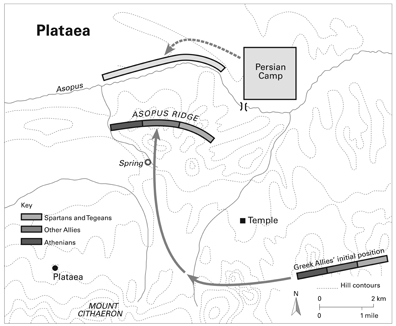
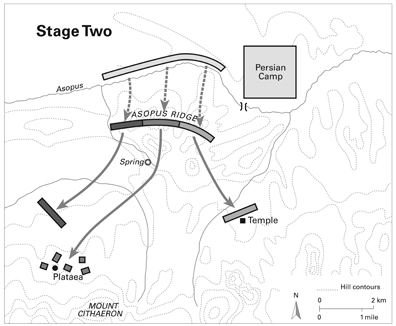
True, there was some relief to be had in the breathless arrival of Amompharetus and his men; but there could be no hope now of any other reinforcements coming to swell the phalanx’s numbers. Alone, then, the Spartans and the Tegeans would have to face Mardonius: 11,500 men against the elite of a superpower. Already, fired by the wheeling, darting Saka, arrows were rattling down upon their shield wall. Then, from behind the horsemen, barely visible through the hail of missiles, and all the more terrifying for it, the measured, thunderous approach of the barbarians’ crack infantry divisions could be felt. Mardonius’ cavalry withdrew; his infantry, maintaining their distance from the bristling phalanx, planted a wall of wicker shields; the rain of arrows began to thicken.
Still the cornered Greeks maintained their discipline. Holding up their shields, they listened from within their helmets to the eerily dimmed hiss and thud of ceaseless missiles all about them. Men began to stumble and fall, the arrows protruding from groins or shoulders bloody to the fletching; and now, every Lacedaemonian and Tegean began to think, was the time for the phalanx to make its charge across no man’s land, to crash into the wall of flimsy wicker, to stab and trample its tormentors underfoot. But still Pausanias held back his warriors. Only once the approval of Artemis for the great enterprise of combat ahead of them had been clearly discerned in a blood sacrifice could he give the order to advance; and the goddess, no matter how many goats were slaughtered in her honor, refused to grant the Greeks her blessing. At last, in despair, Pausanias raised a prayer directly to the heavens, “and a moment later the victims, when they were sacrificed, promised success at last.”55 Just as well: for even as Pausanias was ordering the phalanx to advance, the Tegeans had already begun running toward the Persian lines—and a single Spartan with them. Of the Tegeans, who lacked the authentic Lycurgan discipline, such intemperance might, perhaps, have been expected; but not of Aristodemus, that graduate of the “agoge.” And yet the “trembler”—even though he could hardly be honored for breaking from his place in the Spartan shield wall, for throwing himself single-handed upon the barbarians, for killing and being killed in a frenzy so berserk as to be barely Greek—had nevertheless, his messmates agreed later, redeemed his name. Indeed, his courage would long be remembered by the men of other cities as something truly exceptional. To that extent, at least, it could be reckoned that Aristodemus had died a Spartan.
All the same, true glory in Sparta went to those who fought not in the cause of their own selfish honor but as links in a single machine; and great glory, that terrible morning, was won by every member of the phalanx. Only “Dorian spears, clotting the earth of Plataea with the butchery of a blood-sacrifice,”56 could possibly have secured the victory; for only the men who grasped them had been steeled from birth to fight, to kill and never to yield. Descending the arrow-darkened slope of no man’s land, smashing into the enemy’s front line, the Spartans faced a test for which their whole lives had been preparation. Other men, perhaps, shoving against an enemy as teeming, as celebrated and as courageous as the Persians, would have found their spirits failing, their shield arms wearying, their bodies aching; but not the Spartans. Long though the battle appeared to hang in the balance, they did not cease to grind implacably forward. No matter that the Persians, in their growing desperation, sought to impede their enemy’s advance by taking hold of the Spartans’ spears and splintering them; swords were not so easily snapped, nor the weight of bronze-clad bodies stopped. Still Mardonius, “as brave as any Persian on the field,”57 sought to rally his troops; but by now the Spartans were closing in on the elite that formed his bodyguard, and Mardonius himself, resplendent on his white charger, made for an easy target. A Spartan, picking up a stone, flung it at him, and the missile smashed into the side of his skull; and down from his saddle tumbled the cousin of the Great King, the man who had thought to be Satrap of Greece.
And the Persians, watching him fall, knew the battle lost. Mardonius’ guardsmen, holding their ground heroically, were wiped out where they stood, but the remainder of the divisions, demoralized by the death of their charismatic general, began to run, and soon the rout was general over the battlefield. Forty thousand men, led by a quick-thinking officer, managed to escape northward onto the road to Thessaly, but most, stampeding in their panic, made for the fort, and the Lacedaemonians and Tegeans pursued them there. Soon enough, Pausanias was joined before the gates of the fort by the Athenians, whose bitter grudge match against the Thebans had ended with the medizers breaking and fleeing for their city. Now, together at last, the victorious allies forced the palisade. The massacre that followed was almost total: of the shattered remnants of Mardonius’ army, barely three thousand were spared. And so ended the enterprise of the Great King against the West.
Gawking at the wealth and luxury displayed in Mardonius’ camp, the Greeks again found themselves wondering why he had felt such a burning desire to conquer their land, when, self-evidently, he had more than enough already. One trophy, in particular, served to bring home to them the full, improbable scale of their victory: the King of King’s own tent. Xerxes, it was said, leaving Greece the previous autumn, had granted to Mardonius the use of his campaign headquarters; and so Pausanias, parting its embroidered hangings, walking over its perfumed carpets, took possession of what the previous year had been the nerve center of the world. Gazing in astonishment at the furnishings, the Regent pondered what it would be like to sit where the death of his uncle had been plotted; and so he ordered Mardonius’ cooks to prepare him a royal dinner. When it was ready, he had a second dinner of Spartan black broth laid out beside it, and invited his fellow commanders to come in and admire the contrast. “Men of Greece,” Pausanias laughed, “I have invited you so that you could appreciate for yourselves the irrational character of the Mede, who has a lifestyle such as you see here laid out before you, and yet who came here to our country to rob us of our wretched poverty.”58 A joke; and yet, of course, not wholly so. Freedom was no laughing matter. Few of the sweat-stained Greek commanders, gazing at the obscene luxury of the Great King’s table and then comparing it with the bowls of simple soup, could have doubted to what the barbarians owed their defeat, and their own cities their liberty.
Meanwhile, beyond the tasseled doorways of the tent, the helots were hard at work, grubbing through the camp. Ordered by Pausanias to make a great pile of the loot, they lugged furniture out of tents, shoved golden plate into sacks, and pulled rings off the fingers of corpses. Naturally, they refrained from declaring all that they found; what they could, they salted away. With these scavengings, the helots hoped to secure their own liberty; but they were ignorant and backward, and so proved easy meat for con men. A consortium of Aeginetans, smelling an easy profit, managed to persuade the helots that their gold was brass, and paid for it accordingly. The helots, comprehensively ripped off, appear not to have won their freedom; but the Aeginetans, it is said, made a killing.