
3
Back in the early years of the Persian rise to greatness, while Cyrus was still in Lydia, he had found himself unexpectedly visited by a delegation from across the Aegean Sea. The ambassadors were Greek, but quite different from the Greeks of Asia, whose cities, prosperous and tempting, Cyrus was plotting at that very moment to crush and make his own. The strangers wore their hair long; they sported distinctive red cloaks; they spoke not with the subtlety and sense of propriety that conventionally marked an ambassador’s language, but brusquely, bluntly, rudely. The message they gave the greatest king on earth was simple: Cyrus should leave the cities of the Ionians well alone; if he did not, then he would have to answer to those who had sent them—the Spartans. Evidently, the strangers felt that the mere mention of this name was sufficient to chill the blood, for they added nothing more. Cyrus, turning from them, was obliged to summon a nearby Ionian attendant. “Tell me,” he demanded, all bemusement, “who are the Spartans?”1
A startling question for any Greek to have to answer. How could an Asiatic not have heard of the Spartans? Nothing could better have illustrated the remote and alien quality of the Persians than the fact that they were ignorant of history’s most notorious woman. Helen of Sparta, hundreds of years before, had brought ruin to Asia as well as Greece. Her abduction from the home of her husband, King Menelaus, to the fabled city of Troy had made all the world bleed. For ten long years, the heroes of East and West had butchered each other in the dust of the Trojan plain. Only with the annihilation of what, in the opinion of the Greeks, had been Asia’s greatest city, the slaughter of its men and the enslavement of its women, had the terrible war at last been brought to an end. To the descendants of the victors, there had been, in the sheer scale of the destruction, something sobering and fearful: after all, “an immense expeditionary force had been assembled, Asia invaded and Trojan power wiped out, merely for the sake of a single Spartan woman.”2 No wonder that many Greeks, and particularly those who actually lived on the margins of Asia, imagined the whole vastness of the East to be sullen still with resentment, brooding on ancient wrongs. Perched precariously as they were on the edge of the great continent, the Ionians had good cause to fear the vengeful shadows of the Trojan dead.
To the Spartans themselves, however, the memory of their city’s most famous daughter was precious. Menelaus, it was said, searching for Helen amid the final massacre of the Trojans, had been planning to add her to the piles of corpses, a fitting punishment for all the slaughter she had caused—but when at last he had found his wife, rather than kill her, he had instead dropped his sword, struck dumb by the perfection of her naked breasts, and swept her up into his arms. Both had returned to Sparta, and their tomb could still be seen on a promontory south of the city, its immense stone blocks raised on earth as red as Menelaus’ hair. Helen herself, “that radiance of women,”3 had been altogether more aureate than her husband: not only had she been a blonde, but even her spindle had been fashioned out of gold. Had Cyrus known that the Spartans worshipped at the shrine of such a woman, sensual and pleasure-loving, he would no doubt have been confirmed in his contempt for their ridiculous pretensions. Certainly, their ambassadors, long-haired and scarlet-cloaked as they were, would have appeared apt devotees of Helen; for Cyrus would have had sufficient opportunity to learn that the wearing of long hair, among the Greeks, was generally regarded as evidence of effeminacy, and the use of expensive vermilion as a mark of wild extravagance. The Persians, unsurprisingly, chose to scorn the Spartan threats. Surely they could have little to fear from such a luxury-loving race?
Appearances, of course, could be deceptive; but it was true that once, in the earliest years of their history, the Spartans had indeed been notorious for their materialism and greed. “Acquisitiveness will be their ruin” had been a common prediction.4Sparta, in the eighth and seventh centuries BC, had served as a model of everything that other Greeks hoped to avoid: her elite was brutal and rapacious; its land-hunger was obscene; the impoverishment of the average citizen, leeched of his patrimony and often even of his freedom, was something shocking. Appalled foreign analysts, observing the toxic quality of Sparta’s class hatreds, had no hesitation in judging her “the worst-governed state in Greece.”5 And this at a time when competition was hardly lacking; for everywhere in the Greek world, by the seventh century BC, the gap between rich and poor, the few and the many, had begun to widen alarmingly, so that the ideal of good governance, “eunomia” as it was called, seemed a distant dream, and all was instability.
Social convulsions were not unknown elsewhere in the world, as the clan chiefs of Media or Persia could have vouched. Among the Greeks, however, the yearning for eunomia had a peculiar urgency. In their search for it, they were, in a sense, alone. There was certainly no equivalent in their poor and backward land of the millennia-old traditions of the monarchies of the East. Unlike the clansmen of the Zagros, they were far removed from the wellsprings of civilization. With no ready models of bureaucracy or centralization to hand, the Greek world had early on fragmented into a multitude of competing city-states, each with its distinctive brand of constitutional crisis. Racked by chronic social tensions though they were, however, the Greeks were not entirely oblivious to the freedom that provincialism gave them: to experiment, innovate and forge their own distinctive paths. “Better a small city perched on a rock,” it could be argued, “so long as it is well governed, than all the splendors of idiotic Nineveh.”6 Certainly, compared to the rugged landscape across which Greek cities were dotted, the bland alluvium of Mesopotamia might indeed appear just a little effete. In Greece, the mountains which hemmed in the lowlands, cutting many a state off from state, to say nothing of the reach of the broader world beyond, afforded a rough-hewn autonomy as well as isolation.
The Spartans, certainly, had profited from the location of their city. That they had been left free to indulge their taste for class warfare had owed almost everything to geography. Lacedaemon, the territory in the remote reaches of southern Greece which their city dominated, was framed all around by formidable natural bulwarks: to the east and south, the sea; to the north, gray, forbidding hills; to the west, savage and immense, the mountain of Taygetos, its five claw-like peaks streaked with snow even in the heat of summer. Behind such frontiers a city might easily bring itself to the point of ruin, and still remain undisturbed.
But behind such frontiers it might equally evolve and metamorphose. The Spartans, like the Persians, had originally been a tribal monarchy, with a state that had its roots in an ancient nomadic past. Sparta itself, despite its venerable name, was little more than an agglomeration of four villages, founded on what had previously been an almost virgin site. Certainly it owed nothing to the original Sparta, the Sparta of Helen and Menelaus. Impressively though the couple’s tomb loomed over the Lacedaemonian plain, the shrine bore witness not to continuity but to the very opposite: a brutal rupture with the past. Hillocks of buried rubble surrounded it, all that remained of a long-abandoned palace, perhaps one that had been occupied by Helen and Menelaus themselves; and yet, around 1200 BC, it and all the other great buildings of Lacedaemon had been sacked and burned to the ground. Why, and by whom, had rapidly been forgotten: the ruin had been too total for the memory to be preserved. Centuries had passed. Gradually, the void left by the collapse of Menelaus’ kingdom had been filled by newcomers from the north, wandering tribes who would be known much later as the Dorians, in proud contradistinction to the vanquished native Greeks.7 Yet the Dorians too were Greek, and far from oblivious to their adopted homeland’s golden past. Indeed, it would be said of them that there was no nation more devoted “to tales of the age of heroes, of the ancient beginnings of cities, and of anything that related to far-off times.”8 The settlers, intrigued by Lacedaemon’s pedigree, began to appropriate it to themselves. Around 700 BC, for instance, roughly when the Medes and Persians were putting down their own roots in the distant Zagros, the fortuitous identification of Helen’s tomb was first made. Even more sensationally, the Spartan elite also began to manufacture an ancestry for itself that stretched far beyond the reign of Menelaus, back to the greatest hero of them all, Heracles, slayer of monsters and son of Zeus, the king of the gods. What had been an invasion by the Dorians’ distant ancestors could now be presented as a return; what had been won by conquest as a patrimony. The leading Spartans called themselves “Heraclids”—and they laid claim, as the heirs of Heracles, not only to Lacedaemon but to the dominion of much of Greece.
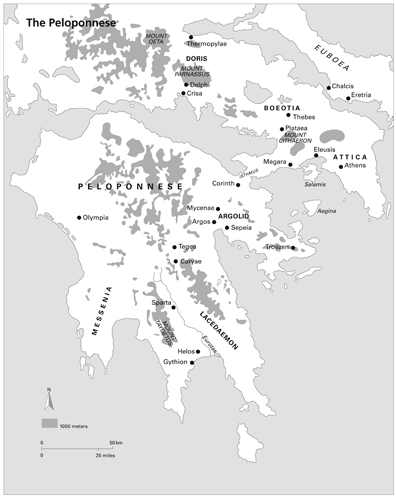
All of which, of course, was profoundly alarming for their neighbors. By 700 BC, the Spartans had already achieved the startling feat of crossing the most intimidating of their natural frontiers, the Taygetos range, and launching a war of annexation in the land of Messenia that lay beyond it to the west. The “broad dancing-grounds” to be found there, “good for ploughing, good for growing fruit,”9 were more fertile even than those of Lacedaemon, and although the Messenians too could lay claim to Dorian ancestry, the Spartans savagely demonstrated their disdain for any possible ties of kinship by the brutality of their assault, and by the implacability of their resolve. A territory as extensive as Messenia was not easily subdued, but the Spartans, keeping grimly to their objective, had continued for decades to wash its fields and groves with blood. The Messenians’ submission, when it came at last, was total. Victory had taken their conquerors more than a century to force.
Such an enslavement of one Greek people by another was wholly without precedent. It established the Spartans not only as the richest people in Greece, but as a prodigy, a mutant race, unnerving and unique. As far as the Spartans themselves were concerned, this aura of mystery was merely their due. Where else in a world long since decayed from the golden age of heroes could a bloodline be traced back to the king of the gods himself? Brutally pragmatic in the ends to which they put their superstitions, the Spartans believed in them devoutly all the same. They knew themselves shadowed, in everything they did, by the whims of the divine. Offend the gods, and all might be lost; attend to their wishes, and Sparta’s greatness would surely be secured. So it was that she had been able, in the end, to subdue Messenia. And so it was, in the teeth of that interminable campaign, that she had also been able to redeem herself from an even greater crisis, a near-fatal social meltdown, and emerge from it, astonishingly, as the model ofeunomia.
This choice—between reform or ruin—was one that the Heraclids had long sought to postpone. The conquest of Messenia, however, far from putting off the hour of reckoning, had served only to hasten it. Victory, although it brought Sparta great wealth, had done little to ease the miseries of the poor. Indeed, by concentrating even greater resources in the hands of the aristocracy, it had threatened to exacerbate them. Perhaps, had the circumstances of the Spartan upper classes corresponded to those of their counterparts in far-off Media, they could have afforded to ignore the impoverishment of their fellow citizens, their cries for redistribution of land, and all their “seditions against the realm.”10 But Sparta was not Media—and a great revolution in military affairs, one that had begun to surge and swell across the whole of Greece, was at that very moment threatening to sink the Heraclids.
For it was not cavalry—prancing, expensive, indelibly upper class—that had won Messenia for Sparta. Rather, the victory had gone to plodding foot soldiers, citizens of farming stock, men who may not have had the resources to afford horses but who could still supply themselves with arms and armor; and in particular with hopla, circular shields of a radically new design, a meter high and wide, and faced with bronze across their wood. A line of hoplon-holders—“hoplites”—advancing in a phalanx, protected as well, perhaps, by bronze helmets and cuirasses, and bristling with spears, was potentially a devastating offensive weapon; and the Spartans, in the course of the Messenian War, had been given every opportunity to experiment with this radical and lethal new form of warfare. Yet it was not easily waged. A particular breed of man was required to make it succeed. Every hoplon, if it were to serve its purpose, had to offer protection to its neighbor as well as its holder—so that the line of a phalanx, as it advanced toward an enemy, risked being cut to pieces on any show of social division.
“Keep together,” exhorted a Spartan battle hymn, “hold the line, do not give in to alarm, or disgraceful rout.”11 A cry for discipline aimed at hoplites of every class. What, after all, would be the fate of even the most blue-blooded Heraclid in battle if he could not trust his flank to his neighbor, the humble farmer? And what, even more pressingly, would be the fate of Sparta herself if the farmer could no longer afford his expensive shield? Ruin—as sure and violent as the hatreds of Messenia. The Spartan establishment, having grown fat on the lower classes, suddenly found itself, in the very hour of victory, staring catastrophe in the face. No longer, by the middle of the seventh century, could civic cohesion be regarded merely as an idle aspiration of down-at-heel farmers. It had become, even for the Heraclids, a matter of life and death.
Panic bred a truly extraordinary solution. Revolution came to Lacedaemon. The Spartan people, despairing of their future, were somehow persuaded to forget their time-honored class differences and submit to a majestic yet murderous experiment in social engineering. But how, precisely—and at whose instigation? The Spartans themselves, enthusiasts for dramatic tales of ancient heroes, were hardly the type of people to attribute their new order to anonymous social forces. Surely it could only have been the work of some visionary sage? Soon enough, a name, “Lycurgus,” began to be floated. Barely a century after the establishment of eunomia in Sparta, and this mysterious figure had been definitively hailed as its architect. By and large, it was agreed that he had been a Heraclid grandee, uncle to a Spartan king, no less, and possessed of the sternest temperament, “high-principled and fair.”12 Such, however, were the limits of his biographers’ consensus. Even oracles confessed that they were baffled as to whether Lycurgus was “human or a god”—although their inclination was, on balance, to believe the sage divine.13 The Spartans shared this opinion: a temple was raised in the great man’s honor, and his purported reform program increasingly located back in the mists of time, giving it, like the Heraclid bloodline, a pedigree as venerable as it was bogus. Control the past, and you control the future: as radical an act of surgery as had ever been attempted by a state upon itself was soon being represented as the essence of its traditions. Lycurgus, it would later be claimed, “moved and gratified by the beauty and loftiness of his legislation, now that it was completed and implemented, had longed to make it immortal and unbudging, for all time—or at least so far as could be achieved by human foresight.”14 The Spartans, by reverencing him, and possibly by fabricating him as well, had duly fulfilled his dream. Revolution, as they were the first people in history to discover, could best be buttressed if it was transfigured into myth.
The sense of strangeness that had long haunted the Spartans now came to animate the structures of their state. They had become, it appeared to the men of other cities, both more and less than human. Lycurgus was said to have been divine, and yet he had worn the aspect of a beast, of something feral, as well as that of a god. “He who brings into being the works of a wolf”: this, portentous and menacing, was the literal meaning of his name. No longer, under the constitution established by Lycurgus, were the Spartans to be counted as predators upon their own kind, the rich upon the poor, the Heraclids upon the farmers, but rather as hunters in a single deadly pack. Every citizen, be he aristocrat or peasant, was to be subsumed within its ranks. Henceforward, even “the very wealthy were to adopt a lifestyle that was as much as possible like that of the ordinary run of people.”15 Merciless and universal discipline was to teach every Spartan, from the moment of his birth, that conformity was all. The citizen would assume his place in society; the hoplite would assume his place in a line of battle. There he would be obliged to remain for the length of his life, “his feet set firmly apart, biting on his lip, taking a stand against his foe”16—with only death to redeem him from his duty. Indeed, Lycurgus, it was said, in a supreme illustration of what a citizen owed the state, had gone so far as to commit suicide, hoping by such a gesture that he might educate his people. “For it was his reasoning that even a statesman’s end should be of some value to society, by setting it an example both virtuous and practical—and so it was that he starved himself to death.”17
A grim philosophy, to be sure. Yet, self-denying though it might appear, it was valued by the Spartans precisely for the freedoms that it gave them. That their city had become a barracks and their whole society an immense phalanx braced for war reflected not coercion but rather a hard-wrought class consensus. The balance it struck between the rich and the poor was delicate. The Heraclids, although they had ceded sovereignty to the people, and also a seeming equality, nevertheless preserved their wealth, their estates, and much of their power. The poorer classes, initiated into the ranks of an elite and peerless army, gained a status they had hitherto been denied—and material security to boot. No more sordid scratching around for them, trying to make a living out of farming or trade. A warrior had no business with mending shoes, or sawing wood, or making pans. Such activities were best left to the citizens of other communities in Lacedaemon, the “perioikoi,” or “about-dwellers,” as they were dismissively labeled, second-rate men denied the rights of a full and tested Spartan.
Only one source of wealth, to the true soldier, could be counted worthy of his rank. Gratifyingly, for a people once haunted by land-hunger, the conquest of Messenia had provided ample scope for the aristocracy to be generous with their spoils. Hazy though the precise details are, it appears likely that one of the key policies of the Lycurgan reform program had been the partitioning of much of Messenia into allotments for the poor.18 Not that any member of the master race ever farmed these grants in person: it was out of the question for a Spartan warrior to toil and sweat in a field. That was the function of the conquered Messenians. The Spartans, even prior to the crossing of Taygetos, had displayed a peculiar genius for the exploitation of vanquished foes. Their whole history bore witness to it. Learned scholars, curious about the name—“helots”—that the Spartans gave their wretched underclass, derived it from Helos, a town in Lacedaemon, conquered in the very earliest days of their expansion.19 What had first been practiced on one side of the Taygetos range was refined and perfected on the other: a whole population was reduced to serfdom. The Messenians, laboring “like asses suffering under heavy loads,”20 found themselves having to shoulder the full weight of Spartan greatness.
And no sooner had the conquerors found themselves growing rich off their helots than they began to cast around for more. By the early sixth century BC, with the west successfully pacified, the focus of their ambitions was inevitably turning north. There, however, blocking the path of empire, loomed a menacing rival. Argos, a city less than forty miles from the Lacedaemonian frontier, was a power just as restless and arrogant as Sparta, and had claims on southern Greece that were, if anything, more impressive. While the Spartans boasted of Menelaus as their forebear, the Argives could cite an even more celebrated figure, his elder brother Agamemnon, master of golden Mycenae, and commander in chief of the Greeks at Troy. Mycenae herself, although no longer the seat of kings, was still to be found, albeit a crumbled shell of her former greatness, huddled between ravines to the north of the plain of Argos. The Argives, despite taking regular pains to crush even the slightest hint of independence from her, had eagerly adopted her ancient pretensions. These, in the endless propaganda war waged by every Greek city, were certainly not to be sniffed at. Agamemnon, after all, had ruled as heir to his grandfather, the hero Pelops, an ivory-shouldered adventurer who had given his name to the entire peninsula which formed the south of Greece. Why, then, in any struggle for the mastery of “Pelops’ island”—“Peloponnesos” in Greek—should the Argives be content with second place? Surely Argos, not Sparta, should reign as the mistress of the Peloponnese?
As far back as 669 BC, during the earliest days of the Lycurgan revolution, the Argives had not merely countered the first assault upon their territory by the Spartans’ new citizen army, but annihilated it. Half a century later, the Spartans were still struggling to impose themselves on states even immediately over their frontier. Taking the road north, after crossing a range of barren hills, the traveler from Lacedaemon would descend into a fertile expanse of fields and olive groves, the territory of Tegea, a city with the misfortune to lie midway between Argos and Sparta. To the Spartans, in particular, the richness of Tegea’s farmland was an intolerable provocation, and in the early years of the sixth century, looking to seize it for themselves and turn the Tegeans into helots, they unleashed a full-scale war of annexation. The invaders, encouraged by an oracle’s assurance that they would soon be “dancing upon the plain of Tegea,”21 were sublimely confident of victory—so much so that they even brought surveying equipment with them and fetters for their new serfs. The oracle, however, had deluded them: their invasion was defeated, and the only dancing done by the Spartans was beneath the whip, as toiling prisoners of war, shackled by the chains they themselves had brought from Sparta.
This delivered such a blow to the Spartans’ self-confidence that it forced an abrupt and decisive shift in their foreign policy. It had begun to dawn on them that the goal of reducing the whole of the Peloponnese to helotage was monstrously over-ambitious—and that hegemony could take a multitude of forms. There was no question that the Tegeans had to be brought to heel; perhaps, though, where naked oppression had failed, intimidation and force of prestige might yet succeed? The Spartans, employing their customary blend of low cunning and religiosity, duly dispatched a delegation to Tegea under cover of a truce. News had reached them of a strange find in a blacksmith’s yard, the spine of what appeared to be a monstrous skeleton. The Spartans, sensing a possible propaganda coup, wished to stake this startling discovery for themselves. The prize was duly dug up, smuggled home, shown off, then reinterred. The skeleton, it was revealed, had belonged to none other than—a blast of trumpets!—Agamemnon’s son. An identification more calculated to infuriate the Argives could not, of course, have been imagined; and yet the fanfare made over it by the Spartans had a far more calculated aim. The bones might have been stolen from Tegea, but Sparta, by enshrining them within her soil, was offering a public reassurance to others in the Peloponnese that she valued and respected their ancient traditions. No longer, as she had done in Messenia, was she aiming to trample them in the dirt. Cities which had demonstrated that they would rather fight to the death than be reduced to helotage could now submit to Sparta without fear of total ruin. Indeed, the Spartans hinted, it might even bring them some perks. To a Peloponnese long racked by rival hatreds, not to mention the menaces of Argos, Sparta offered the order of a protection racket, at least. Worse fates might be imagined. In 550 BC, just a few decades after her victory at the Battle of the Chains, Tegea entered into a league established and controlled by her fearsome neighbor.
Other cities soon followed. Like Tegea, they were wooed and reassured into submission. Spartan bone-hunters toured the remotest reaches of the Peloponnese, prospecting for the remains of further heroes, and having, in a landscape studded with the fossils of Pleistocene mammoths, considerable success. Not that the Spartans, in their ambition to forge a great league of subordinate cities, were content to rely on paleontology alone. Even as they promoted themselves as the guardians of their neighbors’ mythic past, so they remained true to the ideals of the wolf pack, to the practice of terror and total war. The early defeats inflicted on their newly reformed army, far from denting their faith in the Lycurgan system, had only steeled them to perfect it. One century on, the transformation of their society into a killing machine had given the Spartans a rare and sanguinary mystique. To the hoplites of other cities, the wealthy elites whose armor, every season, would be brought out of haylofts and dusted down, and whose tendency, in best amateur spirit, was to regard warfare as a ritual, if often lethal, sport, the prospect of meeting the Spartans in battle was a dreadful one. That an entire city could mobilize itself was alarming enough; that the main object of its citizens was to meet and annihilate anyone who stood up to them was terrifying. Many non-Spartan hoplites, rather than test themselves against such an adversary, preferred simply to run away.
And the Spartans themselves, masters of psychological as well as every other form of warfare, knew precisely how to turn their enemies’ blood to ice. From far off, the advance of their phalanx would be heralded by the shrilling of high-pitched pipes, and the earth would shake with the rhythm of their slow and metronomic approach. Then, as they emerged through the dust of battle, a dazzling “wall of bronze and scarlet”22 would appear, for it was the practice of the Spartans to burnish their shields until they glittered, and to wear, supposedly on the personal prescription of Lycurgus himself, brilliant cloaks dyed the color of fresh blood.23 Above the slow step of their marching, chilling battle hymns to ancient heroes would be raised, until officers, their distinctive horsehair crests running from ear to ear, would yell out a command and the phalanx would cease its paean. Immediately, upon the silence, a blast of trumpets would rend the air. The hoplites would quicken their pace, lower their spears—then start to run. Not necessarily, however, in a single mass: the wings might advance separately, like the horns of a bull, to turn the enemy flanks. The discipline required for such a maneuver, far beyond the ambitions, let alone the abilities, of amateur troops, served as grim testimony to the Spartans’ addiction to drill. Such proficiency, to the hoplites of other cities, seemed almost like cheating. No dishonor, then, to acknowledge the greatness of a city that gave its men such training and such devastating skills. It was, everyone agreed, “a terrible thing to fight the Spartans.”24
By the early 540s BC, when Croesus, the King of Lydia, was advised by an oracle to seek out “the most powerful of the Greek cities” as an ally in his looming war against the Persians, he had little hesitation in approaching Sparta. No greater tribute to her prestige could have been paid—nor a more direct snub to Argos. Indeed, with the friendship of a king as rich and powerful as Croesus, and with Tegea and much of the rest of the Peloponnese subordinated, it appeared to the Spartans that the time had finally come for a reckoning with the old enemy. Around 546 BC, even as the Lydian Empire was succumbing to Cyrus, the Spartans advanced, not to the aid of Croesus, as they were bound to do by the terms of their alliance, but directly against Argos. The Argives, harking back to an earlier age, immediately proposed a tournament, a clash between three hundred champions from their own city and three hundred of the invaders. The Spartans, ever enthusiasts for the example provided by tales of ancient heroism, agreed. At the end of the day, three men were left standing: two Argives and a solitary Spartan. The Argives, believing themselves the victors, duly returned to their city in triumph—leaving their adversary, blood-drenched but still very much alive, to accuse them of abandoning the battlefield, and to claim the triumph for himself. When the Argives disputed this in tones of high indignation, the Spartan’s countrymen were there to back their champion up: meeting the enemy the next day with the full complement of their invasion force, they won a crushing victory. Strategically vital swaths of the Argive frontier were permanently annexed to Lacedaemon, and the Argives themselves, shaving their heads as a mark of their prostration, were left crippled for a generation. Even as the shears were getting to work in Argos, the Spartans were taking a precisely opposite vow: they would grow their hair long evermore, and wear oiled tresses, like red cloaks, as a mark of who they were.
It was in the midst of their celebrations, however, that news reached the Spartans of Croesus’ fall. Their failure to live up to the terms of their alliance with the King of Lydia was an evident humiliation. Worse was to follow. Still unwilling to commit troops beyond the Aegean, Sparta dispatched instead only a small embassy, which duly met with Cyrus and was subjected to his celebrated put-down: “Who are the Spartans?” The Persians, certainly, had little cause to care. The lesson was sobering. Although Sparta appeared a colossus to the Greeks, in Asia she barely registered as a name, still less a power. Why should she? Compared to the fantastical scale of Cyrus’ dominion, all the Peloponnese was but an insignificant dot.
But the time would come when the Spartans would fling the Persians’ mockery back in their teeth. “Who are the Spartans?” This question, asked in scorn, could just as well be asked in fear. Shielded behind their mountain frontiers, self-sufficient, xenophobic and suspicious, the Spartans took but never gave, spied but never revealed. Alone among the people of Greece, they made no attempt to distinguish between Greeks and non-Greeks, condemning all non-Spartans as “foreigners,” and periodically expelling any found in their city. To their neighbors, at any rate, the wolf-lords of Lacedaemon were a source of obsessive fascination and fear. The riddle they posed their neighbors, like Cyrus’ question, afforded no ready answers. The truth was veiled by fantasy, the reality by mirage. Ever conscious of the value of terror, the Spartans perfectly understood that it would diminish them to have the heart plucked out of their mystery. For in their mystery lay their dread.