
3
The main events of the AD 79 Vesuvian eruption happened over two days, as is clear from both Pliny’s Letters and the geological evidence. This chapter reviews the physical and historical context of the Bay of Naples, considers evidence for the time of year when the AD 79 eruption happened, and outlines the volcanological sequence according to the latest research.
Before the Eruption
The eruption record in the Bay of Naples goes back about 60,000 years. Massive blasts in the Phlegraean, “Burning,” Fields (Campi Flegrei) at the northwest corner of the Bay of Naples (Figure 1.5) around 39,000 years ago (the Campanian Ignimbrite) and 15,000 years ago (the Neapolitan Yellow Tuff) plus dozens of smaller events (the last in 1538) created the calderas that defined the area as a mythical entrance to the Underworld.1 It was at the southwest corner of this pock-marked rim—Misenum—where Elder and Younger Pliny and Plinia were residing. That corner teases the edge of a submerged super-volcano.2
Across the Bay to the East in AD 79 was the broad indented height of the Somma-Vesuvius Complex (SVC). The original mountain built up gradually by means of lava flows; explosive episodes began about 36,000 years ago with the Schiava eruption. A major shift to the shape and activity of Somma occurred about 22,000 years ago, when the Pomici di Base (Sarno) eruption, the largest in terms of volume, was precipitated by a massive caldera collapse. New cones may have grown up inside the Somma caldera, each time blasted away by subsequent events such as Pomici Verdoline (19,000) and Mercato (8,900 years old).3 The Pomici di Avellino eruption (ca. 1995 BC) preserved Bronze-Age houses, inhabitants, and footprints at places such as Croce di Papa and Afragola on the Nola plain, northeast of the mountain.4 For two millennia afterward, no massive-scale eruptions recurred.5 The volcanological term for the mountain that existed until AD 79 is “Somma”; technically, “Vesuvius” marks the cone growing, erupting, and occasionally being reduced within the larger Somma crater ever since. In this book, however, Vesuvius (because the Romans knew it by that name) designates the volcano of Pliny’s Letters.
Its summit served as a strategic hideout for Spartacus and his rebel slaves in 73 BC. The imperial-era writer Florus, in his Epitome of Roman History, recounts (2.8.4–5):6
Prima sedes velut ara Veneris mons Vesuvius placuit. Ibi cum obsiderentur a Clodio Glabro, per fauces cavi montis vitineis delapsi vinculis ad imas eius descendere radices et exitu inviso nihil tale opinantis ducis impetu castra rapuerunt.
The first base that pleased them (Spartacus’ men), like an altar of Venus, was Mount Vesuvius. There, while they were being besieged by Clodius Glaber (the Roman commander), having slid down a gap in the hollow part of the mountain by means of vine-ropes, they descended to its very roots and, by an unseen sally, seized by assault the camp of the general, who was expecting nothing of the sort.
In the late first-c. BC–early first-c. AD, the geographer Strabo remarked (5.4.8):7
ὑπέρκειται δὲ τῶν τόπων τούτων ὄρος τὸ Ὀυέσουιον, ἀγροῖς περιοικούμενον παγκάλοις πλὴν τῆς κορυφῆς: αὕτη δ᾽ ἐπίπεδος μὲν πολὺ μέρος ἐστίν, ἄκαρπος δ᾽ ὅλη, ἐκ δὲ τῆς ὄψεως τεφρώδης, καὶ κοιλάδας φαίνει σηραγγώδεις πετρῶν αἰθαλωδῶν κατὰ τὴν χρόαν, ὡς ἂν ἐκβεβρωμένων ὑπὸ πυρός, ὡστε τεκμαίροιτ᾽ ἄν τις τὸ χωρίον τοῦτο καίεσθαι πρότερον καὶ ἔχειν κρατῆρας πυρός, σβεσθῆναι δ᾽ ἐπιλιπούσης τῆς ὕλης.
Above these places (i.e., Campanian towns such as Pompeii, Nola, etc.) lies Mt. Vesuvius, occupied all around by very beautiful fields except for its summit, which is level ground for the most part, but entirely barren, like ashes in appearance, and it reveals the pitted cavities of rocks blackened on the surface, as if eaten away by fire, so one could infer that the place was formerly in flame, containing bowls of fire, and was quenched when the fuel dwindled.
Similar is Cassius Dio’ description (via Xiphilinus), 66.21.1–4, written more than a century after the eruption, but preserving some description of its former appearance:8
καὶ ἦν μέν ποτε πᾶν ὁμοίως ὑψηλόν, καὶ ἀπ᾿ αὐτοῦ μέσου τὸ πῦρ ἀνέτελλε· ταύτῃ γὰρ πεπύρωται μόνον, τὰ δὲ ἔξωθεν αὐτοῦ πάντα ἄπυρα καὶ νῦν ἔτι διαμένει. (2) ἐκ δὲ τούτου, ἐκείνων μὲν ἀκαύστων ἀεὶ ὄντων, τῶν δὲ ἐν τῷ μέσῳ κραυρουμένων καὶ τεφρουμένων, αἱ μὲν πέριξ κορυφαὶ τὸ ἀρχαῖον ὕψος ἐς δεῦρο ἔχουσι, τὸ δὲ ἔμπυρον πᾶνδαπανηθὲν ἐν τῷ χρόνῳ κοῖλον ἐκ τοῦ συνίζειν γέγονεν, ὥστε κυνηγετικῷ τινι θεάτρῳ τὸ ὄρος σύμπαν, ὡς μικρὰ μεγάλοις εἰκάσαι, ἐοικέναι. (3) καὶ αὐτοῦ τὰ μὲν ἄκρα καὶ δένδρα καὶ ἀμπέλους πολλὰς ἔχει, ὁ δὲ δὴ κύκλος ἀνεῖται τῷ πυρί, καὶ ἀναδίδωσι τῆς μὲν ἡμέρας καπνὸν τῆς δὲ νυκτὸς φλόγα, ὥστε δόξαι πολλὰ ἐν αὐτῷ καὶ παντοδαπὰ θυμιᾶσθαι θυμιάματα. (4) καὶ τοῦτο μὲν οὕτως ἀεί, ποτὲ μὲν ἐπὶ μᾶλλον ποτὲ δὲ ἐπὶ ἧττον, γίνεται· πολλάκις δὲ καὶ τέφραν ἀναβάλλει, ὅταν ἀθρόον τι ὑφιζήσῃ, καὶ λίθους ἀναπέμπει, ὅταν ὑπὸ πνεύματος ἐκβιασθῇ. ἠχεῖ τε καὶ βοᾷ, ἅτε μὴ συμπεπιλημένας ἀλλ᾿ ἀραιὰς καὶ λαθραίας τὰς ἀναπνοὰς ἔχων.
Once it (Vesuvius) was equally high at all points and the fire rose from the center of it; for here only have the fires broken out, whereas all the outer parts of the mountain remain even now untouched by fire. (2) Consequently, as the outside is never burned, while the central part is constantly growing brittle and being reduced to ashes, the peaks surrounding the centre retain their original height to this day, but the whole section that is on fire, having been consumed, has in the course of time settled and therefore become concave; thus, the entire mountain resembles a hunting theatre—if we may compare great things to small. (3) Its outlying heights support both trees and vines in abundance, but the crater is given over to the fire and sends up smoke by day and a flame by night; in fact, it gives the impression that quantities of incense of all kinds are being burned in it. (4) This, now, goes on all the time, sometimes to a greater, sometimes to a lesser extent; but often the mountain throws up ashes, whenever there is an extensive settling in the interior, and discharges stones whenever it is rent by a violent blast of air. It also rumbles and roars because its vents are not all grouped together but are narrow and concealed.
Pre-eruption descriptions present a broad crater with steep sides, a relatively flat and burned-out central area, and no central cone. Recent volcanological studies support just such a “caldera-type” profile, differing greatly from Vesuvius’ current appearance. The old Somma caldera rim, then about 1250–1300 m. high and still prominent today on the north side, would have continued around the east and southern sides (Figure 1.5), with a diameter of just over 3 km.9 There was probably a break in the rim (mirroring subterranean volcanic structures) on the west-southwest side, toward Herculaneum, where a secondary caldera had collapsed in the Avellino eruption, forming an opening by which the first pyroclastic density current (the EU 2/3pf PDC; see below) of the AD 79 eruption overran that town.10
Two paintings from Pompeii are often said to represent the mountain. The first (Figure 3.1) was installed in the east wall of a small court (49) used as a domestic shrine, or lararium, in the Casa del Centenario (Region IX.8.3, 6).11 It shows the god Bacchus draped in grapes, holding a thyrsus (festal staff) in his left hand and pouring out wine with his right from a kantharos, where a leopard laps at the liquid. Behind the god is a peaked mountain, with well-ordered vineyard trellises on its lower slopes, trees thinning out toward the top, and two shallow scalloped curves at its base on the right, interpreted as caldera edges.12 Garlands, fillets, birds, and a bearded snake approaching an altar frame a vibrant scene that continues around the east wall, into which a physical shrine is set. In Martial’s Epigrams 4.44, a lament on the blasted Vesuvian landscape written a decade after the eruption, the poet remembers:
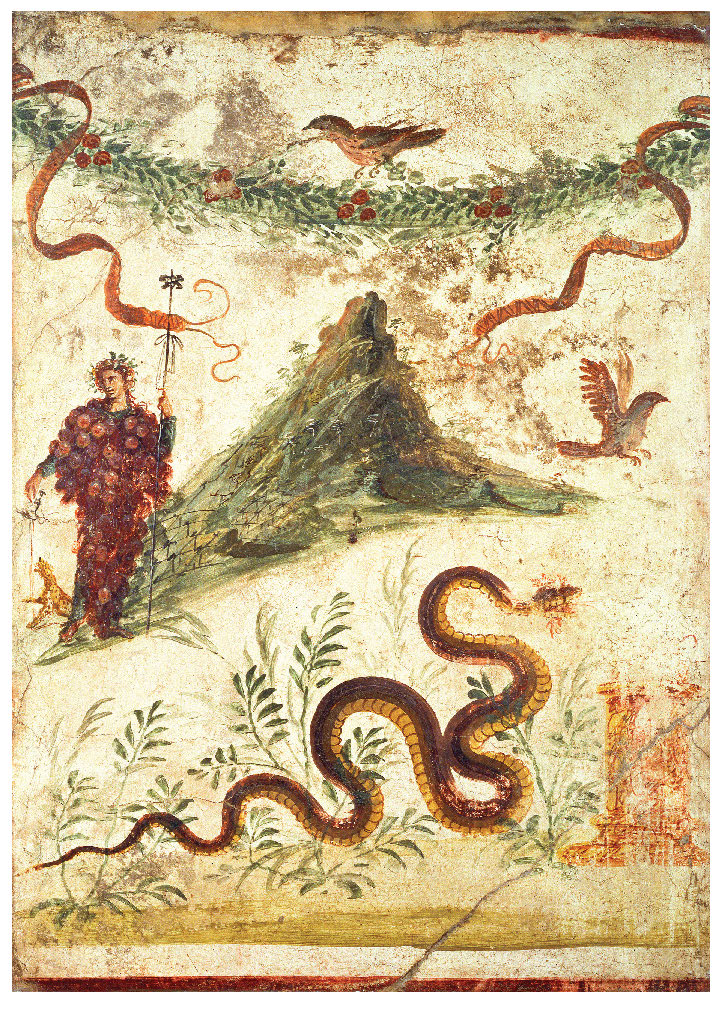 Figure 3.1 Wall painting that may (or may not) represent Mt. Vesuvius before the AD 79 eruption. East wall of atriolum 49 in the Casa del Centenario, Pompeii (IX.8.3, 6). Museo Archeologico Nazionale, Naples. Bridgeman Images.
· Hic est pampineis viridis modo Vesbius umbris,
· presserat hic madidos nobilis uva lacus:
· haec iuga, quam Nysae colles plus Bacchus amavit,
· hoc nuper Satyri monte dedere choros.
· Haec Veneris sedes, Lacedaemone gratior illi,
· hic locus Herculeo numine clarus erat.
· Cuncta iacent flammis et tristi mersa favilla:
· nec superi vellent hoc licuisse sibi.
· Here is Vesuvius, not long ago green with shady vines,
· Here the noble grape had pressed tanks soaking-full:
· These ridges, which Bacchus loved more than Nysa’s hills,
· On this mountain Satyrs recently performed their dances.
· This was the seat of Venus, more pleasing to her than Sparta,
· This spot famous for the majesty of Hercules.
· All lies now engulfed in flames and melancholy ash:
· Not even gods above would wish they could have done this.13
Campanian wines were profitable and popular in the years prior to the eruption, as Elder Pliny notes (Hist. Nat. 14.69) and as archaeological excavations have revealed.14 It has been no great leap to label this painted mountain as Vesuvius. But thinking the volcano had a conical form in AD 79 because of this image is too literal a reading. It could as well represent Bacchus’ home mountain of Nysa; nothing makes the image historical rather than mythological. A second image, of Mars and Venus or Aeneas and Dido embracing below a flat-topped mountain on the north wall of room (20) in the Casa del Citarista at Pompeii (I.4.5, 25), is no more certain, though its flat-rimmed morphology better fits the volcanological reconstruction of a caldera volcano.15
The awakening of Vesuvius in AD 79 was the result of a long process. In AD 37, a regional tremor wrecked the lighthouse at Capri and conveniently prefigured an emperor’s death (Suetonius, Tib. 74). Even more serious was an earthquake in AD 62 or 63, recorded both by Tacitus and the Younger Seneca, which was probably just the first and most severe of a series that continued until the eruption. Tacitus’ version (Annales 15.22) reports:16
Isdem consulibus gymnasium ictu fulminis conflagravit effigiesque in eo Neronis ad informe aes liquefacta. Et motu terrae celebre Campaniae oppidum Pompei magna ex parte proruit; defunctaque virgo Vestalis Laelia ...
During the same consulship, a gymnasium [in Rome] burned down from a lightning strike, and in it, a statue of Nero melted into a bronze lump. And because of an earthquake, the populous town of Campania—Pompeii—for the most part tumbled down; and the Vestal Virgin Laelia died ...
Tacitus often lists unusual events (omens, prodigies, natural disasters) at the end of his entry for each year of the Annales, and so the Campanian earthquake falls comfortably for him between a lightning strike that destroyed an image of Nero (slyly looking forward to that tyrant’s own fall), and the death of a priestess.17 Tacitus’ text gives a date for the earthquake of AD 62, in the consulship of Publius Marius and Lucius Afinius (14.48), as Tacitus begins the very next section of the text (15.23) with consuls for the following year (AD 63): Memmius Regulus and Verginius Rufus.18 As seen in the passage below, Seneca (alive during the event, unlike Tacitus) specifically cites Regulus and Verginius as consuls during the disaster, and therefore a date of AD 63, specifically the Nones (the 5th) of February. The year does not much matter; both authors are relatively reliable and seem irreconcilable, so 5 Feb. AD 62/63 best indicates the date of the earthquake (or earthquakes; it is possible there was more than one event, separated by time for repairs).19 Seneca’s account appears in four chunks about earthquakes within his Naturales Quaestiones (6.1.1–3, 6.1.10–11, 6.27.1–2, 6.31.1), de terrae motu:20
(6.1.1) Pompeios, celebrem Campaniae urbem ... consedisse terrae motu vexatis quaecumque adiacebant regionibus, Lucili, virorum optime, audivimus, et quidem hibernis diebus, quos vacare a tali periculo maiores nostri solebant promittere. (2) Nonis Februariis hic fuit motus Regulo et Verginio consulibus, qui Campaniam, numquam securam huius mali, indemnem tamen et totiens defunctam metu, magna strage vastauit. Nam et Herculanensis oppidi pars ruit dubieque stant etiam quae relicta sunt, et Nucerinorum colonia ut sine clade ita non sine querela est; Neapolis quoque privatim multa, publice nihil amisit leuiter ingenti malo perstricta; villae vero prorutae, passim sine iniuria tremuere. (3) Adiciuntur his illa: sexcentarum ouium gregem exanimatum et divisas statuas, motae post hoc mentis aliquos atque impotentes sui errasse.
(6.1.1) Lucilius, best of men, I’ve heard that Pompeii, the populous city in Campania, sank from an earthquake, along with with various neighboring areas. Indeed, it happened in wintertime, a season which our ancestors used to claim was free from such hazard. (2) This earthquake was on the Nones of February, in the consulship of Regulus and Verginius—with great ruin it ravaged Campania (never safe from this danger but so often undamaged and safe with just a scare). Also, part of the town of Herculaneum fell down and even the buildings left standing are shaky. The colony of Nuceria escaped destruction but is not without complaint. Neapolis also lost many private but no public structures, having been lightly grazed by the great disaster; but some villas collapsed, others here and there shook without damage. (3) Added to these: a flock of hundreds of sheep dead, statues cracked, and some people went mad and afterwards wandered around unable to help themselves.
(6.1.10) Proinde magnum sumamus animum adversus istam cladem quae nec evitari nec provideri potest, desinamusque audire istos qui Campaniae reuntiaverunt quique post hunc casum emigraverunt negantque ipsos umquam in illam regionem accessuros. (11) Quis enim illis promittit melioribus fundamentis hoc aut illud solum stare?
(6.1.10) Accordingly, let us gather great courage in the face of that disaster, which can neither be averted nor foreseen. Let’s stop listening to those who have renounced Campania, who have emigrated after this catastrophe, and deny they will ever visit that district again. (11) For who promises them some other ground stands on better foundations?
(6.27.1–2) Quaedam tamen propria in hoc Campano motu accidisse narrantur, quorum ratio reddenda est. Diximus sexcentarum ovium gregem exanimatum in Pompeiana regione. Non est quare hoc putes ovibus illis timore accidisse. Aiunt enim solere post magnos terrarum motus pestilentiam fieri, nec id mirum est. Multa enim mortifera in alto latent. Aer ipse, qui vel terrarum culpa vel pigritia et aeterna nocte torpescit, gravis haurientibus est, vel corruptus internorum ignium vitio, cum e longo situ emissus est, purum hunc liquidumque maculat ac polluit insuetumque ducentibus spiritum affert nova genera morborum.
(6.27.1–2) Yet certain things are said to have happened that are peculiar to this Campanian earthquake—they need explanation. I said that a flock of hundreds of sheep was killed in the Pompeian district. There is no reason you should think this happened to those sheep due to fear. For they say that a plague usually occurs after a great earthquake, and this is not surprising. Many deadly things lie hidden underground. The air itself, which grows stale either from some flaw in the earth or from stagnation and eternal darkness, is harmful to those breathing it. Or, tainted by the poison of internal flames, when discharged from its long inertness, it stains and pollutes the pure, clear air and brings new types of diseases upon those breathing unfamiliar fumes.
(6.31.1) Quare tamen per plures dies motus fuit? Non desiit enim assidue tremere Campania, clementius quidem, sed cum ingenti damno, quia quassa quatiebat, quibus ad cadendum male stantibus opus non erat impelli sed agitari.
(6.31.1) Why then has an earthquake lasted several days? For Campania did not stop constantly trembling; milder, sure, but still with great damage because it kept shaking shaken things, and for those structures scarcely standing and ready to fall, there was no need to be pushed—only disturbed.
Seneca here employs natural disaster for Stoic instruction. The earthquake was acute in Campania—especially in Herculaneum and Pompeii—but the earth is everywhere uncertain due to its hollowness (6.1.11, 27.1–2). The only sure defense is not external, but internal: securitas, rational, calm strength of mind (see Ch. 4, 6.16.12; Ch. 5, 6.20.5).21
Usefully, the earthquake is visually documented in two marble reliefs from the northern part of Pompeii, providing topographic detail about the damage and supporting recent seismological research that it was inclined along a southwest-northeast axis.22
The first (Figure 3.2) comes from the SE side of the lararium in the House of L. Caecilius Iucundus (V.1.26) at Pompeii. It depicts jumbled monuments at the city center (left to right): arch, Temple of Jupiter (with flanking equestrian statues, perhaps of the Dioscuri)—or alternately, the Temple of Augustan Fortune just N of the forum—and an altar, complete with sacrificial implements and taurine victim.23 As for the second relief (Figure 3.3), although its exact findspot was unrecorded and it may not originally have belonged to Caecilius’ house, it was displayed on the north wall above the shrine for many years.24 In 1977, the original was stolen and has not been recovered, but a copy in plaster had fortunately been made in the 1930s.25 The relief shows (left to right): the castellum aquae (the distribution point for water to the city from the Aqua Augusta, or “Serino Aqueduct”), the collapsed Porta Vesuvio (a gate on the north side of Pompeii), a donkey-cart in front of the city walls, and an altar and tree outside the gate.26 The Porta Vesuvio was still under repair at the time of the AD 79 eruption, one of the many signs of long-term disruption caused by the earthquake.27
 Figure 3.2 Marble earthquake relief from household shrine (lararium) of the House of L. Caecilius Iucundus (V.1.26). NPL–DeA Picture Library / Bridgeman Images.
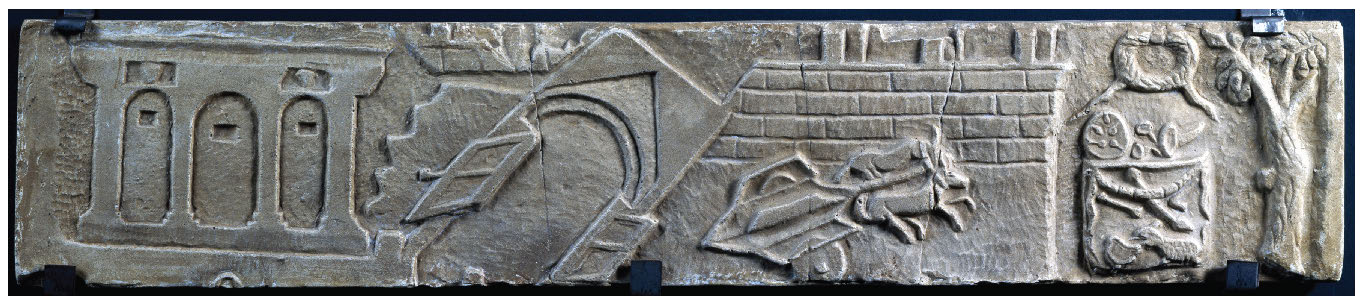 Figure 3.3 Earthquake relief from Pompeii: plaster copy of relief from nearby the House of L. Caecilius Iucundus (V.1.26). Museo della Civiltà Romana, Rome. NPL – DeA Picture Library / L. Pedicini / Bridgeman Images.
Iucundus was a banker and broker who kept an archive of 153 writing tablets documenting financial transactions, the latest of which dates to January, AD 62.28 A lararium documenting the serious effects of the earthquake may have been a way in which Iucundus’ family expressed thanks for survival (or acknowledged their loss) to the tutelary gods of house and family.29 How severe was it? The physical evidence of earthquake damage and repair, combined with the ancient descriptions, feed scientific estimates. A recent assessment assigns a magnitude of 5.1 +/– 0.3 on the Moment Magnitude Scale, and a IX on the Modified Mercalli Intensity Scale (to better describe local damage at Pompeii).30
Seismic activity continued between AD 62/63 and 79. Suetonius (Nero 20) and Tacitus (Annales 15.33–34, providing the date) record that in AD 64, after Nero debuted a vocal performance at the theater in Neapolis, the building collapsed—Suetonius says from an earthquake during the show. Perhaps in support, a dipinto (painted notice) from Pompeii on the right side of doorway at house IX.7.3 has been reconstructed as follows: pro salute Ner[onis] in terr[ae motu], “on behalf of Nero’s safety in the earthquake,” marking gratitude for Nero’s escape from death, for rebuilding funds, or for sponsoring entertainments despite the ban on gladiatorial contests at Pompeii.31 Sanctions had been imposed after a serious riot between local fans and those of the neighboring town of Nuceria in AD 59.32
Post-earthquake reconstruction is the theme of two inscriptions connected to local temples; one from the Isaeum at Pompeii (CIL 10.846), and one referring to the Temple of Mater Deum at Herculaneum in AD 76 (CIL 10.1406). The former reads:33
N(umerius) POPIDIUS N(umerii) F(ilius) CELSINUS / AEDEM ISIDIS TERRAE MOTU CONLAPSAM / A FUNDAMENTO P(ecunia) S(ua) RESTITUIT. HUNC DECURIONES OB LIBERALITATEM / CUM ESSET ANNORUM SEXS ORDINI SUO GRATIS ADLEGERUNT
Numerius Popidius Celsinus, son of Numerius, rebuilt the Temple of Isis, collapsed from the earthquake, from its foundations, with his own money. On account of his generosity, the town councilors enrolled him free of charge into their ranks, even though he was only six years old.
Young Numerius is a startling example of upward mobility in Roman society. His father (Numerius Popidius Ampliatus) was a freedperson—and so ineligible for public office—but the boy had full citizenship by means of his free birth. By paying for the restoration of the temple in his son’s name, the father was trying to ensure that his descendants would belong to Pompeii’s political elite. The “donation” also ensured that the boy’s adlection was “free” of the usual fee and exempted him from the minimum age restriction of 25 years old.
CIL 10.1406, in contrast, documents funding from the very top of the Roman social pyramid:34
IMP(erator) CAESAR VESPASIANUS AUG(ustus) PONTIF(ex) MAX(imus)/ TRIB(unicia) POT(estate) VII IMP(erator) XVII P(ater) P(atriae) CO(n)S(ul) VII DESIGN(atus) VIII/ TEMPLUM MATRIS DEUM TERRAE MOTU CONLAPSUM RESTITUIT
The Emperor Caesar Vespasianus Augustus, Chief Priest, with Tribunician Power for the 7th time and acclaimed Imperator for the 17th time, Father of the Fatherland, Consul for the 7th time (Elect for the 8th time), restored the Temple of the Mother of the Gods [Cybele], which had collapsed from the earthquake.
The specific honorifics and titles of Vespasian, especially the detail of being consul elect for the eighth time, date it to August–December of AD 76. The inscription is clear evidence of imperial stimulus funds to redevelop an area stricken by disaster, even more than a decade later. The earthquake impact—and recovery—was challenging and locally variable, just as the eruption would be.35
The Date of the Eruption
Four broad categories of evidence speak to the date of the Vesuvian eruption: literary; epigraphic and numismatic; archaeo-climatological; and archaeobotanical. This section considers each in turn.
Literary Evidence: Cassius Dio
First: the year of the eruption, since Pliny gives no hint. The year comes from Roman historian and senator Cassius Dio (writing in Capua and Rome, and publishing his work ca. AD 207–19), preserved in epitomized (paraphrased) form by the late 11th-c. Xiphilinus and early 12th-c. Zonaras.36 Section 66.20.3 tells us it happened in the first year of Titus’ reign (AD 79):37
(66.20.3) Ἐν μὲν τῇ Βρεττανίᾳ ταῦτ᾿ ἐγένετο, καὶ ἀπ αὐτῶν ὁ μὲν Τίτος αὐτοκράτωρ τὸ πεντεκαιδέκατον ἐπεκλήθη,
(66.20.3) “As a result of these events in Britain Titus received the title of imperator for the fifteenth time…”
Some of the “events in Britain” to which Dio refers coincide with the successful third campaign of the general Gnaeus Julius Agricola on the island, in summer AD 79 (Tacitus wrote his father-in-law’s biography: Ch. 1). But Dio (66.20.1–2) also conflates with that year an odd military mutiny and the circumnavigation of Britain, which actually happened in AD 83.38 Titus received his 15th conquering citation sometime after 8 September AD 79, but Dio is not writing in strict chronological order; he hops between events and locations of a given year within the annalist format.39
The epitome continues:
(66.21.1) Ἐν δὲ τῇ Καμπανίᾳ φοβερά τινα καὶ θαυμαστὰ συνηνέχθη· πῦρ γὰρ μέγα κατ᾿ αὐτὸ τὸ φθινόπωρον ἐξαπιναίως ἐξήφθη. τὸ γὰρ ὄρος τὸ Βέσβιον ἔστι μὲν πρὸς τῇ θαλάσσῃ κατὰ Νέαν πόλιν, ἔχει δὲ πυρὸς πηγὰς ἀφθόνους.
(66.21.1) In Campania remarkable and terrifying things happened, as a great blaze suddenly flared up at the very end of summer. For Mt. Vesuvius stands over Neapolis near the sea and it has inexhaustible founts of fire.
Note the reference in 21.1 to the eruption happening “at the very end of summer.” Xiphilinus’ Greek is: κατ᾽ αὐτὸ τὸ φθινόπωρον (αὐτὸ = “right at”). Zonaras writes: κατὰ τὸ φθινόπωρον ἀθρόον (ἀθρόον = “suddenly”); their agreement on κατὰ τὸ φθινόπωρον gives us Dio’s kernel. The word φθινόπωρον is interesting; it is a compound of φθιν, “the waning of,” or “the last part of,” from φθίω (“to waste, decay, wane”), and όπώρα, “hottest part of summer,” “late summer,” or “beginning of autumn,” when fruit ripens. όπώρα follows the early part of summer (θέρος), the warming-up growing season. Dio’s translators tend to be literal here: “right at the waning of summer.”40
In 1797, a bishop and scholar named Carlo Maria Rosini wrote a long treatise, Dissertatio Isagogica, or “Introductory Discourse,” about the exciting excavations happening at Herculaneum. Rosini had worked on the carbonized papyrus scrolls found there, the first volume of which he helped publish in 1793. He was incredulous that the eruption happened in August, because excavators had found braziers in the atria of houses, part of a carpet over a mosaic, and remains of chestnuts, figs, raisins, pinecones, and dates, which, to his experience, did not ripen or were not processed until at least October.41 Since archaeology at this date had not yet developed scientific stratigraphic principles, Rosini did not understand how archaeological deposits—even in the buried cities—were palimpsests.42
Rosini therefore considered Dio’s passage; four editions were available to him. Leunclavius’ 1592 ed. repeated Blancus’ (correct) 1551 editio princeps translation: sub Autumni tempus, “on the eve of autumn,” but added a marginal alternative that significantly changed the sense: autumni extremi tempore, “at the time of autumn’s end.”43 That option was retained in Leunclavius and Estienne’s Greek and Latin side-by-side 1606 ed., which Tillemont cited and approved in his 1693 Histoire des empereurs: ou même à la fin de l’autonne ... [ce ne peut pas avoir esté au mois d’aoust] “or even at the end of autumn ...[it cannot have been in August].”44 Following Leunclavius and Tillemont, then, Rosini dismissed Blancus and offered two new Latin translations: autumno iam ad exitum vergente and sub ipsum autumni exitum. The exitum in both of those improperly doubles the φθιν in φθινόπωρον, warping the translation to: “toward the (at the very) end of the end of summer (i.e., autumn).”45 In other words, the date shifted from the end of summer to the end of autumn. Rosini’s error has regularly resurfaced, even though in 1709 and 1763 Masson and Rezzonico had already refuted Leunclavius’ and Tillemont’s translations.46 Regardless, Dio did not offer a precise date, but a time of year. How were seasons defined in his day?
The temporality of seasons in the Roman world was not fixed; autumn was not simply between the autumnal equinox and winter solstice, evidence from the few centuries prior to Pliny and Dio’s time shows (Table 3.1).47 Dates for the start of autumn range from 24 July to 22 September because seasonal definitions depended on the diverse ways people kept track of time: positions of fixed stars, solar-day lengths, lunar cycles, astrological signs, deity-based seven-day weeks, eight-day agricultural market weeks (nundinae), and climate.48 Moreover, observation of the rising and setting of stars was hardly an “exact science”; it differed according to the latitude of observation, the century in which it was made, the quality of the horizon, etc. Elder Pliny, for instance, notes that the star Vindemiatrix (for him, Vindemitor) rose on 22 August in Rome and 5 September in Egypt.49 Two Greek sources, Geminus and Ptolemy, both cite Euctemon, a fifth-c. BC Athenian astronomer, based on when the star Arcturus became visible (which in Pliny’s day in Attica was 5 September, not Euctemon’s 13 September). Ptolemy also lists two equinoctial options (Hipparchus and Caesar). But most Latin sources had agricultural purposes, and so cite early–mid August for the commencement of autumn. Clearly “autumn” starting in August was common; Dio’s φθινόπωρον supports Pliny more than contradicts him. In any case, Dio wrote more than a century after the fact, and his actual text for this period survives for us only in late summaries, so his account is far more problematic than Pliny’s. It also mixes fancy with fact:50
|
Table 3.1 Dates for Autumn in ancient sources through the early third c. AD. |
||
|
Source |
Date |
Autumn Dates: |
|
Geminus |
second c. BC |
τὴν δὲ Παρθένον … κʹ. Ἀκτοῦρος Εὐκτήμονι ἐκφανής· μετοπώρου ἀρχή· “The sun traverses Virgo in thirty days ... On the 20th: Arcturus is visible according to Euctemon. Beginning of autumn.” (13 Sept.). |
|
Varro, De re rustica 1.28 |
37 BC |
autumnalis ex a.d. iii. id. Sextilis “(the beginning) of autumn on the third day before the Ides of Sextilis” (11 Aug.). |
|
Latium parapegma (calendar inscription, central Italy) |
8 BC–first c. AD |
[Autumnus ex IX K. August. in XI K. Nov. Dies LXXXXI] “[Autumn from the ninth day before the Kalends of august to the eleventh day before the Kalends of November, 91 days]” (24 Jul.–22 Oct.). |
|
Columella, De re rustica 11.2.57 |
ca. AD 60 |
Pridie idus Aug. Fidis occidit mane, et autumnus incipit “On the day before the Ides of August Lyra sets in the morning, and autumn begins” (12 Aug.). |
|
Pliny the Elder, HN 18.222, 271, 288–89, 309 |
AD 77 |
(222) quoniam inter solstitium et aequinoctiam autumni fidiculae occasus autumnum inchoat die XLVI (222) “since between the (summer) solstice and the autumnal equinox, the setting of Lyra on the 46th day begins autumn” (8 Aug.). (271) III id. [Aug.] fidicula occasu suo autumnum inchoat, ut is [Caesar] adnotavit, sed vera ratio id fieri invenit VI id. easdem (271) “On the third day before the Ides of August, Lyra by its setting begins autumn, as he (Caesar) noted, but a true reckoning has found it to happen on the sixth day before the Ides” (11 Aug. [Caesar], 8 Aug. [new calculation]). (288–89) solstitium VIII kal. Iul. (cf. 222) … Vinalia altera, quae aguntur a.d. XIV kal. Sept. Varro ea fidicula incipiente occidere mane determinat, quod vult initium autumni esse et hunc diem festum tempestatibus leniendis institutum: nunc fidiculam occidere a.d. VI id. Aug. servatur. (288–89) “The (summer) solstice is on the eighth day before the Kalends of July (cf. 222) ... The second Vinalia, which happens on the fourteenth before the Kalends of September, Varro determines by Lyra beginning to set in the morning, which he wishes to be the start of autumn (11 Aug.; see above), and a holiday established to mitigate the weather: now it is observed that Lyra sets on the sixth day before the Ides of August” (8 Aug.). (309) Sequitur ex divisione temporum autumnus a fidiculae occasu ad aequinoctium ac deinde vergiliarum occasum initiumque hiemis (309) “Autumn follows in the partition of seasons from the setting of Lyra to the equinox, and then to the setting of the Pleiades and the start of winter” (8 Aug.–6 Nov.). |
|
Claudius Ptolemy, Phaseis (Egyptian calendar) |
ca. AD 130–70 |
Μεσορί … ιθʹ. φθινοπώρου ἀρχή; Θώθ … ιηʹ. Εὐκτήμονι μετοπώρου ἀρχή; … ιθʹ. … Ἱππάρχῳ ... φθινοπώρου ἀρχή; … κʹ. Καίσαρι μετοπώρου ἀρχή; καʹ. ...Εὐδόξῳ μετόπωρον μέσον. “Mesore ... 19. Beginning of autumn.” (12 Aug.); “Thoth ... 18. ... According to Euctemon, the beginning of autumn.” (20 Sept.); “19. ... According to Hipparchus ... the beginning of autumn.” (21 Sept.); “20. According to Caesar the beginning of autumn.” (22 Sept.); “21. According to Eudoxus the middle of autumn.” (23 Sept.). |
(66.22.1) Τοιοῦτον μὲν τὸ Βέσβιόν ἐστι, καὶ ταῦτα ἐν αὐτῷ κατ᾿ ἔτος ὡς πλήθει γίγνεται. ἀλλὰ τὰ μὲν ἄλλα ὅσα ἐκείνῳ ἐν τῷ χρόνῳ συνηνέχθη, εἰ καὶ μεγάλα παρὰ τὸ καθεστηκὸς τοῖς ἀεὶ ὁρῶσιν αὐτὰ εἶναι ἔδοξε, σμικρὰ ἂν πρὸς τὰ τότε συμβάντα, καὶ τὰ πάντα ἐς ἓν συναχθέντα, νομισθείη.
(66.22.1) Such is Vesuvius, and these phenomena usually occur there every year. But all the other occurrences that had taken place there in the course of time, however notable they may have seemed to those who on each occasion observed them—because unusual—nevertheless would be regarded as trivial in comparison with what now happened, even if all had been combined into one.
(66.22.2) ἔσχε γὰρ οὕτως. ἄνδρες πολλοὶ καὶ μεγάλοι, πᾶσαν τὴν ἀνθρωπίνην φύσιν ὑπερβεβληκότες, οἷοι οἱ γίγαντες γράφονται, τοῦτο μὲν ἐν τῷ ὄρει τοῦτο δ᾿ ἐν τῇ περὶ αὐτὸ χώρᾳ ταῖς τε πόλεσι μεθ᾿ ἡμέραν καὶ νύκτωρ ἐν τῇ γῇ περινοστοῦντες καὶ ἐν τῷ ἀέρι διαφοιτῶντες ἐφαντάζοντο. (3) καὶ μετὰ τοῦτ᾿ αὐχμοί τε δεινοὶ καὶ σεισμοὶ ἐξαίφνης σφοδροὶ ἐγίγνοντο, ὥστε καὶ τὸ πεδίον ἐκεῖνο πᾶν ἀναβράττεσθαι καὶ τὰ ἄκρα ἀναπηδᾶν. ἠχαί τε αἱ μὲν ὑπόγειοι βρονταῖς ἐοικυῖαι αἱ δὲ καὶ ἐπίγειοι μυκηθμοῖς ὅμοιαι συνέβαινον, καὶ ἥ τε θάλασσα συνέβρεμε καὶ ὁ οὐρανὸς συνεπήχει. (4) κἀκ τούτου κτύπος τε ἐξαίσιος ἐξαπιναίως ὡς καὶ τῶν ὀρῶν συμπιπτόντων ἐξηκούσθη, καὶ ἀνέθορον πρῶτον μὲν λίθοι ὑπερμεγέθεις, ὥστε καὶ ἐς αὐτὰ τὰ ἄκρα ἐξικέσθαι, ἔπειτα πῦρ πολὺ καὶ καπνὸς ἄπλετος, ὥστε πάντα μὲν τὸν ἀέρα συσκιασθῆναι, πάντα δὲ τὸν ἥλιον συγκρυφθῆναι καθάπερ ἐκλελοιπότα.
(66.22.2) This was what happened. Numbers of huge men quite surpassing any human stature—such creatures, in fact, as the Giants are pictured to have been—appeared, now on the mountain, now in the surrounding country, and again in the cities, wandering over the earth day and night and also flitting through the air. (3) After this, fearful droughts and sudden and violent earthquakes occurred, so that the whole plain round about seethed and the summits leaped into the air. There were frequent rumblings, some of them subterranean, that resembled thunder, and some on the surface, that sounded like bellowing; the sea also joined in the roar and the sky re-echoed it. (4) Then suddenly a portentous crash was heard, as if the mountains were tumbling in ruins; and first huge stones were hurled aloft, rising as high as the very summits, then came a great quantity of fire and endless smoke, so that the whole atmosphere was obscured and the sun was entirely hidden, as if eclipsed.
(66.23.1) νύξ τε οὖν ἐξ ἡμέρας καὶ σκότος ἐκ φωτὸς ἐγένετο· καὶ ἐδόκουν οἱ μὲν τοὺς γίγαντας ἐπανίστασθαι (πολλὰ γὰρ καὶ τότε εἴδωλα αὐτῶν ἐν τῷ καπνῷ διεφαίνετο, καὶ προσέτι καὶ σαλπίγγων τις βοὴ ἠκούετο), οἱ δὲ καὶ ἐς χάος ἢ καὶ πῦρ τὸν κόσμον πάντα ἀναλίσκεσθαι. (2) καὶ διὰ ταῦτ᾿ ἔφυγον οἱ μὲν ἐκ τῶν οἰκιῶν ἐς τὰς ὁδοὺς οἱ δὲ ἔξωθεν εἴσω, ἔκ τε τῆς θαλάσσης ἐς τὴν γῆν καὶ ἐξ ἐκείνης ἐς τὴν θάλασσαν, οἷα τεταραγμένοι καὶ πᾶν τὸ ἀπὸ σφῶν ἀπὸν ἀσφαλέστερον τοῦ παρόντος ἡγούμενοι. (3) ταῦτά τε ἅμα ἐγίγνετο, καὶ τέφρα ἀμύθητος ἀνεφυσήθη καὶ τήν τε γῆν τήν τε θάλασσαν καὶ τὸν ἀέρα πάντα κατέσχε, καὶ πολλὰ μὲν καὶ ἄλλα, ὥς που καὶ ἔτυχε, καὶ ἀνθρώποις καὶ χώραις καὶ βοσκήμασιν ἐλυμήνατο, τοὺς δὲ δὴ ἰχθύας τά τε ὄρνεα πάντα διέφθειρε, καὶ προσέτι καὶ πόλεις δύο ὅλας, τό τε Ἑρκουλάνεον καὶ τοὺς Πομπηίους, ἐν θεάτρῳ τοῦ ὁμίλου αὐτῆς καθημένου, κατέχωσε. (4) τοσαύτη γὰρ ἡ πᾶσα κόνις ἐγένετο ὥστ᾿ ἀπ᾿ αὐτῆς ἦλθε μὲν καὶ ἐς Ἀφρικὴν καὶ ἐς Συρίαν καὶ ἐς Αἴγυπτον, ἦλθε δὲ καὶ ἐς τὴν Ῥώμην, καὶ τόν τε ἀέρα τὸν ὑπὲρ αὐτῆς ἐπλήρωσε καὶ τὸν ἥλιον ἐπεσκίασε. (5) καὶ συνέβη κἀνταῦθα δέος οὐ μικρὸν ἐπὶ πολλὰς ἡμέρας οὔτ᾿ εἰδόσι τοῖς ἀνθρώποις τὸ γεγονὸς οὔτ᾿ εἰκάσαι δυναμένοις, ἀλλ᾿ ἐνόμιζον καὶ ἐκεῖνοι πάντα ἄνω τε καὶ κάτω μεταστρέφεσθαι, καὶ τὸν μὲν ἥλιον ἐς τὴν γῆν ἀφανίζεσθαι, τὴν δὲ γῆν ἐς τὸν οὐρανὸν ἀνιέναι. ἡ μὲν οὖν τέφρα αὕτη οὐδὲν μέγα τότε κακὸν αὐτοὺς εἰργάσατο (ὕστερον γὰρ νόσον σφίσι λοιμώδη δεινὴν ἐνέβαλε).
(66.23.1) Thus day was turned into night and light into darkness. Some thought that the Giants were rising again in revolt (for at this time also many of their forms could be discerned in the smoke and, moreover, a sound like trumpets was heard), while others believed that the whole universe was being resolved into chaos or fire. (2) Therefore they fled, some from the houses into the streets, others from outside into the houses, now from the sea to the land and now from the land to the sea; for in their excitement they regarded any place where they were not was safer than where they were. (3) While this was going on, an inconceivable quantity of ashes was blown out, which covered both sea and land and filled all the air. It wrought much injury of various kinds, as chance befell, to men and countryside and cattle, and in particular it destroyed all fish and birds. Furthermore, it buried two entire cities, Herculaneum and Pompeii, the latter place while its populace was seated in the theatre. (4) Indeed, the amount of dust, taken all together, was so great that some of it reached Africa and Syria and Egypt, and it also reached Rome, filling the air overhead and darkening the sun. (5) There, too, no little fear was occasioned, that lasted for several days, since the people did not know and could not imagine what had happened but, like those close at hand, believed that the whole world was being turned upside down, that the sun was disappearing into the earth and that the earth was being lifted to the sky. These ashes, now, did people no great harm at the time, though later they brought a terrible pestilence upon them.
Dio dramatically moves through a set of portents, on a spectrum of mythical to real (22.2–3): giants wandering through earth and sky, drought, and, finally, pre-eruption tremors before the mountain explodes (22.4). His inversions of night and day and heaven and earth, and his simile of a solar eclipse may have come from Pliny (Ch. 5: Ep. 6.20.14–15, 18), as did perhaps his account of people’s psychological response to what seemed the end of the world (Chs 4–5: Ep. 6.16.15–16, 20.14–15, 17, 19). Dio could also have acquired such details from Tacitus’ version of events in the Historiae (which must have used Pliny), but Tacitus does not survive (Ch. 1).51 Dio’s gigantomachic narrative may also foreshadow, metaphorically, political decline: a “good” emperor (Titus) giving way to a “bad” one (Domitian).52
Dio does mention Herculaneum and Pompeii, which don’t appear in Pliny’s account; the passage (23.3) about Pompeians dying in the theater was an open question until the theater began to be excavated and no bodies were found.53 As in Seneca (6.27.1–2), “plague” followed in the wake of natural disaster, reflecting no doubt the injuries, trauma, lack of food and water, and disease spread by crowded refugees (See Ch. 5).
Literary Evidence: Pliny
On the question of the date in Pliny’s text, recent research has often been too quick to cite previous publications rather than return systematically to the manuscript evidence. Let’s outline the sequence of readings, based on the reconstruction of the manuscript tradition for the Epistulae (in Ch. 2, Table 2.1, Figures 2.2a–d); all data is in Online Resources. This shows why the manuscript and printed sources read the way they do. Then we can trace the errors in subsequent scholarship.
Our oldest and best manuscripts, going back to the ninth century on the 9-Book (α) side in M and U and to the fifth-century Π (10-book side, as represented by 04 and a) read: nono (or nonum) kal. Septembres. This follows the standard (abbreviated) Roman sequence of number, month-marker (kalends, nones, ides), and finally month-name that Pliny uses without fail.54 Full syntax would read (in U, Π): nono (“on the ninth,” ordinal number, ablative of time when) die ante (“day before,” usually left out) Kalendas (“Kalends” or “first of the month,” accusative plural feminine noun, after ante), Septembres (“of September,” accusative plural feminine adjective). An alternative and more popular stylistic construction (in M) began: ante diem (“day before,” usually left out) nonum (ordinal number, accusative by attraction to diem after ante).55 Given that “ninth” appears independently in the oldest examples of the 9- and 10-Book branches of the tradition—but in slightly different syntactical form—the numeric notation viiii (preferable to ix) is likely what Pliny wrote.56 The ninth day before the first of September was 24 August, since the Romans used inclusive counting, which reckoned both the first and last items of a sequence.
The γ and θ families, however, did not preserve this passage intact. We have no insight from θ whatsoever; it was used sparingly to correct gaps (and a few readings) in the γ text. If θ had offered a solution to offer this corrupted portion of γ texts, evidence might be present in f and q (it is not). As noted in Ch. 2, to determine a γ reading, one ought to compare these texts (Table 3.2):
|
Table 3.2 Readings for Ep. 6.16.4c in the γ family. |
||
|
γ Subfamily |
Manuscript |
Readings |
|
γ0 |
D |
nonum |
|
γ1 |
H , Burney 231 |
non, no̅n̅ ( = nonum) |
|
γ2 |
h |
nonū ( = nonum) |
|
γ3a |
p , corr. Burney 230 |
nonum, nonum |
|
γ3b ( 3) |
Modena Est.lat. 275 |
nonū ( = nonum) |
|
γ3b ( 2) |
A531 |
nonū ( = nonum) |
|
γ3b ( 1a) |
n , AI75 |
novum, novum |
One can see a consistently acceptable nonum reading: the month name was simply absent in the γ archetype. However, in subfamily γ3b1a there is something “new”: novum, which makes no syntactic sense (γ3b descendants Parma 2659 and Oxford Linc.Coll.77 also read novū, and were corrected to nonū). (Note: in Latin, u and v are the same letter, acting either as consonant or vowel.) The γ3b group took emendations from a γ2c text, whose descendants k and Oxford Auct.F.2.22 also read novum (Ch. 2). Other descendants of γ2c were Milan Ambros. H.54.sup. and ML47.34. Their readings have a middle consonant that is ambiguously n or u (nonū or novū) because, in their minuscule script, those letters consist of slightly articulated vertical strokes (m, n, i, and u all get confused).57 γ2c must have read likewise, and this ambiguity passed to γ3b1, so that in 1429, the scribe of n, Antonio di Mario, read novū (for nonū) from the text (or an annotation) in his exemplar, and expanded it to novum. The effects of this misread single letter became profound.
Such consequence is due to a member of the γ3b1 branch, R1472, written in October of 1453 (Ch. 2). Its original reading was nou, followed by an extended gap that acknowledged a problematic passage: nou can be an abbreviation for November, but by itself in front of KŁ (Kalendas), the phrase would have been misordered (see above) and confusing. This is probably why Valerius Sanvenantius, the scribe of R1472, when he made another copy of Pliny near simultaneously (Vatican lat.5881), decided to use non (the exemplar was likely ambiguous).
A descendant of R1472 was c°, the manuscript that added readings from Lorenzo Valla’s emended manuscript (Valla, Figure 2.2c). Like its parent, c° originally would have read nou followed by a blank space. Valla’s base manuscript, meanwhile, was a copy of ML47.34; its reading was likely no̅n̅, but given its exemplar’s ambiguity, the reading could have resembled no̅u̅.58 The corrector of c°, uncertain about the nou + extended gap inherited from R1472, probably inserted Valla’s reading (no̅n̅/no̅u̅) as an alternative, which seeped into subsequent copies. As a result, descendants of c° have either: no̅u̅ (c, q) or no̅n̅ (f). no̅n̅ would have meant nonum; no̅u̅ probably was meant to construe November. For two more decades, this subfamily of Pliny’s text was limited to Rome, but that changed in 1474.
In that year the second printed edition appeared (r), for which R1472 returned as its base-text; the r-editor heavily corrected R1472 from θ3, a source with both Valla and θ readings (Ch. 2, Figure 2.2c). At 6.16.4c the r-editor expanded nou (filling the extended gap) by adding -emƀ in an imitative hand, making: nouemƀ.59 This did not change the meaning so much as clarify it for the printer’s copy. The -emƀ was not original; I checked all 41 other instances in R1472 with an emb, mbr, bris, or bres letter sequence, and none of them (including Septembribus in Ep. 9.39.2) match the upright strokes and sharp nib of the sequence -emƀ in 6.16.4c.60
Furthermore, Sanvenantius’ colophon on fol. 116v of R1472, as well as his dating of a poem to Timoteo Maffei in 1454 on the occasion of Maffei being offered the archbishopric of Milan (he turned it down), show how the scribe wrote months: novemƀr and octoƀr, in each case with the slash through the b extending leftwards over the previous letter, unlike the forward slash in the R1472 correction.61 The editor of r was no accomplished Latinist; his printing of November Calenđ was formally wrong (it should be Kalendis Novembribus if he is trying to express 1 November), as was his use of Idibus Septembris in Ep. 9.39.2.62
Nevertheless, simply because it was in print, more widely distributable and seemingly authoritative, r’s mistake spread, appearing in every printed edition (save one: 04) for the next 34 years: 76, 78, 83, Laet., the Moretus and Roscius eds. of the 1490s (92b, 92a), 98, the 1500/01 pirated Beroaldus, and Cat., as well as manuscripts such as t and BL23777 (Table 2.1). At last, after Π was discovered in Paris, nono kal. Septembres appeared in 04 and a, and “November” seemed obsolete. Except—it survived. A few editors continued to use the 1506 Cat., or its 1510 and 1519 pirated editions (all have cal. Novembris). These were the 1552 Froben ed., and three printings of Ep. 6.16 as prefatory material for editions of Elder Pliny’s Natural History: Asulanus in 1536, Dalecampius in 1587, and Harduinus in 1685.63
In 1608, the jurist Polycarpo Palermo entered the picture with a three-book salvo in the ongoing battle between Verona and Como over which was the Elder’s native city (Chs 1–2).64 Palermo was curious about the day that Elder Pliny died, but inconsistencies in codices of the Epistulae troubled him: “in one of which is said that he died on the eighth day before the Kalends of September, in another indeed the third day before the Nones of November (3 Nov.), the day after, of course, he had sailed from Misenum.”65 Palermo was not interested in dating the start of the eruption, but rather Pliny’s death the following day (a fact that continues to be misunderstood). His first date for the eruption reckons unsurprisingly to 24 August, but the second omitted a digit; his Latin should have read IIII Non. for Pliny’s death on 2 November, making the eruption the day before on the Kalends, in line with the generally circulating 1474–1506 editions. Palermo must not have counted inclusively, but in trying to express 2 November as the day the Elder died, erroneously subtracted three from the Nones of November (the 5th).66 No known source reads IV Non. Nov. for the eruption date and therefore III Non. for Elder Pliny’s demise (even if one were found, it would belong to this corrupted sequence).
Gruterus noted the controversy in the 1611 ed. of the Epistulae, adding a comment that appeared in nearly all editions for the next two centuries: “To the person who has some leisure, let them investigate, but for me, in a hurry, I can hardly put it to paper.”67 Most who followed merely repeated their predecessors (a methodological lapse that continues to haunt this entire debate). Harduinus in his 1685 ed. printed Cal. Novemb. (following Cat.) and, in a note, cited Palermo’s VIII Cal. Septemb. and III Non. Novemb. as options for the eruption date (not Pliny’s death!). Masson’s 1709 biography did similar, but reminded readers that the eruption was a multiday event.68 Rezzonico took up Palermo’s challenge in 1763 with the most thorough survey on the question so far, sorting out the eruption date from the uncle’s death, and arguing for 24 August.69 But even he fell prey to absurdity, stating that Harduinus had listed I. Cal. Nov. as an option, when the I was simply a footnote mark (there can be no such date).70 Editions throughout the 17th–18th centuries recycled the same statements, capped by Rosini in 1797, who uncritically totted up what he saw as the available problematic alternatives to 24 August: VIII Kal. Sept. (the misreading of Palermo), γ variations with no month (VIIII kal., VIII kal. [not present in any known source], nonas kalendas from Escorialensis N.III.10), and the November “options” of Kal., I Cal., and III Non.71 None of these proved late enough for Rosini, who invented IX Kal. Decembris (23 November), which to his mind better matched the archaeological evidence being found at Herculaneum (see above and below). This set a precedent for keeping nonum and contriving one’s favored month. In the late 19th c., Ruggiero assessed the archaeological evidence between 24 August or Rosini’s 23 November and leaned slightly toward the latter, though not much debate followed. At the end of the 20th c., the question revived.72
Borgongino and Stefani escalated affairs in a long article that began with Rosini’s objections to the traditional August date. They listed all of Rosini’s alternatives, but chose yet another date first proposed in the 1920s: nonum kal. novembris (24 October), which was a doubling: keeping nonum while morphing its γ3b1 alternative novum into novembris.73 Osanna has adopted the same date to support his argument about an inscription found in October 2018 (see below), and it is now widely used (thanks to the Internet), though it has zero evidentiary basis.74 None of these studies have offered any new source arguments; they have just tried bending a corrupt date from the least reliable manuscript family into a shape that fits their preferred reading of the archaeological evidence. One should not ignore the fact that no philological editor of the Epistles in the last 500 years has supported any other date than 24 August.75
Here’s the point—not all textual sources have equal value. For the eruption date, the γ and θ branches had a gap, and one cannot horn a preferred month name into that lacuna as if Pliny could have written it. He didn’t. An eyewitness to the event, he wrote viiii Kal. Septembres, preserved separately in the two oldest and most reliable branches of the manuscript tradition. If that date is to be overturned, archaeologists and historians will need to do better than cast doubt by citing error-riddled studies. They will need to wield overwhelming physical evidence, with sufficient accuracy and precision, to prove Pliny wrong. Let’s examine the efforts so far.
Epigraphic and Numismatic Evidence
Inscriptions
In October 2018, Massimo Osanna, Director General of the Pompeii archaeological park, publicized a discovery from new excavations in Regio V, Insula 3, an area that had been partially cleared in the 18th century. Removing debris from the Casa del Giardino, “House of the Garden,” his team discovered a two-line charcoal graffito written near the top edge of pink stucco about 1.7 meters above the floor near the north end of the east wall of the atrium.76 It read: xvi k nov in olearia / proma sumserunt [...], “On the 16th day before the kalends of November (17 October), they took [something] in the olive-oil storerooms.”77 Presuming that the graffito belonged to AD 79, and was written a week before the disaster (arguing that charcoal was too fragile to last more than a year), Osanna adopted Borgongino and Stefani’s convenient 24 October eruption date, claiming “this spectacular find finally allows us to date, with confidence, the disaster.”78
However, charcoal inscriptions can last indefinitely, especially if protected from sun and rain, as this one was, underneath a roof (truss holes are visible in the wall above) that sloped toward the garden.79 Osanna later acknowledged that the inscription itself does not suggest a year, and shifted the October argument to one based on archaeological context.80
According to that revised argument, renovation on the house was in progress; the atrium was being re-floored and replastered; other parts of the house had already been refinished and repainted. The numerous graffiti and dipinti on the walls must have been made by workers, children, slaves, family members, and such an unkempt situation could have been endured for weeks or months, but not more than a year—how would the family have welcomed visitors? Indeed it appears the house was inhabited during the renovation work, as on the day of the eruption ten skeletons were found in room (8) just west of the atrium. Yet, as Rebecca Benefiel has shown, it was normal for graffiti and dipinti to be visible on the walls of active houses.81 In the Casa di Paquius Proculus (I.7.1) and Casa dei Quattro Stili (I.8.17,11), neither of which was under repair (the former contained seven victims), Benefiel found 69 and 34 examples, respectively, of wall scrawls. Moreover, “... ancient graffiti are not hidden or tucked away in dark corners ... rather, the majority ... occur in central spaces of the house.”82
Graffiti in Pompeian houses were not visually embarrassing, needing cover according to some modern pristine sensibility; they were the outcomes and evidence of an active domestic social life. Scholars have consistently underestimated how long a structure could have been under renovation, and how long residents would have “endured” inscribed walls. The Casa del Giardino inscription could have been made on any number of October seventeenths prior to the eruption. Neither its nature nor context proves it was written in AD 79, and no other known inscriptions from the buried sites can either.83 The Vesuvian archaeological sites preserve evidence from multiple years, and only irrefutable internal or stratigraphic evidence for a terminus post/ante quem can prove an inscription belongs to the year of their destruction.
Coinage
A perfectly unassailable piece of evidence would be any coin manufactured after 24 August and buried by Vesuvius in an undisturbed primary context. On 7 June 1974, a family of four victims (parents and two children) was discovered under staircase (30) in the Casa del Bracciale d’Oro, “House of the Golden Bracelet” at Pompeii (Ins. Occ. VI.17.42). The mother was carrying a heavy container of coins that included two silver denarii of Titus (who had only become emperor on 24 June 79), and so were freshly minted. Inventory no. IV.754 shows an obverse portrait of Titus and a reverse capricorn leaping over an orb. Initial reading of this coin’s reverse inscription gave: TR P VIIII IMP XV COS VII P VX, when Titus was imperator for the 15th time (see above).84 The argument seemed airtight—the eruption would have to post-date 8 September.
However, in 2013 the British Museum numismatist Richard Abdy reexamined the two coins and new high-resolution photographs (previously, just artist renderings had been published, as the coin is poorly preserved in the area of the reverse inscription).85 He showed that the latter part of the inscription actually read: IMP XIIII COS VII—the original cataloger had erred. The coin therefore dates to July-August 79 and cannot prove (but does not prevent) a post-August eruption date. Likewise for all other coins so far found.
Archaeo-Climatological Evidence
So much for written evidence. The following categories of archaeological data all relate to perceptions of what would have been climatologically likely either on 24 August or 24 October (i.e., they are exercises in probability). To frame the discussion, some contextual data for the Bay of Naples is necessary.
* * *
First, where was Pliny’s residence (Figures 1.5, 4.1)? On the north side of Misenum, the hills carried the Naples road and the Aqua Augusta (Serino Aqueduct); both funneled through the Crypta Neapolitana tunnel (the half-oval perforated by two “archways” to the right of Puteolis: Figure 1.6).86 The aqueduct ended in cisterns, one being the Piscina Mirabilis, a massive vaulted space with a capacity of 12,600 m3 that supplied the naval base.87 The road also curved around the Bay of Puteoli, passing through that major port city and past a string of coastal villas at Baiae. Finally, it crossed a moveable wooden bridge (pons ligneus) over the channel that separated a protected western, inner harbor (Lago di Miseno) from an eastern, outer harbor whose jaws, now a subsided line of pillars, would have permitted mooring on the interior.88 The Naples road (“B,” Figure 4.1) arrived at the town of Misenum along the south side of the outer harbor, where a theater, imperial shrine (Sacellum of the Augustales), and other structures have been identified.89 The town, with a population of perhaps 4,000, was tucked into the base of a steep promontory (Capo Miseno) to the south, home to a lighthouse and the ancient location of the Villa of Lucius Lucullus, famous for luxury.90
Another road (“A,” Figure 4.1) led west from Misenum along the southern beach of the peninsula, behind the inner harbor, and north-northwest past Monte di Procida through a pass toward Cumae.91 Pliny’s villa would have been located both near the double harbor (from which he twice calls up ships in Ep. 6.16.7, 9), and the town (whose residents join Younger Pliny and Plinia in flight, Ep. 6.20.7). It was adjacent to water, mare a tectis modico spatio (Ch. 5: Ep. 6.20.4), but close to the coastal road leading west that was the escape route, permitting them to observe the tsunami effect of the sea sucked away from the shore, opposite the collapse of the eruption cloud (Ep. 6.20.9). All these clues indicate a location on the peninsula south of the outer harbor.
To investigate further, Beth Wilkerson, Geographic Information Systems (GIS) expert at DePauw University, and I constructed a Digital Elevation Model (DEM) for the pre-eruption AD 79 Bay of Naples, based on the latest mapping efforts, and geophysical investigations into the shape and height of the volcano (see above), subsequent volcanic depositions, and coastal change; the result is Figure 1.5.92 This has permitted a viewshed analysis to address the question: where, in the area around Misenum, would it have not been possible to see the origin of the eruption cloud? In other words, in what areas, due to local topography, was Vesuvius not visible? The results offered four candidates: two on the N-NE sides of each harbor and another on the steep western side of Capo Miseno, none of which fit Pliny’s narratives (Figure 4.1). The fourth location was set in the southwest nook of the outer harbor, at Punta Sarparella, just behind Misenum’s theater, on the water but sheltered from open sea. Raised ground to the east precludes any view of Vesuvius unless one climbs up about 15 meters (about four flights of stairs) from just above sea level; Elder Pliny had to make such an ascent (Ep. 6.16.5) to observe the eruption. In 1879 Beloch described tiered substructures at this very location and proposed it for the admiral’s residence; its command of the ports (though not its view of Vesuvius) is perfect.93 The coordinates are: Lat. 40.788780 N, Long. 14.082710 E, the area appears undeveloped, and archaeological prospection may be worthwhile.
The location of Pomponianus’ villa at Stabiae, where Pliny died (Ch. 4: Ep. 6.16.12–15), is less ascertainable; the steep ridge (collina di Varano) above the shore was densely occupied with luxury residences. In addition, the shoreline was several hundred meters closer to the base of that ridge than it is today (Figures 1.5, 4.2; Ep. 6.16.12).94 Stabiae has been explored in three phases: the Bourbon period (1749–82), using tunnels; an open-air dig organized by a local school principal after World War II; and 21st-c. scientific studies.95 Several major complexes have been uncovered, including the Villa Arianna and Villa San Marco, but the AD 79 identities of the owners of these luxurious cliffside, sea-view residences are unknown. While direct evidence cannot pinpoint Pomponianus, there are clues. Ashfall patterns in phase EU2 graded sharply west to east (see Figure 3.5). About a meter had accumulated at the center of Stabiae by evening, but only ca. 25 cm had fallen near the western edge of the port—a nuisance, not a hazard, and the next phase of gray pumice was not as heavy there either. Pliny was able to bathe, dine, watch, and discuss the eruption (Ep. 6.16.12–13). Surely while on his ship he could tell that Pomponianus’ residence was less affected and perhaps safe. Overnight, however, additional accumulation and drifting threatened blockage of his room (Figure 3.7, Ch. 4: Ep. 6.16.14).96 By that time, the company had become more concerned about roofs collapsing from tremors than pumice (6.16.15). The whole coast was occupied; eighteen definite or possible maritime villas have been identified west from Stabiae to the tip of the Sorrentine peninsula (Punta Campanella) with its Temple of Athena (Figure 3.12).97 Accordingly, I place his villa hypothetically at a site identified with an imperial-era bathing complex above the harbor, 2–3 km west of the built cluster of Stabiae (Figure 4.2) at the Fontana Grande in Castellammare di Stabia.98 Those coordinates are: Lat. 40.690641N, Long. 14.474418E, and should be understood as quite approximate. The point is that Pomponianus could not have lived in the main town area.
* * *
Calendrical calculations are also in order. In 46 BC, Julius Caesar instituted a solar year for the Roman calendar in order to realign the formal dates of the equinoxes, and thereby, the seasons.99 His year, however, was slightly long, which eventually desynchronized agricultural cycles with liturgical holidays.100 Pope Gregory XIII, in order to realign the Julian calendar to the solar year, decreed that the day after 4 Oct. 1582 become 15 Oct.: ten days disappeared.101 When making sunrise/sunset calculations or climatic estimates for the Vesuvian eruption, because software extrapolates the Gregorian calendar backward, one needs Gregorian equivalents for the Julian calendar dates of 24 August/October; these are: 22 August/October.102
The NOAA Solar Calculator determines apparent sunrise and sunset anywhere, at any time.103 For his villa at ancient Misenum, where Elder Pliny starts his journey across the Bay of Naples, and for Stabiae, where he finishes it, see the coordinates above; Time Zone: Europe/Rome; Date: 22 August/October 79, Local time (not relevant). The results for 24 August are: sunrise at 5:17, sunset at 18:52 (Misenum); sunrise at 5:16, sunset at 18:50 (Stabiae). On 24 October: sunrise at 6:25, sunset at 17:15 (Misenum); sunrise at 6:23, sunset at 17:13 (Stabiae). 24 August had 813 minutes of daylight for Elder Pliny, and each hour was 67.75 minutes long; 24 October had 648 minutes and each hour lasted 54 minutes. In each case, “civil twilight” would have afforded an additional ca. 30 minutes of moderate visibility both before sunrise and after sunset.
Pliny (Ep. 6.16.4) informs us that his mother first noticed the eruption cloud hora fere septima.104 The Roman system for hours divided up daylight into 12 equal parts regardless of the time of year, so hours during the summer were longer than during the winter (at the vernal and autumnal equinoxes they equaled our 60 minutes). Roman hour markers designated when an hour expired, so hora fere septima meant: “nearly at the end of the seventh hour,” though it could also express more generally a period of time that ended at that point: “approximately the seventh hour.”105 The seventh hour on 24 August at Misenum would have been 12:04–13:11; on 24 October, 11:49–12:43; in other words, about 13:00 (1 p.m.)106 At that hour, the average seasonal air temperatures at Pozzuoli (5 km N along the coast) are 28°C / 82°F on 24 August, and 21°C / 69°F on 24 October, and respectively for water: 26°C / 78°F and 21°C / 70°F.107 Now let’s examine the arguments.
Bathing
Shortly after the seventh hour on the first day, the barefoot Elder Pliny takes a sunbath and then a cold bath (see Ch. 4; either in the sea next to the villa, or an artificial pool) before he observes the eruption cloud. In Ep. 3.5.10–11 (Ch. 1), Younger Pliny describes his uncle’s specific summer customs (aestate): he tended to sunbathe (iacebat in sole) and then afterward (post solem) take a cold, i.e., unheated, water bath (frigida lavabatur). The imperfect tense in both verbs demonstrates habituality (Elder Pliny liked his regimen). In Ep. 6.16.4–5, Younger Pliny twice uses the verb root utor to contrast the unexpected eruption cloud (inusitata) with the constancy of his uncle’s habits (usus ille sole, mox frigida). This is part of Pliny’s project to cast the Elder as a bulwark of calm, controlled virtue in the face of chaotic danger.
As noted above, average air and water temperatures for sunbathing and unheated swimming are more favorable in August, but do not preclude October, though the latter is definitely outside any definition of “summer.” Given that Elder Pliny did not favor exercise (Ep. 3.5.16) and was not in good health (Ep. 6.16.13, 19), it is unlikely that his bathing was rigorous or lengthy, but rather a refreshing, pleasurable custom—a brisk wash after toasting under the sun.108 Such evidence is too circumstantial and inconclusive to favor any particular eruption date.109
Daylight for the Journey
After Plinia serves notice of the eruption cloud about 13:00, at least ten things occur before the Elder sets sail (Ep. 6.16.5–9; Ch. 4; Figure 1.5): sunbath, unheated bath, lunch, study-time, request for sandals, climb to observe the cloud, orders to ready a light ship, reception of message requesting rescue from Rectina, change of orders to add and fit out multiple large ships, and boarding. It seems unlikely that all this could have taken place in less than two hours.110 A 15:00 departure on 24 August would have left three hours and fifty minutes of full daylight to sail across the Bay toward Rectina’s villa, be prevented from landing, and then veer south to Pomponianus’ villa at Stabiae.
On 24 October that window is significantly reduced to two hours and fifteen minutes. We do not know the location of Rectina’s villa; it has broadly been thought to be along the coast between Herculaneum and Oplontis (see Chs 1, 4 and below, eruption sequence). Pliny explains there was no escape except by sea (Ep. 6.16.8: nec ulla nisi navibus fuga), but he may assume rescuing not just people but also household goods (Ep. 6.16.12, 6.20.8). Terraced maritime villas with their own harbors were ubiquitous on the Bay, making the entire coastline seem urbanized, per Strabo (5.4.8):111
μέχρι μὲν δεῦρο ἔχει τέλος ὁ κόλπος ὁ Kρατὴρ προσαγορευόμενος, ἀφοριζόμενος δυσὶν ἀκρωτηρίοις βλέπουσι πρὸς μεσημβρίαν, τῷ τε Μισηνῷ καὶ τῷ Ἀθηναίῳ. ἅπας δ᾽ ἐστὶ κατεσκευασμένος τοῦτο μὲν ταῖς πόλεσιν, ἃς ἔφαμεν, τοῦτο δὲ ταῖς οἰκοδομίαις καὶ φυτείαις, αἳ μεταξὺ συνεχεῖς οὖσαι μιᾶς πόλεως ὄψιν παρέχονται.
Here, then, the gulf called the “Crater” comes to an end, marked off by two capes facing south: Misenum and Athenaeum. And the whole is furnished, partly by the cities which I’ve just mentioned, and partly by residences and plantations, which, being crammed together, offer the appearance of a single city.
A sailing route from Misenum to Stabiae that grazes the coast just south of modern Leopardi requires a voyage of at least 37 km (Figure 1.5).
The top speed of ancient ships, whether rowed or driven before the wind, has been much debated. Casson argued for 5–6 knots (9–11 km/hr) with favorable winds (based on literary accounts of long-distance journeys); others provide accounts of short- and medium-distance trireme trips at 9 knots (16.7 km/hr) and postulate a top sprint speed (sustainable for only 5–10 minutes) of 11.5 knots (21.3 km/hr)—for larger pentaconters, 9.5 knots (17.6 km/hr).112 Both surface and high-altitude winds ran strong toward the SE-SSE that day; we know this from the fallout pattern of ash and because the Elder Pliny’s own ship later got stuck at Stabiae in the SE corner of the Bay (Ep. 6.16.7, 9, 12, 17; more below).113 Carro’s estimate of an urgent speed of 6–8 knots (11.1–14.8 km/hr) seems appropriate either for a Liburnian or a quadrireme; at that rate plus a fifteen-minute pause off the Vesuvian coast (Ep. 6.16.11), it would have taken Pliny 2:45–3:35 to reach Stabiae.114 He could have arrived between 17:45–18:35, before sundown (18:50) on 24 August, but after sunset (17:13) on 24 October.
It should be noted that Pliny did not have to arrive at Stabiae before dusk; twilight would have offered at least another half-hour of decent visibility (see above), and experienced sailors in the Bay probably recognized lighthouse markers and/or patterns of buildings lit by torches or lamps.115 In fact, there is a chance that Pliny witnessed the pyroclastic density current (EU2/3pf PDC; see below) that engulfed Herculaneum near sunset. On this basis, an August date provides much more time for Pliny’s expedition; the timing is extremely tight for October.
Wind Direction
In 2007, Rolandi led a team that examined seasonal high-altitude wind patterns that govern volcanic fallout. During the eruption, debris came down in a SE-SSE direction, ca. 140–155°.116 They concluded that “... the southeast dispersion for the 25 ka BP and for the AD 79 eruptions indicate a southeast Autumn-Winter component, which ... poses a serious problem for the date of 24th August ...”117 Their data was necessarily proxy in time and space (modern, measured at Rome and Brindisi). Problematically, however, it was broadly categorized by month and “season” (rather than week or day). They did not disclose sufficient data resolution to show whether the last week in August shows a pattern closer to the rest of summer, or to September, when winds shift from a westerly, “summer” direction to an easterly “fall/winter” direction. In addition, Rolandi’s own graphs (Figures 2, 4) make clear that high-level winds toward 140–55° (SE-SSE) are rare at all times of year (a chance of only ca. 1–8%). Furthermore, the one datable historical eruption seasonally closest to the 24 October date (6 November 472) has an ENE dispersal pattern.118 Clearly, the wind direction that day in AD 79 was unusual regardless of season, and provides no clarification to whether the eruption happened in late August or late October.
Braziers and Carpets
Rosini remarked in 1797: Pompeiis enim pavimentum musivi operis tapeto stratum fuisse deprehendimus, & in domus cuiusdam atrio extincti ignis, quo circumstantes calefieri oportuit, reliquias agnovimus. “At Pompeii we discovered that a pavement in mosaic had been covered by a carpet, and in the atrium of a certain house we discerned the remains of a burnt-out fire, by which the surrounding (rooms) must have been heated.”119 He and others have since argued that these finds prove cold weather (not August). A century later, Ruggiero responded:120
As for carpets, for example, in the hundreds of rooms excavated under my eyes in Pompeii I have not found a trace, except for one rush mat, whose remains I painstakingly conserved; one couldn’t discern whether it was large or small, or whether it was flat or rolled-up on the floor. The braziers collected between Herculaneum and Pompeii don’t add up to more than fifty, a small number compared to the number of houses. And because they are often found with cooking lids or other cooking pots next to or on top of them, one can surmise with confidence that they were used indiscriminately for cooking and for heating.
Rarely more than one or two braziers have been found per house, and most are found in ventilated court areas, where they would have been used principally for cooking and secondarily could provide heat on the coldest days.121 Average low temperatures at Pompeii range from 20–25°C / 68–77°F (average 22°C / 72°F) on 22 August and 12–19.5°C / 54–67°F (average 16°C / 60°F) on 22 October—when a few blankets would be sufficient (recall that Rosini was arguing for 23 November).122 Multiuse braziers cannot prove an October eruption.
Clothing
Cold weather has also been invoked to explain certain textile finds. In the Casa della Gemma (Ins. Or. I.1a) at Herculaneum, an oak cradle was discovered, with remains of an infant skeleton on fragments of mattress stuffing and fabric. Microscopy and x-ray analysis proved the fabric to be common wool, which Borgongino and Stefani argued would have been “out of place” on an August night.123 Such judgment is questionable, given the house’s position high on a marine terrace with brisk wind from the sea. Neither do we know whether the neonate was wrapped in the blanket, or placed upon it over the mattress padding.
Rosini did not comment about clothing, the nature of which began to be recognized in February 1863, when Fiorelli perfected a technique for pouring plaster into the cavities left by bodies, and creating casts (calchi) of the missing organic remains.124 None of the first four victims found wore heavy garments; in fact, in a 2003 count, of the 41 samples of fabric identified from Vesuvian sites, only 19.5% were wool; the rest were plant-based.125 Alfano and Friedlaender in 1929 first suggested victims’ heavy clothing meant a late date (24 October); a fur cap found in 1984 on a Herculaneum victim stoked the argument.126 Woolen garments might seem unseasonable for August, given that the recent average high temperature in Pompeii ranges between 27–33.5°C / 81–92°F (average 30°C / 86°F) on 22 August, though on 22 October it is hardly cold: 18–25.5°C / 64–78°F (average 22°C / 72°F).127 Blocking of the sun by an eruption cloud may have dropped temperatures ca. 3–4°C/6–8°F at eye level; there were also strong N-NW winds.128
But air temperature was probably not why any Roman wore wool—even heavy wool—that day. As the eruption progressed, fallout hit the Bay settlements at increasingly scorching temperatures (see below, also Figure 3.4a-c). At Pompeii, in Phase EU2f of the eruption, from about 13:00–19/20:00 on the first day, falling chunks measured ca. 120–140°C (248–284°F), enough to cause burns on bare skin within a few seconds (the human heat pain threshold on exposed skin is about 44°C [111°F]).129 Overnight Phase EU3 fallout was still hotter, ca. 180–220°C (356–428°F), burning exposed skin in less than a second. Heavy wool clothing, however, would have offered complete thermal protection from this fallout. Wool has flame-resistant properties: ignition temperature of 570–600°C (well above fallout temperature), low heat of combustion, and self-extinguishing properties.130
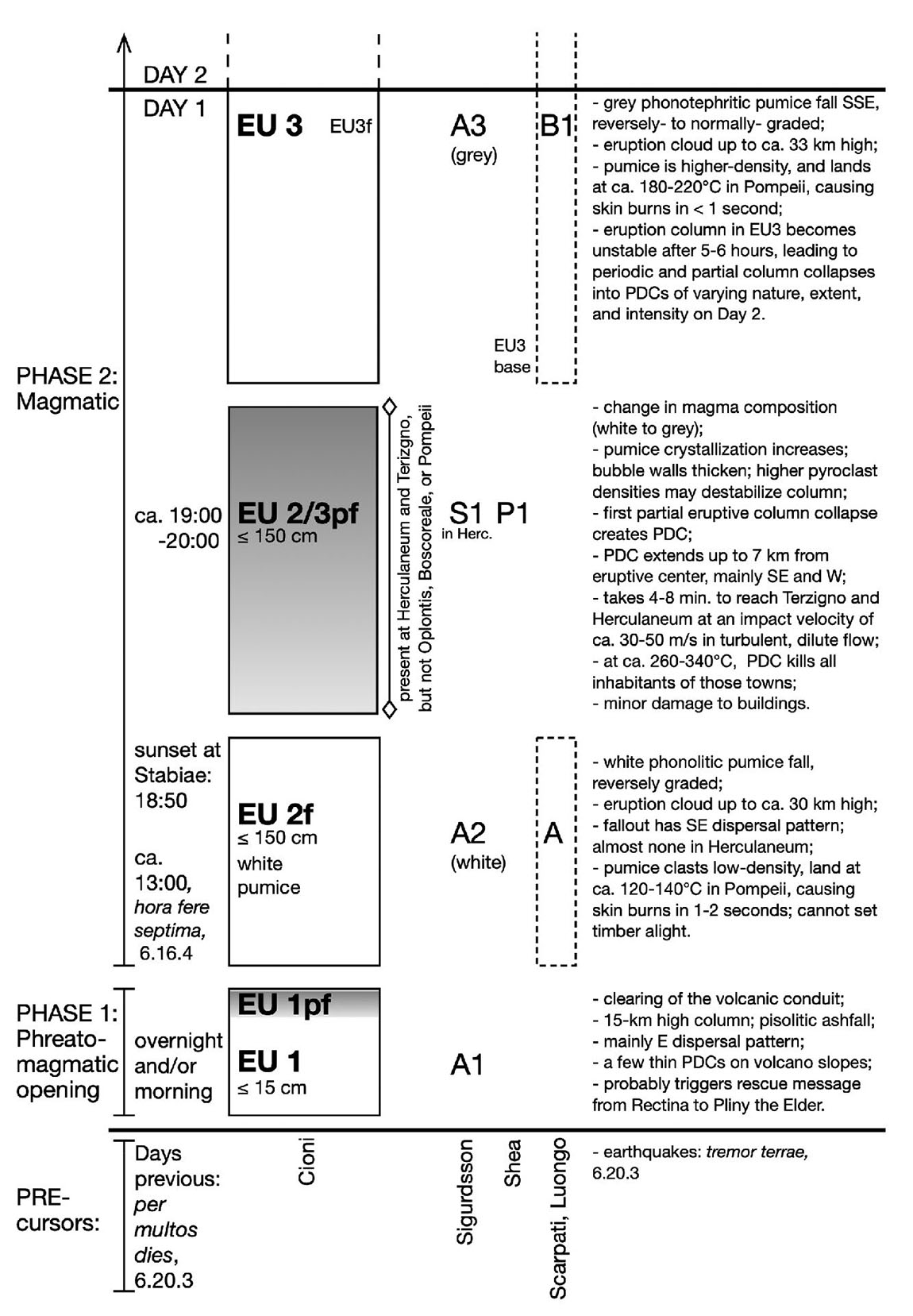 Diagram of the AD 79 Somma-Vesuvius eruption sequence. Read sequence from bottom to top. Height of layers is not to scale or proportional to time. EU = Eruption Unit; f = fallout; pf = pyroclastic flow; A = ash fallout; S = pyroclastic surge; F = pyroclastic flow; P = pyroclastic density current (PDC). Unshaded column sections: ash and pumice fall; Shaded column sections: PDC.
Figure 3.4(a) Day 1.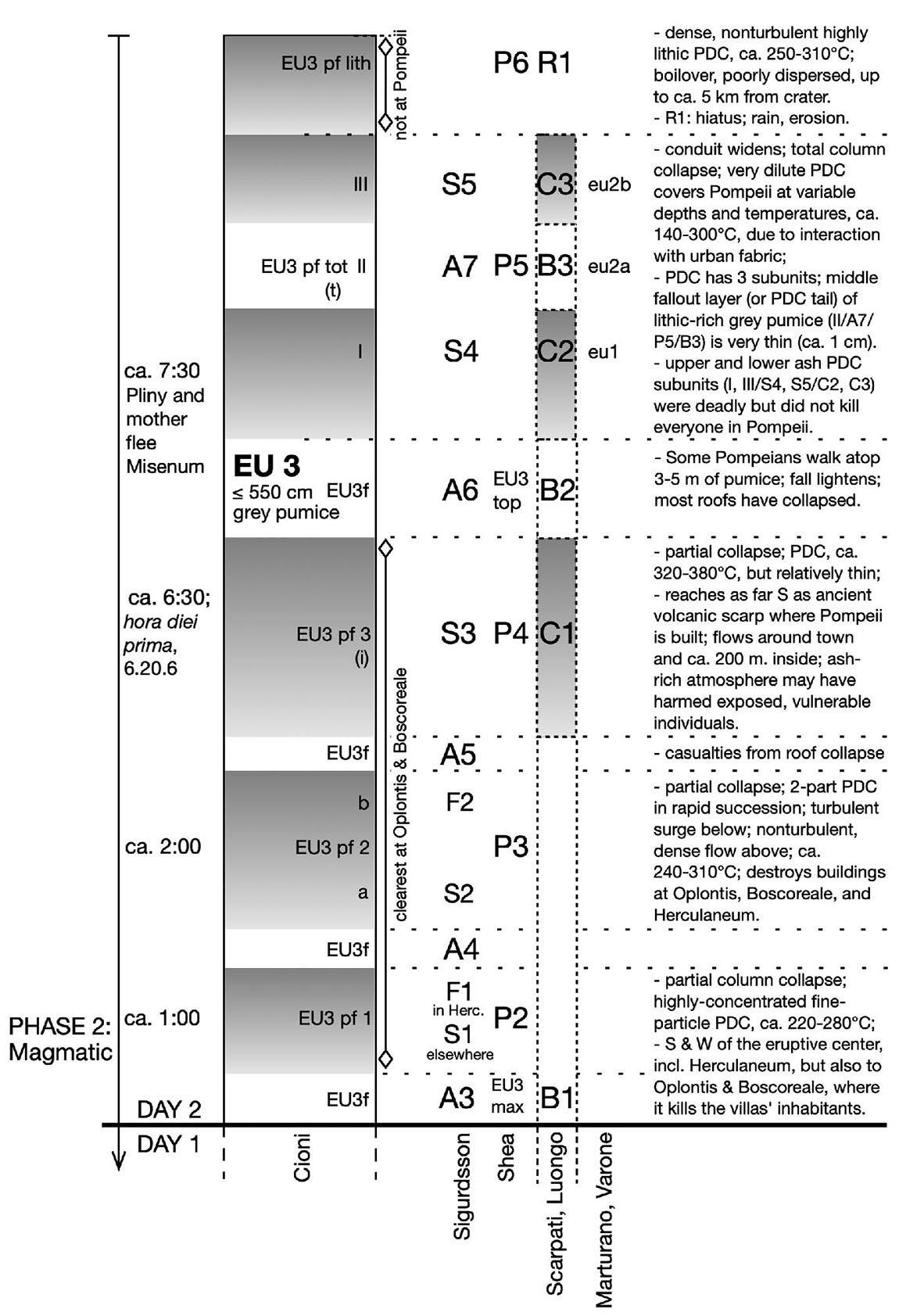 Figure 3.4(b) Day 2, overnight to early morning.
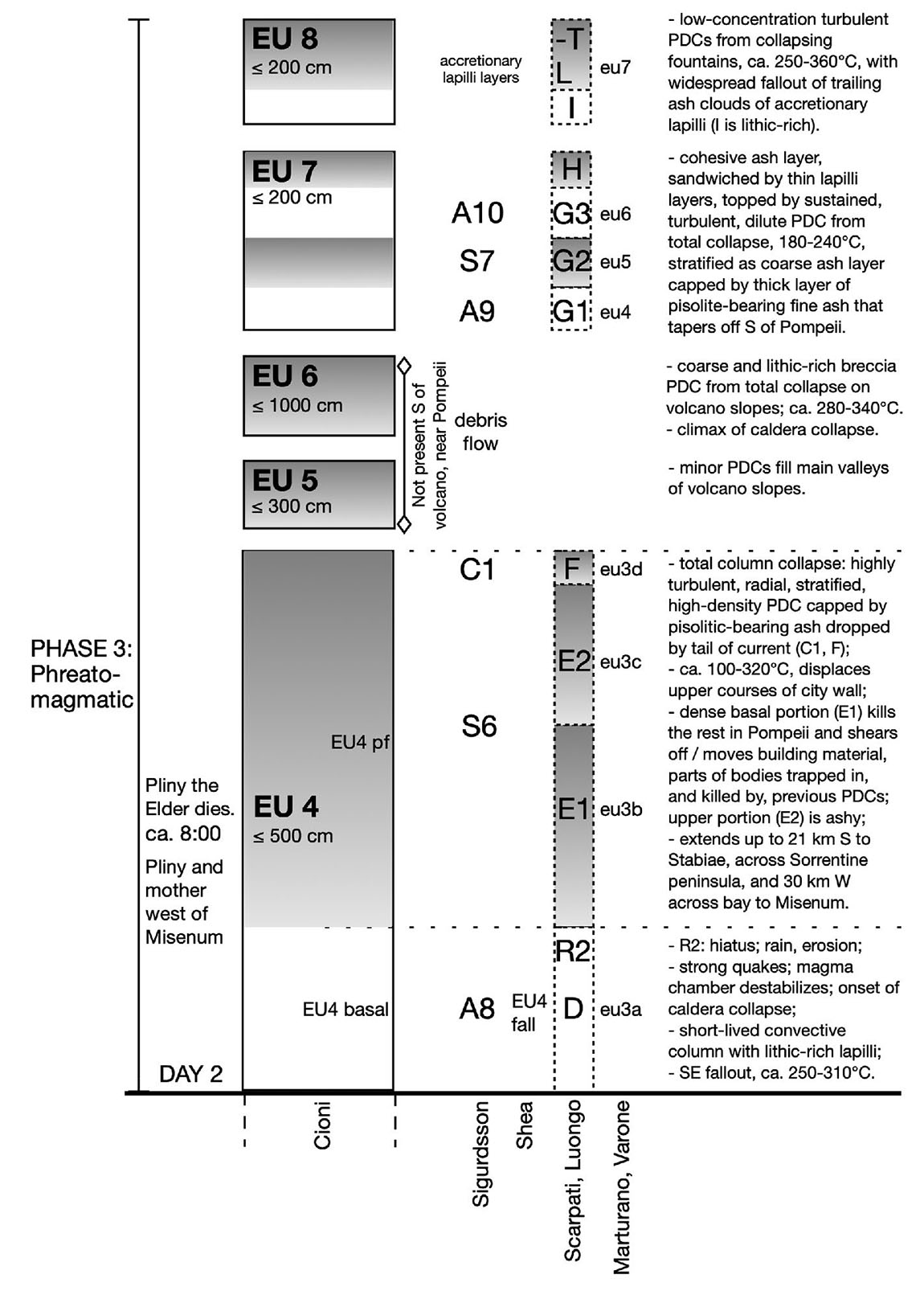 Figure 3.4(c) Day 2, the rest of the day.
Romans knew about wool’s thermal qualities; cento was the term for wool blanket or quilt, and wool blankets belonged to standard fire-fighting equipment in the first century AD.131 Pliny the Elder himself says (HN 8.192): Lanae et per se coactae vestem faciunt et, si addatur acetum, etiam ferro resistunt, immo vero etiam ignibus novissimo sui purgamento. “And wool pressed into itself (i.e., felted) makes clothing and, if vinegar is added, it can even resist iron, no, to be sure, even fire—the latest cleaning method for it.”132 Using the thermal protection and padding of wool clothing to protect from hot objects pelting down from the sky would have been common sense to residents of the Bay of Naples; Elder Pliny and his companions in fact used fabric to armor themselves at the last hour (Ep. 6.16.16). Finds of such clothing do not support either date.
* * *
At present, archaeological evidence and proxy climatological data do not provide the certainty or specificity to decide between August and October/November. However, much progress has taken place over the last sixty years in the recovery, identification, and understanding of animal and plant remains from Vesuvian sites. It is to that evidence that we now turn.
Archaeobotanical Evidence
The presence of carbonized organic remains inspired Rosini to consider that the eruption happened in November:133
...castaneas, caricas, uvamque passam, qui sane fructus in nostra Campania non ante mensem Octobrem & colliguntur, & exsiccantur…Etenim…pinus, earumque nucleos, quae non ante Novembris idus apud nos colligi mos est, nec ex antecedenti anno nuclei in pinu inclusi, quin putrescant, servari commode queunt: praeterea dactilos, qui non ante brumam ex Oriente huc adveniunt.
... chestnuts, figs, and raisins, which clearly ripen in our Campania not prior to the month of October, and are collected and dried ... and even ... pinecones with their pine nuts, which it is not our custom to collect before 13 November, nor can the pine nuts easily be preserved in the pinecones from the previous year, lest they spoil: moreover, dates, which do not arrive here from the East before winter.
Ruggiero refuted each point in 1879, and addressed the archaeobotanical evidence generally and dispassionately, laying groundwork for the revolution of modern scientific investigations that really began with Jashemski’s work in the 1960s, including taking root casts and doing seed, pollen, microfloral, and microfaunal analyses.134 Preserved or long-lasting foods left over from a previous harvest are to be expected at an archaeological site destroyed completely and suddenly (a palimpsest: many years’ residue get captured at once). In the last three decades, techniques for plant and animal remains have evolved tremendously, but still no scientific consensus fixes late August or October.
Fish Sauce
The key flavoring ingredient in Roman cooking was fish sauce (garum, liquamen), the production and sale of which has been identified at Pompeii.135 Fish sauce is made by soaking, heavily salting, sieving, mixing, and fermenting fish, seafood, and herbs/spices; the whole process takes one to three months. Recent analyses have treated residues found in dolia and amphorae (large storage jars and transport vessels) at the Officina del Garum (I.12.8) at Pompeii. One amphora contained a single species: the common picarel (spicara smaris).136 The fish were nearly all young females, about a year old; bone growth indicated they were killed when waters were warmest (summer or start of autumn) as the fish shoaled in great numbers just off Sorrento. The articulated nature of the skeletons demonstrates that the eruption hit as they were being brined whole, before any filtering or stirring phases, only a week (or two) after having been caught. Accordingly, “August 24 ... coincides perfectly with the results obtained by archeozoological analyses,” but an October date is also possible if they “were fished at the end of the summer and left to brine for a month.”137
Grape Harvest
Widespread evidence for the grape harvest (vendemmia in Italian) in progress or complete would disprove an August eruption. According to ancient sources, the vinalia rustica festival on 19 August ritually opened the harvest season to ensure good weather for ripening, and the main harvest took place between 24 September and 11 November.138 There was no single harvest phase; different varieties were picked at different times for different products, such as the acidic omphacium, “verjuice,” squeezed early from unripe grapes to use for cooking or perfume. Elder Pliny noted (HN 18.315): Vindemiam antiqui numquam existimavere maturam ante aequinoctiam; iam passim rapi cerno. “The ancients never judged the grape-harvest ready before the (autumnal) equinox, but now I notice it is hurried along everywhere.”139
Remains have survived: a few carbonized grapes, grape seeds, and raisins (which, like all dried fruit, cannot date the eruption); also vinacce, “pomace, marc”—stems, pulp, skins, pips—about fifteen kilos found at Herculaneum in 1761, and lesser amounts elsewhere.140 Vinacce was added to water made a cheap drink for laborers; it was also stored for fodder or fertilizer.141 After treading and pressing, the must (thick grape juice) was directed into jars or tanks for settling and initial fermentation over several days (up to a week). Vinacce was filtered off and re-pressed, and the must transferred into large sunken dolia for secondary fermentation and aging. The dolia were then covered and sealed with a double lid system. The following spring, most of the wine was transferred to amphorae for further aging, more flexible storage, transport, and sale.
In some cases, wine was aged longer in dolia; an amphora dipinto from Pompeii (VII.2.11), dated to AD 65, says: “... decanted on 13 August after two years.”142 The Ides of August seem to have marked a common contractual period; a wax tablet from Herculaneum preserves a contract in which a certain Theophilus grants Severus storage for his share of their formerly joint grape harvest until the following 13 August, when Severus was obliged to remove his wine (bottled in amphorae, no doubt) and all other property from the premises:143
Wax tablet from Herculaneum (Tabulae Herculanenses 4).
· C. Velleio Paterculo M. Manilio Vopisco cos.
· IIII non(as) Sept(embres)
· Q. Iunius Theophilus scripsi me repromisisse A. Tetteio Severo
· ex fundo Blandiano fructus omnes suae partis percipere
· perfruui evehi exportari et vinis stabulum in id[us] Aug. pri[m(as)]
· et signa salva praestari et res et mancipia et pecora su[a]
· omnia inde evehere exportare educere auctionari uti
· liceat. (vac.) Ea omnia, q(uae) s(upra) s(cripta) s(unt), fieri praestari stipul[atus]
· est A. Tetteius Severus, spo[po]ondi Q. Iunius T<h>eophilus.
· Actum Hercul[ani].
While C. Velleius Paterculus and M. Manilius Vopiscus are consuls, on the 4th day before the Nones of September (2 September, AD 60).
I, Quintus Junius Theophilus, stipulate that I have promised A. Tetteius Severus that he can take his whole share of the hanging fruit from the Blandianus property, and fully use the wine cellar, (its wine) to be evacuated and taken away by the next Ides of August (Aug. 13th of the following year), and as the seals (on this document) are vouched as valid it is permitted (for him) to carry off, take away, and lead out all his implements, slaves, and cattle, or for them to be auctioned (on the spot). All these things, which are written above, A. Tetteius Severus has promised to be responsible for having done. I, Quintus Junius Theophilus, have pledged (it). Enacted at Herculaneum.
Two menologia rustica, inscribed first-century AD public farmer’s almanacs, list monthly agricultural activities, including for September: dolia picantur, “the dolia are coated with pitch.”144 In preparation for the new harvest, storage and fermentation vessels needed cleaning, repair, and waterproofing.145
Some wine dolia were found closed at the Pisanella villa, and all 18 from the Villa Regina at Boscoreale were sealed (Fig. 3.6).146 They are the only villa sites known so far with substantial intact wine storage (they rank among the best excavated and best documented). Because all Villa Regina dolia were undisturbed, Borgongino and Stefani argue that harvest and processing must have been complete—if the wine in the dolia was aging for more than a year, where would the owners have put the new wine? Yet we do not know that all dolia in all farms were cleaned out by mid-August. The epigraphic evidence shows that wine was still being decanted from dolia at that time; might some owners have done it a week or so later? It seems perilous to insist on strict calendrical uniformity of practice in ancient agriculture; there was still a month or more—enough time, according to Columella—to prepare dolia for the new pressing.147
At any rate, as Zehnacker notes, if the eruption had occurred during the harvest, evidence of grapes at presses and in tanks at villae rusticae should be abundant and everywhere, not scanty and sporadic; only two of the 33 sufficiently documented sites in the Vesuvian area show possible evidence for vinification: stems and seeds (vinacce) at Oplontis Villa B and Terzigno Villa 2—this in an area where perhaps half of all rural villas produced wine.148 If the harvest had been complete, moreover, dolia throughout the area should have been full and sealed; most are apparently empty or contained other, dry foodstuffs.149 What better fits the evidence is a time when some dolia at villas still held wine (either for further aging or because decanting had not yet occurred—awaiting transport, a good price, etc.), but most had been emptied and were being prepared for the next harvest, the preliminaries of which had begun, including omphacium production.
At Oplontis B, chemical analysis of organic residues from eleven empty wine amphorae (of more than 1200 found) has shown they were waiting to be refilled; a pot of resin and stoves for softening were used to patch and prepare containers.150 Oplontis B was a commercial bottling, distribution, and export center, and “the late summer/early autumn may have been the time when wine-making facilities, such as the nearby Villa Regina, cleared their stock to make room for the new vintage. Perhaps the eruption has preserved evidence of a seasonal trade in the prior year’s vintage that occurred here before the new harvest.”151 In other words: August is more likely. That said, we await results of a project to analyze the latest growth rings in samples of vines and other wood.152
Olive Harvest
Olives grow to nearly their full length by late August; their color is a function of maturation. Green olives for consumption and preservation (in oil or brine), edible for a year, are picked in late September or early October in Campania. Black olives for pressing oil are harvested from November through December.153 Neither a 24 August nor 24 October date should show any substantial evidence for large-scale olive-processing, and such is the case. A few whole or nearly whole carbonized examples have been recovered from Pompeii (II.5) and the Villa Regina at Boscoreale—contexts that suggest unripe fruits falling haphazardly from trees.154 Preserved in glass jars, clay amphorae, and dolia, whole olives have been found at Pompeii, Herculaneum, and the Villa of M. Cellius Africanus.155
Pomegranates
Also found at Oplontis B, in Room 42, was a remarkable find of some 1000 kg. of pomegranates stacked across eight piles, in four layers alternating with hay matting.156 Ripe pomegranates are normally harvested from late September through October; they must be handled carefully, have a limited shelf life, are sensitive to air, temperature, and pressure, and should be set in packing material without touching. Despite these constraints, pomegranates were transported even to Roman army camps in Switzerland with other “exotic” foods, stored in pitched wooden barrels.157 The Oplontis pomegranates were small—unripe, with stems twisted to impede maturation. They were probably accumulated for industrial purposes: medicine or leather processing—not for eating.158 The skins of unripe pomegranates were used for tanning and dyeing leather (when they are most rich in tannin), as Elder Pliny notes (HN 13.113, 23.107).159 Accordingly, the pomegranate finds cannot decide between August or October.
Trees, Fruit, Vegetables, Seeds, Nuts, Grasses, and Pollen
Dried and preserved fruits are designed to last by definition and so cannot point to any particular eruption date; neither can their pits—or seeds or nuts. Edible or stale, preservable foodstuffs were not periodically and thoroughly cleaned out of all human contexts such that examples from previous seasons cannot appear in the archaeological record of sites destroyed on such short notice. For their part, trees and vegetables typically have long growing seasons and may not provide chronological precision. Grasses can be dried and last for years. Nevertheless, scholars have examined (and disagreed on): pinecones and pine nuts (starting with Rosini), chestnuts, walnuts, hazelnuts, figs, carobs, peaches, plums, pears, sorb, dates, laurel and plane trees, hemp, grasses, and herbs.160 Clarity and certainty have proved elusive; future techniques and excavations may provide an answer (or not).
Pollen, practically indestructible, is essential to reconstructing paleoenvironments, but because of its durability, it is difficult to find contexts in which a pollen sample can be limited to a particular time frame. Recently, however, a team has sampled pollen from the nasal cavities of three eruption victims (an adult and two young children), representative of what was floating in the air and ash during their last days.161 Over 1800 grains representing 31 species were identified, of both wind- and insect-borne taxa. The majority belong to plants flowering in spring to early summer, which would still be in circulation. Artemisia (in the daisy family) and Erica/Ericaceae (heather) flower from spring/summer through November and provide no clarification. High amounts of Hedera (ivy), flowering from September–October, were found only in the children, which the researchers attribute to a pharmaceutical store of the plant material to treat pediatric respiratory ailments (see Elder Pliny, HN 24.77). The pollen evidence is therefore inconclusive.
* * *
Let’s summarize. Precise and accurate dates that can link historical, literary, and archaeological evidence for events are rare. It is this scarcity that drives intense debate over the difference of a few months time in the Bay of Naples. Because it seems possible to determine the actual date, we are driven to attempt it. This is not a bad thing; debate develops theoretical and methodological tools to test new and old data. Pliny unequivocally recorded 24 August, and no scientific evidence has yet provided the verifiable exactitude to revise his date. A “smoking gun” may someday be found, but I doubt it.
If one wishes the immediacy of precision, 24 August has the strongest evidentiary basis. If one prefers accuracy, however, a more vague “late AD 79” suffices to mark when Vesuvius awoke. In the following volcanological narrative, I simply use “first” and “second” day.
The Eruption Sequence
Figures 3.4a-c correlate five different systems volcanologists have used to sequence the eruption.162 Unshaded sections represent episodes of tephra fall (ash: tiny fragments of jagged rock and volcanic glass less than 2 mm in diameter; lapilli: particles 2–64 mm; bombs/blocks: greater than 64 mm), largely composed of pumice (light, perforated, rapidly expanded magma, like “lithic popcorn”).163
Shaded sections indicate pyroclastic density currents (PDCs), created by the partial or full gravitational collapse of eruptive columns—a kind of fiery volcanic avalanche.164 Terms such as “pyroclastic flow” (for higher density components of the current that hug the ground) and “pyroclastic surge” (for lower density components not inhibited by topography) are also used. The PDC is a mix of tephra and gases that, mixed together, behaves as a fluid, and travels with great dynamic pressure at high speeds (up to 300 km/hr [185 mi/hr]) and temperatures (70–800°C [158–1472°F]), even across water.165
The eruption was not uniform everywhere; some effects were localized, especially close to Vesuvius, as at Herculaneum, Oplontis, or Terzigno. Finally, it must be noted that Sigurdsson’s detailed 19-hour timeline for the eruption (affecting rates of deposit, etc.), was fashioned on the basis of Pliny’s Letters, and has been largely followed by scholars ever since.166 When that eruption timeline is then used to explain Pliny’s account, a severe peril of circular reasoning emerges.
Phase 1: Opening Act
Pliny notes (Ep. 6.20.3; cf. Cassius Dio 66.22.3 above) that for several days prior to the eruption, the Bay of Naples had been experiencing earthquakes.167 Magma—some remaining from the Bronze-Age Avellino eruption—had been rising within chambers ca. 7–8 km below the mountain and fracturing the underlying rock, causing tremors.168 As the magma rose and its pressure lessened, gasses and water—dissolved within the magma, under deep planetary compression—began to come out of solution and form gas bubbles and fractures (“vesicles”), a process called “degassing.” Those vesicles combined and expanded, but the magma was viscous, keeping volatile compounds from degassing gently.
Overnight and/or on the morning of the first day, rising, thick magma packed with expanding volatiles met groundwater (which enters the volcanic structure on its southwest side). The water superheated into steam, which noisily broke through the rock stopping the older volcanic conduit, and created an eruption column ca. 15 km. high that delivered a light ashfall toward the east with the tropospheric winds. Ash accumulation has been measured there up to 15 cm deep; at Herculaneum it was less than a centimeter. This Phase 1 (Figures 3.4a, 3.5: EU1, A1) is called the “phreato-magmatic opening,” and its column collapsed in one or more poorly dispersed PDCs identified at Villa Telesi on the east slopes.169 The sight and sound of the vent-opening at some point during the early hours of the first day perhaps triggered the rescue appeal sent to Elder Pliny at Misenum from Rectina at the base of Vesuvius (see above and Ch. 4; Ep. 6.16.8).
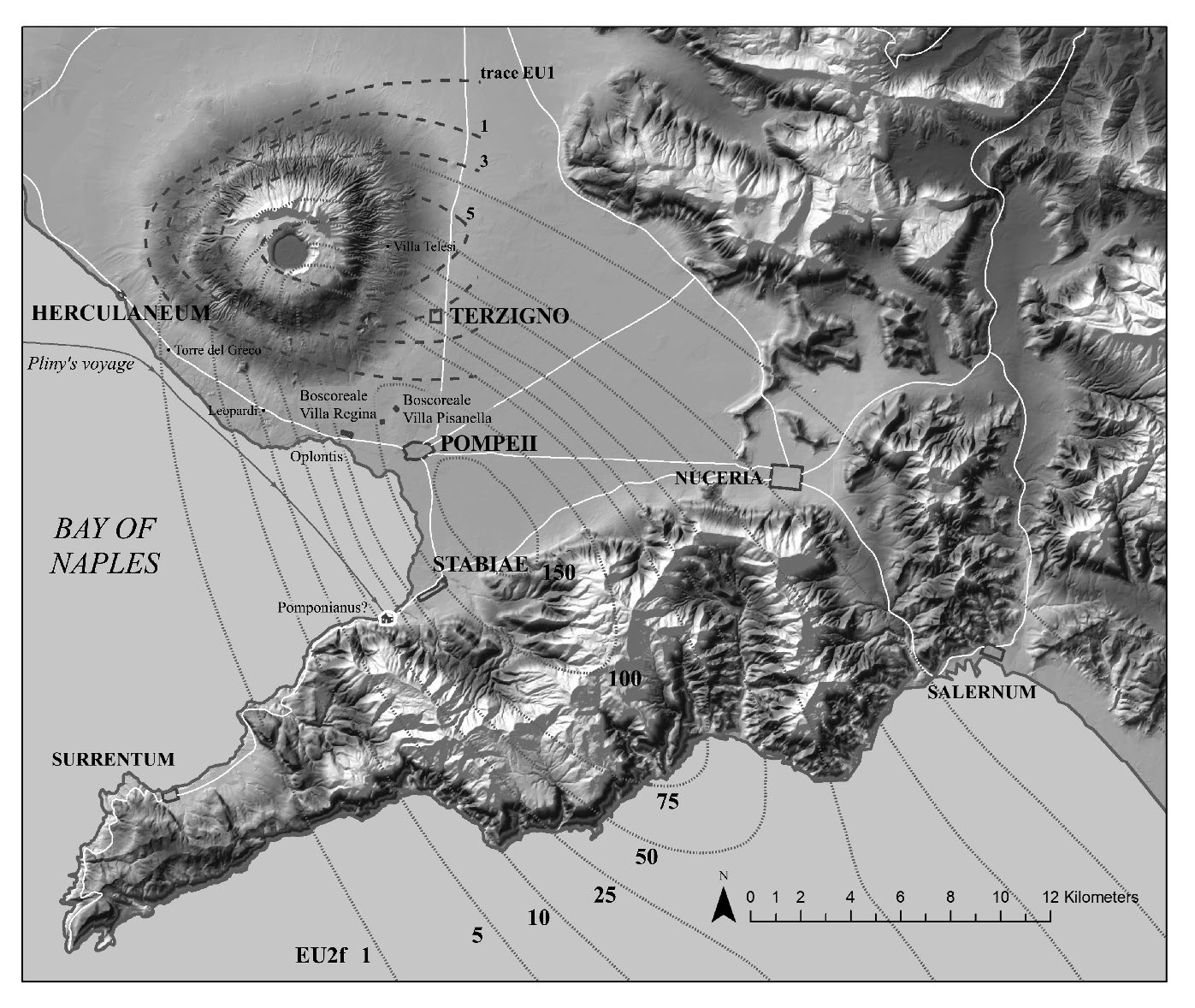 Figure 3.5 Ash and white pumice fall, AD 79 Somma-Vesuvius eruption on Day 1: EU1, morning (isopleth dashed lines: deposit depth in cm) and EU2f, ca. late morning to 19:00–20:00 (isopleth hash lines: deposit depth in cm). Sources: Shea, “White Pumice”; Pfeiffer, Costa, and Macedonia, “Numerical Simulation”; Sigurdsson, et al., “Eruption” (1985). GIS: B. Wilkerson, P. Foss, Salve Project, Deutsches Archäologisches Institut, Berlin.
Phase 2: Towering Cloud
This opening further reduced magma pressure, which allowed embedded gasses to expand in an ever quicker and more violent feedback loop. Magma accelerated upward through the vent; it shattered and spewed into ash and white pumice 27–30 km into the stratosphere, carried in a S and then SE direction (Figures 3.4a, 3.5: EU2f, A2, A).170 Plinia saw this plume ca. 13:00 at Misenum (see above; Ep. 6.16.4), though the phase could have begun prior; all we know is when she noticed it. Almost no fallout affected Herculaneum, but it thickened southeastward along the coast: upwards of 5 cm at Leopardi, 25 cm at Torre Annunzianta (Oplontis), and 1 m at Pompeii and beyond.
At the same time, the force of the blast began excavating a widening and deepening crater around the vent. Lithics (rock fragments) rained down amongst the pumice and ash at temperatures of 120–140°C (248–284°F), and the fall continued for six to seven hours, up to 100–150 cm in depth, enough to stress and break through many roofs.171 This was the period in which Elder Pliny launched his rescue mission (Ep. 6.16.10–22), and people in the fallout zone either sheltered or escaped.
Then the magma composition changed; its pressure and temperature spiked, and the pumice shifted from white to higher-density gray. During that transition there was a brief lessening of the eruption plume: the density of pyroclasts increased, and a partial column collapse occurred, directed SE and W (in the area of the Piano delle Ginestre, where there was a substructural gap as well as an aboveground break in the rim of the volcano; see above). Within a span of 4–8 minutes, the resulting PDC, at a temperature of ca. 260–340°C (500–608°F), sped a distance of 6–7 km, over the towns of Herculaneum and Terzigno (Figures 3.4a, 3.6: EU2/3pf, S1Herc, P1). There was only minor damage to buildings because the flow was dilute, but it was nasty enough to kill all inhabitants.172 So far, 378 victims have been identified at Herculaneum (340 on the open beach and sheltered in vaulted concrete galleries (fornici, sometimes called “boathouses”) along the shore; 38 in the town) and 12 at Terzigno (in Villas 2 and 6).173 Disproportionately, more young and adult men were outside, and more women and children better insulated inside, but all perished instantly from thermal shock after being hit by the blast wave of the PDC, the baking heat, and the influx of hot, fine ash into respiratory tracts.174
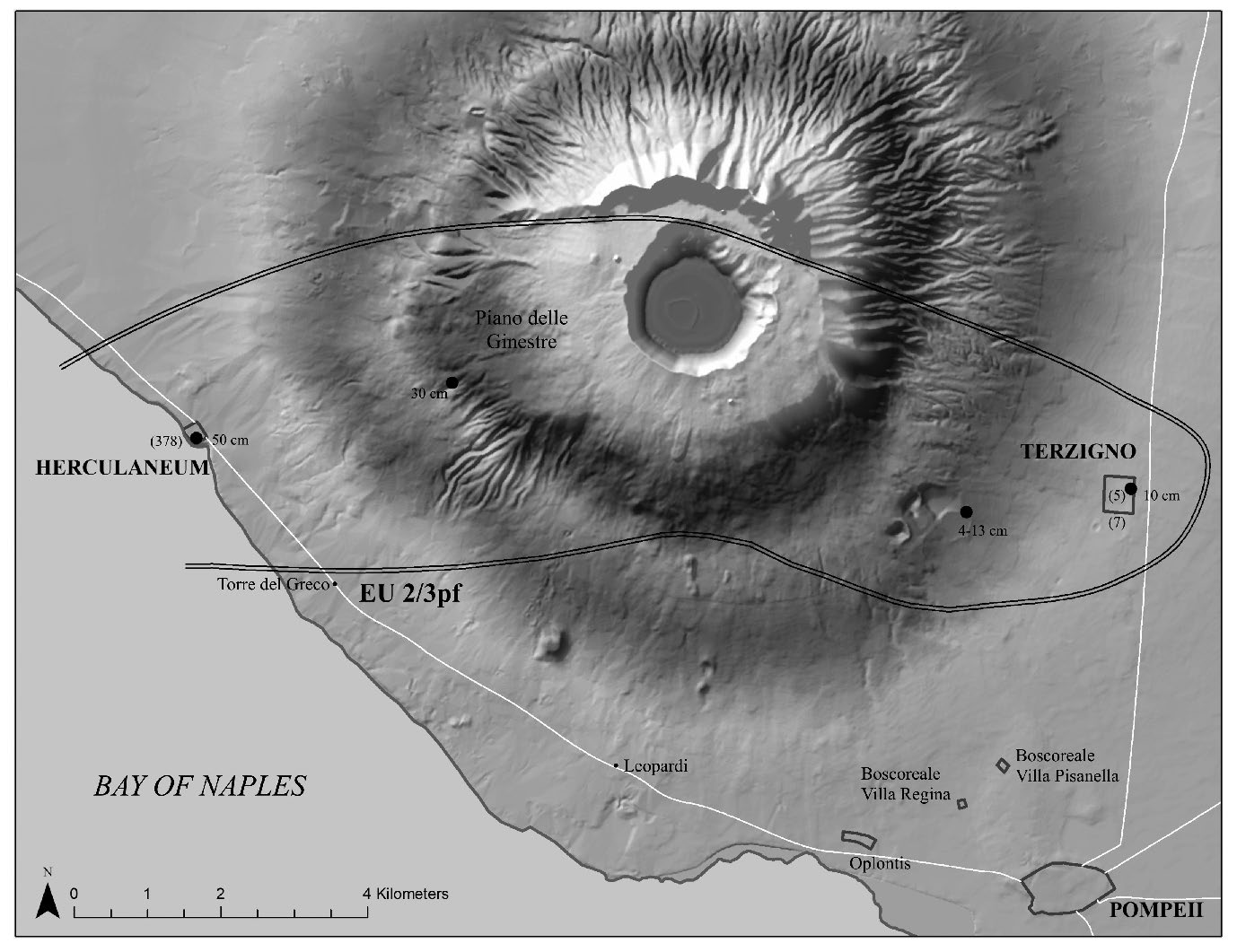 Figure 3.6 EU2/3pf / S1Herc pyroclastic density current, AD 79 Somma-Vesuvius eruption, ca. 19:00–20:00 on Day 1: extent (double line), depth of deposit in key locations (cm), and (number of) deaths caused. Sources: De Carolis, Patricelli, and Cominesi, “Suburbio”; Cioni et al., “Temperatures;” Gurioli, et al., “Transport.” GIS: B. Wilkerson, P. Foss, Salve Project, Deutsches Archäologisches Institut, Berlin.
That first PDC hit Herculaneum and Terzigno on the evening of the first day (ca. 19:00–20:00).175 Elder Pliny may have seen it happen; as his fleet tried to approach Rectina’s coastal villa (Ep. 6.16.11; see above), a possible detachment sent earlier to assist evacuation at Herculaneum may even have been caught onshore (Ch. 4: 6.16.9). The naval group encountered ash (cinis), which increased in thickness and heat, then lithics and pumice—both “dark,” nigri, and ambusti (a thoroughly “burnt-out” white?). Perhaps the ships, near twilight, witnessed the changeover from EU2f to EU3f.
Pryoclastic fall was probably an insufficient obstacle to reaching shore, but a PDC was.176 Pliny mentions sudden shallow water (vadum subitum) and the collapse of the mountainside blocking the shore (ruinaque montis litora obstantia). Pliny the Elder used the latter term in his Natural History to describe large-scale hydraulic mining operations in Hispania Tarraconensis (Spain, Figure 1.4), where he had served as procurator only five years previous (Ch. 1). Pliny describes three methods for extracting gold; the third involves tunneling to undercut a mountain slope and precipitating a mass collapse of debris that is washed for gold by means of aqueduct-fed sluices (HN 33.66–73):177
(33.66) Aurum … aut in ruina montium quaeritur. ... (70) Tertia ratio opera vicerit Gigantum. Cuniculis per magna spatia actis cavantur montes lucernarum ad lumina; eadem mensura vigiliarum est, multisque mensibus non cernitur dies. Arrugias id genus vocant. Siduntque rimae subito et opprimunt operatos, ut iam minus temerarium videatur e profundo maris petere margaritas atque purpuras. Tanto nocentiores fecimus terras … (73) Mons fractus cadit ab sese longe fragore qui concipi humana mente non possit, aeque et flatu incredibili. Spectant victores ruinam naturae. ...
(33.66) Gold ... is sought in the collapse of mountains (ruina montium). ... (70) The third method will have surpassed the accomplishments of the Titans. The mountains are hollowed out by means of galleries driven for long distances by the light of lamps. The lamps also measure the periods of work, since the miners do not see daylight for many months. They call this type of mine arrugia. Faults suddenly slip and crush the workers, so that now it seems less audacious to seek pearls and purple dye in the depths of the sea, so much more harmful have we made the earth! ... (73) The broken mountain (mons) falls far away from itself with a crash that cannot be imagined by the human mind, along with an equally unbelievable blast of air. The victors (miners) behold the overthrow (ruinam) of Nature.
The Younger’s account must derive from notes the Elder made during his voyage and interviews with survivors (Ch. 4, Ep. 6.16.9–11, 22). Elder Pliny would have used terminology most familiar and sensible to him if he observed and noted a partial collapse of the eruption column and its PDC.
Prior to its destruction, Herculaneum had scanty ashfall (less than a centimeter), while at Oplontis (Torre Annunziana) to the south, white pumice accumulated to 40 cm, but did not experience the EU2/3pf PDC. Rectina’s villa was probably between just north of Torre del Greco and the coast below modern Leopardi, today covered by pyroclastic deposits and lava flows from subsequent eruptions, an archaeological terra incognita.178 Pliny continued to Stabiae in his personal craft (a liburnica, I suggest: Ch. 4, 6.16.9); the other ships probably tried to assist evacuation as they could, though darkness and heavy seas would have caused difficulties everywhere along the coast (Ch. 4: Ep. 6.16.7, 9, 12, 17).
The eruption column recharged to a height of 32–33 km, and gray pumice continued falling overnight, eventually up to 1 m. deep in areas SE of Pompeii, causing more casualties from caved-in roofs (Figures 3.4a-b, Figure 3.7: EU3f, A3, B1). At intermittent intervals, column collapses precipitated more PDCs. The first occurred ca. 1:00 on the second day, at the peak of the mass discharge rate (MDR) of material (Figures 3.4b, 3.8: EU3pf1, S1Elsewhere, F1Herc, P2), causing a highly-concentrated fine-particle PDC, ca. 220–280°C (42–536°F).179 Thicker (ca. 1 m.), it flowed W over Herculaneum again, damaging buildings, and extended S as well, killing ten in the areas excavated so far at Boscoreale (Villa della Pisanella, Piazza Mercato, and Villa Regina) and another 54 at Oplontis.180
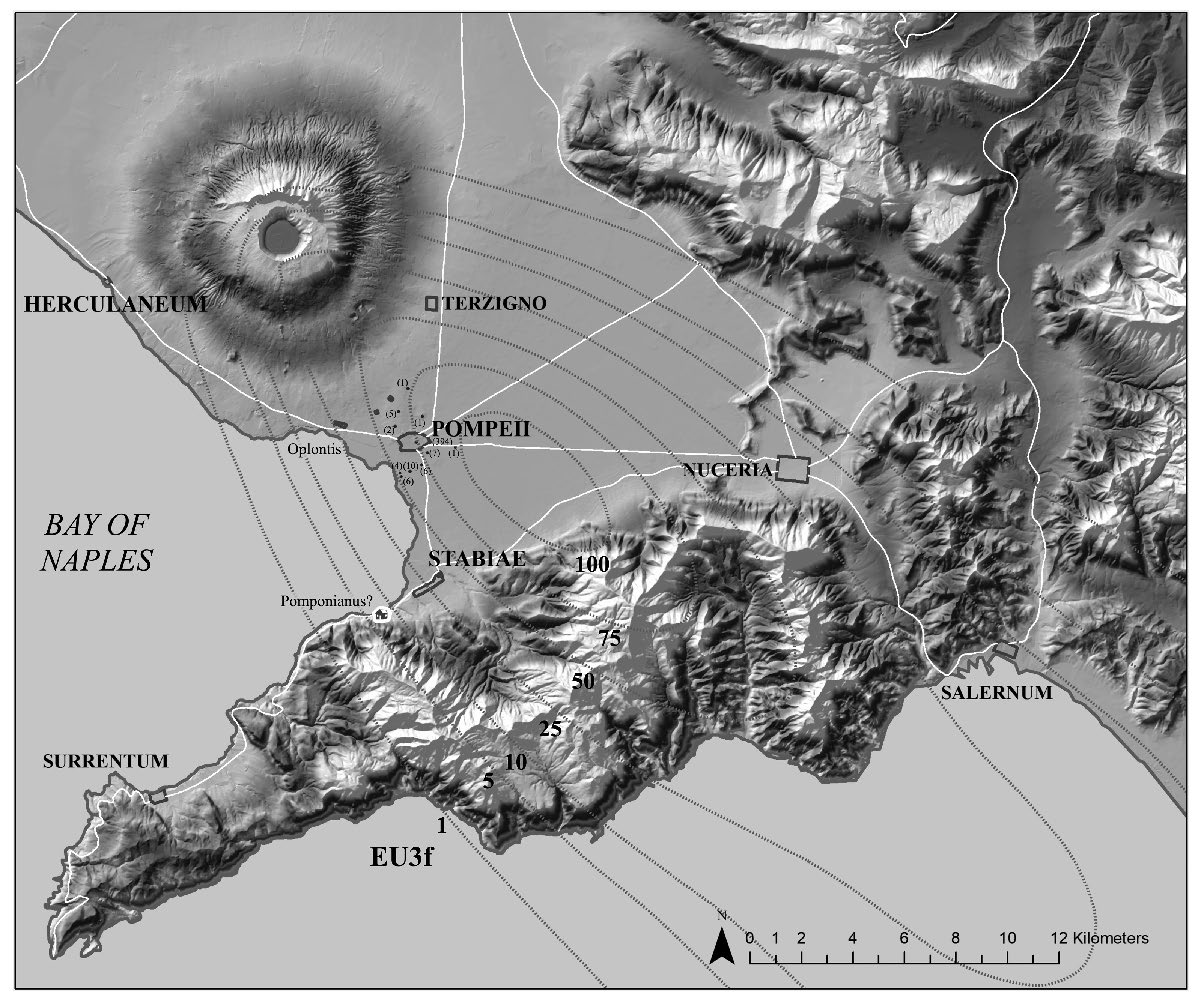 Figure 3.7 Ash and gray pumice fall, AD 79 Somma-Vesuvius eruption, ca. 19:00–20:00 on Day 1 to ca. 7:00 on Day 2: EU3f (isopleth hash lines: deposit depth in cm); (number of) deaths caused by tephra accumulation and roof collapses. Sources: Pfeiffer, Costa, and Macedonia, “Numerical Simulation”; De Carolis, Patricelli, and Cominesi, “Suburbio”; De Carolis, Patricelli, and Ciarallo, “Urbana.” GIS: B. Wilkerson, P. Foss, Salve Project, Deutsches Archäologisches Institut, Berlin.
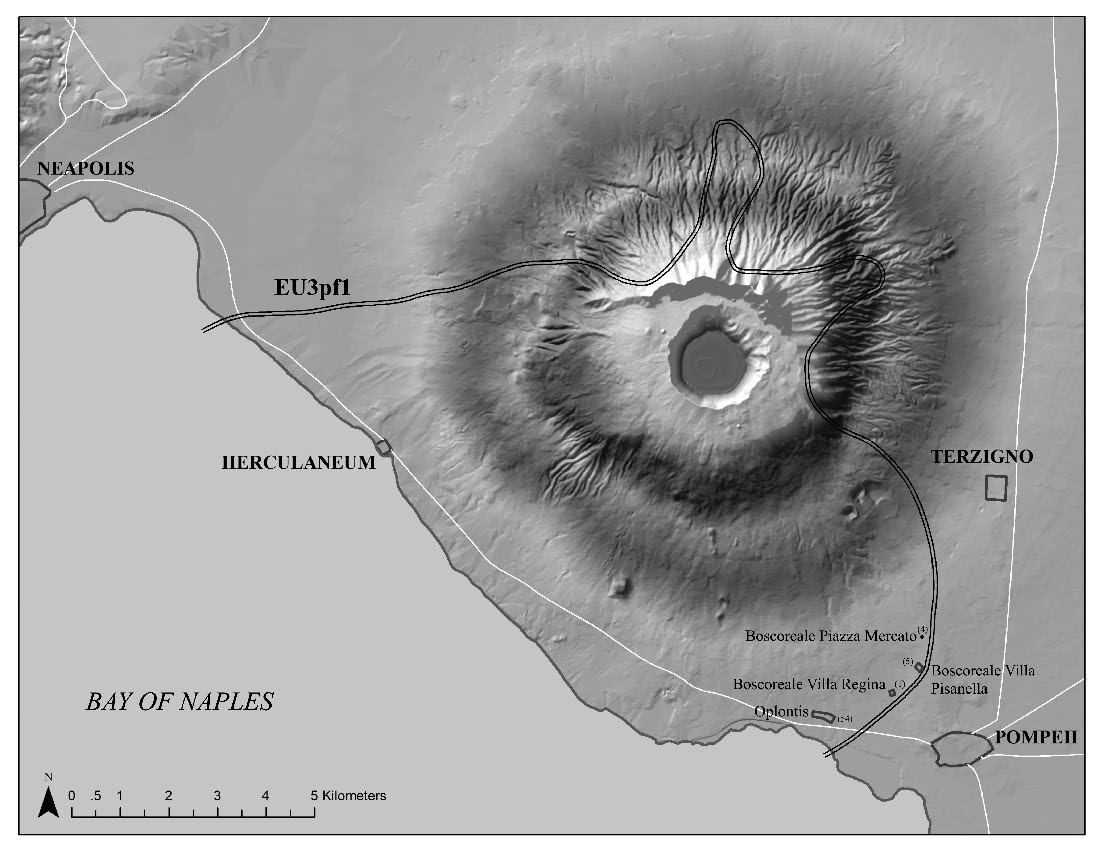 Figure 3.8 EU3pf 1 / S1Elsewhere pyroclastic density current, AD 79 Somma-Vesuvius eruption, ca. 1:00 on Day 2: extent of (double line), and (number of) deaths caused in Oplontis and Boscoreale. Sources: De Carolis, Patricelli, and Cominesi, “Suburbio”; Sigurdsson, et al., “Eruption” (1985). GIS: B. Wilkerson, P. Foss, Salve Project, Deutsches Archäologisches Institut, Berlin.
The column resumed for about an hour, when (ca. 2:00), another PDC hit (Figures 3.4b, 3.9: EU3pf2, S2–F2, P3), this one composed of a turbulent surge below (up to 2 m. thick at Herculaneum) and a dense nonturbulent flow above (up to 5 m. thick). At temperatures of ca. 240–310°C (464–590°F), this heavy and powerful current sheared off portions of buildings at Herculaneum, Boscoreale, and Oplontis, carrying pieces downslope.181 It is unclear whether this particular PDC caused additional casualties, but one individual was overcome by a EU3 PDC at the Villa of C. Olius Ampliatus on the NW slopes.182
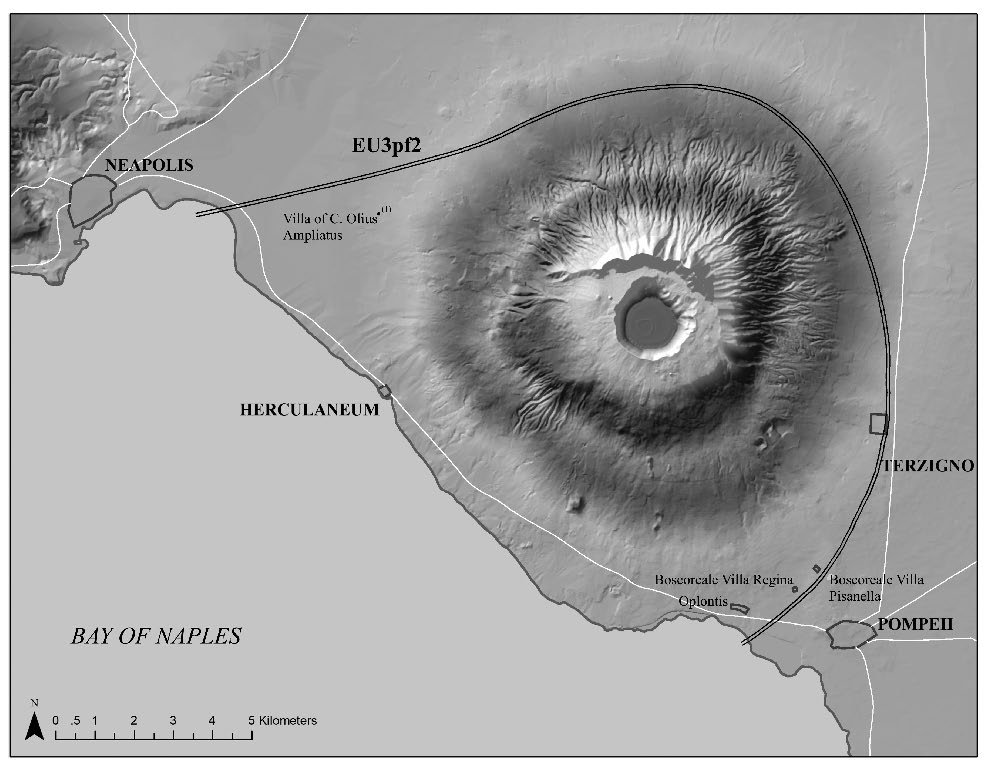 Figure 3.9 EU3pf 2 / S2 pyroclastic density current, AD 79 Somma-Vesuvius eruption, ca. 2:00 on Day 2: extent of (double line), and death caused on NW side of Vesuvius. Sources: De Carolis, Patricelli, and Cominesi, “Suburbio”; Sigurdsson, et al., “Eruption” (1985); Cascella and Vecchio, La villa rustica. GIS: B. Wilkerson, P. Foss, Salve Project, Deutsches Archäologisches Institut, Berlin.
Plume restored, it continued dropping ash and pumice until just past a dull, dusty dawn (at 5:17). Elder Pliny had already been awakened at Stabiae lest he be trapped in his room due to accumulating ash (Ep. 6.16.13–14), and Younger Pliny and Plinia were also active at Misenum (Ep. 6.20.3–4); all were concerned about heavy tremors. At about 6:30 (Ep. 6.20.6: hora diei prima) another partial eruption column collapse occurred (Figures 3.4b, 3.10: EU3pf3/pfi, S3, P4, C1). This thin, ashy PDC made its way past the city walls and about 200 m. into Pompeii; it may not have been fatal to humans, though it could have caused breathing difficulties.183 At this point, the fallout (Figure 3.4b: EU3f, A6, EU3top, B2) may have lightened; many surviving Pompeians seem to have clambered out onto the pumice, at this point ca. 3–5 m. high. Just over a third of those still in the city had already been killed by tumbled roofs or falling objects.184
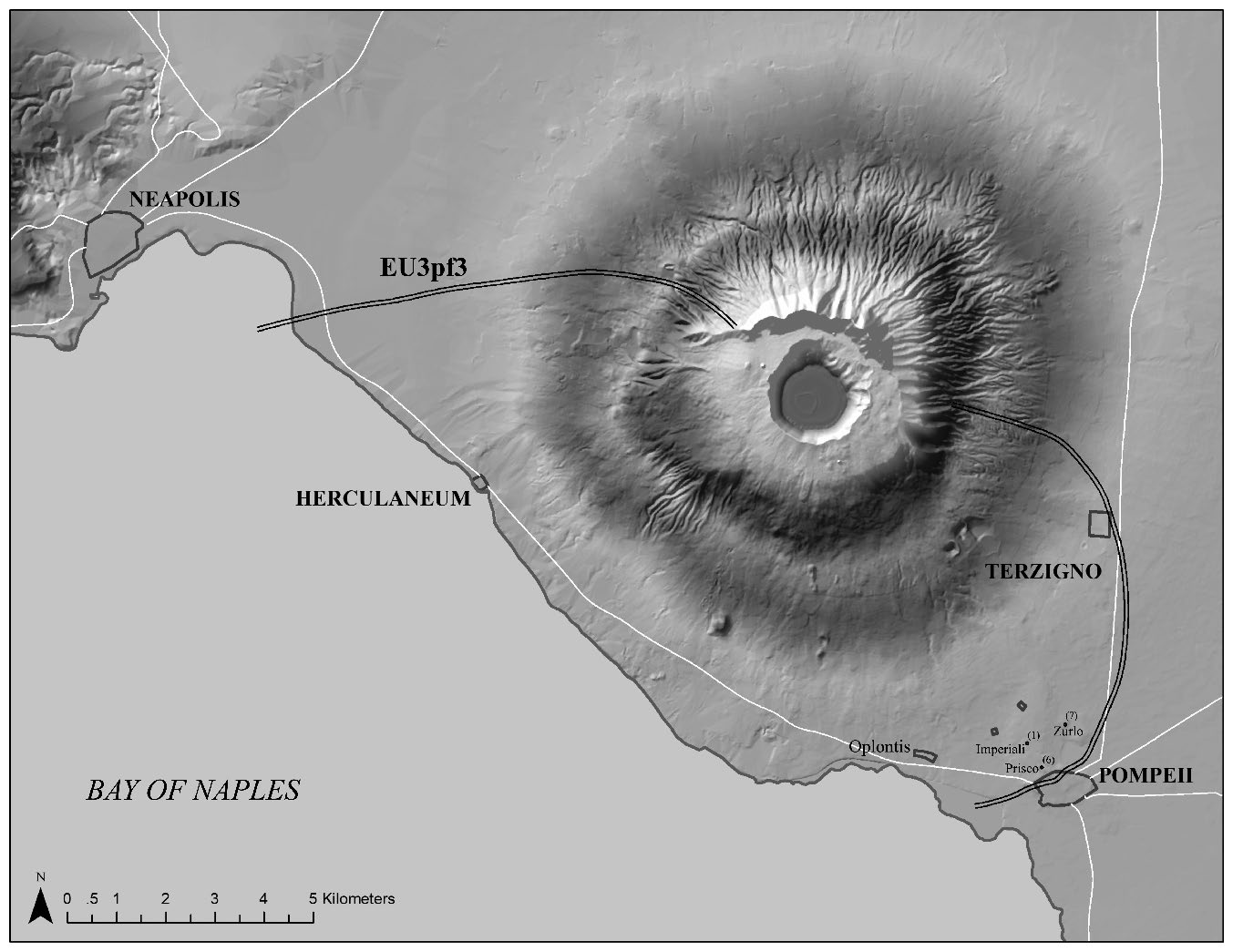 Figure 3.10 EU3pf 3 / S3 pyroclastic density current, AD 79 Somma-Vesuvius eruption, ca. 6:30 on Day 2: extent of (double line), and (number of) possible deaths caused just north of Pompeii. Sources: De Carolis, Patricelli, and Cominesi, “Suburbio”; Scarpati et al., “Pompeian Hiatuses”; Sigurdsson, et al., “Eruption” (1985). GIS: B. Wilkerson, P. Foss, Salve Project, Deutsches Archäologisches Institut, Berlin.
Some tried flight, attempting to take what they could with them; Younger Pliny describes loaded carts at Misenum as he, his mother, and a Spanish friend escaped west with the townspeople (Ep. 6.20.8). Elder Pliny and his friends, accompanied by slaves, strapped cushions on their heads and headed shoreward to their boats (Ep. 6.16.17).
About 7:30, Vesuvius’ conduit widened (lessening its pressure), carving out denser wall-rock that got incorporated into the eruption column (increasing its weight). The plume totally collapsed. A very dilute, fast-moving, and multipart PDC spilled radially at temperatures of ca. 140–300°C (284–572°F), overwhelming Pompeii (Figures 3.4b, 3.11: EU3pf tot I, S4, C2, eu1).185 A short fallout intervened that barely reached Pompeii (Figure 3.4b: EU3pf tot II, A7, B3, eu2a) and then the last part of the PDC arrived, covering a slightly wider area (Figures 3.4b, 3.11: EU3pf tot III, S5, C3, eu2b). This blast killed most left in Pompeii—but not everyone, it seems. Buildings locally affected the PDC’s force and temperature, and subsequently some survivors went outside during a hiatus.186 Settlements to the south were briefly spared. During that break, the volcano boiled over; a dense, lithic-rich PDC spread only 5 km from the center (Figure 3.4b: EU3pf lith, P6, R1). Further away, it began to rain, eroding gullies in the surface of volcanic deposits.187
 Figure 3.11 EU3pf tot I–III / S4–S5 pyroclastic density currents, AD 79 Somma-Vesuvius eruption, ca. 7:30 on Day 2: extent of (double lines), and (number of) possible deaths caused in and near Pompeii (* Pompeii number, based on Luongo et al., “Causes of Death,” resulted either from this PDC and/or the EU4 pf PDC, and will change with new discoveries). Sources: De Carolis, Patricelli, and Ciarallo, “Urbana”; De Carolis, Patricelli, and Cominesi, “Suburbio”; Sigurdsson, et al., “Eruption” (1985); Scarpati et al., “Pompeian Hiatuses.” GIS: B. Wilkerson, P. Foss, Salve Project, Deutsches Archäologisches Institut, Berlin.
Phase 3: Big Blast
Reintroduction of groundwater into the equation gradually shifted the eruption mechanics into its final phreato-magmatic phase.188 A steam-rich eruption column briefly re-established itself with a hot, lithic fallout (Figure 3.4c: EU4 basal, A8, EU4 fall, D, eu3a), but it fizzled out as strong earthquakes destabilized the magma chamber, which began to collapse the caldera. Another brief hiatus occurred, with more rain and local erosion (Figure 3.4c: R2); it was during this break that Elder Pliny rested and drank some water on the beach (Ch. 4; Ep. 6.16.18) and probably when Younger Pliny convinced Plinia to continue their escape (Ep. 6.20.13: cinis, adhuc tamen rarus).
Soon, perhaps ca. 8:00, the final and most devastating total column collapse occurred, triggering a three-part PDC, up to 5 m. deep, that blanketed the entire Bay (Figures 3.4c, 3.12: EU4pf, S6-C1, E1-E2-F, eu3b-d). The basal portion (E1, eu3b) was heavy with coarse lapilli, moving ca. 300 km/hr when it hit Pompeii’s city wall and at least 65–80 km/hr in other parts of town, killing anyone left alive. At 100–320°C (212–608°F), and high dynamic pressure, it moved victims from previous PDCs, knocked over walls and shoved back the top three surviving rows of ashlar blocks at the top of the northern city fortification, though its effects varied locally by topography.189 The dilute middle portion (E2, eu3c) of the flow formed dune-shaped layers of fine and coarse ash, and the upper part of ash and lapilli (C1, F, eu3d) was probably fallout dropped by the tail of the PDC.
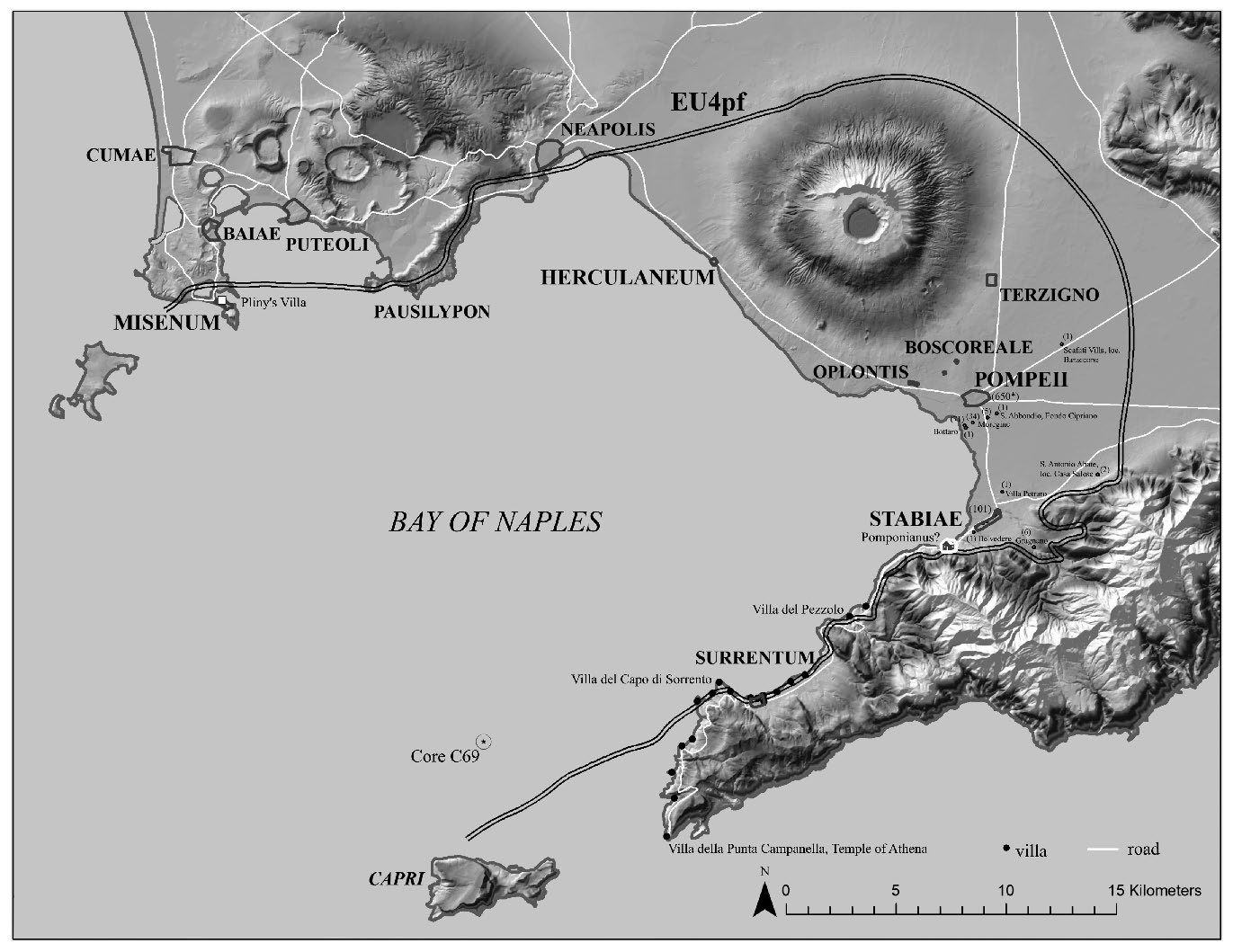 Figure 3.12 EU4pf pyroclastic density current, AD 79 Somma-Vesuvius eruption, ca. 8:00 on Day 2: extent of (double line), and (number of) deaths caused from Pompeii to Stabiae (* Pompeii number, based on Luongo et al., “Causes of Death,” resulted either from this PDC and/or the EU3 pf tot PDC and will change with new discoveries). Extent of PDC hypothetical after the Villa del Pezzolo, Marina di Equa; maritime villas shown on the Sorrentine peninsula. Sources: De Carolis, Patricelli, and Ciarallo, “Urbana”; De Carolis, Patricelli, and Cominesi, “Suburbio”; Sigurdsson, et al., “Eruption” (1985); Filser, et al., “Surrounded.” GIS: B. Wilkerson, P. Foss, Salve Project, Deutsches Archäologisches Institut, Berlin.
This PDC plowed all the way to Stabiae, leaving ca. 80 cm. of deposit there, though its force at the fringes diminished significantly.190 Elder Pliny, on the beach west of Stabiae (Ep. 6.16.18–19), saw the approaching burning cloud and rose to leave, assisted by two slaves, but collapsed. Enough of his companions must have survived to tell the story afterward. Younger Pliny and his mother were enveloped as well, but at that distance the PDC, which took some time to travel over water (ca. 20 minutes), did not carry dangerous heat (Ch. 5: Ep. 6.20.11–16).
Additional PDCs took place close to the summit from the climax of the caldera collapse (Figure 3.4c: EU5-6), followed by a series of alternating ashfalls and dilute PDCs (EU7-8, G1-T).191 Any significant rains should have caused lahars (mudslides) to plague survivors, along with intermittent ashfall and earth tremors (Ch. 5).192 Appreciable stratigraphic evidence for post-eruption lahars has so far just been found on the steeply-sloped Sorrentine peninsula (Monti Lattari).193 A grim landscape of fire and ash is described by poets writing a decade or so later; Vesuvius had become a tragic trope by the time Tacitus and then Younger Pliny entered the senate, became colleagues and friends, and began to correspond.194
Notes
· 1 Forni et al., “Long-Term”; Aucelli et al., “Vesuvius”; Scarth, Vesuvius, 12–21; Sigurdsson, “Before the Disaster,” 29. Radiocarbon dates calibrated to calendar years are usually given as “cal ky [or ka or kya] BP” (thousands of years Before Present, “Present” set permanently at AD 1950).
· 2 Piochi et al., “Campi Flegrei caldera.”
· 3 Sbrana et al., “Volcanic Evolution”; Sparice et al., “New Proximal Tephras,” esp. 79; Di Vito et al., “Late Pleistocene”; Cioni et al., “Explosive Activity.”
· 4 Livadie et al., “The Effects”; Di Vito et al., “Dynamics”; Matarazzo, Berna, and Goldberg, “Micromorphological”; Principe et al., “Archaeomagnetic.”
· 5 Cioni et al., Explosive Activity,” 334–44 classifies all explosive Vesuvian eruptions over the last 20,000 years. See also Scarth, Vesuvius, 36–37; Cioni, Santacroce, and Sbrana, “Pyroclastic Deposits”; Sbrana et al., “Volcanic Evolution.”
· 6 Text: Jal, ed., Florus. The word Veneris is his conjecture for most of the mss. readings, which have viris or ruris. As Hamblenne, “De Vésuve,” notes, no options are satisfactory. The standard shape of a Roman altar had a recessed top surface surrounded by raised edges, so perhaps ara describes the topography of the crater; see d’Ambrosio and Borriello, Arule. Martial, Epigrams 4.44 (below) calls the mountain the “seat of Venus.” In the late first century AD, Frontinus, Strategemata 1.5.21, gives the same account as Florus (both probably drew from Livy) but adds that the gladiators numbered 74. Cooley and Cooley, Sourcebook, 32, offer additional references: the early first-c. AD M. Velleius Paterculus, Historiae 2.30.5, the late first–early second-c. Plutarch, Crassus 9, and early fifth-c. Orosius, Historiae 5.24.1.
· 7 Text: Jones, trans., Geography, vol. 2, 452–53. See also Cooley and Cooley, Sourcebook, 44; Carlino, Neapolitan, 125–27; Scarth, Vesuvius, 41; Reichenberger, “Schriftquellen.” Contemporary with Strabo, Vitruvius (De architectura 2.6.2) notes the heat and flame under Vesuvius that long ago formed useful construction materials such as “Pompeian pumice” and pozzolana. Slightly earlier, Diodorus Siculus (4.21.5) describes Vesuvius as showing signs of ancient flames, from the time of the Giants (Cooley and Cooley, Sourcebook, 100–1). Sherwin-White, Letters of Pliny, 372, reads the terse: litore autem ... Herculaneum, Pompei haud procul spectato monte Vesuvio, “But along the coast (are) ... Herculaneum, Pompeii with Vesuvius in view not far off” (Pliny, HN 3.62) as evidence that no one in Pliny’s day suspected danger from the mountain.
· 8 Cary, trans., Roman History, vol. 8, 302–5 (text and translation).
· 9 Estimates of reconstructed cone heights for Somma-Vesuvius vary widely, from 1800 m. (Scarth, Vesuvius, 22–25) to a scarcely believeable 3000 m. (De Carolis and Patricelli, Vesuvius, 21); Cioni, Santacroce and Sbrana, “Pyroclastic Deposits,” 207–9 suggest a maximum of 1900 m. These all seem too high for its profile—the current height of the Vesuvius cone is 1281 m.; our GIS reconstruction (Figure 1.5) for the AD 79 caldera volcano uses 1270 m., just above the ancient caldera rims still preserved on the NE side.
· 10 For the pre-AD 79 shape of Vesuvius, see: Linde, “3-D structure,” Figure 1; De Simone, “Agricultural Economy,” 24–25; De Simone, “On the Shape”; Nazzaro, “The Shape”; Cioni, Santacroce and Sbrana, “Pyroclastic Deposits”; Cioni et al., Explosive Activity”; Scarth, Vesuvius, 36–37; Sigurdsson, “Before the Disaster,” 32–33; Renna, Vesuvius Mons, 38–49; Scherillo, “Il Vesuvio”; De Carolis and Patricelli, Vesuvius, 41–46. Sbrana, “Volcanic Evolution,” Plate I, is a state-of-the-art 1:20,000 map keyed to eruption events, caldera locations, etc.
· 11 The address convention at Pompeii: IX.8.3, 7 = Region 9, Insula (city block) 8, Entrances 3 and 6. See Dobbins and Foss, World of Pompeii, Maps 2–3. For the painting, discovered in 1879, its architectural context, and documentation, see Caratelli and Baldassare, eds., Pitture e mosaici, vol. 9, 903–1104, esp. 1094–96; Museo Archeologico Nazionale di Napoli (MANN) 112286.
· 12 Scherillo, “Il Vesuvio” and De Simone, “On the Shape,” suggest the scallops indicate the southern scarp of the Somma caldera.
· 13 Text: Shackleton-Bailey, ed., Epigrams, 292–93; Cooley and Cooley, Sourcebook, 119; Riemer, “Ein Beispeil,” 32–33; Gigante, Il Fungo, 14–15; Bromberg, “Telemacheia,” 50; Newlands, “Eruption,” 110–11.
· 14 De Simone, “Agricultural Economy,” 35–40 (calculating that the amount produced around Vesuvius was quadruple the local demand); Moormann, “Villas”; J. Berry, Complete Pompeii, 212–18; Cooley and Cooley, Sourcebook, 230–33; Jashemski, Meyer, and Ricciardi, “Plants,” 171–74. See below re: efforts to date the eruption on the basis of wine production.
· 15 Caratelli and Baldassare, eds., Pitture e mosaici, vol. 1, 117–77, esp. 151–54; Nazzaro, “The Shape,” 720–22; De Carolis and Patricelli, Vesuvius, 44–45; MANN 112282.
· 16 Fisher, Cornelii Taciti, 351.
· 17 Owen and Gildenhard, Tacitus Annals; Syme, Tacitus, 520–27.
· 18 For the consuls of AD 62: Eck, “Miscellanea,” 227–28.
· 19 On date, description, and nature of the earthquake(s), see: Ruggieri, “Stabian Baths,” who argues for two events, one oriented southwest-northeast, followed by repair, and then another aligned east-west; likewise Wallat, “Seneca und Tacitus.” See also Taylor, “Roman Neapolis,” 284–90; Williams, “Seismology,” 125, n.3, 137–46; Hine, “Cosmos,” 68–72, “The Date” (arguing for AD 62); Wallace-Hadrill, “Seneca” (favoring AD 63); Pappalardo, “L’eruzione pliniana,” 207–10; Cooley and Cooley, Sourcebook, 38–40; Marturano, “Geophysical Precursors,” 250–55; Cioni et al., “Precursors,” 722–24; Savino, “Nerone”; Scarth, Vesuvius, 46–48; Anderson, “Disruption”; Bromberg, “Telemacheia,” 53–55. Tuck, “Tsunami,” ties the destruction of 200 ships at Ostia in AD 62 to the Campanian earthquake.
· 20 Text and translation modified from Corcoran, trans., Seneca, vol. 2, 126–29, 132–33, 204–5, 212–13.
· 21 Connors, “Land of the Giants,” 125–26; Williams, Cosmic, 213–57; Williams, “Seismology.” Elder Pliny also backed a theory of underground wind pressure suddenly being released (HN 2.192–94): Dunn, Shadow, 8–9.
· 22 Ruggieri, “Stabian Baths,” 870; Tuck, “Tsunami,” 445 prefers a NW-SE fault line. See Brozzetti, “Campania-Lucania,” for the structural faults of the region.
· 23 13.5 x 87.5 cm., SAP inv. no. 20470; part of the Boscoreale Antiquarium collection. See Trinacty, “Fear and Healing,” 93, 102–112; Roberts, Life and Death, 272–73, Figure 357; Gavel, “Placing,” 204–5.
· 24 Karivieri and Forsdell, “V 1,26.”
· 25 18 x 86 cm., Museo della civiltà romana in Rome, MCR 1368; see Traina, “Calamità,” 201–2, Trinacty, “Fear and Healing,” 103, n.43; Caratelli and Baldassare, eds., Pitture e mosaici, vol. 3, 1991, pp. 578–79.
· 26 For the castellum aquae and the Aqua Augusta: Ohlig, De aquis; Peers, “Aqua Augusta”; Keenan-Jones, “Large-Scale,” 240–46; Keenan-Jones, “Ground Movements”; Lorenz et al., “Prominent features”; De Feo and Lorenz, “Route and tunnels”; Libertini et al., “Augustan aqueduct”; G. Jansen, “Water System.”
· 27 van der Graaff, Fortifications, 130–31; J. Berry, Complete Pompeii, 236–41.
· 28 Cooley and Cooley, Sourcebook, 277–86; Karivieri, “Mythic”; Broekaert, W. “Financial Experts”; Andreau, Monsieur Jucundus.
· 29 Trinacty, “Fear and Healing,” for an argument about the shrine as a method for coping with trauma through the ordered routine of daily sacrifice and remembrance.
· 30 Cubellis and Marturano, “Felt index.” De Carolis and Patricelli, Vesuvius, suggest it was slightly stronger.
· 31 Mau and Zangemeister, CIL 4.3822 (p. 494); Sogliano, Notizie degli Scavi 1888, 517–18, c (see also g); Savino, “Nerone.”
· 32 Tacitus, Annales 14.17; Sheppard, “Mass Spectacles,” 155–71; Cooley and Cooley, Sourcebook, 80–85; De Bernardi, “La rissa”; Jacobelli, Gladiators, 106.
· 33 Cooley and Cooley, Sourcebook, 41; E.M. Moormann, “Temple of Isis”; Petersen, Freedman, 17–56; Dickmann, “Numerius.”
· 34 Cooley and Cooley, Sourcebook, 41–43; Conti, “Provvedimenti.”
· 35 Taylor, “Roman Neapolis,” 282–90; Monteix, “Pompéi et Herculaneum”; Anderson, “Disruption.” Also Roberts, Life and Death, 272–78; De Carolis and Patricelli, Vesuvius, 71–76; Sigurdsson, “Before the Disaster,” 33–35.
· 36 Millar, Cassius Dio, 28–33; Fomin, “How Dio Wrote,” 10, n. 27; Scarth, Vesuvius, 53; Hillard, “Other Accounts,” 5–21.
· 37 The Cassius Dio here and below is adapted from Cary, trans., Roman History, vol. 8, 302–9.
· 38 Ash, “Great Escape”; Smith, “Chronology,” 156–57, 191–94; 191: .”..the epitome compresses the outcome of seven years’ campaigning (mostly post-dating 79) into a single narrative and so has no value for dating purposes.”
· 39 A bronze copy of a letter from Titus to the city of Munigua in Spain (Seville Provincial Museum; L’Année Epigraphique 1962, 288), and a military diploma from Egypt (British Museum 1923,0116.1; CIL 16.24) show Titus with the title of Imperator for the 14th time, dated to VII and VI Idus Sept. respectively (7–8 September); see below for how this impacts the dating of coin finds. Of course communication of an acclamation was not instant; it would have taken weeks for provinces to be made aware of updated titulature. See Rolandi et al., “79 AD Eruption,” 94–95 for the diplomas.
· 40 Veh, Cassius Dio, 162: gerade zu Sommersende. If one prefers “autumn” more generally as a fair translation of φθινόπωρον (and it can be), then the specifying force of αὐτὸ needs explanation, which for Savino, “Considerazioni,” 370, n.10, simply means during the same year of the events in Dio’s previous section.
· 41 Rosini, Dissertatio, 67.
· 42 See Parslow, Rediscovering Antiquity, for Bourbon-era excavation methodology and understanding.
· 43 Blancus, Dionis, 166; he first translated the Greek into Latin. See Glare, ed., Oxford Latin Dictionary, sub + accusative, s.v. B23. Leunclavius, Dionis, 756, note b.
· 44 Leunclavius and Estienne, Dionis, 755, note b. Estienne was also known by his Latin name “Stephanus,” which is how Rosini refers to him. Tillemont, Histoire, 855.
· 45 Zehnacker, “Dernier jour,” 322–23.
· 46 Masson, Vita, 27–30; Rezzonico, Disquisitiones, vol. I, 182. The most influential modern followers of Rosini have been Borgongino and Stefani, “Intorno alla data,” 177–80, 188, who cherry-pick Geminus as their calendrical authority and follow Renna, Vesuvius Mons 53–56, 107–12. See also Ruggiero, La regione sotterata, 3, 15; Pappalardo, “L’eruzione pliniana,” 210–11; Rolandi et al., “79 AD Eruption,” 95; Roberts, Life and Death, 278–79.
· 47 For Geminus, Ptolemy, and the Latium Parapegma: texts and translations from Lehoux, Astronomy, 30–35, 227, 234, 262–63, 282, 284–85, 308; Lehoux, “Days,” 104–8; Lehoux, “Image”; for Varro: Hooper, trans., De Re Rustica, 248–49; for Columella: Forster, trans., De re rustica, vol. 3, 102–3; for Elder Pliny: Rackham, trans., Natural History, vol. 5, 330–31, 382–83. See Hannah, Calendars, 26–27, 46–47, for various seasonal defintions from Greek and Roman writers. Equinox and solstice data for Pliny (AD 77) from Rocher et al., “Dates of Seasons.” For Egyptian calendar dates: van der Waerden, “Tables.”
· 48 Lehoux, Astronomy.
· 49 Pliny, HN 18.309–10. See Robinson, “Ardua,” for many problems in trying to be too precise with ancient astronomical data.
· 50 Dio follows other historians such as Livy and Tacitus in recording supernatural occurences, whether or not he believed them; see Fomin, “How Dio Wrote,” 88–105; Scarth, Vesuvius, 53–54; Hillard, “Other Accounts,” 5–21, provides useful context about the author and his dramatic tendencies. Text and adapted translation from Cary, trans., Roman History, vol. 8, 304–9.
· 51 Unfortunately, the study of Dio’s sources (Quellenforschung) has been somewhat underproductive. Dio does claim to have read widely (1.fr.1.2, 53.19.6); see Fomin, “How Dio Wrote,” esp. 40–56; Millar, Cassius Dio, 34–38.
· 52 Connors, “Land of the Giants,” 132–33.
· 53 Moormann, Pompeii’s Ashes, 8 n.8 cites a source from 1753 that challenged the veracity of Cassius Dio’s account due to a lack of skeletons found in the theater (Anonymous, “Extract”), though the Large Theater did not see concerted excavations until 1764 (J. Berry, Complete Pompeii, 49; Iannace and Trematerra, “Luoghi dello spettacolo,” 334) also Hillard, “Other Accounts,” 17–18.
· 54 Of 766 instances of Kalends with a month name in Latin literature from Cato to Tacitus, 746 (97.4%) use the standard: (number) + Kal. + month; 17 examples (2.2%) reverse the order to fit poetic meter (Tibullus, Horace, Ovid, Statius, and Martial); Elder Pliny reverses the order in Historia Naturalis 2.123.6, 17.76.2, and 17.136.9 (the latter two concerning planting times for fruit trees). Pliny’s Epistulae has seven dates with month-names, besides the Vesuvian eruption: 1.7.4: idus Octobris; 8.6.13: x kal. Februarias; 9.39.2: idibus Septembribus; 10.8.3: kalendis Septembribus; 10.17a.2: xv kal. Octobres; 10.17b.1: quinto decimo kal. Octob.; 10.25.1: viii kal. Decembres. Data from Packard Humanities Institute, “Latin.” For the structure of the Roman calendar as derived from lunar phases, see: Rüpke, Roman Calendar, 24–32; Lyle, “Archaic calendar,” 248; Michels, Calendar, 19–22.
· 55 Hime, Introduction, 148–50. Varro and Elder Pliny both include and abbreviate ante diem (as a.d.) when noting dates for astronomical phenomena as cited above.
· 56 Ep. 10.17b.1 also uses the ablative: quinto decimo kal. Octob.; all other examples in Pliny (see above) use numerals.
· 57 Other examples: 6.16.5k Vesuvium/Vesuinum/Vesunium/Vesnuinum; 6f: evecta/enecta; 8e: nam villa/navicula; 15i: nutabant/initabant. See Stout, Scribe, 14, 38, 62, esp. 82.
· 58 Manuscripts influenced by or copied from Valla read: no̅n̅ (e), nonē changed to novē (LL52), no̅u̅ changed to novē (Naples, Ex-Vindobonensis lat. 42), nono (BL Add. 20054), and nonas (Escorialensis N.III.10). Later copyists struggled to construe the proper expansion for no̅n̅.
· 59 A note on Vatican Pal.lat. 893, probably written in the 1440s in northern Italy, perhaps the Veneto (M. Reeve, pers. comm.), a selection of ten letters from various sources. Ep. 3.5, 1.6, 2.1, 2.3, 2.11–12, 4.15, 4.16 all show influence of contaminated F-texts such as 1778, which appear throughout the γ2 (Guarinian) tradition and its descendants; Ep. 5.8 has readings identical to D, an unedited version of γ; Ep. 6.16 came from the γ1 branch (from an ancestor common to H). That ancestor read non błas, with the bottom leg of a stylized k (for kłas, Kalendas) extended and curled underneath like a b, as in H. The scribe of Vat.Pal.lat. 893 seems to have misread the minuscule of non as nou, and made błas into bris, adding the ē between to construe Novēbris. The corrector of the manuscript then added kłas in the margin with the insertion siglum ÷ after Novēbris, since a month name without a month marker would not have made sense. (Still the phrase is incorrect in order and form: it should be: Kalendis Novembribus; see below). This error parallels non/nou in the γ3b1 subfamily. Vat.Pal.lat. 893 had no descendants, unless the editor of r saw it in Rome, and it inspired his reading of November (both share 6.16.4b praeses).
· 60 M. Reeve agrees (pers. comm.); -mber and -ber don’t occur. R1472 / r°: https://digi.vatlib.it/mss/detail/Reg.lat.1472 (Ep. 6.16 at 68v). At 85v (Ep. 7.27.6 conducere), the r° editor’s insertion of emere seu quis from θ shows the same hand for em. Likewise a gloss above 1.10.7 monentem.
· 61 Poem to Maffei: Vaticanus lat.3908, fol. 62r (p. 70 online). Also Vat.lat. 5881, fol. 139r.
· 62 Dates indicated for a month marker should be expressed in the ablative; Ep. 9.39.2: idibus Septembribus, “on the Ides of September.” See also Cicero, In Catilinam 1.8: Kalendis ipsis Novembribus, “on the November Kalends.” The Paris BNF Rés. Z 688 ed. of r, in its correction, is the only text I have found to express 1 November correctly. The -bris and -bres endings are functionally identical.
· 63 The 1515 Zeffi ed. used readings from 04 and a, but kept Novembris Kalendas and many others from 98. There were several reprints of Dalecampius. See the collations in Online Resources.
· 64 Palermo in his book urgently confronted Paulo Cigalini, who had written a 1605 essay, De vera patria C. Plinii Secundi, favoring Como as the Elder’s homeland, included in vol. 2, pp. 1601–52 of Dalecampius’ 1608 edition of the Natural History. Cigalini did not address the date of Pliny’s death. See Palermo, De vera; Schuh, “Plinius”; Nauert, “C. Plinius Secundus,” 411; Gibson, High Empire, 1–3; Reeve, Transmission, 1–2. Both essays were reprinted in Graevius, Thesaurus, 51–75, 91–142 (Archive.org PDF). See also Russell, “Hypnerotomachia,” 110.
· 65 Palermo, De Vera, 8–9: in quorum altero dicitur VIII Kal. Septemb. in altero vero III Non. Novemb. illum obiisse, postridie scilicet quam a Miseno solvisset.
· 66 Palermo published nothing else than a gushing 5-page ode to the marriage of Margarita of Austria and Phillip III of Spain in 1598.
· 67 Pp. 401–2: cui otium aliquod est, excutiet verum mihi properanti, vix haec licet committere papyro.
· 68 Masson, Vita, 27–30.
· 69 Rezzonico, Disquisitiones, vol. I, 113–14, 181, 185–86. See also Reeve, Transmission, 3–4.
· 70 Rezzonico, Disquisitiones, vol. I, 181, n.2.
· 71 Rosini, Dissertationis isagogicae, 67–68. Rezzonico, Disquisitiones, vol. I, 181, n.2, cites the 1480 and 1481 eds. of Elder Pliny’s HN for viii. Kal, but both of those editions actually read viiii. Kal.
· 72 Ruggiero, La regione sotterata, 15–20. 20th c.: Pappalardo, “L’eruzione pliniana”; Renna, Vesuvius Mons, 107–12; Ciarallo and De Carolis, “La data.”
· 73 Borgongino and Stefani, “Intorno alla data,” 177–87; Stefani and Borgongino, “Ancora.” In 1929 Alfano and Friedlaender, Geschichte des Vesuv, 11–12, 15 argued a 24 October date, first postulated by Antonio Sogliano in unpublished university lecture notes according to Borgongino and Stefani, “Intorno alla data,” 182, n.28. They all cite a Non. kal. Nov. date that exists in no extant manuscript or printed edition; perhaps they saw a copy of the editio princeps that had later been hand-corrected to add Nov., e.g. Escorialensis 70.VII.15 (1°). None were expert in textual transmission. Borgongino and Stefani brought to light the Naples BNN XVI.A.42 manuscript (γ3b2c sub-family), but it adds no insight. See also: Stefani, “Das Datum”; Pappalardo, “Sulla data”; Lazer, Resurrecting Pompeii, 79–80; “Fichi, fiamme”; Cooley and Cooley, Sourcebook, 43; Abdy, “Last Coin”; Roberts, Life and Death, 278–79; Luisi, “L’esplosione,” 75–86; Rolandi et al., “79 AD Eruption”; J. Berry, Complete Pompeii, 20; Stefani, “La vera data”; D’Ambrosio et al., Storie da un’eruzione. 407–20; Dunn, Shadow, 42–44.
· 74 Osanna, Tempo ritrovato, 146–53, and popular writers such as Angela, I tre giorni, 467–78. Unfortunately, the latter thinks M is in the Vatican, and doesn’t realize that the Oratorianus is derivative (see Ch. 2).
· 75 Zehnacker, “Dernier jour,” 320–22, 336–37. Froben’s 1552 ed. is almost entirely a reprint of the 1519 pirated Catanaeus ed.
· 76 Until final publication, see Osanna, Tempo ritrovato, 138–53.
· 77 G. Ammannati has proposed the reading currently accepted by the Pompeian authorities: Osanna, Tempo ritrovato, 148–49. Antonio Varone’s original reading of the inscription concluded: ...in[d]ulsit pro masumis esurit(ioni), .”..s/he excessively indulged her/his hunger”; cf. Lidz, “New Treasures.” Pappalardo, “Sulla data” 228, references an unpublished reading by P.L. Tucci: …in[p]ulsit pro masum[is] Vesuvius…, “…Vesuvius excessively pushed...,” which seems conveniently specific to the debate. In any case, impello is a transitive verb needing a direct object (only Pomponius Mela uses it in a geographical-geological sense, for seas pressing onto shores); Seneca and Pliny use verbs such as movere, agere, tremere and quassare to describe earthquakes.
· 78 Lidz, “New Treasures,” 60.
· 79 Osanna admits a covered atrium: Ministero della cultura, “esclusivo tour,” 3:14–3:21.
· 80 Osanna, Tempo ritrovato, 150–51.
· 81 Benefiel, “Dialogues”; see also Baldwin et al., “Writing and Space,” a spatial analysis of the 100 graffiti (most from circulation areas) in the Villa San Marco at Stabiae.
· 82 Benefiel, “Dialogues,” 39, contra Osanna, Tempo ritrovato, 146.
· 83 A graffito in vestibule (3) at the Villa Sora near Herculaneum mentions Kalendas Novembres as a repainting date, but does not demonstrate how many weeks prior it was written in AD 79 (if that was even the year): Osanna, Tempo ritrovato, 151–52; Pesando, “Fichi, fiamme,” 49–51. A graffito from Pompeii (VI.16.22–23) advertised the electoral support of the vindemitores, “grape-gatherers” for M. Casellius Marcellus as edile (“city manager”), but it was not necessarily written during the September-October harvest (elections were in March). It is not known what year Caesellius was a candidate. See Sogliano, Notizie degli Scavi 1906, 150; Mau and Zangemeister, CIL 4.6672 (p. 701); Castrén, Ordo, 150; Franklin, Pompeis, 188; Borgongino and Stefani, “Intorno alla data,” 182, 188–89, who also list other inscriptions that do not indicate years. Attempts to pin these graffiti to AD 79 typically insist, e.g., Carro, Quadriremi, 51, that it is “unthinkable” that renovation work would ever last more than a year. Such assumptions are unsound; diverse families had diverse strategies for their renovations: Anderson, “Disruption.”
· 84 D’Ambrosio et al., Storie da un’eruzione. 407–20, Naples Archaeological Museum (MANN P 14312/176). See also Rolandi, “79 AD Eruption,” 94–95; Stefani, “La vera data,” 12; Borgongino and Stefani, “Intorno alla data,” 189; Stefani and Borgongino, “Ancora”; Zehnacker, “Dernier jour,” 323–24.
· 85 Abdy, “Last Coin,” 82–83; Moruzzi, “Verità.”
· 86 Amato, “Crypta Neapolitana”; D’Ovidio, “Crypta Neapolitana.” The tunnel is 711 m. long, and was constructed in the late first c. BC, along with the Grotta di Saiano (780 m., at Posillipo: see Varriale, “Pausilypon”), and Grotta di Cocceio (970 m., between Lago Averno and Cumae), by the Roman architect Lucius Cocceius Auctus (for whom, see Gros, “Statut social,” 436–38 and Strabo 5.4.5).
· 87 Peers, “Aqua Augusta”; Rispoli, “Unveiling”; Keenan-Jones, “Large-Scale,” 240–46; Lorenz et al., “Prominent features”; Libertini et al., “Augustan aqueduct”; Ferrari and Lamagna, “Augustean Aqueduct.” See Carro, Quadriremi, 35–48, for a study of the fleet and its base at Misenum.
· 88 Carro, Quadriremi, 37–39; the base was probably built by Agrippa ca. 20–12 BC. For coastal structures at Baiae (modern Bacoli): Di Michele, “Villa maritima.”
· 89 Ostrow, “Augustales,” 75–76; D’Arms, “Memory”; Beloch, Campanien, 196–200.
· 90 D’Arms, “Memory,” 133–34; Keppie, “Guess Who’s Coming,” 45; J. Bodel, “Monumental Villas,” 14; D’Arms, Bay of Naples, 113, 184–85; Keenan-Jones, “Large-Scale,” 242; Lighthouses: Carro, Quadriremi, 40–41.
· 91 Roads connecting Misenum: Illiano, “Misenum,” 384–85.
· 92 Sources for the DEM: The basemap from Tarquini, “TINITALY,” supplemented by Vogel’s DEM of the Sarno Plain (see Vogel et al., “Pre-AD 79 Topography,” “Reconstructing,” and http://134.2.216.32/salve/index.php?id=79 ); Sbrana, “Volcanic Evolution,” using data from the CARG’88 project of the Servizio Geologico d’Italia (ISPRA); Aucelli, “Late Holocene”; “Coastal Lanscape Evolution”; Cioni, Santacroce, and Sbrana, “Pyroclastic Deposits”; Gurioli et al., “Pyroclastic Flow Hazard”; Linde, “3-D structure”; Beloch, Campanien, Plates I-VI. We also consulted: Aucelli, “Palazzo degli Spiriti”; Aucelli, “Historical”; Aucelli, “Studying”; Aiello and Marsella, “Marine Geophysics”; Milia, “Syneruptive Features”; Passaro, “High-resolution”; Passaro, “Multi-resolution”; Sacchi et al., “Use and Beauty”; “Stratigraphic signature”; Morhange, “Rapid”; Di Vito, “Magma Transfer”; Seiler, “Interdisciplinary”; Seiler, Vogel, and Esposito, “Ancient Rural Settlement.”
· 93 Beloch, Campanien, 199–200 (“Scarparella”). Also agreeing: Gigante, Il Fungo, 40; Carro, Quadriremi, 39, 63–64, Figure 9; Gibson, High Empire, 56. For the topography and layout of Misenum: Illiano, “Misenum,” esp. Figures 2–4; Miniero, “Miseno.”
· 94 Vogel and Märker, “Reconstructing,” esp. 74–76; De Luca, “Il rapporto.”
· 95 See: Zarmakoupi, Designing for Luxury; Gleason, “Constructing nature”; D’Orsi, Gli scavi di Stabiae; Ruffo, “Topograpfia”; Parslow, Rediscovering Antiquity; Adams, Suburban Villas, 88–98; Bonifacio and Sodo, Stabiae: Storia; Camardo and Ferrara, Stabiae, Dai Borbone; Camardo and Ferrara, Stabiae: Le Ville; Pesce, In Stabiano; Ruggiero, Degli Scavi di Stabiae; Senatore, Stabiae. See now De Luca, “Il rapporto.”
· 96 For models of primary deposition pyroclastic fall: Pfeiffer, Costa, and Macedonia, “Numerical Simulation” (esp. Run V1), and Vogel and Märker, “Modeling,” 10–11, who found that the depth of deposits sampled at slope bases in the Lattari mountains were significantly exaggerated by post-eruption erosion.
· 97 Reinfeld, Fritsch, and Filser, “Underwater,” 1; Filser et al., “Surrounded,” Figure 2; Russo, “Viscera rupis”; Perrella, “Villeggiatura marittima”; Aucelli, “Historical.” Athena sanctuary and via Minervia: Pollone, “‘Sacred Routes’,” 150–53.
· 98 Miniero, “Ricerche,” 243–44, with refs.; “Insediamenti,” map no. 34.
· 99 Feeney, Caesar’s Calendar.
· 100 González-García and Belmonte, “Which Equinox?” 102–4, 106, n. 4.
· 101 The leap year calendar was also adjusted to drop leap years in years not divisible by 400. Dershowitz and Reingold, Calendrical Calculations, 46–47.
· 102 Using the algorithms of Fortunado, “Julian Calendar”; confirmed by Morse, “Converting.”
· 103 National Oceanic & Atmospheric Administration, “Solar Calculator.”
· 104 Riggsby, “Space and Time,” 180: Pliny notes a specific, absolute hour of the day only four times in his letters, two of them in the Vesuvian narration where historical specificity and chronological sequence seem particularly important to him: Ep. 2.20.3, 3.1.4, 6.16.4, 6.20.6.
· 105 The expired hour (hora expleta or hora completa): Dohrn-van Rossum, History of the Hour, 19–20; Ehrlich, “Horae,” 64–71; Duff, Liber Sextus, 58. For the manifestation of these hours on Roman sundials, see Pagliano, Le ore, esp. 40–41.
· 106 Carro, Quadriremi, 53–54 attempts to make hora septima refer to noon (it doesn’t, as any Roman sundial shows: Pagliano, Le ore), in order to leave more daylight for Pliny’s journey across the Bay in October. Sherwin-White, Letters of Pliny, 372, errs in the opposite direction by two hours.
· 107 Temperature data for 1980–2016 from Weather Spark. 10–90% probability range for air temperature: 24 August: 26–31°C; 24 October: 17–24°C.
· 108 See Fagan, “Bathing,” for Elder Pliny’s terminology and treatment of bathing in the Natural History, closely connected to the use of pharmaceutical substances.
· 109 Borgongino and Stefani, “Intorno alla data,” 188, try to have it both ways (vis-à-vis Cassius Dio) by noting autumn could start on 8 August, but reasonably conclude that Ep. 3.5.10–11 means that Elder Pliny took his outdoor baths in favorable weather. Their citation of the Elder’s friend Spurinna’s apricatio (nude walkabout, Ep. 3.1.8), however, is no evidence for the Elder’s own habits—on the contrary. See Zehnacker, “Dernier jour,” 332. On the bathing habits of the Plinys: Gibson and Morello, Reading the Letters, 111–21.
· 110 Carro, Quadriremi, 69–70, allocates about an hour just for readying a dozen quadriremes. Guadagno, “Il viaggio,” 69–70 offers his own chronology for 24 August, but doubts a multi-ship expedition.
· 111 Adapted from Jones, trans., Geography, vol. 2, 454–55. For villas: Zarmakoupi, Designing for Luxury; Perrella, “Villeggiatura marittima”; Gazda, “Villas”; Pausilypon’s Villa: Varriale, “Pausilypon”; D’Arms, Bay of Naples, 221–22; Pompeii: Tybout, “Rooms with a view”; Herculaneum, the Villa dei Papiri: Lapatin, Buried by Vesuvius. Ancient paintings of coastal scenes: Zarmakoupi, “Harbours.”
· 112 Leidwanger, Roman Seas, 58–62; Casson, “Speed under Sail”; Foley and Soedel, “Oared Warships,” 150, 154; Bevan, “Travel,” 6. See also Arcenas, “ORBIS”; Scheidel, “Shape.”
· 113 Rolandi, “79 AD Eruption of Somma”; Carro, Quadriremi, 57–60.
· 114 Carro, Quadriremi, 69; at 60–61 he dismisses currents or tides as being significant to sailing speed.
· 115 Carro, Quadriremi, 40–41; Leidwanger, Roman Seas, 62–66.
· 116 Sigurdsson and Carey, “Eruption,” (2002) 47; Pfeiffer, Costa, and Macedonia, “Numerical Simulation.”
· 117 Rolandi, “79 AD Eruption,” 91; Carro, Quadriremi, 57–60. Rolandi’s team did not take into account Pfeiffer, Costa, and Macedonia, “Numerical Simulation.”
· 118 Rolandi, “79 AD Eruption,” 89, 95; De Simone and Russell, “Late-Antique Eruption,” 367–68.
· 119 Rosini, Dissertationis isagogicae, 67.
· 120 Ruggiero, La regione sotterata, 15 (my translation from the Italian). Borgongino and Stefani, “Intorno alla data,” 190 cite a wicker mat from Pompeii (I.8.14), but it was found in fill 20 cm above the floor.
· 121 Foss, “Kitchens and dining rooms,” 62–74, from a study of 14 city blocks in Herculaneum and Pompeii. See also Ciarallo and De Carolis, “La data,” 63; Allison, Households, 89–103, 108, 126. Borgongino and Stefani, “Intorno alla data,” 190–93 suggest that braziers were salvaged after the eruption and were originally more ubiquitous, but then more reasonably argue that braziers would have been moved from sleeping areas to a corridor or court at night so as not to suffocate the sleepers—but should have been absent in August. They ignore the cooking evidence. The full study of braziers they note (n.75) remains unpublished.
· 122 Weather Spark, “Average Weather in Pompei,” on “August 22” and “October 22” (adjusted Gregorian dates; see above). Records for the years 1980–2016.
· 123 Borgongino and Stefani, “Intorno alla data,” 190. For the find: Maiuri, Ercolano, 342–45; Mols, “Woods,” 228–30; Mols, Wooden Furniture; Budetta and Pagano, Legni, 20–21; Ciarallo, “In margine,” 378. Analysis of Sample 18069A: D’Orazio, “Natural Fibres.”
· 124 Dwyer, Living Statues; Lazer, Resurrecting Pompeii, pp. 247–64; Rowland, From Pompeii, 168–73; Osanna, Tempo ritrovato, 301–32; Dunn and Dunn, Pompeii in Pictures, “Casts,” https://www.pompeiiinpictures.com/pompeiiinpictures/R0/Casts.htm .
· 125 Ciarallo, “In margine,” 378. For the textile industry in Pompeii: Flohr, “Textile Economy,” Fullo, 52–95. Materials were both local (e.g., hemp, broom, grasses, linen) and imported (e.g., cotton, silk); see D’Orazio, “Natural Fibres”; Galli, “Textile Culture.”
· 126 Alfano and Friedlaender, Geschichte des Vesuv, 11. Fur cap: Pappalardo, “L’eruzione pliniana,” 211, n. 30, citing L. Portoghesi; the cap has not been published; Renna, Vesuvius Mons, 108–9; Borgongino and Stefani, “Intorno alla data,” 189–90.
· 127 Weather Spark, “Average Weather in Pompei,” on “August 22” and “October 22.”
· 128 Under tree shade as opposed to sunlight: a drop of 5–7°C at 1.1 m. above the surface: Armson et al., “Effect of Tree Shade,” 248–53. Under conditions of a solar eclipse, a drop of 2–3°C at 1.5 m. above the surface: Anderson, “Meteorological,” 207–9. I found no studies of air temperature drop from the effects of a volcanic eruption cloud.
· 129 Zanella et al., “Influences of Urban Fabric,” 8–9. Pumice clasts larger than 6 cm lose little heat as they fall. Zanella’s team measured the proxy temperature of emplaced clasts by using Thermoremanent Magnetization (TRM) on tiles and stones from damaged Pompeian buildings encased in the pumice. In other words, they measured the heat absorbed by the tiles or stones from the pumice. If anything, these temperature estimates are on the low side. Tiles emplaced within the white pumice layer (EU2f) on the western edge of Pompeii warmed to ca. 120–140°C. Gray pumice (EU3) layers were identified both outside the southern Porta di Stabia and on the western edge of town (insula VII.16); it was coarser-grained (and therefore hotter). Lithics in that gray pumice landed at a minimum of 180–220°C. Lithics during the EU4 fallout phase, sampled from the northwest corner of insula I.16, arrived in Pompeii at 220–260°C, but at that point, any survivors were about to die in the largest PDC; see below. Human heat pain threshold and burn times: Ungar and Stroud, “Touch Temperature,” 2–6.
· 130 International Wool Textile Organisation, “Flame Resistance.” Baxter et al., “Human Survival,” 1054, notes that clothing, compared to bare skin, offers significant protection against skin burns in a low-temperature PDC. Also Dunn, Shadow, 43.
· 131 Ulpian, Digesta 33.7.12.18 (Ulpianus 20 ad Sab., attributed to the jurist Pegasus): Lanae et per se coactae vestem faciunt et, si addatur acetum, etiam ferro resistunt, immo vero etiam ignibus novissimo sui purgamento. “Pegasus and most other authorities say that vinegar also, which is maintained for the purpose of extinguishing fire, likewise wool blankets, pumps, and poles as well as ladders, also mats and sponges and buckets, and brooms, are included.” See Liu, “Clothing Supply,” 25; Liu, Collegia Centonariorum, 63–66. For Pegasus, active under the Flavian emperors, see Champlin, “Pegasus.”
· 132 Adapted from Rackham, trans., Natural History, vol. 3, 134–35; Liu, Collegia Centonariorum, 66. For the felting process, Forbes, Ancient Technology, 90–93.
· 133 Rosini, Dissertationis isagogicae, 67.
· 134 Ruggiero, La regione sotterata, 15–16; Jashemski and Meyer, Natural History; Jashemski, Gardens.
· 135 Grainger, “Garum”; Ellis, “Rise.” Analysis of fish and seafood residues from a Herculaneum sewer: Nicholson et al., “From the Waters.”
· 136 Amphora Inv. No. 12963: Carannante, “Last Garum.”
· 137 Carannante, “Last Garum,” 384. See also Bernal-Casasola and Cottica, “Dalla pesca”; “Produzione.” Hammond, “Putrid” reported similar results for the bogue fish (Boops boops), citing A. Ciarallo, director of the Applied Research Laboratory at Pompeii from 1994–2011.
· 138 Vinalia rustica: Varro, De Lingua Latina 6.16; Pliny, HN 18.284, 289. Harvest dates between the autumnal equinox and the setting of the Pleiades: Varro, De re rustica 1.34.2; Columella, De re rustica 11.2.75; Pliny, HN 18.319. Also Borgongino and Stefani, “Intorno alla data,” 184–85, 193–95; Ciarallo and De Carolis, “La Data,” 64–65; Ruggiero, La regione sotterata, 17–20. Viticulture in ancient Italy: Castaldo, Archeologia dei vini; Thurmond, Vines to Wines, esp. 136–207.
· 139 Rackham, trans., Natural History, vol. 5, 386–87; a growing taste for drier wines might have advanced the harvest: Thurmond, Vines to Wines, 137.
· 140 Terzigno Villa 2 and Oplontis Villa B: Borgongino, Archeobotanica, 39–41, 137–39; Meyer, “Carbonized,” 430, 433–35.
· 141 Varro, De re rustica 1.54.3; other references in Thurmond, Vines to Wines, 154–63.
· 142 Schöne and Zangemeister, CIL 4.2551 (p. 173): C. Pomponio C. Anicio cos. ex fund. Badiano diff. id. Aug. bimum.
· 143 Camodeca, “Tavolette cerate,” 71–73.
· 144 Bormann and Henzen, eds., CIL 6.2305–6 (pp. 637–39).
· 145 Thurmond, Vines to Wines, 136, 168–72; Cato, de agricultura 23.
· 146 Pisanella (Fondo Pulzer-De Prisco): In the original excavation publication, Pasqui, “Villa,” 486 says: “alcuni (dolii) si trovarono perfettamente chiusi, o con coperchio posato accanto,” “some (dolia) were found perfectly sealed, or with a covering placed alongside.” In other words, some of some of the jars were both double-sealed and undisturbed. Borgongino and Stefani, “Intorno alla data,” 193, try re-characterizing the evidence: “erano in gran parte pieni e sigillati,” “most of them were full and sealed.” Stefani in Borgongino, Archeobotanica, 157–60 clarifies that most were pitched and had wine residue at their bottom; some were sealed. She lists all villa sites at which presses and dolia have been found; most have been inadequately investigated. Also: De Caro, Villa Regina, 63–69; De Simone, “Agricultural Economy,” 35–40. A monograph by Esposito on villas and land use in the Sarno plain is forthcoming.
· 147 Columella, de re rustica 11.2.70.
· 148 Oplontis B was storing and tranferring wine, however, not making it (see below). Zehnacker, “Dernier jour,” 329–30; Ciarallo, Flora, 87–96; Ciarallo and De Carolis, “La Data,” 64–65; Borgongino, Archeobotanica, 139; Borgongino and Stefani, “Intorno alla Data,” 184–85; D. Esposito, “Villae rusticae.” Predictive modelling of the rural settlement in the Sarno plain and its wine production: Vogel et al., “Rural Settlement”; Seiler, Vogel, and Esposito, “Ancient Rural Settlement.”
· 149 Stefani in Borgongino, Archeobotanica, 159–60.
· 150 Pecci, “Use and Reuse”; Thomas, “Oplontis B,” 409; Muslin, “Working,” 168–69; van der Graaff, “Preliminary Notes”; “First Results”; “Row Houses.”
· 151 Thomas, “Oplontis B,” 411.
· 152 Dott.ssa Alessia D’Auria, Plant and Wood Anatomy Lab, University of Naples Federico II, pers. comm.
· 153 Borgongino, Archeobotanica, 118–20; Malheiro, “Physico-chemical,” 211; Conde, “Physiological,” 1548.
· 154 Jashemski and Meyer, Natural History, 134; Jashemski, Gardens, vol. I, 210–11; vol. 2, 288.
· 155 Borgongino, Archeobotanica, 118–22; Borgongino and Stefani, “Intorno alla data,” 202–3. An inscription: oliva condita XVII K Novembres, “preserved olive, 16 October,” was scratched on the front of a shelf in the east wall of a Pompeian shop (II.2.3): Della Corte and Ciprotti, CIL 4.8489, but it probably marks a year’s expiration date: Zehnacker, “Dernier jour,” 327–28. Large-scale olive production was not widespread in the Sarno Plain: Seiler, Vogel, and Esposito, “Ancient Rural Settlement,” 190.
· 156 Borgongino, Archeobotanica, 107–9; Jashemski, Meyer, and Ricciardi, “Plants,” 152–54; Zehnacker, “Dernier jour,” 328. In Latin the fruit is called granatus, or malus Punica, the “Punic apple.”
· 157 Jacomet, “Pomegranates.” The fruit was carbonized in situ when a storage building burned. Modern experimention in carbonizing ripe pomegranates for comparison yielded specimens ca. 7.5–8 cm in diameter (Figure 9).
· 158 Average diameter 5 cm; even smaller (1 cm) examples were recovered from a plate along the Vicolo di mare at Herculaneum on 6 February, 1754. Meyer, “Food Plants,” 208; Pesando, “Tutti frutti,” 630; Ciarallo, Flora, 69. Pliny, HN 23.107 mentions their medicinal use. Ciarallo and De Carolis, “La data,” 64–65: Columella, de re rustica 5.10, 12.46.2 describes twisting the stems and explains how to store and conserve them effectively; Borgongino and Stefani, “Intorno alla data,” 201–2 contest the reason for twisting the stems and assert the fruits were mature. They also argue that two carbonzined walnuts found in the deposit (nuts normally harvested in late September–early October) prevent an August date, but there is no guarantee that the nuts were not in the room from the storage of previous crops or within the hay packing.
· 159 HN 13.113: Corticis maior usus ex acerbis ad perficienda coria, “The principal purpose of the rind from unripe (fruits) is for finishing leather.” The color produced is a yellow or reddish-brown: Jacomet, “Pomegranates,” 85.
· 160 Ciarallo and De Carolis, “La data,” 65–71; Ciarallo, “In margine,” Flora; Borgongino and Stefani, “Intorno alla data,” 195–205; Borgongino, Archeobotanica; Jashemski, Meyer, and Ricciardi, “Plants”; Zehnacker, “Dernier jour,” 326–28, 330–31. Pesando’s argument about figs in “Fichi, fiamme,” “Tutti frutti,” 629–33 founders, among other things, on a severe misunderstanding about the precession of the equinoxes (it does not change the timing or experience of the seasons).
· 161 Weber et al., “Pollen Analysis.” See also Dimbleby and Grüger, “Pollen Analysis.”
· 162 The sources for Figure 3.4 and this narrative are, from left to right: Cioni: Cioni et al., “Dynamics,” “Temperatures,” “Precursors,” “Pyroclastic”; Gurioli et al., “Influences,” “Interaction,” “Complex Changes,” “Transport”; Shea, “New Perspectives”; “White Pumice”; Sbrana, “Volcanic Evolution”; Scandone, Giacolmelli, and Rosi, “Death.” Sigurdsson: Sigurdsson et al. “Eruption” (1982, 1985, 2002). Shea: Shea et al., “Column Collapse,” “Transitions.” Scarpati and Luongo: Scarpati et al., “Pompeian Hiatuses”; Giacomelli et al., “The Eruption”; Luongo, “Relations,” “Causes of Death.” Marturano and Varone: Varone and Marturano, “L’eruzione vesuviana”; Marturano and Varone, “The A.D. 79 Eruption.” Also: Vogel and Märker, “Modeling”; Pfeiffer, Costa, and Macedonia, “Numerical Simulation”; Mastrolorenzo, “Der Zorn”; Osanna, Tempo ritrovato, 273–300.
· 163 AD 79 pumice: Shea, “Conduit,” “White Pumice.”
· 164 The PDC was originally dubbed a nuée ardente, or “burning cloud” after the eruption of Mt. Pelée on the island of Martinique in 1902 which destroyed the town of St. Pierre and killed ca. 30,000 people. Made aware of Pelée, Merrill, “Notes,” 307–9 became the first scholar to wonder whether Vesuvius had produced the same dynamic, an understanding made mainstream by Sigurdsson in the 1980s (Gibson, High Empire, 63).
· 165 Carlino, Neapolitan, 63–65; Breard, “Dynamics”; Sulpizio et al., “Pyroclastic.” PDCs over water: Carey, “Pyroclastic Flows,” Insinga et al., “Proximal,” 183; also Ch. 5 (6.20.11). This research area is lacking, nearly absent from a recent subject review: Sulpizio et al., “Pyroclastic Density Currents.”
· 166 Sigurdsson estimated an average of 15 cm. fall per hour: Sigurdsson, “Eruption (1982),” 48; (1985), 342–43, 374–82, from the total depth of deposits within a 19-hour time window provided by Pliny’s Letters from 13:00 on the first day to 8:00 on the second day. The actual rate of fall no doubt varied during that time.
· 167 Scandone, Giacolmelli, and Rosi, “Death,” 12–16.
· 168 Scaillet, “Upward Migration”; Shea, “White Pumice.” See also for this section Linde, “3-D Structure,” Barbieri, “Magmatic”; De Carolis and Patricelli, Vesuvius, 10–11; Scarth, Vesuvius, 56.
· 169 Shea, “White Pumice,” 70; Gurioli, “Complex Changes,” 144–46; Sigurdsson, “Eruption,” (1985) 375.
· 170 Vogel and Märker, “Modeling,” using Pfeiffer, Costa, and Macedonia, “Numerical Simulation,” Run V1, who model the depth of the fall before settling and compaction.
· 171 Zanella et al., “Influences of Urban Fabric,” 8–9; Luongo et al., “Causes of Death,” 216. Crater excavation: Aravena, “Lithic Component.” The rate of discharge was not necessarily constant: Carey and Sigurdsson, “Temporal Variations.”
· 172 Giordano et al., “Thermal Interactions”; Martyn, “Re-evauation”; see also Caricchi et al., “79 AD”; Cioni et al., “Precursors,” “Temperatures,” Gurioli et al., “Transport,” “Pyroclastic Flow Hazard”; The temperature of the PDC varied, affected by buildings, organic substances, and flow patterns.
· 173 Herculaneum: De Carolis, Patricelli, and Cominesi, “Suburbio,” 18–21, 27, 30; Martyn, “Re-evauation”; Capasso et al., “Die Flüchtlinge.” Terzigno: De Carolis, Patricelli, and Cominesi, “Suburbio,” 12–13, 18, 26, 29; Cicirelli, “Terzigno,” Le ville.
· 174 Baxter et al., “Human Survival”; Martyn, “Re-evauation” argues against the soft-tissue vaporization and exploding skull theory put forth by Mastrolorenzo et al., “Lethal Thermal Impact”; Petrone, “Herculaneum Victims,” “Hypothesis,” “Heat-Induced,” “Preservation.” According to Petrone, a young man ca. 20 years old from the Collegium Augustalium in Herculaneum shows evidence for brain vitrification, and a PDC temperature up to 520°C (968°F), but Morton-Hayward et al., “Conscious Rethink,” contest that extreme heat was the cause, and that the find was even brain tissue.
· 175 Rather than in the early hours (ca. 1:00) of the next day; Cinque and Irollo, “Eruption,” 13. It was not until the 1990s that Cioni’s team began to recognize that the PDC that Sigurdsson called S1 was actually two different PDCs that covered different areas at different times. See Cioni et al., “Dynamics,” 112, Figure 3 (EU 2/3pf), 114–15; “Compositional,” 742, Figure 2 (EU2pf); “Pyroclastic,” 217, Figure 11a (EU 2pf). Archaeologists have not completely integrated the new timeline into discussions of Herculaneum, e.g.: Roberts, Life and Death, 282–91; Capasso et al., “Die Flüchtlinge,” 49; Sigurdsson and Carey, “Eruption” (2002); Sigurdsson, “Context.”
· 176 Anticipated by Sullivan, “Pliny,” 198 and suggested by Scandone, Giacolmelli, and Rosi, “Death,” 10, 21–22, though their timeline is otherwise problematic.
· 177 Adpated from Rackham, trans., Natural History, vol. 9, 50–57; translation: Humphrey, Olson, and Sherwood, Technology, 187–88. Archaeological surveys of these gold-mining areas in Spain: Fernández-Lozano et al., “Anthropic Landscape,” “Unraveling.”
· 178 An area suggested by Maiuri, “Nuovi studi,” 140ff.; see Renna, Vesuvius Mons, 85–86, n.172; Lloris, “La muerte,” 125; Sigurdsson, “Eruption (1982),” 45, 48; (1985), 375. For lava coverage, cf. Cioni, “Pyroclastic,” 217, Figure 11c; Sbrana, “Volcanic Evolution,” Map 1.
· 179 Gurioli et al., “Transport,” 932, 939–40; Shea, “Conduit,” 319, Figure 2; Scandone, Giacolmelli and Rosi, “Death,” 10.
· 180 De Carolis, Patricelli, and Cominesi, “Suburbio,” 13–20, 26, 29–30.
· 181 Gurioli et al., “Transport,” 940–42.
· 182 Cascella and Vecchio, La villa rustica.
· 183 Scarpati et al., “Pompeian Hiatuses,” 696–98 identified this layer in Pompeii for the first time. See also Luongo et al., “Relations,” “Causes of Death” (where it is part of unit C). Given the century-old excavations, it is not clear whether this PDC (or the next) caused the deaths north of Pompeii at the Civita Giuliana-Fondo Zurlo villa (7 victims), Civita di Nitto-Fondo Imperiali (1), and Civita Giuliana-Fondo Prisco villa (6); see De Carolis, Patricelli, and Cominesi, “Suburbio,” 13–15, 17, 25, 29; Stefani, “Civita di Nitto,” 49–53, Map 2.
· 184 Based on a 2003 count, ca. 37% of 1044 recognizable Pompeians were killed by collapse (90% of them indoors), and the rest by the EU3pf tot I-S4-C2 PDC (both indoors and out): Giacomelli et al., “The Eruption,” 235–36; Luongo, “Causes of Death.” Their work was based on data from De Carolis, Patricelli and Ciarallo, “Urbana.” In addition, De Carolis, Patricelli, and Cominesi, “Suburbio,” 29–30 list 43 victims crushed in the pumice layer at sites around Pompeii. Also Scandone, Giacolmelli, and Rosi, “Death,” 17–19.
· 185 Cioni et al., “Temperatures”; Shea et al., “Column Collapse,” Zanella et al., “Influences of Urban Fabric,” 2, 8; Gurioli, “Complex Changes”; Gurioli et al., “Influences,” 17–23.
· 186 Bodies were found on top of EU4 basal and above a few centimeters of EU4 pf / E1 (Figure 3.3c): Luongo, “Causes of Death,” 174–81; Scarpati et al., “Pompeian Hiatuses,” 699.
· 187 Scarpati et al., “Pompeian Hiatuses,” first identified these breaks.
· 188 Gurioli, “Complex Changes,” 158; Shea et al. “Transitions,” 2364.
· 189 Marturano and Varone, “The A.D. 79 Eruption,” 254–56; Ruggieri, Galassi, and Tempesta, “City Walls”; Zanella, “Influences of Urban Fabric,” 8–11; Gurioli et al., “Influences,” 19, 22–25; Luongo, “Relations”; Cioni et al., “Temperatures.” The model of Dellino et al., “Impact,” strangely concludes that the PDC did not damage buildings at Pompeii when archaeological evidence (above) shows the opposite. The studies they cite actually conclude that the urban fabric of the town significantly influenced localized flow impact, but not that it lacked power or that the fabric was unaffected. Their model also assumes an October eruption with colder air temperatures and a low-temperature (115°C [239°F]) current. They argue this PDC lasted some 17 minutes and asphyxiated its victims; the latter conclusion may have merit.
· 190 Santangelo et al., “Stratigraphy,” have done the most recent analysis of profiles at Stabiae. Also Scandone, Giacolmelli, and Rosi, “Death,” 11; Sigurdsson and Carey, “Eruption,” (2002) 50. For victims of this PDC, De Carolis, Patricelli, and Cominesi, “Suburbio,” 11–12, 15–16, 22–24 count 113 found just from south of Pompeii to Scafati, and 111 from Stabiae and its vicinity.
· 191 Gurioli, “Complex Changes,” 147, 158; Cioni et al., “Temperatures,” 2; Scandone, Giacolmelli and Rosi, “Death,” 11; Sigurdsson et al., “Eruption” (1982).
· 192 Giacomelli et al., “The Eruption,” 235; Lirer et al., “Occurrence.”
· 193 AD 79 lahars: S.C. Martin, “Past Eruptions,” 9, 12 (Figure 8); Vogel and Märker, “Modeling,” 11. On the Sorrentine peninsula, the deposit is called the “Duerce unit”: Aucelli et al., “Villa del Pezzolo”; Cinque and Robustelli, “Alluvial.” The 6 November 472 “Pollena” eruption of Vesuvius has abundant evidence for lahars. De Simone and Russell, “Late-Antique Eruption,” 367–68; Principe et al., “Chronology.”
· 194 Vesuvius as a locus horridis: Martial, Epigrams 4.44 (AD 88; see above); Statius, Silvae, 4.4.78–85, 4.8.3–5 (AD 95); Plutarch, Moralia 398E (de Pythiae oraculis 9). See Ch. 5; Cooley and Cooley, Sourcebook, 54–55, 122–23; Gigante, Il fungo, 13–18. Statius describes many survivors: 3.5.72–75; some sites were rebuilt by century’s end: Scarpati, Perrotta, and De Simone, “Impact.” Also, re: Statius in the Bay of Naples: Newlands, “Eruption”; P. Esposito, “Campanian Geography.”