
CHAPTER THIRTEEN

There is a strong smell of salt air on the island of Andros, even in the tent, and a man who steps outside will feel a breeze off the water. The sea is dark at night, but the sound of it lapping against the shore is a reminder of its presence. To Eurybiades son of Eurycleides the sea is an unstable thing and sailors are untrustworthy. Although he is commander in chief of the Greek navy, he has never gotten used to sea people and their habit of defying their betters. And being a Spartan, he considers himself to be better than any foreigner. For two months he has had to put up with the disrespect of Themistocles, and he is doing so again tonight in the Greeks’ war council. Eurybiades might have wished that he had stayed in Sparta, where he could feel the earth below him and count on the lesser folk to know their place.
So we might imagine the frustrations of the Spartan as his allies continued to argue. It was probably the night of September 27, two days after the battle of Salamis. The Persian fleet had stolen out of Phaleron Bay on the night of September 26. When the Greeks learned that the enemy had given them the slip, they immediately decided to follow. With the Persian navy gone, it was safe to leave just a token force of Greek ships on Salamis.
The Persians had sailed to Athens that summer by following the coast of mainland Greece. That route made strategic sense when they hoped to crush the Greek navy at Artemisium, but it was the long way from Anatolia. Now that they were in a hurry to reach the Hellespont in the fall, the Persians would surely island-hop directly across the Aegean Sea. So the Greeks figured, and they headed straight from Salamis to the enemy’s logical first stop: the island of Andros.
Andros is about eighty nautical miles from Salamis, and even oarsmen tired and short-handed after a battle could have made the trip in a day. But hurry as they did to reach Andros, the Greeks did not see any Persian ships there. If they wanted to catch up to the enemy, they would have to head farther away from home. The Athenians were game, but it was more than most of the Greeks had bargained for, so they held a council to decide on their next step. What to do was by no means obvious, because their fortunes had swung back and forth in the past days.
As the Greek triremes had pulled back to Salamis on the evening of September 25, the cheers and congratulations no doubt gave way to the same rush of postbattle activity as in the Persian camp. Surgeons, soldiers, and slaves hurried to help the living and attend to the dead. The difference, of course, is that at Salamis there would also have been prayers of thanksgiving and maybe even family reunions on the part of Athenian men and their refugee wives and children. And there would have been additional jobs to do.
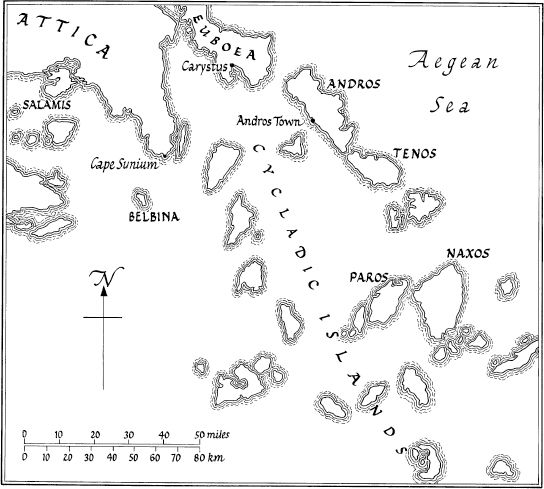
Salamis and Andros
The Greeks would have hauled onto Salamis whatever wrecks of either fleet were worth saving. After a naval battle, the victors always salvaged boats and towed them ashore. The buoyant wooden hulls of triremes often remained afloat, even after having been rammed. The shipwrights would immediately get busy with repairs to make them seaworthy again. Greek scavengers would scour the straits for hulls, as long as they avoided the Persian archers on the Attic coast, which Xerxes’ men still held. It was a reminder that Greece’s victory at sea was astonishing but not absolute.
In fact, the Greeks braced themselves after the battle for another attack. They knew that in spite of the damage they had inflicted on Persia’s ships, the majority of the enemy’s triremes had escaped. In the confusion of battle, the Greeks probably did not know how high a percentage of their kills consisted of the enemy’s best ships. And the Greeks’ victory was not bloodless: they, too, had suffered casualties and lost ships, if far fewer than the enemy had.
Herodotus calls the Athenian fleet “the salvation of Greece,” but the Greeks did not know that yet on the day after the battle of Salamis. They had won a great victory over the Persian fleet but not so great as to destroy it. What they did not understand at first was how great a blow they had struck at Xerxes’ will.
When they saw the Persians begin to build a causeway, the Greeks might have groaned at Xerxes’ terrible exuberance. Suddenly they had to fear an attack by land as well as by sea. Then came the shock of discovering on the morning of September 27 that the Persian fleet had left Phaleron Bay. We do not know just how the Greeks learned this information, since the enemy vessels had departed at night. Perhaps when no ships approached Salamis that morning, the Greeks sent a small force of ships to investigate and so learned the truth.
The day before, the Greeks would have marveled at the spectacle of Persian corpses on Salamis. Some were men who had tried to struggle ashore, only to be killed by Greek soldiers. Others had washed ashore, but a strong west wind blew up after the battle and carried the dead away from Salamis and toward Attica. Besides, after sinking within a few hours of death, many of the bodies would have stayed at the sea bottom for days until the gases of decay caused them to rise. Eventually, the shores of Salamis and Attica would have stunk of the unmistakable odor of decomposing human flesh.
The dead rowers would have been near naked, but the Persian marines wore gold jewelry, and the grandees even more of it. Booty belonged to the state or, in this case, to the Greek alliance, to be distributed after it was all collected. Still, everyone was a potential free-lancer, unable to resist helping himself to whatever piece of treasure he could get away with taking. Consider in this context a story told about Themistocles and a friend. They were walking along the shore after a naval battle, perhaps Salamis, and they saw corpses wash up with gold torques and bracelets. When his friend pointed them out, Themistocles replied, “Help yourself, for you are not Themistocles.” A general could not afford to get caught with dirty hands.
We hear nothing about prisoners at Salamis, although there were usually prisoners in naval battles. Wealthy captives would be ransomed and the rest enslaved. It may be that at Salamis the Greeks were too angry to spare enemy lives and the Persians too hard-pressed to stop to take captives. The Persians did capture at least five hundred Athenian civilians in Attica, but they were probably marched back east rather than given valuable space aboard the ships.
The Persian fleet was in a hurry to pull out of Phaleron in any case. To catch them in flight, on September 27 the Greeks launched their “swift ships” of Salamis, as an Athenian victory monument later called them, until the avenging armada reached Andros.
Andros island is big and nearly vertical. Its steep hills, terraced for grain cultivation and for growing figs, olives, and grapes, rise precipitously from the sea like a tan-colored screen, streaked with green, set above an enamel-blue background. Andros is a stepping-stone to Euboea, from which it lies about seven miles away, and to Attica, whose southern tip at Cape Sunium is about forty-five miles away. Andros’s location was both its fortune and its bad luck. Eyeing it as a useful stopping point for their ships, the Persians had conquered Andros in 490 B.C. and imposed a tribute, a tax. After Artemisium, they forced the Andrians to contribute ships to their fleet. With Salamis so near, the Andrians had no excuse to sit on the fence. We do not know how their ships fared in the battle, but now that an angry Greek fleet had descended on Andros, the islanders would have a great deal of explaining to do.
Andros Town, the classical city, commanded a wide bay. It sat on the west coast of Andros island, where its harbor was sheltered from the winds. The city was located about halfway down the coast of the long and narrow island, beneath the two peaks of Andros’s highest mountain.
Because Andros was hostile to the Greek cause, the commanders probably held their war council outside the city, in one of the tents pitched on the shore beside the moored fleet. It was there that Eurybiades had to put up with Themistocles’ challenge. Themistocles behaved with the ease of a man who was still in Salamis, staring across the straits at the familiar hills of Attica. He pressed his case against his commander in chief like a mathematician unveiling a new equation.
Themistocles argued that the road to the Peloponnese ran through the Hellespont. Let the Greeks sail beyond Andros, pursuing the Persian fleet through the islands all the way to the bridges connecting Europe and Asia. The Greeks could finish the job they had started at Salamis: they could defeat the Persians with their ships. Cut off and terrified, Xerxes and his men would practically swim home in their haste to escape.
Even if he was not to be moved by pity for the dispossessed, surely Eurybiades was ready to bow to Themistocles’ strategic genius, now that it had proven itself in the bloodstained sea at Salamis. No, yielding was un-Spartan. Tyrtaeus, favorite poet in Sparta, summed up the national ethos in his ode to battle: “So let each stand his ground firmly with his feet well set apart and bite his lip.”
But Eurybiades stood up to the Athenian and drew others to his banner. The commanders from Aegina and other islands might have agreed with Themistocles, but the mainlanders surely thought that victory had driven him mad. Even as the Greeks sat on Andros, Xerxes still occupied Athens, and the Persian army was marching toward the Isthmus. Raised in a world where battles were decided by men who fought on land, most Greeks would have thought it obvious that the road to the Peloponnese ran through the Isthmus of Corinth. What good would it do to break the bridges at the Hellespont when the Persian army was still at large and dangerous in the Greek homeland?
Eurybiades argued that far from trapping Xerxes in Greece, they should do everything to encourage him to go home. Leave the bridges alone; allow Xerxes to cross them. To isolate him in Greece would be like cornering a hungry lion. The barbarian would then spring back more ferociously than ever, threatening to conquer the cities of Greece one by one. In fact, it was likely that the Persians would now leave Greece, since they no longer had a navy and since they were short of food.
We might imagine that Eurybiades had another, perhaps unspoken, reason for opposing Themistocles’ plan. To concede the supremacy of sea power would amount to announcing the supremacy of Athens.
Themistocles was only speaking for his countrymen, since most Athenians agreed with him. They were in no mood to sit in exile on Salamis and wait patiently while the Persians decided what to do. Victory in the straits had convinced them of what they might have suspected at Artemisium: they had built the most effective navy in the eastern Mediterranean. From the Adriatic to the Nile, no sea power could challenge the Athenian fleet. And having realized this, the Athenians wished to shout it from the rooftops.
But they were not prepared to do it over the opposition of the rest of the Greeks. Or rather, Themistocles was not ready to lead his countrymen down that road alone. When he realized that he could not win the debate in the war council, Themistocles decided to give in. He would accept the argument of the majority of the allies and turn the fleet back to the mainland. First, he had to convince the Athenians. The men of the Athenian fleet would not have hesitated to leave their allies at Andros and go after the Persians on their own.
Themistocles left the council and called a meeting of the Athenians. Sitting outside near their ships, they would have represented no small gathering of men. Athens had mustered 180 triremes at Salamis. Assuming that it had lost some ships in the battle, that others needed repairs, and that others had been left to guard the island, Athens might easily have sent a hundred ships to Andros. No doubt some of these boats had lost men in the battle, and no doubt some of the crews were slaves and so ineligible to attend assemblies, but it would not be surprising if about fifteen thousand Athenian citizens or more heard Themistocles on Andros.
Themistocles sounded three themes: strategy, religion, and Athenian self-interest. Now that he had established himself as a military genius among his own people, Themistocles spoke in the sharp, short sayings of a man polishing his reputation. “Forced to fight,” he said, “defeated men battle back and repair their earlier cowardice.” He agreed with Eurybiades that it would be dangerous to trap the Persians in Greece.
Turning to religion, Themistocles said that it was not the men of Greece who had pushed back “a great cloud of men,” but rather it was “the gods and heroes who were jealous that one man—and an impious and wicked man—should rule both Asia and Europe.” Then he recited a list of Xerxes’ crimes against temples, statues of the gods, and even the sea, which he had whipped and fettered as punishment of the Hellespont for spoiling the Persians’ first attempt to bridge it.
Tempted to pass over these nods to piety, the modern reader should remember how fine a line there was for the Greeks between the human and divine worlds. For example, when a Greek wanted to say that he understood the limits of naval technology, he might have said he was a god-fearing person who respected the power of the sea god, Poseidon. And when he wanted to say that the Greeks had cleverly made use of nature at Salamis, from the narrowness of the straits to the force of the wind, he might have cited the help of the gods and heroes.
Finally, Themistocles advised the Athenians to think about their families, to rebuild their homes and plant their crops. In the spring they would sail for the Hellespont and for Ionia. Since the Persians were still in Attica, he was promising something he could not deliver—like many a politician. No doubt it was unnecessary to explain to his listeners that the Persians could not stay in Attica much longer, since they lacked food. But it was bold to promise a naval offensive in the next year, and one that would not stop at the Hellespont but would include Ionia!
Themistocles won the day with these words. He had done some fast talking, but he then followed it with outright treason. Or so Herodotus says: he reports that Themistocles sent a small ship back to Athens, perhaps a ten-oared vessel with a sail. He had staffed it entirely with close associates, men whom he trusted to stay loyal even if tortured. His slave Sicinnus was among them. They made for Phaleron and the Persian camp. There, while everyone else stayed aboard ship, Sicinnus got off and delivered a message to Xerxes.
It is a sign of how terrified the men were that they stayed on board. A small boat could not have reached Attica quickly from Andros, and the crew would normally have been eager to get on dry land. But they were also eager to survive. The intrepid Sicinnus told the Great King that he had a message from Themistocles. The clever Athenian wanted to do the king a favor, so he reported to him that the Greeks were following his fleet and planned to break the bridges at the Hellespont. The coast was clear for Xerxes to depart overland in peace.
It may seem strange that, after Salamis, Xerxes was willing to hear out Sicinnus again instead of having him hauled off and beheaded. But the story may show just how slippery Sicinnus and his master were. They might have argued that Themistocles’ message before Salamis was true as, after all, it largely was. If Panaetius the Tenian deserter had not warned the Greeks, they would have been surprised by the Persians and Xerxes would have won. And so, having delivered a second message, Sicinnus would have made everyone happy, even if the message was completely false. Xerxes and his army, who had to decamp for the winter, would leave Attica all the sooner; Themistocles had the satisfaction of having contributed to the liberation of his homeland while also keeping open his pipeline to the enemy; and Sicinnus and his crew-mates escaped back to Andros.
But a question remains: was Eurybiades right in holding back the Greek fleet? In the short term, he probably was right, because autumn, with its risk of storms, was the wrong season for a naval offensive. But in the long term he was wrong. The Greeks would have been foolish not to attack the Persian fleet in the following year, before the Persians had a chance to repair their broken navy. If the Greeks could keep the enemy from projecting naval power across the Aegean Sea, they would make it very, very difficult for Persia to conquer Greece. As for Eurybiades’ argument that holding Xerxes in Greece would only force him to attack, the big question was whether the Persians could beat the Spartan-led Greek army at the Isthmus before the Persians’ food supply ran out. An answer would have tested Sparta forcefully: no wonder Eurybiades preferred not to seek the answer.
Deprived of his naval offensive, Themistocles next did a remarkable thing. He and his allies had stood up to Persia in the name of liberty. They preferred death to giving the Great King earth and water and submitting to his demand that they pay tribute. The islanders of the Aegean had been forced by the Persian navy to do just that. Most of them, like Andros, had fought for Xerxes at Salamis, but it would have taken exceptional bravery to have done otherwise. Now that the Greeks had defeated the Persian fleet, they sailed to Andros and announced its freedom.
But Themistocles asked the Andrians to pay tribute to his fleet. In other words, he told them that they had, in effect, exchanged one master for another. The Andrians, who might have been dumbfounded by the demand, refused. Never at a loss for words, Themistocles said that Athens had two great goddesses who would demand the money: Persuasion and Necessity. Not to be outdone, the Andrians replied that they had two great goddesses of their own, Poverty and Hardship, and could not pay.
The wordplay was elegant but it gave way to force. The Greeks laid siege to Andros in order to get the money they had asked for. Andros Town sat on a steep hill that climbs spectacularly from the sea to the acropolis, which enjoys a height of about 1,250 feet, more than twice as high as the Acropolis of Athens. The city was protected by a well-built stone wall that connected harbor and acropolis. A sensible man would have shuddered at trying to take a fortress like this by siege. By even attempting to conquer the city, the Greeks might just have been trying to put the best face on the Andrians’ refusal to meet their demand for tribute. In any case, the siege could not have lasted long, since the Greeks moved on next to Euboea and then Sparta. Then the sailing season was near its end. Andros remained unconquered.
Yet quietly and apparently without a moment of hesitation, the Greeks had started a paradoxical venture. If a philosopher had asked Themistocles how he could defend Athenian freedom in one breath and attack Andrian freedom in the next, he might have shrugged off the contradiction. People on a god-given mission to liberate their homeland tend not to let inconsistency stop them.
Besides, the Greeks made no bones about the victor’s right to the spoils. After the battle of Marathon in 490 B.C., Athens’s triumphant commander Miltiades led a naval expedition to the island of Paros. It was a Persian ally and a very wealthy island. Miltiades promised his fellow citizens gold on Paros. But their siege of Paros failed. Miltiades was wounded, and all he got for his pains when he returned home was a jury that imposed a big fine on him for incompetence; he would have had to pay it, but he died first of his wounds. No wonder Themistocles was relentless at Andros.
He certainly did not single out Andros in his desire for money. After Sicinnus and his crew returned from Phaleron, Themistocles sent them to the other nearby Greek islands that had supported Persia. Their message was the same as at Andros: pay up or suffer siege and destruction. Paros, which had held its triremes back from Xerxes until the outcome of Salamis was clear, yielded to the demand, as did Carystus, a city in southern Euboea. Other islands may have contributed as well; the evidence is unclear.
It would be easy to criticize Themistocles for extorting money, especially because he kept it secret from his fellow Greek commanders. But remember that all of the cities that Themistocles held up had supported the attack on Athens; that a navy was very expensive to maintain; and that Sparta and the other Peloponnesian states had been ready only a few days before to abandon every last inch of Athenian territory. And if Themistocles kept for himself some of the money that was collected, remember, too, that he was not paid a thing by Athens for his public service.
But Themistocles probably should be taken to task for the attack on Carystus. When the siege of Andros failed, the Greek fleet made a short journey northward to Euboea. Carystus was the main city of southern Euboea. Its steep acropolis lay several miles inland from the coast. A siege would have been no more successful than it had been at Andros, so the Greeks contented themselves with doing some damage to Carystus’s countryside. This might have meant looting farmhouses, trampling on grapevines, and hacking at some olive trees while a terrified populace huddled within the walls of the town. If Eurybiades had known that the former Persian ally already was paying protection money to Athens, he might have spared it. Then again, it seems that Carystus had skimped, compared to Paros, which paid Themistocles enough to deter an attack, so the Euboean city bears some blame for its misery.
The Greek navy next returned to Salamis. By now, Xerxes and the Persian army had pulled back from Athens into northern Greece. That meant, first and foremost, that the Athenians could go back to their homes. From Troezen and Aegina, and above all from Salamis, there was a mass movement of return. We would expect that the Athenian navy helped people get home, just as it had taken part in the evacuation.
Attica itself was probably largely intact. The Persians had not been there long enough to inflict deep devastation on the land’s infrastructure. But they had gone after prestige targets. Besides destroying temples and overturning statues, they had carried off works of art with them back to Anatolia. The most famous losses were a bronze statue of the goddess Artemis, taken from her rural shrine at Brauron, and a set of statues of the heroes Harmodius and Aristogeiton. The images of these two men, honored as tyrant slayers, were taken from the Athenian Acropolis to Xerxes’ palace at Persepolis, in southwestern Iran. When Alexander the Great arrived there as a conqueror in 330 B.C., he arranged for the statues to be brought back to Greece. The originals have disappeared, but Roman-era copies of excellent quality still survive.
On Salamis, the commanders had the breathing space to take care of an important post-battle ritual: distributing booty. It was standard procedure for the victors to comb the field—or the ships and the shore—for anything worth taking. Afterward, it was up to the commanders to parcel out the loot. It was to be expected that each commander would keep something for himself. And valor on the battlefield would also be rewarded.
After the battle, all the talk was of the bravery of Aegina, followed by that of Athens. Plunder was distributed accordingly. The gods were rewarded before cities or individuals. The Greek way was to dedicate one tenth of the booty, the so-called first fruits, to the gods. The Salamis tithe consisted of various objects, including three Phoenician triremes, one at Salamis, as an offering to Ajax, and the other two as offerings to Poseidon, one at Cape Sunium in Attica and the other at the Panhellenic shrine at the Isthmus. This was the ship that Herodotus reported seeing fifty years after the battle.
The shrine of Apollo at Delphi was the holiest site in Greece and it, too, had to receive a thank-offering. The fleet at Salamis sent enough booty to Delphi to erect an almost eighteen-foot-high bronze statue of Apollo holding the stern ornament of a ship in his hand. But the priests of Delphi let it be known that the god Apollo felt shortchanged by Aegina, the biggest single beneficiary of the plunder of Salamis. The Aeginetans made amends by building a monument at Delphi consisting of three gold stars on a bronze mast, which Herodotus also saw.
After dividing the booty, the Greek allies left Salamis. They were finally going to the Isthmus. After they launched their ships and began the trip, as the island disappeared in the distance, it might have occurred to someone aboard one of the departing triremes just how much the world had changed since the night of September 24–25, when the Greek move to the Isthmus had been interrupted by the news that the enemy had surrounded them at Salamis.
Isthmia was a religious shrine, sacred to Poseidon, lord of the sea. It was also territory that belonged to Corinth. Isthmia lay just beyond the makeshift wall thrown up a month earlier to stop the Persians. Here, the ongoing threat to Greece would have often intruded into men’s minds. It was not the place for calm reflection, but it was where the alliance had chosen to make an important decision.
The commanders were to choose which one of them should be awarded a prize for bravery at Salamis. Each man’s career, and the honor that every Greek craved, depended on the result. To win the vote would be splendid; to support a loser would be fatal. In what might have been an effort to substitute solemnity for favoritism, the commanders followed a ritual voting procedure: one by one, they were to walk up to the altar of Poseidon and each deposit his ballot.
But unfortunately, nobody rose to the occasion. Each general without exception voted for himself. But he was also asked to award second place. On this matter, a majority—though not all—voted for Themistocles. But jealousy prevented the awarding of any prize. The navy was disbanded and the commanders each sailed home, but not without a murmur making the rounds, as Herodotus reports:
Themistocles’ name was the cry of the hour, and it was agreed that he was the smartest man in all of Greece.
But an ambitious man like Themistocles wanted more than a murmur of support; he wanted formal recognition. He had not received it from his comrades at Salamis nor was he likely to get it from his fellow citizens in Athens. Democracy distrusts great men, and Themistocles was not ashamed about reminding Athenians of his greatness. We can detect the signs of a postwar debate in Athens as to whether Salamis was a victory of the Athenian people or of their most famous strategist. Besides, it is human nature to hate those who see our secret weakness, and Themistocles had seen his countrymen at their most vulnerable.
A revealing anecdote is told about a certain Athenian named Timodemus of the deme of Aphidna. He was an insignificant person whose jealousy of Themistocles verged on insanity but brought him into the public eye. Timodemus constantly told Themistocles that he would have been nothing had he not been an Athenian. Finally, Themistocles swatted his enemy down with a witticism: “If I came from [the tiny islet of] Belbina,” Themistocles said, “I’d be nothing, but even though you are an Athenian, Timodemus, you are still nothing.” Timodemus may have been a buffoon, but behind him, one suspects, there stood thousands of Athenians who each felt that in his private sacrifice—from fighting on a ship in the straits to living off the handouts of strangers in exile—he or she had made a difference. And none of them wished to bow down before a statue of Themistocles, however much he might have deserved their curtsy.
Disrespected in his own city-state, Themistocles had to go to Sparta to achieve recognition. If this seems strange, remember that the more Sparta glorified Themistocles, the less it had to honor its own hero, Eurybiades. Spartans liked the cult of personality no more than Athenians did. So they chose the perfect gesture to force Themistocles and Eurybiades to share their glory: they gave them each an olive wreath, Eurybiades for bravery and Themistocles for wisdom and dexterity. It was as much as saying that neither man could quite have won the victory alone.
The Spartans also gave Themistocles a chariot, the most beautiful available in Sparta. It was probably a fairly plain affair, given how much Spartans disliked luxury. But no one could deny the praise that was heaped on Themistocles in Sparta. The most striking thing of all was the escort that he received: three hundred picked men accompanied Themistocles to the border when he left. Herodotus knew of no other man in history to have received this honor from Sparta. And the number three hundred, of course, recalled the number of men who died with Leonidas at Thermopylae. To be sure, this tended to downplay the battle of Salamis, but let us give the man his due: the gesture also meant that the greatest military power in the history of the Greeks associated Themistocles with their finest hour.
It could not have been easy to go back to the plain homespun of democratic Athens, especially of an Athens in mourning. To the loss of its religious heart on the Acropolis, add Athens’s experience of death, dislocation, and devastation. Athenians had died at Artemisium, on the Acropolis, and in the straits of Salamis; Athenians had been dragged off in slavery to the east. A society in which suffering had been spread as evenly as it had in Athens was ready to draw an unknown soldier to its breast, but it was in no mood to crown a king.
When the war began again in the spring of 479 B.C., Themistocles commanded no Athenian army. The generals of the day were his old rivals, Aristides and Xanthippus. In all likelihood, Themistocles had failed to be reelected to the annually chosen board of ten generals, but in any case, he was out of favor. It would not be the last time that a democracy dropped a dominant leader.
To jealousy and fear of ambition, we might add another reason for Themistocles’ eclipse at home, and that is the dawning realization that the war was not over. Themistocles had been the architect of a naval strategy. Its brilliant success now guaranteed its eclipse. A second Salamis would not save Greece: this time, an infantry battle loomed.
To put it in more modern terms, Salamis was a Greek Gettysburg; it was not Appomattox Courthouse. Salamis was Stalingrad, not the battle of Berlin. Salamis was a decisive battle because it broke the Persian navy, but it did not drive the Persians out of Greece. Salamis brought final victory nearly into the Greeks’ hands, but it was not the last battle of the war.
Contrary to what Eurybiades had predicted at Andros in the autumn of 480 B.C., the Persians did not all leave Greece. A large enemy army remained on the Greek peninsula, threatening Attica and the Peloponnese beyond, and aided and comforted by such famous Greek states as Macedon and Thebes. In the end, only a wall of Spartan spears and a sea of Spartan blood would drive them out. The result would bring glory to Sparta but not to Eurybiades, for he was an admiral and not a general. And Athens would gain glory too, for its spearmen stood in the front lines as well and fought hard, but none of that glory would go to Themistocles.
Still, glory is not the same as power. In the aftermath of the Greek victory on land at Plataea and both on land and at sea at Mycale (a battle in 479 B.C.), Themistocles’ star rose again in Athens. As soon as they had driven Persia out of Greece, the Greeks turned on each other. To stand up to Sparta, the Athenians needed a leader who was not only brave, but ruthless and devious. Neither the ham-fisted heroics of Aristides nor the stubborn energy of Xanthippus was enough. Only Themistocles and his webs of intrigue would do.
Returned to power, Themistocles managed to defy Sparta and rebuild the walls of Athens (the Persians had destroyed them). He did this by lying through his teeth to the Spartans, his former friends. By using diplomacy as a delaying tactic, Themistocles kept them from discovering that Athens was rebuilding its walls—until it was too late. The Spartans were furious, but Athens protected itself from outside interference. Themistocles also got the Athenians to finish fortifying their new harbor at Piraeus, a project he had begun years before but which had not been completed.
Themistocles served during these years as the leading spokesman for the viewpoint that Athens’s future lay at sea. He was a tireless advocate of naval power. He urged Athenians to move to Piraeus, to find work in the dockyards there, and to think of Athens as a maritime country. In other words, he said that the fleet of Salamis was no aberration but the real Athens.
Themistocles was a revolutionary and creative thinker. But like many a prophet, he lacked honor in his homeland. His political base in the 470s was narrow, and he did not play a major role in setting up the new naval confederacy of Delos that Athens established in 477 B.C. The leadership in Athens passed to other shoulders.
And yet Themistocles was truly the father of the new Athens. He had founded the fleet and so had saved his country. But by raising Athens’s power to new heights, Themistocles also sowed the seeds of a new conflict. Fifty years after Salamis, the two former allies against Persia would lead the entire Greek world into a new and even more destructive conflict. The Peloponnesian War (431–404 B.C.) was brutal enough to make many long for the good old days of the barbarian invasion.
For two months at the moment of their civilization’s greatest danger, Themistocles and Eurybiades had put rivalry aside. Their common effort saved Greece. But only for a while: Greek indifference to the long-term dangers of competition ultimately doomed it. The image of an Athenian and a Spartan standing side by side, each crowned with a victor’s wreath, would not be seen again.
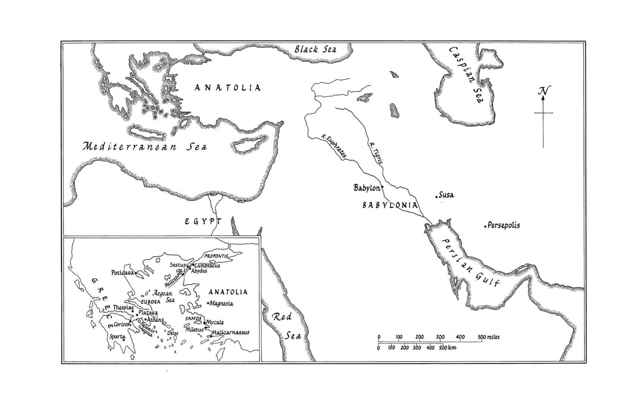
Greece and the Ancient Near East