
5
In the eighteenth chapter of the Qur’an, an account is given of an enigmatic figure called Dhūl Qarnayn, the Two-Horned One. Allah is said to have given Dhūl Qarnayn power over the earth, enabling him to travel to the outer limits of the world, east and west. Most later Islamic scholars agreed that the figure of Dhūl Qarnayn was an allegory of Al-Iskandar, Alexander the Great. The two horns represented Alexander’s rule over the two halves of the world, Rūm (Europe) and Persia. The ancient conquests of Al-Iskandar were understood as prefiguring the Arab conquests of the seventh and eighth centuries AD, which created an Islamic empire stretching from the Atlantic to India. At the city of Cadiz, beyond the straits of Gibraltar, where the Mediterranean and Atlantic meet, Al-Iskandar had built a lighthouse, indicating the point beyond which it was unsafe for ships to sail. In the far north, at the fringe of the central Asian steppe, he had constructed a great iron wall to keep out the unclean races of Gog and Magog. It was Alexander who had fixed the limits of the civilized world once and for all.
The geographical extent of Alexander’s conquests was indeed astonishing. Between 334 and 330 BC Alexander overran the Asia Minor peninsula, Syria, Egypt, and the Persian heartlands of Mesopotamia and western Iran. The last Achaemenid king, Darius III, was overwhelmed in two great battles, at Issos and Gaugamela; the passing of the Persian world order was ceremoniously marked by the burning of the palaces of Xerxes at Persepolis in the winter of 331/0 BC. It is telling that after the capture of the four Persian royal capitals, Babylon and Susa in southern Mesopotamia and Persepolis and Ecbatana in western Iran, Alexander dismissed the Greek contingents in his army. The campaign of revenge for the Persian invasion of Greece, ostensibly undertaken on behalf of the League of Corinth, was at an end. But Alexander himself pressed on eastwards across northern Iran, in pursuit of the fugitive Darius III. After Darius’ assassination by his own courtiers, the emergence of a Persian pretender to the throne, Bessus, drew Alexander into a long and gruelling guerrilla campaign in the central Asian satrapies of Bactria and Sogdiana (modern Afghanistan, Uzbekistan and Tajikistan). The deep isolation of the royal court, chasing ghostly Persian rebels across the endless central Asian steppe, fuelled Alexander’s growing paranoia and megalomania; shadowy plots against the king’s life were followed by summary executions, and for the first time Alexander began to expect divine honours from his court and subjects.

Map 17. The campaigns of Alexander the Great, 334–323 BC.
Alexander the Great and the Ottoman conquest
In 1453 the city of Constantinople fell to the Ottoman armies of Mehmed the Conquerer, thus bringing to an end the thousand-year history of Byzantium, the ‘New Rome’. As we are told by several Latin authors who witnessed the siege of Constantinople, or who met Mehmed shortly afterwards, the Conquerer had a particular interest in the history of Alexander the Great. ‘He wished to be recognized as the master of the earth and all its peoples, that is to say, as a second Alexander; it is for this reason that he used to read the works of Arrian, who compiled a careful account of the deeds of Alexander, on an almost daily basis.’
The idea of a fifteenth-century Turkish sultan reading Arrian’s Anabasis (the longest surviving Greek history of Alexander, written in the second century AD) might seem rather unlikely at first sight. However, Mehmed’s own private copies of Arrian’s Anabasis and Homer’s Iliad, commissioned after the fall of Constantinople, are still preserved today in the imperial library of Topkapı Palace in Istanbul. The court historian Kritoboulos of Imbros, a Greek who completed his hagiographical biography of the Conquerer in the mid-1460s, claimed to be recounting for his fellow-Greeks a career which was ‘in no way inferior to that of Alexander of Macedon’. No doubt influenced by Mehmed’s admiration for Alexander the Great, Kritoboulos presented Mehmed as a new Alexander, who had succeeded (through the conquest of Constantinople) in once again yoking together Europe and Asia. Mehmed himself liked the idea that he was repeating Alexander’s campaigns in reverse. Kritoboulos recounts how, in the course of his campaign against the island of Lesbos in 1462, Mehmed passed by the ruins of the site of Troy, just as Alexander had done in the summer of 334 BC. He asked that the tombs of Achilles, Ajax and the other heroes be pointed out to him, and praised them both for their deeds and because they had found so fine a writer as Homer to commemorate them. Shaking his head a little, Mehmed reflected how God had at last, after many generations, allowed him to avenge the sack of Troy and punish the enemies of the Trojans. With the fall of Constantinople, the Greeks had finally paid the penalty for the long centuries of injustices towards ‘us people of Asia’.
In spring 327 Alexander turned south, and later that year he led his army over the Hindu Kush into India. In the late sixth century BC Darius I had claimed India as part of the Persian empire, but his conquests were probably short-lived; there is virtually no archaeological evidence for Persian presence in the lands beyond the Khyber Pass. For the first time, Alexander was extending his conquests beyond the boundaries of the Persian empire. But the invasion of India was perhaps not as much of a leap into the unknown as it might appear. Due to an unfortunate geographical misconception – that the Indian Ocean was an inland lake – Alexander had believed that the Indus river was connected to the upper course of the Nile. On reaching the Punjab, he could simply sail back downstream to the Mediterranean. This idea was initially confirmed by the presence of lotus flowers and crocodiles in the Indus. Since the fifth century BC, Greek botanists had believed that certain flora and fauna were unique to particular parts of the world; it was well known that lotuses and crocodiles were to be found only in the Nile. When the true geography of the region finally became clearer, the result was mutiny among Alexander’s Macedonian troops, who refused point-blank to continue their march eastwards. The long journey back to the west, down the Indus river and across the Gedrosian desert (modern Baluchistan), was marked by increasingly reckless and gratuitous slaughter of native populations. In summer 323 BC, in the midst of preparations for a naval assault on the Arabian peninsula, after a massive drinking bout with his Macedonian companions, Alexander, king of the world, died at Babylon.
Alexander’s premature death makes it hard to judge quite how far he was planning to go. Arrian, the author of the fullest surviving history of the Macedonian conquests, believed that his intended empire had no geographical limits; Alexander would never have been satisfied even if he had added Europe to Asia and the British Isles to Europe. The actual course of Alexander’s Far Eastern conquests tells against this view. With the exception of the Indian provinces – which were abandoned within a generation – Alexander made no attempt to extend the limits of the Persian empire. In the north-east, Alexander advanced only as far as the limits of Cyrus’ campaigns, the Syr Darya river in what is now Tajikistan. The foundation there of a new city called Alexandria Eschatē, or ‘Alexandria the Furthest’ (probably the modern city of Khujand) shows that further expansion to the north was explicitly renounced. Indeed, in most respects, the vast empire which Alexander left behind bore a striking resemblance to that which he had set out to conquer. The old Persian provinces (‘satrapies’) were preserved, though now with Macedonians rather than Persians acting as provincial governors. The Persians had believed that their empire encompassed the entire inhabitable world, stretching southwards and northwards to where heat and cold respectively made it impossible to live, and Alexander seems to have accepted this view of world geography. Alexander’s empire was nothing less, but also nothing more than, the oikoumenē, the ‘inhabited world’, as defined by his Persian predecessors.
At no stage did the Macedonians see themselves as striking out into the unknown. Their conquests all took place within the limits of the world mapped out by the travels of Greek heroes of the remote past. In the winter of 332/331 BC, Alexander travelled deep into the Libyan desert to consult the oracle of Zeus Ammon, in emulation of two of his supposed ancestors, Heracles and Perseus, both of whom were said to have visited the oracle. Where existing Greek stories failed to provide precedents for a stretch of Alexander’s campaigns, suitable precedents were simply invented. When Alexander stormed the mountain fortress of Aornos, high in the tribal regions of modern Pakistan, considered by the locals to be impregnable even for a god, this was swiftly spun into a legend that Heracles had tried and failed to capture the fortress. The presence of ivy in the mountains north of the Khyber Pass, a plant closely associated with the god Dionysus, encouraged Alexander to think that he was following in Dionysus’ footsteps. Since no pre-existing mythological tradition associated Dionysus with India, the Macedonians had to use their imaginations. A new episode was added to the god’s career, describing how Dionysus conquered the sub-continent some time in the distant past, bringing civilization and the rule of law to the barbarous Indians. On this interpretation, Alexander was merely restoring Graeco-Macedonian rule to a society which owed its existence in the first place to the conquests of Dionysus. Late in 325 BC, when the Macedonians finally emerged from the crossing of the Gedrosian desert, their own successful reconquest of India was celebrated with a week-long drunken riot in honour of the god, with Alexander himself playing the role of Dionysus. And so it was that the venture into India, the wildest and most remote campaign ever undertaken by an ancient general, was brought firmly back within the familiar realms of Greek and Macedonian mythical geography.
Alexander was succeeded by his mentally deficient half-brother Arrhidaeus and his own unborn baby, the child later known as Alexander IV. Neither was capable of ruling Alexander’s empire in his own right, and it was clear from the outset that a regent would be required. Unfortunately, Alexander’s tendency to concentrate all power in his own person had left no obvious candidate for the post. The decade immediately following Alexander’s death was characterized by violent clashes between self-appointed regents of the kings, none of whom possessed sufficient authority to hold the vast empire together. Arrhidaeus was assassinated in 317 by Alexander’s formidable mother Olympias, who seems to have been aiming at the Macedonian throne in her own right, and the young Alexander IV was quietly done away with in 310.
By this stage it had become clear that the real players were the Macedonian governors of the old Persian satrapies. Most of these men were veterans of Alexander’s campaigns, and could draw on the formidable financial and military resources accumulated by their Persian predecessors. The most energetic of these satraps was a man of Philip’s generation, Antigonus the One-Eyed, governor of Phrygia in central Asia Minor. By the time he declared himself king in 306 BC Antigonus had won for himself a huge realm in Asia Minor and Syria, ringed by four other great powers, Ptolemy in Egypt, Seleucus in Babylon and the Far East, Lysimachus in Thrace, and Cassander in Macedon. Antigonus was killed in battle in 301 BC, and his short-lived empire was carved up between the other dynasts. However, his son Demetrius the City-Besieger managed to rebuild an impressive kingdom, this time in Macedon and mainland Greece. By 281 BC, when Lysimachus’ Thracian realm was overrun by the 77–year-old Seleucus, the essential balance of power for the next century had become clear: the Ptolemies in Egypt and the Levant, the Seleucid dynasty in Asia, and the descendants of Antigonus in Macedon.
The dynastic legitimacy of the new kingdoms was shaky to say the least. None of the three families which eventually triumphed in the wars of the Successors bore any blood relationship to Alexander himself. Their claim to a share of the conqueror’s throne had to be justified by other means. Ptolemy, conveniently, had been one of Alexander’s boyhood friends, and he cheerfully encouraged the rumour that he was really a bastard son of Philip II, and thus half-brother to Alexander himself. Ptolemy also possessed the most potent royal relic of all: Alexander’s body. The king’s funeral cortège had been shamelessly hijacked by Ptolemy’s agents while it was being transported back home to Macedon, and the embalmed corpse of Alexander was put on display in a glass coffin in the Ptolemaic capital of Alexandria. Although the other dynasts were unable to claim such intimate links with Alexander, they could at least copy his image. For centuries, royal portraits from all corners of Alexander’s former empire depicted the kings as clean-shaven, with an upturned gaze, wild, flowing hair, a quiff, and divine attributes of one kind or another, just like Alexander (see Plate 31a). Alexander provided a model and an ideal of kingship, against which all his Successors would be judged.

Map 18. The Hellenistic kingdoms in the third century BC.
To treat the Successor kingdoms as part of the history of Classical Europe might seem to be stretching the definition of ‘Europe’ a bit. After all, most of Alexander’s empire lay deep in Asia; the royal capitals of the Seleucid kingdom were located in modern Syria and Iraq, and its eastern marches bordered on China. The principal reason why the Seleucids and Ptolemies deserve a place in European history is their role in spreading Greek culture among the non-Greek populations of the former Persian empire. Since the late nineteenth century this process of ‘Hellenization’ has given its name to the entire historical epoch: the three centuries after Alexander’s death are today generally known as the Hellenistic age, an age not merely of Greekness but of becoming Greek.
The Hellenization of the east had begun well before the fall of the Persian empire. Over the course of the fifth and fourth centuries BC, the non-Greek peoples of western and southern Asia Minor had been profoundly influenced by the culture of their Greek neighbours. The native dynasts of Lycia, for example, certainly employed Greek sculptors for their lavish funerary monuments. The Nereid Monument (c. 400– 380 BC), now in the British Museum, is a fairly characteristic case. It is probably the tomb of a Lycian dynast by the name of Arbinas, a member of a pro-Persian family controlling a small fiefdom in the Xanthos valley in western Lycia. Despite Arbinas’ political sympathies, both the architecture and sculpture of the Nereid Monument are thoroughly Greek in inspiration. When recounting his military exploits in prolix verse inscriptions, Arbinas chose to have the texts written in both the Lycian and Greek languages. Even this pro-Persian dynast wished to present himself to his subjects as culturally Greek.
The progress of Hellenization in Asia sharply accelerated after Alexander’s conquests. Between 332 BC, when Alexander founded the great city of Alexandria on the Mediterranean coast of Egypt, and the mid-third century BC, hundreds of new Greek cities were established across the breadth of the oikoumenē, from Egypt to Afghanistan. One of the best known is the Greek colony at Ai Khanoum, near Mazar-i Sharif on the modern Afghan–Tajik border, excavated by French archaeologists in the 1960s and 1970s (seeFigure 19). Here, in the heart of ancient Bactria, the Hellenistic settlers could exercise in a Greek-style gymnasium, equipped with olive oil imported all the way from the Mediterranean. Papyrus fragments of an unknown philosophical work by Aristotle were excavated here; under a Bactrian sun, tragedies by the Athenian playwright Sophocles were performed in a Greek theatre. At the heart of the city, in the hero-shrine of the city-founder Kineas, Delphic maxims were inscribed for the moral improvement of the Greek colonists: ‘as a child, be well-behaved; when a young man, self-controlled; in middle age, be just; as an old man, a good counsellor; at the end of your life, free from sorrow.’ Ai Khanoum mimics the outward forms of the Classical Greek polis so effectively that it is an effort to recall that this was not an independent citizen-state like fourth-century Athens or Messene, but a tiny cog in the vast engine of a Macedonian military dictatorship stretching from the Aegean to Kandahar. The countryside around Ai Khanoum was farmed, not by free Greek citizens, but by a subject population of Bactrian serfs with names like Oxyboakes and Atrosokes, whose taxes were collected and processed at a Persian-style palace sprawling across the central zone of the city, before being sent west to Syria and Mesopotamia to fund the colossal Seleucid armies. Whatever else Hellenization may have meant, it certainly did not mean giving Oxyboakes the vote.
Throughout Alexander’s former empire, the segregation between the Graeco-Macedonian ruling class and their non-Greek subjects was all but total. At best, a few bilingual Egyptians, Persians and Syrians could aspire to jobs as clerks, accountants and tax-collectors. Of all the thousands of royal officials, courtiers and high-ranking officers in the Ptolemaic and Seleucid kingdoms, less than 3 per cent were anything other than Greek or Macedonian. In the mid-250s BC, a Greek businessman and camel-trader in Egypt, Zeno, received a letter from one of his Egyptian agents, who complained that his immediate superiors had maltreated him, starved him and refused to pay him his salary, ‘because I do not speak Greek’.
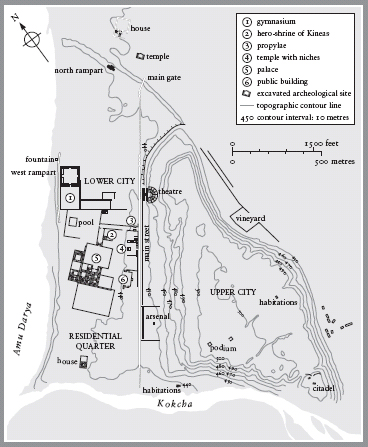
Figure 19. Ai Khanoum, site plan.
The Hellenization of the non-Greek people of the oikoumenē was, then, by no means an article of royal policy. Instead, the transformation of local cultures was driven from below. In a world where Greekness meant power, there were strong incentives to adopt the trappings of Greek culture as best one could. We saw in the previous chapter that the creative manipulation of Greek stories about the remote past played a central role in the formation of the Messenian state. This kind of manipulation now took on a new urgency. Early in his campaign, Alexander had advertised a ‘new deal’ for the Greek cities of Asia Minor: both freedom from taxation and (albeit limited) political autonomy. When Alexander arrived at the obscure Cilician town of Mallos, on the south coast of Asia Minor, in late summer 333 BC, the Mallians had their story ready. Culturally speaking, there was nothing Greek about Mallos at all. But one of their local Cilician divinities was, they argued, none other than the mythical hero Amphilochos of Argos, who had founded Mallos some time in the distant past. Therefore the Mallians, however Cilician they might look, were in fact the descendants of Argives. The reason why this was such an ingenious line to take was that the Macedonian kings also claimed to be of Argive descent, tracing their ancestry back to the Argive hero Heracles. Alexander was sufficiently impressed by this appeal to kinship with Macedon that the Mallians were instantly accorded the status of a Greek city and received full tax-exemption. The message was clear enough: Greek ancestry meant favourable treatment.
It is hardly surprising that in the late fourth and third centuries BC hundreds of cities in western Asia, from Lydia to Syria, suddenly discovered Greek gods and heroes at the roots of their family trees. Some cities were fortunate. According to one Greek version of the myth of Europa and the bull, Europa and Kadmos were the children of Agenor, king of the Phoenician city of Sidon. When Europa was abducted by Zeus, Kadmos set out from Phoenicia to search for his sister; he eventually settled in Greece, founding the city of Thebes in Boeotia. Few Phoenicians would even have been aware of this story before the third century BC: Europa, Kadmos and Agenor were purely Greek figures, with no place in native Phoenician mythology. But once it dawned on the Sidonians that they already held a special place in the Greek legendary past, they seized on the story with enthusiasm. From the early second century BC the figures of Europa and the bull start to appear on the coins of Sidon. Around 200 BC a Sidonian athletic victor at the Nemean games – a highly significant event in itself, since only Greeks were allowed to participate at the Panhellenic games – described Sidon as the ‘house of the sons of Agenor’, and spoke of the delight felt by the Thebans, ‘the sacred city of Kadmos’, at the success of their Phoenician mother-city at the games. The Sidonians were learning fast: the monument on which the victory was recorded, written in impeccable Greek elegiac couplets, is the earliest Greek inscription known from Sidon. Other non-Greek states had to work much harder at reshaping their past. The inhabitants of the little town of Harpagion in north-west Asia Minor, named after a Persian general called Harpagus, furiously denied they had anything to do with the Persians at all. Instead, their town was named after the seizing (harpagē) of Ganymede by Zeus, which had, they claimed, happened right there at Harpagion.
Hellenism in Asia Minor
In the nineteenth century there were around 1 million Greeks living under Ottoman rule in Asia Minor, making up some 8 per cent of the total population. Most of the Greek population was concentrated in the far west of the peninsula, with smaller communities living in Cappadocia and on the Black Sea coast. In the early nineteenth century the Greeks of Asia Minor had lived in small koinotites (‘communities’), relatively cut off from one another and with very little sense of a collective identity. Once an independent Greek state had emerged on the far side of the Aegean in the 1830s this began to change very rapidly. Increasing numbers of Greek schools and literary societies were established in the provincial towns of Asia Minor, offering an educational system modelled on that of the fledgling Greek state. In Sinasos, deep in the heart of rural Cappadocia, the school curriculum included Greek history, Church history, Xenophon, Isocrates, Demosthenes and Plato; Ottoman studies are conspicuous by their absence. The emphasis on ancient Greek culture was crucial in fostering a new sense of Greek national identity among the Asia Minor Greeks.
There was also a growing interest in the local history of the ancient Greek cities of Asia Minor. The Mouseion and Nea Smyrnē, learned journals produced at Smyrna in the 1870s and 1880s, published hundreds of ancient Greek inscriptions discovered and copied by doctors and schoolmasters in the small towns of western Asia Minor. Most of these local Greek antiquarians – Dr N. Limnaios of Artaki, G. Sarantidis of Alaşehir – are little more than names to us. However, the gravestone set up by Sarantidis for his 1–year-old daughter Efthalia can still be seen in the ruins of the church of St John at Alaşehir. The inscription concludes with the words ‘born on 24 May 1878, died on 18 June 1879, in Philadelpheia’. Virtually all that we know of Mr Sarantidis, apart from the inscriptions which he copied, is the fact that he chose to identify his home town of Alaşehir by its ancient Greek name of Philadelpheia, a name which had not been in use for four hundred years.
The re-emergence of a Greek national identity in Asia Minor ultimately had tragic consequences. As the Ottoman empire imploded at the end of the First World War, the Greek army (with the encouragement of the British Prime Minister, David Lloyd George) occupied first the area around Smyrna, and ultimately much of the western half of the Asia Minor peninsula. The Greek aim – the so-called megalē idea, or ‘Grand Ambition’ – was the establishment of a greater Greek state encompassing all the ‘historically Greek’ territories around the Aegean sea. After two years of bloody warfare (1920–22) the Greeks were driven out of the peninsula. In 1923 Greece and Turkey agreed a general exchange of populations; more than a million Greek Orthodox inhabitants of the Ottoman empire, most of them from western Asia Minor, were relocated to Greece, ending a Greek presence that had lasted some three and a half thousand years.
This ‘rediscovery’ of a Greek past by the non-Greek city-states of Phoenicia and western Asia Minor was accompanied by an enthusiastic adoption of the trappings of Greek civic life. Characteristic Greek institutions and public buildings – theatres and council-houses, the use of silver and bronze coinage, athletics and the culture of the gymnasium – were widely taken up across the Near East. A few enterprising local historians, like Berossos in Babylon and Manetho in Egypt, wrote histories of their native countries in the Greek language; the surviving fragments of Manetho’s work include elements from various Egyptian historical traditions (king-lists, prophecies and priestly autobiographies), woven with remarkable success into a Greek-style narrative history. One of Manetho’s main aims was to correct the hit-and-miss account of Egyptian history in the Histories of the Greek historian Herodotus. Others responded to Herodotus’ work in more self-interested ways. In the mid-220s BC the city of Sardis, former capital of the Achaemenid province of Lydia, sent an embassy to Delphi to seek recognition of their status as a Greek polis. The Sardians appealed to the ancestral goodwill shown by Delphi towards their city; it seems that they were relying here on the first book of Herodotus’ Histories, which gives a long account of the warm relations between the sixth-century Lydian king Croesus and the Delphic oracle. The Sardians’ route into the privileged Greek club was evidently smoothed by their prominent position in Herodotus’ work.
Not all the inhabitants of the Near East found it so straightforward to assimilate their local cultures to that favoured by the ruling power. In the late 170s BC a group of cultural Hellenizers at Jerusalem petitioned the Seleucid monarch Antiochus IV Epiphanes for permission to reorganize Jerusalem as a Greek polis, and establish a gymnasium in the heart of the city. There is no real evidence that this group had any intention of reforming or ‘Hellenizing’ the Jewish religion itself. However, a few years later, in 167 BC, Antiochus IV decided to suppress the Jewish religion by force. The observation of Jewish religious practices was forbidden by law, circumcision was punishable by death, and a pagan altar to Zeus Olympios was built on top of the great altar of burnt-offering in the Temple at Jerusalem. Why Antiochus should have tried to impose this policy of enforced Hellenization remains very unclear; as we have seen, most of the Hellenistic monarchs were quite happy for their non-Greek subjects to stay non-Greek. Indeed, subsequent events in Judaea made it all too clear why Antiochus’ predecessors had refrained from imposing European cultural norms on their subjects. Jewish resistance was widespread, violent and ultimately decisive: the Temple cult was restored within three years, and by the 140s Judaea had won effective independence from Seleucid rule.
The apocryphal Book of Daniel, composed in the earliest years of the Jewish resistance in the mid-160s, gives us some sense of the ways in which the Jews tried to legitimize their struggle against Antiochus in relation to the Jewish past. The Book of Daniel purports to be a prophetic text of the sixth century BC, recording the visions of the prophet Daniel in the last days of Jewish captivity at Babylon and the earliest years of the Persian empire. In one of Daniel’s visions, a ram (the king of Media and Persia, Darius III) is defeated by a goat from the west (the king of Greece, Alexander the Great), whose horn is broken and replaced by four horns (the four Hellenistic kingdoms, the Seleucids, Ptolemies, Antigonids and – presumably – the Attalids of Pergamum). From one of these horns shall come a little horn (Antiochus IV), who will destroy the Temple, suppress daily sacrifice, and impose the ‘abomination of desolation’ (the pagan altar at Jerusalem). The reign of this king, predicts Daniel, will come to an end with the Day of Judgement and the dawning of the Kingdom of God – a fairly good indication that the author of the Book of Daniel was writing before the end of Antiochus’ reign. It is fascinating to see the Jews of the second century BC trying to weave the history of the Hellenistic kingdoms and the persecution under Antiochus IV into the fabric of the wider Jewish past. The religious crisis of the 160s BC is given meaning and significance through the ‘discovery’ that it had all been predicted by a sixth-century Jewish prophet in exile at Babylon.
Similar writings were certainly circulating in Egypt at the same period. One particularly remarkable text of the late second century BC, the Oracle of the Potter, claims to record a prophecy once made by an Egyptian potter to Pharaoh Amenhotep, one of four pharaohs of that name who reigned in the second millennium BC. The Oracle predicts that the patron deity of Alexandria will abandon that city and come to Memphis, the old native capital of Lower Egypt, ‘and the city of foreigners which was founded will be deserted’. The abandonment of Alexandria will mark the end of ‘the period of evils, when a crowd of foreigners like fallen leaves descended on Egypt’. The Potter was overly optimistic: the Greeks were not expelled from Egypt, and Alexandria is still going strong today. Nonetheless, the Oracle of the Potter continued to circulate in Egypt as late as the third century AD, representing a deep undercurrent of local cultural resistance to Macedonian, and later Roman, rule.
It is a striking fact that, throughout the Hellenistic world, it was the culture and institutions of the Greek polis, rather than those of Alexander’s Macedonian tribal state, which triumphed. Even the Macedonian dialect of the Greek language, like most of the other regional Greek dialects, died out in the Hellenistic period, to be replaced by a universal form of Standard Greek, the so-called koinē or ‘common tongue’, based on the old local dialect of Athens and Ionia. Although the political centres of the world now lay in Mesopotamia, Egypt and Macedon, the old city-states of mainland Greece evidently lost none of their cultural significance in the Hellenistic age. The Aegean basin was always the main theatre of conflict between the Hellenistic superpowers, and hence it is perhaps unsurprising that all three of the major dynasties took particular pains to present themselves as cultural philhellenes.
None of the Hellenistic dynasties flaunted their philhellenism more openly than the Ptolemaic kings of Egypt. In the winter of 279/8 BC, the Ptolemaic capital of Alexandria saw the first celebration of a four-yearly festival, the Ptolemaieia, in memory of the founder of the Ptolemaic dynasty, Ptolemy I Soter (reigned 305–282 BC). Quite by chance, a long description survives of an extraordinary procession laid on during one of the first celebrations of the Ptolemaieia. The main part of the procession was a reconstruction of Dionysus’ return from India, in which a 6–metre-high statue of Dionysus lounging on an elephant was followed by an exotic menagerie of oriental animals: elephants, camels, leopards, cheetahs, ostriches and so forth. Ethiopian tribute-bearers – presumably genuine Indians were not available – carried 600 elephant tusks and 2,000 logs of ebony. A total of 57,000 cavalry and 23,000 infantry were said to have marched alongside. At the very end of the procession came a golden statue of Alexander himself, on a chariot pulled by a team of four elephants.
This stupendously tasteless procession gives us some sense not only of the spectacular wealth of the Ptolemaic house, but also of the way in which it wished to be seen by its subjects. Native Egyptian culture was conspicuous by its absence. Among the floats was one bearing statues of Alexander the Great and Ptolemy. Alexander was accompanied by a personification of the city of Corinth, and beside Ptolemy stood a personification of Virtue (aretē). Behind them came a cart filled with women, wearing lavish jewellery and robes, representing the Greek cities of Ionia and the islands which Alexander had liberated from the Persians. The symbolism here comes as something of a surprise. The figure of Corinth is clearly intended to recall the League of Corinth, the alliance of mainland Greek states in whose name Alexander had led the invasion of Asia in 334 BC. This League had been a dead letter by Alexander’s death in 323, if not before; by the 270s BC it was ancient history. Nonetheless, by setting a statue of Ptolemy alongside personifications of Alexander’s United States of Greece and the free Greek cities of Asia Minor, the Ptolemies were proclaiming continuity with Alexander’s policy of freedom and autonomy for the Greeks. That fits very well with the wider political aspirations of the Ptolemaic dynasty in the early third century BC. The Ptolemies took great pains to be seen as the defenders of Greek liberty. In 287 BC the city of Athens had successfully revolted from Antigonid Macedon with Ptolemaic help; for twenty-five years the Ptolemies actively supported an independent democratic regime at Athens.
A particularly original and influential aspect of the Hellenizing pretensions of the Ptolemaic dynasty was the establishment of a great library and scholarly community at Alexandria dedicated to the service of the Muses, the Mouseion or Museum. The most important of the first generation of scholars at the Museum, Callimachus of Cyrene (in modern Libya), produced a critical inventory of all surviving Greek literature in 120 volumes, which also served as a kind of vast library-catalogue. Works were catalogued according to literary genre, many of which were now clearly defined for the first time. Later in the third century, another Museum scholar, Eratosthenes, produced the first critical chronology of Greek history, based on lists of victors in the Olympic games. The earliest Olympic victor known to Eratosthenes was a certain Koroibos of Elis, whom he dated to 776 BC. The influence of Eratosthenes’ work can be gauged by the fact that as recently as 2007, the earliest period of Greek history available for study at Oxford University was deemed to begin in 776 BC. For pre-Olympic history, Eratosthenes used a list of Spartan kings, which allowed him to place the return of the Heracleidae to the Peloponnese in 1104/3 BC, and the fall of Troy eighty years earlier, in 1184/3 BC. Some modern scholars have been impressed by the apparent ‘fit’ between Eratosthenes’ date and the apparent destruction of Troy VIIa c. 1200 BC. But this ‘fit’, if such it is, cannot be anything more than a coincidence, since Eratosthenes had not a scrap of evidence for his date of 1184/3: the evidence which would have allowed him to carry his chronology back beyond the first Olympiad never existed.
Many of Eratosthenes’ dates were clearly little more than guesswork – he placed Homer in the eleventh century BC. But the importance and originality of his work lay in its method. This was the first attempt to produce a respectable chronological framework for early Greek history based on exclusively documentary sources: lists of kings, Olympic victors, priests and civic magistrates. The compilation of works of this kind, dictionaries, handbooks and encyclopaedias, reflects a new way of thinking about the past. The scholars of the Museum were for the first time attempting to classify and organize their cultural heritage. A by-product of this fever of scholarly activity was the drawing up of a fixed canon of Greek poets and orators, whose work was judged especially worthy of study and imitation. The first hints of the emergence of this canon came during the reign of Alexander the Great, when the Athenian statesman Lycurgus deposited authorized copies of the tragedies of Aeschylus, Sophocles and Euripides in the city archives at Athens, and imposed a legal obligation on actors to stick to the official texts. In the early second century BC the scholar Aristophanes of Byzantium, head of the royal library at Alexandria, drew up select lists of first-class authors: three tragic poets, nine lyric poets, ten orators and so forth. Aristophanes’ lists of canonical authors were tremendously influential, playing a major role in determining which Greek authors continued to be copied and so survived down to our own day. Just as Eratosthenes had chosen not to carry his chronological work beyond the death of Alexander, so Aristophanes’ lists included not a single Hellenistic poet, orator or historian. Even the most successful poets of the Hellenistic age, Philitas, Theocritus, Aratus, were never accorded ‘canonical’ status. The Romans habitually referred to the authors selected by Aristophanes as classici or ‘of the first class’. It is ultimately to the scholars of Ptolemaic Alexandria that we owe our concept of the ‘classical’.
Of equal, if not greater historical significance was the work of the Museum in the fields of science and mathematics. Here the achievements of Alexandrian scholars were, quite simply, breathtaking. The Elements of Euclid, composed in Alexandria around 300BC, was still in use as a school textbook in Britain in the late nineteenth century. Archimedes of Syracuse, one of the outstanding geniuses of antiquity, is probably best known today for his method of measuring the density of solid objects through water displacement (‘I found it!’, the original ‘eureka moment’). However, Archimedes’ most important and original work lay in the field of geometry: his proof that the value of pi lies between 31/7 and 310/71 would alone suffice to establish him as mathematician of the first order. Mathematical methods were applied to questions of geography by, once again, the polymath Eratosthenes. In his book On the Measurement of the Earth, he used a method of remarkable elegance and simplicity to estimate the earth’s circumference as 39,689 kilometres, astonishingly close to the true figure of 40,011 kilometres.
Greek mathematics and science in Baghdad
In the mid-eighth century AD, after the rise to power of the  Abbāsid caliphate in the Near East, the caliph Al-Mansūr (AD 754–75) initiated a great translation movement of Greek mathematical and scientific works. This movement, subsidized at public expense and conducted with remarkable scholarly rigour, continued throughout the ninth and tenth centuries. Among the earliest works to be translated were Euclid’s Elements and the vast work on mathematical astronomy by Claudius Ptolemaeus, which we still know by its Arabic name, the Almagest. The greatest of the Arabic translators, Hunayn ibn-Ishāq (AD 808–73), who is said to have been able to recite Homer by heart, describes the pains he took to locate good Greek manuscripts: ‘no one has yet come across a complete Greek manuscript of Galen’s de Demonstratione … I travelled in search of it in northern Mesopotamia, all of Syria, Palestine and Egypt until I reached Alexandria. I found nothing except about half of it, in disorder and incomplete, in Damascus.’
The scholars of Abbāsid Baghdad used and developed Greek mathematics for the practical needs of the Islamic state. Around half a century after the translation of Euclid’s Elements into Arabic, the ninth-century mathematician Al-Hwārizmī tells us that the caliph Al-Ma mūn ‘encouraged me to compose a compendious work on algebra, confining it to the fine and important parts of its calculations, such as people constantly require in cases of inheritance, legacies, partition, law-suits and trade’. The precise measurement of the circumference of the earth was a matter of particular interest, since the qibla, or direction of prayer, could be determined only by knowing the distance and orientation of Mecca from any point on the earth’s surface. In this field, Eratosthenes’ work was not superseded until the early eleventh century, when a superior method was finally devised by the great Persian scientist Al-Birūni.
The legacy of the Arabic translators is incalculable. The great flowering of Arabic philosophy in central Asia (Avicenna) and Andalusia (Averroes) during the eleventh and twelfth centuries is unimaginable without the impetus provided by the translation of the philosophical works of Aristotle. In the twelfth century it was largely through Latin translations of Arabic works that Greek philosophical and scientific thought was reintroduced to western Europe. Still today, several important Greek mathematical and medical works, including Hero of Alexandria’s Mechanics, parts of Apollonius of Perge’s Conic Sections and Galen’s Anatomical Procedures, survive only in their Arabic translations.
The vast new world opened up by Alexander’s conquests was ripe for exploration. Geography, botany and ethnography flourished. Megasthenes, a Seleucid ambassador to the court of the Indian king Chandragupta, wrote a comprehensive history and geography of India, including the first known description of the Indian caste system. The Red Sea and the Persian gulf were opened up, and the elephant-hunters of the Ptolemies penetrated deep into Ethiopia and the Sudan. Perhaps the most spectacular of these journeys of exploration was that of Pytheas of Massilia, undertaken around 320 BC. Sailing out through the straits of Gibraltar, Pytheas travelled north from Cadiz along the Atlantic coast. From Land’s End in Cornwall, he circumnavigated Britain in a clockwise direction; finally he reached a land called Thule, ‘where the night is extremely short, two or three hours, so that only a short interval passes between sunset and sunrise’. The exact location of Thule is still disputed, but most probably Pytheas had made landfall on either the Shetlands or Iceland. On his return journey across the North Sea, Pytheas may have sailed east as far as Denmark. It is telling that Pytheas’ discoveries in the far north were treated with scepticism and contempt by the historian Polybius (c. 200–118 BC). Pytheas had few successors; it was not until the Roman conquests of the first century BC that Europe north of the Alps finally lost its status as terra incognita.
As Pytheas skirted its northern shores, temperate Europe was passing through a period of violent social upheaval. As we saw earlier (pp. 95–7), the Iron Age Hallstatt culture of middle Europe, stretching from the Rhône valley to the modern Czech Republic, had been profoundly transformed in the late sixth century BC by its contact with the Greek trading cities of the Mediterranean coast. In the mid-fifth century BC, there was a dramatic collapse in the main centres of the West Hallstatt chiefdoms. Some, like the great princely residence at the Heuneburg, were violently destroyed; at those settlements which survived, there is a sharp decline in the number of royal burials and imported prestige goods from the Mediterranean world. An entire way of life had vanished in a single generation.
The West Hallstatt elites had stood at the head of a wealthy agricultural society, grouped around royal centres and manufacturing towns, mostly lying on the trade routes to the south. But the material prosperity of West Hallstatt culture was based on a highly unstable relationship with their northern neighbours. The raw materials with which these elites had purchased their Mediterranean luxuries – slaves, furs, amber and metals – were largely procured from the warlike Celtic peoples living beyond the Hallstatt zone to the north. Around the middle of the fifth century, this procurement system broke down altogether. The Celtic warriors of the Marne valley, the Moselle and Bohemia overran the old West Hallstatt chiefdoms, and took over the system of trade with the Greeks and Etruscans for themselves.
These northern warriors are today generally known as the La Tène Celts, taking their name from the site of La Tène at the eastern end of Lake Neuchâtel in Switzerland. In the central La Tène regions in north-west Europe, large fortified residences are almost unknown, and the burials of La Tène aristocrats reflect the society’s overwhelmingly military ideology: war-chariots and weapons, rather than drinking-vessels, were the norm. Chieftains proved and reaffirmed their status through successful raiding, at increasingly greater distances from the La Tène northern homelands. The relations of these Celtic societies with the Mediterranean world were very different from those enjoyed by the princes of the Heuneburg or Vix. Luxury imports from the south (particularly Etruscan Italy) continued, but now we find them being adapted and modified by their new owners: bronze jugs from Italy were often reshaped by local metal-smiths and recarved with Celtic-style decoration. By the fourth century Mediterranean imports had become distinctly rare. Instead, the Celts had developed their own distinctive repertoire of locally made prestige goods, decorated with floral motifs, especially palmettes, and stylized, swirling representations of humans and animals (see Plate 15).
Over the course of the fourth century BC burial goods decorated in the unique La Tène style start to appear in clusters of burials spread ever more widely across central and southern Europe. This dramatic expansion of La Tène material culture, southwards into northern Italy and eastwards into the Balkans, can be interpreted in several different ways. The traditional view holds that the spread of La Tène culture is the mark of an entire people on the move: a great phase of mass Celtic migration and conquest, beginning around 400 BC, and culminating with the settlement of perhaps as many as 300,000 men, women and children in new homes on the fringes of the Mediterranean world. However, some archaeologists have recently argued that these mass migrations are a phantom. Instead, the widespread diffusion of Celtic art and burial customs in the fourth and third centuries BC perhaps reflected an enthusiastic adoption of La Tène culture by non-Celtic communities, who had become familiar with the goods and lifestyles of their northern European neighbours through trade.
Superficially, the modern debate over the Celtic migrations appears similar to the problem of Al Mina (see above, pp. 87–9). We saw there that the predominance of Euboean Greek pottery at Al Mina, interpreted by an earlier generation of archaeologists as showing the existence of a Euboean settlement at Al Mina, might reflect only the desirability of Euboean pottery to native Syrians. Strictly speaking, no Euboean need ever have visited Al Mina at all. Archaeological evidence alone can never give definitive answers to questions about the physical movements of ethnic groups. But the case of the ‘phantom’ Celtic migrations is in fact quite different from that of the phantom Euboeans at Al Mina. The crucial point is that the Celtic migrations, unlike the settlement at Al Mina, are directly attested by a mass of Greek and Roman historical records, both documentary and literary. And in this case, the written evidence (describing mass Celtic invasions of Italy in the early fourth century, and of Greece in the early third century) and the archaeological evidence (showing a steady expansion of Celtic material culture into northern Italy and the central Balkans over the same period) are in perfect alignment with one another.
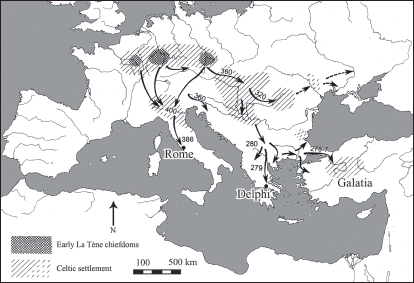
Map 19. The Celtic migrations.
The story told by Greek and Roman historians, then, is very likely to be substantially correct. In the first decade of the fourth century, a large group of Celts crossed the Alps and settled in the Po valley, in northern Italy. Raiding bands swept across Etruria and central Italy; Rome itself was sacked in around 386 BC. Simultaneously, another group was spreading devastation eastwards along the Danube, and by the mid-fourth century, the Celts were firmly installed in Hungary and Transylvania. In 335 BC, the year before his crossing into Asia, the young Alexander the Great was met by an embassy from the Danubian Celts, seeking an alliance with Macedon. When the king asked the Celts to name their greatest fear, hoping that they would say ‘You’, they replied that the only thing they feared was the sky falling on their heads. There is something strangely thrilling about this fleeting encounter between Celtic migrants from the forests of northern Europe and the future conqueror of India, as if two great currents of history had touched for an instant, and parted again.
Finally, in 279 BC the Celts of the lower Danube region launched a mass invasion of the Greek peninsula. The Macedonian and Thracian low-lands were pillaged, and despite heroic efforts by a hastily assembled Greek coalition force, one band of Celts succeeded in forcing the pass of Thermopylae and pouring into central Greece. This vast Celtic army was finally shattered in a great battle, fought in the midst of a snowstorm, at the very gates of the oracular sanctuary of Delphi; it was said that not a single Celt escaped alive. The following year, a second group of Celts crossed the Hellespont into Asia Minor. The cities of western Asia Minor endured a horrific decade of indiscriminate raiding by roaming Celtic warbands, until at last, in the early 260s BC, the Celts settled deep in inland Turkey, on the northern fringe of the Anatolian plateau around modern Ankara. These Anatolian Celts, known to the Greeks as the Galatians, retained many of the traditions and much of the social structure of their north European homeland. The geographer Strabo, writing in the early first century AD, tells us that the Galatians, living in the heart of the scorching and treeless Anatolian steppe, still used the term drunemetos for their assemblies, literally a sacred grove of oak trees, as though they were still gathering in the dark forests of Bohemia and the Rhine. The Celtic tongue could still be heard in the wilds of inner Anatolia as late as the sixth century AD.
The Celtic invasions hit the Greek world like a thunderbolt. Nothing of the kind had been seen in Greece since Xerxes’ invasion two centuries earlier. The parallels between the two invasions were soon being exploited for political purposes. The prime movers in the defence of mainland Greece in 279 were the Aetolians, a populous but somewhat backward Greek tribe from west-central Greece with a reputation for piracy. After the victory over the Celts, the Aetolians promptly set up the shields of the defeated barbarians in the metopes of the west and south friezes of the temple of Apollo at Delphi, mirroring the Persian shields which had been placed on the north and east sides by the Athenians after the victory at Marathon in 490 BC. A new festival was established at Delphi under Aetolian patronage, the Soteria or ‘Festival of Salvation’, ultimately to become one of the major events in the Greek festival calendar. The Aetolian League, previously a relatively minor federal state, swiftly grew into one of the major powers of the Hellenistic world, enveloping many of its smaller central Greek neighbours.
Something very similar happened in Asia Minor. In the later third and second centuries BC the brunt of the seemingly endless struggle against the Galatians was borne by the rulers of a small independent principality in north-western Asia Minor, the Attalids of Pergamum. The great phase of Attalid expansion, which would end with the entire western half of the peninsula coming under their control, began when Attalus I of Pergamum (reigned c. 240–197) defeated the Galatians at a great battle at the sources of the Caicus river, around 240 BC. The Attalids consistently presented their victories over the Galatians as the latest in a grand succession of wars between Greeks and barbarians, mythical and historical. Around 200 BC Attalus set up a dramatic victory dedication on the Athenian Acropolis (see Figure 20). Four pedestals, each around 30 metres long, were erected south of the Parthenon, with free-standing statue groups of gods fighting giants (Gigantomachy), Athenians fighting Amazons (Amazonomachy), Greeks fighting Persians (Persianomachy) and, inevitably, Attalid soldiers defeating the Galatians (Galatomachy). The monument itself is lost, but Roman copies of several of the statues survive. The imagery of this monument, reinforced by its location at the foot of the Parthenon, deliberately recalls the sculptural programme of fifth-century Athens, and in particular the metopes of the Parthenon, on which gods, Lapiths and Greeks calmly mastered the various barbarian enemies of Greek civilization. Attalus claimed to be the latest hero of the ongoing defence of Greece against the barbarian, successor to the victorious Athenians of Marathon and Salamis.
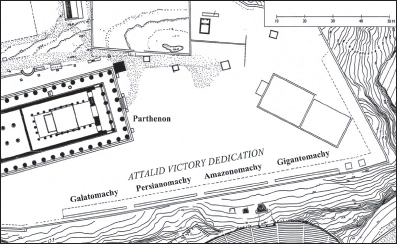
Figure 20. Attalid victory monument on the Athenian Acropolis, c. 200 BC.
His choice of Athens as the site for the monuments to his victory over the Celts is telling. In the second century BC, the cultural prestige of Athens was probably greater than it had ever been in the Classical period. In the 420s BC, at the height of the Athenian empire, the Athenians had requested a tithe of the grain-harvest from the entire Greek world, in recognition of Athens’ self-appointed status as mother-city of the Ionians and the cradle of Greek civilization. Three hundred years later, the rest of the Greeks finally caught up. In 125 BC the Delphic amphictiony (an international body responsible for the affairs of the sanctuary at Delphi) voted lavish honours for the Athenians, ‘since’, we are told, ‘it was the Athenian people, being the fount and origin of all things beneficial for humanity, who raised mankind from a bestial existence to a state of civilization’. A contemporary inscription from Maronea in Thrace describes Athens as the ‘ornament of Europe’. The Hellenistic monarchs outdid one another in conspicuous generosity towards Athens. The city-centre filled up with huge new public buildings paid for by philhellenic kings: the Attalids themselves funded two lavish market-buildings or stoas, one in the Athenian agora, the other on the south slope of the Acropolis.
The resurgence of Athens in the second century BC reminds us that although the Hellenistic oikoumenē was a world of regional superpowers, it also remained a world of wealthy, self-governing, autonomous Greek cities, with specific local concerns and distinctive regional cultures. In this respect, the conquests of Alexander the Great were less of a watershed than is sometimes supposed. The cities continued to engage in regular warfare with their neighbours, to compete for prestige at an ever-growing circuit of Panhellenic festivals, and to build massive fortifications and lavish public buildings, whether at their own expense or that of the kings. Under the Hellenistic monarchies, the polis did not merely survive; it flourished. To judge from the mass of surviving documentary evidence, inter-state diplomacy achieved new heights of complexity and sophistication. In the late third century BC, as part of a sustained effort to protect their coastlines from the ravages of Cretan pirates, the Athenians struck a treaty with the west Cretan city of Kydonia (modern Khania). The basis of the treaty was the mythological kinship between the two peoples: as the Athenians could claim to be the descendants of Ion, son of Apollo, so the Kydonians claimed to be descended from Kydon, another of Apollo’s many sons. The Greek mythological tradition was sufficiently flexible that, if one tried hard enough, any given polis could plausibly be connected to almost any other. Several cities employed professional historians among their diplomatic corps, men who were capable of explaining exactly why the people of Xanthos in Lycia (for instance) ought to help pay for the new city wall of far-off Kytenion in central Greece.
These convoluted kinship ties can appear faintly ridiculous. But the Greek cities took them perfectly seriously. In 196 BC the Greek city of Lampsacus in the Troad (the far north-west of the Asia Minor peninsula) appears to have been suffering from raids at the hands of one of the Galatian tribes of central Asia Minor. In response to this, the Lampsacenes sent an embassy to the city of Massilia in southern Gaul to ask for a letter of introduction to the Galatians. This embassy is deeply bizarre. It is extremely unlikely that the Anatolian Celts, living deep in inland Asia Minor at the opposite end of the Mediterranean from Massilia, had ever even heard of the Massiliots. Certainly, Massilia had long enjoyed close trading relations with the Celts of the Rhône valley; but the idea that this might carry any weight with the Galatians, who had cut off all ties with their central European homelands more than 200 years previously, is frankly absurd. The really interesting thing here is the Lampsacenes’ expectation that the Galatians would be susceptible to the kinds of arguments used in ordinary Greek kinship diplomacy. ‘The western Celts have an ancestral alliance with Massilia; therefore you, as Celts, have a special connection with Massilia. We, the Lampsacenes, are kinsmen of the Massiliots [both Lampsacus and Massilia were originally colonies of the Ionian city of Phocaea]; therefore you, as “allies” of the Massiliots, ought also to be allied with us (or at least stop raiding us).’ Who can say what the Galatians made of all this.
*
The same Lampsacene embassy which visited Massilia went on to pay a visit to the most important non-Greek city in the western Mediterranean. Rome was at this point just beginning to emerge as the dominant power in mainland Greek affairs. Since the 280sBCthe Romans had been steadily expanding their influence along both shores of the Adriatic. In 214 BC, while Hannibal was ravaging Italy, an energetic young king of Macedon, Philip V (reigned 221–179 BC), seized the opportunity to try to re-establish Macedonian control over the eastern Adriatic. After several years of shadow-boxing between the two powers, in 211 BC the Romans allied themselves with the Aetolian League against Philip. The war was an unusually vicious and bloody one; the Aetolians and Romans collaborated in selling entire cities into slavery. Not without reason, the Aetolians were accused of consorting with barbarians for the enslavement of Greece. Eventually, in 197 BC, the Macedonian army was defeated at the battle of Cynoscephalae in Thessaly and Philip was effectively expelled from mainland Greece. The Lampsacenes were understandably eager to get off on a good footing with this new superpower of the Hellenistic world. Once again, they rolled out a complex argument based on mythological kinship. The Romans were descendants of the Trojans, who had moved to Italy after the fall of Troy at the end of the heroic age. As inhabitants of the Troad, the ancient homeland of the Trojans, the Lampsacenes were thus kinsmen to the Roman people.
The Romans, unlike the Galatians, were entirely receptive to this way of thinking. Since the early years of the war against Philip, the Romans had learned the importance of presenting themselves not as foreign barbarians but as kinsmen and benefactors to the Greeks. The Roman general Titus Flamininus, the victor of Cynoscephalae, set up lavish dedications at the sanctuary of Delphi on which he was tactfully described as a descendant of Aeneas, the Trojan hero responsible for the foundation of Rome. Finally, at the Isthmia festival of summer 196 BC, Flamininus proclaimed the freedom of the entire Greek world; all Roman troops were withdrawn from Greece two years later. The symbolism was well chosen. Flamininus’ choice of the Isthmian games at Corinth for his proclamation recalled the earlier role of Corinth as the meeting-place of the Greek alliance against Persia in 480 BC, and as the seat of Philip II’s League of Corinth in the late fourth century. The freedom of the Greeks had been regularly declared by the Hellenistic monarchs, but none had taken such concrete steps to ensure it as the Romans had now done. Flamininus himself was hailed in terms appropriate to a Hellenistic monarch: he issued a gold coinage in his own name, carrying a heroic Alexander-style portrait of himself on one side, and on the other, his name being crowned by a winged Victory (see Plate 31b). The poet Alcaeus of Messene celebrated the Roman victory with a resonant comparison: ‘Xerxes led a Persian host to the land of Greece, and Titus led another from broad Italy; but one came to lay the yoke of slavery on Europe’s neck, the other to free Greece from slavery.’ The wheel of Macedonian fortune had at last turned full circle: the new barbarian despot was none other than Philip V of Macedon, and it was Rome which had emerged as the true champion of the freedom of the Greeks.
Once the Romans had shown themselves willing to intervene in Greek affairs, their Greek allies could seldom resist the temptation to call in Roman firepower in support of their own interests. In the late 190s BC the Attalid kingdom of Pergamum was under fierce attack from their neighbours to the east, the Seleucid dynasty of Syria; the most vigorous of all the Seleucid monarchs, Antiochus III (reigned 223–187 BC), was trying to re-establish Seleucid rule over the whole of the Asia Minor peninsula. Although the Attalids had been allies of Rome since the early days of the war against Philip V, this was not Rome’s war. For all that the new Attalid king, Eumenes II, bombarded the Roman Senate with hair-raising tales of Seleucid ambitions in continental Europe, it is clear that Antiochus, unlike Philip, posed no direct threat to Roman interests. Nonetheless, Eumenes got his army. In 190 BC the Roman general Scipio Africanus crossed the Hellespont in support of Pergamum; Antiochus was expelled from Asia Minor, and most of the western half of the peninsula was handed over to Eumenes. The Romans were evidently quite happy to play the role of police officers of Europe; equally happy, for the time being, to leave the actual running of east Mediterranean affairs to their Greek allies.
Since the reign of Alexander, the Greek states had regularly worshipped the Successor monarchs as gods. With the emergence of Rome as the dominant power in the Greek world, similar divine honours began to be offered to Roman generals and magistrates (including Flamininus). More striking is the establishment in several Greek cities, during the 190s BC, of the cult of a new goddess, Roma, the personified power of Rome itself. The worship of Roma was not an import from Rome, but a Greek innovation, expressed in purely Greek religious terms. A few states did go a little further in trying to understand their new ‘benefactors’. Around the time of the Roman victory over Antiochus, the inhabitants of Chios, an island-state lying just off the Asia Minor coast, established a new festival in honour of the goddess Roma. But the island’s loyalty to Rome was also marked by the dedication of a visual image (it is not clear whether it was a statue, relief or painting) depicting the birth of Romulus, the founder of Rome, and his brother Remus. The Chiots were eager to please; they had made some effort to inform themselves about the Romans’ own traditions about their city’s foundation. But even here the Roman-style depiction of Romulus and Remus is associated with a thoroughly Greek-style religious festival to Roma.
In the late 170s BC, the eastern Mediterranean world must have looked superficially much as it had done a century earlier. A strong king still ruled in Macedon: Perseus (reigned 179–168 BC), who had succeeded his father Philip V in 179 BC, had restored much of the territory and prestige lost by Philip at Cynoscephalae. Mainland Greece retained a precarious freedom; indeed, for the first time in its history, the entire Peloponnese was united under the umbrella of a single strong federal state, the Achaean League. Despite the loss of Asia Minor to Eumenes II of Pergamum, the Seleucid kingdom under Antiochus IV (reigned 175–164 BC), with its capital at Antioch on the Orontes (modern Antakya, in southern Turkey), was still the dominant power in Asia. But all that was about to change. The Romans, the ‘common benefactors’ of the Greek world, had scrupulously withdrawn their troops from the east after every intervention; in return, they expected their dispositions in Greece to be observed. Perseus, in his efforts to rebuild Macedonian power in the central Balkans, and in particular through his eagerness to win the goodwill of the mainland Greek states, was felt to have breached the spirit of those arrangements. Perseus could hardly have challenged Rome directly, but he certainly threatened the balance of power in the southern Balkan peninsula. In 171 BC, in response, yet again, to an appeal by the unscrupulous Eumenes, the Romans fabricated a quarrel with Perseus and once more declared war on Macedon. After a crushing Roman victory at Pydna in 168 BC, Perseus’ kingdom was dissolved; the king himself was paraded as a captive through the streets of Rome.
Meanwhile, the Seleucid king Antiochus IV had taken advantage of Rome’s entanglement in Macedonian affairs to launch a dramatic and ambitious invasion of Ptolemaic Egypt. In summer 168, while Antiochus was besieging Alexandria, he was met by Roman ambassadors, who curtly ordered him to leave Egypt immediately. When Antiochus replied that he needed time to consult his advisers, the leader of the Roman embassy, Gaius Popillius Laenas, drew a circle in the sand around the king’s feet, and told him that they required a reply before he stepped out of it. Mindful of the fate of Macedon, Antiochus bowed to the inevitable; the Seleucid armies were instructed to withdraw.
Roman interventions in Greek affairs, which had so far been fairly benevolent, had begun to take on a hard and unpleasant edge. By the end of 167 BC one of the four superpowers (the Antigonids of Macedon) had simply ceased to exist; another (the Seleucids) had been summarily humiliated; the remaining two royal houses (the Attalids and the Ptolemies) owed their kingdoms to Roman support. The fact of Roman dominance was soon rendered all too clear. Macedon had been left free after the fall of Perseus, but in 148BC, after an abortive attempt to restore the Antigonid monarchy, the region was reduced to the status of a tribute-paying province under a Roman governor: this was the first Roman province east of the Adriatic. Two years later, in 146 BC, when Roman envoys attempted to intervene in an internal dispute in the Achaean League, the ambassadors were jeered and pilloried by an assembly at Corinth. The Roman response was swift and ruthless. Later that same year, the forces of the Achaean League were annihilated by Roman legions, and the city of Corinth, cradle of Greek liberty in the Persian Wars, where only fifty years earlier Flamininus had declared the universal freedom of the Greeks, was wiped off the face of the earth.
Polybius begins his history of the rise of Rome with the assertion that the conquests of Alexander marked no real turning point in history. The Macedonian empire (or rather, empires) of the Hellenistic age was simply the third in a sequence of transient hegemonies: the Persians, the Spartans and the Macedonians. This is a slightly surprising claim from our perspective – not least in privileging the Spartan empire over the Athenian – but it contains more than a grain of truth. For Polybius, the crucial point was that the Hellenistic monarchs had not concerned themselves with anything west of the Greek mainland; Italy, Sicily, Libya and Sardinia were untouched by the Macedonians, and the barbarian peoples of mainland Europe were simply unknown to them. Hence world history down to the second century BC was, in his view, ‘scattered’, held together by no unity. It was left to the Romans to unite world affairs into a single organic whole.
Early in 86 BC, when King Mithradates VI persuaded much of mainland Greece to revolt one final time from Roman rule, the Roman general Cornelius Sulla appeared before the walls of Athens. An Athenian embassy came and urged Sulla to spare the city, recounting the exploits of Theseus and the heroism of the Athenians during the Persian Wars. Sulla replied simply that he had come to teach Athens a lesson, not to learn ancient history. Nothing could express more clearly the divergent paths which the histories of the western and eastern Mediterranean had taken since the fifth century BC. It is time to turn our attention to events in the Italian peninsula.