
50
If you felt the fires of love, mule-driver,
You would make more haste to see Venus.
I love a charming boy, so I beg you, goad on the mules; let’s go.
You have had a drink, so let’s go. Take up the reins and shake them.
Take me to Pompeii where love is sweet.
Inscribed in the peristyle courtyard of House IX.V.ii, Pompeii
The new men promoted from the towns of Italy in the 70s were credited with a new frugality and restraint. For a glimpse of their values in action, we can turn to archaeology’s great survivors, the remains of Pompeii and nearby Herculaneum. On 24 August 79 Mount Vesuvius erupted in Italy, near Naples. A thick shower of dust and pumice ascended over the surrounding territory, accompanied by earthquakes, flames and a cloud shaped like a tree (said the eyewitness Pliny), with a crown of branches like an umbrella pine, a variety which is still so familiar around the ruins. This cloud rose up to a height of some twenty miles above the mountain, and, if we compare the similar recent explosions of Mount St Helens in north-west America, we have to reckon that the explosions in Vesuvius had had a force five hundred times greater than the atom bomb at Hiroshima. At Pompeii we can trace the effects in three awful stages. First of all, a shower of white pumice, some three yards deep, blocked the daylight, then greypumice blackened streets and buildings. On the following morning, 25 August, by about 7.30 a. m., a great ‘burning cloud’ of hot gas rolled into the streets, suffocating and burning those who had stayed or been trapped. This very powerful ground surge was
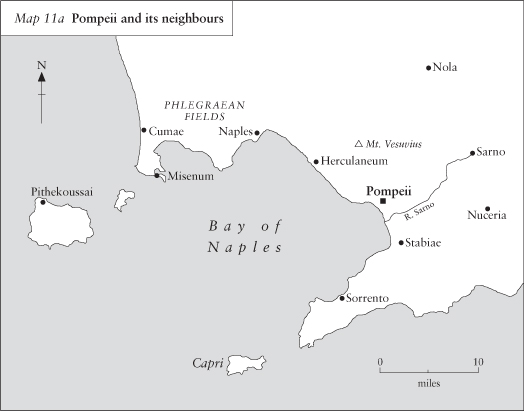
followed by the pyroclastic flow of hot liquified rock and pumice which destroyed buildings and rolled on far past the town; then ‘surge’ and ‘flow’ came in four waves of increasing ferocity until 8 a. m. They caused the death of the spectacle’s most learned observer, Pliny the Elder: as his nephew’s letters recall, Pliny had boated across the Bay of Naples to have a closer look. Inside the town, bodies of the dead continue to be found. They range from mules, trapped by their mangers near the millstones which they used to turn, to the young lady, dressed in jewels, whose breasts had left their imprints in the mud where she died. At Herculaneum, the surge and flow struck earlier in the morning and hit the town in six waves, running out into the sea. The town was buried even more deeply than Pompeii and not, it now seems, from the secondary effects of rain and floods. The entire disaster was massive, and we can well understand why it was a strain and expense on the Emperor Titus’ first year in power.
Pompeii and Herculaneum were close to the Bay of Naples, where so many of the grandest Romans had built spectacular villas. Even at the height of the Bay’s luxury (in the first century BC), neither place had been a city of the first rank; by the 70s the Bay had lost a little of its predominance. Pompeii, the better known, would have covered about 350 acres and contained a population of perhaps 8,000–12,000 in its last days. The town was laid out on a plateau of volcanic lava, the relic of a former eruption, and various types of volcanic rock had helped to build it. But the inhabitants did not know the risk they ran: Vesuvius’ last eruption was more than a thousand years in the past, and the stone probably seemed harmless. Pompeii itself had grown up in layers, through clear phases of history since the sixth century BC: Etruscan (with Greeks), Samnite, colonial Roman (from 80 BC onwards) when Cicero had had one of his houses there. By AD 79 its roots, like modern London’s, were at least two centuries old, and the residents continued to build and rebuild over them right until the end.
One result is that the best-preserved ancient town is in many ways still hard to understand. It never stood still, and after the fatal eruption the looting began promptly. It has been continuing ever since excavation began again in the 1740s. Fortunately, one-third of Pompeii has been reserved for future archaeology, although so much has been destroyed, sold or dispersed meanwhile.
One side of Pompeian life seems appealingly modern. There was a planned street-system to exclude wheeled traffic from areas in the town centre. There are well-preserved wine-bars with ‘pub signs’ of a phoenix or a peacock. There are theatres and a so-called ‘sports complex’ and a special market-building for fish, meat and delicacies for people doing the shopping. Many of the houses have big paintings or frescos on their walls, and there was a definite cult of ‘house and garden’.Trompe l’œil paintings seem to enlarge the gardens’ space and even show exotic birds and the flowers which grew in pots and borders, whether roses or bushes of myrtle. Owners would eat out around a shaded table in their ‘room outside’: 118 pieces of silver were found stored in one big house’s basement, including a set for dinner parties of eight people.1 There were also graffiti and well-written inscriptions. Forty-eight graffiti of Virgil’s poetry have been found (including some in a brothel). On the street-fronts of the bars, houses and public buildings, election-posters – some 2,800 in all – advertised support for particular candidates for civic office. About forty of these posters name women’s support, although women themselves could not vote.2
Through painted portraits we feel we know these people, the young ladies with a pen to their lips and blond, classicizing features, or the men beside them with dark eyes and a shifty sort of look. But so much of this time warp is not our idea of a cosy town at all. Images and shrines of the gods were all over the place, quite apart from the big formal temples on the main forum. Slaves were essential to the households and crafts, although the loss of the buildings’ upper storeys makes it hard to visualize where many of them lived. Ex-slaves, freed-men, were also essential to the economyand the social structure. After being freed, most of them still worked for their former owners (as they did in Rome) who could thus profit ‘from’ business without being tied down ‘to’ it. There were no high-street banks (money lending was a personal transaction) and there were no hospitals or public surgeries. There were brothels, but no moral ‘zoning’ into red-light districts. There were no street-signs, either. There are well-preserved lavatories behind discreet partitions, but two, even six, people would be accommodated on them side by side, wiping their backsides with communally provided sponges.
Despite the theatres, the main sports complex was an amphitheatre for blood sports, both human and animal: it is the earliest one to survive, dating back to the 70s BC when Pompeii’s population had been changed by the arrival of Roman veteran-colonists. Gladiatorial shows are announced and applauded in many of the town’s surviving graffiti: ‘the girls’ idol, Celadus the Thracian gladiator!’3 Nor were the town’s big houses the inward-looking centres of privacy which we now cherish. Like a Roman’s, a Pompeian’s home was not his castle and ‘home life’ was not a concept which men prized for its own sake. It is not that the Roman family was an extended family by definition, somehow sprawling in one house across generations and between siblings. It was nuclear, like ours, but it was embedded in a different set of relationships. If the head of the household, or paterfamilias, was an important person, he was also a patron to many dependants and ‘friends’ who both gave and expected favours. Every morning, a string of visitors went in and out of the house, which was itself a sort of reception centre. Many of the older, bigger houses thus gave visitors an impressive view through them from the entrance, as they looked down the straight main axis of their central rooms: this axis was supported on huge timber cross-beams, some thirty feet long.
In the last decades of the city, this type of plan was far from universal. Big houses now included workshops for craftsmen, shops or even bars adjoining the street, obscuring the ‘view through’. The Latin word familia included household slaves, and in these workspaces they and their owner’s freedmen would be put to profitable use. Inside, in the household proper, we would be struck by the relative absence of furniture, the multi-purpose use of many of the rooms and the consequent absence of our ideas of privacy. Even the plants in the bigger gardens were often there for their economic value, not for useless gardening. In the southern sector, houses with quite large vineyards inside their plots have now been excavated, while even roses might be grown for the important industry of scent.
As the identity of so many houses’ owners is still uncertain, their connections with outlying farmhouses and country villas are still uncertain too. Was Pompeii a town based on consumer-spending, where property-owners simply spent their rents and other income and consumed goods, including crops, which were only produced locally? It seems most unlikely, not just because of casual long-range imports found in the city (a pack of fine pottery from Gaul or a superb ivory statuette of a nude Indian goddess), but also because Pompeian produce is discovered so far abroad in Gaul or Spain. The town’s wine was not high class, but it was widely known and widely drunk as a result: its good millstones were famous too, as was its salty fish sauce whose use is also widely attested outside the town. In the years before 79, the king of fish sauce was the freedman Umbricius Scaurus whose product was exported out into Campania: he even commemorated it in prominent mosaics in his house. Continuing excavations of the villa-farmhouses nearby confirm their role as centres of storage and production, often on an impressive scale: it was presumably not all produced for local consumption. Nor was such production ‘undignified’ for the town’s ruling class. A big vineyard, surely a commercial one, has been found down near the amphitheatre with holes for more than 2,000 vines: the production was surely sold in the street shops and perhaps even sent outside. Prominent families in Pompeii’s civic life were even remembered for giving their names to particular types of grape (the ‘Holconian’). Profits from wine-growing surely mattered to them, though the workforce were their slaves and freedmen: perhaps those villa-houses with the most florid paintings of vines and grapes really were owned by keen profit-making wine-growers.4 There must have been frequent connections between the place in town, the big house for social and political obligations, and another place in the country, a landed centre of produce. Unfortunately, the inter-connections are seldom attested by what survives. But Pompeii was excellently sited above the navigable river Sarno, with fine access to the sea. It was important to the town’s outward-looking economy.
Profit did not exclude a passion for display. Hence the impressive tombs of Pompeian families extend outside the town gates along the main roads: they are most visible outside the south wall, where they are now known to run for more than a mile along the road towards Nuceria. These tomb-monuments were introduced to the locals by the Roman settlers. Some of the smarter ones commemorate whole families, even including a few of their slaves. As the tombs’ public siting reminds us, life was an open-air existence, where important people wished to be seen to be important: the boasting and social competition would surprise even New Yorkers.
Culturally, the theatres in the town did matter, although mimes and pantomimes would be important in the programme. As for literary taste, the inscriptions may mislead us. The Virgil graffiti are not all evidence for bookishness or a deeply literate society. Many of them come from the opening lines of a book or poem (known through writing exercises?) and able inscribers were commissioned to write them elegantly (had the customer only heard them from others or in a theatrical recitation?). Lines from Virgil’s homosexual eclogue (a pastoral poem) are particularly favoured, no doubt because of their sexual reference. One painting even parodies Aeneas and his family as dog-headed figures with huge penises.
Among the electoral posters, some, too, are rather contrived. They give ostentatious praise of a candidate who has already been elected, rather than support for a bid for electoral power. The town was headed by two magistrates (duumviri), with two lesser ones (the aediles), and their election was annual in March. In the last days of the town, the jobs of lesser magistrates are the ones which appear to be the most contested. The few posters which cite women’s names proclaim them as supporters, or cheerleaders, but naturally not as candidates: they may sometimes even be satirical, implying that a candidate is ‘fit onlyfor women’. Candidates had to be male, free-born and elected members already of the town council (a life appointment). As the councillors had had to pay for their election (sometimes offering gladiatorial games) they, and therefore the magistrates, would be the richer citizens. But the aediles’ elections, at least, were still lively: about a hundred electoral posters have been recovered from the election-campaign for one Helvius Sabinus as an aedile in what was probably the last, fateful year of 79. They have been found on most of the main streets and they allude to the usual wide range of supporters: trademen’s groups, households, a woman or two and even the ‘dicethrowers’. ‘Are you asleep?’ one poster for him says. ‘Vote for Helvius Sabinus as aedile’.5 These posters are all in Latin, but not in our classical Latin. The Bay of Naples was still multi-cultural in 79, a place where Greek was widely spoken along with Latin and the south Italian language, Oscan. All three would be heard in Pompeii, where the Oscan, which our Latin literature conceals, was still being inscribed in the first century AD.
The town was so very close to the luxurious villa life on the Bay: were Pompeii’s ‘last days’ nonetheless indicative of steadier ‘Italian values’? The last days had in fact been quite long. In 62 the town had already been badly damaged by an earthquake whose aftershocks continued into the 70s. A final phase, from 62 to 79, has been isolated by excavators, allowing us to see ‘little Italy’ in action during Vespasian’s rise to power. In this phase, the need to repair and restore certainly did not kill off the urge to decorate, paint and fresco; houses were enlarged, and sometimes took over new plots: shops, apartments and work-spaces sometimes turned basic house-plans at an angle to their main entrance. Among all this activity, were the previous owners moving out of town and selling or developing their former urban homes for new purposes? The earthquake has been widely blamed for their departure, but so far as there was a change, it was probably longer-term, and social. Even without an earthquake, no governing class of a town remained stable in this age of early death and uncertainty. Up and down Italy, ‘new blood’ always had to be exploited for money, after a time in which its ‘newness’ could tone down. Part of the story may be that a new class of parvenus, freedmen by origin, were taking over old houses in Pompeii and showing off by over-doing them up. In several properties, there is evidence of this change, and there are also signs in this period of that designer-disaster, the ‘small town garden’. Like the gardens of the Chelsea Flower Show, it crams in a jumble of scaled-down grandeur, including painted trompe l’œil on the walls, pergolas and third-rate sculpture. The style is not so much that of a ‘villa in miniature’ (big villa gardens were an agglomeration of features, anyway) as a distinctive town-garden fantasy, which often evoked quite other landscapes (woodlands, waterfalls and even Egypt and the Nile). A similar taste is visible indoors: after 62 new paintings proliferated in houses such as the ‘House of the Tragic Poet’, where they smothered the walls with episodes from Greek myths. Only some of the paintings evoke theatrical scenes which might be known from nights out in the town. Like prints and wallpapers from a modern pattern book or a newspaper special offer, most of these big panels evoke a world of culture which the owners themselves did not have to comprehend. Outside and inside, there was a taste for pretty, decorating style for its own sake.
Such redecoration was bright and, in its way, luxurious. This ‘luxury’ was not morally problematic. It was not that it was somehow distanced safely from its spectators by its faraway fantasy, nor was it ‘acceptable’ because it could be perceived as a celebration of ‘abundance’.6 The point was that, by Roman or Julio-Claudian standards, it was relatively minor luxury, and what we see at Pompeii was not a dangerous, enervating sort of luxury, one for moralists to deplore. To our eyes, the representations of ‘sex’ are the licentious element. However, no local protest is known about them, and not all of them belong to the town’s last days, either. On doorbells, lamps or door-posts there had long been images of erect penises: there had also been sexual scenes, very explicit, on the surrounds of personal hand-mirrors and so forth. Some of them may be coarse jokes, like modern souvenirs, while others maybe unfussed images of ‘fertility’ or apt erotica suitable for the walls of a specialized brothel. But when we find paintings of a naked woman on top of a man in the colonnade round a central peristyle garden or numbered paintings of oral sex between men and women, including foursomes, in the changing-room of a set of public baths, we cannot explain them somehow as paintings to avert the ‘evil eye’ and assure good fortune.7 They are simply sexy. The changing-room scenes, above the clothes-lockers, might even (like the mirrors) have been seen by women.
Pompeian values, then, were not ‘Victorian values’. But was the most blatantly coarse or erotic art in the 60s and 70s mostly displayed by a particular social class? In this era, the big House of the Vettii is famous for its painting of a man weighing an enormous penis on scales against gold coins: the Vettii were evidently freedmen. The painting of a woman having sex on top of a man in the garden colonnade was installed by the son of a moneylender who was himself the son of a freeman. Perhaps these newly rich patrons liked to show off this sort of thing, like modern bankers who buy female nudes. The vulgarity of freedmen in the Naples area is immortalized in the most remarkable prose work of this era, the Satyricon, written by Nero’s witty and elegant courtier, Petronius. Only a fragment survives, but it tells of the adventures of three Greek companions, self-styled homosexual ‘brothers’ in their various sexual interrelationships. The most remarkable adventure is their dinner with the flamboyant Trimalchio and his freedmen-guests in his vulgar villa in a town which is surely the harbour-town Puteoli, also on the Bay of Naples. Petronius characterizes the freedmen-speakers by a distinctive Latin style, rich in proverbs (the mark of the uneducated) and cultural howlers. They are exaggerated characters and are only seen through his fictitious narrator, but Trimalchio’s dinner artfully conjures up a showy vulgarity, a coarse love of money and extremely bad taste. The episode is a highly civilized man’s satire on preposterous freedmen at large. The excruciating music, the theatricality and stage effects, the hilariously common wives (who compete over the weight of their gold bracelets) are easily imagined in embryo at an evening with Pompeii’s Vettii or with fellow freedmen in the town, people like Fabius Eupor or Cornelius Tages. Some of Trimalchio’s instructions for the decoration of his tomb actually match details of a known tomb which was built at Pompeii by a wife, Naevoleia Tycho, for her dead husband.
In the 60s and 70s then, freedmen were among those who were active in redecorating big houses in Pompeii. Yet they were still socially excluded from civic office (as freedmen) and the older, more restrained families at Pompeii had certainly not all vanished from the town just because the ground had started to quake. In this period, we also find the well-planned trompe l’œil painting of a nude ‘marine Venus’ in the so-called House of Venus: it was installed for the Lucretii Valentes, important citizens under Nero. The ‘House of the Tragic Poet’ was also redecorated for the colony’s ‘first citizen’ (although he did then rent it out). It was not, then, that Venus and profit were attractive only to freedmen. But perhaps (a guess) it took men on the make to flaunt sex-scenes more openly on their house walls. For people in the earlier Pompeii had echoed the steadier patriotic values of Augustus’ new age. The east side of its central forum had been transformed in the age of emperors: temples to their cult had been built, while the statues outside one big civic building, paid for by the prominent priestess Eumachia, showed heroes like Romulus and father Aeneas. They evoked the moral sculptures in Augustus’ new programmatic Forum in Rome.
‘Thrift’ and ‘restraint’ are relative terms. To the new intake of Italians into the Roman Senate of the 70s, they meant that they were not extravagant Julio-Claudians or those senators (often provincials) who had the very biggest fortunes. By 70 there had certainly been families in Pompeii who would have adapted well to the prodigal theatricalityof Nero’s court. But nobodygave them the chance: none of the excavated houses belonged to someone who rose anywhere near as high as the Roman Senate. The only possible exception is Nero’s beautiful Poppaea, who probably did own the huge villa at nearby Oplontis, though perhaps not the Pompeian houses which have sometimes been ascribed to her too.8 When given scope, Pompeii’s Poppaea was as luxurious as the best of them. But the trophy-wife of an emperor was exceptional. In the 60s and 70s there were plenty of others in Pompeii, perhaps the majority, who still saw themselves upholding ‘traditional’ values. The freedmen were only part of the story. In the colonnade of one garden-space for dining outside, verses told guests to ‘divert your lascivious looks and sweet little eyes from somebody else’s wife’.9 On the Street of Abundance, the big letters of one inscription do proclaim ‘Sodom and Gomorrah’, perhaps as a biblical warning to Pompeians of the perils of sexual misbehaviour. But Pompeii did not collapse in a final torrent of orgies.