'Often... a barbarian whose legs had given way from fatigue would bend bis left knee as he sank to the ground and continue to attack his foe, a proof of supreme devotion.’
Ammianus Marcellinus 16. 47-19
During the 3rd and 4th centuries ad the Roman Empire was all too frequently disturbed by outbreaks of civil war and external invasions. Periods of peace and stability were few and far between. The army continued to display high levels of military efficiency, but over time its strength was eroded fighting against fellow Romans. Yet the Roman Empire was big, and the threats facing it uncoordinated and weak, and it did not quickly collapse. The army changed to deal with the new circumstances. The defence of fortified positions became more important, whilst pitched battles occurred less frequently than in earlier periods. The army emphasized speed of movement and surprise, striking unexpectedly at enemies who ideally were unprepared for such an assault.
In some respects the Late Roman army remained very much like its predecessor under the Principate. The names of many units and the titles of many officers changed, but most functioned in much the same way as they had in earlier periods. However, all ranks were now essentially career soldiers and the old tradition of the senior posts being held by senators following a mixed military and civilian career was abandoned Emperors based their power directly on the control of troops and needed to maintain this if they were not to be deposed by the army’s senior officers.
Eventually the distinction between legions and auxilia became very slight, and far more important was the division between field army units (comitatenses) and static frontier troops (linitanei). The legions dwindled in size, probably to no more than 1,000 men, less than a quarter of their strength in earlier centuries. Cavalry units figure prominently in the accounts of the late army, but in fact there does not seem to have been a significantly higher proportion of horsemen than in earlier times. Very large armies were fielded in civil wars, which frequently went to the side with the most troops, and for major expeditions against the Persians, but otherwise most campaigns were waged by comparatively small forces. This trend would continue into the 5th century and set the pattern for medieval European warfare.
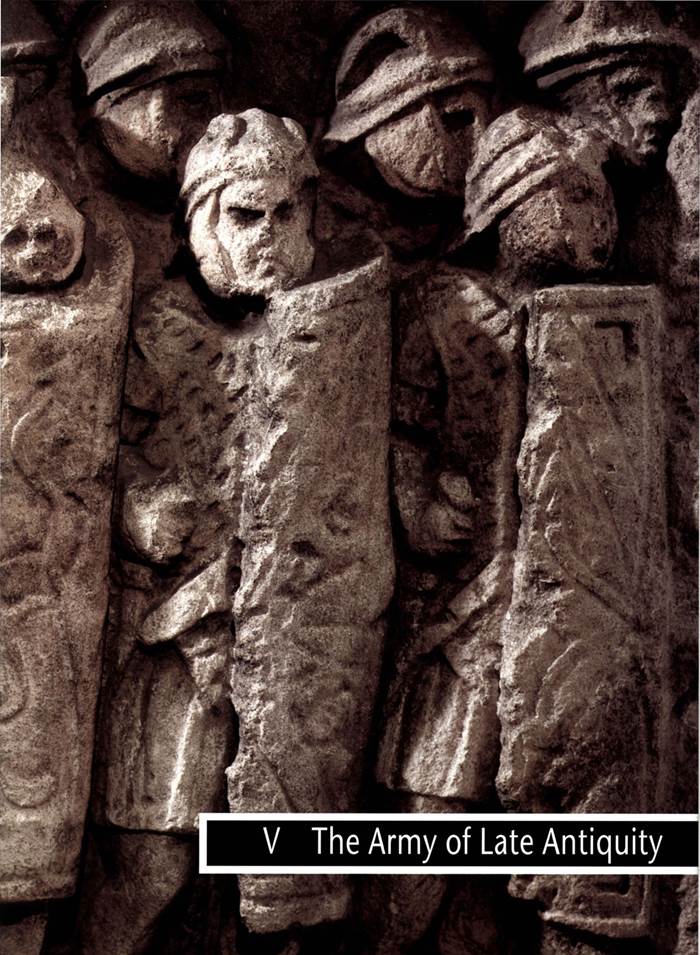
This 3rd-century relief from Gaul depicts a formation of soldiers in a uniform very similar to that worn under the Principate. Each man wears an imperial helmet and mail armour, and carries a rectangular scutum.


(Above) One of the few depictions of another nation triumphing over the Romans, this Persian relief shows the Sassanid King Sharpur I with a captured Roman kneeling before him. Sharpur defeated and killed the Emperor Gordian in AD 244 and Valerian in 260.
(Above Left) The Tetrarchic system was created by Diocletian at the end of the 3rd century AD by which the Empire was divided into an eastern and western section, each controlled by a senior emperor or Augustus, assisted by a junior Caesar. The ideal relationship between these four men was symbolized by this group of statues
Problems and changes
Augustus rose to power through bloodshed and civil war, but the regime he established gave Rome the internal peace and stability which the Late Republic had lacked. Nero was the last of Augustus’ extended family to rule, and following his suicide in AD 68, the Empire was wracked by civil war for over a year, until Vespasian, the fourth man to occupy the throne in just over 12 months, was able to create a stable regime. From ad 69 to 192, Rome enjoyed a period of prolonged peace, prosperity, and political stability, when attempts to usurp the throne were rare and gathered little momentum and most emperors died natural deaths. In 192 Commodus, the deranged son of the philosopher- Emperor Marcus Aurelius, was strangled in a household conspiracy involving the commander of his praetorian guard. His successor, Pertinax, lasted a mere three months before he was lynched by the praetorians, having failed to pay them the full donative which he had offered to gain power. The commanders of the guard then auctioned the throne off to the highest bidder from the walls of their barracks in Rome. The purchaser had little time to enjoy power, since the largest provincial garrisons in the Empire, Britain, Upper Pannonia and Syria, each rallied behind their respective governors in bids for supreme power. It was not until 197 that Septimius Severus had defeated all his rivals and became undisputed Emperor.
In 211 Severus died at York, having spent the last few years of his life campaigning against the Caledonian tribes of what is now Scotland. He bequeathed power jointly to his two sons, but within a few months the younger of the two, Geta, had been murdered by his older brother Caracalla. In 217 Caracalla was about to embark on a major eastern war, when he was stabbed to death by one of his cavalry bodyguards. The praetorian prefect, Macrinus, seized power, but was defeated and killed by a rival claimant before the year was out. The 3rd century witnessed a cycle of civil wars which rivalled, and eventually out-stripped the chaotic last decades of the Republic. Usurpations were common, but it was considerably easier to reach supreme power than to hold on to it. Many emperors lasted for no more than a few months, and reigns of more than a decade were rare periods of stability. The vast majority of emperors met violent ends, usually through assassination, but sometimes in battle fighting against Roman rivals or foreign enemies. In 251 the Emperor Decius and his son and heir were both cut down when their army was defeated by a force of Goths. The Sassanid Persians defeated a number of Roman expeditions, and in 260 captured and executed the Emperor Valerian. Disorder within the Empire encouraged attacks on almost all the frontiers, with barbarian raids driving deep into the provinces.
Yet in the main the Empire endured this long period of chaos, and territorial losses, such as the province of Dacia and much of Mesopotamia, were comparatively slight. However, there were growing signs of political fragmentation. In the second half of the 3rd century there was for more than a decade an independent Gallic Empire with its capital at Trier, whilst Queen Zenobia of Palmyra united for a while many of the eastern provinces into a kingdom for her infant son. At various times in the past, emperors had chosen to rule jointly with a colleague, or sometimes been forced to acknowledge, at least temporarily, another man’s right to rule part of the Empire. In the late 3rd century, the principle of having more than one man in charge of the Empire became formally accepted. Diocletian (284-305) took this a stage further when he established the Tetrarchic system, where the Empire was divided into an eastern and western part. In each region a senior Augustus ruled with the aid of a junior Caesar. The system in its purest form did not long survive Diocletian’s retirement, but in various modified forms it endured for over a century. Strong rulers like Diocletian and Constantine did bring periods of stability, but it is only in comparison with the 3rd century that the 4th appears as a time of strong government, freedom from civil war, and greater success over foreign enemies. Usurpations remained common, and in a sense the Tetrarchic system encouraged such attempts, for it was now possible for a man to advance to imperial power in stages.
The division of imperial power between several emperors was reflected in a fragmentation of authority at all levels. Provinces became more numerous, but much smaller in size, so that by the late 4th century each province from the Principate was divided into four or more smaller regions. Within these civil and military power was separated and there were no leaders equivalent to the old provincial governors. Much of the military activity in the later Empire occurred on a much smaller scale than had been the case in the past, with even emperors involving themselves in minor local campaigns.
It was within this context of weakening central authority, frequent outbreaks of civil war, and serious problems in many frontier areas that the army of Late Antiquity was forged. As society and the political system changed, so did the army, and by the 4th century many of its institutions were profoundly different from earlier periods. Not everything changed, and there was probably more continuity than is at first suggested by the many new ranks and unit types, whilst in other areas the shift was more one of emphasis than fundamental change. Many aspects of daily routine and military ritual would still have been recognizable to soldiers from the Principate. The army’s strategic thinking continued to be dominated by the offensive, punitive expeditions which were mounted in much the same way in the 4th century AD as in the 1st. There were some tactical innovations, but in battle the later army continued to prove itself superior to its foreign opponents, winning far more battles than it lost, although it probably engaged in this type of fighting less readily than in the past. Similarly the basic methods of siege warfare remained the same, although it became more common for the Romans to be the defenders rather than the besiegers.
Much remained the same. This chapter will concentrate on some of the chief differences between the later army and its better-documented predecessor, the army of the early Empire.
Commanders: the rise of the equestrian officer
The intimate link between political and military leadership had been at the core of the Roman system since at least the early Republic. Senators, following a career which brought them in turn civil and military responsibilities, provided the army with its commanders, and wise emperors portrayed themselves as the most prominent member of the Senate. In Late Antiquity this all changed, and senators gradually ceased to have a military role. In the 2nd century some emperors, most notably Marcus Aurelius, began to promote equestrian officers to command first legions and then whole armies. Usually these men were first enrolled in the senatorial order before being given such senior posts, but in the 3rd century this practice was largely dropped. An equestrian prefect replaced the senatorial legal us as the commander of a legion, and in time equestrians were appointed to command armies and govern provinces. Most of these men were career officers, spending far longer with the army than had senators following the traditional political career. They were probably more experienced than their senatorial predecessors, though it is much harder to judge whether they were on average any more competent. At first it must have seemed to emperors that equestrian officers posed less of a potential threat to them, for they lacked the political connections of senators. Yet at a time when the emperor was required to spend much of his reign on campaign with the army, such factors became of less significance. An officer who could secure the support of the other senior commanders in the army could readily arrange the murder of the current ruler and seize power himself. The latter part of the 3rd century was dominated by a group of equestrian officers from the Danubian provinces who made emperors from amongst their own number, and in some cases broke them as readily.
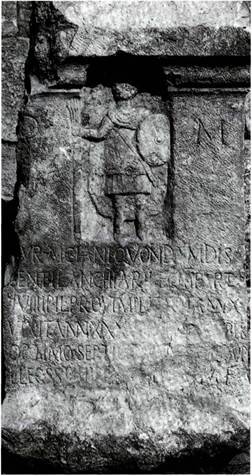
Legio II Parthica, one of three new legions raised by Septimius Severus (ad 197-208) for his eastern campaigns, was stationed in Apamea in Syria for some time This tombstone is one of several found in the city depicting legionaries from this unit. In this case it marked the grave of Aurelius Mucianus. who was an instructor in the use of throwing-spears (discens lanciarius). He holds a bundle of lanceae in his right hand and - like the soldiers on other tombstones of II Part hica - carries an oval, almost circular shield. His sword is worn on the left. Several of the other Apamea tombstones commemorate specialists with other weapons, such as the bow, not normally associated with legionaries. It is unclear if this reflects a general shift in the equipment carried by the legions or II Parthica in particular, or whether a unit as large as a legion often contained a wide range of weapons specialists.
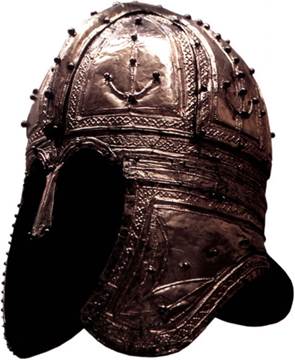
An iron helmet found in Holland sheathed in silver and decorated with semi-precious stones. Such an expensive piece of equipment seems most likely to have been worn by an officer. It would have offered good protection, but restricted the hearing of the wearer.
The traditional rank structure of the army appears to have been altered at all levels during the 3rd and 4th centuries. Unit commanders had a range of titles, which do not always appear readily to conform to a fixed pattern. The rank of praepositus at first meant an officer temporarily placed in command of another unit, but swiftly became a permanent title. Many prefects and tribunes appear in our sources, often as unit commanders, but all three titles seem to have embraced a very broad range of responsibilities. Some tribunes and prefects were sometimes also referred to as praepositi. At a lower level were the ranks of primicerius and the junior (as well as intriguingly named) senator. Within a unit there might be ducenarii, who according to Vegetius commanded 200 men, and beneath them centenarii, presumably commanders of 100 or century sized sub-units, and so perhaps equivalent to the old centurions. Apart from their titles, even less is known about the various more junior ranks attested in the later army.
Field armies and static forces
Alongside the changes which reduced the large provinces of the Principate to the more numerous but much smaller regional military commands of the 4th century, came another fundamental division between army units. These were now either comitatenses, allocated to one of the field armies, or limitanei, assigned to garrison a particular area, usually on the frontiers. The comitatenses were at the immediate disposal of one of the emperors or his senior subordinates. The limitanei were commanded by the dux assigned to that region. The development of this system cannot now be traced with any certainty. In some respects it was foreshadowed by earlier developments, such as Septimius Severus’ creation of a force based around the foot and horse guards and Legio II Parthica - in total equivalent to a strong provincial army - just outside Rome at the end of the 2nd century, or Gallienus’ formation of a powerful army, including especially strong cavalry forces, at Milan in the middle of the 3rd century. Important stages in the process appear to have occurred in the reigns of Diocletian and Constantine, although the details remain obscure. Our best evidence is provided by the Notitia Dignitatum, which lists imperial posts and military commands at the very end of the 4th century. This was the system in its fully developed form and attempts to reconstruct earlier versions remain to a fair extent conjectural. In the Notitia the Eastern Empire mustered five field armies, two associated with the imperial court, whilst the West had seven, three of which were comparatively small.
The comitatenses have sometimes been seen as mobile strategic reserves, which were able to move to each trouble spot as required. Most were certainly stationed well within the provinces, in marked contrast to the deployment of the army of the Principate which was primarily spread around the Empire's perimeter. The old system meant that if an enemy was able to penetrate the frontier zone, it took considerable time to shift forces from other frontiers to defeat them. This in turn weakened those frontiers and could lead to new problems there. There is a measure of truth in this interpretation, but the mobility of the comitatenses should not be exaggerated. Ultimately, one of these armies could move no faster than a marching infantryman or, which in many ways was even more of a restriction, the speed of its baggage train. The field armies moved no quicker than other armies, but they did have the advantage of not being tied to a particular region. Under the Principate the legions in particular performed so many administrative roles that their removal from the area to fight elsewhere caused major problems. This had led to the frequent use of legionary vexillations rather than entire units. Moving a field army caused no such administrative dislocation, but the extent to which these troops provided a strategic reserve for the entire Empire is highly questionable. What is certain is that they provided a powerful military force to protect the emperor from the internal threat of usurpers. Civil wars remained common throughout the late Empire, so that the army’s structure was to a great extent intended to guard against threats of this nature.
In the past the limitanei were often depicted as local militias of part-time farmer-soldiers, in a sense closer to the legionaries of the Mid Republic than to the later professional soldiers of the Principate. This idea is clearly mistaken. The limitanei were regular units of trained troops, who differed only in status from the comitatenses. The limitanei undertook the day-to-day patrolling and garrison duty on most frontiers, as well as some areas with problems of internal disorder. In general they seem to have performed their duties well. Although their numbers were inadequate to stop a major raid or invasion on their own, the limitanei appear to have coped with much smaller-scale warfare. On occasions units of limitanei were attached to the field armies and operated effectively. In some cases this attachment became permanent, and the units were rated as pseudocomitatenses.
Units in the late Roman army
A range of different units appear in the Notitia Dignitatum, with legions, auxiliary alae and cohorts alongside less familiar types. The cavalry of the field armies were now formed into units called vexillationes. A few units were given the apparently honorific title of comites (or companions). Additional cavalry were provided by the imperial guard regiments or scholae, which at some periods often served with the field armies, although they were not formally part of them. Infantry consisted of legions or auxilia palatina. The latter seem to have been a creation of Constantine. They are sometimes seen as a distinct break with the past, marking an important stage in a perceived overreliance on German recruits from outside the Empire, but in fact they shared many features in common with the auxiliary cohorts of the Principate. There does appear to have been little difference between legionary and auxiliary infantry by this time in equipment or tactics. The best vexillationes and legions were called palatina rather than comitatenses and enjoyed a higher status. Another distinction which had more to do with precedence than any practical difference was between two identically named units of which one was known as seniores and the other as iuniores. Quite a few cavalry and infantry units in the comitatenses were paired with another of the same type to form a brigade. We do not know whether such units had a permanent commander, but it does appear to have been rare to split them up. All types of unit quite often appear in our sources under the vague label of numeri, and this is also the term normally used for the foreign units or foederati. Initially recruited from a single ethnic group, and often specializing in a particular fighting technique, over time these tended to draw manpower from any available source and become assimilated into and indistinguishable from the regular army.
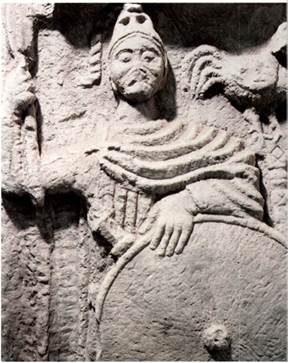
(Above) This late 4th-century ad depiction of a standard- bearer shows a man whose appearance differs in many ways from soldiers in the earlier Roman army. His shield is large and almost circular, while his sword is worn on the left.
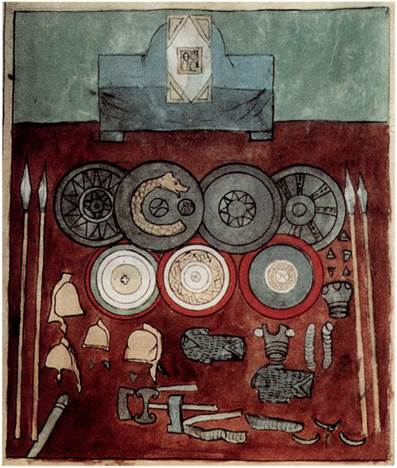
(Above) The Notitia Dignitatum comprises an order of battle for the Roman army at the very end of the 4th century. Military bases and their garrisons are listed, and the insignia of each unit shown. Although it seems probable that the shield patterns are simplified forms of the original, thus still represents one of the best sources for military insignia in any period.
The Field Armies as Listed in the Notitia Dignitatum

The limitanei included an even wider variety of unit types. There were old-fashioned auxiliary cohorts and alae, legions, often divided into several detachments, as well as cavalry vexillationes and cunei and other units with less specific titles, including numeri. There is no trace of a brigade structure linking separate units, although some of the legions had several cohorts. Both comitatenses and limitanei included naval squadrons where appropriate. For the first time in Rome’s history, there were now also specialist artillery units, although it is likely that many ordinary units continued to employ catapults, especially in the defence of forts or cities.
The majority of infantry units, whether legions, auxilia palatina or limitanei, normally fought in close order. A single statement in Vegetius has often been used to suggest that body armour was rare, but this belief is certainly mistaken. Most infantrymen wore a helmet, cuirass of mail or scale and carried a long oval shield. The longer spatlia sword had by now superseded the gladins in all units. A variation on the pilum, the spiculum, was sometimes used, but various throwing- or thrusting-spears were far more common. A man might in addition to his fighting spear carry a number of short javelins and/or weighted throwing darts. The latter, known as plumbatae or mattiobarbuli, had a range of somewhere between 30 and 65 m (100-200 ft) - the effective range probably near the lower end of the scale. Vegetius tells us that some late 3rd-century legionaries carried five of these darts clipped into the backs of their shields. A number of units - both foot and horse - are listed in the Notitia Dignitatum as archers (saggitarii), but it seems likely that a proportion of men in many other units were also trained and equipped with bows.

(Above) These re-enactors from Cohors V Gallorum - one of the only groups attempting to recreate the Roman army of the 3rd century ad - look very different from the classic image of the legionary in lorica segmentata and imperial Gallic helmet. Instead these men wear boots, trousers, long-sleeved tunics, scale armour - and in one case a coif They also carry their swords on the left, wield spears and have oval shields Yet although the style of equipment, and in some respects the methods of fighting, had changed, the Roman infantryman was still better protected and more disciplined than the vast majority of his opponents.

A re-enactor from a group formed by English Heritage representing a horse-archer in the late Roman army. By the 6th century many of the best Roman cavalrymen were skilled archers, even if at other times they willingly fought at close quarters.
Some cavalry units were even more heavily armoured than the infantry. In units of cataphracti and clibanarii the rider and often the horse were heavily armoured. The distinction between the two terms is now obscure. The name clibanarius was derived from the word for an iron bread oven, and may have reflected not just the armoured soldier’s appearance, but the discomfort of wearing such gear, especially in hot weather. There were far more units of cataphracts and clibanarii in the eastern than western armies, reflecting the need to defeat the large numbers of equally heavily armoured Persian cavalry. The vast majority of these special units were in the field armies. The bulk of the remaining units of Roman cavalry, whether they were called scutarii, promoti or stablesiani, were primarily, but not exclusively, trained for shock action, in much the same manner as the vast majority of alae under the Principate. Horse archers, and a few other units, such as the Mauri and Dalmatae, appear to have been primarily light cavalry. There is a persistent myth that cavalry became far more important in the later army, an idea often connected with the emphasis on the mobility of field armies. In many respects this view results from a misunderstanding of the importance and prestige of the cavalry, especially the alae, under the Principate. In fact, the Roman ideal continued to be a balanced army mixing horse and foot.
Unit size
The evidence for the size, and still more the internal organization, of all these unit types is exceedingly poor. In general our sources give the impression that most units were comparatively small, and that certainly there was no longer any equivalent to the c. 5,000-man legions of earlier periods. When the legions were reduced in size is difficult to say. Vegetius believed that under Diocletian at least some legions still consisted of as many as 6,000 men. Why the change occurred is equally obscure, though it may simply have happened as units were split into detachments which over time became effectively independent. Most modern commentators suggest that a legion in a field army numbered some 1,000-1,200 men in the 4th century. Auxilia palatina may have been of a similar size, or possibly round the 500-600 mark. Cavalry vexillationes perhaps were theoretically 600 strong, and the scholae, in the 6th century at least, consisted of 500 men. These are estimates of ‘paper strength’ and the meagre evidence would seem to suggest that actual units tended on average to have about two thirds of their full complement at any time. Unit sizes amongst the limitanei are even more poorly recorded, and we do not know whether legions were of similar size to their counterparts in the field army.
Most modern reconstructions are based upon the assumption that there was a system of standard sizes for each type of unit and that this was, on the whole, adhered to. We cannot know whether or not this was in fact the case.
Forts and fortifications
Far more effort was put into the construction of fortifications in Late Antiquity. Existing military bases were strengthened and many new forts built, often on sites chosen primarily for defensive reasons. Walls were higher and thicker, and sometimes included platforms for artillery. Towers, sometimes square or fan shaped, but most often round, were built so that they projected in front of the walls, allowing the defenders to lay down enfilading fire against any attackers. Gateways were in general narrower, but better defended. Ditches tended to be wider, and flat-bottomed rather than the v-shaped cross section of earlier periods. The same trends were also pronounced in the curtain walls built from the 3rd century onwards to protect many of the towns and cities in the provinces. In a number of cases it seems unlikely that the community actually faced a direct threat, but the urge to fortify may well reflect the uncertainty of the times, as well perhaps as competition between cities for status.
Whilst the defences of army bases were often far more formidable than had been the case in the past, the sites themselves were considerably smaller. Many legionary bases, such as Chester and Caerleon in Britain, were largely abandoned by the 3rd century and no new installations of a comparable size built. Instead of the traditional playing-card shape, forts were often square. Some existing forts continued to be used but were dramatically reduced in size. These trends may be an indication of the generally smaller size of army units in this period.
Stronger fortifications reflected the much greater importance of forts and fortified settlements in the warfare of Late Antiquity. Direct attack on a military base was now a real possibility, and the army was no longer quite so confident about advancing to destroy the enemy in the open. It was not always possible to dominate the enemy beyond the frontiers and so deter raiding, and as we have seen in the earlier periods, it was impossible at the best of times to intercept every incoming raid. Vegetius recommended that Roman forces should retreat to their strongholds in the face of invasion, having first gathered up local food supplies. Barbarian peoples had little knowledge of siegecraft and under most circumstances would be unable to capture a fortified place. They might starve a town or city into surrender, but this required them to keep a strong force concentrated outside its walls for months on end. This normally proved impossible or gave sufficient time for a Roman force to march to the city’s relief. When shortage of food or lack of interest persuaded attackers to withdraw, they became vulnerable to Roman counterattack. In this way raids could be endured and the damage they inflicted kept to a minimum. Ideally, in time, an emperor would concentrate sufficient forces to mount a major punitive expedition, striking against the tribes in their own homelands.


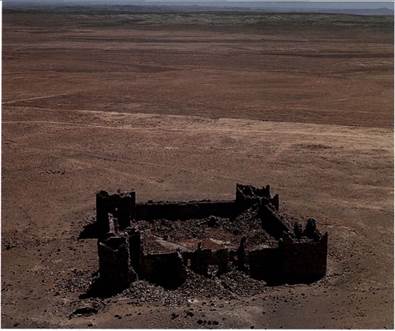
(Opposite above) The fort at Qasr lisheir in Jordan was constructed in the reign of Diocletian. In many respects it typifies the army’s forts in the late 3rd and 4th centuries ad, being smaller in size, but better fortified than the bases of the Principate Comer towers project beyond the walls in contrast to earlier fortifications, and would allow the defenders to enfilade any attacker.
(Above) The walls of the late 3rd-century Roman fort at Porchester on Britain's south coast were later incorporated into the defences of a Norman castle. Notice again that the towers - in this case round rather than square - project beyond the curtain wall. The substantial fortifications protecting bases of the army in this period suggest that serious attack was considered to be far more likely than in earlier times.