
A = Anaxagoras, Ant = Antiphon, At = Atomists, D = Diogenes, DA = Double Arguments, E/D = Euthydemus and Dionysodorus, E = Empedocles, G = Gorgias, H = Heraclitus, Hip = Hippias, M = Milesians, Mel = Melissus, Misc = Anonymous and Miscellaneous Texts, P = Parmenides, Prod = Prodicus, Prot = Protagoras, Pyth = Pythagoreans, T = Thrasymachus, X = Xenophanes, Z = Zeno.
Achilles: Introduction to Aratus’
‘Phaenomena’ 4.34X F13
5.34 E T21
16.43E F47
Aelian: On the Nature of Animals
12.16 At T32
16.29 E F30
Aëtius: Opinions 1.3.4 M T30
1.3.5 A T3
1.3.12 X F10
1.3.18 At T16
1.3.20 E F10
1.4.1–4 At T21
1.18.2 E F12
1.25.4 At F2
1.30.1 E F13
2.1.2 A T1
2.1.4 E T19
2.7.1 P T8
2.7.7 Pyth T40
2.10.2 E T20
2.13.2 E T23
2.13.5 D T3
2.13.11 E T24
2.14.3 M T39
2.20.3 X T5
2.20.10 D T4
2.20.12 Pyth T42
2.20.15 Ant T5
2.21.1 M T25
2.21.4 H F42
2.23.1 M T38
2.23.4 D T5
2.24.7 E T25
2.25.7 P T9
2.25.15 E T26
2.28.4 Ant T6
2.30.1 Pyth T43
2.31.4 E T18
3.3.1 M T26
3.3.2 M T40
3.3.8 D T6
3.4.1 M T40
3.4.4 X T6
3.16.4 Ant T7
5.18.1 E T8
5.19.4 M T27
5.22.1 E T6
Agathemerus: Geography 1 M T13
Alexander: Commentary on Aristotle’s
‘Metaphysics’ 38–9 Pyth T29 Questions 2.23 E T13
Ps.-Alexander: Commentary on Aristotle’s
‘Metaphysics’ 827 Pyth T51
Ammonius: Commentary on Aristotle’s ‘On Interpretation’ 249.6–10 E F26
Anonymous: On Hippomachus B3 Prot T15
Theosophia Tubigensis 68 H F61
The Suda 1.46 Ant F22
1.397 Ant F15
2.723 Ant F14
3.514 Ant F7
see also Papyrus fragments
Anonymus Londinensis 18–19 Pyth T49
Anticleides: fr. 1 Pyth T15
Apollonius: Enquiry into Miracles 6.2 Pyth T12
Aristotle: fr. 65 Z T7
fr. 191 Pyth T12
fr. 195 Pyth T10
fr. 197 Pyth T11
fr. 201 Pyth T45
fr. 203 Pyth T29
fr. 208 At T3 Enquiry into Animals (Historia Animalium) 511b–512b D F8
Metaphysics 983b M T8
985bAt T2
985b–986aPyth T25
986bX T4
986b–987aP T5
987aPyth T26
998aProt T18
1000bE F23
1007bProt T3
1009a–bAt T11
1062bProt T4
1080bPyth T28
1090aPyth T27
1092bPyth T51
Nicomachean Ethics 1176aH F17
On Breathing (De Respiratione) 473a–474aE F42
On Celestial Phenomena (Meteorologica) 342bA T10
345aA T11
353bM T21
354aM T36
355aH T7
357aE T3
365aA T8
365bM T41
On Generation and Destruction (De Generatione et Corruptione) 315b At T14
316a–317aAt T8
324bE T14
324b–325bAt T1
326aAt T15
334aE T10
336aP T7
On Sophistic Refutations (De Sophisticis Elenchis) 183b T T1
183b–184aG T7
On the Generation of Animals 742bAt T6
764aE T16, At T31
On the Heavens (De Caelo) 279bH T5
284aE T22
290bPyth T41
293aPyth T38
293bPyth T39
294a–bM T9
294bM T37
295bM T23
298bP T3
300bAt T17
302a–bA T4
On the Parts of Animals 648aP T11
On the Senses 437b–438aE F41
On the Soul (De Anima) 403b–404aAt T24
404aPyth T47
404b E F9
405aM T11
407bPyth T7, T48
Physics 185aAnt T2
187aM T17
187a–bA T5
188aP T4
193aAnt T1
196aE T2, At T20
203aM T16, A T6
203bM T18, T20
204bM T19
204b–205aH T6
210bZ T5
213bAt T4, Pyth T44
233aZ T2
239b–240aZ T3
250aZ T6
251bAt T7
252aE T9
Poetics 1447bE T4
Politics 1260aG T15
Rhetoric 1400bX T2
1404aG T5
1407bProt T14
1409aT T2
Ps.-Aristotle: On Melissus, Xenophanes, and Gorgias 975bE F11
979a–980bG T12
On Plants 815a, 816bA T12
On the World (De Mundo) 401aH F59
Puzzles (Problemata) 937aE T29
Aristoxenus: fr. 11 Pyth T19
fr. 77 Pyth T24
Arius Didymus: fr. 39 H F33
Augustine: The City of God 8.2 M T33
Aulus Gellius: Attic Nights 4.11.9 E F39
Callimachus: Iambus fr. 94 M T5
Censorinus: On Birthdays (De Die Natali) 4.7 M T28
4.9 At T30
6.3 A T15
6.6–10 E T17
Cicero: Brutus 12.47 G T4
On the Goals of Life (De Finibus) 5.87 At T36
On the Nature of the Gods 1.10 M T32
1.43 At T27
Clement: Miscellanies (Stromateis)
1.2.2 H F18
2.17.4 H F9
2.203.11 Pyth F1
3.14.2 E F34
3.21.1 H F35
4.49.3 H F51
4.141.2 H F49
4.144.3 H F52
4.150.1 E F3
5.9.1 E F2
5.15.5 P F6
5.48.3 E F5
5.59.5 H F50
5.104.2 H F36
5.104.3 H F37
5.109.1 X F3
5.109.2 X F7
5.109.3 X F8
5.115.1 H F4
5.115.2 H F54
5.115.3 H F5
5.138.1 P F9
5.140.5 E F40
6.15.2 Hipp F1
6.17.2 H F44
6.23.3 P F4
6.30.3 E F1
7.22.1 X F9
Protrepticus 22.2 H F62
34.5 H F63
The Pedagogue 1.6.2 At F15
2.99.5 H F41
Crates of Mallus: fr. 32aX F41
Ps.-Demosthenes: Against Aristogeiton 15–16, 17, 20, 35, 93 Misc T3
Didymus the Blind: Commentary on Ecclesiastes (fragment) Prod T8
Commentary on the Psalms (fragment) Prot T7
Diodorus of Sicily: Universal History 1.8.1–9 Misc T5
12.13.3 Prot T17
12.53.2–5 G T1
13.83.1 E F1
Diogenes Laertius: Lives of Eminent Philosophers 1.120 Pyth T4
2.1 M T12
2.9 A T13
8.4–5 Pyth T8
8.6 Pyth T1
8.11–12 Pyth T15
8.34–35 Pyth T10
8.36 X F20
8.57 Z T7
8.59 E F4
8.61 E F1
8.67–9 E T1
8.85 Pyth F2
9.1 H F3, T2, Pyth T2
9.2 H F58, F53
9.7 H F48
9.9–11 H T8
9.19 X F1
9.31–2 At T19
9.51–3 Prot T1
9.57 D F1
9.72 At F4
Diogenes of Oenoanda: fr. 11 Prot T13
Dionysius of Halicarnassus: Demosthenes 3 T F1
Isaeus 20 T T4
On Literary Composition (De Compositione Verborum) 12 G T6
On Types of Style (fragment) G F2
Elias of Crete: Commentary on the Speeches of Gregory of Nazianzus 36.911 A T2
Erotian: Notes on Hippocrates’ ‘On Epidemics’ 102 X F2
Eudemus: fr. 11 P T2
fr. 87 M T6
fr. 88 Pyth T32
fr. 89 Pyth T33
fr. 94 M T4
Eusebius: Preparation for the Gospel 14.23.3 At T10
Galen: Commentary on Hippocrates’
‘Epidemics’ 2.46 P F17
Commentary on Hippocrates’ ‘On the Doctor’s Workshop’ 656 Ant F16, F20
Glossary of Hippocratic Terminology 66 Ant T3
On the Physical Faculties 2.9.50 Prod T9
Harpocration: Lexicon 31 Ant F11
82 Ant F23
92 Ant F21
Heraclides of Pontus: fr. 89 Pyth T8
Heraclitus Homericus: Homeric Questions 24 H T3
Hermias: Notes on Plato’s ‘Phaedrus’ 239 T T6
Herodian: On Peculiar Speech 41.5 X F18
Herodotus: Histories 1.74 M T1
1.75 M T3
1.170 M T2
2.81 Pyth T9
2.123 Pyth T6
4.36 M T14
4.95 Pyth T3
Hippolytus: Refutation of All Heresies
1.3.2 E F36
1.6.4–7 M T24
1.7.4–8 M T35
1.8.3–9.2 A T9
1.12.1–2 At T18
1.13.2–4 At T22
1.14.5–6 X T7, T8
7.29.5–6 E T5
7.29.10 E F18
7.29.13 E F25
7.29.14–23 E F35
7.29.26 E F8
9.9.1 H F10
9.9.2 H F21
9.9.4 H F23
9.9.5 H F24, F28
9.10.4 H F14
9.10.5 H F15
9.10.7 H F39, F40
9.10.8 H F32
Iamblichus: Commentary on Nicomachus’ ‘Introduction to Arithmetic’ 100 Pyth T31
Exhortation to Philosophy (Protrepticus) 95–104 Misc T2
On General Mathematical Knowledge (De Communi Mathematica Scientia) 76–7 Pyth T37
Pythagorean Life 82 Pyth T22
88 Pyth T36
137 Pyth T13
248–51 Pyth T19
Ps.-Iamblichus: The Theology of Arithmetic 25–6 Pyth F8
37–9 Pyth T30
74 Pyth T46
Isocrates: Busiris 28.5–29 Pyth T18
John of Stobi (Stobaeus): Anthology 1.8.2 X F19
1.15.7 Pyth F7
1.18.1cPyth T45
1.21.7aPyth F3
1.21.7bPyth F4
1.21.7dPyth F5
1.21.8 Pyth F6
1.49.53 E F43
2.7.3 At T35
2.9.3 At F9
2.31.39 Ant F1
2.31.40 Ant F2
2.31.41 Ant F3
3.1.27 At F17
3.1.46 At F12
3.1.174 H F11
3.1.176, 177 H F16
3.1.179 H F12
3.1.210 At F8
3.5.6 H F31
3.5.7 H F45
3.5.8 H F47
3.5.27 At F13
3.5.57 Ant F6
3.7.25 At F14
3.10.43 At F11
3.16.20 Ant F12
3.16.30 Ant F13
3.18.8 Ant F8
3.18.30 At F10
3.18.35 At F18
3.20.66 Ant F5
3.29.80 Prot T16
3.40.42 At F16
4.22.66 Ant F4
4.34.56 Ant F10
4.34.63 Ant F9
4.39.25 At F7
4.40.23 H F60
John Tzetzes: Notes on Aristophanes’ ‘Wealth’ 90aH F57
Notes on Homer’s ‘Iliad’ 126 H F20
Lucretius: On the Nature of the Universe (De Rerum Natura) 3.370–3 At T25
Marcus Aurelius: To Himself (Meditations) 4.46 H F8
Origen: Against Celsus 4.25 Ant T4
6.12 H F2, F19
6.42 H F22
Papyrus fragments: PHerc 1428 fr. 19.12–19 Prod T12
POxy 414, cols. 1–3 Ant F25
POxy 1364, fr. A, cols. 1–6 Ant F18
fr. B, cols. 1–3 Ant F17
POxy 1797, cols. 1–2 Ant F19
POxy 3647 Ant F17
P. Strasb. gr. Inv. 1665–1666, a(i)6– a(ii)4, a(ii)21–30 E F20
Philo: On Providence 2.60 E T11
Philodemus of Gadara: On Poetry (fragment) Prot T19
Philoponus: Commentary on Aristotle’s ‘On Generation and Destruction’ 17 At T12
Commentary on Aristotle’s ‘Physics’ 125 X F11
Planudes: Commentary on Hermogenes’ ‘Rhetoric’ 5.548 G F2
Plato: Cratylus 384a–c Prod T3
385e–386a Prot T9
402a H T4
Euthydemus 275d–277c E/D T1
283b–284a E/D T2
286b– 287a Prot T5
287d–e E/D T3
293a–e E/D T4
298d–e E/D T5
301c–d E/D T6
305b–c Prod T10
Gorgias 449a–b G T2
452e–453a G T9
482d–484b Misc T1
Hippias Major 282c Prod T1
285b–286b Hipp T2
300e–301e Hipp T7
Hippias Minor 363a–364a Hipp T1
386b–e Hipp T3
Meno 75e Prod T6
76c–d G T14
Parmenides 127d–128d Z T1
Phaedrus 267a–b G T3
267c–d T T3
Philebus 58a–b G T8
Protagoras 316b–319a Prot T2
320c–322d Prot T12
334a–c Prot T10
337a–c Prod T4
337c–d Hipp T4
340a–b Prod T5
Republic 338c T T7
343a–344c T T7
358e–359c Misc T4
530d–e Pyth T21
531b–c Pyth T21
600a– b Pyth T20
Sophist 237a P F7
242d X T1
Symposium 178b P F14
Theaetetus 151b Prod T2
151e–152c Prot T6
161c–e Prot T8
166c–167d Prot T11
174a M T7
180d–e P T6
Ps.-Plato: Eryxias 397e–398d Prod T7
Plutarch: Against Colotes 1109a At F1
1113a–b E F14
1114b–c P T2
1116a P F15
1118c H F30
Life of Coriolanus 22.2 H F46
On Common Conceptions (De Communibus Notitiis) 1079e At F6
On Exile 604aH F43 607c–d E F35
On the Decline of Oracles (De Defectu Oraculorum) 422b–e Pyth T50
On the E at Delphi 388e H F38
392b–c H F34
On the Face on the Moon (De Facie in Orbe Lunae) 929bA F17, P F16
On the Failure of the Oracles at Delphi These Days to Use Verse (De Pythiae Oraculis) 397a H T11
404d–e H F26
On the Primary Cold (De Primo Frigido) 947f–948a M T31
Platonic Questions 1006e E F46
Roman Questions 288b E T27
Table Talk (Quaestiones Convivales) 616d T T5
663a E F45
733d At T34
734f–735b At T29
746b X F17
Ps.-Plutarch: Letter of Consolation to Apollonius 106e H F13
Miscellanies (Stromateis) 2 M T22
3 M T34
4 X T3
12 D T2
On Superstition 166c H T1
On Whether Desire and Grief are Mental or Physical Phenomena (De Libidine et Aegritudine) 2 At T37
Pollux: Lexicon 2.41 Ant T8
2.223 Ant F24
Porphyry: Commentary on Ptolemy’s ‘Harmonics’ 30 Pyth T16
Life of Pythagoras 19 Pyth T14
30 Pyth T5
42 Pyth T11
On Abstinence 2.21 E F32
2.27 E F32
Posidonius: fr. 49 P T10
Proclus: Commentary on Euclid 65 Pyth T34
352 M T6
379 Pyth T32
419 Pyth T33
Commentary on Hesiod’s ‘Works and Days’ 760–4 G F3
Commentary on Plato’s ‘First Alcibiades’ 256 H F7
Commentary on Plato’s ‘Parmenides’ 708 P F2
Commentary on Plato’s ‘Republic’ 2.27 Pyth T35
2.34 E T15
Commentary on Plato’s ‘Timaeus’ 1.345 P F3
Scholiasts: on Epictetus H T10
on Homer X F14, F15
A F18
on Nicander E F33
on Plato Pyth T17
Pyth T24
Seneca: Questions about Nature 3.14.1 M T10
3.24.1–3 E T28
Sextus Empiricus: Against the Professors (Adversus Mathematicos) 7.49 X F16
7.65–86 G T11
7.90 A F20
7.94–6 Pyth T23
7.111 P F1
7.114 P F7
7.117–18 At F5
7.123 E F6
7.124 E F6
7.125 E F7
7.126 H F27
7.129–30 H T9
7.132 H F1
7.133 H F6
7.135–9 At F3
9.18 Prod T11
9.19 At T27
9.24 At T28
9.54 Misc F1
9.129 E F37, F38
9.144 X F4
9.193 X F6
10.314 X F12
Simplicius: Commentary on Aristotle’s ‘On the Heavens’ 202 At T23
242 At T5
294–5 At T3
529 E F21
530 E F48
557 Mel F5
557–8 P F1
558 P F12
558–9 Mel F8
559 P F10
586 E F29
587 E F29
608 A F3
Commentary on Aristotle’s ‘Physics’ 23 X F5
24 M T15, T29
25 D T1, E T7
27 A T7
31 P F13
32 E F44
32–3 E F21
33–4 E F22
34 A F4
34–5 A F4
35 A F5, F11
38 P F8
39 P F13
86 P F5
87 Mel F7
109 Mel F2, F3
110 Mel F7, F4
111–12 Mel F6
116 P T1
116–17 P F3
117 P F5
139–41 Z F1
145–6 P F8
151–2 D F2
152 D F3, F4
152–3 D F5
153 D F6, F7
155 A F16, F1
155–6 A F2
156 A F15
156–7 A F10
157 A F13
158–9 E F20
159 E F19
160 E F15
160–1 E F17
162 Mel F1
163 A F19
164 A F7, F9, F10
164–5 A F8
175 A F6
179 A F12, F16
180 P F11
300 E F16
300–1 A F14
381–2 E F31
562 Z T4
925 At T9
1124 E F28
1183–4 E F24
1184 E F27
Stobaeus, see John of Stobi
Strabo: Geography 2.2 P T10
14.25 H F56
16.26 H F64
Themistius: Speeches 5.69b H F25
Theodorus Prodromus: Letters 1240a H F55
Theon of Smyrna: Mathematics Useful for Reading Plato 198 M T4
Theophrastus: fr. 226a M T15, T29, D T1
fr. 228a A T7
fr. 232 X T5
Enquiry into Plants 3.1.4 A T14
On Fire 73 G T13
On the Causes of Plants 2.11.7–8 At T33
On the Senses 1–4 P F18
7–11 E T12
27–8 A T16
39–45 D T7
50– 76 At T13
Timaeus: fr. 13a Pyth T17
Tztetzes, see John Tztetzes
Xenocrates: fr. 9 Pyth T16
Xenophon: Memoirs of Socrates (Memorabilia) 2.1.21–34 Prod F1
4.4.14 Hipp T5
4.4.19–21 Hipp T6
Symposium 2.26 G T10
1 However, we may in many cases have a greater proportion of the original work than we might at first imagine. It is likely that the Presocratics’ and Sophists’ books were not long, but were written in a condensed form, because they were meant to be read out loud to an audience and then expanded by discussion afterwards, as much as they were intended as documents for posterity. This helps to explain the frequent dogmatism of their pronouncements, and also, given that much of what these early thinkers were saying was open to interpretation, this must make our judgement of the distortions of Aristotle and Theophrastus less harsh.
2 Vlastos once spoke scathingly of ‘the complacent simplifications of the schoolbooks’ ([33], p. 304). Let me assure anyone who arrogantly agrees with this that in my experience such simplifications are anything but complacent, and cost a great deal in the way of effort and difficult decisions.
1 Ja sie kehrten heim und alles Schöne
Alles Hohe nahmen sie mit fort,
Alle Farben, alle Lebenstöne,
Und uns blieb nur das entseelte Wort.
Aus der Zeitfluth weggerissen schweben
Sie gerettet auf des Pindus Höhn.
Was unsterblich im Gesang soll leben
Muss im Leben untergehn.
2 Sambursky [91], p. 4.
3 Hence the distinction in the translations that follow between F-texts (fragments) and T-texts (testimonia, or reports).
4 This was demonstrated by H. Diels, in his monumental Doxographi Graeci (Berlin, 1879). However, it is also likely that there was a rudimentary pre-Platonic doxographic tradition: see Mansfeld, ‘Aristotle, Plato, and the Preplatonic Doxography and Chronography’, in [29].
5 See Long [77].
6 On the Hippocratics in general, see the ever-increasing series of Loeb texts, with facing English translation, and also: G. E. R. Lloyd (ed.), Hippocratic Writings (Harmondsworth: Penguin, 1978); J. Longrigg, Greek Rational Medicine: Philosophy and Medicine from Alcmaeon to the Alexandrians (London: Routledge, 1993); E. D. Phillips, Greek Medicine (London: Thames and Hudson, 1973).
7 See J. Griffin, Homer on Life and Death (Oxford: Oxford University Press, 1980). Good translations of the Homeric poems include those by Robert Fitzgerald, Robert Fagles, and Richmond Lattimore.
8 The best translation of Hesiod’s surviving poems is by M. L. West (Oxford: Oxford University Press, 1988).
9 Kirk [37], p. 280.
10 Barnes [15], i. 5.
11 However, it is not perfectly clear that the author of On Ancient Medicine is himself free from such postulates. See, for instance, R. A. H. Waterfield, ‘The Pathology of Ps. Hippocrates, On Ancient Medicine’, in L. Ayres (ed.), The Passionate Intellect (New Brunswick, NJ: Transaction Publishers, 1995); R. J. Hankinson, ‘Doing Without Hypotheses: The Nature of Ancient Medicine’, in J. A. López Férez (ed.), Tratados Hippocráticos: Actas del VII Colloque Internationale Hippocratique (Madrid, 1992); and works [86]-[88] by G. E. R. Lloyd in the Select Bibliography.
12 Is it a coincidence that the development of science and philosophy accompanied the rise of literacy? Probably not: there is a connection between literacy and the development of abstract thinking. Literacy is not essential for abstract thinking, but it helps; it speeds up the process of its development, and it allows for leisurely reflection on texts and ideas.
13 The word was occasionally used pejoratively before Plato, but it was his consistent sneering that established the word as a term of abuse. Plato’s reasons for disparaging the Sophists were partly because, as an aristocrat, he was snobbish about their taking money for education, and partly because he thought they reasoned poorly and were not concerned about their students’ moral well-being. Above all, though, he wanted to distinguish Socrates from the Sophists. Aristotle’s reasons largely focused on their poor logic and superficial argumentation.
14 See the summary by E. Schiappa, Protagoras and Logos: A Study in Greek Philosophy and Rhetoric (Columbia: University of South Carolina Press, 1991), 81.
15 And the converse is also true: one could also say that mythos is just another kind of logos. The logic of myth is not Aristotelian logic, but it does follow a peculiar rationale of its own. To repeat: it is important not to fall into the trap of thinking that pre-literate societies were irrational societies.
1 Note the following abbreviation: CAG is Commentaria in Aristotelem Graeca, a multi-volumed work by many hands.
2 Occasionally, when there were further easily distinguishable categories of evidence, such as the lists of Pythagorean akousmata, Diels/Kranz went beyond their basic division into A for testimonia and B for fragments.
3 Bibliographic details of editions of particular thinkers will be found in the bibliographies at the end of each section of the translation.
1 The technical term for this view, sometimes attributed to the Milesians, is ‘hylozoism’.
2 Similarly, Anaxagoras later was credited with predicting the fall of a meteorite! A recently discovered papyrus fragment of a 2nd-cent. CE commentary on Homer’s Odyssey (POxy 3710 col. 2.36–43) implausibly credits Thales (probably on the authority of Aristarchus of Samos, an astronomer of the third century BCE) with a correct account of solar eclipses, as an inference from the fact that they occurred at the time of the new moon. The latter fact may have been known to Thales from Babylonian records, but he is unlikely to have made the inference.
3 For a famous 5th-cent. story, see Herodotus, Histories 3.40; for earlier testimony, see e.g. Hesiod, Works and Days 213–73 or Solon, fr. 1.
4 For a near contemporary view, see the biblical Job 26: 7: ‘He hangeth the earth upon nothing.’ The kind of argument Anaximander apparently employed, sometimes called an ‘indifference argument’, was to flourish in Zeno and the atomists (Makin [64]). AtPhaedo 108e-109a Plato has Socrates allude to this doctrine of Anaximander with distinct approval. A few scholars doubt the attribution of this view to Anaximander and approve the report of Simplicius (Commentary on Aristotle’s ‘On the Heavens’ 532.13) that, like Anaximenes, Anaximander believed that the earth was floating on air. But see Schofield in [14], pp. 51—5.
5 The emphasis on the number 9 may be traditional. Hesiod says (Theogony 722–5): ‘It would take nine nights and days for a bronze anvil to fall from heaven and on the tenth it would reach earth, and it would take nine nights and days for a bronze anvil to fall from earth and on the tenth it would reach Tartarus.’
6 The atomists and Epicureans wanted to banish superstition by claiming that even the gods were no more than conglomerates of atoms, just as everything else is.
7 Aristotle complained at Metaphysics 988b that the Milesians took motion for granted, rather than explaining how it first arose; but for the Milesians the universe was alive, so they saw no need to explain the origins of its living nature. It was only after Parmenides that thinkers felt that motion had to be accounted for.
1 And also very like the Persian divinity referred to by Herodotus in 1.131.
2 The most powerful case for reading Xenophanes as a fully fledged monotheist is the one argued for by Barnes ([15], vol. i., ch. 5).
3 See Runia in the bibliography below.
1 The phenomenon of resonance would be a little clearer had I translated all the fragments. I translate only about half—though nearly all those that are philosophically important, and (as it happens) nearly all those in which resonances occur.
2 Compare the fragment of Heraclitus’ near contemporary, the philosophical comic playwright, Epicharmus of Syracuse: ‘The logos guides men and keeps them always on the straight and narrow. A man has reasoning, but there is also divine logos. Human reasoning is born from the divine logos’ (DK 23B57.1–3).
3 However, if the word translated ‘order’ in F36 is to be translated ‘the world’ (as it certainly could be in slightly later Greek), that would be unequivocal evidence that Heraclitus did not believe in periodic universal conflagration, or indeed in cosmogony, since he would be saying that the world was eternal.
4 On the daily renewal of the sun, compare Xenophanes T5.
1 Note, however, that in the case of Parmenides and his successors, I shall scarcely, if ever, be concerned to assess the validity of the arguments, only to display what I think they were.
2 The goddess may be Necessity, mentioned in T8. Given the tight logical structure of Parmenides’ argumentation, she would make an appropriate spokeswoman. On the other hand, since she is the goddess of the underworld, the Greeks would automatically think of Persephone, and the third-person reference to Necessity at F8 l. 30 is perhaps unlikely in the mouth of Necessity.
3 Mourelatos (see all his entries in bibliography below) and Curd [16] argue, in different ways that Parmenides means a special predicative sense of ‘is’, which answers the question ‘What is it?’ in such a way that the true nature of the object is pinpointed.
4 Readers of the secondary literature will often find discussion of three ways in Parmenides, two of which are prohibited, but on the text and interpretation adopted here, there are only the two ways Parmenides announces programmatically in F3.
5 This appears to confuse the possibility of something’s coming to exist where it did not exist before—e.g. something turning pale instead of dark—with the (admittedly impossible) production of something by nothing.
6 This attribution of what might be called ‘numerical monism’ has been challenged, but it seems indisputable on the basis of the text of F8 l. 4 read here, and because of Plato’s and Aristotle’s understanding of Parmenides as a numerical monist. The main challenge comes from an important and well-argued series of articles by Curd, later developed into a book [16]. She argues that nothing commits Parmenides to a single singularity, rather than a plurality of them (and that this explains the subsequent pluralist and atomist response to his work). So far from banishing cosmology, according to Curd, Parmenides is trying to establish the criteria for a coherent and meaningful cosmology.
7 In F8 ll. 9–10 Parmenides argues: ‘What need could have impelled it | To arise later or sooner, if it sprang from an origin in nothing?’ By the principle of sufficient reason, it could not have been born at a given moment unless there was a sufficient reason for its having done so; but since it is being supposed to have been born from nothing, or what-is-not, then no such reason can be found.
8 Some translate these lines (admittedly with good plausibility) as ‘It never was nor will be, etc.’, and argue that Parmenides (like Plato later, at Timaeus 37d-38a and Parmenides 140e-14id) had a concept of the ‘timeless present’. Strictly, of course, having denied the reality of change, Parmenides could well also have denied the reality of time; but attention to the context of these lines makes it look as though all he is doing is, with the aim of disproving the reality of generation and perishing, prefacing his argument with the claim that what-is is not something that merely existed once in the past, or that merely will exist some time in the future. Moreover, infinite duration rather than timelessness is how Melissus understood Parmenides (see Melissus F2 on p. 84).
9 At any rate, about 100 years later than Parmenides the philosopher Archytas of Tarentum posed the following famous dilemma: ‘If I were to reach the edge, the part of the skies where the fixed stars are, could I stretch my hand or my stick outside or not?’ (DK 47A24).
10 However, there are scholars who believe that Parmenides did think of what-is as a sphere; and it is interesting to note that in ancient Egyptian religion the phrase ‘to know what-is-not’ meant to have transgressed the cosmic order, to have gone beyond the limits of the created order of things. At any rate, it would certainly be right to see the provenance of what Parmenides is saying here in Anaximander T15 (p. 14).
11 A number of modern scholars have followed Aristotle in this ascription. I cannot see how to reconcile it with F11, which clearly states a fully fledged duality of being (as far as mortals are concerned).
12 Compare Plato, Republic 6i6d-e, describing a similar arrangement of concentric rings to explain the movement of the heavenly bodies.
13 On somewhat slender evidence, Finkelberg 1986 attributes to Parmenides a force for destruction, equivalent in power to Love; this turns Parmenides into a proto-Empedocles.
14 Empedocles in DK 31B108 says something very similar to Parmenides in F18. For an explanation of Presocratic theories of the mind in materialist terms, see Wright [73].
1 However, the thesis of Matson (see bibliography below) and others that all these arguments are actually directed against plurality, not motion, is worth considering.
2 Aristotle himself was probably the discoverer of the infinite divisibility of space and time.
3 This can be taken as a paradigm of how Zeno has been treated through the ages; his paradoxes have the ability to engage each generation of thinkers as they build interesting problems on the foundations of the original paradoxes.
4 I say this, trying not to beg the question of what Aristotle, or Zeno, might have meant by a ‘unit of time’. Aristotle says that Zeno’s false assumption is that time consists of ‘indivisible nows’. This is technical Aristotelian terminology, and scholars are divided over what precisely a ‘now’ was for Aristotle. Since Aristotle plainly did not believe in the existence of atomic units of time (Physics 231b-233b), and since he describes a now as the ‘limit of the past and the future’ (233b33–234a5), it must be a durationless instant, if that is not an oxymoron. Aristotle’s criticism of Zeno, then, is that his paradox had frozen the arrow in a durationless instant, but time does not consist of durationless instants. Whether this accurately represents Zeno’s original thinking may be doubted. It is more likely that he was thinking of present instants of some minimal duration (though not quite atomic instants).
5 This was appreciated even in ancient times. In his Commentary on Aristotle’s Physics, at 138.29ff. (see also 97.12f. and 99.7ff.), Simplicius says that both Eudemus (who was Aristotle’s pupil) and, following him, Alexander of Aphrodisias, noticed the implication.
1 The doctrine of metempsychosis or transmigration of souls was not original to Pythagoras: in Greece the idea first occurs in Pherecydes of Syros, who for this reason is sometimes called the teacher of Pythagoras. Pherecydes lived in the 6th cent. and was described by Aristotle as half philosopher, half mythologer (Metaphysics 1091b). There are only two certain fragments (one fortunately preserved on papyrus), but a number of testimonia allow us to reconstruct the outline of his thought in surprising detail. There is an excellent monograph on Pherecydes by Schibli [48], whose only failing is a certain insensitivity to the symbolical aspects of Pherecydes’ thinking. As well as Schibli, see West [72] and Kirk/Raven/Schofield [2].
2 It is not clear, however, that early Pythagoreans came up with arguments for metempsychosis. But the Pythagorizing physician, Alcmaeon of Croton, who lived early in the 5th cent., did. On Alcmaeon, see Barnes [15] i. 114–20.
3 Although it is a late text, The Theology of Arithmetic, preserved in the corpus of works ascribed to Iamblichus, gives a good impression of this aspect of the Pythagorean tradition.
4 ‘Things are numbers, or, if you like, the basis of nature is numerical, because solid bodies are built up of surfaces, surfaces of planes, planes of lines and lines of points, and in their geometric view of number the Pythagoreans saw no difference between points and units’ (Guthrie [10], i. 259).
5 After Plato, Republic 616b-617d, see especially ‘The Dream of Scipio’ at the end of the sixth book of Cicero’s On the Republic, and Macrobius’ commentary on this passage. Both are conveniently available in translation in a single volume: W. H. Stahl,Macrobius: Commentary on the Dream of Scipio (New York: Columbia University Press, 1952).
6 The reasons for this doctrine are complex. There was a Pythagorean way of portraying the sequences of odd and even numbers as follows.
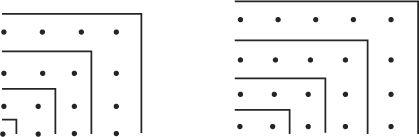
In these diagrams, the lines separating each successive odd or even numbers are called ‘gnomons’ (after a certain carpenter’s tool). Now, the sequence of odd or masculine numbers produce only square numbers, whereas the sequence of even or female numbers produce an unlimited variety of different oblongs. Secondly, in current embryological theory, the male was supposed to give the form to the embryo, while the female was a kind of material receptacle. This still does not quite explain how the Pythagoreans took even numbers to underly the unlimitedness of things, or odd numbers the limitedness of things, but this is the recurrent problem in understanding ancient Pythagoreanism: the difficulty of understanding in what sense ‘All is number’.
7 The only other testimony on Petron comes from Proclus (Commentary on Plato’s Timaeus 138b), but this merely summarizes Plutarch’s testimony, adding the guess that the worlds at the corners were somehow authoritative. Plutarch’s testimony has been contaminated with Platonic talk of forms and essences.
1 The way in which Simplicius cites F5 strongly suggests that it did not follow immediately after F4, but that a clause or two has been omitted in between.
2 However, it is to be noted that Simplicius contradicts himself on this issue, attributing only the one universe to Anaxagoras at Commentary on Aristotle’s ‘Physics’ 178.25, and a plurality of universes at Commentary on Aristotle’s ‘Physics’ 27.17.
3 Contrary to a number of scholars, I do not believe that the opposites have special status in Anaxagoras’ thought.
4 Then why aren’t we nourished by eating stones? Because stones do not have enough flesh etc. in them (see the last words of F10 for the notion that things contain all other things, but in different proportions).
5 Of course, this entails a regress: if we call gold ‘gold’ because its predominant ingredient is gold (though it has all the other homoeomeries in it too), we also call that predominant ingredient ‘gold’ because its predominant ingredient is gold … and so on ad infinitum. I do not think this would have worried Anaxagoras; it is enough that he has given an explanation of things at the macroscopic level. But Strang (see bibliography below) comes up with an ingenious way of stopping the regress.
6 The idea that a vortex or rotation is the principal cosmogonic motion is an important innovation (which some attribute to Empedocles on the basis of the ambiguous F21 on p. 149). Earlier cosmogonies had of course paid attention to the apparent rotatory motion of the universe, but had not suggested that the universe was a result of such motion.
1 No one claims that Heraclitus, for instance, wrote more than one work on the grounds that he covers both spiritual matters and scientific speculation. The conclusion that Empedocles probably wrote just the one major poem has recently been supported by the publication of some new papyrus fragments: see A. Martin and O. Primavesi, L’Empédocle de Strasbourg (P. Strasb. gr. Inv. 1665—1666): Introduction, edition et commentaire (Berlin: de Gruyter, 1999), especially pp. 114–19. If there were originally two poems, the most attractive division of their contents is that of Sedley 1989 (see bibliography below): On Nature contained all doctrinal material, on whatever topic, while Purifications contained no more than oracles and means of ritual purification.
2 Compare Heraclitus F27 on p. 40.
3 The deathblow to the four-element theory was not finally dealt until 1661, with the publication of Robert Boyle’s Sceptical Chymist.
4 See the opening chapters of Kingsley’s 1995 book in the bibliography below.
5 Some scholars think that this applies only to organic things such as bone (see F16), but F15 speaks of the idea in all generality.
6 Notice, then, a likely debt to Heraclitus: our world is born out of the struggle of opposites.
7 Empedocles’ pessimism has been strikingly confirmed by the d-group of fragments of P. Strasb. gr. Inv.1665–1666 which speaks of rotting limbs and prophesies our pursuit by the vengeful Furies for the crime of eating meat.
8 However, just conceivably this fragment belongs elsewhere, and is simply a description of an omnipotent Empedoclean deity. In this case, the ‘thoughts’ with which the deity rushes through the world may be the emotions of love and hatred or strife.
9 Although it is likely that there is Pythagorean influence on Empedocles in this detail, the basic idea of transmigration of souls probably came to him from local Sicilian beliefs: see Demand’s article in the bibliography below.
10 Does this mean that the soul is immortal? If so, what becomes of the idea that only the four elements and love and strife are eternal? Perhaps Empedocles identified the soul with one or more of the elements, or perhaps he meant that the soul was relatively immortal, lasting as long as our universe lasted before being amalgamated into love’s sphere or destroyed in the chaos of strife’s separation (cf. ‘long-lived’ in F15 1. 7, F19 l. 11, F20 l. 40, F35 l. 5). After all, a theory of psychic transmigration by no means entails a theory of absolute immortality. It is also worth remembering that on Empedocles’ theory, worlds recur cyclically; just possibly, then, he held (along with contemporary Pythagoreans; see T14, p. 99) that reincarnated souls were subject to eternal recurrence, which might confer a kind of immortality.
11 There are, however, difficulties with the idea that the elements themselves have pores or channels. What, for instance, would be the elemental status of such channels? They cannot contain air, because each element is in itself pure, so that earth cannot contain air. Are they void or empty space? But Empedocles denied the existence of void.
1 We know of some of the astronomical and meteorological views of both Leucippus and Democritus (they occasionally differ in this domain), but for reasons of space I have not given any of the relevant testimonia here, so as to focus on their more important contributions.
2 ‘Void’ means ‘empty space’, and this is probably how we should understand the atomists. But Sedley (see bibliography below) makes a powerful and interesting case for ‘void’ and ‘what-is-not’ referring, for the atomists, not to empty space but to the ‘negative substance’ (anti-matter?) that occupies empty space. Hence, given the popular conception that to exist is to occupy space, the atomist paradox that what-is-not exists.
3 This is presumably why the atomists felt the need to claim that there were infinitely many atoms. Given infinite space, there is no reason for atoms to be in one part of it rather than another (Aristotle, Physics 203b25–8), so there must be infinitely many atoms. On the likely prevalence of this kind of argumentation at all levels of atomism, see Makin [64].
4 For help with understanding the difficulties of T13 see the articles by Baldes (1975 and 1978), Burkert, and von Fritz. At any rate, it is clear that Democritus was consistent in reducing everything to spatial properties, relations, and motions, so that his account of the senses was purely mechanistic and materialistic. For the sense in which the word ‘mechanistic’ applies to ancient atomism, see Furley [17], ch. 2.
5 How, given Democritus’ theory that perception is due to material emanations from the outside world, could he believe in precognition? T 29 shows that he also had a theory to account for telepathy: that a person’s intention creates a certain motion among the soul-atoms that emanate from him along with body-atoms. Bicknell 1969 (see bibliography below) speculates that if those atoms from person A were to impinge and make an impression on person B, who later saw A doing what she had intended to do, then B may think he had seen into the future.
6 This creates an irony in the history of the Presocratics. The first Presocratics turned to natural forces and laws to counter the fickleness of the Homeric gods, but by following this scientism as far as it could go Democritus has returned to a world dominated by chance.
1 It is precisely the fact that Diogenes seems to think that this is an innovation that makes one doubt that Anaximenes held the same view, whatever the Aristotelian doxographers said: see pp. 8–9.
2 Strictly, however, it is a deduction from F5 that air is the underlying matter, rather than just the principle of intelligence; this allows some scholars to deny testimonia such as T1, which clearly state that Diogenes’ prime matter was air, and claim that Diogenes did not specify what his prime matter was: it was just ‘matter’ (Barnes [15] vol. ii, ch. 11). But if we start rejecting clear testimonia such as T1 the study of the Presocratics becomes chaotic; and the fact that Diogenes identifies the governing intelligence with air could be evidence in favour of the view that his underlying stuff was air, since it was typically Milesian to divinize the arkhē, and Diogenes is, after all, a latter-day Milesian.
1 A great many years later (in 1929), it became a clarion call for the rejection by the philosophers of the Vienna Circle of metaphysical speculation.
2 See e.g. the stories in Plutarch, Life of Pericles 36, and Ps.-Plutarch, Letter of Consolation to Apollonius 118e-f. In particular, Protagoras was invited to draw up the constitution of the new colony of Thurii in 444—a nominally panhellenic colony which was actually the brainchild of Pericles.
3 Some scholars water Protagoras down until all he said was that there are two opposing positions possible about anything, without making any claim that both of them were equally cogent.
4 See also the famous clash between the two personified logoi at Clouds 889–1112.
5 He was famous, however, for suggesting, at least on occasion, that his pupils paid him what they thought his teaching was worth, rather than a fixed fee: Plato, Protagoras 328 b–c.
6 Protagoras has to repeat this point, because in the intervening myth he had made it sound as though civic virtue was innately shared by everyone; in fact, his position probably is, according to Plato, that it is shared by everyone because it is taught. It is precisely the fact that civic virtue is teachable that underpins and justifies Protagoras’ penology of deterrence.
7 As Thomas Hobbes was so memorably to put it, in our natural state there would be ‘no knowledge of the face of the earth; no account of time; no arts; no letters; no society; and which is worst of all, continual fear and danger of violent death; and the life of man, solitary, poor, nasty, brutish, and short’ (Leviathan part 1, ch. 13).
8 The gloss of ‘justice and decency’ as ‘political expertise’ is problematic, as Socrates will go on to argue in Protagoras, because it controversially equates morality with skill.
9 Unless (as is just possible) Protagoras’ statement of agnosticism were merely one half of an antilogical experiment, whose pious contradictory other half has been lost.
10 Diodorus mistakenly attributes this and other reforms to a semi-legendary law-maker called Charondas, who probably lived in the early 6th cent., well before the foundation of Thurii, which Diodorus is here discussing.
1 It should go without saying, though, that it is very hard to do justice to some aspects of Gorgias’ style in translation. For instance, the English equivalents of words that rhyme in Greek rarely rhyme, and similar difficulties apply to alliteration, assonance, homoeoteleuton, and isocolon, to name just the first that come to mind.
2 Athanasius, Introduction to Hermogenes’ ‘Rhetoric’ 14.180.9 Rabe.
3 Note that Plato himself in Meno is not distinguishing Gorgias from Sophists, but making a distinction which is meant to be relevant within the Sophistic movement. And at Apology 19d-20c Plato definitely classifies Gorgias as a Sophist.
4 A sentence from Gorgias’ Palamedes 35 has also been adduced in this context: ‘If it were possible to make the truth about reality pure and clear to the audience through the spoken word, judgement would be easy, since it would simply follow from what was said; but since this is not so …’ But again, this implies that there is truth; it is just that it is hard to communicate.
1 e.g. fragment 490 Kock (from the play The Broilers): ‘This man has been corrupted by a book, or by Prodicus, or by some other babbler.’
2 This debate is best reflected for us now in Plato’s Cratylus, but we glimpse it also in contexts such as Ps.-Hippocrates, The Art 2.
3 Indeed, they may not be the historical Prodicus’ ideas in the first place. They are suspiciously similar to ideas Plato puts into the mouth of Socrates in Euthydemus 279a–282c.
4 It is hard to assess the effect of Sophistic atheism on Greek society, and not least because Greek religion was non-dogmatic, which makes ‘atheism’ a more difficult concept than it is in the Judaeo-Christian tradition. One was required to perform certain ritual actions, and presumably these actions engaged one’s emotions, but beyond this one was not required to subscribe to a doctrinal position. However, there is an instructive passage in Thucydides (2.53.4), where he is describing the social effects of the plague in Athens: ‘No fear of god or human law had a restraining influence. As for the gods, it seemed to make no difference whether or not one worshipped them.’ This perhaps shows that agnosticism or atheism was near enough the surface to break out in a time of crisis. Truly orthodox people turn to the gods in times of crisis, not away from them.
1 On the subject in general, see F Yates, The Art of Memory (London: Routledge & Kegan Paul, 1966).
2 With a reference to Antigone, Aristotle provides a clear statement of the difference between written and unwritten law at Rhetoric 1373b.
1 Antiphon of Athens, the orator, wrote model speeches showing how one could both prosecute and defend certain charges. Even if the orator and the Sophist are different people, these speeches are consummate examples of the Protagorean ability to argue both sides of a case.
2 Contrast Sophocles, Ajax 548–9, which implies exactly the opposite: men are born different and law makes them similar.
1 This was the consequence drawn from these premisses by an earlier atheist, Diagoras of Melos, who lived c. 430BCE. See also Euripides fr. 286, from Bellerophon.
2 For instance, was the parade of eastern gurus in the West in the 1960s and 1970s a symptom or a cause of the increasing interest in eastern religion and religious practices? De Romilly [103] argues that the earliest and greatest Sophists played no part in the attack on conventional morality, but that the techniques and argumentation they taught were later put to this kind of use by people such as Thrasymachus.
1 But after Protagoras, there were other Sophists who produced similar handbooks, according to Aristotle, On Sophistic Refutations 183b.
2 However, since it is likely that Protagoras wrote extended speeches arguing both sides of a case, truer repositories of his influence are the debates in both Euripides and Thucydides.
3 If this section is based on Protagoreanism, it is ill considered, because our author assumes that there is an objective basis to truth and falsity, whereas for Protagoras all such things were relative and subjective.
4 Unless, just possibly, there is enough text missing at the beginning of the section to have contained the whole of the other antilogical half.
5 The debate is also reflected in Plato’s Protagoras and Meno.
1 Some scholars believe the fragment should be attributed to Euripides.
2 For instance, the idea that success depends on both natural talent and practice is a commonplace found in Protagoras T15 (p. 219) and in several fragments of Democritus; the injunction to work hard is found in many conventional moralists, such as ProdicusF1(p. 248); the Anonymus’ utilitarianism may have its roots in Protagorean ideas; the importance of law and justice in a community is found in Protagoras T12 (p. 219) and elsewhere; the anonymous author adumbrates the idea found in Protagoras, Critias, and others of a primitive state for humankind, from which we have progressed; much of the praise of obedience to the law towards the end of the piece is reminiscent of Democritus’ stress on the importance of tranquillity. Cole 1967 (see bibliography below) believes that the treatise is an epitome of a work by Democritus, which was influenced by Protagoras.
3 The locus classicus for this kind of thinking being Hesiod, Works and Days 90–201.
4 See e.g. Aeschylus, Prometheus Bound 442–68, 478–506; Sophocles, Antigone 332—71; Euripides, Suppliant Women 201–13; Ps.-Hippocrates, On Ancient Medicine 2–3, 14. Other works celebrating progress, but written later than the 5th cent., certainly reflect 5th-cent. terms and issues: Isocrates, Panegyricus 28–42; Plato, Laws 676a-683a; Moschion, fr. 6 Nauck; Lucretius, On the Nature of the Universe 5.783–1457. On these and other relevant texts, see Cole 1967, pp. 1–10; several of the later texts are discussed in more detail in subsequent chapters of Cole’s book, in order to establish the likelihood that Democritus was the common source for many of them.