
V

[1]
Had the ancient Greek poet Archilochus and the modern philosopher Isaiah Berlin been magically transported to northern Italy in November of 218 B.C., they might well have speculated on the strategic prospects. “Hannibal knows many things, but Rome knows one big thing,” the Greek might have proposed. To which Berlin might have replied, “Perhaps at the outset. But then the fox could get stuck in a rut, and the hedgehog might learn new tricks.” This would have been the Second Punic War epitomized.
It has been called “the first world war in the history of humankind,”1 a plausible statement at least within the confines of the Mediterranean basin, since the strategic action extended to Sardinia and Sicily, even spilled east into Macedonia, and had to be decided by a two-step process beginning in Spain and then moving to Africa. Yet the conflict is remembered as an Italian war; it was here that the most sustained and vicious combat took place, and the most damage was done—although the nature and longevity of the effects remain controversial. Still, it’s a safe bet that most of the suffering occurred in Italy. Adrian Goldsworthy, one of the very best historians covering this era, counts twelve major land engagements taking place between 218 and 202—three times the number of the First Punic War—with more than half being fought on Italian soil.2 And during the entire conflict, Romans lost only battles that took place on the Italic peninsula. This can be attributed to a single factor … Hannibal, the central agent of destruction, their nemesis. Elsewhere, with the exception of the running fights that killed the Scipio brothers, and a few other skirmishes, the Romans were uniformly victorious. Their armies were better, their navy had become utterly dominant, and their commanders were at least as good as the other Carthaginians. The sole exception was the eldest Barcid brother; he was the hand that stirred the Second Punic War. In all respects—causal, tactical, operational, political, even sociological—it was truly Hannibal’s war.
But if he held the spotlight throughout, he left the stage a loser. In the end he was smacked down by the central non sequitur of the Western way of war: victory in battle does not necessarily mean victory in war. One triumph simply led to another triumph and another, until he found himself confined to a rut in the toe of Italy and eventually back in Africa. Meanwhile, the Romans fell back on a hedgehog who taught them to avoid being mauled by the fox, while they gradually mastered the fox’s tricks and conjured his equal. But first they would writhe and bleed beneath his claws.
[2]
Since Hannibal had lost much of his army in the Alps, his outlook was not likely to have been improved by what he found waiting for him in the Po valley—Gauls grown coy, and Publius Cornelius Scipio … again. He would deal with them in turn. The Taurini occupied the area into which the Punic force had descended, and were at the time preoccupied with fighting the neighboring Insubres. Hence, when Hannibal sent emissaries to their principal stronghold—probably at the site of modern Turin—asking for alliance and supplies for his starving troops, they rebuffed him. In no mood to be trifled with, Hannibal promptly laid siege to the place and took it in three days. He then made an example of the inhabitants, executing the men and boys and letting his soldiers loose on the women and food stores—both devoured, no doubt, with alacrity. All the Gauls in the immediate vicinity took the hint and sent representatives with pledges of allegiance, and very soon the Punic ranks began to swell with increments of both native cavalry and infantry.
But if, as Polybius (3.60) tells us, the remaining Celts of the northern plain were also inclined to join him, they were blocked from doing so by the advance of Scipio’s legions, moving west from Placentia, even pressing some reluctant Gauls into service as they went. Hannibal for his part had decided his best course was forward, hoping his army would attract Gauls as he proceeded. The lethal contest between fox and hedgehog had begun.
Publius Cornelius Scipio was already in trouble. Although Hannibal was surprised and impressed by how fast the Roman consul had made it back from the Rhône, this was only the same general and not the same army Hannibal had avoided earlier.3 (That force had been sent to Spain with brother Cnaeus.) After reporting to the senate that the Carthaginians were crossing the Alps, Publius Scipio had been told to proceed to the Po and delay them as best he could, while the other consul, Tiberius Sempronius Longus, and his legions were recalled from Sicily to support Scipio. So, for the second time in his consulship, Scipio was forced to build himself a new army, this time with a combination of raw recruits and the veterans who had been roughly handled by the Gauls under L. Manlius Vulso.4 But if Scipio had any doubts about his soldiers, he was also a Roman and anxious to engage the Carthaginians before they had time to fully recover from their Alpine journey. Therefore, he marched his army purposefully along the north bank of the Po, crossed its tributary the Ticinus with the Roman equivalent of a pontoon bridge, and moved to within a few miles of where the Punic army was known to be camped.
Meanwhile, Hannibal had been acting vulpine, toying with a few victims, and in the process reminding his troops of just what was at stake.5 Calling them together he had a number of Allobroges captives brought in. He asked if any were willing to engage in single combat, the prize to the winner being freedom, arms, and a fast horse; and the prize to the loser being freedom from the present misery in the form of death’s oblivion. When all volunteered, the winning pair (or pairs, if you believe Livy’s version) was chosen by lot and fought to the death, at which point the remaining prisoners congratulated victor and vanquished alike as being far better off than themselves. Hannibal then elaborated on the theme, reminding his men that their situation was exactly that of the Allobroges. They could conquer, or die fighting—both alternatives much preferable to being captured and led away in chains to a life of servitude and misery. Message sent and received—only desperation would trump Rome’s determination.
Sensing combat was near, Hannibal recalled Maharbal and the five hundred Numidian horse he had sent out to forage, and gathered virtually all of his cavalry to accompany him in an initial attempt to make contact. Scipio, likely remembering how easily the Numidians had been scattered on the Rhône, was also in a combative mood here at the Ticinus. To reconnoiter he brought with him a smaller force of heavy cavalry, along with a body of pedestrian velites, whom, after the Punic force had been spotted by its dust cloud, he sent forward, expecting the velites to act as a screen with their javelins. They crumpled instead. For Hannibal, having realized that his cavalry significantly outnumbered the Romans’, had placed his heavy Spanish troopers in the center and Numidians behind each wing, in position to envelope, and then he had charged, driving the terrified velites back through the advancing Roman horse before they’d had a chance to do any damage with their javelins. When the heavy cavalry of both sides came together, combat took the form of a vicious dismounted mêlée—one characteristic of Roman horsemen but also likely prompted by the run-down condition of the Carthaginians’ mounts. Here the Romans easily gave as good as they got, but on either side the Numidians drove around the flanks, first riding down the fleeing velites and then turning back upon the rear of the Roman cavalry, causing them to flee.
It was probably around this time that Scipio was seriously wounded and in danger of being captured. Most sources credit the consul’s rescue to his seventeen-year-old son, who led a band of horsemen back into the fight to surround and protect his fallen father.6This was more than just an inspirational tale of filial loyalty; the young man, also named Publius, would eventually earn the moniker Africanus as Hannibal’s conqueror at Zama. But that day was far off, and in the meantime this young Scipio would spend the remainder of his adolescence suffering at the hands of the Carthaginian, and, evidently, learning from him.
The fight itself has been dismissed as little more than a skirmish.7 Still, it must have been a confidence builder, demonstrating what the Punic force most needed to know—that it could fight successfully in Italy. Even more important, the encounter demonstrated the same thing to the Gauls. It also unveiled what would be Hannibal’s most devastating trick—pinning the center and then attacking the rear through double envelopment.8 Cavalry would prove very important in the upcoming war, and this encounter near the Ticinus River left little doubt whose was better. Not only did Roman horsemen display an unfortunate tendency to fight on foot, but they also showed little ability to work effectively with light troops, who themselves would prove chronically inferior to their Carthaginian counterparts. All these revelations of weakness Hannibal would use to great effect to counter and manipulate Rome’s real strength in heavy infantry. So if Ticinus was simply a prelude, it was nevertheless a prophetic one.
Publius Scipio was now in a desperate situation, both personally and with regard to his suspect force structure; yet he was apparently a man who knew his own limitations. Before Hannibal—who expected a major battle in a day or two—knew what had happened, the Romans were gone, crossing to the south bank of the Po on their pontoon bridge and racing east toward the relative safety of Placentia. By the time the Carthaginians reached the bridge, Scipio’s engineers had cut its moorings; six hundred stranded Roman troops were captured, but immediate pursuit of the main body was now impossible. Instead, Hannibal marched in the opposite direction, up along the north bank of the Po until he found a place suitable for fording. He left it to Hasdrubal, head of the service corps, to get the army across, while he went ahead to meet with Gallic emissaries, who were now ready to jump aboard the Punic bandwagon with solid offers of soldiers and supplies.9
The Carthaginian pursuit of Scipio could now resume, probably picking up Gauls like a rolling snowball as the army proceeded along the south bank of the Po. Two days later Hannibal reached his goal and deployed for combat in front of the Roman camp, apparently set slightly west of the River Trebia, a challenge Scipio declined to accept. This was a signal of Carthaginian dominance that no Gaul was likely to miss, including those currently pressed into Roman service. That night a body of two thousand Gallic infantry and two hundred cavalry massacred and beheaded a few Romans sleeping nearby, then bolted from the camp, going over to Hannibal, whose army was parked a few miles away.
Scipio realized that his position was untenable—if his own Gauls betrayed him, soon all the Gauls would flock to Hannibal. So he prepared his army to slink off under the cover of darkness, a barometer of his sense of urgency being the pain he would inevitably suffer from his wound along the way. Withdrawal in such close proximity to the enemy was inherently dangerous,10 and upon learning that the Romans were on the march, Hannibal instantly launched the Numidians to ride them down. Fortunately for the Romans, the Numidians were apparently still hungry and stopped to loot the abandoned encampment, a distraction that gave Scipio time to get his army across the River Trebia and heading for higher ground, where he might construct a fortified camp sufficiently strong and well placed to keep the Carthaginians at bay.
Hannibal, at least for the moment, was apparently content to not pursue Scipio and instead play the Gaul magnet, but feeding his army was and would be a continuing preoccupation. Nearby Clastidium, the place where Marcellus had won the spolia opima four years earlier, was known to be a major Roman grain storage site. The Carthaginians were about to attack it when the commander, one Dasius, and the allied garrison went over to the Punic side. A number of sources suspect that this was more than simply a matter of good luck.11 The traitor in charge was a native of Brundisium in the south, where loyalty to Rome was most problematic, and this event may indicate some initial penetration by Hannibal’s agents into an area where he would later have his greatest political success. That Dasius’s subordinates were most likely Latin allies may have also given Hannibal hope that the alliance might be broken at other points—a chimera, as it turned out. Nevertheless, it is also true that from this point until shortly after Cannae, Hannibal appears to have enjoyed an uncanny awareness of Roman intentions and capabilities. While the armies were in the north, this can partly be explained by Gauls serving on both sides, and later by the flow of deserters. Still, there remains an intelligence advantage that is never adequately resolved by the historical sources. This advantage whispers of a mole or moles with ears close to the top of the otherwise sacrosanct monolith on the Tiber.
Tiberius Sempronius Longus and his consular army were now back in Italy. Livy (21.51.6–7) has them sailing from Sicily to Ariminum (modern Rimini) high on the Adriatic side of the Italian boot, but it would have been dangerously late in the season for such an extended voyage. More probable is Polybius’s (3.68.9–14) version of them marching to the same destination along the Via Flaminia, reaching this point in early December. On the way, the historian reports, they passed through Rome, where the consensus was that the skirmish at the Ticinus constituted but a minor setback. Infantry, not cavalry, mattered, and that Sempronius’s army—presumably more capable than Scipio’s—had to do little more than show up to decide the showdown with the Carthaginians.
So, brimming with confidence, Sempronius reached the River Trebia in mid-December and settled his men down next to Scipio’s secure camp. He found his colleague still nursing his wound and generally depressed about the prospects of successfully engaging the Punic army. Scipio argued that the winter months were best spent training what remained of his mostly inexperienced force, while this period of inaction would also cause the mercurial Gauls to begin drifting away from Hannibal. Some have maintained that this reasoning was a later invention designed to protect the Scipionic reputation,12 but it was also very good advice.
Sempronius would have none of it. He was, after all, a Roman, and one whose consulship’s hourglass was quickly running down. Likely his every instinct told him (as Scipio’s had earlier) to aggressively seek glory in battle as quickly as possible. Hannibal almost immediately provided the pretext.
Some of the local allied Gauls were apparently two-timing him, hedging their bets and keeping channels open to the Romans. Hannibal knew this was dangerous and unacceptable, and sent out several thousand Celts and Numidians to ravage their territory between the Trebia and the Po. The Gauls in turn appealed to the Romans for help. Sempronius jumped at the opportunity, deploying his own cavalry and about a thousand velites to deal with the raiders. They caught the Punic marauders scattered and weighed down with booty, and sent them racing pell-mell to the Carthaginian camp. Realizing what had happened, the Carthaginian commanders of the outposts sent a covering force forward, which in turn chased the Romans back to their encampment. This tit-for-tat action took on a momentum of its own, with both sides feeding reinforcements until all the Roman velites and cavalry were engaged and the fighting ebbed and flowed uncontrollably across a wide area. Just as it threatened to escalate into a full-scale battle, Hannibal called a halt. Polybius (3.69.12–13) tells us because the Punic commander knew a “decisive engagement should never be undertaken on any chance pretext and without definite purpose.” Yet it is likely that Hannibal called a halt not because the tit-for-tat action had no “definite purpose” but because the halt itself had a purpose of its own. He was, to use the modern idiom, “preparing the battlefield,” specifically that portion that lay between the opposing commander’s ears.
Sempronius was elated by his apparent success, especially since it had been accomplished by the very parts of the force that had been defeated under Scipio. Despite his colleague’s continued warnings against rash action, Sempronius made up his mind to seek a decisive engagement as soon as opportunity knocked—exactly what Hannibal, short on supplies and long on fickle Gauls, wanted. Livy (21.53.7–11) tells us he had been briefed on Sempronius’s impulsiveness, and he now set about building a battle around it.
The opposing camps were separated by the River Trebia, a shallow braided watercourse swollen by winter rains. On Hannibal’s side beyond the west bank was a broad, flat, treeless plain ideal for cavalry, but it was also the kind of terrain favored by Roman infantry—in other words, the obvious site of battle. Studying the ground to the south, Hannibal discovered a streambed overgrown with vegetation ideal for hiding ambushers. The night before the date he intended to fight, Hannibal secretly sent his brother Mago and a mixed force of two thousand Numidians into this position, with orders to hit the Romans from the rear at the appropriate moment.
At dawn, beneath brooding skies and a cold driving snowfall, the bait was set. Hannibal sent the Numidian cavalry across the river with orders to harass the Roman outposts and lure them and whoever would follow back across the Trebia. Sempronius, playing the human equivalent of Pavlov’s dog, responded exactly as expected, sending all four thousand of his cavalry and six thousand velites after the Numidians, and ordering his heavy infantry to muster immediately and march out of camp without even having their breakfast. This force, sixteen thousand Romans and twenty thousand allied—basically two consular armies13—dutifully waded chest deep across the ice-cold Trebia, marched onto the plain beyond, and deployed for battle in the standard pattern, Romans in the center and allies on the wings—a process likely to have consumed several frigid sleet-laced hours.14 Hungry, wet, and cold—even for soldiers as tough as Romans, this was not a good way to start a battle.
While the Numidians ran the Roman cavalry and velites into exhaustion, Hannibal ordered eight thousand light infantry forward to support them and act as a screen. Only then—after his men had eaten their fill, had armed and rubbed themselves down with oil in front of their campfires—did he lead them out onto the field of battle. He was probably outnumbered, but not decisively so, his army having been swelled by around fourteen thousand Celts.15 He had a clear advantage in cavalry, both in numbers and quality. His infantry formed a single line, Africans and Spaniards to the right and left, with the Gauls in the center, where their individual size and ferocity might blunt the forward surge of the Roman legionaries, hopefully until the other Punic force components could seize the advantage. The Spanish and Gallic cavalry were placed on the flanks, where they were joined by the Numidian horse, back from harassing the Romans, a body of five thousand on either wing … and, it appears, the elephants, probably half-frozen and almost useless. It was time to fight.
The battle opened with the Punic cavalry bearing down on the Roman horsemen, who were now stationed in two groups of two thousand on the flanks of the allied infantry. They didn’t stay long; exhausted and outnumbered, they were routed and scattered by a combination of Punic cavalry and a cloud of javelins thrown by the Carthaginian light troops, who had moved back to their own wings. The Punic cavalry and light infantry now began enveloping both ends of the long Roman line, swarming the allied heavy infantry from all directions and beginning to roll it up.
The fight went better for the Romans in the center. The hastati and principes seemed to have absorbed the initial shock of the individual Gallic swordsmen and were methodically grinding through them, and some of the African units, when Mago and his Numidians emerged from hiding to hit the Roman line in the rear. The Romans’ forward momentum slowed as the triarii turned to face this threat. The younger Barcid’s timing was fortuitous; if the core body of Romans had broken through the Punic forces quickly, they might have had the opportunity to part in the middle and pivot back to support the flagging allied flanks. Instead, Mago managed to throw the entire line into confusion,16 and soon after, both alae and the adjacent Roman units disintegrated into useless human blobs.
Ten thousand legionaries in the middle, though, maintained their formations and finally broke through the Punic line. But with no flanks left to defend and only Carthaginians and the ice-cold Trebia to the rear, they kept marching right off the battlefield and made their way to Placentia and safety. For most of their trapped compatriots, however, death was the only refuge. While there are no casualty figures,17 most men likely fell prey to Carthaginians, drowning, or simply exposure.
Almost certainly the tempo of battle was progressively determined by hypothermia. As the day wore on, the snow turned to a cold penetrating rain that must have sucked the vitality from all the combatants. At least the Carthaginians had been acclimatized in the Alps; many of their adversaries had been basking in the warmth of Sicily not much more than a month earlier. Livy (21.54.9) refers to the Romans after crossing the Trebia as scarcely able to hold their arms, and growing progressively weaker as the day wore on. Because Hannibal had made sure that the Carthaginians had eaten breakfast and otherwise prepared themselves, they must have had a body heat advantage at the beginning, but Livy (21.56) makes it clear that they grew increasingly benumbed. At the end, the fighting and even the slaughter must have taken place in stiff-limbed slow motion, with no attempt made to cross the river and take the Roman encampment. Instead, the Carthaginians staggered back to their own camp, and stayed there, cold and passive for the next several days, a period during which many of their pack animals and almost all of the elephants succumbed to exposure.18 This hypothermic lassitude probably saved Scipio and the Romans left to guard the camp; they were able to escape by rafting down the Trebia, and eventually joined the other fugitives at Placentia.
It appears19 that Sempronius tried to disguise the magnitude of his defeat, sending messengers to Rome to announce that a battle had taken place and that only the storm had deprived him of victory. Quickly his countrymen learned the truth—Hannibal and his army remained secure in their camp, virtually all the Gauls had gone over to him, and fragments of two consular armies were scattered in various localities, cut off from supply except by the River Po. The situation was obviously serious, but the first steps taken to shore up Rome’s position seem pointed in the wrong direction. The Romans readied a fleet of sixty quinqueremes and reinforced Sardinia and Sicily, as if the main threat would come from Carthage and not Hannibal. Still apparently trying to salvage his reputation, Sempronius, Livy (21.57.3–4) tells us, boldly made his way to Rome to preside over the consular elections. The results there also reflected a sense of emergency, though not necessarily good choices. Joining C. Servilius Geminus as consular colleague was Caius Flaminius, the Gauls’ archenemy and, because he’d provided them with Gallic land he’d conquered, the Roman farmers’ friend. He was definitely a controversial figure, particularly among the wealthier elements of the nobility, but his career was all about pummeling the Gauls, and he was known to be a man of action. One can almost hear the conventional wisdom along the Tiber: “Flaminius is just the man to take care of this problem up north.” But he had yet to meet Hannibal.
The ancient Greeks had a term, aristeia, for a serial display of heroic excellence—a sort of berserker kill-fest in which a central character hacks down any and all who stand in his way—in The Iliad, for instance, when Achilles single-handedly routs the Trojan army. The term seems appropriate for Hannibal; such was the magnitude and audacity of his initial series of victories over the Romans. Trebia marked the beginning of the series, and Cannae the climax. But in the first contest he had already revealed the qualities that would make him one of the greatest soldiers who ever lived—his X-ray vision into the minds of his opponents, his trickiness and penchant for surprise, his judicious use of his men, both in their care and feeding and also in how he applied each force component to maximum advantage.20 (The only significant Carthaginian casualties were the Celts who had been placed in the center to absorb the brunt of the Roman assault—troops of uncertain loyalty, virtually untrained, and easily replaceable at this point.) It was a virtuoso display, but unfortunately for the Romans, Hannibal was far from satisfied.
For in the winter of 218–17 his position and that of his army were far from secure. Food must have been a constant concern. Livy (21.57–8) speaks of several Punic attacks on supply depots near Placentia, and a failed attempt to cross the Apennines to find better foraging. Modern historians21 often dismiss these accounts as inventions, but these stories certainly speak to a very basic preoccupation in an environment where Gallic agriculture likely did not produce significant surpluses.
This may have been reflected in Hannibal’s treatment of his prisoners. The Roman captives, whom he expected to ransom, he fed only enough to keep them alive. The Roman allies in his hands he treated better, and after a time he gathered them together, informing them that his war was against Rome and for the liberty of Italy’s people.22 With this he freed them all without ransom. This is generally seen as the first step in Hannibal’s political and information campaign to undermine Rome’s alliance structure, and it undoubtedly was. But it is also worth mentioning that it left him with hundreds, perhaps thousands, fewer mouths to feed.
His precarious status and the questionable hospitality of his hosts were further evidenced in the tale Polybius and Livy both tell of Hannibal having to wear various disguises, even different-colored wigs, to avoid assassination at the hands of the locals.23 The Gauls had not rallied to the Punic standard in order to find their own territory as the seat of war and the kitchen table for what amounted to an occupying army. If Hannibal wanted to keep the Gauls as allies, he had better move south as soon as the weather turned.
[3]
Springtime for Hannibal meant winter for Etruria and Rome.24 Actually, there were two ways he could have gone. The Apennines form the spine of Italy, dividing it longitudinally. Therefore, he could have marched east toward the Adriatic side and then headed south, where he was likely to find support among those most recently conquered by Rome. This route also would have brought him closer to Carthage. Alternatively, he had the choice of moving down to the passes of the Apennines and heading west into Etruria, leaving open communications with the Po valley and Spain, and also putting himself in a position much more directly threatening to Rome itself. Given his motives and his true base of support in Iberia, he chose the latter.
Knowing their own geography, the Romans hedged their bets. They sent Geminus north along the Via Flaminia (the same route probably taken by Sempronius) to Ariminum, where he could combine his new recruits with Publius Scipio’s veterans25 and cover the eastern corridor down the peninsula. Flaminius had already arrived at this destination, assuming office here and not in Rome, thereby flouting tradition and skipping the religious rituals normally presided over by an incoming consul. To compound matters, he ignored the commissioners sent to recall him. Instead, he added the remnants of Sempronius’s force to his own legionaries and moved to Arretium, where he thought he would be in a position to block the Apennine passes leading toward Etruria.26
He wasn’t. Hannibal gave him the slip crossing at the Porretta pass,27 and then struck out through the flooded marshes surrounding the River Arno. This was not simply a matter of deception; as usual the Punic commander had a hidden agenda. The march also would serve as a means of toughening the Gauls and weeding out the weak ones. This trek would be a swampy version of the one over the Alps. He lined up his army with the Spaniards and Africans intermingled with the baggage train, the Celts sandwiched in the middle, and Mago and the Numidians to the rear to keep the whole mass moving and the Gauls from turning back. Those who survived slogged continuously for three days and nights. They had to; in this inundated terrain there was no place above water to rest except upon the corpses of the many fallen pack animals. Cavalry horses frequently lost their hoofs. Hannibal, atop the last surviving elephant, contracted a case of ophthalmia so severe that he lost the sight of one eye.28 All told, it was a bad trip. But when the Carthaginians emerged from the morass somewhere around Faesulae (modern Fiesole), the army was not only clear of the Romans, but also it had rid itself of fair-weather Gauls and begun the process of fully integrating the remaining Gauls into the force structure.
Hannibal’s swarm of scouts and spies had been busy. They confirmed that the rich Etrurian plain was ripe for the plucking and that Flaminius, still at Arretium, was a commander every bit as impulsive and belligerent as Sempronius and just as easy to trap. Hannibal decided to lead him on a fool’s errand south. And as he traveled he understood exactly how to distract the Roman commander; nothing would infuriate the farmers’ friend more than Hannibal’s foragers’ descending like a plague of locusts onto the villages and fields of Rome’s allies. Here in the heart of Italy, Flaminius had only to follow the smoke columns to follow Hannibal, a humiliating circumstance that could be stopped only by bringing Hannibal into action, which Flaminius was determined to do.
Both Polybius and Livy maintain that Flaminius was discouraged by his subordinates, who advised him to await reinforcement from Geminus.29 He ignored them, and also in typical Flaminius fashion, he overlooked a series of ill omens (here is where the hard-to-pull-up tent standards came into play), and probably did so appropriately, if only because he was a Roman and was predisposed to fight. Besides, Hannibal was on the move; how could his colleague Geminus have been expected to catch up? It also says something that Flaminius’s army was joined by a host of irregulars carrying chains for the prisoners they expected to take and enslave after an easy victory. So Flaminius, as always with his ear more attuned to vox populi than to the council of prudence, went forward in hot pursuit.
No more than a day ahead, Hannibal came upon Lake Trasimene and saw opportunity along the route before him—a narrow plain that separated the shoreline from a parallel track of steep hills, the entrance to which was a blind defile. He slowed his army so that late in the day Flaminius would march up and see him entering the gulch, and later Flaminius’s scouts would observe the Punic campgrounds near the far end of the line of hills. The Romans settled down for the night outside the gulch entrance. Hannibal, under the cover of darkness, led his forces back down a parallel path on the other side of the hills and stationed the men high along the hills’ reverse slopes, awaiting the arrival of dawn.
The next day—June 21, 217 B.C.30—broke with a heavy ground fog hanging over the lake and its environs. It is unclear whether the Romans were already deployed into three parallel columns of hastati, principes, and triarii when they entered the defile, but they may have been, since they were expecting action in the near future. But they had no idea they were walking into what would be remembered as the biggest ambush in history, the only time an entire large army was effectively swallowed and destroyed by such a maneuver.31
With amazing self-control the Punic forces waited silently above as the Romans marched along the lakeshore, gradually filling the narrow plain until the Romans made contact with Hannibal’s stopper force of Africans and Spaniards, at which point Hannibal gave the signal for all his troops to come charging down the hill. Emerging out of the mist, they hit virtually the entire length of the Roman army simultaneously, completely surprising and quite probably freezing them into terrified passivity. There was no going back, the Carthaginian cavalry had sealed the defile. Livy (22.5–6) tries to make the case that many stood and fought bravely; some may have, but Polybius’s (3.84) pathetic description seems more in line with the circumstances.
Most of them were cut to pieces in marching order, as they were quite unable to protect themselves…. Those again who had been shut in between the hillside and the lake perished in a still more pitiable manner. For when they were forced into the lake in a mass, some of them quite lost their wits and trying to swim in their armor were drowned, but the greater number, wading into the lake as far as they could, stood there with only their heads out of the water, and when the cavalry approached them, and death stared them in the face, though lifting up their hands and entreating to be spared in the most piteous terms, they were finally dispatched either by the horsemen or in some cases by begging their comrades to do them this service.
Nor did Flaminius survive the attack. The Gauls who had long suffered at his hands went straight for him, easily recognizable by his splendid accoutrements and also, if you believe Silius Italicus (5.132), because he wore a Gallic scalp on the crest of his helmet. For a while his bodyguards fought the Gauls off, but then an Insubrian horseman, whom Livy names Ducarius, charged through the dense mass and first slew Flaminius’s armor bearer, and then, knowing the consul’s face, ran him through with a lance.
The killing spree continued for about three hours, a slaughter so intense that neither side was aware that they were fighting in the midst of a major earthquake that had shot across central Italy.32 According to Fabius Pictor, around fifteen thousand Romans joined their leader that morning in death.33 Another six thousand Romans, probably near the head of the column, seem to have brushed past those in front of them and headed for the hills. Polybius claims they could not see—possibly due to the fog—what had befallen the rest of the force until they reached higher ground, and by then it was too late to help. More likely they were simply demoralized, which better explains their taking refuge as a body in a local Etrurian village, and their abject surrender to Maharbal and his Spaniards and Numidians a little later. At that point they were added to the other prisoners, now totaling fifteen thousand, all of whom Hannibal assembled after the fighting had ceased. As at Trebia, he slapped the Romans in chains and sent the allies home without ransom, but with the same message that he was all about liberating them from the tyrants on the Tiber. Livy (22.7.2) says some ten thousand men were scattered and eventually made it back to Rome; whether this number included the allies Hannibal let go is impossible to say. One thing was and remains clear, however. In a matter of hours an entire consular army had simply vanished.
If ever a Barca lived up to the family appellation Thunderbolt, it was Hannibal at this moment. But it is unlikely that this brilliantly conceived trap materialized out of thin air. Hannibal would not have soon forgotten the two ambushes he’d suffered in the Alps, and it is plausible that they provided the seeds of his plan at Trasimene—the same scheme of assaulting a force on the march, hiding and then attacking from above, leaving no avenue of retreat, and setting a death trap to the side. Had the Romans made this connection, it might have further mortified them. Here was an adversary who not only learned from his mistakes, but found ways to leverage them to his own advantage. He was dangerous not only on the battlefield, but anywhere in his vicinity.
For Hannibal it was an altogether felicitous encounter—after the Alps, the winter, and the swamp, his troops had been exhausted and probably capable of only a short, sharp action. His own losses were low, around fifteen hundred, most of them Celts, who’d likely seen at least some compensation in the opportunity to kill the hated Flaminius. And Hannibal’s good fortune was not at an end. There were scouting reports that the remaining consul, Geminus, had sent a large cavalry force down to support Flaminius and that it was now in the area, presumably unaware of what had happened. So Hannibal sent the enterprising Maharbal and the Numidians to deliver still another unpleasant surprise.
Back in Rome, the city was rife with foreboding. Days passed. Wives and mothers wandered the streets quizzing any and all on the fate of the army. As the frightening gossip clarified, a great crowd formed around the senate house, demanding solid information from the magistrates. Finally, a little before sunset the urban praetor Marcus Pomponius emerged to announce only: “We have been defeated in a great battle.” So the rumor mill ground on, with the women who were gathered at the city gates awaiting their men—or at least some word of them—gradually realizing a great many would not be coming home.34
Meanwhile, Pomponius kept the senate in constant session from sunrise to sunset, racking their collective brains as to how they might deal with a threat that over the course of seven months—punctuated by Ticinus, Trebia, and now Trasimene—had grown exponentially to the point where it was shaking the foundations of the state. For these disasters were palpably worse than those of the First Punic War, having fallen heavily upon the more prosperous elements, who served in and commanded the legions—not upon the poorer and less politically significant types, who rowed the warships that had been lost in the earlier contest. Existentially, the army was at the center of Rome’s conception of itself. Losing in this fashion and leaving an invader free to ravage the Italian countryside was humiliating almost beyond the capacity of words to describe.35
Then, after three days of deliberations, news arrived that Gaius Centenius, who’d been sent to help Flaminius with a force of four thousand horse—most of Rome’s remaining cavalry—had been surprised and surrounded by Maharbal probably somewhere near Assisi.36 Half of the men had been killed immediately, and the rest had surrendered the next day. Still another substantial Roman force had been obliterated. At this moment there was nothing left standing between Hannibal and Rome itself, except an easy hundred-mile march down the Via Flaminia. The situation seemed truly desperate, and the senate fell back on what was the system’s last bulwark in the face of disaster. For the first time since 249, when Rome’s navy had been wiped out off Sicily, a dictator was appointed.
[4]
He was Quintus Fabius Maximus, the same man Livy believed had told the Carthaginians that he held war or peace in his toga. It may not have been him, but he was the sort who could have said such a thing and been taken seriously. He was fifty-eight years old, had been twice consul and once censor, and was from an ancient clan, one that had already earned the title Maximus—“the greatest.” Owner of an impeccable pedigree, he was exactly the type Rome turned to in emergencies. Just the name Fabius sounds august, but actually it relates to what had once been the family business, bean farming. And symbolically, temperamentally, and strategically, he was the Beanman matched against the Thunderbolt. For like the hedgehog, Fabius Maximus understood one big thing—Hannibal’s never ending need to feed his army. To win, Rome did not have to defeat him in battle; they had to simply restrict his ability to provision his troops. Once the dictator took to the field, it became apparent that this involved two essential expedients: the removal or destruction of crops and livestock in the path of the Punic force, and the relentless interception and attrition of Carthaginian foraging parties.37 In the meantime, Fabius would scrupulously avoid a field engagement with Hannibal, electing instead to shadow his every step, but at a safe distance and always taking the high ground to avoid being brought unwillingly into battle.
It is important to realize that the Fabian strategy, from the outset, was seen by Romans not as a magic bean but as a bitter pill. Their entire orientation was offensive; they were acculturated to seek battle; they had been conditioned to believe their military system would triumph over any general, no matter how clever. They were also farmers, whose instincts were to protect, not burn, their fields. Everything Fabius proposed, while prudent in the face of military genius, went against the Roman grain.38 A later generation who benefited from his policies would apply to him the title Cunctator (“the Delayer”), and even this was not altogether positive.39 At the time, his countrymen employed less flattering sobriquets—Verrucosus for the wart that grew above his lip; Ovicula (“Lambykins”); and “Hannibal’s paedagogus,” after the slave who followed Roman schoolboys and carried their books.40 His countrymen also subverted and resisted his approach, undermining his authority even within the short space of his six-month term of office. It probably felt like the right thing to do, but it was a path that led directly to Cannae.
His term actually began with a focus on what was perceived to be the immediate danger to the city. First he sought to explain Flaminius’s defeat in a way the people could understand—that is, Flaminius’s failure to perform the appropriate religious rites, and his ignoring obvious omens of the gods’ displeasure. Fabius had the senate consult the prophetic Sibylline Books and then charge a praetor with performing the prescribed rites to assuage the gods.
Fabius did have a deputy, Marcus Minucius Rufus, his master of horse. (The dictator himself had to get special permission to serve mounted.41) Together they looked to the defenses of the city, and it may be that Minucius was ordered to assemble the legiones urbanae by a certain date.42 It also seems that two additional legions were raised to replace those lost by Flaminius, and that these set out with Fabius up the Tiber valley to meet those of Geminus, who had been ordered to proceed down the Via Flaminia toward Rome. To make it absolutely clear who was in charge, when the consul’s army was spotted, a message was sent that Geminus should come into the dictator’s presence without lictors and as a private citizen. Rome now had a clear leader and a covering force, but by this time it must have been apparent that Hannibal had gone elsewhere.
Given the quality of his intelligence, the Punic commander may well have been aware that nothing stood between him and Rome after Trasimene; but he also would have known that his army was badly rundown and in no shape to besiege what was one of the most heavily fortified population centers in the Mediterranean world. So instead he headed east, crossing the Apennines again on a ten-day march to the rich Picenum district along the Adriatic coast. During this march, he allowed his men to plunder and abuse the local populations to their hearts’ content. They must have been a motley crew at this point, the men exhibiting symptoms of scurvy and the horses afflicted by mange—both the result of vitamin deficiencies.43 So Hannibal let the soldiers gorge themselves on the fresh produce of the area, and bathed the horses with sour wine until both man and beast gradually regained their health and vitality.
But with Hannibal, R & R seldom meant repose. Polybius (3.87.3) tells us that, while in Picenum, he rearmed his African troops with “select weapons” captured in very large quantities. This process, which the historian says began after Hannibal won the “first battle” with the Romans,44 raises some interesting questions. Were they being given the pilum and gladius? If so, this implies their transformation primarily into swordsmen,45 which seems to be contradicted by Plutarch, who says (Marcellus, 12.2) the Libyans “were not javelineers, but used short spears in hand-to-hand fighting.” This description likely eliminates the pilum as an add-on. Whether the Africans adopted the short sword is still at issue, but given the short sword’s lethality and compactness, the addition remains plausible, at least as a sidearm. It is fairly certain they did not carry long pikes and therefore fight as a phalanx. The only evidence that they did carry long pikes is an apparent mistranslation of the Greek word for “spear.”46
Livy (22.46.4) does say that the Libyans at Cannae could have been mistaken for Romans, since they were equipped with Romans’ captured gear. Probably he is referring to their defensive accoutrements, which is what an observer would have noticed. Since a lot of equipment had been captured, it stands to reason that the Africans, who were Hannibal’s key maneuver force, would have gotten the best of it—an oval scutum (a shield heavy enough to preclude using the long two-handed pike of the Macedonian phalanx), the best Montefortino helmet, a full set of greaves, and, most important, a ring-mail cuirass rather than simply a pectorale heart protector. These articles left them as a group considerably better protected than most of the Romans. They were now true heavy infantry, and this equipment upgrade serves to explain their impact at Cannae; when they closed the trap on the Romans, it could not be pried open.
Before leaving Picenum, Hannibal also belatedly reestablished contact with Carthage, informing the city by seaborne messengers of what had transpired since he’d left Spain. Polybius notes that this is the first time Hannibal had touched the coast since reaching Italy, but still he had left the city without word for more than a year. Had he really wanted or needed instructions from Punic central, it seems he would have made a more concerted effort to contact them earlier. Instead, he waited until he had good news, especially for the Barcid faction at home. And apparently it elicited the responses he wanted—rejoicing and promises to support in every possible way the two campaigns in Spain and Italy. Perhaps as public relations, it worked, but in the case of the latter theater the results proved negligible.47
[5]
Refreshed, rearmed, and likely remembering his dream of the serpent tearing up the Italian countryside, Hannibal headed south to begin the next more overtly political phase of his campaign. He applied the sinuous column of his army—in hopes of weaning away his enemy’s allies, of provoking further Roman action in their defense, or of simply demonstrating that the Romans could not protect their allies. Advancing down the Adriatic coastal plain into Apulia, foraging as he went, he turned southwest about two thirds of the way down the Italian boot and headed toward Aecae,48 probably on intelligence that Romans were in the vicinity. He found Fabius Maximus camped nearby with an army of forty thousand—four legions and their allied equivalents—having reached this spot after an extremely cautious journey guided by constant reconnoitering. Hannibal immediately marched up, deployed, and offered battle. But Fabius would have none of it, leaving the Punic commander to withdraw and lecture his troops on the newfound timidity of Romans.49
There ensued a cat-and-mouse, or rather a fox-and-hedgehog game—with Hannibal employing all manner of artifice to incite his opponent, and Fabius clinging to his one big thing, avoiding a showdown. The Punic force was like a shark, to survive it had to keep moving, sending out between one half and two thirds of its numbers to forage.50 To make this more difficult, Fabius had earlier tried to impose a “scorched earth” policy, ordering all those in the Carthaginian path to take shelter in fortified places, but only after destroying all structures and supplies. Given the amount of booty the Carthaginians managed to cart off, this policy was probably honored more in the breach than in the observance, but even partial implementation must have had the effect of dispersing the foragers and leaving them more vulnerable to attack. This was Fabius’s opening. Keeping his own men concentrated and fed from local supply dumps, he sent out hunter-killer teams to prey on isolated Carthaginians, and in the process he rebuilt the confidence of what must have been a demoralized and inexperienced force.
Almost from the outset it seems Minucius, Fabius’s master of horse, objected to the inevitable rural destruction, calling it craven, and champing at the bit for a more aggressive approach. It must have been hard for any Roman to take, especially since, as Minucius noted, the dictator’s habit of camping on high ground created “beautiful theaters for their spectacle of Italy laid waste with fire and sword.”51
Keeping the pressure on, Hannibal pillaged his way west across the Apennines into Samnium, heading toward Campania and the most fertile agricultural district in Italy, the fabled plain of Capua or ager Falernus. On unfamiliar ground, he apparently had some trouble reaching his destination; here is where he crucified one or perhaps several guides when they misunderstood his badly pronounced Latin and took him in the wrong direction.52 Meanwhile, Fabius, following Hannibal’s eventual path down the Volturnus River valley, a day or two’s march behind, realized that the steep narrow pass at the valley’s head was the only viable entrance and exit from the plain. All he had to do was occupy this defile—which he did with four thousand men, stationing the rest of his army in a camp high on a nearby hill—and he had the Carthaginian trapped. Hannibal could plunder to his heart’s content, but the odds were on his returning only to find his path blocked, which is exactly what happened. Laden with loot he would need for the coming months, and faced with the necessity of establishing his winter quarters in a more defensible locality, Hannibal was left to consider his options.
The fox is most unpredictable after dark, and so was the Carthaginian. Appian (Han.14) claims it was here that a desperate Hannibal had his Roman captives slaughtered, but this seems unlikely, since at this point prisoners were still being ransomed and Hannibal needed the money. Besides, he had other beings to sacrifice.
He ordered Hasdrubal, the head of the service corps, to collect a herd of two thousand oxen from the vast throng they had assembled and attach bunches of dry wood to their horns. He rested his troops until around three A.M., and then formed the heavy elements, cavalry, and baggage into a column and began ascending the pass. Meanwhile, he had his herdsmen, accompanied by Numidian skirmishers, light the bundles and drive the animals up toward the ridges on either side of the pass. Maddened by the fire, the beasts raced erratically ahead, drawing the attention of the Romans guarding the pass. They followed in pursuit of what they thought were the torches of the Carthaginian force, only to be greeted by scorched bovines and a hail of Numidian javelins. Fabius also observed the fires and, thinking it a trap, refused to budge from camp. Left unobserved, Hannibal and the main body cleared the now unoccupied pass without incident, sending some Spaniards back to rescue the Numidians on the ridges.53
To Roman eyes at least, Fabius was made to look like a coward and an idiot, with Minucius becoming increasingly vocal and contemptuous in his criticism. Hannibal made a feint toward Rome, but the dictator held to his policy with apparent serenity, dogging Hannibal and keeping to the high ground. It was probably around this time, with the Carthaginian force meandering eastward toward Apulia, that the Punic commander sought to heap calumny atop his opponent’s already soiled reputation. Informed by deserters that the Carthaginians were passing an estate owned by Fabius, Hannibal had his troops meticulously destroy everything around it, leaving only the dictator’s property untouched. When news of this masterful psychological operation reached Rome, it had the intended effect of further undermining the dictator’s popularity.54 Sensitive to appearances, Fabius sent his son Quintus back to the city to sell the farm, the money from which he used to ransom Roman prisoners. Yet the damage had been done. Fabius was recalled, ostensibly to conduct certain religious rites, but more probably to explain his apparently dilatory conduct of the war. He left Minucius with strict instructions not to engage the enemy, but the master of horse had other ideas.
Sometime in the early autumn of 217 the Punic army marched up to a small fortified place called Gerunium, sitting in the midst of a rich Apulian agricultural district. Immediately Hannibal settled on his winter quarters. But when he offered the population terms, they refused him—a serious mistake. His troops made short work of the defenses and slaughtered the survivors.55 Leaving the fort walls intact and preparing the houses inside to serve as granaries, he set about building a fortified camp for his forces around the outer circumference. Before long he was sending two thirds of the men out in foraging parties scampering about the countryside gathering grain for the months ahead like squirrels with swords.
At least until Minucius and the Romans arrived looking for trouble. Hannibal called back a third of his foragers and marched out against the Romans, sending two thousand Numidians to take a hill between the two armies. The Romans responded by capturing the hill and building their camp on top. Hannibal kept his forces consolidated but after a few days resumed foraging. Minucius went after the marauders, and even began assaulting Hannibal’s forward camp—what amounted to Fabian tactics on speed. The normally belligerent Carthaginian seemed uncharacteristically passive; he retreated to Gerunium after considerable losses and was subsequently more circumspect with his raiding for rations.56 Minucius, it seemed, was the man of the hour.
He certainly was in Rome. News of his success swept through the city. Romans were hungry for a victory—any victory—and this one was apt to have gained in perceived significance as its telling passed from mouth to mouth. Likewise, the repute of Fabius, who had yet to return to the field, suffered by comparison. So much so that one Metilius, the tribune of the plebes (the only office retaining its power subsequent to the appointment of a dictator), passed a law equalizing the master of horse’s imperium with that of Fabius. Prominent in recommending this measure, Livy (22.25.18–19) says, was a recent praetor, Caius Terentius Varro. The historian is plainly contemptuous of this politician, portraying him as the lowborn son of a butcher and as an utter demagogue. But Varro’s already elevated status and subsequent election to the consulship argue the contrary. It is a safe bet, however, that Varro objected strenuously to Fabius’s approach to fighting Hannibal, and that when he gained power, things would be different.
In the interim, however, Minucius and Fabius were left to settle their differences. With the dictator’s return to the Apulian front, the question of who would command, now that they were equals, immediately arose. The master of horse initially favored unitary control assumed on alternate days, but Fabius succeeded in convincing his colleague to divide the force, each retaining the equivalent of a consular army. Fabius no doubt argued that the consular army was the most efficient and easily controlled fighting instrument. Minucius promptly took his half and set up a separate camp about a mile distant, possibly at the forward position the Carthaginians had been forced to abandon.57
Hannibal had been biding his time, very much aware, by virtue of his superior intelligence, of the rift between the two Roman commanders. He also understood them. He had learned to respect Fabius for his caution, but Minucius could be tricked, and Hannibal had already set him up for a fall. Just as in the first battle, there was now a hill separating Hannibal and Minucius, a hill that Hannibal planned to occupy, banking on Minucius’s trying to recapture it in a repeat of his earlier success. Hannibal had also surveyed the surrounding terrain, and although it was treeless, it contained many depressions capable of concealing substantial numbers of troops, the same ploy as at Trebia. On the night before he planned to fight, Hannibal sent out about five hundred horsemen and five thousand light infantry to hide themselves in clumps of several hundred.
At dawn Hannibal took the hill, so that Minucius, lacking a vantage point, had no idea he was not alone as he prepared for battle. Instead, the Roman commander concentrated on getting the Carthaginians off the high ground, first sending his light troops, then his cavalry, and finally the legionaries, all of whom Hannibal thwarted with reinforcements of his own. Next, Hannibal had his cavalry sweep down on the Romans, scattering their horse and sending the velites careening helter-skelter back into the main body of legionaries. This maneuver destabilized the maniples sufficiently so that when swarmed by the concealed Carthaginians, the army melted into a crowd.58 Once more disaster was at hand.
But thanks to Fabius Maximus, it did not materialize. He had apparently anticipated such an outcome and had taken the precaution of marching out of camp and deploying nearby, providing a rallying point for the fleeing troops of Minucius. Having already sprung his trap and felled a considerable number of velites and legionaries, Hannibal chose not to press the issue. He had secured his base at Gerunium and would spend the winter there well supplied, resting his army, and probably further integrating its force components, while the Romans were held at bay.
Both Polybius and Livy would have us believe that this incident effectively rehabilitated Fabius and his policies.59 Livy has Minucius returning to the dictator’s camp with his army and once again subordinating himself and his troops in the most abject sort of way. Polybius adds that back in Rome respect for the dictator’s cautious approach was miraculously restored. If so, it was short-lived. Sometime in December 217 the terms of Fabius and Minucius came to an end. Power returned to the original consul, Geminus, and to Flaminius’s replacement, M. Atilius Regulus, both of whom now took command of the army that was keeping an eye on Hannibal. The consuls were content to stay put, but the next consular elections would bring to the fore men with an agenda entirely different from that of Fabius Maximus.
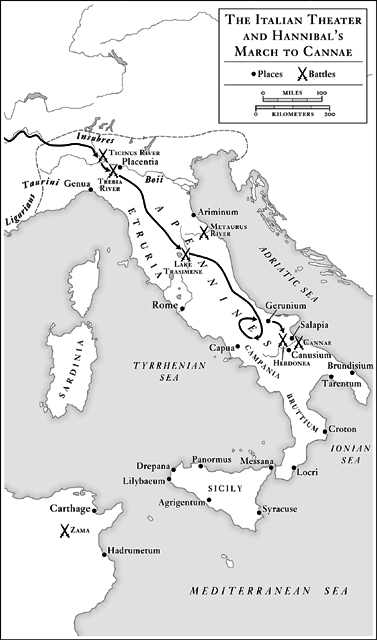
Hannibal had shown himself to be the most dangerous sort of opponent, but thus far his political success in Italy had been minimal, leaving him without a fixed base and obliged to wander the countryside in search of food. That was where Fabius wanted him, with his troops acting not as soldiers but as vulnerable scroungers. Another year of this might have starved and weakened this cunning invader out of existence.60 But Romans remained Romans. They retained a huge manpower advantage, and their every instinct beckoned them to battle. Unfortunately, the battle proved to be Cannae, and the hedgehog was left to watch from the sidelines as the fox had his way yet again.