
ALL THE KING’S MEN
THUTMOSE III’S FOREIGN CONQUESTS LOOM LARGE IN CONTEMPORARY accounts of his reign and still dominate our view thirty-five centuries later. Yet, while the king spent long periods away on campaign, especially during the first two decades of his sole rule, he could not afford to neglect domestic affairs. Egypt was geographically extensive, and a nation of strong local and regional traditions. The forces of decentralization were never far beneath the surface. Bitter experience, twice in Egypt’s history, had shown that in the absence of firm central government, the country could easily fall prey to political fragmentation, internal conflict, and foreign invasion.
For the early Eighteenth Dynasty kings, Ahmose and Amenhotep I, rebuilding their shattered realm had been the priority, overseas adventures an unaffordable distraction. That Thutmose III was able to devote his considerable reserves of energy to widening the frontiers of Egypt is a testament as much to his forebears’ administrative reforms as to his own leadership skills. For the system of government that the early New Kingdom rulers put in place strengthened the absolute power of the monarch while releasing him from the day-to-day exigencies of running the country. The king might be the sole source of power, simultaneously head of state and government, commander in chief of the armed forces, high priest of every cult and the gods’ representative on earth, and the arbiter of policy, but in practice he delegated matters to a small handful of trusted officials. Reveling in their status and wealth, these men (and they were all men—Egypt might have accommodated itself to a female pharaoh, but the corridors of power remained an all-male preserve) who ran the country during the New Kingdom commissioned for themselves beautifully decorated sepulchres in the Theban hills. The so-called Tombs of the Nobles are a favorite tourist attraction today, but also a revealing window on the king’s inner circle. Look beyond the brightly colored wall paintings, and the murky reality of power politics comes sharply into view.
For practical purposes, the administration of Egypt was divided into separate departments. Central government combined the office of royal construction projects, headed by an overseer of works, with the all-important treasury, under the control of the chancellor. The army had its own overseer, as did the Nubian gold mines, so vital to the prosperity of the Egyptian economy. Provincial government was the responsibility of regional appointees, such as the king’s son and overseer of the southern countries, who administered Egyptian-controlled Nubia, while individual towns had their own mayors. Thebes, the monarchy’s theological power base, was treated as a special case, with its own devolved administration entrusted to ultraloyalists. Each temple in the land had its own priesthood with economic as well as religious authority. First among equals was the high priest of Amun, who exercised effective control over the vast landholdings and other assets that belonged to the temple of Ipetsut. Finally, there was the department responsible for the royal household and for the estate that supplied its material needs. Here, the royal steward held sway, controlling access to the king’s person and enjoying privileged access to the monarch. At the very top of the government machine, filling the role of intermediary between every department and the king, was the office of vizier (effectively prime minister). In the Eighteenth Dynasty, this position was divided into two, with a northern vizier based in Memphis and a southern vizier in Thebes. All in all, it was a highly effective system, giving the king, through his placemen, control over every aspect of the nation’s affairs.
In the days of the pyramids, the major offices of state had been reserved for male members of the royal family, but such a system would have provided the king’s younger brothers and sons with opportunities to build up rival power bases, and could have proved disastrous. In the late Fourth Dynasty, the upper ranks of the administration had been opened to men of nonroyal birth. Not only did this keep the king’s potential rivals away from positions of influence, but it also enabled the government to be run in a more professional way. By the early New Kingdom, with Egypt engaged in international relations and empire building on an unprecedented scale, the king’s male relatives—with the exception of the crown prince—could be safely packed off to join the army (much like the younger sons of British monarchs in more recent times). There, they could find an outlet for their skills (and frustration) in the service of the state. Meanwhile, back at home, an entire ruling class of bureaucratic families had established itself at the pinnacle of ancient Egyptian society. Its members monopolized the best jobs, often passing them down from one generation to another. Within this small and claustrophobic clique, men of talent and ambition jostled for power, currying favor with the king to advance their own careers.
A quartet of high-ranking bureaucrats who served under Thutmose III and his successor illustrate particularly well the nature of authority in ancient Egypt and the atmosphere of sycophancy and suspicion that permeated the king’s inner circle. Through them, we may glimpse the inner workings of the Egyptian state at the height of its power and prestige.
CHURCH AND STATE
MENKHEPERRASENEB WAS HIGH PRIEST OF AMUN, IN OVERALL CHARGE of the great temple of Amun-Ra at Ipetsut, the most important religious foundation in Egypt. The string of titles inscribed in Menkheperraseneb’s tomb emphasizes his status as occupant of the senior sacerdotal office in the country: superintendent of the priests of Upper and Lower Egypt; administrator of the two thrones of the god; superintendent of advanced offices; superintendent of the double treasuries of gold and silver; superintendent of the temple of Thes-khau-Amun, set over the mysteries of the two goddesses. Typically for a senior member of the ruling elite, Menkheperraseneb’s chief qualification for high office was his personal connection with the royal family. “Menkheperra” was the throne name of Thutmose III, and Menkheperraseneb’s very name—“Menkheperra is healthy”—expressed his devotion to the monarch, a loyalty born of close family ties. Menkheperraseneb’s grandmother had grown up in the royal palace as a foster sister of the young Thutmose I, while his mother had been a royal nurse. It is quite likely that Menkheperraseneb himself grew up on the fringes of the royal household, and these connections undoubtedly played a part in his rapid promotion through the ranks of the Theban priesthood.
For the ordinary citizens of Thebes, the Eighteenth Dynasty ushered in a new era of public religious spectacle, far removed from the rarefied and secretive activities that had characterized state cults in earlier periods. The city at large had been transformed into a giant open-air arena for the celebration of divine kingship, and the gods themselves had been brought out from behind the high walls of temples to spread their beneficence among the populace. In the privacy of their humble homes the peasant farmers of Upper Egypt continued to worship their traditional household deities: Taweret the hippopotamus, protector of pregnant women; Bes the lion-faced dwarf, guardian of mothers and children; and the cow goddess, Hathor, who watched over all her devotees with a maternal eye. But these familiar companions were now joined by altogether more exalted members of the state pantheon, notably the moon god Khonsu; his mother, Mut; and her consort Amun-Ra, king of the gods. During the great processions that were a feature of Theban religion in the New Kingdom, this triad of deities became directly accessible to the common people for the first time. On high days and holidays—in particular the Beautiful Festival of the Valley and the annual Festival of Opet—the barque shrines of Amun, Mut, and Khonsu were borne on the shoulders of priests from the great temple of Ipetsut through the crowded Theban streets. Farmers and blacksmiths, as much as scribes and priests, could bask in the warm glow of the divine presence as it passed by. Not only did these spectacles bring color and gaiety to humdrum lives, but the rites also allowed the citizenry to feel more closely allied with the official dogma of the state. As always, pharaonic religion was as much about politics as about piety.
From its headquarters at Ipetsut, the cult of Amun dominated Theban society on every level. To judge from the scenes and texts in his tomb, Menkheperraseneb’s secular duties as high priest were more important than his sacred role. He took a keen interest in Thutmose III’s building projects at Ipetsut, and boasted of having directed the work on his monuments. More important still was the administration of the temple’s economic assets: its extensive herds of cattle, its landholdings throughout Egypt, and its mining interests in the Eastern Desert and Nubia. Menkheperraseneb spent much of his time inspecting livestock, supervising the delivery of agricultural and mineral revenues, and ensuring that the temple granaries were kept restocked—all, of course, on behalf of the sovereign. Part of the wealth that poured into Ipetsut was destined for the temple workshops, which employed the finest craftsmen in the land. Their job was to manufacture costly objects not only for the temple itself, but also for the royal household.
Temple and palace—in ancient Egypt the two institutions were inextricably intertwined and mutually reinforcing. As high priest, Menkheperraseneb’s primary duty was to bolster the monarchy, ideologically and financially. These twin strands came together most spectacularly in the formal presentation of foreign envoys to the king. The parade of colorful foreign emissaries with their exotic goods—Minoans with animal-headed drinking cups, Syrians with tame bears, Hittites and Asiatics with weaponry and metal ingots—served to emphasize the superiority of the Egyptian ruler over all other lands, and also his fabulous material wealth.
While Menkheperraseneb ensured that the temple of Amun-Ra and its priesthood remained loyal to the monarch, his colleague Rekhmira was tasked with an even greater responsibility, the smooth running of the civilian administration throughout Upper Egypt. As southern vizier, Rekhmira exercised a combination of courtly, judicial, and administrative authority, hearing petitioners with a grievance against the authorities, presiding as chief judge in important cases, and receiving daily briefings from other government ministers. In his own words, he was “second [only] to the king.”1 Rekhmira, too, owed his exalted position more to influence than to innate ability, coming from a long line of viziers. In accordance with the Egyptian concept of maat (truth, justice, and righteousness), the vizier was sworn to carry out his duties with impartiality. At Rekhmira’s installation, the king himself delivered the admonishment with these words:
These, then, are the teachings: you shall treat just the same the one known to you and the one not known to you, the one near you and the one far away.2
For his part, Rekhmira claimed to have observed this injunction scrupulously. Yet there is something rather telling about his protestations. They suggest that the reverse was the norm, and that most ordinary Egyptians received rough justice from those in authority.
The balance of Rekhmira’s activities is also revealing. Aside from his tours of inspection and his daily audience when he listened to plaintiffs in the Hall of the Vizier, flanked by the master of the privy chamber on his right and the receiver of income on his left, his schedule was dominated by briefings from subordinates. Alongside reports from the treasury and the royal estate, key intelligence was provided each day by the head of the palace guard, the garrison commanders, and the head of the security service. The king’s personal safety seems to have weighed as heavily as the national economy, underlining the autocratic nature of the ancient Egyptian regime. As well as prime minister and first lord of the treasury, the vizier was effectively commissioner of police, minister for the armed forces, and interior minister as well.
Rekhmira also paid regular visits to Ipetsut, no doubt to ensure that the high priest was performing up to the mark—further evidence of the close connection between religious and secular spheres. Having received information from every department of state, Rekhmira relayed this to the king at a daily conference. While the vizier might coordinate government policy, there was no doubt where ultimate authority lay—and where the power to hire and fire senior officials rested. Despite impeccable connections, Rekhmira’s family did not succeed in holding on to high office for a further generation. When Thutmose III was succeeded by Amenhotep II (1426–1400), the old vizier’s sons, who might have expected to follow in their father’s eminent footsteps, were passed over in favor of another family altogether. A new broom, a deliberate break with the past, brought about a decisive change of family at the top of the Upper Egyptian bureaucracy, and reminded the ruling elite of the precariousness of power in an absolute monarchy. The king giveth and the king taketh away—blessed be the name of the king.
PRIDE AND PREJUDICE
THE CHIEF BENEFICIARY OF THE NEW REIGN WAS A FAMILY WITH EQUALLY strong royal connections to Amenhotep II, not his predecessor. As a young prince, Amenhotep II had received instruction from a man named Ahmose-Humay, who was also overseer of the harem palace, the institution that provided a home for the king’s wives and children. Ahmose-Humay’s two sons grew up, if not side by side with the prince, then certainly in the same milieu. When Amenhotep came to the throne, he lost no time in promoting his childhood companions to high office. The elder brother, Amenemopet, gained the southern vizierate in succession to Rekhmira, while the younger brother, Sennefer (literally “good brother”), was appointed mayor of Thebes. Between them, Amenemopet and Sennefer controlled virtually every aspect of the Upper Egyptian administration. Moreover, both brothers reinforced their membership in the new king’s inner circle by marrying women from the same background. Amenemopet married a woman of the harem palace, and Sennefer a royal wet nurse.
Sennefer is one of the few New Kingdom officials whose true character can be seen in the official record, through the carefully chosen biographical details inscribed in his tomb. Although granted the extremely rare privilege (along with his brother) of a burial in the Valley of the Kings, it is his second Theban sepulchre that is the more famous. Dubbed “the tomb of the vines,” it is remarkable for its ceiling, which is molded and painted to resemble a fruitful vine, laden with pendant bunches of grapes. It conjures up an image of Sennefer the bon vivant, the mayor “who spends his lifetime in happiness.”3 This is reinforced by a painting in the tomb and a beautifully carved statue of Sennefer and his wife, both of which share the same small detail—a pendant in the shape of two conjoined hearts, worn by Sennefer around his neck. The pendant is inscribed with the throne name of Amenhotep II and must have been a royal gift. It was evidently Sennefer’s most treasured possession, talisman and symbol of his king’s favor. Not for nothing did Sennefer describe himself as “one who satisfies the heart of the king.”4 The pun may have been intentional. Sennefer’s statue is signed by the two sculptors who fashioned it, which is unusual. Amenmes and Djedkhonsu were “outline draftsmen of the temple of Amun.” Sennefer seems to have used his contacts at Ipetsut to procure the services of skilled craftsmen for his own personal project. Such arrangements must have happened all the time, and reflect the private face of public office.
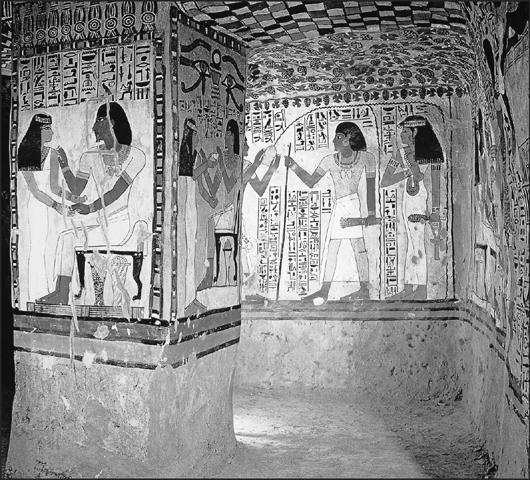
Sennefer wearing his favorite pendant, in his Theban tomb WERNER FORMAN ARCHIVE
Another piece of evidence that reveals Sennefer’s character is an even more remarkable survival, a sealed and unopened letter addressed by him to a man named Baki, who was a tenant farmer in the town of Hut-sekhem (modern Hu), north of Thebes. The reason for the missive was to give notice of Sennefer’s impending arrival at Hut-sekhem, where he intended to take delivery of certain supplies. In imperious tones, Sennefer hectors his subordinate, warning him:
Do not let me find fault with you concerning your post.…
Now mind, you shall not slack, for I know that you are sluggish and fond of eating lying down.5
While Baki may have deserved such a dressing down, it is equally likely that this was the way Sennefer, proud mayor of Thebes, addressed all his underlings. Pomp and circumstance went hand in hand with pride and arrogance—the story of officialdom throughout history.
No member of the Eighteenth Dynasty administration demonstrates this self-satisfied conceit more unashamedly than the fourth member of our high-ranking quartet, Amenhotep II’s chief steward, Qenamun. Like Sennefer and Amenemopet, Qenamun grew up in the harem palace, where his mother was wet nurse to the future king. He referred to her, unblushingly, as “the great nurse who brought up the god.”6 Qenamun was effectively the prince’s foster brother, and the bond forged between the two boys in childhood endured, paying dividends for Qenamun when his playmate acceeded to the throne.
Qenamun’s early career in the army included a spell of active service fighting alongside the king on his Syrian campaign. Not only were the ties of friendship strengthened on the battlefield, but Qenamun’s loyalty and physical fitness would also, doubtless, have struck Amenhotep II as eminently suitable qualities for preferment. Back from the wars, the king appointed Qenamun to the stewardship of Perunefer, a harbor and naval base in northern Egypt. Further promotion followed swiftly, Qenamun’s devoted service eventually landing him one of the plum jobs in the land, that of chief steward, with overall responsibility for the royal estate. It was an important position, supervising the landholdings and other assets that funded the court. On a day-to-day basis, Qenamun had specific responsibility for the royal family’s country residence. This seems to have fitted his character perfectly, since the administrative drudgery was more than usually interspersed with lavish entertainments: troupes of dancing girls, musicians, and the presentation of exotic gifts to the king at the New Year.
In characteristic fashion, Qenamun’s extravagant Theban tomb was designed to provide as much wall space as possible, the better to trumpet his dignities to posterity. In this everlasting monument to his ego, Qenamun was able to give free rein to his obsessive predilection for titles. The result is a list of more than eighty epithets—even though, in reality, few of them signify real office. Most stress his privileged position at court, as a member of the king’s inner circle: member of the elite and high official, royal seal bearer, confidential companion, dearly beloved companion, gentleman of the bedchamber, fan bearer of the lord of the Two Lands, royal scribe, aide to the king, attaché of the king in every place … the list is almost endless. Qenamun devised ever more elaborate formulations to vaunt his position: “chief companion of the courtiers; overseer of overseers, leader of leaders, greatest of the great, regent of the whole land; one who, if he gives attention to anything in the evening, it is mastered early in the morning at daybreak.” The language becomes most pompous when stressing Qenamun’s loyalty to the king: “doing right by the Lord of the Two Lands”; “giving satisfaction to the sovereign”; “inspiring the king with perfect confidence”; and, perhaps most ludicrous of all, “heartily appreciated by Horus.”7 Rarely had an Egyptian official been quite so intoxicated with the exuberance of his own verbosity.
Yet behind all this bombast and vainglory, Qenamun led a secret double life. Because of his privileged access to the inner sanctum of power, he was ideally placed to pick up court gossip, in particular any murmurings against the king. His role as chief steward provided the perfect cover for carrying out clandestine surveillance as master of secrets, the head of the king’s internal security apparatus. Qenamun’s undercover role was to be “the eyes of the king of Upper Egypt, the ears of the king of Lower Egypt.”8 Like Elizabethan England, Eighteenth Dynasty Egypt had a sophisticated court underpinned by a network of spies and agents who monitored those in positions of authority, as well as the general population, for signs of dissent. Qenamun’s relationship to Amenhotep II was as Sir Francis Walsingham’s was to Elizabeth I: ultraloyal, devoted to his monarch, confident of his own authority, and unafraid of making enemies. And enemies there clearly were. After Qenamun’s death and burial, the gorgeous reliefs in his Theban tomb were systematically defaced. Not a single image of him survived the attackers’ chisels. The same posthumous vilification was meted out to Rekhmira, exemplary vizier. Theirs are cautionary tales, suggesting that high office in ancient Egypt could bring great unpopularity. The self-confident image of the official record masked an unpalatable truth.
SCHOOL RULES
THE CAREERS OF SENNEFER AND QENAMUN ILLUSTRATE THE IMPORTANCE of personal relationships in winning promotion under an absolute monarchy. Amenhotep II in particular surrounded himself with officials he had known since childhood. In ancient Egypt, growing up alongside the future king was a near certain passport to high office. To be a “child of the nursery” was to rub shoulders not only with the royal children, but also with the offspring of Egypt’s great and good, in an atmosphere of privilege and power. The country’s future leaders were trained from infancy for the responsibilities they would later assume, receiving an education that was practical and vocational rather than narrowly academic. There was also an overtly political dimension. In the New Kingdom, the inhabitants of the nursery—where children lived as well as learned—included the sons of foreign vassals, brought to court for indoctrination into the Egyptian way of life, in the hope that it would inculcate a lifelong loyalty to the pharaoh. The future Amenhotep II and his friends would therefore have come into contact with Nubian and Asiatic princes, which would have given them a much more cosmopolitan outlook than their forebears. Perhaps this explains why Egypt and Mittani, at war for decades, only finally concluded a peace treaty in the reign of Amenhotep II. As Egypt attempted to reeducate its neighbors, the neighbors in turn had an equally profound influence on the host country.
In the Eighteenth Dynasty, the most important royal nursery was at Gurob, a verdant place in the fertile Fayum depression. Here, kings since the dawn of history had built their pleasure palaces. The abundance of birdlife, attracted to the waters of Birket Qarun, made for excellent hunting, while the royal women who lived in the adjoining harem palace busied themselves with the manufacture of textiles, their raw materials supplied by the Fayum’s extensive flax fields. Gurob was hence a place of women and children, relaxation and laughter. Royal princesses and the daughters of the elite could expect to learn at their mothers’ feet the accomplishments expected of them: weaving, singing, dancing, perhaps a smattering of reading and writing. By contrast, a harsher discipline was enforced when it came to the education of princes and their male contemporaries. Nowhere was this more keenly felt than in the scribal school, for literacy was the key to power in ancient Egypt.
Reading and writing were central elements in the nursery curriculum, under the guidance of the scribe in the house of the royal children. By repeated copying of examples, this scribe taught his pupils to write in cursive script with pen and ink on papyrus. As they progressed, pupils moved on to the study of longer, classic texts, such as the Middle Kingdom Tale of Sinuhe and—a particular favorite—the work known as Kemit, “the compendium.” Kemit was a model letter, used as a set text for scribal training, and it was intended to hone its readers’ morals as much as their writing skills. By emphasizing the advantages of literacy, it sought to perpetuate the elevated status enjoyed by the elite:
As for any scribe in any position at court,
he shall not be poor in it.9
A kindred text, Satire of the Trades, developed this theme, denigrating every other occupation while eulogizing the work of the scribe:
Look, there is no job without a controller
except that of the scribe: he is the controller.
So if you are literate, it will be good for you,
unlike these [other] jobs I have shown you.…
Most beneficial for you is a day in the schoolroom.10
Making the pupils learn such texts by rote was a mild form of brainwashing. Yet these idealizing sentiments shy away from the harsh re-ality of the school environment. Ancient Egypt, like Dickensian England, believed wholeheartedly in the maxim “Spare the rod and spoil the child.” As one New Kingdom proverb put it, “A boy’s ear is on his back: he hears when he is beaten.”11 The discipline of the scribal school was meant to prepare its pupils for the rigors of government service. The harsh and uncompromising style of education accurately reflected the exercise of power in ancient Egypt. The royal court, despite its luxury, was no place for effete intellectuals. Ambition, determination, resilience, and manly vigor—these were the qualities prized by the government machine, and the nursery sought to drum them into its pupils.
Once the young princes and their schoolmates had mastered the Egyptian language, they were introduced to Babylonian cuneiform, the diplomatic lingua franca of the age. Egypt could no longer afford to luxuriate in its own sense of superiority. In a new era of internationalism , power politics demanded a knowledge of foreign languages and cultures. The curriculum also included mathematics and music, for an appreciation of singing and instrumental music, if not the ability to perform, went hand in hand with membership in polite society. Just as important, for the future king if not for his classmates, was a firm grasp of military strategy. The future Amenhotep II would no doubt have studied the accounts of classic engagements (including, perhaps, his father’s great victory at the Battle of Megiddo) alongside the literary, mathematical, and musical papyri.
FIGHTING FIT
IN THE MACHO WORLD OF THE EIGHTEENTH DYNASTY, WHERE A KING was expected to lead his troops into battle and display feats of bravery in the face of the enemy, training the body was as important as educating the mind. Energetic and physical pursuits played a particularly important part in the education of future leaders. Running, jumping, swimming, rowing, and wrestling were all part of the weekly routine, designed to develop strength, stamina, and team spirit. While Sennefer and Qenamun may have preferred the life of the mind, physical exploits being conspicuously absent from both men’s biographies, their royal schoolmate, the future Amenhotep II, relished his time spent on the training ground. Taller and stronger than most of his contemporaries, he reveled in sport and developed a prodigious talent as a rower and runner. It was archery, however, that held a special appeal. While staying at the royal palace at Tjeni, he took lessons from the local mayor, Min, who was evidently a great shot himself. It was the proudest moment of Min’s life, lovingly recorded in his tomb, as he guided the young prince’s aim, advising him “Stretch your bow to your ears.”12
By the time he reached his teens, “a fine youth, with his wits about him,”13 Amenhotep had matured into such an accomplished archer that he was apparently able to shoot an arrow through a solid copper target while mounted in a chariot. (We might be rightly suspicious of this fabled act of royal strength and skill, were it not for the abundant evidence of Amenhotep’s singular ability with a bow and arrow.) Among his prized possessions was a richly decorated composite bow of wood and horn, the very best of its kind. Archery is mentioned or depicted more frequently than any other activity in the monuments of Amenhotep’s reign, a clear indication that it was something of a royal obsession. On one notable occasion, eager to demonstrate his superior skill, he challenged the members of his retinue to beat him in an archery competition, declaring, “Anyone who pierces this target as deep as His Majesty’s arrow shall have these things [as a prize].”14 This unique instance of a sporting contest between a supposedly divine king and his mortal followers provides a vivid insight into Amenhotep’s competitive character. His exploits helped to establish the motif of the “sporting king” as a central element in New Kingdom royal ideology.
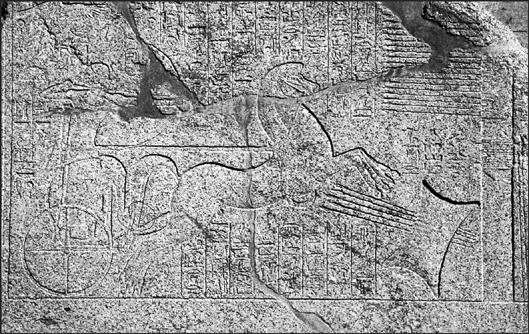
Amenhotep II shooting arrows at a copper target WERNER FORMAN ARCHIVE
Amenhotep’s other favorite pastime was horsemanship. Unknown in the Nile Valley before the Hyksos invasion, horses had been swiftly adopted by Egypt’s ruling class in the early Eighteenth Dynasty. In an age of warrior pharaohs, the ability to ride in the saddle and in a chariot were vital military skills. In keeping with his general sporting prowess, Amenhotep displayed a special affinity with horses from an early age:
Now, when he was still a young prince, he loved his horses and delighted in them. He was strong-willed in breaking them in and understanding their natures, skilled in controlling them and learning their ways.15
When he was asked as a young man to look after some of the horses in the royal stables, the results spoke for themselves: “He raised horses without equal.”16
On becoming king, Amenhotep stressed not only his physical prowess but also his credentials as a military ruler. He was determined to prove himself a worthy heir and successor of his father, the great warrior pharaoh. Following in Thutmose III’s footsteps, he led two major campaigns in the Near East. The purpose of the first was to extend and consolidate Egypt’s imperial possessions by securing the allegiance of various unaligned chiefs and quelling a revolt in Takhsy (modern Syria). The unfortunate rebels should have learned from recent history: Egypt was not about to be humbled on such an important stage. Amenhotep’s army easily prevailed against the enemy and meted out a predictably gruesome fate to the ringleaders. The seven defeated chiefs of Takhsy were rounded up and taken back to Egypt, suspended head-down from the masts of the royal flagship. On arrival in Thebes, in a final act of humiliation, six of the rebels were hung up on the walls of Ipetsut, as an offering to the Egyptian gods and a warning to would-be insurgents. The body of the seventh chief was carried all the way to Napata, in upper Nubia, the southernmost outpost of the Egyptian Empire, to be similarly displayed. As it swung, rotting and stinking in the desert sun, the corpse served as a powerful and grim reminder to the local population of the price of rebellion.
Amenhotep II’s first Asiatic campaign not only achieved its political and propaganda goals, it was also immensely successful in economic terms, adding vastly to Egypt’s wealth. The booty brought back from Takhsy and neighboring lands comprised nearly three-quarters of a ton of gold, a staggering 54 tons of silver, 210 horses, 300 chariots, 550 enemy cavalry, and nearly 90,000 prisoners of war, including more than 21,000 entire families. Little wonder that the kingdom of Mittani, together with the Hittites and Babylonia, may have sued for peace and established diplomatic relations with Egypt. Victory against such a determined opponent was an impossibility.
Amenhotep’s second campaign, two years later, ranged closer to home, in Palestine, but was similarly directed against a specific enemy, in this case the rebel leader of a town near Megiddo. There was no way Amenhotep was going to allow a region so hard won by his father to secede from Egyptian control within a mere generation. The outcome, once again, was never in doubt. The chief “whose name was Qaqa was carried off, the wife, his children, and all his dependents likewise.”17 Their ultimate fate is not recorded, but it is safe to assume it was appropriately unpleasant. As a final act of vengeance, Amenhotep ordered his army to massacre the town’s entire population before returning in triumph to Egypt, “his desire slaked in all the hill countries, all lands beneath his sandals.”18
No further military campaigns would be required for the rest of Amenhotep’s reign. In their place, peace and prosperity ushered in opportunities for building projects at home. His fame established throughout the foreign lands, it was now time for Amenhotep to secure his immortal memory among his own people.
TOWARD THE SUNRISE
THE GIZA PLATEAU, WEST OF MEMPHIS, HELD A SPECIAL PLACE IN Amenhotep II’s affections, for it was here that he had first practiced archery and horse riding. A training gallop lay near the Great Sphinx, already a thousand years old, and the area was a favorite location for royal sporting activities. One day, as Amenhotep cantered around the great necropolis, he marveled at the pyramids of Khufu and Khafra, his distant forebears from remote antiquity. Inspired by the monuments’ size, splendor, and sheer age, the king decided to record his own achievements for posterity on a magnificent stela erected between the paws of the Great Sphinx. Its combination of the usual lofty sentiments and specific details of the king’s sporting achievements reveals much about his character. In a further gesture of homage to the guardian of the Giza necropolis, Amenhotep built a temple next to the Sphinx, which he worshipped as the sun god Horemakhet, “Horus of the horizon.” It soon became a favored focus for acts of piety by other members of the royal family, including Amenhotep’s son and heir, Thutmose IV (1400–1390).
Indeed, Thutmose went one step further in his reverence for the Sphinx. He claimed Horemakhet as his personal protector, attributing his very position to the god’s favor. His great stela, erected next to his father’s, told how Horemakhet spoke to him in a dream when he was still a prince, promising him the kingship if he would clear sand away from the body of the Sphinx. Once safely ensconced on the throne of Horus, Thutmose kept his side of the bargain, completing the re-excavation of the monument from the sand of centuries, and building an enclosure wall to prevent future encroachment by the shifting desert dunes. It is telling that Thutmose’s inscription makes no mention the state god Amun-Ra (in sharp contrast to his father’s stela), concentrating instead on Horemakhet. Under the Sphinx-blessed king, the northern, solar deity was honored as the primary guarantor of royal legitimacy. Even at Ipetsut, home of Amun-Ra, the king had himself depicted as half human, half celestial falcon, emphasizing his identification with the sun god (Horus and Ra now being closely associated in Egyptian theology). Through such carefully chosen imagery, he sought to underline the divine solar aspects of his office, abandoning the image of the military ruler that had served his forebears so well.
Thutmose IV reaped the benefits of peace with Mittani, dedicating his reign to internal affairs instead of foreign campaigns. Diplomacy likewise replaced military action as the main instrument of overseas policy. The administration of Nubia was reformed, with the appointment of a viceroy of all Egyptian-controlled lands. Looking to the northern part of his empire, Thutmose IV cemented the alliance with Mittani by taking a Mittanian princess as his wife. Just two generations earlier, his forebear and namesake Thutmose III had fought Mittani for supremacy in the Near East. Now the erstwhile foes were united in marriage. With peaceful conditions restored, trade could flourish once more between the great powers, and caravans of luxury goods traveled by land and sea across the eastern Mediterranean, Palestine, Syria, and Mesopotamia. With an almost inexhaustible supply of gold (every ruler’s favorite commodity), Egypt benefited most from this upsurge in commerce, exchanging its mineral wealth for metals, timber, precious stones, and other royal desiderata. Another peace dividend from the alliance with Mittani was a rash of new construction projects the length and breadth of Egypt and Nubia. On each monument the king’s fascination with solar symbolism loomed large, presaging a new direction in royal ideology.
A country secure in its borders and at peace with its neighbors, and a monarchy resplendent as never before—the scene was set for an aggrandizement of kingship beyond anything Egypt had seen since the days of the Great Pyramid.